
Exercises (1874)
Pyramid training (medium): 45-60-90-60-45
Pyramid training
Single run or in strength groups, with the pacemaker controlling the time
Pyramid training is a special type of interval training that can be run extensively (longer sections at a brisk pace) or intensively (shorter sections at a very fast pace). As the name suggests, the effort initially increases continuously (in the form of a staircase) and is then reduced again to the same extent. There is always a trotting break between the efforts, which is measured by the intensity of the effort. The units should be run so fast that an interval can just be added at the end (extensive) or another interval would no longer feel possible (intensive). It is important to concentrate on an optimal running technique, because as soon as you are no longer running "cleanly", you are travelling too fast. The individual intervals are run very quickly, but as evenly as possible (the shorter the effort, the higher the intensity and vice versa). For shorter workouts, you cannot rely completely on the heart rate for intensity levels, as the heart rate only adapts to the exertion with a slight delay at the start of the workout.
Running training with alternating effort and recovery:
- 45 seconds of effort (intensity level: 4-5) - 45 seconds of rest
- 60 seconds of effort (intensity level: 4-5) - 60 seconds of rest
- 90 seconds of effort (intensity level: 4) - 60 seconds of rest
- 60 seconds of effort (intensity level: 4-5) - 45 seconds of rest
- 45 seconds of effort (intensity level: 4-5)
Intensity level 4:
HFmax: 90-95%
Rule of speech: brief exchange of words
Intensity level 5:
HFmax: 95-100%
Rule of speech: No more exchange of words possible
The pyramid training can be carried out as follows:
- Round track: To ensure that the participants have enough space available for the run, they can be spread out on the round track for the start. The sports director has all participants in view and can therefore start or stop the intervals by signalling. The participants decide for themselves how to spend the breaks (e.g. on the spot, marching or at a relaxed trot).
- Distance of at least 700 metres: Distances are marked with signs (every 25-50 metres). Each participant receives a stop/pulse watch, runs along the specified route for the duration of the respective exercise (observe the running directions as specified by the sports director so that the total length of the route is sufficient) and calculates the distance covered. It is possible for participants to start in stages, whereby the running routes must be determined in order to avoid collisions. If the course allows it, the sports director can give the start/stop signal for all participants (no staggering possible).
- Longer distance race: The distances are marked with signs (every 25-50m). Each participant receives a stop/pulse watch, runs the course independently and calculates the distance travelled (no staggered start of the participants necessary). During the breaks, participants wait in place or continue running at a relaxed trot until the break time has elapsed. After the last run, all runners return to the starting point, which takes additional time. Ideally, the running distance corresponds approximately to the distance that can be covered in the time available in order to generate as little additional displacement time as possible.
With the same duration of exertion, an attempt is made to ensure that the participants/groups also reach the same distance. However, there is very little time to calculate and record the distances, which makes it difficult to compare runs of the same duration in practice.
Distance markers (signs with metres)
1 signalling instrument (e.g. whistle)
FTA evaluation (group formation)
Per participant:
1 heart rate monitor
For sports leader or per participant/group:
1 stopwatch
Tyre pulling
Fighting and roughhousing games
Partner work
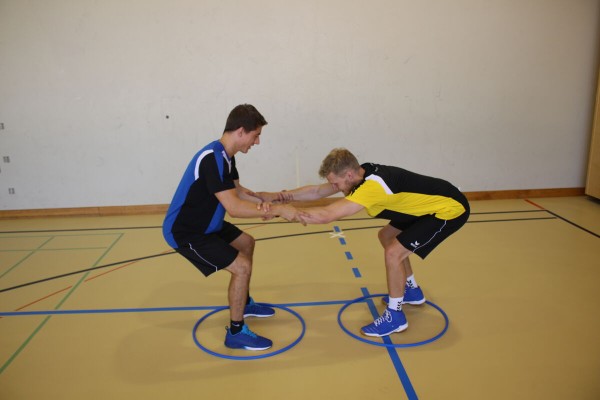
Two participants stand opposite each other in a hoop and grab each other by the hands or forearms. They try to push or pull their opponent out of the hoop. The first person to touch the ground outside the tyre loses.
2 tyres
Rescue and transport
Power
Partner work
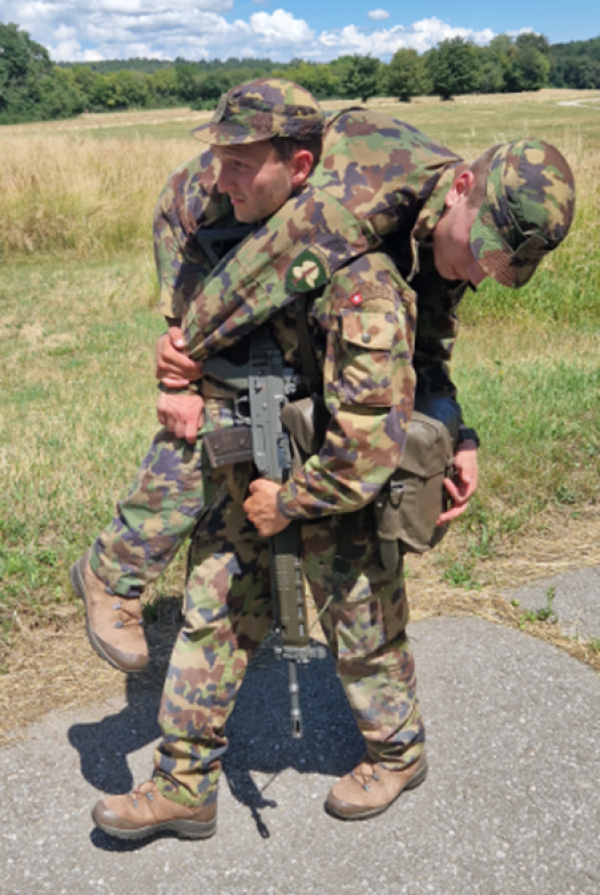
Transport your comrade from one fanjon to another (Gamstrage grip) using the transport techniques from the regulations for self-help and comrade assistance (59.005).
Attention:
The back must be straight when lifting the comrade.
Material per participant: Tenue CNG 428
Additional material: 2 fanjons
Roll with raised arms and legs in lateral position left/right
Power
Individual work


Lay on your side, stretch your legs and arms and lift them slightly off the floor. Pull your navel towards your spine and consciously tense your abdomen and then change your side position without changing your body position (roll alternately to the right or left side).
Attention:
Stretched arms and legs practically form a line.
Lighten:
Just hold the position with your arms and legs raised and switch sides from time to time.
Harden:
Add weight to your arms and/or legs.
2-4 weight cuffs/2 weight balls/dumbbells ► Make the exercise more difficult (additional weight)
Rotation of the upper body in frontal stance to the wall (left) ► standing upper body rotation
Power
Individual work
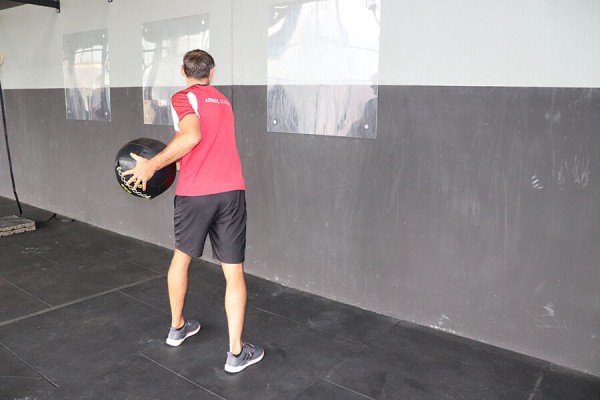
Stand upright in front of a wall, shoulder-width apart (facing the wall), with arms bent (approximately 90 degrees at the elbow joint), holding a medicine ball in front of the body with both hands slightly below chest height. The upper body is turned/rotated as far as possible to the left side (gaze follows the movement), while the legs and arms remain stable (lift the heel on the opposite side - right - as far as possible). Then swing the upper body back to the starting position and at the same time throw the ball (sideways) against the wall. Catch the ball and return to the starting position to restart the exercise.
Attention:
Tighten your stomach, keep your back straight, your pelvis remains in place and only your upper body moves.
Lighten:
Smaller movements (less rotation); lighter ball.
Harden:
Additional weight (on the arms); heavier ball; unstable base.
1 wall
1 medicine ball
1 volleyball or football ► make the exercise easier
2 weight cuffs ► make the exercise more difficult (additional weight)
1-2 balance cushions/1 balance board ► make the exercise more difficult (unstable surface)
Rotation of the upper body in frontal stance to the wall (right) ► standing upper body rotation
Power
Individual work

Stand upright in front of a wall, shoulder-width apart (facing the wall), with arms bent (approximately 90 degrees at the elbow joint), holding a medicine ball in front of the body with both hands slightly below chest height. The upper body is turned/rotated as far as possible to the right side (gaze follows the movement), while the legs and arms remain stable (lift the heel on the opposite side - left - as far as possible). Then swing the upper body back to the starting position and at the same time throw the ball (sideways) against the wall. Catch the ball and return to the starting position to restart the exercise.
Attention:
Tighten your stomach, keep your back straight, your pelvis remains in place and only your upper body moves.
Lighten:
Smaller movements (less rotation); lighter ball.
Harden:
Additional weight (on the arms); heavier ball; unstable base.
1 wall
1 medicine ball
1 volleyball or football ► make the exercise easier
2 weight cuffs ► make the exercise more difficult (additional weight)
1-2 balance cushions/1 balance board ► make the exercise more difficult (unstable surface)
Rotation of the upper body in frontal stance alternating to the wall ► standing upper body rotation
Power
Individual work


Stand upright, shoulder-width apart, in front of a wall (facing the wall), with arms bent (approximately 90 degrees at the elbow joint), holding a medicine ball in front of the body with both hands slightly below chest height. The upper body is turned/rotated as far as possible to the side (gaze accompanies the movement), while the legs and arms remain stable (lift the heel on the opposite side of the rotation movement at most). Then swing the upper body back to the starting position and at the same time throw the ball (sideways) against the wall. Catch the ball and return to the starting position to start the same exercise on the other side.
Attention:
Tighten your abdomen, keep your back straight, your pelvis stays in place and only your upper body moves.
Lighten:
Smaller movements (less rotation); lighter ball.
Harden:
Additional weight (on the arms); heavier ball; unstable base.
1 wall
1 medicine ball
1 volleyball or football ► make the exercise easier
2 weight cuffs ► make the exercise more difficult (additional weight)
1-2 balance cushions/1 balance board ► make the exercise more difficult (unstable surface)
Rotation of the upper body while standing sideways to the wall (left) ► standing upper body rotation
Power
Individual work


Stand upright in front of a wall (facing the wall horizontally, left shoulder closer to the wall), with arms bent (approximately 90 degrees at the elbow joint), hold a medicine ball in front of the body with both hands slightly below chest height. The upper body is turned/rotated to the side towards the wall in a swinging motion (gaze accompanies the movement) until the arms are facing the wall and the ball is thrown against the wall at the same time. During the rotation movement, the legs and arms remain stable (lift the heel of the foot furthest from the wall at most). Catch the ball and bring your upper body back to the starting position.
Attention:
Tighten your stomach, keep your back straight, your pelvis remains in place and only your upper body moves.
Lighten:
Smaller range of motion by pointing the stance more towards the wall (less rotation); lighter ball.
Harden:
Additional weight (on the arms); heavier ball; unstable base.
1 wall
1 medicine ball
1 volleyball or football ► make the exercise easier
2 weight cuffs ► make the exercise more difficult (additional weight)
1-2 balance cushions/1 balance board ► make the exercise more difficult (unstable surface)
Rotation of the upper body while standing sideways to the wall (right) ► standing upper body rotation
Power
Individual work


Stand upright in front of a wall (facing the wall horizontally, right shoulder closer to the wall), with arms bent (approximately 90 degrees at the elbow joint), hold a medicine ball in front of the body with both hands slightly below chest height. The upper body is turned/rotated to the side towards the wall in a swinging motion (gaze accompanies the movement) until the arms are facing the wall and the ball is thrown against the wall at the same time. During the rotation movement, the legs and arms remain stable (lift the heel of the foot furthest from the wall at most). Catch the ball and bring your upper body back to the starting position.
Attention:
Tighten your stomach, keep your back straight, your pelvis remains in place and only your upper body moves.
Lighten:
Smaller range of motion by pointing the stance more towards the wall (less rotation); lighter ball.
Harden:
Additional weight (on the arms); heavier ball; unstable base.
1 wall
1 medicine ball
1 volleyball or football ► make the exercise easier
2 weight cuffs ► make the exercise more difficult (additional weight)
1-2 balance cushions/1 balance board ► make the exercise more difficult (unstable surface)
Rotation of the upper body in lateral forearm support (left) ► rotational lateral pillar bridge / side bridge
Power
Individual work


Side support on the (left) forearm and vertically extended upper arm, looking upwards, bring the upper arm under the body and back to the starting position, accompany the movement with your head (looking down from above).
Attention:
Pelvis remains stable.
Lighten:
Knees on the floor.
Harden:
Additional weight (for the free arm); unstable base (possible for both the supporting arm and the legs).
1 weight cuff/dumbbell ► making the exercise more difficult (additional weight)
1 ball/1-2 balance cushions/1 balance board ► making the exercise more difficult (unstable surface)
Rotation of the upper body in lateral forearm support (left) ► rotational lateral pillar bridge / side bridge
Power
Individual work
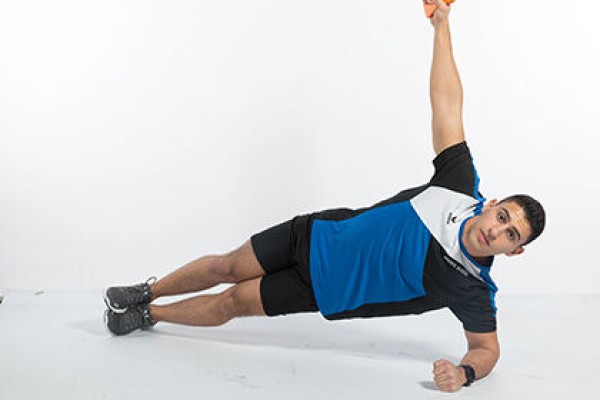

Side support on the (left) forearm and vertically extended upper arm, hold the pistol in the free hand, look towards the weapon, bring the pistol under the body and back to the starting position, accompany the movement with the head (look from top to bottom).
Attention:
Pelvis remains stable.
Lighten:
Knees on the floor.
Harden:
Instable support (possible for both the supporting arm and the legs).
1 pistol (neutralised)
1 ball/1-2 balance cushions/1 balance board ► Make the exercise more difficult (unstable surface)
Rotation of the upper body in lateral forearm support (left) ► rotational lateral pillar bridge / side bridge
Power
Individual work


Side support on the (left) forearm and vertically extended upper arm, hold the dumbbell in your free hand, look towards the weight, bring the dumbbell under your body and back to the starting position, accompany the movement with your head (look down from above).
Attention:
Keep your pelvis stable; keep the shoulder of the supporting arm above your elbow.
Lighten:
Knees on the floor.
Harden:
Stable support (possible for both the supporting arm and the legs).
1 dumbbell
1 ball/1-2 balance cushions/1 balance board ► Make the exercise more difficult (unstable surface)
Rotation of the upper body in lateral forearm support (left) ► rotational lateral pillar bridge / side bridge
Power
Individual work


Side support on the (left) forearm and vertically extended upper arm, feet on the balance board, look towards the free arm, bring the playing arm under the body and back to the starting position, accompany the movement with your head (look from top to bottom).
Attention:
The pelvis remains stable; keep the shoulder of the supporting arm above the elbow.
Lighten:
Without an unstable base.
Harden:
Instant base for the supporting arm as well; hold additional weight in the free hand.
1 balance board
1 ball/1-2 balance cushions/1 balance board ► Make the exercise more difficult (unstable surface)
1 dumbbell ► Make the exercise more difficult (additional weight)
Rotation of the upper body in lateral forearm support (right)
Power
Individual work
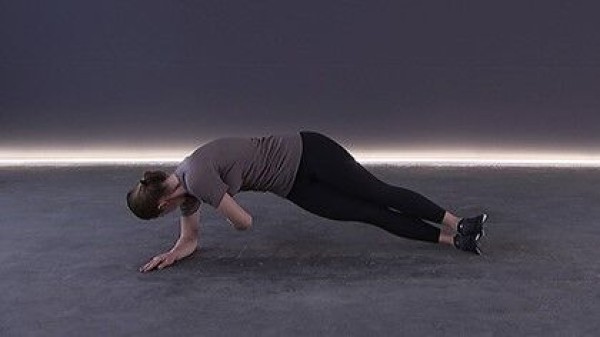

Side support on the (right) forearm and vertically extended upper arm, looking upwards, bring the upper arm under the body and back to the starting position, accompany the movement with your head (looking down from above).
Attention:
Pelvis remains stable.
Lighten:
Knees on the floor.
Harden:
Additional weight (for the free arm); unstable base (possible for both the supporting arm and the legs).
1 weight cuff/dumbbell ► making the exercise more difficult (additional weight)
1 ball/1-2 balance cushions/1 balance board ► making the exercise more difficult (unstable surface)
Rotation of the upper body in lateral forearm support (right) ► rotational lateral pillar bridge / side bridge
Power
Individual work


Side support on the (right) forearm and vertically extended upper arm, hold the pistol in the free hand, look towards the weapon, bring the pistol under the body and back to the starting position, accompany the movement with the head (look from top to bottom).
Attention:
Pelvis remains stable.
Lighten:
Knees on the floor.
Harden:
Instable support (possible for both the supporting arm and the legs).
1 pistol (neutralised)
1 ball/1-2 balance cushions/1 balance board ► Make the exercise more difficult (unstable surface)
Rotation of the upper body in lateral forearm support (right) ► rotational lateral pillar bridge / side bridge
Power
Individual work


Side support on the (right) forearm and vertically extended upper arm, hold the dumbbell in your free hand, look towards the weight, bring the dumbbell under your body and back to the starting position, accompany the movement with your head (look down from above).
Attention:
Pelvis remains stable; rotation of the upper body in lateral forearm support.
Lighten:
Knees on the floor.
Harden:
Instable support (possible for both the supporting arm and the legs).
1 dumbbell
1 ball/1-2 balance cushions/1 balance board ► Make the exercise more difficult (unstable surface)
Rotation of the upper body in lateral forearm support (right) ► rotational lateral pillar bridge / side bridge
Power
Individual work


Side support on the (right) forearm and vertically extended upper arm, feet on the balance board, look towards the free arm, bring the playing arm under the body and back to the starting position, accompany the movement with your head (look from top to bottom).
Attention:
Pelvis remains stable; keep the shoulder of the supporting arm above the elbow.
Lighten:
Without an unstable base.
Heavier:
Instable base also for the supporting arm; hold additional weight in the free hand.
1 balance board
1 ball/1-2 balance cushions/1 balance board ►Make the exercise more difficult (unstable surface)
1 dumbbell ►Make the exercise more difficult (additional weight)
Rotation of the upper body in lateral forearm support with dumbbells (left) ► rotational lateral pillar bridge / side bridge
Power
Individual work
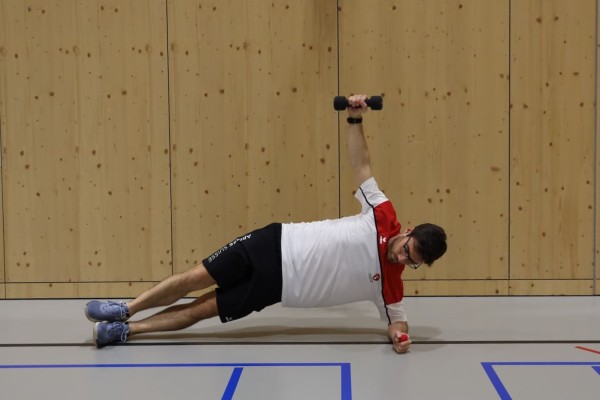
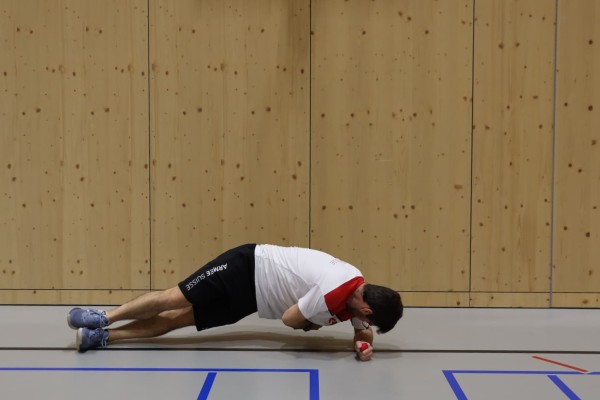
Side support on the (left) forearm and vertically extended upper arm, hold the dumbbell in your free hand, bring the dumbbell under your body and back to the starting position.
Attention:
Keep your pelvis stable; keep the shoulder of the supporting arm above your elbow.
Lighten:
Perform without dumbbells; do the exercise on your knees.
Harden:
More weight.
1 dumbbell
Rotation of the upper body in lateral forearm support with dumbbells (right) ► rotational lateral pillar bridge / side bridge
Power
Individual work
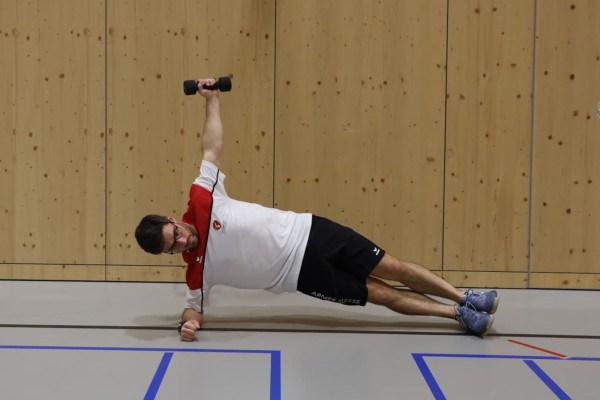
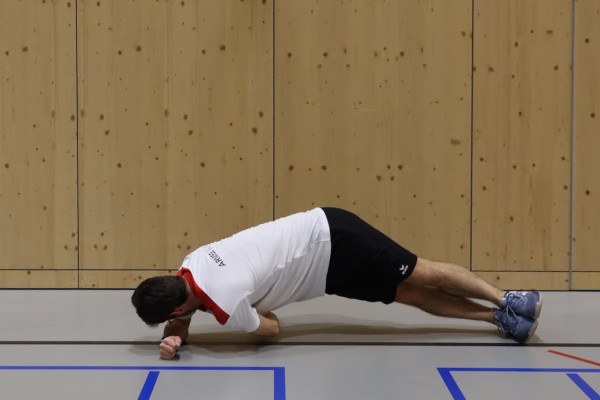
Side support on the (right) forearm and vertically extended upper arm, hold the dumbbell in your free hand, bring the dumbbell under your body and back to the starting position.
Attention:
Keep your pelvis stable; keep the shoulder of the supporting arm above your elbow.
Lighten:
Perform without dumbbells; do the exercise on your knees.
Harden:
More weight.
1 dumbbell
Rotation of the upper body in side support (left) ► rotational pillar bridge
Power
Individual work


Lateral support with the (left) arm extended, upper arm holding the dumbbell also extended (vertically upwards in a high hold), gaze directed upwards, bring the upper arm under the body and back to the starting position, accompany the movement with the head (gaze directed downwards from above).
Attention:
Pelvis remains stable.
Lighten:
Knees on the floor; no weight for the free arm.
Heavier:
More weight; unstable base (possible for both the supporting arm and the legs).
1 dumbbell
1 ball/1-2 balance cushions/1 balance board ►Make the exercise more difficult (unstable surface)
Upper body rotation in the side plank (left) ► rotational pillar bridge / high side plank T-spine rotation / T-rotation
Power
Individual work

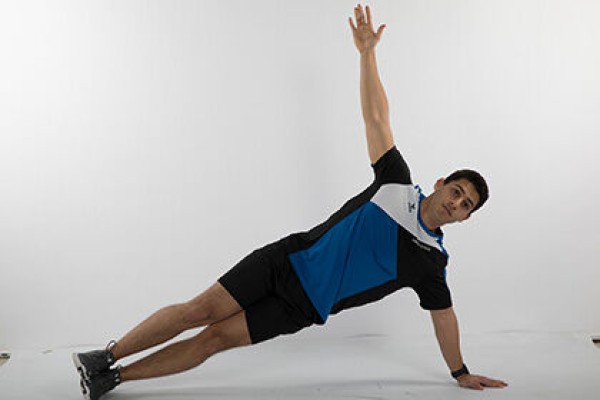
High side plank on the extended (left) arm, with the hand positioned directly beneath the shoulder; the wrist, elbow and shoulder should be in a straight line, with the legs either crossed or slightly offset. Lift the body until the head, torso and legs also form a straight line. First stretch the free arm upwards, then slowly rotate the upper body forwards/downwards and bring the free arm under the torso (rotation). Keep the hips stable; the movement should come from the thoracic spine, not the pelvis.
Attention:
The hips do not tilt or rotate (loss of stability), momentum rather than control (training effect is lost), rotation is too fast, the shoulder ‘sags’ in the supporting arm, the neck rotates instead of the thoracic spine, do not hold your breath.
Lighten:
Knee on the floor (modified side plank); rotation without bringing the arm all the way under the body (smaller range of motion); feet staggered rather than one on top of the other; open the hand of the free arm only to shoulder height (no full rotation).
Harden:
Stack your feet on top of each other (less stable base); perform a slow, controlled eccentric phase (rotate very slowly); additional weight in the top hand; unstable surface under the supporting hand; pause at the end of the rotation (isometric hold under tension); combine with leg lifts (e.g. lift the top leg in the side plank).
1 weight cuff/dumbbell ►making the exercise more difficult (additional weight)
1 ball/1-2 balance cushions/1 balance board ►making the exercise more difficult (unstable surface)
Rotation of the upper body in lateral support (right) ► rotational pillar bridge
Power
Individual work


Side plank with the (right) arm extended, upper arm holding the dumbbell also extended (vertically upwards in a high position), look upwards, bring the upper arm under the body and back to the starting position, accompany the movement with your head (look down from above).
Attention:
Pelvis remains stable.
Lighten:
Knees on the floor; no weight for the free arm.
Heavier:
More weight; unstable base (possible for both the supporting arm and the legs).
1 dumbbell
1 ball/1-2 balance cushions/1 balance board ►Make the exercise more difficult (unstable surface)
Upper body rotation in the side plank (right) ► rotational pillar bridge / high side plank T-spine rotation / T-rotation
Power
Individual work


High side plank on the extended (right) arm, with the hand positioned directly beneath the shoulder; the wrist, elbow and shoulder should be in a straight line, with the legs either crossed or slightly offset. Lift the body until the head, torso and legs also form a straight line. First stretch the free arm upwards, then slowly rotate the upper body forwards/downwards and bring the free arm under the torso (rotation). Keep the hips stable; the movement should come from the thoracic spine, not the pelvis.
Attention:
The hips do not tilt or rotate (loss of stability), momentum rather than control (training effect is lost), rotation is too fast, the shoulder ‘sags’ in the supporting arm, the neck rotates instead of the thoracic spine, do not hold your breath.
Lighten:
Knee on the floor (modified side plank); rotation without bringing the arm all the way under the body (smaller range of motion); feet staggered rather than one on top of the other; open the hand of the free arm only to shoulder height (no full rotation).
Harden:
Stack your feet on top of each other (less stable base); perform a slow, controlled eccentric phase (rotate very slowly); additional weight in the top hand; unstable surface under the supporting hand; pause at the end of the rotation (isometric hold under tension); combine with leg lifts (e.g. lift the top leg in the side plank).
1 weight cuff/dumbbell ►making the exercise more difficult (additional weight)
1 ball/1-2 balance cushions/1 balance board ►making the exercise more difficult (unstable surface)
Rotation of the upper body in the seat (left) ► seated chop
Power
Individual work


Attach the elastic band to the wall bars (or e.g. a tree) at head height, sit upright on a long bench/swinging box top/chair at a 90 degree angle to the wall bars (to the tree), keep your legs shoulder-width apart, grasp the elastic band at shoulder height with both hands, move your upper body to the far (right) knee/thigh and return to the starting position, keeping your arms stable.
Caution:
Work from the torso and not with the arms.
Easier:
Choose an elastic band with less resistance.
Harder:
Choose an elastic band with greater resistance.
1 elasticated rubber band
1 wall bars/tree
1 long bench/1-2 swing box elements (incl. top section)/chair
Rotation of the upper body in the seat (right) ► seated chop
Power
Individual work


Attach the elastic band to the wall bars (or e.g. a tree) at head height, sit upright on a long bench/swinging box top/chair at a 90 degree angle to the wall bars (to the tree), keep your legs shoulder-width apart, grasp the elastic band at shoulder height with both hands, move your upper body to the far (left) knee/thigh and return to the starting position, keeping your arms stable.
Caution:
Work from the torso and not with the arms.
Lighten:
Choose an elastic band with less resistance.
Heavier:
Choose an elastic band with greater resistance.
1 elasticated rubber band
1 wall bars/tree
1 long bench/1-2 swing box elements (incl. top section)/chair