
Exercises (1874)
Lifting the upper body whilst bringing the hand and knee together with the leg extended in a supine position (right) ► isometric knee press
Power
Individual work
Lie on your back with one leg (the right) raised (knee bent at about 90°), whilst the other (left) leg remains either straight or resting loosely. Lift your upper body slightly (into a crunch position, but do not sit up fully), and place one hand (the right) on the raised knee. Actively press the knee against the hand, and the hand against the knee. Hold this tension isometrically without moving. Keep the head and neck in a neutral position (do not strain).
Attention:
Do not pull with your neck; instead, engage your core. If your knees or hands bear the load, movement occurs – this is not true isometric tension. Do not lift your upper body too high (as this puts too much strain on your hip flexors). Avoid arching your lower back, and ensure your shoulders remain relaxed.
Lighten:
Lift your upper body only slightly (mini-crunch); press your hand only lightly against your knee (no maximum pressure – focus on control rather than strength); keep your head on the floor and press only isometrically.
Harden:
Apply more pressure (maximum isometric tension); angle the leg further outwards or higher (greater leverage).
1 soft mat (small)
Lifting the upper body and bent legs whilst bringing the elbows and knees together whilst lying on your back ► isometric dead bug
Power
Individual work
Lie on your back with your legs at a 90° angle (hips and knees bent, ‘tabletop position’); with your arms bent, clamp an object (e.g. a foam roller or ball) between your elbows and knees. Engage your core (gently pull your navel inwards, press your lower back into the floor), press the object firmly between your arms and knees, and hold the isometric tension.
Attention:
Do not arch your back; continue to breathe normally (do not hold your breath).
Lighten:
Increase the angle at the hip joint (move the thigh further away from the upper body) and press the object against your knees with your hands; rest your heels on the floor instead of keeping them raised; without an object, just do the classic dead bug without applying pressure.
Harden:
Reduce the angle at the hip joint (bring the thigh closer to the torso) and press your elbows against your knees (without the object); apply more pressure to the object; use an unstable surface (e.g. a balance pad).
1 soft mat (small)
1 foam roller/ball
1 Balance Pad ► Make the exercise more challenging (unstable base)
Lifting the upper body and bent legs whilst bringing the hands and knees together whilst lying on your back ► isometric dead bug
Power
Partner work
Lie on your back with your legs raised (hips and knees bent at approximately 90 degrees), whilst simultaneously raising your upper body slightly (crunch position). Bring your hands and knees together (making contact), pressing your hands gently against your knees and your knees against your hands. Hold this position isometrically and continue to breathe calmly.
Attention:
Keep the lower back flat on the floor (avoid arching the back), do not strain the neck, do not place the knees too close together or too far apart (this causes you to lose the optimal tension), maintain active counter-pressure between your hands and knees, and do not let your shoulders drop again.
Lighten:
Keep your head and shoulders on the floor (hold only your legs + apply light pressure with your hands and knees); lift just one leg (unilateral for less strain); apply less pressure between your hands and knees (focus on technique); pull your legs closer to your body (shorter lever = easier).
Harden:
Apply stronger isometric pressure (maximum tension); move your legs further away from your body (greater leverage = more intense); gently ‘push’ your arms away from your knees (anti-extension); lift one leg at a time (a more unstable variation for greater anti-rotation).
Soft mat (small)
Lifting the upper body and legs whilst lying on your back ► c-position hold
Power
Individual work
Lie on your back with your legs slightly bent, feet lifted off the floor, arms stretched out in front of you so that your upper body and legs form a ‘C’ shape. Tighten your abdominal muscles actively, lift your shoulder blades slightly off the floor, and hold the position still. Breathe calmly and evenly; do not hold your breath.
Attention:
Your lower back should not arch (reason: too much tension, legs too high or too straight); do not tense your neck or push your head forwards (keep your head in a neutral position, neck relaxed).
Lighten:
Keep your legs slightly extended (feet on the floor, only the upper body in a C-shape); bend your legs more; keep your arms closer to your body (arms in front of your chest instead of outstretched); adopt a partial C-shape by lifting only your shoulders slightly off the floor (focus on the upper abdominal muscles, less tension in the lower back).
Harden:
Straighten your legs completely; stretch your arms upwards (holding them above your head); hold your weight in your hands and/or on your legs.
1 soft mat (small)
2–4 weight cuffs/2 medicine balls/dumbbells/1–2 weight plates ► Make the exercise more challenging (additional weight)
Lifting the upper body and bringing one leg across to meet the opposite elbow whilst lying on your back (left) ► unilateral dead bug hold
Power
Individual work
Lie on your back with one leg (right) raised at a 90° angle and the other leg (left) stretched out flat on the floor. With your right arm bent, place an object (e.g. a foam roller or ball) across your body and wedge it between your elbow and the knee of your raised leg (right). Actively engage your core (press your lower back into the floor), press the object firmly between your arm and knee, and maintain isometric tension. Continue to breathe evenly; do not hold your breath.
Attention:
The lower back does not arch (sign: abdominal muscles not engaged enough), the ball does not fall out/the elbow or knee does not tilt (focus on position required, hips remain stable), do not tense the neck (head neutral, neck relaxed).
Lighten:
Only apply light pressure (hold the object loosely, use less pressure); press the object against your knee with your hand.
Harden:
Use a heavier object to clamp; apply more pressure to the object; reduce the angle at the hip joint (bring the thigh closer to the torso) and press the elbows against the knees (without the object); perform a slight movement by moving the clamped ball up and down minimally (dynamic variation – maintain tension).
1 soft mat (small)
1 foam roller/ball
1 medicine ball/weight ball ► To make the exercise more challenging (additional weight)
Lifting the upper body and bringing one leg across to meet the opposite elbow whilst lying on your back (right) ► unilateral dead bug hold
Power
Individual work
Lie on your back with one leg (left) raised at a 90° angle and the other leg (right) stretched out flat on the floor. With your right arm bent, place an object (e.g. a foam roller or ball) across your body and wedge it between your elbow and the knee of your raised leg (left). Actively engage your core (press your lower back into the floor), press the object firmly between your arm and knee, and maintain isometric tension. Continue to breathe evenly; do not hold your breath.
Attention:
The lower back does not arch (sign: abdominal muscles not engaged enough), the ball does not fall out/the elbow or knee does not tilt (focus on position required, hips remain stable), do not tense the neck (head neutral, neck relaxed).
Lighten:
Only apply light pressure (hold the object loosely, use less pressure); press the object against your knee with your hand.
Harden:
Use a heavier object to clamp; apply more pressure to the object; reduce the angle at the hip joint (bring the thigh closer to the torso) and press the elbows against the knees (without the object); perform a slight movement by moving the clamped ball up and down minimally (dynamic variation – maintain tension).
1 soft mat (small)
1 foam roller/ball
1 medicine ball/weight ball ► To make the exercise more challenging (additional weight)
Lifting the upper body and bringing one leg across to the opposite side using the hand and knee whilst lying on your back (left) ► oblique isometric knee press
Power
Individual work
Lie on your back, lift one leg (the right one) (hip and knee at approx. 90°), and place the opposite hand (the left one) against the knee (crossed over). Press the hand and knee together without moving (isometric). Optional: Lift your upper body slightly (crunch position) to increase the tension.
Attention:
Do not arch your back (keep your lower back flat on the floor); do not apply too little pressure (lack of tension makes the exercise ineffective); do not strain your neck when lifting (only tilt your head slightly, do not pull); do not tilt or rotate your pelvis (keep it stable); do not hold your breath (continue to breathe calmly).
Lighten:
Keep your head on the floor (no crunches); reduce the pressure between your hand and knee; raise your supporting leg for greater stability; keep the movement shorter (just find the position, don’t push all the way down).
Harden:
Lift your upper body (hold the crunch position); increase the pressure between your hand and knee; keep your free leg straight, just above the floor.
1 soft mat (small)
Lifting the upper body and bringing one leg across to the opposite side using the hand and knee whilst lying on your back (right) ► oblique isometric knee press
Power
Individual work
Lie on your back, lift one leg (the left one) (hip and knee at approx. 90°), and place the opposite hand (the right one) against the knee (crossed over). Press the hand and knee together without moving (isometric). Optional: Lift your upper body slightly (crunch position) to increase the tension.
Attention:
Do not arch your back (keep your lower back flat on the floor); do not apply too little pressure (lack of tension makes the exercise ineffective); do not strain your neck when lifting (only tilt your head slightly, do not pull); do not tilt or rotate your pelvis (keep it stable); do not hold your breath (continue to breathe calmly).
Lighten:
Keep your head on the floor (no crunches); reduce the pressure between your hand and knee; raise your supporting leg for greater stability; keep the movement shorter (just find the position, don’t push all the way down).
Harden:
Lift your upper body (hold the crunch position); increase the pressure between your hand and knee; keep your free leg straight, just above the floor.
1 soft mat (small)
Lifting one arm in a push-up position alternating ► pillar bridge
Power
Individual work

In the push-up position, alternate between raising one arm and bringing the hand next to the head/to the ear (same side of the body).
Attention:
Keep the torso stable and do not let it sag (actively tense the torso muscles).
Lighten:
Just hold the push-up position.
Harden:
Add weight (on the arms/on the back).
Variant I:
Combine the exercise with push-ups (i.e. lift the left arm and stretch it out). raise and extend your left arm, push-up, raise and extend your right arm, push-up, etc.).
Variant II:
Hold a dumbbell in both hands in the push-up position.
2 weight cuffs/1 weight vest/weight disc/sandbag ► Make the exercise more difficult (additional weight)
2 dumbbells ► Variation of the exercise
Lifting one arm in a push-up position alternating ► pillar bridge
Power
Individual work

In the push-up position, alternate between raising one arm and bringing it to the hip/thigh (same side of the body).
Attention:
Keep the torso stable and don't let it sag (actively tense the torso muscles).
Lighten:
Only hold the push-up position.
Harden:
Additional weight (on the arms/back).
Variant I:
Combine exercise with push-ups (i.e. raise left arm and move to the side, push-up, raise right arm and move to the side, push-up, etc.).
Variant II:
Hold a dumbbell in both hands in the push-up position.
2 weight cuffs/1 weight vest/weight disc/sandbag ► Make the exercise more difficult (additional weight)
2 dumbbells ► Variation of the exercise
Raising one arm and leg crosswise in forearm support (left-right) ► pillar bridge / star plank
Power
Individual work

Underarm support, raise one arm (left) and one leg (right) crosswise and stretch out in the body extension, hold position.
Attention:
Head, torso, hips and knees form a line (do not stretch your buttocks upwards or let them sag, tense your stomach).
Lighten:
Place one knee (left) on the floor; hold the position in forearm support without lifting an arm or leg.
Harden:
Additional weight (on the back or on the arms/legs).
Variation:
Bring your elbow and knee together under your body, then stretch your arm and leg out again.
2-4 weight cuffs/1 weight vest/weight disc/sandbag ► Make the exercise more difficult (additional weight)
Raising one arm and leg crosswise in forearm support (right-left) ► pillar bridge / star plank
Power
Individual work

Underarm support, raise one arm (right) and one leg (left) crosswise and stretch out in the body extension, hold position.
Attention:
Head, torso, hips and knees form a line (do not stretch your buttocks upwards or let them sag, tense your stomach).
Lighten:
Place one knee (right) on the floor; hold the position in forearm support without lifting an arm or leg.
Harden:
Additional weight (on the back or on the arms/legs).
Variation:
Bring your elbow and knee together under your body, then stretch your arm and leg out again.
2-4 weight cuffs/1 weight vest/weight disc/sandbag ► Make the exercise more difficult (additional weight)
Lifting one arm and the opposite leg while on all fours (left/right) ► bird dog hold
Power
Individual work
Get down on all fours, with your hands directly beneath your shoulders and your knees directly beneath your hips. Keep your spine in a neutral position (no arch in the lower back, no rounded back) and actively engage your core. Extend your left arm forwards and your right leg backwards, holding the position isometrically. Keep your hips and shoulders parallel to the floor, look down at the floor (neck in a neutral position), and maintain tension throughout your body.
Attention:
Do not arch your lower back (lower back sagging – lack of core tension), do not rotate your hips to the side, do not lift your leg too high (compensatory movement through the lower back), do not let your arm hang or keep it passively extended (lack of tension in the upper body), do not lift your head or let it droop (strain on the neck).
Lighten:
Extend only the arm or only the leg (on one side); reduce the range of motion (do not fully extend the arm or leg); keep the hand or foot closer to the floor.
Harden:
Unstable surface (e.g. balance pad); additional resistance (e.g. band around the foot or arm); dead bug hold (different position, similar core engagement).
1 soft mat (small)
1 balance pad ► Makes the exercise more challenging (unstable surface)
1 elastic resistance band ► Makes the exercise more challenging (additional resistance)
Lifting one arm and the opposite leg while on all fours (right/left) ► bird dog hold
Power
Individual work
Get down on all fours, with your hands directly beneath your shoulders and your knees directly beneath your hips. Keep your spine in a neutral position (no arch in the lower back, no rounded back) and actively engage your core. Extend your right arm forwards and your left leg backwards, holding the position isometrically. Keep your hips and shoulders parallel to the floor, look down at the floor (neck in a neutral position), and maintain tension throughout your body.
Attention:
Do not arch your lower back (lower back sagging – lack of core tension), do not rotate your hips to the side, do not lift your leg too high (compensatory movement through the lower back), do not let your arm hang or keep it passively extended (lack of tension in the upper body), do not lift your head or let it droop (strain on the neck).
Lighten:
Extend only the arm or only the leg (on one side); reduce the range of motion (do not fully extend the arm or leg); keep the hand or foot closer to the floor.
Harden:
Unstable surface (e.g. balance pad); additional resistance (e.g. band around the foot or arm); dead bug hold (different position, similar core engagement).
1 soft mat (small)
1 balance pad ► Makes the exercise more challenging (unstable surface)
1 elastic resistance band ► Makes the exercise more challenging (additional resistance)
Raise one arm and leg crosswise in a push-up position (left-right)
Power
Individual work


Lie down in the push-up position, raising one arm (left) and one leg (right) crosswise and stretching them out in the extension of the body, hold the position.
Attention:
Head, torso, hips and knees form a line (do not stretch your buttocks upwards or allow them to sag, tense your stomach).
Lighten:
Hold the position with raised arm and foot only briefly before returning to the push-up position.
Harden:
Additional weight (on the back or on the arms/legs).
Variant:
Bring the elbow and knee together under the body, then extend the arm and leg again.
2-4 weight cuffs/1 weight vest/weight disc/sandbag ► Make the exercise more difficult (additional weight)
Raise one arm and leg crosswise in a push-up position (right-left)
Power
Individual work
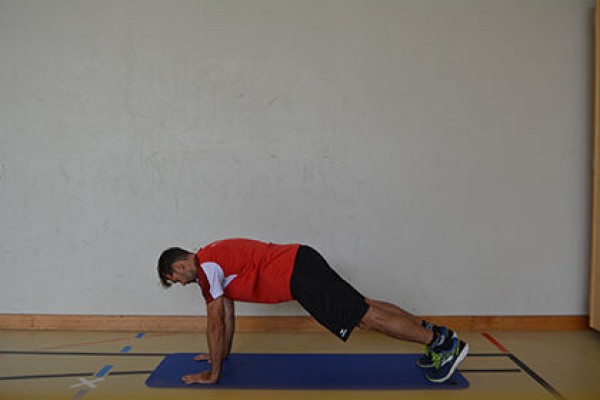

Lie down in the push-up position, raising one arm (right) and one leg (left) crosswise and stretching them out in the extension of the body, hold the position.
Attention:
Head, torso, hips and knees form a line (do not stretch your buttocks upwards or allow them to sag, tense your stomach).
Lighten:
Hold the position with raised arm and foot only briefly before returning to the push-up position.
Harden:
Additional weight (on the back or on the arms/legs).
Variant:
Bring the elbow and knee together under the body, then extend the arm and leg again.
2-4 weight cuffs/1 weight vest/weight disc/sandbag ► Make the exercise more difficult (additional weight)
Lifting one leg alternately in the seat
Power
Individual work


Sit on the balance board, place your feet on the floor and alternately stretch one leg forwards.
Attention:
Strong back.
Lighten:
Both feet placed on the floor (no stretching of the legs).
Harden:
Both legs lifted off the floor (bent and held up).
1 balance board incl. roller
Lifting one leg in forearm support alternately
Power
Individual work

Underarm support on the balance board, with one leg stretched out in a high position (extension of the body) and the other leg bent (kneeling) on the floor. Balance and change the leg position regularly.
Attention:
Head, torso, hips and knees practically form a line (do not stretch your buttocks upwards or let them sag, tense your stomach).
Lighten:
Both legs bent on the floor (kneeling).
Harden:
Both legs stretched out in extension of the body (standing on the tips of the feet). Make it even more difficult by slightly lifting the legs alternately.
1 balance board incl. roller
Raising one leg while kneeling on all fours (left) ► 4-point kneeling leg lift hold
Power
Individual work
Four-foot stance (hands under shoulders, knees under hips), back neutral, engage core, gaze towards floor, neck in line with spine. From this position, slowly lift one leg (left) backwards until thigh and upper body form a straight line. Keep your foot relaxed (either flexed or loosely stretched), your pelvis stable and avoid arching your back. Hold position.
Attention:
Do not arch your back or tilt your pelvis to the side.
Lighten:
Lift your leg slightly off the floor instead of up to hip height. Move both hands further forward in the starting position (this relieves pressure on the lower back).
Harden:
Add extra weight to the training leg (e.g. weight cuff, mini band)
Variation I:
Perform small pulsating movements with your leg in the end position.
Variation II:
Raise your arm in the opposite direction.
1 Weight cuff/mini band ► Makes the exercise more difficult (additional weight)
Raising one leg while kneeling on all fours (right) ► 4-point kneeling leg lift hold
Power
Individual work
Four-foot stance (hands under shoulders, knees under hips), back neutral, engage core, gaze towards floor, neck in line with spine. From this position, slowly lift one leg (right) backwards until thigh and upper body form a straight line. Keep your foot relaxed (either flexed or loosely stretched), your pelvis stable and avoid arching your back. Hold position.
Attention:
Do not arch your back or tilt your pelvis to the side.
Lighten:
Lift your leg slightly off the floor instead of up to hip height. Move both hands further forward in the starting position (this relieves pressure on the lower back).
Harden:
Add extra weight to the training leg (e.g. weight cuff, mini band)
Variation I:
Perform small pulsating movements with your leg in the end position.
Variation II:
Raise your arm in the opposite direction.
1 Weight cuff/mini band ► Makes the exercise more difficult (additional weight)
Anheben eines beines in Schulterlage alternierend ► glute bridge march
Power
Individual work
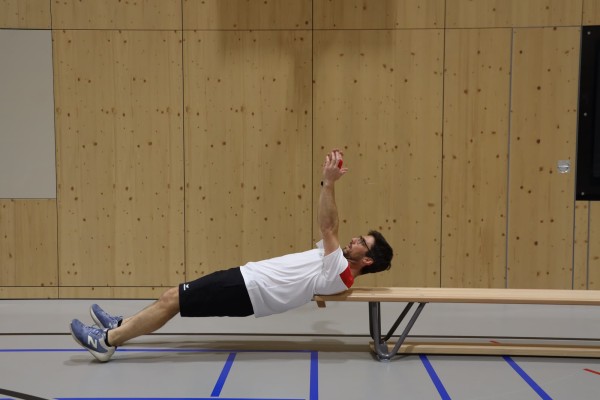
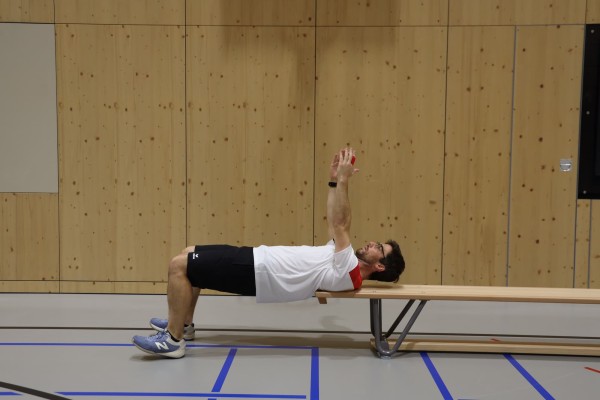
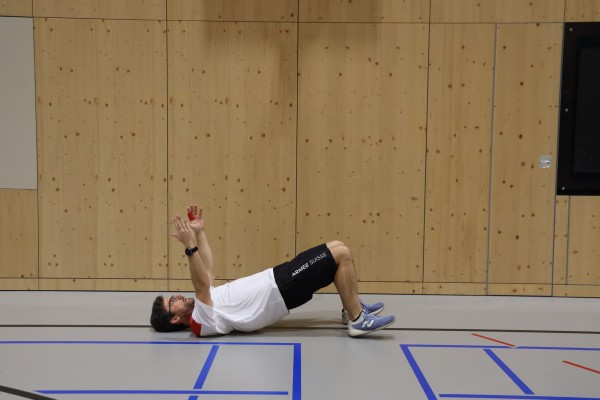
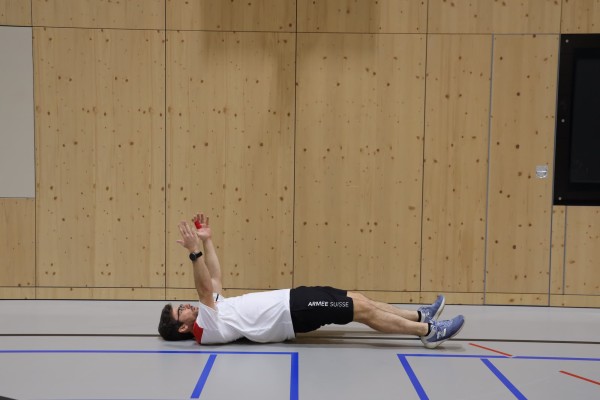
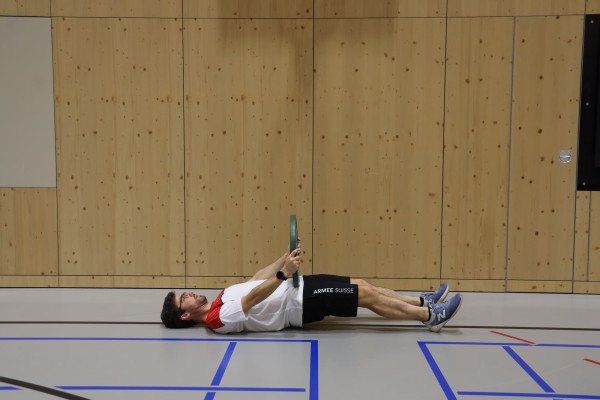
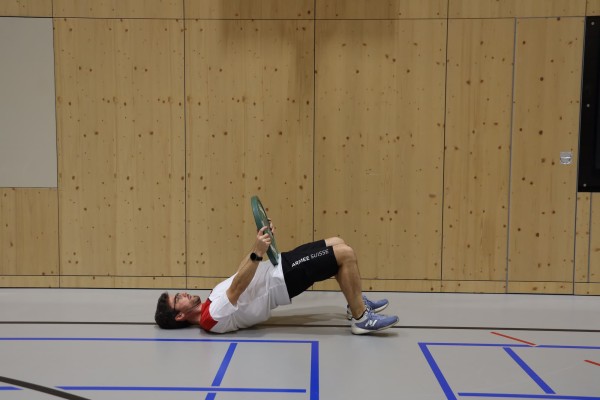
Lying on your shoulders with your legs bent and your feet up (hip-width apart). The arms are at the side of the body and flat on the floor (palms facing down). The pelvis is lifted off the floor so that the body forms a straight line from shoulders to knees. Actively tense your buttocks (bridge position). From this position, alternately lift one leg off the floor (as when marching). The raised leg remains at a right angle (knee over hip). Lower the leg slowly and in a controlled manner back to the starting position. Then switch sides.
Attention:
Shoulders and head remain on the floor. The pelvis remains stable, do not tilt to one side.
Lighten:
Static bridge (without marching). Smaller movements when marching (lift leg only a few centimetres off the ground).
Use the bench as an elevated support.
Harden:
Resistance band around the thighs. Position legs on an elevation. Weight on the pelvis. Unstable base.
1 elasticated rubber band ► Make the exercise more difficult
1 weight vest/weight disc/dumbbell/sandbag ► Make the exercise more difficult (additional weight)
1 bench ► Make the exercise harder or easier (position)
1 (gym) ball/balance cushion/balance board ► Make the exercise more difficult (unstable surface)
Lifting an object
Power
Individual work

Lift one item of basic military equipment (approx. 10kg) onto an elevation and place it back on the ground.
Attention:
The back must be straight when lifting the load.
Lighten:
Equipment approx. 5kg
Harden:
Equipment approx. 15kg
Small wall/table
Weight 10kg
Weight 5kg ► Make the exercise easier
Weight 15kg ► Make the exercise more difficult
Lifting an object while standing
Power
Individual work
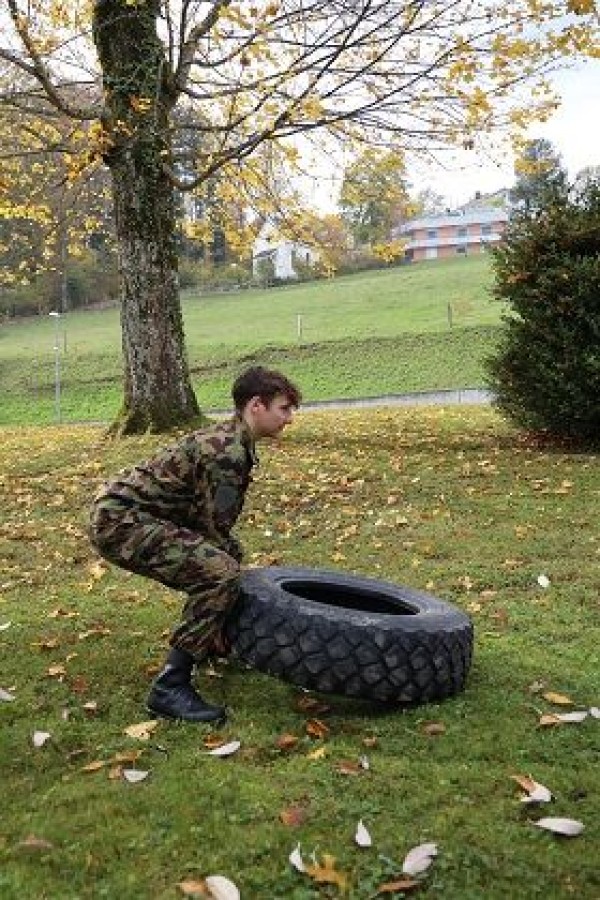
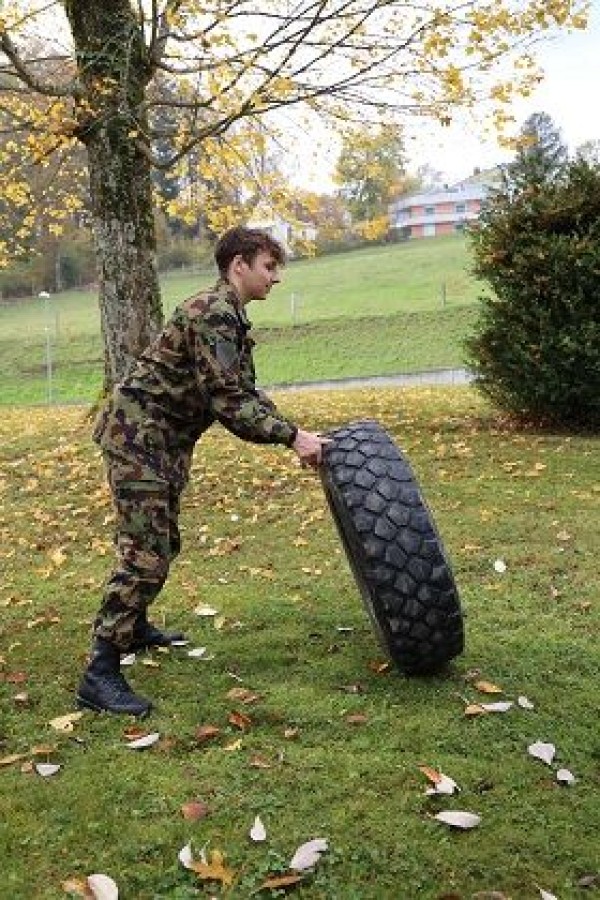

Grab the tyre lying on the floor with both hands and turn it to the other side.
Attention:
Keep your back straight, lift the weight out of your legs.
Lighten:
Less weight/load.
Harden:
More weight/greater load.
1 tyre (DURO)
1 tyre (PUCH) ► Make the exercise easier
1 tyre (10DM) ► Make the exercise more difficult
Raising and lowering the arms while standing
Power
Individual work


Stand shoulder-width apart on the gymnastics pole lying on the floor, upper body bent forwards, forearms bent, hands in the loops (thumbs pointing upwards), with the elastic bands crossed, move the arms sideways backwards and upwards (elbows at shoulder height, arms pointing diagonally upwards, shoulder blades close together) and back to the starting position.
Attention:
Keep your back straight and stable throughout the exercise (tense your core).
Lighten:
Select less strong elastic bands.
Harden:
Choose stronger elastic bands.
Variant:
Perform the exercise sitting upright, bend your legs slightly and hold the pole in place with your feet up.
1 gymnastic bar with elasticated straps
Raising and lowering the arms while standing
Power
Individual work
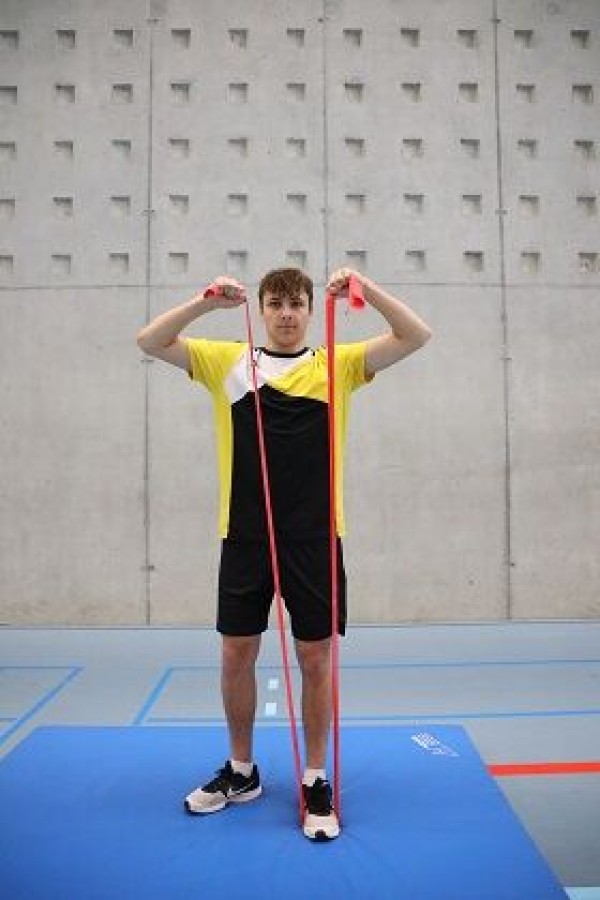
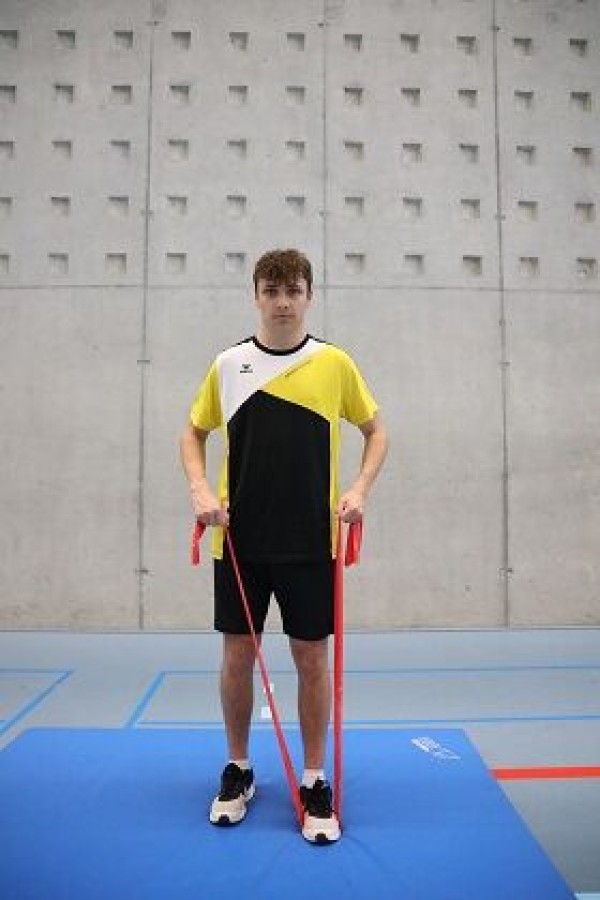
Step, step onto the centre of the elastic band with your front foot, hold one end of the elastic band at hip height with your arms slightly bent (hands shoulder-width apart or together), raise your arms (elbows at shoulder height, hands approximately at face height) and lower them back to the starting position without changing the angle in the elbow joint.
Attention:
The movement only takes place in the shoulder joint (do not raise your shoulders), no hollow back (tighten your stomach).
Lighten:
Choose an elastic band with less resistance.
Harden:
Choose an elastic band with greater resistance.
1 elasticated rubber band