
Exercises (1633)
Alternating push-up position and forearm plank ► push up position & elbow plank / push up position & front plank / push up position to elbow plank / push up position to front plank
Power
Individual work
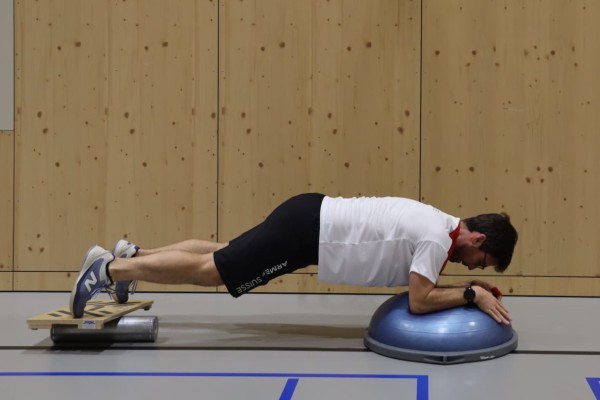
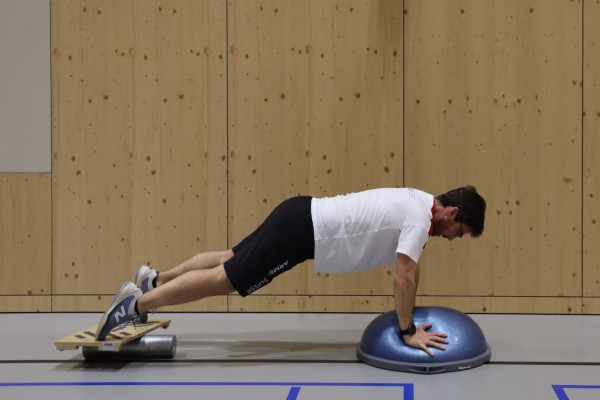
From the push-up position, alternate between the forearm plank and the push-up position (bending and extending one arm at a time). The hands or forearms are placed on the balance half-ball. The legs are positioned on an unstable surface.
Attention:
Feet, knees, pelvis and shoulders form nearly a straight line (body engaged, pelvis pushed slightly upward). Do not fully extend the arms. In the final position, actively pull the shoulder blades together.
Lighten:
Perform the exercise without the balance board.
Harden:
Add additional weight (on the back).
1 balance hemisphere
1 ball/balance cushion/balance board
1 weight vest/weight disc/sandbag ► to make the exercise more difficult (additional weight)
Alternating push-up position and forearm plank ► push up position & elbow plank / push up position & front plank / push up position to elbow plank / push up position to front plank
Power
Individual work
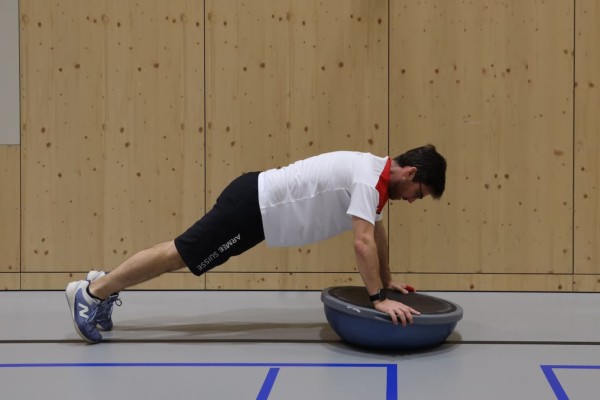
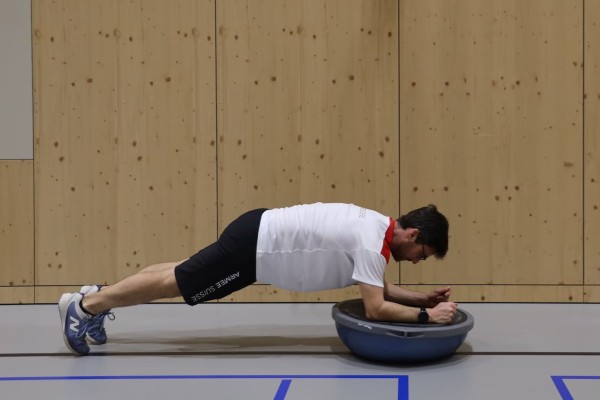
Switch from the push-up position to the forearm support and back (bend and stretch one arm at a time), placing the hands or forearms on a balance ball.
Attention:
Head, torso, hips and knees practically form a line (do not stretch your buttocks upwards or let them sag, tense your stomach).
Lighten:
Perform the exercise without the balancing hemisphere; knees on the floor.
Harden:
Additional weight (on the back); unstable base for the legs.
1 balance hemisphere
1 weight vest/weight disc/sandbag ► to make the exercise more difficult (additional weight)
1 ball/balance cushion/balance board ► to make the exercise more difficult (unstable base)
Move your arms upwards while standing
Power
Individual work


Standing upright, hold two dumbbells at the side of your body with your arms hanging down, grasp the dumbbells with an underhand grip (palms facing forwards), raise your practically straight arms upwards in a circular motion so that your almost closed arms are pointing diagonally upwards in front of your head (first raise the dumbbells sideways before bringing your arms together slightly above head height at about shoulder height). While raising the dumbbells, turn your arms in so that the backs of your hands are pointing upwards in the end position. Then move your arms back to the starting position in the reverse sequence of movements.
Attention:
Keep your shoulders lowered and your back straight; always keep your arms under tension (do not let them hang completely or bring them fully together).
Lighten:
Without/less weight.
Harden:
More weight or additional weight (on the arms).
2 dumbbells
2 weight cuffs ► Make the exercise more difficult (additional weight)
Move your arms forwards and backwards in the forearm plank position ► ball plank rollout
Power
Individual work
Rest on your forearms on two exercise balls, legs straight, feet hip-width apart. Actively engage your entire body (core, glutes, legs). Roll the balls forward slowly and in a controlled manner (your body will gradually extend as you do so). Stop briefly at the point where you can no longer maintain the tension, then roll back to the starting position. The entire movement should be slow and controlled (no momentum) and the body should remain in a stable line.
Attention:
Do not arch your back when rolling forward; do not lift your bottom too high or let it drop, do not roll too quickly (momentum rather than control), do not let your shoulders roll inwards, do not rely solely on your arms (instead of your core – incorrect movement pattern), do not roll too far forward (loss of control in the lower back).
Lighten:
Smaller rolling motion (just slightly forwards and backwards); keep your knees on the floor instead of your feet (knee plank rollout); start with the ball closer to your body; perform the exercise using a gym ball.
Harden:
Roll further forwards (greater leverage); stand on one leg or with feet closer together; slow down the eccentric phase; hold the stretched position; use a high plank position instead of a forearm plank.
2 exercise balls
Move the arms forwards and backwards in a prone position ► W-extension / W-raise / W-Y-extension
Power
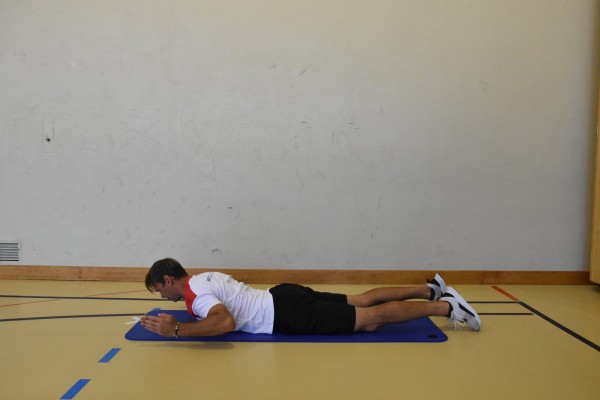
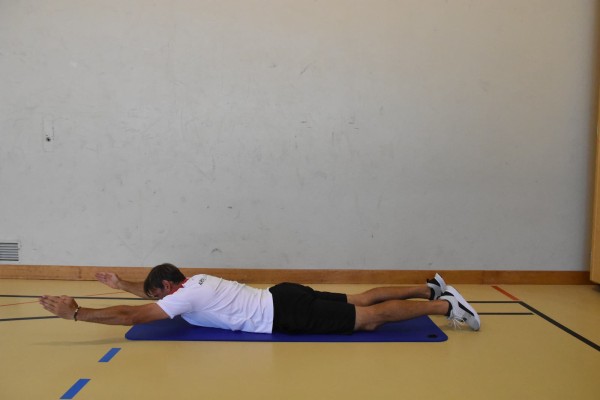
Lying on your stomach with your upper body slightly raised, feet shoulder-width apart, arms bent beside your body (hands at head height - palms facing inwards or downwards - W position), stretch your arms out diagonally forwards as an extension of your body and bend them back to the starting position.
Attention:
Do not lower your upper body and arms completely.
Lighten:
Lower your upper body/arms after each repetition or every now and then.
Harden:
Additional weight on the arms/in the hands.
Note:
The position of the hands is important for the target muscles and the position of the joints.
Palms facing down (pronated grip) = muscle activation: emphasizes the upper trapezius and the external rotators of the shoulder (e.g., infraspinatus, teres minor) / shoulder position: shoulders are more externally rotated / advantage: good posture correction, strengthens the back of the shoulders / disadvantage: can be uncomfortable or restrictive if you have shoulder problems.
Palms facing each other (neutral grip) = muscle activation: activates the middle trapezius, rhomboids, and rear deltoid muscles more strongly / shoulder position: less external rotation, easier on the joints / advantage: often more comfortable for the shoulder joints, better control / disadvantage: less targeted external rotation if that is the goal.
When to choose which: Shoulder health/rehab = neutral (palms facing each other)/focus on external rotators = pronated (palms facing down)/improve posture = both options are useful/keep movement pain-free = neutral is preferable.
Conclusion: The hand position during the W extension influences which parts of the shoulder muscles are used more and how stressful the movement is for the shoulder joints. Both variants are useful – depending on the goal or how it feels, both can be used (or even alternated during training).
Variation I:
Alternately raise one arm (instead of both at the same time).
Variation II:
Position on a flat bench or an incline bench.
2 weight cuffs/weight balls/dumbbells ► Make the exercise more difficult (additional weight)
Move the arms forwards and backwards in a prone position ► W-extension / W-raise / W-Y-extension
Power
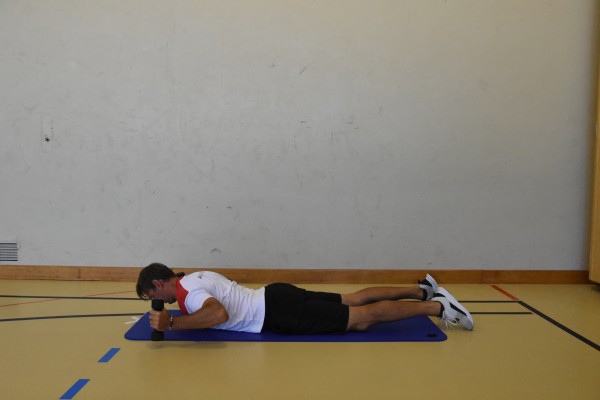
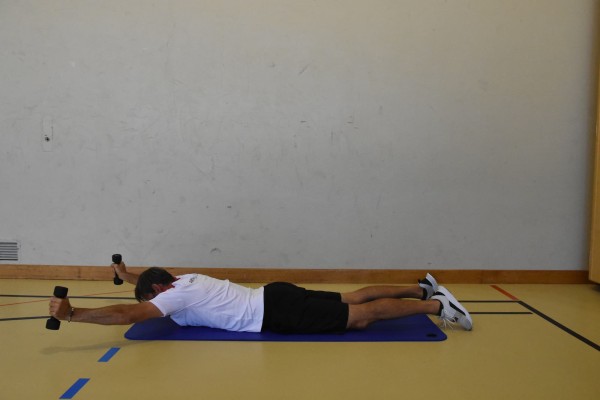
Lying on your stomach with your upper body slightly raised, feet shoulder-width apart, arms bent beside your body (hands at head height - palms facing inwards or downwards - W position), hold a (light) dumbbell in each hand, stretch your arms out diagonally forwards as an extension of your body and bend them back to the starting position.
Attention:
Do not lower your upper body and arms completely.
Lighten:
Lower your upper body/arms after each repetition or every now and then.
Harden:
Additional weight on the arms/in the hands.
Note:
The position of the hands is important for the target muscles and the position of the joints.
Palms facing down (pronated grip) = muscle activation: emphasizes the upper trapezius and the external rotators of the shoulder (e.g., infraspinatus, teres minor) / shoulder position: shoulders are more externally rotated / advantage: good posture correction, strengthens the back of the shoulders / disadvantage: can be uncomfortable or restrictive if you have shoulder problems.
Palms facing each other (neutral grip) = muscle activation: activates the middle trapezius, rhomboids, and rear deltoid muscles more strongly / shoulder position: less external rotation, easier on the joints / advantage: often more comfortable for the shoulder joints, better control / disadvantage: less targeted external rotation if that is the goal.
When to choose which: Shoulder health/rehab = neutral (palms facing each other)/focus on external rotators = pronated (palms facing down)/improve posture = both options are useful/keep movement pain-free = neutral is preferable.
Conclusion: The hand position during the W extension influences which parts of the shoulder muscles are used more and how stressful the movement is for the shoulder joints. Both variants are useful – depending on the goal or how it feels, both can be used (or even alternated during training).
Variation I:
Alternately raise one arm (instead of both at the same time).
Variation II:
Position on a flat bench or an incline bench.
2 weight cuffs/weight balls/dumbbells
Move the arms forwards and backwards in a prone position ► W-extension / W-raise / W-Y-extension
Power
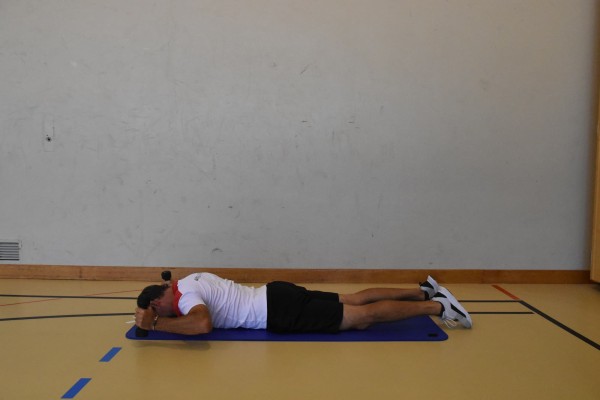
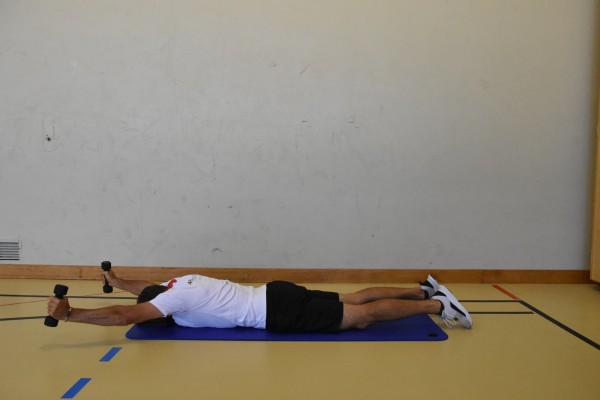
Lying on your stomach with your forehead resting on a folded cloth, feet shoulder-width apart, arms bent beside your body (hands at head height - palms facing inwards or downwards - W position), hold a (light) dumbbell in each hand, stretch your arms out diagonally forwards as an extension of your body and bend them back to the starting position.
Attention:
Do not lower your upper body and arms completely.
Lighten:
Lower your upper body/arms after each repetition or every now and then.
Harden:
Additional weight on the arms/in the hands.
Note:
The position of the hands is important for the target muscles and the position of the joints.
Palms facing down (pronated grip) = muscle activation: emphasizes the upper trapezius and the external rotators of the shoulder (e.g., infraspinatus, teres minor) / shoulder position: shoulders are more externally rotated / advantage: good posture correction, strengthens the back of the shoulders / disadvantage: can be uncomfortable or restrictive if you have shoulder problems.
Palms facing each other (neutral grip) = muscle activation: activates the middle trapezius, rhomboids, and rear deltoid muscles more strongly / shoulder position: less external rotation, easier on the joints / advantage: often more comfortable for the shoulder joints, better control / disadvantage: less targeted external rotation if that is the goal.
When to choose which: Shoulder health/rehab = neutral (palms facing each other)/focus on external rotators = pronated (palms facing down)/improve posture = both options are useful/keep movement pain-free = neutral is preferable.
Conclusion: The hand position during the W extension influences which parts of the shoulder muscles are used more and how stressful the movement is for the shoulder joints. Both variants are useful – depending on the goal or how it feels, both can be used (or even alternated during training).
Variation I:
Alternately raise one arm (instead of both at the same time).
Variation II:
Position on a flat bench or an incline bench.
2 weight cuffs/weight balls/dumbbells
Move the arms forwards and backwards in a prone position ► W-extension / W-raise / W-Y-extension
Power
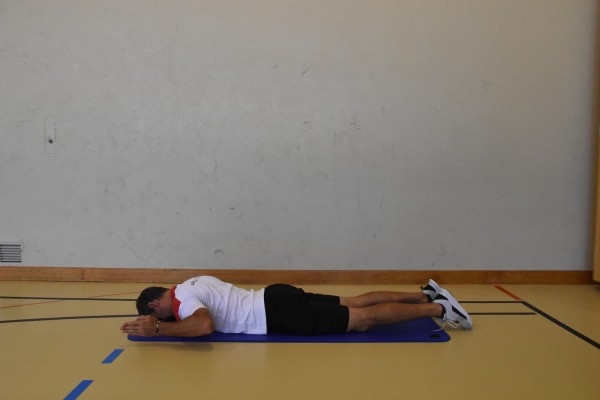
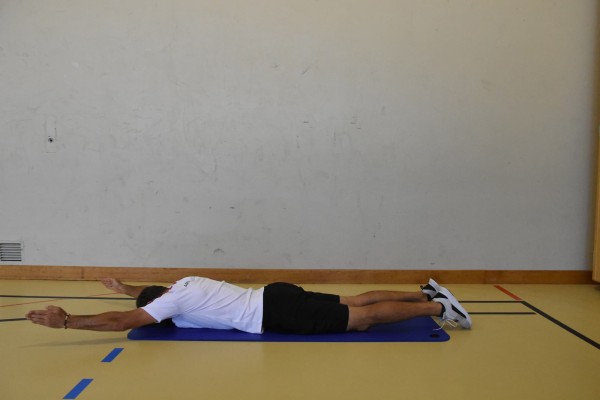
Lying on your stomach with your forehead resting on a folded cloth, feet shoulder-width apart, arms bent beside your body (hands at head height - palms facing inwards or downwards - W position), stretch your arms out diagonally forwards as an extension of your body and bend them back to the starting position.
Attention:
Do not lower your upper body and arms completely.
Lighten:
Lower your upper body/arms after each repetition or every now and then.
Harden:
Additional weight on the arms/in the hands.
Note:
The position of the hands is important for the target muscles and the position of the joints.
Palms facing down (pronated grip) = muscle activation: emphasizes the upper trapezius and the external rotators of the shoulder (e.g., infraspinatus, teres minor) / shoulder position: shoulders are more externally rotated / advantage: good posture correction, strengthens the back of the shoulders / disadvantage: can be uncomfortable or restrictive if you have shoulder problems.
Palms facing each other (neutral grip) = muscle activation: activates the middle trapezius, rhomboids, and rear deltoid muscles more strongly / shoulder position: less external rotation, easier on the joints / advantage: often more comfortable for the shoulder joints, better control / disadvantage: less targeted external rotation if that is the goal.
When to choose which: Shoulder health/rehab = neutral (palms facing each other)/focus on external rotators = pronated (palms facing down)/improve posture = both options are useful/keep movement pain-free = neutral is preferable.
Conclusion: The hand position during the W extension influences which parts of the shoulder muscles are used more and how stressful the movement is for the shoulder joints. Both variants are useful – depending on the goal or how it feels, both can be used (or even alternated during training).
Variation I:
Alternately raise one arm (instead of both at the same time).
Variation II:
Position on a flat bench or an incline bench.
2 weight cuffs/weight balls/dumbbells ► Make the exercise more difficult (additional weight)
Move upper leg forwards in lateral forearm support (left) ► knee raise lateral pillar bridge / side bridge
Power
Individual work

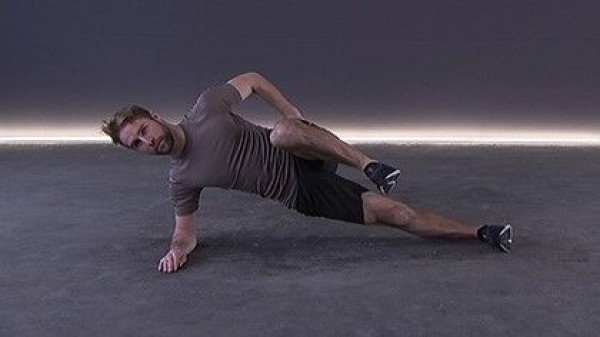
Side support on the (left) forearm, push the thigh of the upper leg straight out forwards (lower leg parallel, thigh bent at approx. 90 degrees to the body/leg) and return to the starting position.
Attention:
Head, torso, hips and knees practically form a line (pelvis does not tilt backwards or forwards), keep the shoulder above the elbow.
Lighten:
Knee on the floor; move your leg less forwards; just hold the position.
Harden:
Additional weight (for the free leg or on the hip); unstable support (possible for both the arm and the leg).
1 weight cuff/weight vest/weight disc/sandbag ► making the exercise more difficult (additional weight)
1 ball/1-2 balance cushions/1 balance board ► making the exercise more difficult (unstable surface)
Move upper leg forwards in lateral forearm support (right) ► knee raise lateral pillar bridge / side bridge
Power
Individual work


Side support on the (right) forearm, push the thigh of the upper leg straight out forwards (lower leg parallel, thigh bent at approx. 90 degrees to the body/leg) and return to the starting position.
Attention:
Head, torso, hips and knees practically form a line (pelvis does not tilt backwards or forwards), keep the shoulder above the elbow.
Lighten:
Knee on the floor; move your leg less forwards; just hold the position.
Harden:
Additional weight (for the free leg or on the hip); unstable support (possible for both the arm and the leg).
1 weight cuff/weight vest/weight disc/sandbag ► making the exercise more difficult (additional weight)
1 ball/1-2 balance cushions/1 balance board ► making the exercise more difficult (unstable surface)
Move upper leg forwards in lateral support (left) ► knee raise lateral pillar bridge / side bridge
Power
Individual work


Lateral support with outstretched (left) arm, push the thigh of the upper leg straight out forwards (lower leg parallel, thigh bent at approx. 90 degrees to the body/leg) and return to the starting position.
Attention:
Head, torso, hips and knees practically form a line (pelvis does not tilt backwards or forwards), keep shoulder above elbow.
Lighten:
Knee on the floor; move your leg less forwards; just hold the position.
Harden:
Additional weight (for the free leg or on the hip); unstable support (possible for both the arm and the leg).
1 weight cuff/weight vest/weight disc/sandbag ► to make the exercise more difficult (additional weight)
1 ball/1-2 balance cushions ► to make the exercise more difficult (unstable surface)
Move upper leg forwards in lateral support (right) ► knee raise lateral pillar bridge / side bridge
Power
Individual work


Lateral support with outstretched (right) arm, push the thigh of the upper leg straight out forwards (lower leg parallel, thigh bent at approx. 90 degrees to the body/leg) and return to the starting position.
Attention:
Head, torso, hips and knees practically form a line (pelvis does not tilt backwards or forwards), keep shoulder above elbow.
Lighten:
Knee on the floor; move your leg less forwards; just hold the position.
Harden:
Additional weight (for the free leg or on the hip); unstable support (possible for both the arm and the leg).
1 weight cuff/weight vest/weight disc/sandbag ► to make the exercise more difficult (additional weight)
1 ball/1-2 balance cushions ► to make the exercise more difficult (unstable surface)
Move upper body forwards and backwards in forearm support ► dynamic pillar bridge
Power
Individual work


Underarm support (the outstretched legs and upper body practically form a line, the legs are supported on the tips of the toes and the upper body on the forearms, the forearms lie flat on the floor parallel to each other, the upper arms are vertical), move the upper body forwards and backwards by changing the angle between the forearm and upper arm.
Attention:
Head, torso, hips and knees practically form a line (do not stretch your buttocks upwards or let them sag, tense your stomach).
Lighten:
Knees on the floor (kneeling shift).
Harden:
Additional weight (on the back); unstable support for the legs and/or arms possible.
1 weight vest/weight disc/sandbag ► make the exercise more difficult (additional weight)
1 ball/1-2 balancing cushions/balance board ► make the exercise more difficult (unstable surface)
Bend your upper body to the side whilst standing (left) ► side bend
Power
Individual work
Stand upright with your feet shoulder-width apart, holding a dumbbell in one hand (left), the other hand resting loosely at your side or on your hip, shoulders back, chest out, and looking straight ahead. Slowly lean your upper body towards the side of the dumbbell without pushing your hips backwards, feeling a gentle stretch in your oblique abdominal muscles, then return to the starting position in a controlled manner. Breathing: Exhale as you straighten up, inhale as you bend to the side.
Attention:
Do not tilt your hips backwards, avoid jerky movements, do not twist your torso (your upper body should lean to the side), do not tense your neck (keep your head in line with your spine).
Lighten:
Less or no weight; knees slightly bent (takes the strain off the lower back and makes it easier to balance); smaller movements (minimal side-to-side tilt); lean against the wall (stabilises the back and hips).
Harden:
Add more weight; stand on a raised or unstable surface (greater balance required); hold the final position for slightly longer and/or slow down the pace.
1 dumbbell/weight plate
1 Step/Box/Balance Pad ► Make the exercise more challenging (raised or unstable surface)
Bend your upper body to the side whilst standing (right) ► side bend
Power
Individual work
Stand upright with your feet shoulder-width apart, holding a dumbbell in one hand (right), the other hand resting loosely at your side or on your hip, shoulders back, chest out, and looking straight ahead. Slowly lean your upper body towards the side of the dumbbell without pushing your hips backwards, feeling a gentle stretch in your oblique abdominal muscles, then return to the starting position in a controlled manner. Breathing: Exhale as you straighten up, inhale as you bend to the side.
Attention:
Do not tilt your hips backwards, avoid jerky movements, do not twist your torso (your upper body should lean to the side), do not tense your neck (keep your head in line with your spine).
Lighten:
Less or no weight; knees slightly bent (takes the strain off the lower back and makes it easier to balance); smaller movements (minimal side-to-side tilt); lean against the wall (stabilises the back and hips).
Harden:
Add more weight; stand on a raised or unstable surface (greater balance required); hold the final position for slightly longer and/or slow down the pace.
1 dumbbell/weight plate
1 Step/Box/Balance Pad ► Make the exercise more challenging (raised or unstable surface)
Pebble walk
Power
Individual work

Place 3 small stones on the floor; balance on two of these stones. Move the third free stone; switch to this stone with one foot. Repeat the process without losing your balance.
Lighten:
Without equipment;
Larger stones.
Harden:
With a backpack;
Smaller stones.
Material per participant: Tenue CNM
Additional material: 3 small stones
Pronation of the forearm in the sitting position (left)
Power
Individual work
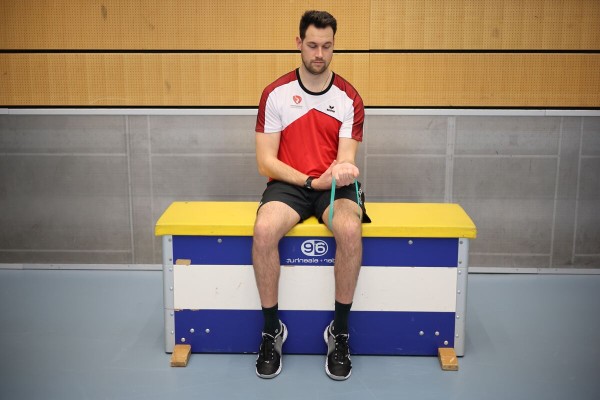
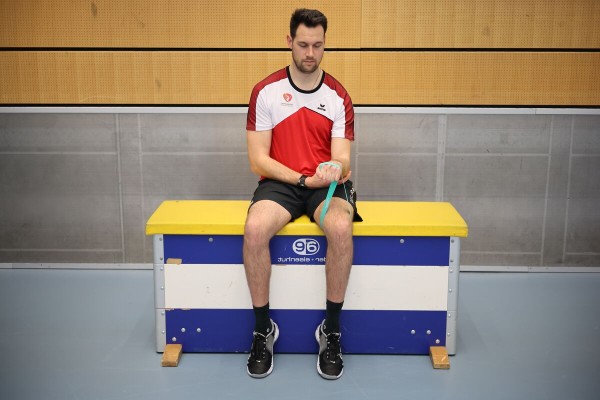
While seated, place an elasticated band around the (left) thigh and grasp the band with the (left) hand, with the back of the hand pointing downwards. The arm holding the band is bent so that the upper arm is against the body and the lower arm is pointing forwards (90 degree angle at the elbow joint). The other (right) arm fixes the training arm by holding the forearm at the elbow. From this position, rotate the arm inwards (pronation) so that the back of the hand is pointing upwards in the end position.
Attention:
The movement only takes place in the forearm, the upper arm remains stable.
Lighten:
Select a rubber band with less resistance.
Harden:
Select a rubber band with greater resistance.
1 mini-band
1 seating option (e.g. chair, plyo box or vaulting box)
Pronation of the forearm in the sitting position (right)
Power
Individual work

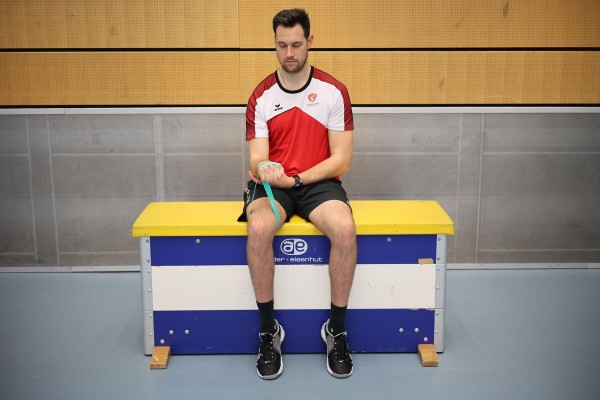
While seated, place an elasticated band around the (right) thigh and grasp the band with the (right) hand, with the back of the hand pointing downwards. The arm holding the band is bent so that the upper arm is against the body and the lower arm is pointing forwards (90 degree angle at the elbow joint). The other (left) arm secures the training arm by holding the forearm at the elbow. From this position, rotate the arm inwards (pronation) so that the back of the hand is pointing upwards in the end position.
Attention:
The movement only takes place in the forearm, the upper arm remains stable.
Lighten:
Select an elastic band with less resistance.
Harden:
Select an elastic band with greater resistance.
1 mini-band
1 seating option (e.g. chair, plyo box or vaulting box)
Rescue and transport
Power
Partner work
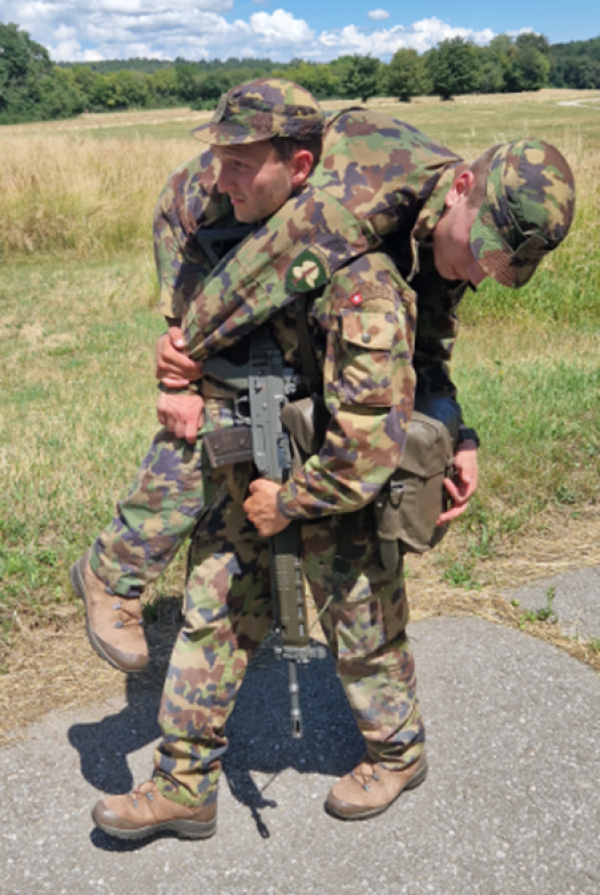
Transport your comrade from one fanjon to another (Gamstrage grip) using the transport techniques from the regulations for self-help and comrade assistance (59.005).
Attention:
The back must be straight when lifting the comrade.
Material per participant: Tenue CNG 428
Additional material: 2 fanjons
Roll with raised arms and legs in lateral position left/right
Power
Individual work


Lay on your side, stretch your legs and arms and lift them slightly off the floor. Pull your navel towards your spine and consciously tense your abdomen and then change your side position without changing your body position (roll alternately to the right or left side).
Attention:
Stretched arms and legs practically form a line.
Lighten:
Just hold the position with your arms and legs raised and switch sides from time to time.
Harden:
Add weight to your arms and/or legs.
2-4 weight cuffs/2 weight balls/dumbbells ► Make the exercise more difficult (additional weight)
Rotation of the upper body in frontal stance to the wall (left) ► standing upper body rotation
Power
Individual work
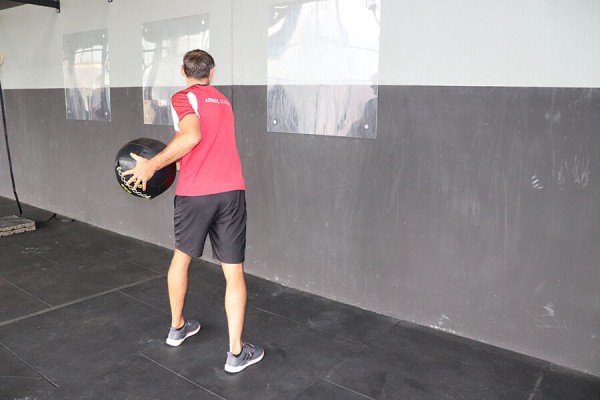
Stand upright in front of a wall, shoulder-width apart (facing the wall), with arms bent (approximately 90 degrees at the elbow joint), holding a medicine ball in front of the body with both hands slightly below chest height. The upper body is turned/rotated as far as possible to the left side (gaze follows the movement), while the legs and arms remain stable (lift the heel on the opposite side - right - as far as possible). Then swing the upper body back to the starting position and at the same time throw the ball (sideways) against the wall. Catch the ball and return to the starting position to restart the exercise.
Attention:
Tighten your stomach, keep your back straight, your pelvis remains in place and only your upper body moves.
Lighten:
Smaller movements (less rotation); lighter ball.
Harden:
Additional weight (on the arms); heavier ball; unstable base.
1 wall
1 medicine ball
1 volleyball or football ► make the exercise easier
2 weight cuffs ► make the exercise more difficult (additional weight)
1-2 balance cushions/1 balance board ► make the exercise more difficult (unstable surface)
Rotation of the upper body in frontal stance to the wall (right) ► standing upper body rotation
Power
Individual work

Stand upright in front of a wall, shoulder-width apart (facing the wall), with arms bent (approximately 90 degrees at the elbow joint), holding a medicine ball in front of the body with both hands slightly below chest height. The upper body is turned/rotated as far as possible to the right side (gaze follows the movement), while the legs and arms remain stable (lift the heel on the opposite side - left - as far as possible). Then swing the upper body back to the starting position and at the same time throw the ball (sideways) against the wall. Catch the ball and return to the starting position to restart the exercise.
Attention:
Tighten your stomach, keep your back straight, your pelvis remains in place and only your upper body moves.
Lighten:
Smaller movements (less rotation); lighter ball.
Harden:
Additional weight (on the arms); heavier ball; unstable base.
1 wall
1 medicine ball
1 volleyball or football ► make the exercise easier
2 weight cuffs ► make the exercise more difficult (additional weight)
1-2 balance cushions/1 balance board ► make the exercise more difficult (unstable surface)
Rotation of the upper body in frontal stance alternating to the wall ► standing upper body rotation
Power
Individual work


Stand upright, shoulder-width apart, in front of a wall (facing the wall), with arms bent (approximately 90 degrees at the elbow joint), holding a medicine ball in front of the body with both hands slightly below chest height. The upper body is turned/rotated as far as possible to the side (gaze accompanies the movement), while the legs and arms remain stable (lift the heel on the opposite side of the rotation movement at most). Then swing the upper body back to the starting position and at the same time throw the ball (sideways) against the wall. Catch the ball and return to the starting position to start the same exercise on the other side.
Attention:
Tighten your abdomen, keep your back straight, your pelvis stays in place and only your upper body moves.
Lighten:
Smaller movements (less rotation); lighter ball.
Harden:
Additional weight (on the arms); heavier ball; unstable base.
1 wall
1 medicine ball
1 volleyball or football ► make the exercise easier
2 weight cuffs ► make the exercise more difficult (additional weight)
1-2 balance cushions/1 balance board ► make the exercise more difficult (unstable surface)
Rotation of the upper body while standing sideways to the wall (left) ► standing upper body rotation
Power
Individual work


Stand upright in front of a wall (facing the wall horizontally, left shoulder closer to the wall), with arms bent (approximately 90 degrees at the elbow joint), hold a medicine ball in front of the body with both hands slightly below chest height. The upper body is turned/rotated to the side towards the wall in a swinging motion (gaze accompanies the movement) until the arms are facing the wall and the ball is thrown against the wall at the same time. During the rotation movement, the legs and arms remain stable (lift the heel of the foot furthest from the wall at most). Catch the ball and bring your upper body back to the starting position.
Attention:
Tighten your stomach, keep your back straight, your pelvis remains in place and only your upper body moves.
Lighten:
Smaller range of motion by pointing the stance more towards the wall (less rotation); lighter ball.
Harden:
Additional weight (on the arms); heavier ball; unstable base.
1 wall
1 medicine ball
1 volleyball or football ► make the exercise easier
2 weight cuffs ► make the exercise more difficult (additional weight)
1-2 balance cushions/1 balance board ► make the exercise more difficult (unstable surface)