
Exercises (1633)
Rotation of the upper body while standing sideways to the wall (right) ► standing upper body rotation
Power
Individual work


Stand upright in front of a wall (facing the wall horizontally, right shoulder closer to the wall), with arms bent (approximately 90 degrees at the elbow joint), hold a medicine ball in front of the body with both hands slightly below chest height. The upper body is turned/rotated to the side towards the wall in a swinging motion (gaze accompanies the movement) until the arms are facing the wall and the ball is thrown against the wall at the same time. During the rotation movement, the legs and arms remain stable (lift the heel of the foot furthest from the wall at most). Catch the ball and bring your upper body back to the starting position.
Attention:
Tighten your stomach, keep your back straight, your pelvis remains in place and only your upper body moves.
Lighten:
Smaller range of motion by pointing the stance more towards the wall (less rotation); lighter ball.
Harden:
Additional weight (on the arms); heavier ball; unstable base.
1 wall
1 medicine ball
1 volleyball or football ► make the exercise easier
2 weight cuffs ► make the exercise more difficult (additional weight)
1-2 balance cushions/1 balance board ► make the exercise more difficult (unstable surface)
Rotation of the upper body in lateral forearm support (left) ► rotational lateral pillar bridge / side bridge
Power
Individual work


Side support on the (left) forearm and vertically extended upper arm, looking upwards, bring the upper arm under the body and back to the starting position, accompany the movement with your head (looking down from above).
Attention:
Pelvis remains stable.
Lighten:
Knees on the floor.
Harden:
Additional weight (for the free arm); unstable base (possible for both the supporting arm and the legs).
1 weight cuff/dumbbell ► making the exercise more difficult (additional weight)
1 ball/1-2 balance cushions/1 balance board ► making the exercise more difficult (unstable surface)
Rotation of the upper body in lateral forearm support (left) ► rotational lateral pillar bridge / side bridge
Power
Individual work
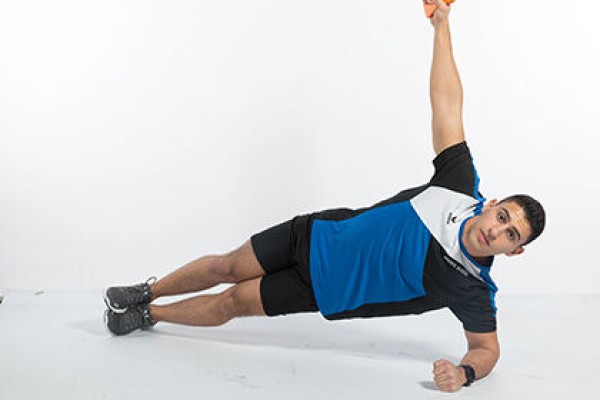

Side support on the (left) forearm and vertically extended upper arm, hold the pistol in the free hand, look towards the weapon, bring the pistol under the body and back to the starting position, accompany the movement with the head (look from top to bottom).
Attention:
Pelvis remains stable.
Lighten:
Knees on the floor.
Harden:
Instable support (possible for both the supporting arm and the legs).
1 pistol (neutralised)
1 ball/1-2 balance cushions/1 balance board ► Make the exercise more difficult (unstable surface)
Rotation of the upper body in lateral forearm support (left) ► rotational lateral pillar bridge / side bridge
Power
Individual work


Side support on the (left) forearm and vertically extended upper arm, hold the dumbbell in your free hand, look towards the weight, bring the dumbbell under your body and back to the starting position, accompany the movement with your head (look down from above).
Attention:
Keep your pelvis stable; keep the shoulder of the supporting arm above your elbow.
Lighten:
Knees on the floor.
Harden:
Stable support (possible for both the supporting arm and the legs).
1 dumbbell
1 ball/1-2 balance cushions/1 balance board ► Make the exercise more difficult (unstable surface)
Rotation of the upper body in lateral forearm support (left) ► rotational lateral pillar bridge / side bridge
Power
Individual work


Side support on the (left) forearm and vertically extended upper arm, feet on the balance board, look towards the free arm, bring the playing arm under the body and back to the starting position, accompany the movement with your head (look from top to bottom).
Attention:
The pelvis remains stable; keep the shoulder of the supporting arm above the elbow.
Lighten:
Without an unstable base.
Harden:
Instant base for the supporting arm as well; hold additional weight in the free hand.
1 balance board
1 ball/1-2 balance cushions/1 balance board ► Make the exercise more difficult (unstable surface)
1 dumbbell ► Make the exercise more difficult (additional weight)
Rotation of the upper body in lateral forearm support (right)
Power
Individual work
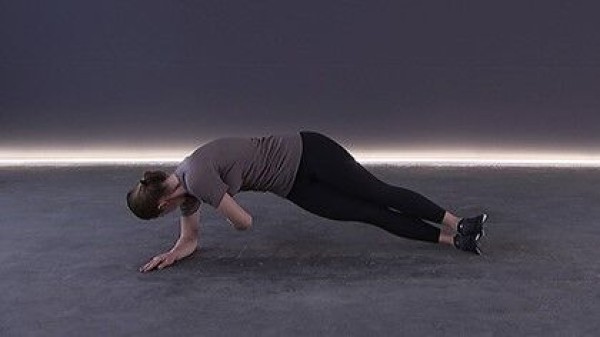

Side support on the (right) forearm and vertically extended upper arm, looking upwards, bring the upper arm under the body and back to the starting position, accompany the movement with your head (looking down from above).
Attention:
Pelvis remains stable.
Lighten:
Knees on the floor.
Harden:
Additional weight (for the free arm); unstable base (possible for both the supporting arm and the legs).
1 weight cuff/dumbbell ► making the exercise more difficult (additional weight)
1 ball/1-2 balance cushions/1 balance board ► making the exercise more difficult (unstable surface)
Rotation of the upper body in lateral forearm support (right) ► rotational lateral pillar bridge / side bridge
Power
Individual work


Side support on the (right) forearm and vertically extended upper arm, hold the pistol in the free hand, look towards the weapon, bring the pistol under the body and back to the starting position, accompany the movement with the head (look from top to bottom).
Attention:
Pelvis remains stable.
Lighten:
Knees on the floor.
Harden:
Instable support (possible for both the supporting arm and the legs).
1 pistol (neutralised)
1 ball/1-2 balance cushions/1 balance board ► Make the exercise more difficult (unstable surface)
Rotation of the upper body in lateral forearm support (right) ► rotational lateral pillar bridge / side bridge
Power
Individual work


Side support on the (right) forearm and vertically extended upper arm, hold the dumbbell in your free hand, look towards the weight, bring the dumbbell under your body and back to the starting position, accompany the movement with your head (look down from above).
Attention:
Pelvis remains stable; rotation of the upper body in lateral forearm support.
Lighten:
Knees on the floor.
Harden:
Instable support (possible for both the supporting arm and the legs).
1 dumbbell
1 ball/1-2 balance cushions/1 balance board ► Make the exercise more difficult (unstable surface)
Rotation of the upper body in lateral forearm support (right) ► rotational lateral pillar bridge / side bridge
Power
Individual work


Side support on the (right) forearm and vertically extended upper arm, feet on the balance board, look towards the free arm, bring the playing arm under the body and back to the starting position, accompany the movement with your head (look from top to bottom).
Attention:
Pelvis remains stable; keep the shoulder of the supporting arm above the elbow.
Lighten:
Without an unstable base.
Heavier:
Instable base also for the supporting arm; hold additional weight in the free hand.
1 balance board
1 ball/1-2 balance cushions/1 balance board ►Make the exercise more difficult (unstable surface)
1 dumbbell ►Make the exercise more difficult (additional weight)
Rotation of the upper body in lateral forearm support with dumbbells (left) ► rotational lateral pillar bridge / side bridge
Power
Individual work
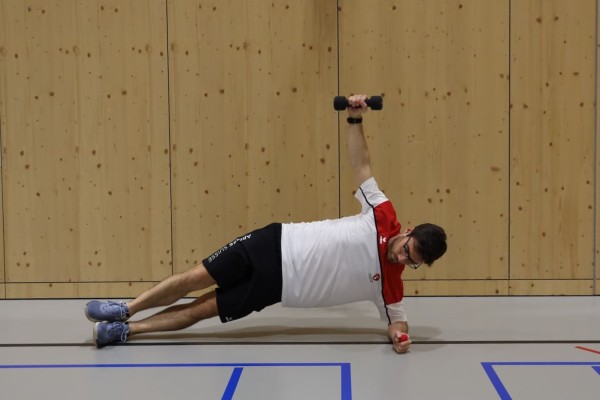
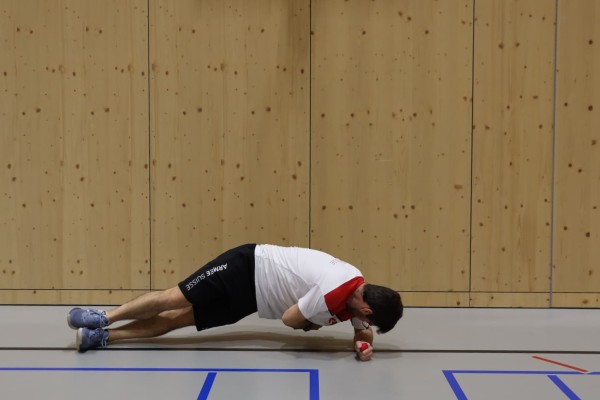
Side support on the (left) forearm and vertically extended upper arm, hold the dumbbell in your free hand, bring the dumbbell under your body and back to the starting position.
Attention:
Keep your pelvis stable; keep the shoulder of the supporting arm above your elbow.
Lighten:
Perform without dumbbells; do the exercise on your knees.
Harden:
More weight.
1 dumbbell
Rotation of the upper body in lateral forearm support with dumbbells (right) ► rotational lateral pillar bridge / side bridge
Power
Individual work
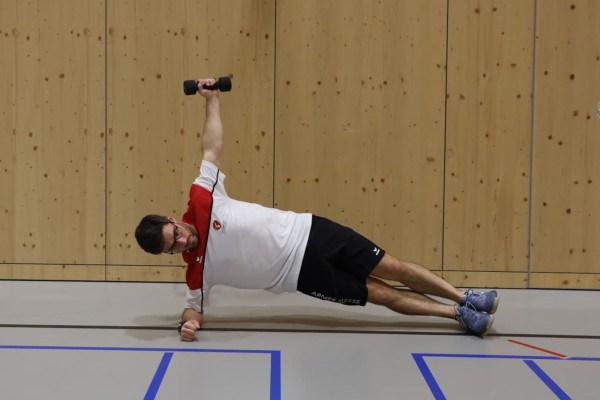
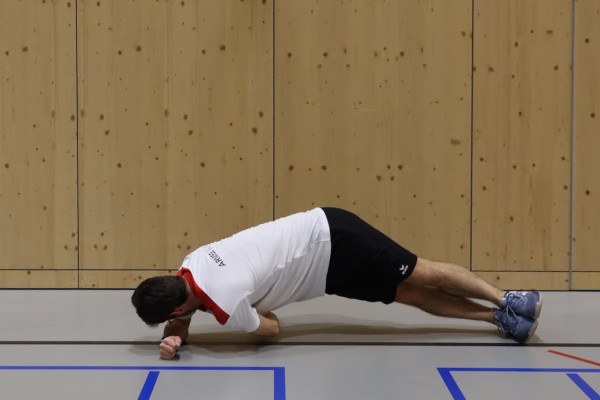
Side support on the (right) forearm and vertically extended upper arm, hold the dumbbell in your free hand, bring the dumbbell under your body and back to the starting position.
Attention:
Keep your pelvis stable; keep the shoulder of the supporting arm above your elbow.
Lighten:
Perform without dumbbells; do the exercise on your knees.
Harden:
More weight.
1 dumbbell
Rotation of the upper body in side support (left) ► rotational pillar bridge
Power
Individual work


Lateral support with the (left) arm extended, upper arm holding the dumbbell also extended (vertically upwards in a high hold), gaze directed upwards, bring the upper arm under the body and back to the starting position, accompany the movement with the head (gaze directed downwards from above).
Attention:
Pelvis remains stable.
Lighten:
Knees on the floor; no weight for the free arm.
Heavier:
More weight; unstable base (possible for both the supporting arm and the legs).
1 dumbbell
1 ball/1-2 balance cushions/1 balance board ►Make the exercise more difficult (unstable surface)
Upper body rotation in the side plank (left) ► rotational pillar bridge / high side plank T-spine rotation / T-rotation
Power
Individual work

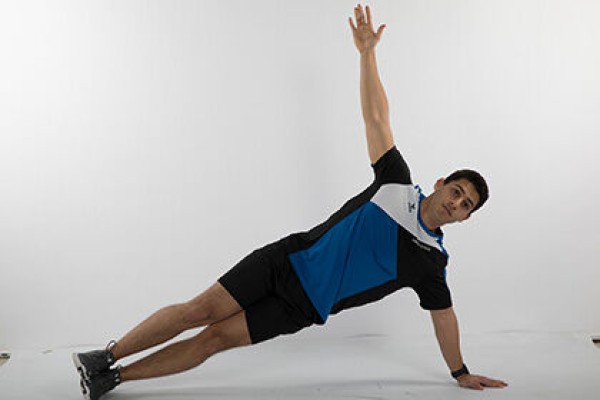
High side plank on the extended (left) arm, with the hand positioned directly beneath the shoulder; the wrist, elbow and shoulder should be in a straight line, with the legs either crossed or slightly offset. Lift the body until the head, torso and legs also form a straight line. First stretch the free arm upwards, then slowly rotate the upper body forwards/downwards and bring the free arm under the torso (rotation). Keep the hips stable; the movement should come from the thoracic spine, not the pelvis.
Attention:
The hips do not tilt or rotate (loss of stability), momentum rather than control (training effect is lost), rotation is too fast, the shoulder ‘sags’ in the supporting arm, the neck rotates instead of the thoracic spine, do not hold your breath.
Lighten:
Knee on the floor (modified side plank); rotation without bringing the arm all the way under the body (smaller range of motion); feet staggered rather than one on top of the other; open the hand of the free arm only to shoulder height (no full rotation).
Harden:
Stack your feet on top of each other (less stable base); perform a slow, controlled eccentric phase (rotate very slowly); additional weight in the top hand; unstable surface under the supporting hand; pause at the end of the rotation (isometric hold under tension); combine with leg lifts (e.g. lift the top leg in the side plank).
1 weight cuff/dumbbell ►making the exercise more difficult (additional weight)
1 ball/1-2 balance cushions/1 balance board ►making the exercise more difficult (unstable surface)
Rotation of the upper body in lateral support (right) ► rotational pillar bridge
Power
Individual work


Side plank with the (right) arm extended, upper arm holding the dumbbell also extended (vertically upwards in a high position), look upwards, bring the upper arm under the body and back to the starting position, accompany the movement with your head (look down from above).
Attention:
Pelvis remains stable.
Lighten:
Knees on the floor; no weight for the free arm.
Heavier:
More weight; unstable base (possible for both the supporting arm and the legs).
1 dumbbell
1 ball/1-2 balance cushions/1 balance board ►Make the exercise more difficult (unstable surface)
Upper body rotation in the side plank (right) ► rotational pillar bridge / high side plank T-spine rotation / T-rotation
Power
Individual work


High side plank on the extended (right) arm, with the hand positioned directly beneath the shoulder; the wrist, elbow and shoulder should be in a straight line, with the legs either crossed or slightly offset. Lift the body until the head, torso and legs also form a straight line. First stretch the free arm upwards, then slowly rotate the upper body forwards/downwards and bring the free arm under the torso (rotation). Keep the hips stable; the movement should come from the thoracic spine, not the pelvis.
Attention:
The hips do not tilt or rotate (loss of stability), momentum rather than control (training effect is lost), rotation is too fast, the shoulder ‘sags’ in the supporting arm, the neck rotates instead of the thoracic spine, do not hold your breath.
Lighten:
Knee on the floor (modified side plank); rotation without bringing the arm all the way under the body (smaller range of motion); feet staggered rather than one on top of the other; open the hand of the free arm only to shoulder height (no full rotation).
Harden:
Stack your feet on top of each other (less stable base); perform a slow, controlled eccentric phase (rotate very slowly); additional weight in the top hand; unstable surface under the supporting hand; pause at the end of the rotation (isometric hold under tension); combine with leg lifts (e.g. lift the top leg in the side plank).
1 weight cuff/dumbbell ►making the exercise more difficult (additional weight)
1 ball/1-2 balance cushions/1 balance board ►making the exercise more difficult (unstable surface)
Rotation of the upper body in the seat (left) ► seated chop
Power
Individual work


Attach the elastic band to the wall bars (or e.g. a tree) at head height, sit upright on a long bench/swinging box top/chair at a 90 degree angle to the wall bars (to the tree), keep your legs shoulder-width apart, grasp the elastic band at shoulder height with both hands, move your upper body to the far (right) knee/thigh and return to the starting position, keeping your arms stable.
Caution:
Work from the torso and not with the arms.
Easier:
Choose an elastic band with less resistance.
Harder:
Choose an elastic band with greater resistance.
1 elasticated rubber band
1 wall bars/tree
1 long bench/1-2 swing box elements (incl. top section)/chair
Rotation of the upper body in the seat (right) ► seated chop
Power
Individual work


Attach the elastic band to the wall bars (or e.g. a tree) at head height, sit upright on a long bench/swinging box top/chair at a 90 degree angle to the wall bars (to the tree), keep your legs shoulder-width apart, grasp the elastic band at shoulder height with both hands, move your upper body to the far (left) knee/thigh and return to the starting position, keeping your arms stable.
Caution:
Work from the torso and not with the arms.
Lighten:
Choose an elastic band with less resistance.
Heavier:
Choose an elastic band with greater resistance.
1 elasticated rubber band
1 wall bars/tree
1 long bench/1-2 swing box elements (incl. top section)/chair
Rotation of the upper body while seated ► oblique crunch / rotational crunch
Power
Individual work
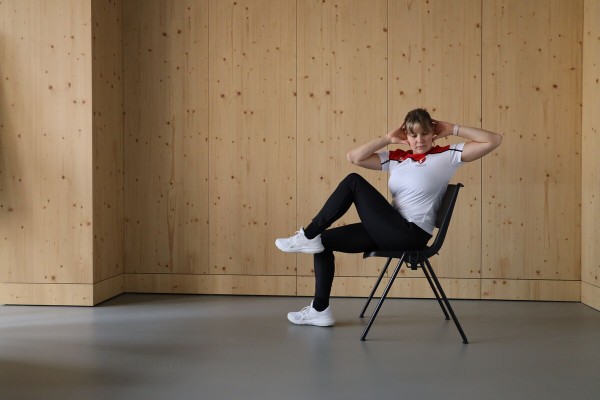
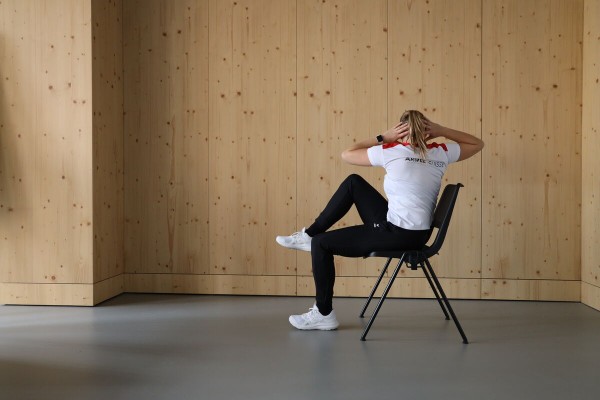
Sitting upright on a chair, cross your arms behind your head or place your hands on either side of your ear (elbows pointing to the side). Alternately lift one leg off the floor and move the elbow crosswise to the knee (bring it together approximately at the level of the navel). Raise the upper body to the starting position and lower the leg again. Switch sides after each exercise.
1 (office) chair
Rotation of the upper body in the seat ► russian twist / sitting twist / oblique twist
Power
Individual work


Sit on the floor, upper body leaning slightly backwards, legs bent and slightly raised, arms outstretched horizontally with the pistol in your hands and alternately bring the weapon sideways to the floor by rotating your upper body.
Caution:
Keep only the buttocks in contact with the floor, keep the upper body straight.
Lighten the load:
Lower the legs to the floor; hold the position only (without moving the upper body).
1 pistol (neutralised)
Rotation of the upper body in the seat ► russian twist / sitting twist / oblique twist
Power
Individual work


Sit on the floor, upper body leaning slightly back, legs bent (heels on the floor or slightly raised), arms bent and hands clasped in front of the chest; rotate the upper body in a controlled manner to the left and right (optionally, touch the floor with your hands at hip height). Aim: controlled trunk rotation whilst maintaining a stable core. Important: The rotation comes from the core, not from the arms.
Attention:
Hunching instead of a stable core posture, momentum instead of controlled rotation, excessive range of motion without control, hips not moving with the body (no isolated rotation), feet hanging loosely without tension (in the advanced version), breath not held.
Lighten:
Keep your feet on the ground; keep your upper body more upright (less forward lean); slower, smaller rotation; keep your heels in place (e.g. by tucking them under something).
Harden:
Add weight to your hands; perform the eccentric phase slowly (deliberately rotating back); hold the position at the end of the rotation (isometric hold); use a longer lever arm (arms straight rather than bent); use an unstable surface under your bottom (e.g. a balance pad).
2 weight cuffs/weight balls/1 (medicine) ball/weight plate/dumbbell ► Increase the difficulty of the exercise (additional weight)
1 balance pad/balance board ► Increase the difficulty of the exercise (unstable surface)
Rotation of the upper body in the seat ► russian twist / sitting twist / oblique twist
Power
Individual work


Sit on the floor, upper body leaning slightly backwards, legs bent and slightly raised, holding an object (e.g. helmet or ball) in your hands and moving from one side to the other (optionally touching the floor with the object at buttock height), the upper body accompanies the movement.
Caution:
Only touch the floor with your buttocks, keep your upper body straight.
Lighten:
Do not hold any additional weight in your hands; put your legs on the floor; only hold the position (without moving your arms).
Lighten:
Additional weight (e.g. place stones in your helmet or hold a rucksack).
1 helmet/(basket, medicine) ball
1 combat rucksack/tyre (PUCH)/3-4 stones ►Make the exercise more difficult (additional weight)
Rotation of the upper body in the seat ► russian twist / sitting twist / oblique twist
Power
Individual work


Sit on the floor, upper body leaning slightly backwards, legs bent and slightly raised, arms holding the (gym/medicine) ball in front of the body, arms (ball) moving from side to side, upper body accompanying the movement.
Attention:
Only keep your buttocks in contact with the floor, keep your upper body straight.
Lighten:
Place your legs on the floor; only hold the position (without moving your arms).
Lighten:
Additional weight on the arms/legs.
1 exercise ball, medicine ball, ball
2-4 weight cuffs ►to make the exercise more difficult (additional weight)
Rotation of the upper body in the seat ► russian twist / sitting twist / oblique twist
Power
Individual work


Sit on the floor, upper body leaning slightly backwards, legs bent and slightly raised, arms with assault rifle in hands stretched out horizontally (barrel pointing to the side or upwards) and by rotating the upper body bring the rifle alternately sideways to the floor.
Caution:
Contact the floor only with the buttocks, keep the upper body straight.
Easier:
Place your legs on the ground; only hold the position (without moving your upper body).
Variant:
Place your feet on the ground; hold the assault rifle with both hands on the hand guard so that the barrel is pointing upwards.
1 assault rifle (neutralised)
Rotation of the upper body in the seat ► russian twist / sitting twist / oblique twist
Power
Individual work


Sit on the floor, upper body leaning slightly backwards, legs bent and slightly raised, holding a medicine ball in your hands, which is alternately thrown to the floor on the left or right side at buttock height. The medicine ball is thrown in a large arc to the other side of the body.
Caution:
Only keep the buttocks in contact with the floor, keep the upper body straight.
Lighten:
Place your legs on the floor; do not hold any additional weight in your hands and only move your arms from side to side.
Heavier:
Add weight.
1 medicine ball
Rotation of the upper body in the seat ► russian twist / sitting twist / oblique twist
Power
Individual work


Sit on the floor, upper body leaning slightly backwards, legs bent and slightly raised, hold the medicine ball at the side of your body, throw the ball with both hands against the inclined mini-trampoline, catch the ball in front of your body and bring it to the other side. Then perform the exercise on the opposite side. The upper body always accompanies the movement (looking towards the ball).
Caution:
Only keep your buttocks in contact with the floor, keep your upper body straight.
Lighten the load:
Place your legs on the floor.
Lighten the load:
Add weight.
1 mini trampoline
1 medicine ball