
Exercises (3302)
Squat and extension and flexion of the arms (shoulder press) ► thruster
Power
Individual work


Stand upright with your feet pointing slightly outwards, the barbell is placed on your shoulders in the front position (pick up the barbell with an overhand grip and place it on your shoulders by bending your arms so that your palms are facing upwards, your forearms are horizontal and your elbows are pointing towards the floor). Bend your knees and lower your buttocks as far as possible without losing stability in your back (always look forwards in a neutral position). Then straighten your legs again and at the same time straighten your arms to press the weight powerfully upwards overhead (utilise the momentum of the legs). Standing upright with your arms not fully extended and holding them up, return the weight to the starting position in a controlled manner by bending your arms (place the dumbbell on your shoulders in the front position).
Starting position:
- Deep squat, feet pointing slightly outwards
- Barbell rests on the shoulders (front position)
- Abdominal and gluteal muscles are tensed, back straight (no hollow back)
- Gaze is (always) straight ahead in a neutral position
Finishing position:
- Stand upright with shoulders shoulder-width apart, legs straight
- Weight is held overhead with arms almost fully extended (held high)
- Back (still) straight
Attention:
Distribute weight over the entire foot, push knees outwards (do not tilt inwards). This exercise is only for advanced users and requires a high level of knowledge, mobility and stability. Always make sure your back is straight (torso tension).
1 Langhantel
Squat and extension and flexion of the arms (shoulder press) ► thruster
Power
Individual work


Stand upright with your feet pointing slightly outwards, grasp a dumbbell/kettlebell with both hands (neutral grip), hold the weight at shoulder height with your arms bent (forearms horizontal, elbows pointing downwards and close to your body so that the weights are right next to your shoulders on the same side of your body). Bend your knees and lower your buttocks as far as possible without losing stability in your back (always look forwards in a neutral position). Then straighten your legs again and at the same time straighten your arms to push the weights powerfully up overhead (utilise the momentum of your legs). Standing upright with your arms not fully extended and holding them up, return the weights to the starting position in a controlled manner by bending your arms (place the weights next to your shoulders).
Starting position:
- Deep squat, feet pointing slightly outwards
- Weights in neutral grip at shoulder height (arms bent)
- Abdominal and gluteal muscles are tensed, back straight
- Gaze is (always) straight ahead in neutral position
Finishing position:
- Stand upright with feet shoulder-width apart, legs straight
- Weights are held overhead with arms almost fully extended (held high)
- Back (still) straight
Attention:
Distribute weight over the entire foot, push knees outwards (do not tilt inwards). This exercise is only for advanced users and requires a high level of knowledge, mobility and stability. Always make sure your back is straight (torso tension).
2 dumbbells/kettlebells
Squat and extension and flexion of the arms (shoulder press) ► thruster
Power
Individual work


Squat in a low position with your feet pointing slightly outwards, holding a weighted disc between your legs with your arms stretched out (disc almost horizontal to the floor). In the squat position, look forwards in a neutral position and ensure that you do not lose stability in your back. From the squat position, straighten your legs to stand upright and simultaneously bend your arms to move the upper edge of the weight disc to approximately chin height (elbows close to the body, forearms pointing upwards, disc aligned horizontally to the floor). In a flowing movement, benefit from the momentum of the legs as you stand up so that the weight disc can immediately be raised further (arms extended overhead). After pushing the weight upwards, move the disc back down to the floor in the squat position in the reverse sequence of movements.
Attention:
Distribute the weight over the entire foot, push the knees outwards (do not tilt them inwards). Always make sure your back is straight (torso tension).
Lighten:
Less weight.
Harden:
More weight.
1 weight disc
Squat as well as extension and flexion of the arms ► squat & shoulder press
Power
Individual work


Squat in a low position with your feet pointing slightly outwards, holding a weighted disc between your legs with your arms stretched out (disc horizontal to the floor). When squatting, look forwards in a neutral position and ensure that you do not lose stability in your back. From the squat position, straighten your legs to stand upright and simultaneously bend your arms to move the upper edge of the weight disc to approximately chin height (elbows close to the body, forearms pointing upwards, disc aligned horizontally to the floor). Then extend your arms overhead (hold them up), keeping the disc horizontal to the floor. Under certain circumstances, the weight can also be pushed upwards in a fluid movement in order to benefit from the momentum of the legs (thruster). Reverse the sequence of movements to return to the starting position in the squat.
Attetion:
Distribute the weight over the entire foot, push the knees outwards (do not tilt inwards). Always make sure your back is straight (torso tension).
Lighten:
Less weight.
Harden:
More weight.
1 weight disc
Squat and extension and flexion of the arms ► wall ball
Power
Individual work


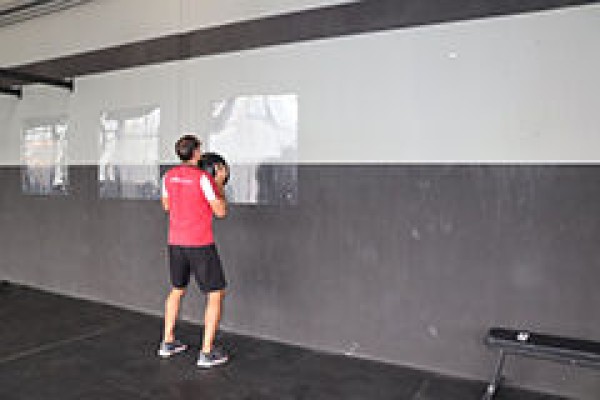

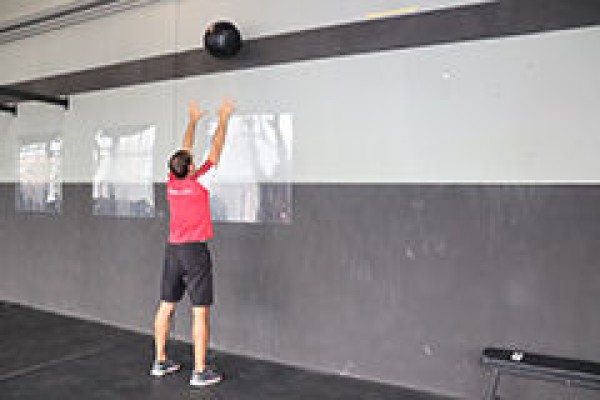


Stand upright shoulder-width apart in front of a wall (facing the wall) with your feet pointing slightly outwards, holding a medicine ball in front of your chest with your arms bent (elbows close to your body and pointing backwards, place both hands under the ball). Bend your knees and lower your buttocks as far as possible without losing stability in your back (always look forwards towards the wall in a neutral position). Then straighten your legs again and at the same time straighten your arms to powerfully push the ball upwards against the wall (utilise the momentum of your legs). Standing upright with your arms stretched upwards, catch the ball and return to the starting position by bending your arms to restart the exercise.
Attention:
Distribute the weight over the entire foot, push your knees outwards (do not tilt inwards). Always keep your back straight (torso tension).
Lighten:
Do not lower your buttocks too low (greater angle in the knees); lighter medicine ball.
Harden:
Additional weight (on the arms).
1 wall
1 medicine ball
2 weight cuffs/1 weight waistcoat ► Make the exercise more difficult (additional weight)
Squat and extension and flexion of one arm (shoulder press) (left) ► thruster
Power
Individual work


Stand upright with your feet pointing slightly outwards, grasp the weight (kettlebell or dumbbell) with one hand (left) (neutral grip) and hold it at shoulder height with your arm bent (forearm horizontal, elbow pointing downwards and close to your body so that the weight is right next to your shoulder). Bend your knees and lower your buttocks as far as possible without losing stability in your back (always look forwards in a neutral position). Then straighten your legs again and at the same time straighten your arm to push the weight powerfully up overhead (utilise the momentum of your legs). Standing upright with your arm not fully extended and holding it up, return the weight to the starting position in a controlled manner by bending your training arm (left).
Starting position:
- Deep squat, feet pointing slightly outwards
- Weight in neutral grip at shoulder height (arm bent)
- Abdominal and gluteal muscles tensed, back straight
- Gaze (always) straight ahead in neutral position
Finishing position:
- Stand upright shoulder-width apart, legs stretched
- Weight is held overhead with one arm almost fully extended (held high)
- Back (still) straight
Attention:
Distribute weight over the whole foot, push knees outwards (no tipping inwards). This exercise is only for advanced users and requires a high level of knowledge, mobility and stability. Always make sure your back is straight (torso tension).
1 dumbbell/kettlebell
Squat and extension and flexion of one arm (shoulder press) (right) ► thruster
Power
Individual work


Stand upright with your feet pointing slightly outwards, grasp the weight (kettlebell or dumbbell) with one hand (right) (neutral grip) and hold it at shoulder height with your arm bent (forearm horizontal, elbow pointing downwards and close to your body so that the weight is right next to your shoulder). Bend your knees and lower your buttocks as far as possible without losing stability in your back (always look forwards in a neutral position). Then straighten your legs again and at the same time straighten your arm to push the weight powerfully up overhead (utilise the momentum of your legs). Standing upright with your arm not fully extended and holding it up, return the weight to the starting position in a controlled manner by bending your training arm (right).
Starting position:
- Deep squat, feet pointing slightly outwards
- Weight in neutral grip at shoulder height (arm bent)
- Abdominal and gluteal muscles tensed, back straight
- Gaze (always) straight ahead in neutral position
Finishing position:
- Stand upright shoulder-width apart, legs stretched
- Weight is held overhead with one arm almost fully extended (held high)
- Back (still) straight
Attention:
Distribute weight over the whole foot, push knees outwards (no tipping inwards). This exercise is only for advanced users and requires a high level of knowledge, mobility and stability. Always make sure your back is straight (torso tension).
1 dumbbell/kettlebell
Squat and jump in the air (squat jump) alternating ► squat tuck jump
Power
Individual work


Stand upright shoulder-width apart with your arms outstretched in front of you at chest height, bend your knees to approximately a right angle at the knee joints (squat position, buttocks approximately at knee height), push your legs off the floor to jump upwards (raise your arms horizontally as a swing). During the jump, pull your knees up towards your chest as far as possible (squat jump). Then land in a controlled manner (cushion the jump; bend your knees), straighten your legs and straighten your upper body to return to the starting position.
Attention:
Keep your back straight, cushion the jump when landing, keep your whole foot on the ground without bending your knees and keep your knees behind your toes while your legs are in contact with the floor. The palms of your hands touch your knees with every jump.
Lighten:
Smaller/less intense jumps, pull your knees up less.
Harder:
Additional weight; jump on a soft surface.
2-4 weight cuffs/shorter weights/1 weight waistcoat ► making the exercise more difficult (additional weight)
1 small/large soft mat ► making the exercise more difficult (base)
Squat and jump to the side alternating ► squat & side jump
Power
Individual work


Get into a squat position with one leg on the balance half sphere, straighten your legs and simultaneously jump to the other side of the half sphere so that you change your standing leg on the sphere. With the landing movement, perform another squat and then jump back to the starting position in a fluid transition. In this way, the trainee jumps continuously from one side of the balance half-ball to the other and changes their standing leg on the training device with each exercise. In the lower squat position, the arms are bent and brought together in front of the body (landing), while the arms hang next to the body (flight phase) when the body is extended.
1 balance hemisphere
Squat and lunge alternating in jump (alternating jump) ► squat & jumping lunge
Power
Individual work
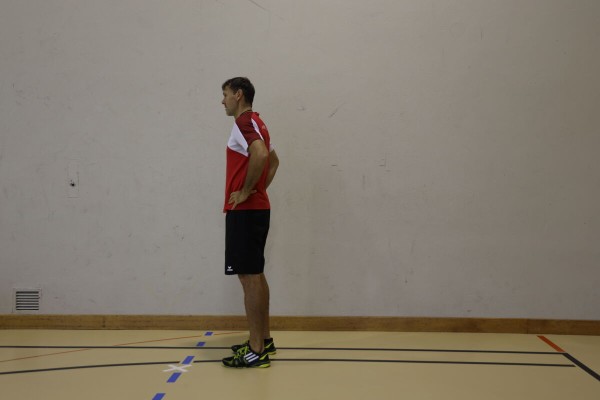
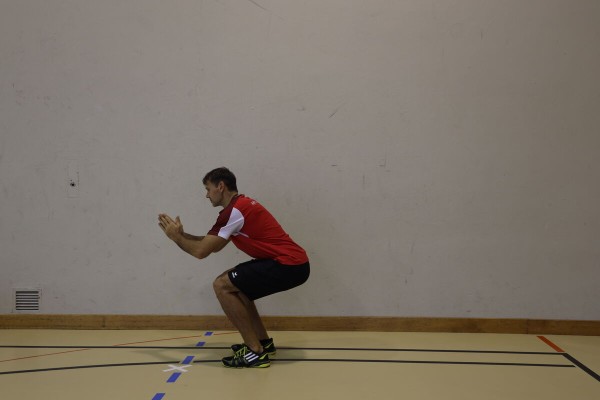
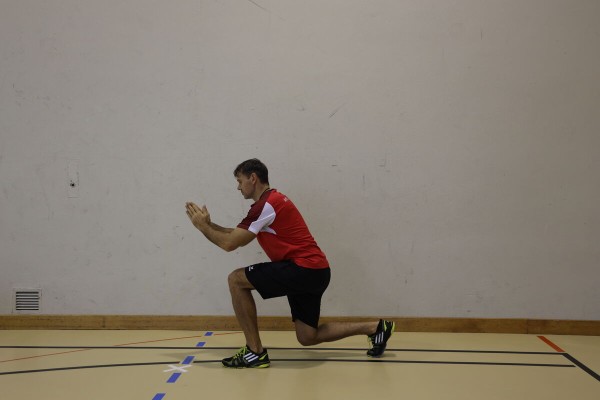

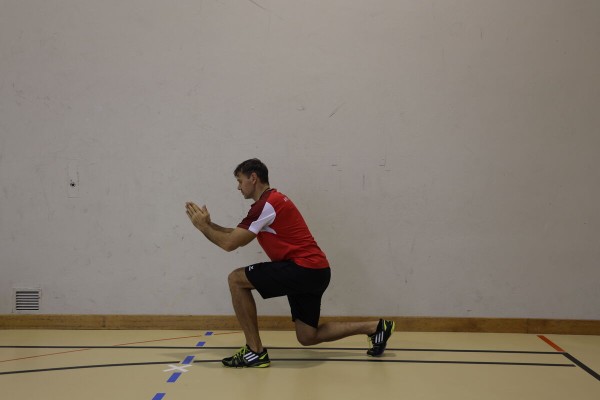
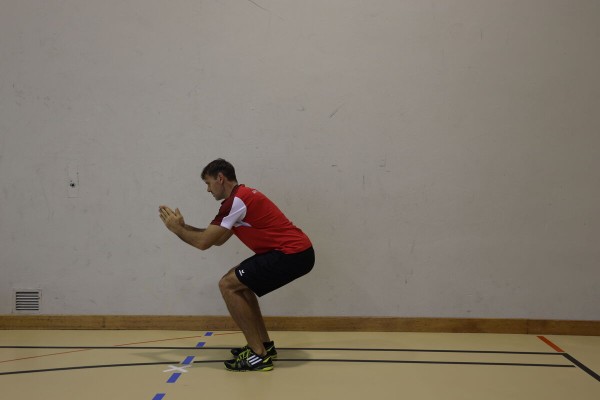


Stand with your feet shoulder-width apart, arms supported on your hips, bent or in front of you at chest height, bend your knees to approximately a right angle at the knee joints (buttocks at about knee height). From the deep squat position, perform a lunge backwards (upper body upright, abdomen tensed), arms again supported on the hips, folded on the chest, bent in front or at an angle, front (and back) leg bent to a right angle, two-legged jump to change leg position during the jump (move back leg forwards and front leg backwards - body position remains low), new alternating jump to return to the starting position in the lunge. Move the back leg forwards to the deep squat position before stretching the legs back to the starting position in a shoulder-width stance. After the new squat, change the side of the lunge compared to the previous version.
Attention:
When squatting, move your buttocks backwards, not your knees forwards. Keep your knees behind your toes. Keep your back straight at all times (tense your core), distribute your weight over your entire foot, push your knees outwards (do not tilt them inwards). When lunging, always keep the front knee behind the toe and centred over the foot. Keep your upper body as stable as possible.
Lighten:
Do not lower your buttocks too low (greater angle in the knees) when squatting. Higher basic position/lower upper body less (greater angle at the knees) when doing lunges.
Harden:
Additional weight (on the shoulders, with hanging arms or in a forward or upright position).
Variation:
Jump height can be varied: high jumps with plenty of time to change leg position or only small jumps with quick leg shifts.
1 weight vest/weight disc/(medicine) ball/sandbag/fighting backpack/2 dumbbells ► Make the exercise more difficult (additional weight)
Squat and straddle jump alternating ► sumo squat jump
Power
Individual work

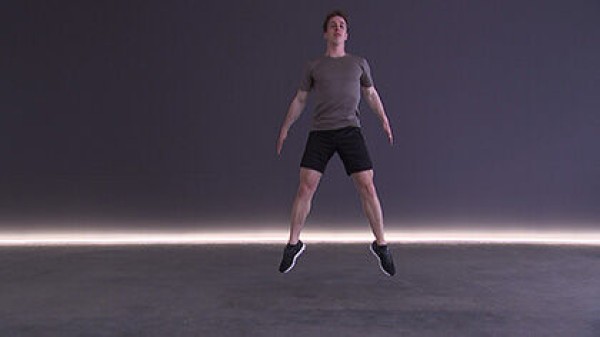
Stand with your feet shoulder-width apart, bend your knees to approximately a right angle at the knee joints (buttocks at about knee height), arms supported on your hips, folded across your chest, bent or in front of you at chest height, jump up and simultaneously spread and stretch your legs (straddle jump), cushion the jump (bend your knees slightly) and return to the starting position.
Attention:
Bring your buttocks back, not your knees forwards. Keep your knees behind your toes. Keep your back straight at all times.
Lighten:
Do not lower your buttocks too low (larger angle in the knees), smaller/less intense/higher jumps.
Harden:
Hold additional weight (on your shoulders, in front of you or with your arms hanging in your hands); larger, more intense/higher jumps.
2-4 weight vest/1 (medicine) ball/weight disc/sandbag/1-2 dumbbells ► Make the exercise more difficult (additional weight)
Knee bend and body extension alternating
Power
Individual work


Stand with your feet shoulder-width apart, arms bent in front of your body (hands at chest height), bend your knees to a right angle at the knee joints (buttocks at knee height, deep squat), stretch one arm overhead at the same time as you stretch your legs (slightly crosswise, hand approximately at the height of the opposite shoulder), squat down again and stretch the other arm upwards with the next body stretch.
Attention:
Move your buttocks backwards, not your knees forwards. Keep your knees behind your toes. Keep your back straight at all times.
Lighten:
Do not lower your body too low (greater angle in the knees).
Harden:
Additional weight (hold on the arms or in the hands).
2 weight cuffs/weight balls/dumbbells/1 weight waistcoat ► Make the exercise more difficult (additional weight)
Squat and jump onto an object alternately ► squat jump
Power
Individual work


Sit on an object lying on the floor (e.g. tyre - both legs inside or one leg inside and one leg outside the tyre), jump off with both legs to stand on the object, jump back to the starting position in the seat.
Attention:
Upright upper body, do not put all your weight down, keep your knees behind the tips of your feet.
Lighten:
Jump straight up from the seat without landing on the object in between (sit with both legs outside the tyre); lower your buttocks less (do not touch the object); lower cadence.
Harden:
Jump up after standing on the object with a direct landing on the seat; additional weight (on the shoulders); higher cadence.
1 tyre (10DM)
1 weight vest/sandbag/fighting rucksack ► to make the exercise more difficult (additional weight)
Squat and jump onto an object alternately ► squat jump
Power
Individual work
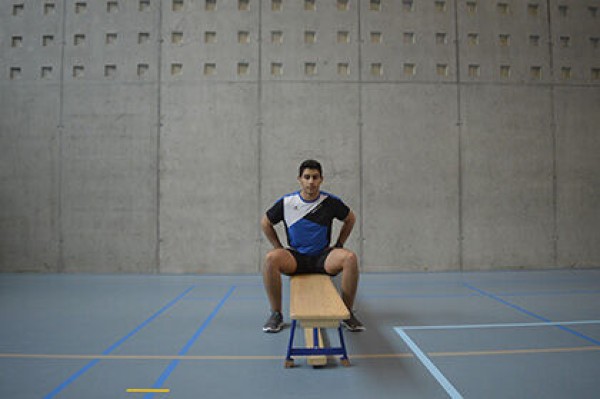

Sit on the long bench (one leg on each side of the bench), arms supported on the hips or in front, jump off with both legs to stand on the long bench, jump back to the starting position in the seat.
Attention:
Upright upper body, do not put all your weight down, keep your knees behind the tips of your feet.
Lighten:
Sit with both legs on the same side of the bench, only jump straight up from the seat without landing on the long bench in between; lower your buttocks less (do not touch the long bench); lower cadence.
Harden:
After standing on the long bench, jump up with a direct landing to the seat; choose a higher element (squat less intense, but jump up more difficult); additional weight (on the shoulders); higher cadence.
1 long bench
2 vaulting box elements (incl. top section) ► Make the exercise more difficult (position)
2 weight cuffs/1 weight vest/sandbag ► Make the exercise more difficult (additional weight)
Squat and stretch jump alternating ► squat jump
Power
Individual work


Stand with your feet shoulder-width apart, bend your knees to approximately a right angle at the knee joints (buttocks approximately at knee height), arms supported on your hips, folded across your chest or in front of you at chest height, jump up slightly, cushion the jump (bend your knees slightly) and return to the starting position.
Attention:
Bring your buttocks back, not your knees forwards. Keep your knees behind your toes. Keep your back straight at all times.
Lighten:
Do not lower your buttocks too low (larger angle in the knees), smaller/less intense/higher jumps.
Harden:
Hold additional weight (on your shoulders, in front of you or with your arms hanging in your hands); larger, more intense/higher jumps.
1 weight vest/(medicine) ball/weight disc/sandbag/1-2 dumbbells ► Make the exercise more difficult (additional weight)
Squat and stretch jump alternating ► squat jump
Power
Individual work
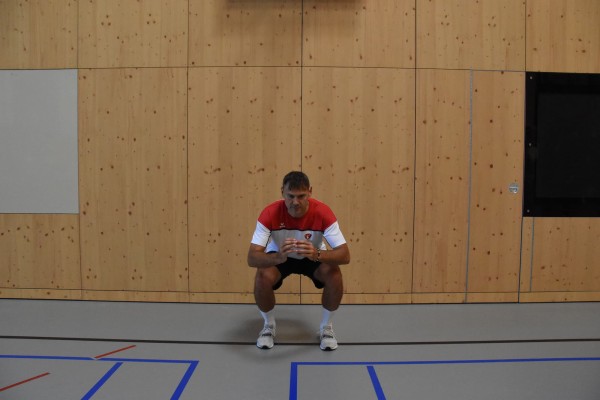
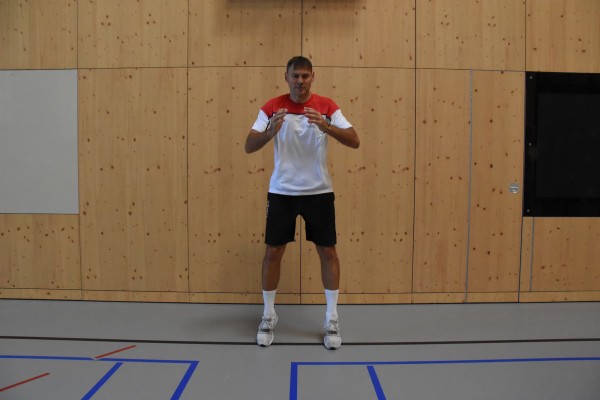
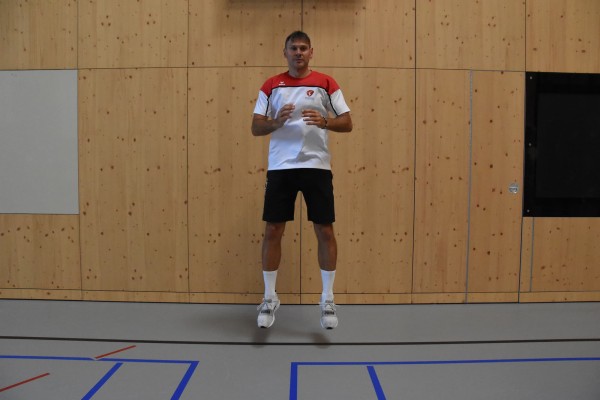
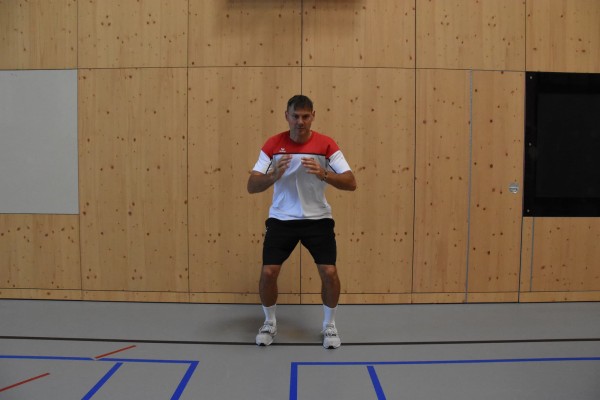
Stand shoulder-width apart, bend your knees almost to a right angle at the knee joints (buttocks slightly above knee height), arms supported on your hips, folded across your chest or in front of you at chest height (possibly with bent arms including hands), jump upwards, cushion the jump and return to the starting position. Repeat the sequence of movements continuously.
Attention:
Bring your buttocks back, not your knees forwards. Keep your knees behind your toes.
Lighten:
Do not lower your buttocks too low (larger angle in the knees), smaller/less intense/higher jumps.
Harden:
Hold additional weight (on your shoulders, in front of you or with your arms hanging in your hands); larger, more intense/higher jumps.
1 weight vest/(medicine) ball/weight disc/sandbag/1-2 dumbbells ► Make the exercise more difficult (additional weight)
Knee lift (skipping) / jump in place incl. knee to chest jump ► high knees / high knee jump (knee to chest tuck jump)
Increase pulse
Individual work
Running very quickly on the spot, with the knees raised to at least the level of the navel (skipping). At a signal from the instructor, the participants perform a few jumps on the spot. The knees are also brought to the chest during the jumps. After the jumps (3-5x), continue with fast skipping.
Variant:
Replace the jumps with other short, intensive exercises (e.g. quick jumping jacks or a push-up and a stretch jump on the signal).
No material required
Knee raises on the spot with arms held overhead ► knee raise with overhead plate hold (high knees)
Power
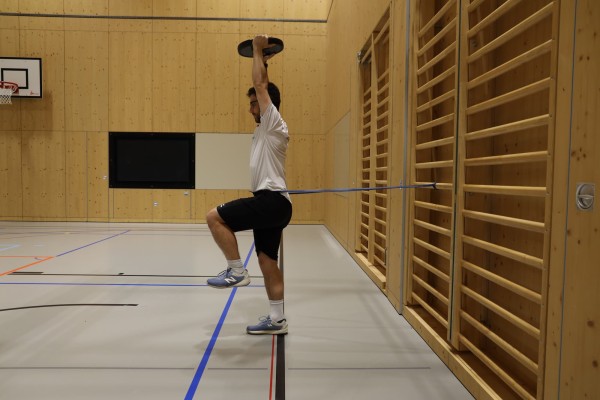
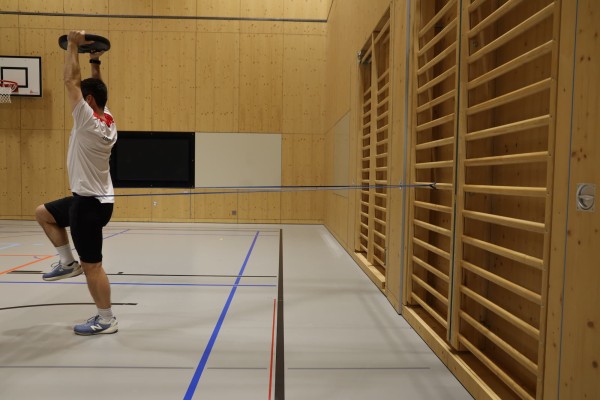
A fixed elasticated band (e.g. on the wall bars, on a post or candelabra) is worn around the hips. Move away from the attachment of the elastic band so that the band is well tensioned. Knee lift (lift your knees alternately with high intensity up to the level of your navel), holding a weight disc overhead with your arms almost outstretched.
Lighten:
Lift your knees less; less weight or no weight at all in the hold-up position.
Harden:
Stronger elastic band; more weight in the hold-up position; additional weights on the legs; knee lift on a soft surface (e.g. small soft mat).
1 wall of bars
1 elastic band
1 weight disc/medicine ball/dumbbell/kettlebell
1 small soft mat ► to make the exercise more difficult (support)
Knee raises on the spot with arms held overhead ► knee raise with overhead plate hold (high knees)
Power
Individual work
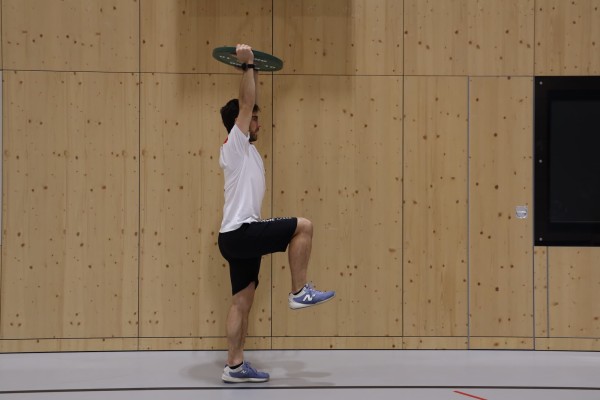
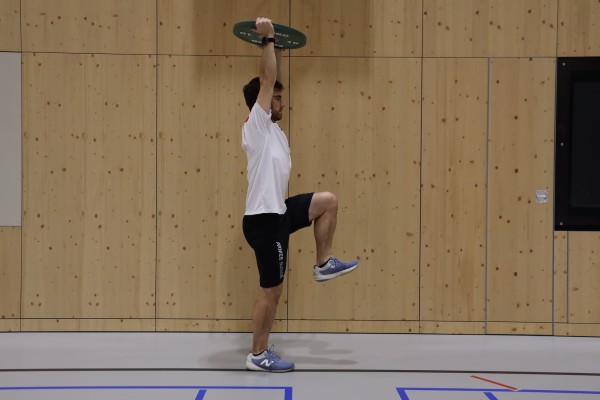
Stand upright with your feet hip-width apart, holding the weight plate above your head with both hands, arms almost fully extended. Keep your shoulders low and actively engage your core and glutes. Look straight ahead. Alternately lift one knee dynamically to approximately hip height. The other leg remains firmly on the floor. Keep the weight plate in the raised position throughout the exercise. Lift the knees rhythmically and in a controlled manner, alternating between them. Keep your upper body as upright and stable as possible.
Attention:
Do not lower the weight plate forwards or backwards; do not arch your back; do not raise your shoulders; keep your pelvis as still as possible; keep your supporting leg slightly bent and stable; actively lift your knee and do not simply swing it from the hip.
Lighten:
Lift your knees less high; use a lighter weight or no weight at all; hold the weight plate at forehead or shoulder height.
Harden:
Use more weight whilst holding the barbell aloft; perform knee-lift runs on a soft surface; lift your knees above hip height; increase your pace (high knees) / bounce slightly on your supporting leg.
Variation:
Use 2 dumbbells instead of a weight plate.
1 weight disc/medicine ball/dumbbell/kettlebell
1 small soft mat ► to make the exercise more difficult (support)
Kneecap ► kneedrop
Coordination exercises
Individual work
Position your front foot straight and bend your leg. With your back leg, hook your shin onto the strap and try to push your knee under the slackline.
Lighten the load:
Perform the exercise close to the attachment.
Harden the load:
Touch the slackline with one hand (line grab); stand up again from the kneedrop position, take a step forwards and perform another kneedrop (different forefoot).
1 Slackline
Kneeling position and jumping onto an object ► kneeling position & box jump
Power
Individual work


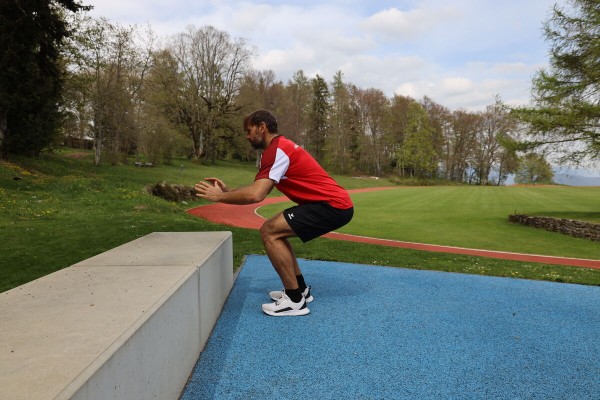

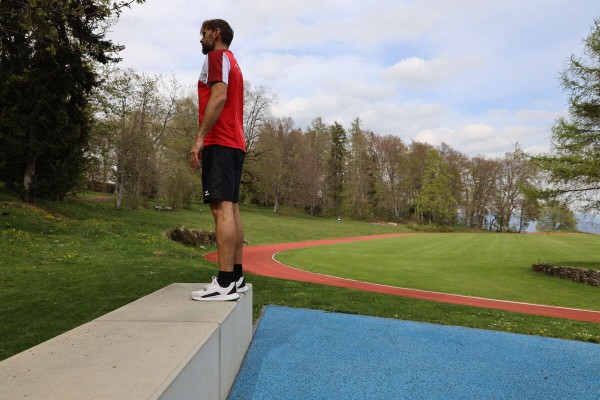
Stand on one knee, alternate between standing on one leg and assuming a deep squat position. From the squat position, tilt your upper body slightly forwards, stretch your arms backwards at an angle to your body (like a ski jumper on a ski jump), push off the floor powerfully to perform a jump onto a raised object (plyo box or swinging box element incl. top) (use the momentum of the arms), straighten your upper body (stand on the object) and jump back to the starting position (possibly the other side of the object), then return to the kneeling position. Change the starting leg with each execution.
Attention:
Land as softly as possible (cushion the jump with your knees).
Lighten:
Lower intensity between each execution; lower the height of the object.
Harden:
Additional weight; higher object.
1 flat bench/plyo box/swivel box
2-4 weight cuffs/1 weight waistcoat ► Make the exercise more difficult (additional weight)
Tricky turns
Stimulate circulation
Individual work
Each participant practises various movement tasks with the frisbee:
- Fingerspin: The aim is to make the disc spin vertically or horizontally around the index finger (middle finger). In the starting position, the disc is held vertically with the index finger at the edge. Now the disc is spun from the wrist (spin). The index finger always remains stretched on the edge of the disc.
Variations:
Switch fingers while spinning, spin a disc with both hands simultaneously or throw the disc up from the spin, catch it with one finger and continue spinning.
- Thumb flip: This trick involves spinning the disc once around its longitudinal axis around the thumb. Starting position: hold the disc in your hand with the underside facing up. The thumb is on top, the remaining four fingers are under the disc. The disc is rotated around the resting thumb to the left and stopped again. The rotation of the disc is triggered by a slight twist of the wrist. At this moment, the fingers are released from the underside of the disc. Once the disc has rotated once around the hand, it is stopped again with the thumb at the top and four fingers at the bottom.
Variant:
Turn the disc to the right, turn it once to the left and then to the right or perform two double thumb flips without stopping.
- Chest roll: Hold your arms horizontally outwards. Hold the disc in one hand with the underside facing upwards. With a light kick from the wrist, the disc is rolled over the arm, chest and other arm to the opposite hand.
- Blind catch: Throw the disc up with a spin and catch it behind the back with one or both hands.
Per participant:
1 throwing disc (frisbee)
1 additional throwing disc (frisbee) per participant ►Variant
Coconut thieves
Fighting and roughhousing games
Group work
2 teams
The participants in the "pinch team" face each other in pairs and each pinch a medicine ball between their backs/upper body. One after the other, the participants from the "capture team" try to capture the trapped medicine balls. Which team needs less time to conquer the medicine balls?
x medicine balls
1 stopwatch
Column run
Leakage
Group work
Together in the group
The participants easily run 2-3 laps in the hall/outdoors and integrate some relaxation exercises (e.g. shaking out arms and legs, moving legs sideways or trotting backwards). The last part of the route is completed by marching. Participants make themselves as tall as possible from time to time (running on tiptoe with arms outstretched and held high), breathing in deeply while doing so and exhaling fully when lowering their arms and heels.
No material required
Column run
Leakage
Group work
Together in the group
Participants complete 2-3 laps of the indoor/off-road course while jumping rope. The last part of the course is completed marching. Participants make themselves as tall as possible from time to time (running on tiptoe with arms outstretched and held high), breathing in deeply while doing so and exhaling completely when lowering their arms and heels.
Pro Tn:
1 skipping rope