
Exercises (3274)
Extension and flexion of one leg in standing position alternating with arms in high holding position (knee raise in place / skipping) ► run in place with knee raise (high knees)
Power


A fixed elasticated band (e.g. on the wall bars, on a post or candelabra) is worn around the hips. Move away from the attachment of the elastic band so that the band is well tensioned. Knee lift (lift your knees alternately with high intensity up to the level of your navel), holding a weight disc overhead with your arms almost outstretched.
Lighten:
Lift your knees less; less weight or no weight at all in the hold-up position.
Harden:
Stronger elastic band; more weight in the hold-up position; additional weights on the legs; knee lift on a soft surface (e.g. small soft mat).
1 weight disc
1 elasticated rubber band (medium)
1 elasticated rubber band (strong) ► Make the exercise more difficult (stability)
2 weight cuffs ► Make the exercise more difficult (additional weight)
1 small soft mat ► Make the exercise more difficult (base)
Extension and flexion of one leg in standing position alternating with arms in high holding position (knee raise in place / skipping) ► run in place with knee raise (high knees)
Power
Individual work
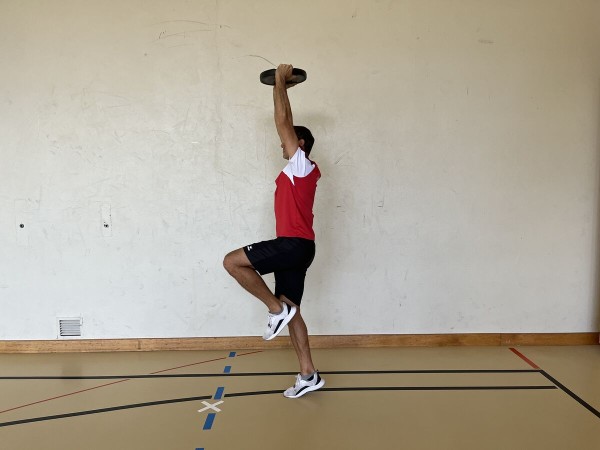
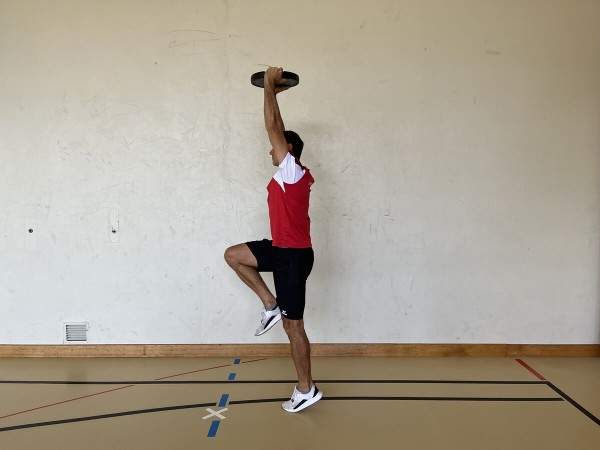
Knee lift on the spot (lift your knees alternately with high intensity up to the level of your navel), holding a weight disc overhead with your arms almost outstretched.
Lighten:
Lift your knees less; less weight or no weight at all in the hold-up position.
Harden:
More weight in the hold-up position; additional weights on the legs; knee lift on a soft surface (e.g. small soft mat). Wear an attached elasticated band around your hips, move away from the attachment until the band is taut enough to complete the knee lift.
1 weight disc/medicine ball/dumbbell/kettlebell
1 elasticated rubber band ► to make the exercise more difficult (stability)
2 weight cuffs ► to make the exercise more difficult (additional weight)
1 small soft mat ► to make the exercise more difficult (support)
Alternating extension and flexion of one leg in support ► knee raise
Power
Individual work


Support yourself on the top of the vaulting box, buttocks on the edge (arms behind your back, fingers pointing towards your body), alternately lift/bend one knee up to hip height against resistance, keeping the other leg extended downwards. Resistance: Weight cuff on the legs or elasticated rubber band (tuck the elastic under the swinging box).
Attention:
Do not rest your buttocks on the swinging box.
Lighten:
Lower resistance (no weight cuffs or softer elastic).
Harden:
More resistance (harder elastic).
Variant:
Exercise hanging from the wall bars (back against the bars) instead of supported on the vaulting box (elastic attached to the bottom bar of the wall bars).
1 vaulting box
2 weight cuffs/1 elasticated rubber band
1 wall bars ► Variation of the exercise (position)
Alternating extension and flexion of one leg in support ► knee shift
Power
Individual work
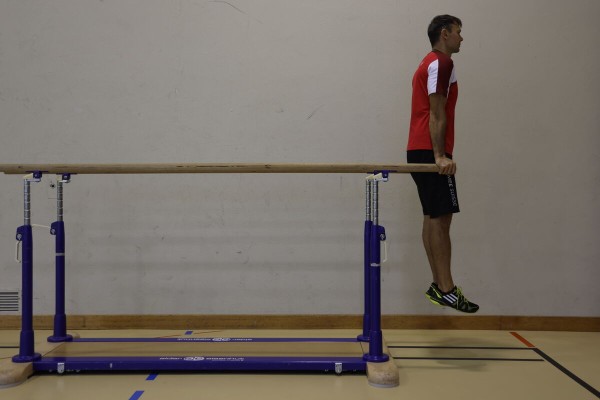
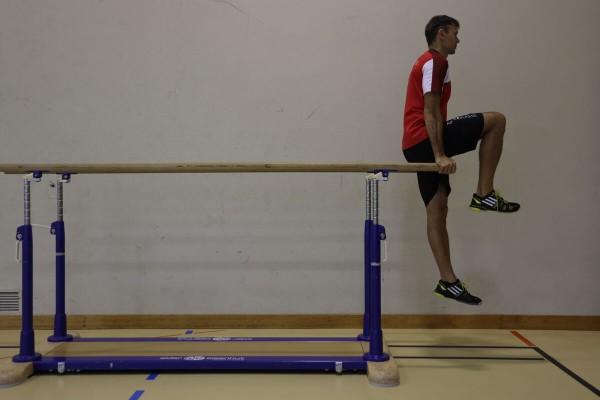
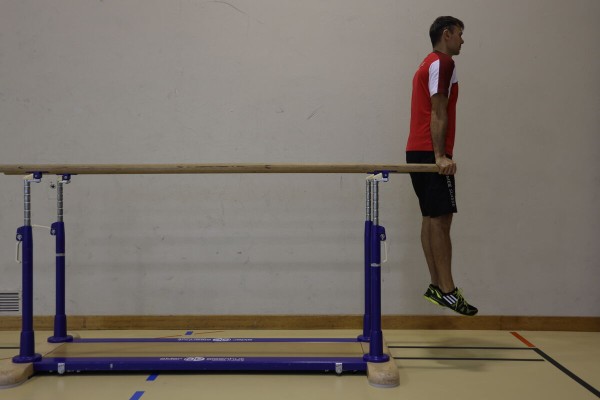
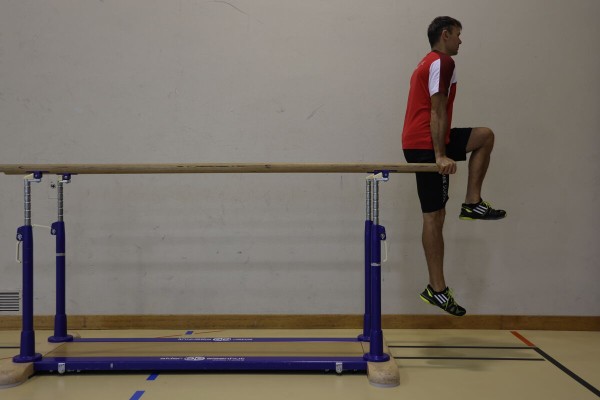
Stand at the bar (end), body stretched, legs pointing (closed) towards the floor, alternately bend one leg and raise the knee to the level of the navel. Then stretch the leg back to the starting position (raise and lower the leg) to perform the exercise with the other leg.
Attention:
Keep the upper body/arm position stable during the exercise (elbows close to the body), slightly forward with the upper body, perform the movement in a controlled manner.
Lighten:
Lift the leg less.
Harden:
Additional weight (on the legs); tighten the elastic band between the legs.
Variation:
Bend both legs at the same time.
1 bar
2 weight cuffs/1 elasticated rubber band ► Make the exercise more difficult (additional weight)
Extension and flexion of one leg backwards (left) ► leg extension
Power
Individual work
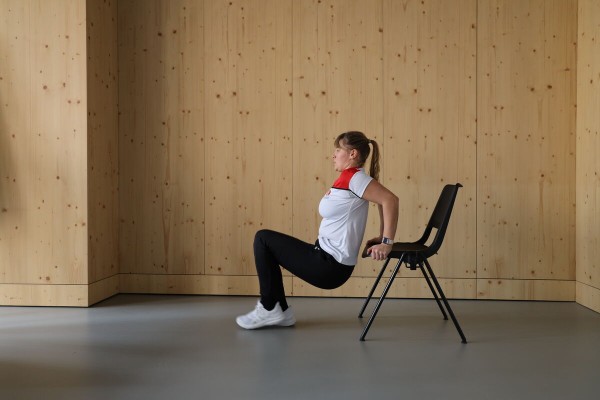
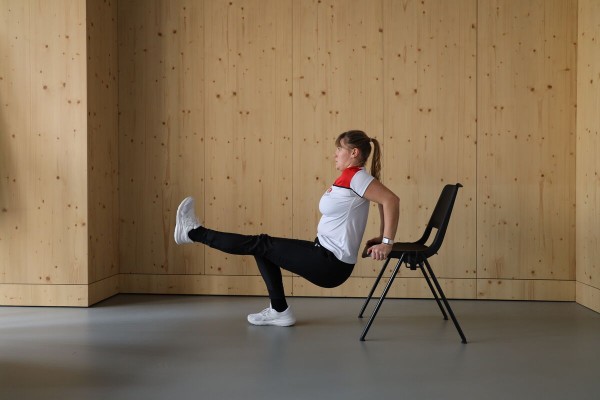
Place one leg (right) on the floor and lift the other very slightly off the arch (approximately 90 degree angle in the knee joints), support the upper body with the hands on the seat of the chair (arms stretched behind the back, hands pointing towards the body). From this position, extend the free leg (left) horizontally towards the floor and return to the starting position.
Attention:
The movement takes place exclusively in the knee joint (upper body and thighs remain stable).
1 (office) chair
Extension and flexion of one leg backwards (right) ► leg extension
Power
Individual work
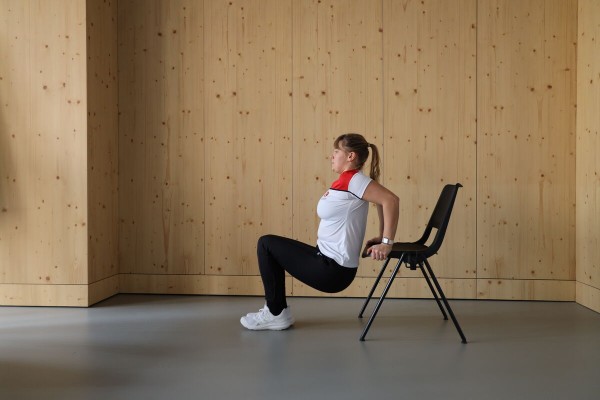
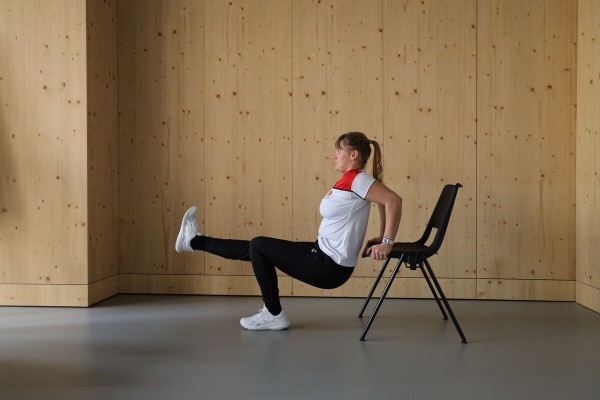
Place one leg (left) on the floor and lift the other very slightly off the arch (approx. 90 degree angle in the knee joints), support the upper body with your hands on the seat of the chair (stretched arms behind the back, hands pointing towards the body). From this position, extend the free leg (right) horizontally towards the floor and return to the starting position.
Attention:
The movement takes place exclusively in the knee joint (upper body and thighs remain stable).
1 (office) chair
Extension and flexion of one leg alternating backwards in support ► leg extension
Power
Individual work
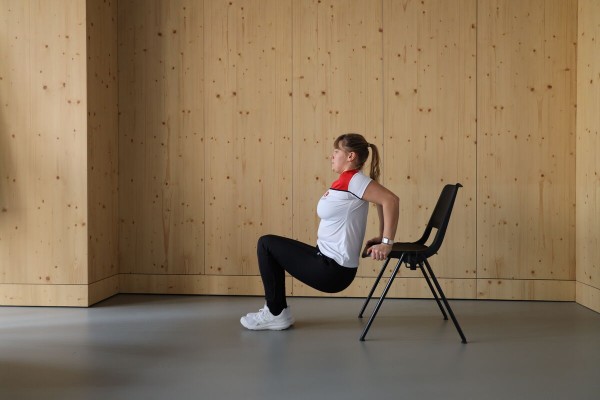
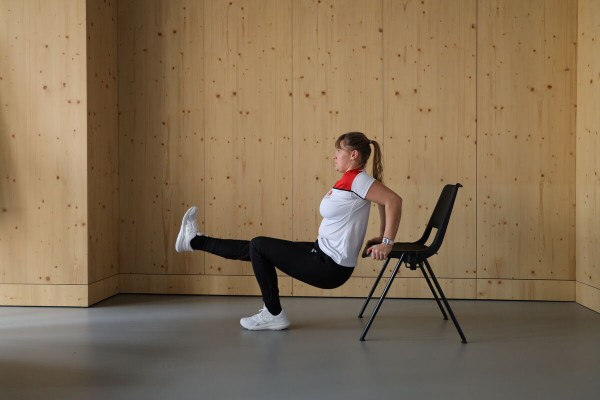
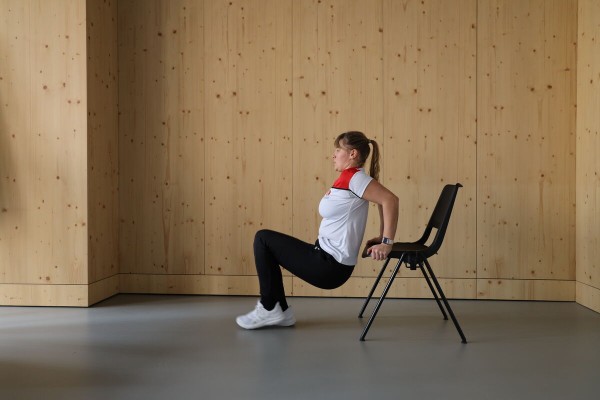
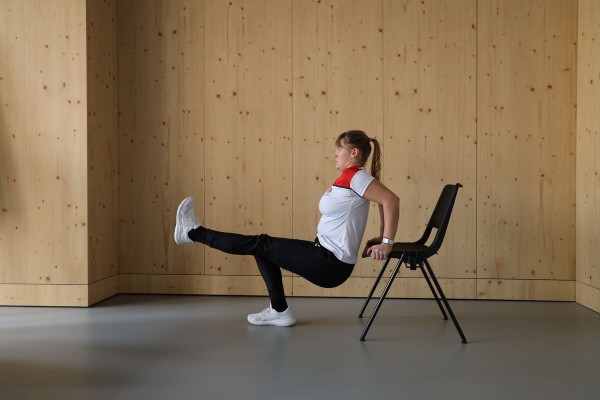
Place your legs on the floor at an angle of approximately 90 degrees with your knees together and support your upper body with your hands on the seat of the chair (arms outstretched behind your back, hands pointing towards your body). From this position, alternately lift one leg and extend it horizontally towards the floor and return to the starting position.
Attention:
The movement only takes place in the knee joint (upper body and thighs remain stable).
1 (office) chair
Alternating extension and flexion of one leg in push-up position ► barbell knee blast / mountain climber
Power


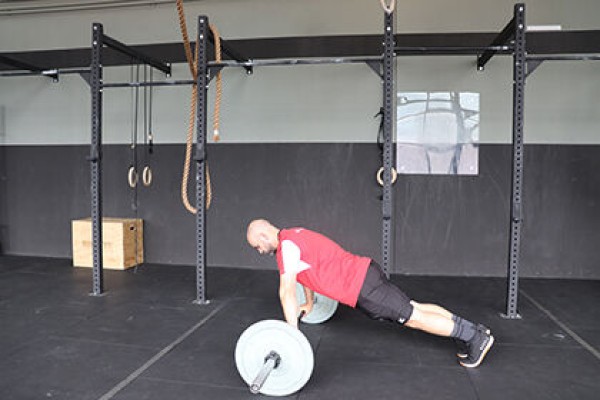

Lieback position, resting your arms on a barbell (possibly with weight plates) at about shoulder width (high support, face/look down), alternately bend one leg and lift it slightly off the floor (bring your knees between your arms/to your chest).
Attention:
Keep your upper body as stable as possible (entire body forms a line from the shoulders to the feet), no hollow back (tighten your stomach).
Lighten:
Just hold the basic position (push-up position); barely lift your leg off the floor and/or move it less forwards; perform the exercise without a barbell.
Harden:
Add weight to the legs.
Variant:
Move your knee diagonally (crosswise) to the opposite arm.
1 barbell
2 weight cuffs ► Make the exercise more difficult (additional weight)
Extension and flexion of one leg in push-up position alternating ► mountain climber
Power
Individual work


High plank position, hands directly beneath the shoulders, arms straight, body in a straight line. Actively engage the core (abdomen and glutes). Alternately bring your knees towards your chest (right knee to chest – back to the starting position – left knee to chest). Keep your upper body as stable as possible throughout the exercise. The movement can be performed slowly (in a controlled manner) or quickly (with a focus on cardio). Keep your breathing steady.
Attention:
Do not arch your back during the movement; do not bounce your hips up and down too vigorously; do not let your shoulders slump forwards; do not increase your speed too much without maintaining control; do not land your feet uncontrollably; do not let your head hang down or lean forwards (this puts strain on your neck).
Ligthen:
Slower pace (step-by-step rather than sprinting – more control, less cardio strain); hands raised (e.g. on a bench or box); shorter range of motion (knees only slightly towards the chest); Place feet down deliberately instead of ‘running’; lift feet alternately in a controlled manner instead of bending them; knee-plank-mountain climbers.
Harden:
Faster pace (high-intensity – greater cardiovascular and core strain); slow, controlled execution (time under tension – more core and stabilisation work); Sliding mats for less friction and more core work (e.g. sliders/towels); cross mountain climbers (more oblique abdominal muscles).
Variation:
Bring your knee diagonally (across) towards the opposite arm.
2 Weighted cuffs/sliders/towels ► Make the exercise more challenging (additional weight/sliding surface)
1 Balance cushion/balance board ► Make the exercise more challenging (unstable surface)
Extension and flexion of one leg in push-up position alternating ► mountain climber
Power
Individual work

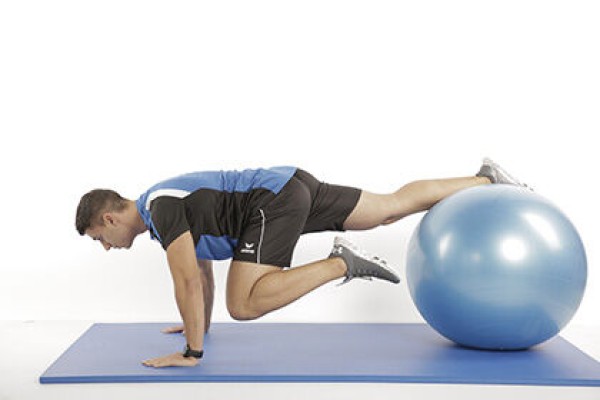
Push-up position, legs resting on the exercise ball (shins), alternately bring one knee to the arms (chest height)/bend the leg.
Attention:
Head, shoulders, buttocks and feet form a line, no hollow back, actively tense the torso. To prevent the ball from rolling away, you can lean it against a wall.
Lighten:
Support in place (without tightening the leg); exercise ball closer to the hips.
Harden:
Additional weight (on the back); tighten both legs simultaneously (roll the ball towards the body); unstable support for the arms.
1 exercise ball
1 weight vest/weight disc/sandbag ► to make the exercise more difficult (additional weight)
1 balance cushion/balance board ► to make the exercise more difficult (unstable base)
Extension and flexion of one leg in push-up position alternating ► mountain climber
Power
Individual work
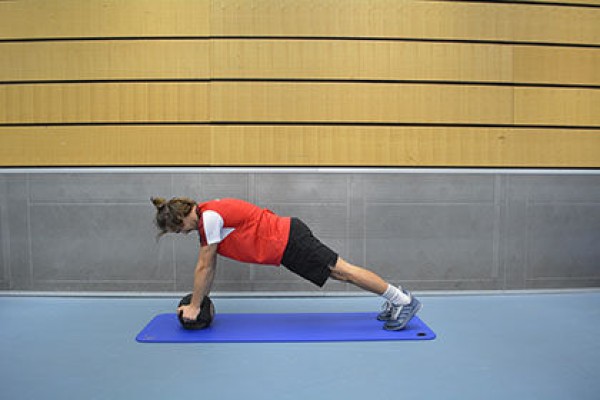

Push-up position with your hands supported on a medicine ball (high support, face/look down), alternately bend one leg and lift it slightly off the floor (bring your knees between your arms/to your chest).
Attention:
Keep your upper body as stable as possible (entire body forms a line from the shoulders to the feet), no hollow back (tense your stomach).
Lighten:
Just hold the basic position (push-up position); barely lift your leg off the floor and/or move it less forwards; perform the exercise without a medicine ball.
Harden:
Additional weight on the legs.
Variant:
Bring your knee diagonally (crosswise) to the opposite arm.
1 medicine ball
2 weight cuffs ► to make the exercise more difficult (additional weight)
Extension and flexion of one leg in push-up position alternating ► mountain climber
Power
Individual work
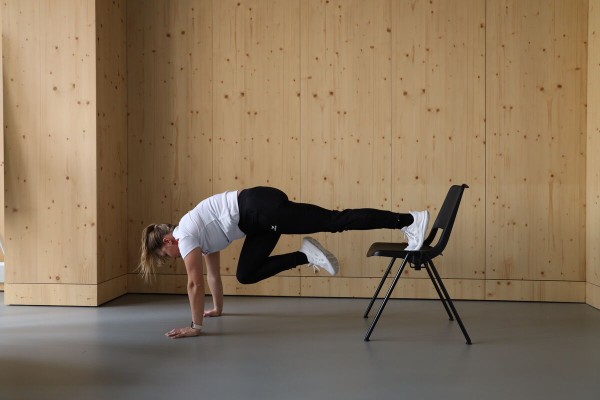
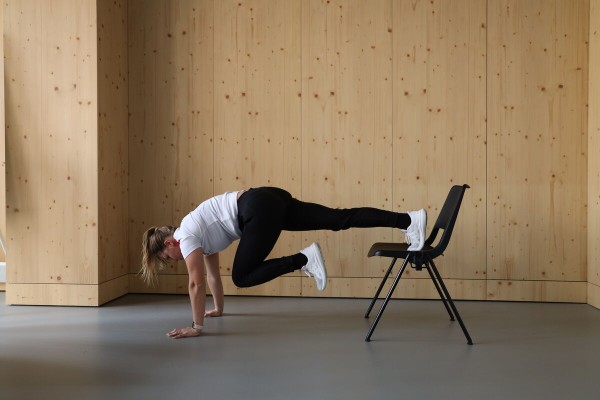
Push-up position with your feet placed on the seat of the chair, alternately bring one knee to your arms (chest height)/bend your leg.
Attention:
Head, shoulders, buttocks and feet form a line, no hollow back, actively tense your torso.
1 (office) chair (without castors)
Extension and flexion of one leg in push-up position alternating ► mountain climber
Power
Individual work
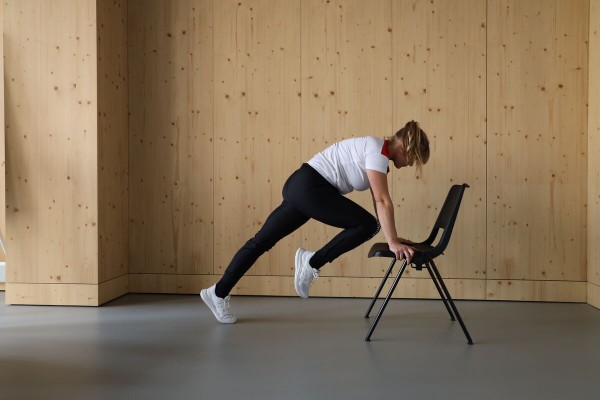
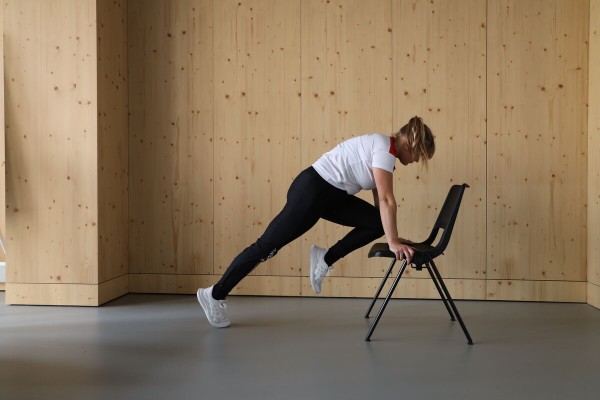
The hands of the almost outstretched arms grip the seat of the chair and support the upper body. The legs are placed well behind the chair so that the body is tilted forwards as in a raised push-up position (head against the backrest). Alternate between lifting one leg off the floor and bringing the knee between the arms (chest height)/bending the leg.
1 (office) chair
Extension and flexion of one leg in push-up position alternating ► mountain climber
Power
Individual work
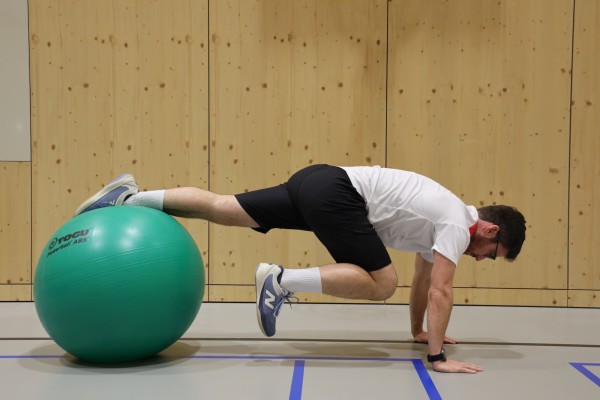
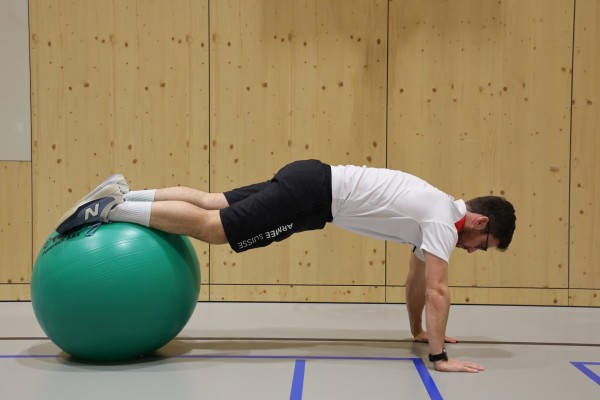
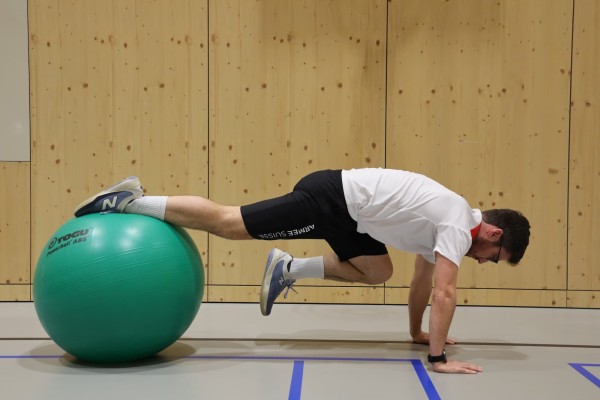
Start in a high plank position, with your lower legs resting on a gym ball. Keep your body as straight as possible, with your core and buttocks engaged. Alternately pull one knee towards your chest and then return it to the starting position. Gradually increase the pace in a controlled manner, without allowing the gym ball to roll back and forth too much.
Attention:
Maintain body tension; do not let your lower back sag; keep your pelvis as stable as possible; actively position your shoulders above your hands; pull your knees towards your chest in a controlled manner, not just by momentum; do not let the ball roll too far forwards or backwards.
Lighten:
Slow down the pace; pull your knees only slightly towards your chest, or simply support yourself in place (without lifting a leg); rest your lower leg more firmly on the ball or bring the ball closer to your body.
Harden:
Increase the pace; pull your knees further towards your chest (or move them diagonally towards your elbow); add extra weight (on your back); use an unstable surface for your arms (e.g. a balance board).
Variation:
Pull both legs in at the same time (the ball rolls towards your body).
1 exercise ball
1 weight vest/weight disc/sandbag ► to make the exercise more difficult (additional weight)
1 balance cushion/balance board ► to make the exercise more difficult (unstable base)
Leg extension and flexion in a push-up position followed by a jump ► mountain climber burpee
Power
Individual work


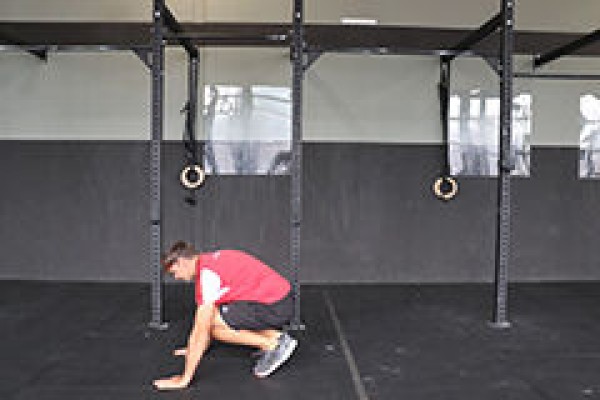

From a standing position, bend your legs, place your hands in front of your feet and hop backwards with both legs at the same time to get into the push-up position. In the push-up position (high support, face/look down), alternately bend your left and right leg and lift them slightly off the floor (bring your knees between your arms/to your chest). Then jump back forwards with both legs to the starting position. From the squatting position, perform a stretch jump (optionally cross your arms briefly behind your head during the flight phase) and land back in the starting position to restart the exercise.
Attention:
Do not arch your back in the push-up position (body tension).
Lighten:
Lower intensity between the individual exercises; lower height during the stretch jump (or only straighten the upper body); only assume the push-up position without bending the legs alternately or barely lift the legs off the floor or move them less far forwards.
Harden:
Additional weight.
2-4 weight cuffs/1 weight waistcoat ► Make the exercise more difficult (additional weight)
Alternating extension and flexion of one leg in supine position ► leg press
Power
Individual work


Lie on your back with your legs raised and bent (approximately right angle in the knee joints), your feet are in the loops, hold the gymnastics pole with bent parallel forearms under your sternum (baby position), stretch the elastic bands significantly (wind them up), alternately stretch out one leg (approximately 45 degrees or even horizontally) and pull back to the starting position.
Attention:
Actively tense your abdomen, the lower back must not lift off the floor (no hollow back).
Lighten:
Select less strong elastic bands; roll up the elastic bands less.
Harden:
Choose stronger elastics; roll up the elastics more.
Variant:
Stretch out your legs at the same time (keep your feet in a slight V-position).
1 gymnastic bar with elasticated straps
Extension and flexion of one leg in supine position alternating ► lying bent knee leg raise / alternating knee raise / lying single knee raise
Power
Individual work


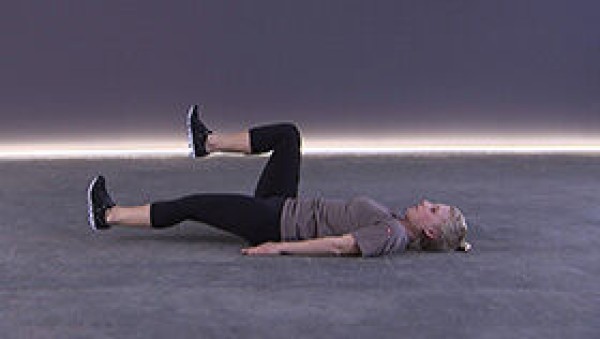
Lying on your back, arms at your sides on the floor or on your body, lower back (lumbar spine) pressed towards the floor, one leg bent and held high (lower leg parallel to the floor, thigh approx. 90 degrees to the body), the other leg stretched out and slightly raised from the floor, alternate the position of the legs (bend/bend one leg, stretch out the other).
Attention:
Keep your back in constant contact with the floor (no hollow back, consciously tense your stomach), do not put your legs down.
Lighten:
Lower your legs less.
Harden:
Add weight to your legs.
2 weight cuffs ► Make the exercise more difficult (additional weight)
Extension and flexion of one leg in supine position alternating ► lying bent knee leg raise / alternating knee raise / lying single knee raise
Power
Individual work


Lie on your back with your upper body slightly raised (shoulder blades lifted off the floor), legs bent and held high (slightly more than 90 degrees at the knee joint, lower legs parallel to the floor), outstretched arms pointing slightly backwards at an angle, grasp the weight with both hands. Extend one leg and return to the starting position. Switch sides after each exercise.
Attention:
Always keep your shoulder blades off the floor (constant tension), do not put your outstretched leg down, keep your head in a neutral position (no double chin).
Lighten:
Hold your arms at chest height or even further forwards; do not hold any additional weight in your hands; extend your leg less close to the floor.
Harden:
Hold your arms further back at an angle; more weight.
1 weight disc
Extension and flexion of one leg in supine position alternating ► lying bent knee leg raise / alternating knee raise / lying single knee raise
Power
Individual work


Lie on your back, legs stretched out in extension of the body slightly raised from the floor, lower back (lumbar spine) pressed towards the floor, grasp the weights (2 dumbbells, 1 kettlebell or weight disc) with both hands, arms stretched out at chest height pointing upwards (in front of you), with the shoulder blades slightly detached from the floor. Bend one leg (lower leg parallel to the floor, thigh approximately 90 degrees to the body) and stretch back to the starting position. Switch sides after each exercise.
Attention:
Keep your back in constant contact with the floor (no hollow back, consciously tense your stomach), do not put your legs down.
Lighten:
Lift your legs further off the floor in the starting position; lower your legs completely after each repetition; do not hold any weight in your arms or bring your arms to the floor at the side of your body.
Harden:
Additional weight for the legs.
2 dumbbells/1 weight disc/kettlebell
2 weight cuffs ► Make the exercise more difficult (additional weight)
Extension and flexion of one leg in supine position alternating ► lying bent knee leg raise / alternating knee raise / lying single knee raise
Power
Individual work
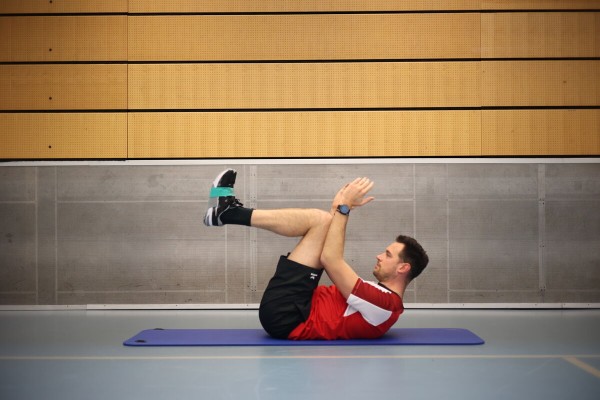

Lie on your back with your shoulders raised off the floor and your outstretched arms pointing vertically upwards (holding position), your legs are bent so that your lower legs point forwards parallel to the floor and your thighs point diagonally backwards (approx. 45 degree angle at the knee joint). In this position (deadbend), the elbows are close to the knees. An elasticated band is held between the legs (place the band around the outer edge of the foot). Alternately bend the hips and straighten the knee so that the leg is pointing diagonally forwards in extension of the body.
Attention:
Do not fully lower the shoulder blades.
Lighten:
Choose an elastic band with less resistance.
Harden:
Choose an elastic band with greater resistance.
1 mini-band
Extension and flexion of one leg in supine position alternating ► lying bent knee leg raise / alternating knee raise / lying single knee raise
Power
Individual work
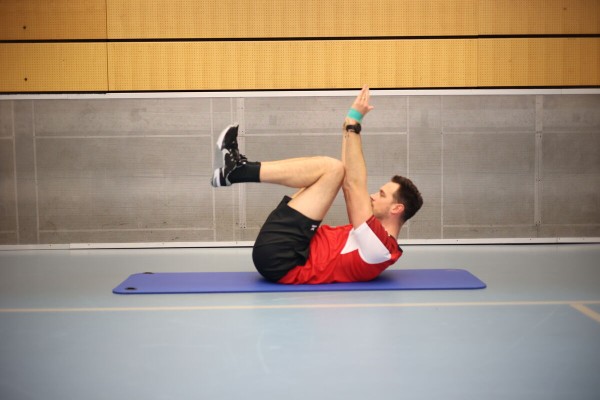

Lie on your back with your shoulders raised off the floor and your outstretched arms pointing vertically upwards (holding position), your legs are bent so that your lower legs point forwards parallel to the floor and your thighs point diagonally backwards (approx. 45 degree angle at the knee joint). In this position (deadbend), the elbows are close to the knees. An elasticated rubber band is held between the arms (place the band around the edges of the hands/wrists), with the arms/shoulders constantly pressed apart (external rotation of the shoulders). Alternately bend the hips and straighten the knee so that the leg is pointing diagonally forwards as an extension of the body.
Attention:
Do not fully lower your shoulder blades; consciously push your shoulders outwards.
Lighten:
Lower your legs less.
Harden:
Add weight to your legs.
1 mini band
2 weight cuffs ► to make the exercise more difficult (additional weight)
Extension and flexion of one leg in supine position alternating ► lying bent knee leg raise / alternating knee raise / lying single knee raise
Power
Individual work

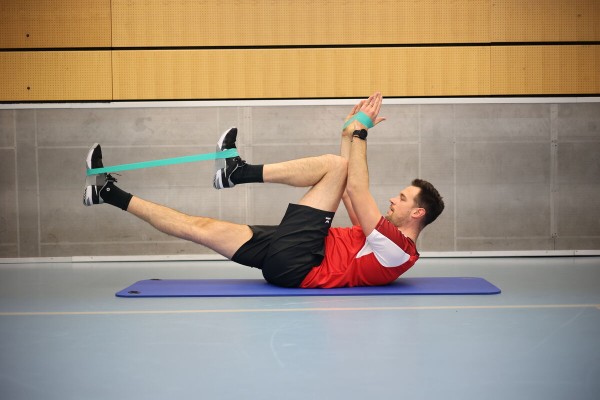
Lie on your back with your shoulders raised off the floor and your outstretched arms pointing vertically upwards (holding position), your legs are bent so that your lower legs point forwards parallel to the floor and your thighs point diagonally backwards (approx. 45 degree angle at the knee joint). In this position (deadbend), the elbows are close to the knees. An elasticated rubber band is held between the arms (place the band around the edges of the hands/wrists), whereby the arms/shoulders are always pressed apart (external rotation of the shoulders). An elasticated band is also held between the legs (place the band around the outer edge of the foot). Alternately bend your hips and straighten your knee so that your leg is pointing diagonally forwards as an extension of your body.
Attention:
Do not fully lower the shoulder blades; consciously push the shoulders outwards.
Lighten:
Select an elastic band with less resistance.
Harden:
Select an elastic band with greater resistance.
2 mini ribbons
Extension and flexion of one leg in supine position alternating ► lying bent knee leg raise / alternating knee raise / lying single knee raise
Power
Individual work
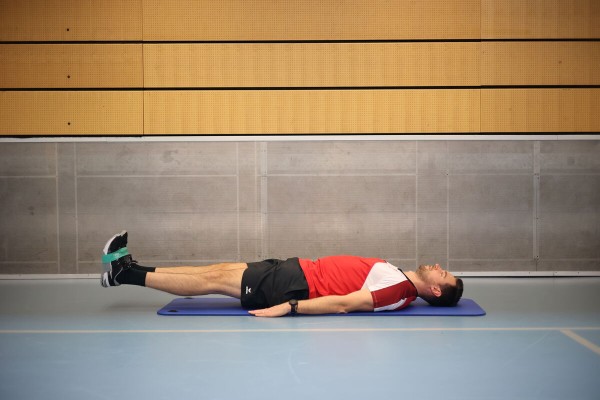
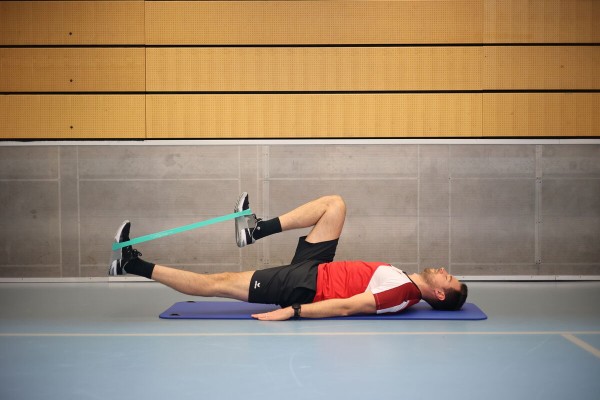
Lie on your back with your arms flat on the floor at your sides (or place your hands under your buttocks/or clasp your hands behind your head), your outstretched legs slightly raised off the floor, stretch an elasticated band between your legs (place the band around the instep/soles of your feet). From this position, alternately bend one leg (lower leg practically parallel to the floor, upper leg approx. 90 degrees to the body - one-sided hip flexion) and stretch back to the starting position.
Attention:
Keep your back in constant contact with the floor (no hollow back, consciously tense your stomach), do not put your legs down.
Lighten:
Choose an elastic band with less resistance.
Harden:
Choose an elastic band with more resistance.
1 mini-band
Extension and flexion of one leg and the arms in supine position alternating ► dead bug
Power
Individual work


Lie on your back with your legs raised and bent (approximately right angle in the knee joints), your feet are in the loops, the gymnastics bar is held with both hands at chest height (backs of hands pointing towards the floor), alternately stretch both arms and one leg each against the resistance of the elastic bands in extension of the longitudinal axis of the body and return to the starting position.
Attention:
Actively tense your abdomen, the lower back must not lift off the floor (no hollow back).
Lighten:
Choose less strong elastic bands; roll up the elastic bands less.
Harden:
Choose stronger elastic bands; roll up the elastic bands more.
1 gymnastic bar with elasticated straps
Extension and flexion of one leg combined with rotation of the upper body bringing the elbow and knee together whilst lying on your back performed alternately ► rotational crunch / bicycle crunch
Power
Individual work

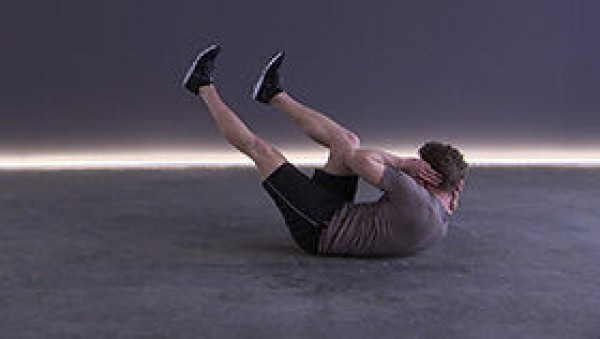
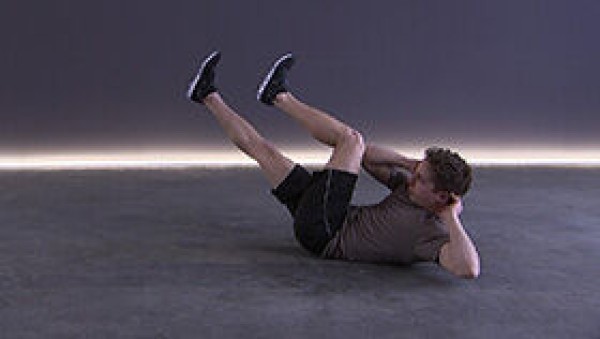
Lie on your back, hands resting loosely on your head (do not pull), legs raised, hips and knees bent at approximately 90°. Lift your shoulders slightly off the floor (crunch position). Extend one leg forwards, simultaneously bringing the opposite elbow towards the bent knee (in a criss-cross motion). Switch sides smoothly (like a cycling motion). Perform the movement in a controlled manner; do not simply ‘kick about’.
Attention:
Do not pull on the head (strains the neck), avoid fast and jerky movements (less effective), only ‘rotate’ the elbows, not the upper body, do not lift the legs too high (less tension in the abdomen), do not arch the lower back (the core loses tension).
Lighten:
Keep your feet on the floor (move only your upper body); perform the movement more slowly and with smaller ranges of motion; extend your legs less; rest your legs occasionally (avoid constant tension).
Harden:
Extend your legs further towards the floor (greater leverage); perform slower repetitions (greater tension); hold the position at the top of each rotation; use additional weight (e.g. small dumbbells in your hands).
2-4 weight cuffs/2 dumbbells ► make the exercise more difficult (additional weight)