
Exercises (3274)
Alternating extension and flexion of one arm in push-up position
Power
Individual work


In the push-up position, rest both hands on a dumbbell. In this position, alternately lift one dumbbell by bending the arm towards the opposite shoulder. Then lower the weight back to the starting position in the push-up position. The movement only takes place in the elbow and shoulder joint, the rest of the body remains stable.
Starting position:
- Push-up position, both hands resting on a dumbbell each in a neutral grip
- Tension in the torso (no hollow back)
Finishing position:
- Dumbbell brought crosswise to the chest
- Tension in the torso maintained
Variant:
Combine exercise with push-ups (i.e. after each repetition, one push-up is performed).i.e. a push-up is performed after each repetition, which also works the chest and arm extensor muscles)
2 dumbbells
Alternating extension and flexion of one arm in a push-up position (rowing motion) ► dumbbell renegade row
Power
Individual work


Place two dumbbells with flat edges on the floor, shoulder-width apart and parallel to each other, grip them firmly and assume a high push-up position (plank). Your wrists should be directly beneath your shoulders, your body should form a straight line, and your feet should be slightly wider than hip-width apart to ensure a stable base. Tighten your core and glutes, look down and shift your body weight in a controlled manner to one side. Pull the free dumbbell upwards, keeping it close to your chest, towards your chest or lower ribs. Your elbow should guide the movement close to your body, and your shoulder blade should be actively drawn towards your spine. Briefly stabilise the dumbbell at the top of the movement and lower it back down smoothly. Throughout the entire pull, keep the pelvis absolutely parallel to the floor and do not allow it to tilt sideways. After a brief pause to realign, repeat the movement fluidly with the other arm.
Attention:
With every rowing stroke, the pelvis rotates sharply to one side; the buttocks rise high or the lumbar spine sags; the dumbbell is jerked upwards from the torso with momentum, rather than being pulled cleanly; the wrists bend inwards at the sides of the dumbbells; the shoulder of the supporting arm sags and loses its active stability.
Lighten:
Perform the exercise on your knees (knee plank), keeping your pelvis stable and extended forwards; spread your feet even further apart to increase your base of support; Perform the exercise without dumbbells as a ‘plank with shoulder taps; place your hands on a raised, stable plyo box or bench (upper body higher = less leverage).
Harden:
Include one push-up on the dumbbells after every second row; bring your feet closer together; increase the dumbbell weight; hold the dumbbell statically in the top position for 2–3 seconds; wear a weighted vest.
2 dumbbells
1 plyo box ► makes the exercise easier (raised platform)
1 weight vest/weight disc/sandbag/fighting backpack ► make the exercise more difficult (additional weight)
Extension and flexion of one arm in push-up position alternating (rowing pull) ► row 1-arm push up position
Power
Individual work


In the push-up position, rest both hands on a dumbbell each. In this position, alternately lift one dumbbell by bringing the elbow back towards the body (next to the ribcage). Then lower the weight back to the starting position in the push-up position. The movement only takes place in the elbow and shoulder joint, the rest of the body remains stable.
Starting position:
- Push-up position, both hands resting on a dumbbell each in a neutral grip
- Tension in the torso (no hollow back)
Finishing position:
- Dumbbell resting on/next to the body at approximately chest height
- Elbows of the arm to be trained bent behind the body pulled up and shoulder blades actively pressed together
- Tension in the torso maintained
Variant:
Combine exercise with push-ups (i.e. after each repetition, a push-up is performed).i.e. a push-up is performed after each repetition, which also works the chest and arm extensor muscles)
2 dumbbells
Extension and flexion of one arm in push-up position alternating ► biceps curl push up position
Power
Individual work


In the push-up position, you support yourself with both hands on an object (e.g. dumbbell or rucksack) and alternately bring the object back towards your body by bringing your elbow back. The movement only takes place in the elbow and shoulder joint.
Attention:
Keep the torso stable and do not let it sag, actively tense the torso muscles.
Lighten:
Less weight/load.
Harden:
More weight/increased load; additional weight (on the back).
Variant:
Combine the exercise with push-ups (i.e. perform a push-up every time both arms are stretched).
2 dumbbells/fighting backpacks (light)
2 PET bottles (1.5 litres) ► Make the exercise easier
1 weight vest/weight disc/sandbag/(additional) fighting backpack ► Make the exercise more difficult (additional weight)
2 dumbbells/fighting backpacks (medium-heavy) ► Make the exercise more difficult (load)
Alternating extension and flexion of one arm in a push-up position ► renegade row
Power
Individual work
High plank position, hands directly beneath your shoulders, feet set fairly wide apart for stability. Shift your weight slightly to one side, pulling the elbow of the free hand backwards (simulating a rowing motion); lift your hand briefly off the floor, then lower it back down in a controlled manner. Switch sides after each repetition.
Attention:
Do not tilt or twist the hips too much (aim for stability, not weight transfer), do not raise the buttocks too high or let the back sag (hollow back), do not move too quickly (loss of control), do not shift your weight too much (unstable), do not let your shoulders slump inwards, do not have too little body tension, do not use too heavy a weight (movement becomes sloppy).
Lighten:
Hands slightly raised (e.g. on a bench): feet wider apart for greater stability.
Harden:
Narrower stance (more core engagement); added weight (hold two dumbbells in your hands); combine with push-ups; slower repetitions (more control); unstable surface (e.g. balance tools); one-legged variation (very challenging).
Variation:
Raise your hand and tap the opposite shoulder (shoulder tap).
1 raised surface (e.g. box) ► Make the exercise easier (position)
1 balance tools ► Make the exercise harder (unstable surface)
2 dumbbells ► Make the exercise harder (additional weight)
Extension and flexion of an arm in a stepping position (left)
Power
Individual work


In a stepping position (right leg in front) approximately one metre in front of a wall, hold a medicine ball at head height with the palm of the left hand (hand almost resting on the shoulder, arm bent, elbow close to the body), the free (right) hand additionally supports the medicine ball. Powerfully thrust the playing arm (left) forwards (extend the arm towards the wall) to propel the medicine ball against the wall. Catch the ball and bring it back to the starting position to restart the exercise.
Attention:
Keep the upper body upright and stable, the pushing movement comes from the arm (no swinging the upper body backwards or forwards/getting momentum).
Lighten:
Less weight.
Harden:
More weight.
1 wall
1 medicine ball
1 ball (foam, volleyball, football, basketball) ► Make the exercise easier
Extension and flexion of an arm in a stepping position (right)
Power
Individual work


In a stepping position (left leg in front) approximately one metre in front of a wall, hold a medicine ball at head height with the palm of the right hand (hand almost resting on the shoulder, arm bent, elbow close to the body), the free (left) hand additionally supports the medicine ball. Powerfully push the playing arm (right) forwards (extend the arm towards the wall) to propel the medicine ball against the wall. Catch the ball and bring it back to the starting position to restart the exercise.
Attention:
Keep the upper body upright and stable, the pushing movement comes from the arm (no swinging the upper body backwards or forwards/getting momentum).
Lighten:
Less weight.
Harden:
More weight.
1 wall
1 medicine ball
1 ball (foam, volleyball, football, basketball) ► Make the exercise easier
Extension and flexion of the arm with a step backwards (drawing the bow)
Power
Individual work


Stand upright with your feet shoulder-width apart, arms outstretched at shoulder height in front of you, simultaneously with a step backwards, bend your arms on the same side (tighten the arch, bring your hand to your elbow), upper body, gaze and toe of the back leg now point to the side, the upper body is rotated back to the starting position with a step forwards. Switch sides after each exercise.
Attention:
Always keep your arms at shoulder height.
Lighten:
Smaller movements (arm pull/lunge).
Harden:
Hold additional weight on your arms or in your hands.
2 weight cuffs/weight balls/dumbbells ► Make the exercise more difficult (additional weight)
Extension and flexion of one arm and leg in supine position alternating ► bench press 1-leg/1-arm
Power
Individual work
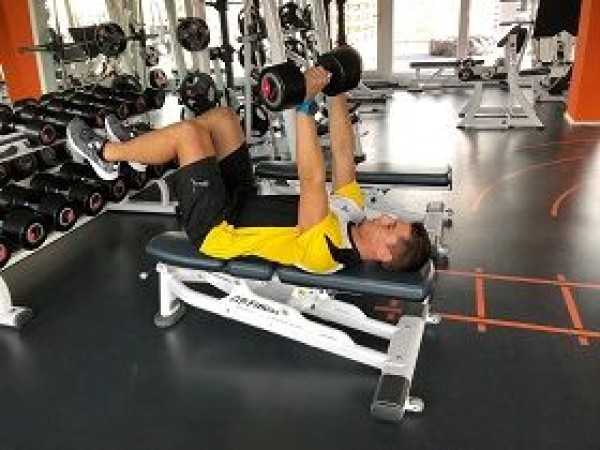
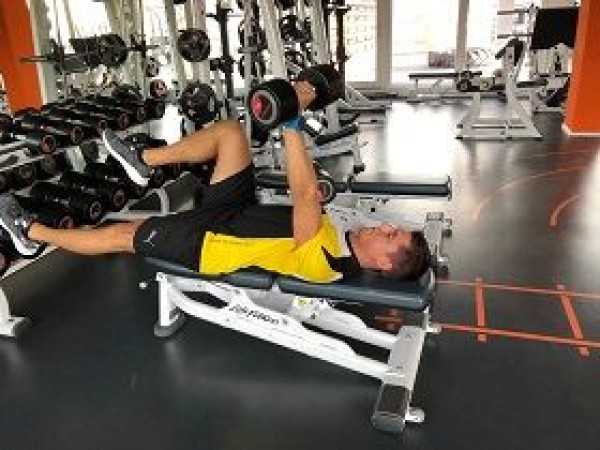
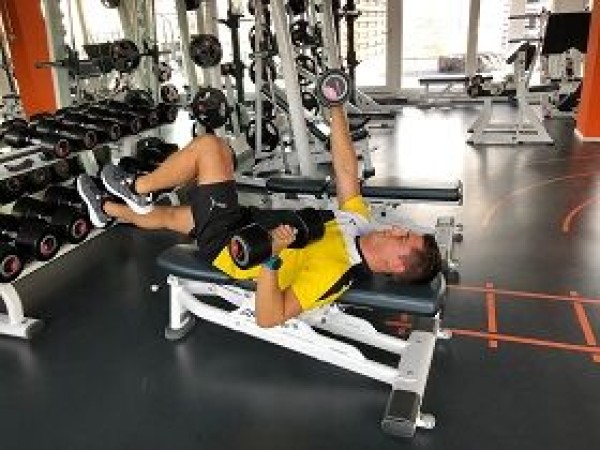
Lying on your back, bend your legs (90 degrees at the hips and knees - thighs pointing upwards, lower legs parallel to the floor pointing forwards), arms at chest height in front of you (pointing upwards), hands each holding a dumbbell, stretch one leg out in extension of your body and simultaneously bend one arm crosswise until the dumbbell makes (slight) contact with your chest area, bend your leg again and stretch your arm to return to the starting position. Then perform the exercise in reverse.
Starting position:
- Lying on your back on the flat bench
- Legs bent and held high (thigh pointing upwards, lower leg pointing forwards)
- Arms almost stretched out in front position (pointing upwards)
Finishing position:
- One arm bent, dumbbell lowered to the chest
- One leg extended forwards as an extension of the body (cross over the bent arm)
Attention:
Elbows are always under the wrists, wrists fixed, elbows slightly bent away from the upper body (A-shape). If you are working with a lot of weight, the exercise should be performed with a partner for safety reasons, with the helper standing by the exerciser's head for support to lift the weight in an emergency.
Variant:
The exercise can also be performed on an incline bench, whereby the bench should be set at an angle of approximately 45 degrees.
1 flat bench
2 dumbbells
Extension and flexion of one arm and one leg, bringing the elbow and knee together in a cross-body position whilst on all fours (left/right) ► quadruped reach / bird dog
Power
Individual work


Get down on all fours, with your hands directly beneath your shoulders and your knees directly beneath your hips. Keep your spine in a neutral position (no arching or rounding of the back), look down and actively engage your core. Extend your left arm forwards and your right leg backwards, hold the position briefly (without wobbling). Keep your hips and shoulders parallel to the floor, look down (neck neutral), maintain tension throughout your body. Then bring your arm and leg back in a controlled manner.
Attention:
Do not arch your back (when extending your leg); do not tilt or rotate your pelvis to the side; do not perform the movement too quickly (loss of stability); do not lift your arm/leg too high (instead, stay in line in a controlled manner); do not overextend your neck (look straight ahead rather than down).
Lighten:
Move only your arm or only your leg; keep the movement smaller; work without holding the position; keep your hands slightly raised (e.g. on a bench).
Harden:
Hold the stretched position for longer; perform repetitions more slowly (greater tension); bring your elbows and knees together under your body (‘crunch’ variation); use an unstable surface (e.g. balance pad); Additional weight (e.g. a light weight on the leg); additional resistance (e.g. a band around the foot or arm).
Variation:
Put your arm and leg down after each repetition (easier and more controlled – good for beginners) or stay in the air as you bring your elbow and knee together (significantly more intense for the core).
1 raised surface (e.g. bench) – makes the exercise easier (position)
1 unstable surface (e.g. balance pad) – makes the exercise harder (surface)
1–2 weight cuffs/1 medicine ball/dumbbell ► Make the exercise more challenging (additional weight)
1-2 elastic bands ► Make the exercise more challenging (resistance)
Extension and flexion of one arm and one leg, bringing the elbow and knee together in a cross-body position whilst on all fours (right/left) ► quadruped reach / bird dog
Power
Individual work


Get down on all fours, with your hands directly beneath your shoulders and your knees directly beneath your hips. Keep your spine in a neutral position (no arching or rounding of the back), look down and actively engage your core. Extend your right arm forwards and your left leg backwards, hold the position briefly (without wobbling). Keep your hips and shoulders parallel to the floor, look down (neck neutral), maintain tension throughout your body. Then bring your arm and leg back in a controlled manner.
Attention:
Do not arch your back (when extending your leg); do not tilt or rotate your pelvis to the side; do not perform the movement too quickly (loss of stability); do not lift your arm/leg too high (instead, stay in line in a controlled manner); do not overextend your neck (look straight ahead rather than down).
Lighten:
Move only your arm or only your leg; keep the movement smaller; work without holding the position; keep your hands slightly raised (e.g. on a bench).
Harden:
Hold the stretched position for longer; perform repetitions more slowly (greater tension); bring your elbows and knees together under your body (‘crunch’ variation); use an unstable surface (e.g. balance pad); Additional weight (e.g. a light weight on the leg); additional resistance (e.g. a band around the foot or arm).
Variation:
Put your arm and leg down after each repetition (easier and more controlled – good for beginners) or stay in the air as you bring your elbow and knee together (significantly more intense for the core).
1 raised surface (e.g. bench) – makes the exercise easier (position)
1 unstable surface (e.g. balance pad) – makes the exercise harder (surface)
1–2 weight cuffs/1 medicine ball/dumbbell ► Make the exercise more challenging (additional weight)
1-2 elastic bands ► Make the exercise more challenging (resistance)
Extend and flex one arm and one leg bringing the elbow and knee together in a cross-body motion whilst on all fours alternating ► quadruped reach / bird dog
Power
Get down on all fours, with your hands directly under your shoulders and your knees directly under your hips. Keep your spine in a neutral position (no arching or rounding of the back), look down and actively engage your core. Extend one arm forwards and one leg backwards (crossed), hold the position briefly (without wobbling). Hips and shoulders remain parallel to the floor, gaze towards the floor (neck neutral), maintain tension throughout the body. Then bring the arm and leg back in a controlled manner and lower them. Switch sides for the next repetition.
Attention:
Do not arch your back (when extending your leg); do not tilt or rotate your pelvis to the side; do not perform the movement too quickly (loss of stability); do not lift your arm/leg too high (instead, stay in line in a controlled manner); do not overextend your neck (look straight ahead rather than down).
Lighten:
Move only your arm or only your leg; keep the movement smaller; work without holding the position; keep your hands slightly raised (e.g. on a bench).
Harden:
Hold the stretched position for longer; perform repetitions more slowly (greater tension); use an unstable surface (e.g. a balance pad); add extra weight (e.g. a light weight on the leg); add extra resistance (e.g. a band around the foot or arm).
1 raised surface (e.g. bench) – Makes the exercise easier (position)
1 unstable surface (e.g. balance pad) – Makes the exercise harder (surface)
2–4 weight cuffs/2 medicine balls/dumbbells ► Make the exercise more challenging (additional weight)
2 elastic bands ► Make the exercise more challenging (resistance)
Alternating extension and flexion of one arm crosswise in sitting position ► L sit cross punch
Power
Individual work


Sit in a slightly supine position, legs resting slightly bent on the heels, arms bent in front of the chest, alternately stretching one arm crosswise to the respective knee and back to the chest (punching a straight line diagonally downwards in front). The upper body always rotates to the side of the punching movement.
Attention:
Keep your head in a neutral position (no double chin), keep your back straight, consciously tense your stomach (body tension).
Lighten:
Sit upright (upper body less backwards).
Harden:
Hold additional weight in your hands.
2 weight cuffs/weight balls/dumbbells ► Make the exercise more difficult (additional weight)
Extension and flexion of one leg in sitting position (left) ► leg extension
Power
Individual work

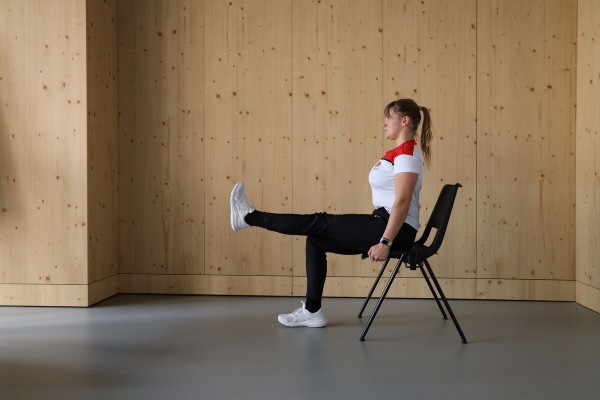
When sitting upright, one leg (right) is placed on the floor and the other is lifted slightly off the floor (approximately 90 degree angle in the knee joints). Extend the free leg (left) horizontally towards the floor and return to the starting position.
Attention:
The movement only takes place in the knee joint (upper body and thighs remain stable).
1 (office) chair
Extension and flexion of one leg in sitting position (right) ► leg extension
Power
Individual work
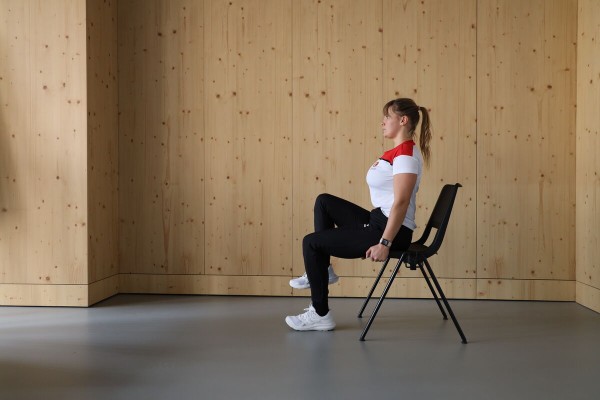
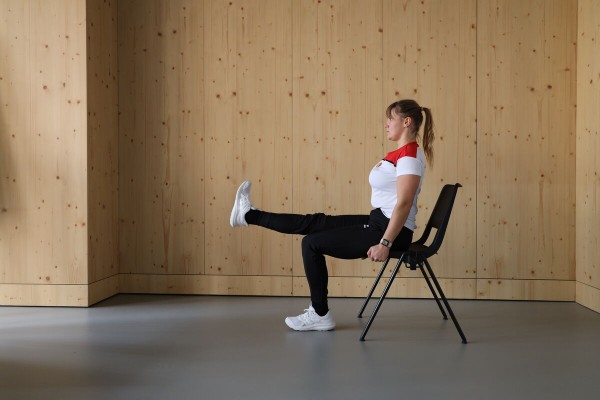
When sitting upright, one leg (left) is placed on the floor and the other is lifted slightly off the floor (approximately 90 degree angle in the knee joints). Extend the free leg (right) horizontally towards the floor and return to the starting position.
Attention:
The movement only takes place in the knee joint (upper body and thighs remain stable).
1 (office) chair
Alternating extension and flexion of one leg while seated ► leg extension
Power
Individual work
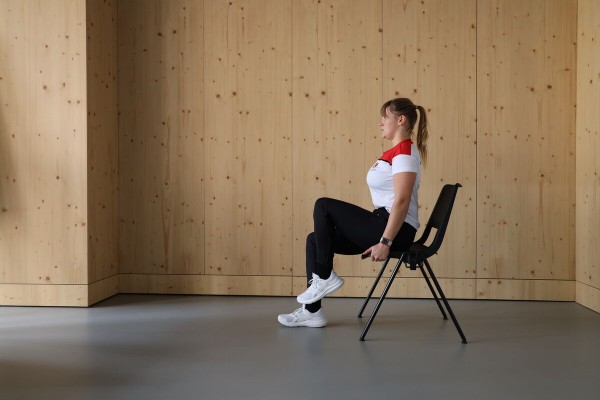
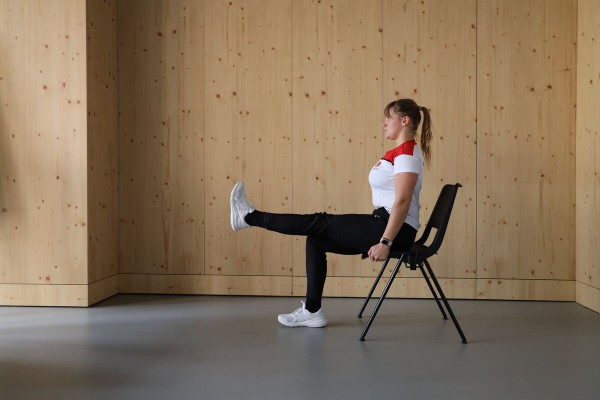
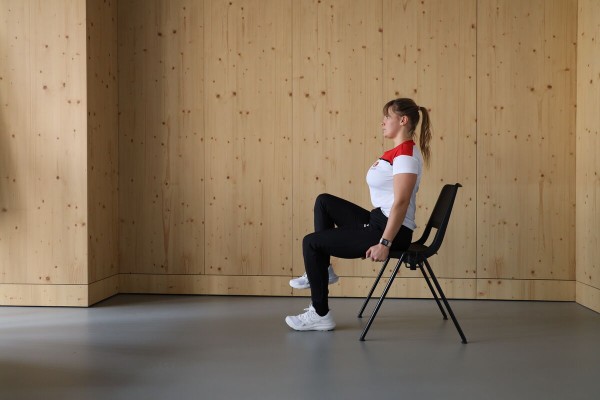
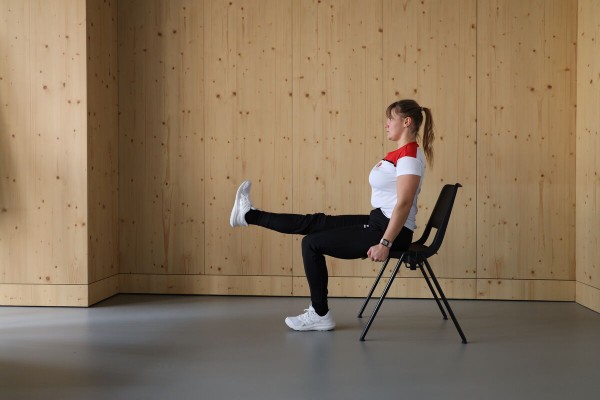
When sitting upright, place both legs on the floor (approx. 90 degree angle in the knee joint). Alternately lift one leg and extend it horizontally towards the floor and return to the starting position.
Attention:
The movement takes place exclusively in the knee joint (upper body and thighs remain stable).
1 (office) chair
Extension and flexion of one leg in standing position (left)
Power
Individual work
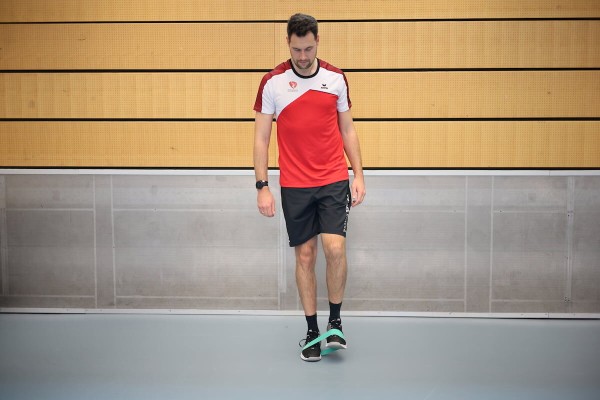
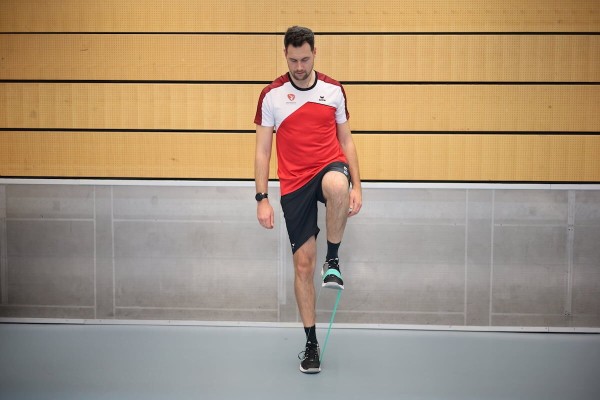
Stand upright with your feet shoulder-width apart, lift your training leg (left) slightly off the floor, hold an elasticated rubber band with the foot of your training leg (place the band around the instep/sole of your foot), fix the other end of the rubber band to the floor with your standing leg (right). From this position, raise the training leg (left) (bend the knee to hip height - one-sided hip flexion) and lower it back to the starting position.
Caution:
Consciously tense your abdomen and keep your upper body as stable as possible.
Lighten:
Choose a rubber band with less resistance.
Heavier:
Choose a rubber band with more resistance.
1 mini-band
Extension and flexion of one leg in standing position (right)
Power
Individual work

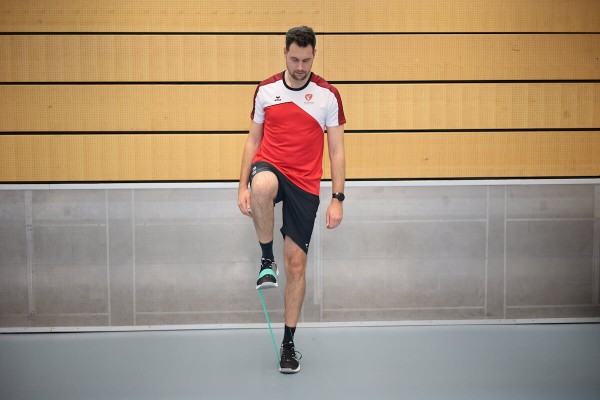
Stand upright with your feet shoulder-width apart, lift your training leg (right) slightly off the floor, hold an elasticated rubber band with the foot of your training leg (place the band around the instep/sole of your foot), fix the other end of the rubber band to the floor with your standing leg (left). From this position, raise the training leg (right) (bend the knee to hip height - one-sided hip flexion) and lower it back to the starting position.
Caution:
Consciously tense your abdomen and keep your upper body as stable as possible.
Lighten:
Choose a rubber band with less resistance.
Heavier:
Choose a rubber band with more resistance.
1 mini-band
Alternating extension and flexion of one leg while standing
Power
Individual work
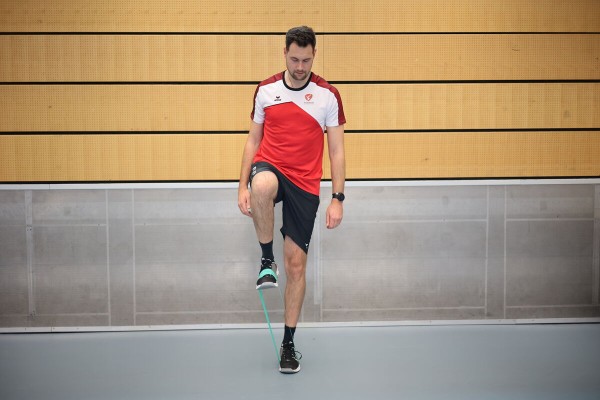
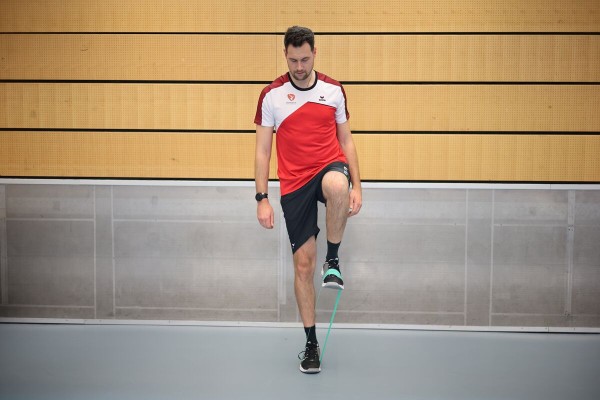
Stand upright with your feet shoulder-width apart on an elasticated band (wrap the band around the soles/crests of your feet), alternately raise one leg (bend your knee to hip height - one-sided hip flexion) to stretch/tension the band and lower it back to the starting position.
Attention:
consciously tense your abdomen, keep your upper body as stable as possible.
Lighten:
choose a rubber band with less resistance.
Harden:
choose a rubber band with greater resistance.
1 mini-band
Alternating extension and flexion of one leg while standing (knee raise in place / skipping) ► knee raise on place (high knees)
Power
Individual work
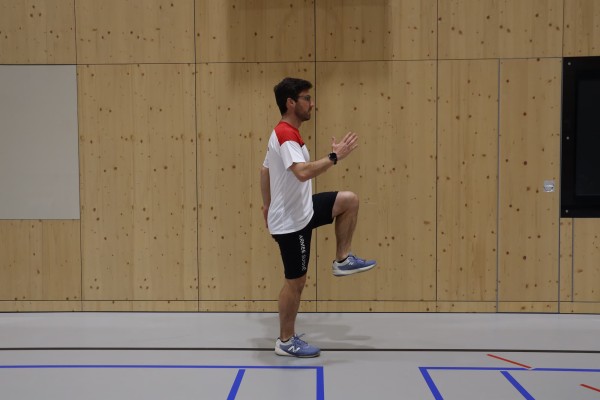
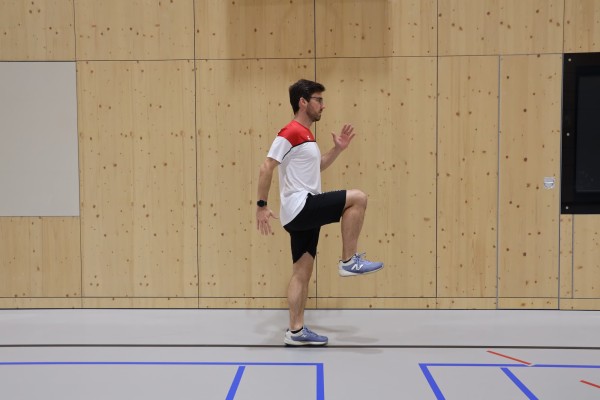
Stand upright, feet about hip-width apart. Keep your upper body upright, look straight ahead, and hold your arms at your sides. Alternately bring your knees forwards and upwards in a quick, dynamic motion, whilst lightly springing on the opposite leg. The arms move in the opposite direction. Keep your upper body as upright as possible. Depending on your training goal, the movement can also be performed slowly and in a controlled manner.
Attention:
Do not lean your upper body too far back; actively lift your knees (do not just lift your feet); Do not land on your heels; keep your standing leg slightly bent; ensure an active arm movement; work rhythmically and in a controlled manner; ensure a stable landing at high intensity.
Lighten:
Lift your knees only as high as your hips or lower; perform the movement more slowly (reduce the intensity) or lift them alternately without bouncing.
Harden:
Raise your knees well above hip height; perform the exercise on a soft mat; increase the speed of the movement / use more vigorous arm movements (high knees).
1 soft mat ► make the exercise more challenging (additional weight)
Alternating extension and flexion of one leg while standing (knee raise in place / skipping) ► run in place with knee raise (high knees)
Power
Individual work
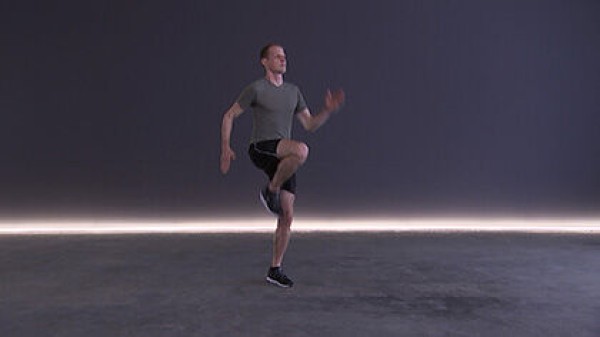

Stand upright with hips wide apart (starting position, then one leg always moving freely), alternately lift one knee straight up to navel height and lower it back to the standing position, the arms swing along and support the movement (knee lift in place). The rhythm/intensity can be varied.
Attention:
Keep your upper body stable/upright, actively support the movement with your arms.
Lighten:
Lift your knees less high; slower execution (reduce rhythm/intensity).
Harden:
Lift your knees higher; fast execution (increase rhythm/intensity); additional weight on your legs (hold in your hands).
Variant I:
Execute the movement very slowly and linger briefly in the one-legged stance to further improve your balance.
Variant II:
Arms folded behind the head, elbows crossed towards the raised knee.
Variant III:
Knees turned out to the side when lifting, arms swinging more to the side.
2 weight cuffs/weight balls/dumbbells/1 weight waistcoat ► Make the exercise more difficult (additional weight)
Alternating extension and flexion of one leg while standing (knee raise in place / skipping) ► run in place with knee raise (high knees)
Power
Individual work


Knee lift (lift your knees alternately with high intensity up to the level of your navel and actively support the movement with your arms) on a small soft mat, which rests on a large soft mat.
Attention:
Actively move your arms and not just swing them to the side of your body. Bend your arm and leg in opposite directions (not on the same side).
Lighten:
Lift your knees less; small soft mat lies on the floor (without large soft mat).
Harden:
Additional weights (on the legs). Perform a knee lift on the large soft mat (remove the small mat).
1 soft mat (large)
1 soft mat (small) ► Make the exercise easier
2 weight cuffs/1 weight waistcoat ► Make the exercise more difficult (additional weight)
Alternating extension and flexion of one leg while standing (knee raise in place / skipping) ► run in place with knee raise (high knees)
Increase pulse
Individual work
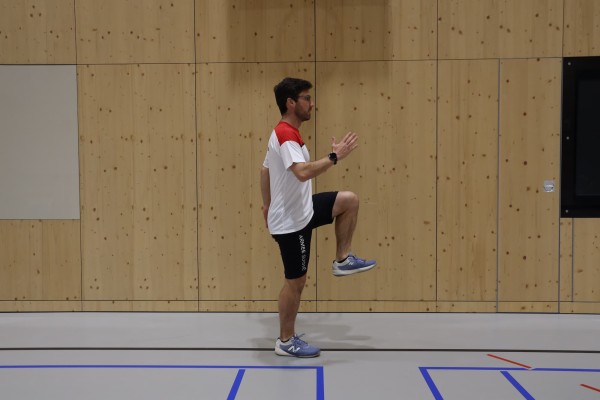

Stand upright with hips wide apart (starting position, then one leg always moving freely), alternately lift one knee straight up to navel height and lower it back to the standing position, the arms swing along and support the movement (knee lift in place). The rhythm/intensity can be varied.
Attention:
Keep your upper body stable/upright, actively support the movement with your arms.
Lighten:
Lift your knees less high; slower execution (reduce rhythm/intensity).
Harden:
Lift your knees higher; fast execution (increase rhythm/intensity); perform the exercise on a soft mat.
Variant I:
Execute the movement very slowly and linger briefly in the one-legged stance to further improve your balance.
Variant II:
Arms folded behind the head, elbows crossed towards the raised knee.
Variant III:
Knees turned out to the side when lifting, arms swinging more to the side.
1 soft mat ► Make the exercise more difficult
Alternating extension and flexion of one leg while standing ► knee raise
Power
Individual work


Stand upright with your feet shoulder-width apart, hold your assault rifle outstretched (at chest height), lift your knees alternately to the height of your navel.
Lighten:
Lift your knees less.
Harden:
Do not put your heels down/stand only on the balls of your feet (additional strain on the calf muscles and more demanding in terms of coordination).
Variant:
Fast exercise execution (knee lift).
1 assault rifle (neutralised)
Alternating extension and flexion of one leg while standing ► wall drill / marching
Power
Individual work
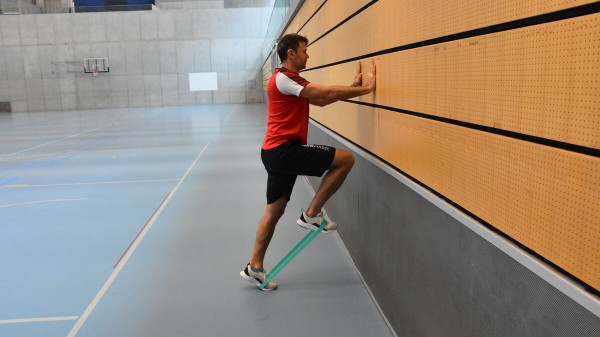

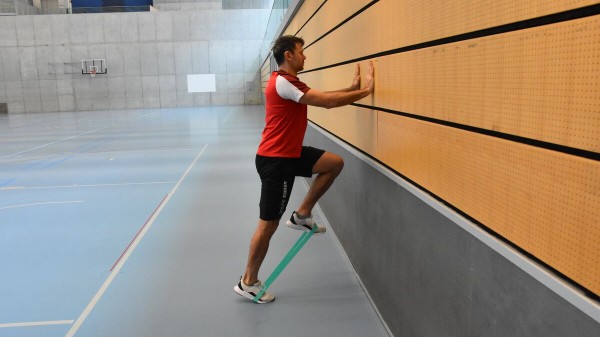
With your upper body leaning slightly forwards, support yourself against a wall with your hands (arms practically stretched out - facing the wall), rest both straight legs on the balls of your feet with an elasticated band under your feet. Step into the loop of the band with the instep of the foot. From this position, alternately raise one leg (knee at hip height) to further stretch/tension the band and lower it back to the starting position. The respective supporting leg fixes the band to the floor when the training leg is raised. The exercise is similar to running in place, with the knees always raised almost to the navel.
Attention:
The movement takes place exclusively in the hip and knee joint of the training leg.
Lighten:
Choose a rubber band with less resistance.
Harden:
Choose a rubber band with greater resistance.
1 wall
1 mini band