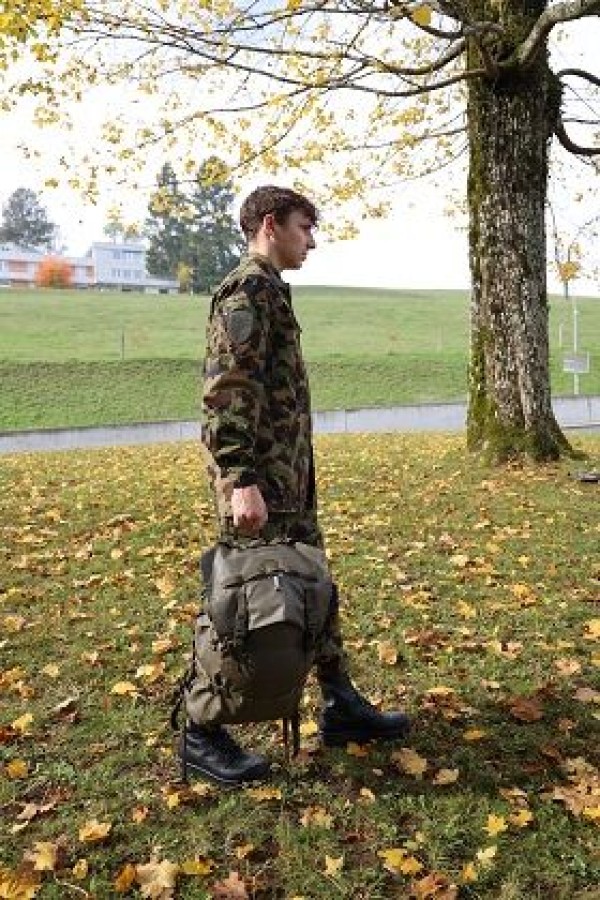
Bend your knees whilst keeping your back straight, lift a heavy dumbbell from the floor with one arm, and stand up in a controlled manner. The weight hangs at your side, next to your thigh, like a suitcase, whilst both shoulders remain at exactly the same height, without slumping towards the side bearing the weight or leaning back towards the opposite side. The upper body is upright, your gaze is directed straight ahead and the lateral core muscles are tensed to the maximum to compensate for the asymmetrical load. The free arm can be held out slightly for stabilisation. Now walk straight ahead at a steady, controlled pace. The torso remains absolutely vertical and stable, without swaying sideways or buckling, and the weight does not shift onto the leg. Halfway through the exercise, set the leg down in a controlled manner with a straight back and change sides. The aim is to achieve a completely composed, upright gait.
Attention:
The upper body tilts towards the side of the weight (lateral flexion); the exerciser leans extremely far to the free side in order to balance the weight purely through leverage; the shoulder on the side bearing the weight sags passively downwards and loses muscular control; the dumbbell swings back and forth like a pendulum; the gait is sloppy, hurried or shuffling; the head is thrust forward or held at an angle; the barbell is lifted and lowered with a rounded back.
Lighten:
Reduce the weight of the dumbbell; shorten the walking distance or take breaks to realign your posture; Slow down your walking pace; carry the weight with both arms (Farmer’s Walk) if stabilising your core on one side is still too challenging.
Harden:
Choose a significantly heavier weight (combat rucksack/sandbag); carry the weight overhead with your arm fully extended (Waiter Walk / Overhead Carry); balance on a line (e.g. walk along the narrow edge of an upturned Swedish bench); wear a weight vest as well.