
Exercises (1641)
Lunge backwards alternating ► reverse lunge
Power
Individual work


Stand upright with your feet approximately hip- to shoulder-width apart. Your feet should point forwards as much as possible, and your weight should be distributed evenly between them. Keep your upper body upright, look straight ahead and engage your abdominal muscles. Your pelvis should be in a neutral and stable position. The arms can be rested on the hips, held in front of the body or used to aid balance. Move one foot controlledly backwards and land on the front foot or the ball of the foot. Choose a step length that allows both legs to be bent in a controlled manner afterwards. Bend both knees and lower your body as vertically as possible. Bring the back knee towards the floor without letting it drop uncontrollably. The front foot remains fully on the floor and the weight is distributed evenly across it. Guide the front knee towards the tips of the toes in a controlled manner. From the bottom position, press firmly into the floor through the entire front foot. Bring the back leg forwards again and return to the starting position. Switch sides for the next repetition.
Attention:
The front knee falls noticeably inwards; the knee and the tip of the foot of the front leg point clearly in different directions; the upper body leans sharply forwards or to one side; the stride length is too short or too long, thereby preventing stable movement; the heel of the front foot lifts noticeably off the ground. The back knee is placed on the ground in an uncontrolled manner; when pushing up, the movement is generated mainly through the back leg; the pelvis rotates or shifts noticeably to one side; ensure your posture is stable and move your front knee in a controlled manner towards the tips of your toes; the entire front of your foot should remain as stable as possible on the floor during the loading phase.
Lighten:
Reduce the range of motion and lower your body less far; choose a stride length that feels comfortable and stable for you; lean lightly against a wall, pole or other stable object; Perform the movement slowly and return fully to the starting position after each repetition; start by doing several repetitions with the same leg and then switch sides.
Harden:
Hold dumbbells or kettlebells in your hands; use a weighted vest or sandbag; Use a barbell on your shoulders; deliberately slow the downward movement over 3–4 seconds; hold the bottom position steady for 2–3 seconds; combine the reverse lunge with a subsequent knee lift of the rear leg; carry additional weight on one side, thereby increasing the demands on core stability.
1 weight vest/sandbag/barbell/2 dumbbells ► make the exercise more difficult (additional weight)
Lunge sideways alternating ► lateral lunge
Power
Individual work


Stand upright with your feet approximately hip- to shoulder-width apart. Your feet should point forwards as much as possible, with your weight distributed evenly between them. Keep your upper body upright and your abdominal muscles slightly tensed. Look straight ahead. Your arms can rest on your hips, be held in front of your chest, or be used to help maintain balance. Take a sufficiently large and controlled step to the side with one leg. Place your foot flat on the floor. Then bend the knee of the leg moved to the side whilst simultaneously moving the hip backwards and downwards. Keep the opposite leg as straight as possible. The entire foot of the bent leg remains on the floor, with weight distributed evenly. The knee should follow the direction of the toes. Keep your upper body as upright as possible, although a slight forward lean from the hips is acceptable. Then press firmly into the floor with the entire foot of the bent leg and return your body to the starting position. Change sides for the next repetition.
Attention:
The knee of the bent leg turns significantly inwards; the knee and the tip of the foot point in distinctly different directions; the heel of the bent leg lifts off the floor; body weight is mainly shifted onto the forefoot; the hips are not moved back far enough; the upper body leans heavily forwards or to one side; the opposite leg is bent unnecessarily sharply; the lateral step is too small, thereby preventing the movement from being performed cleanly; guide the knee of the bent leg in the direction of the toes and bear weight on the whole foot; perform the movement only as deeply as a stable and pain-free position can be maintained.
Lighten:
Reduce your range of motion and bend the affected leg less; Keep your hands on your hips rather than lowering them towards the floor; use a wall, pole or other stable object for light support; perform the movement slowly and in a controlled manner; return fully to the starting position after each repetition; start by performing several repetitions on the same side.
Harden:
Increase the range of motion and lower the hips further, provided the position remains stable; hold dumbbells or kettlebells in your hands; hold a weight plate or medicine ball in front of your chest; Use a weight vest, sandbag or barbell as additional weight; deliberately slow the downward movement over 3–4 seconds; hold the bottom position for 2–3 seconds; hold the additional weight on one side to increase the demands on core stability.
Variation:
Place a slide mat, a piece of carpet or a similar non-slip surface under one foot; let the corresponding leg slide out to the side in a controlled manner, whilst bending the supporting leg and moving the hip backwards; then bring the sliding leg back towards the centre of the body in a controlled manner.
1 weight vest/weight disc/(medicine) ball/barbell/sandbag/fighting backpack/2 dumbbells ► make the exercise more difficult (additional weight)
2 carpet remnants/felt slippers/gliders ► variation of the exercise
Extension and flexion of the arms / moving the arms upwards while standing (shoulder press) ► shoulder press
Power
Individual work
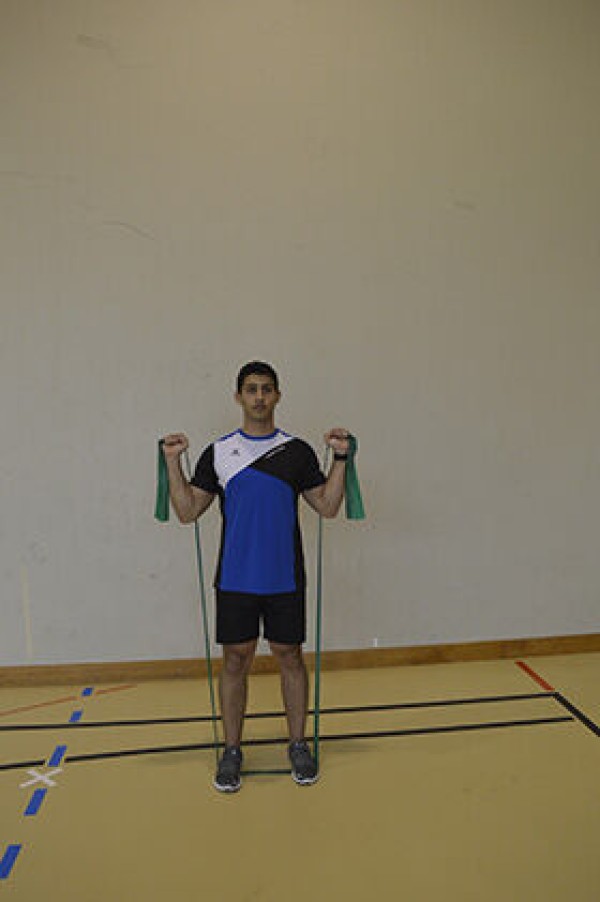

Stand upright with your feet approximately shoulder-width apart in the centre of the resistance band. Both feet should be firmly and stably planted on the band or the floor. Grasp one end of the resistance band in each hand and position your hands at approximately shoulder height. Your elbows should be bent and pointing slightly downwards or forwards to the side.
Keep your wrists as straight as possible. Tense your abdominal and gluteal muscles so that your pelvis and spine remain stable. Keep your chest in a controlled position and do not lift it excessively. Look straight ahead. From this stable starting position, press both arms upwards in a controlled manner. Gradually straighten the elbows and lead the hands upwards past the sides of the head. The arms are extended almost fully, without jerking the elbows through. In the top position, the hands are approximately above or slightly to the side of the shoulders. The torso remains stable throughout the entire pushing movement. The shoulders move in a controlled manner, without being deliberately pulled excessively towards the ears. Hold the top position briefly. Then slowly bend the elbows again and guide the hands back to shoulder height in a controlled manner. Actively control the downward movement and do not let the resistance band dictate the motion.
Attention:
When pushing upwards, the lower back arches excessively; the upper body leans significantly backwards; core and gluteal engagement is lost during the movement; the chest is raised excessively; the arms are pushed upwards unevenly; the wrists bend sharply backwards or to the side; the elbows are pulled sharply backwards in the starting position; the band pulls the arms downwards uncontrollably as they are lowered.
Lighten:
Use a rubber band with less resistance; Apply less tension to the band; reduce the range of motion and raise your arms only as far as you can whilst maintaining a stable posture; take a short break between repetitions; perform the exercise whilst sitting on a stable surface, provided this allows for better control of your upright position.
Harden:
Use a resistance band with greater resistance; pre-tension the band more; hold the end position with your arms almost fully extended for 2–3 seconds; Consciously slow down the return movement over 3–4 seconds; perform the exercise with one arm whilst stabilising the torso against a sideways tilt; carry out several repetitions without fully releasing the tension in the band.
Variation:
The exercise can be performed in a standing position or on your knees; this changes the starting position and the demands placed on the body’s stability; the kneeling variation, in particular, reduces the ability to use the legs to support the movement.
1 elasticated rubber band
Extension and flexion of the arms in a seated position (rowing pull) ► row
Power
Individual work
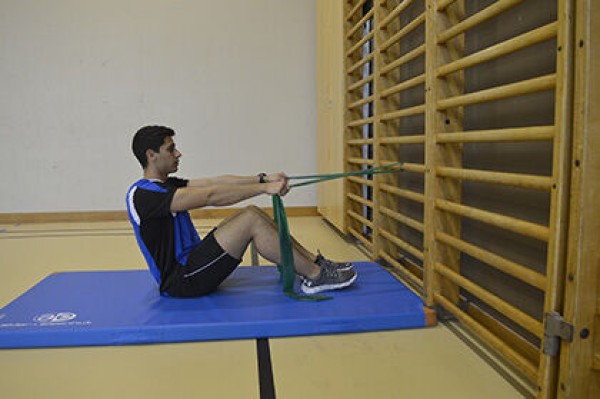
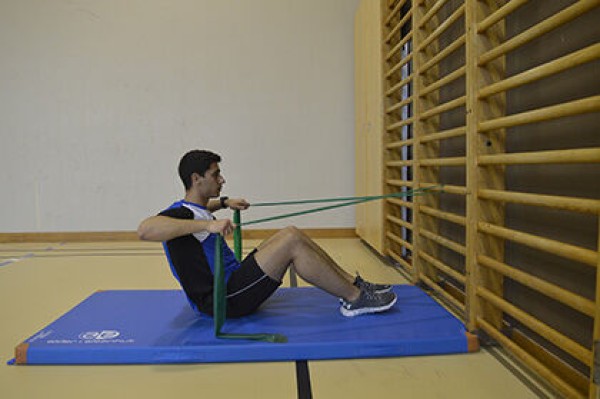
Sit facing the wall bars or another stable anchor point. Secure the resistance band firmly at approximately shoulder height. Keep your legs apart and your feet firmly planted on the floor. Lean your upper body slightly backwards without rounding your back. Actively engage your abdominal muscles and keep your chest upright. Grasp one end of the resistance band in each hand. To begin with, your arms are stretched out in front of you and the resistance band is already under slight tension. Keep your shoulders relaxed and as far away from your ears as possible. From the stable starting position, pull both elbows back in a controlled manner. Move your elbows to the sides of your body, keeping them at approximately shoulder height or slightly below. At the same time, actively move your shoulder blades backwards and slightly downwards. Bring your hands towards your chest in a controlled manner. The movement ends when the elbows are positioned at the sides or slightly behind the upper body and the shoulder blades have been actively drawn together. Hold the end position briefly. Then slowly and in a controlled manner, extend your arms forwards again. The shoulder blades may move forwards in a controlled manner without the upper body slumping. Throughout the entire movement, the upper body remains as still as possible and the core is engaged.
Attention:
The back becomes rounded or is severely overextended; the upper body moves noticeably forwards and backwards during the pull; momentum from the upper body is used to overcome the resistance; the shoulders are pulled up significantly towards the ears during the pull; the shoulder blades are not actively drawn back; the elbows are moved uncontrollably far upwards or downwards; the arms are pulled forwards by the resistance band as they return to the starting position; the tension in the resistance band is completely lost between repetitions; tighten your stomach and keep your upper body stable throughout the entire movement; the resistance band must be securely attached to the anchor point and must not be able to come loose during the exercise.
Lighten:
Use a resistance band with less tension; sit closer to the anchor point to reduce the pre-tension; Slightly reduce the range of motion; perform the movement more slowly and take a short pause between repetitions; initially practise only the shoulder blade movement before performing the full rowing stroke.
Harden:
Use a resistance band with greater tension; sit further away from the anchor point to increase the tension; hold the end position of the pull for 2–3 seconds; deliberately slow down the return movement over 3–4 seconds; perform the exercise with one arm whilst keeping the torso stable to prevent rotation; carry out several repetitions in succession without fully releasing the tension in the band.
1 elasticated rubber band
1 wall bar/tree
Extension and flexion of the arms whilst standing (chest press) ► band chest press
Power
Individual work
Secure the elastic band behind your body at approximately chest height to a stable anchor point. Grasp one end of the elastic band in each hand. Take a controlled step forwards into a stable stance so that the band is already slightly taut. Your feet should be planted firmly on the floor and your knees slightly bent. Your hands should be at chest height at your sides, with your elbows bent and positioned slightly below your shoulders. Keep your wrists as straight as possible. Tighten your abdominal and gluteal muscles and keep your upper body upright and stable. From the stable starting position, push both hands forwards in a controlled manner. As you do so, extend your elbows almost fully without jerking them through. Move your hands forwards in parallel or slightly towards the centre of your body. During the pushing movement, keep your upper body and pelvis as still as possible. Keep your shoulders low and do not pull them up towards your ears. Briefly check your final position. Then slowly bend your elbows again and guide your hands back towards the starting position in a controlled manner. Actively slow down the return movement and prevent the resistance band from pulling your arms back uncontrollably. Maintain tension in the resistance band throughout the entire movement.
Attention:
The upper body is tilted sharply forwards or backwards; a pronounced hollow back results from a lack of core stability; the shoulders are pulled up significantly towards the ears; the elbows are raised excessively high; the movement is supported by momentum from the upper body; the arms are pulled back uncontrollably as they return; the wrists bend noticeably backwards or to the side; the stance is too unstable and the body is pulled backwards by the band; actively tense your abdomen and buttocks and keep your upper body stable throughout the entire movement; the elastic band must be securely fastened and must not come loose under load.
Lighten:
Use a resistance band with lower tension; stand closer to the attachment point to reduce the pre-tension; slightly reduce the range of motion; perform the movement deliberately slowly; pause briefly between repetitions and return to the stable starting position.
Harden:
Use a resistance band with greater tension; stand further away from the anchor point to increase the tension; hold the end position with your arms almost fully extended for 2–3 seconds; Consciously slow down the return movement over 3–4 seconds; perform the exercise with one arm and stabilise the torso against the resulting rotation; perform the exercise with one arm whilst keeping the opposite leg forward to increase the demands on whole-body stability.
1 elastic band
1 wall bars/tree
Extension and flexion of one leg and arm in supine position alternating ► dead bug
Power
Individual work


Lie on your back on the floor. Rest your head relaxed on the floor and look upwards. Stretch your arms straight up so that your hands are roughly level with your shoulders. Lift your legs and bend your hips and knees to approximately 90 degrees. Your thighs should be pointing upwards, whilst your lower legs are roughly parallel to the floor. Keep your pelvis in a stable position and consciously engage your abdominal muscles. Your lower back should remain stable throughout the exercise and should not progressively arch into a hollow back during the stretching movement. Extend one arm and the opposite leg simultaneously and in a controlled manner, in line with the body. Slowly bring the arm behind the head and the opposite leg forwards or downwards at the same time. Lower the arm and leg towards the floor only as far as the position of the pelvis and lower back can be maintained in a controlled manner. Hold the stretched position briefly. Then slowly return the arm and leg to the starting position. For the next repetition, use the opposite arm and leg. Alternate sides evenly. Continue to breathe calmly throughout the entire movement and maintain core tension.
Attention:
The lower back gradually lifts off the floor, resulting in a pronounced hollow back; abdominal tension is lost during the extension movement; the arm and leg are lowered further than the stability of the torso allows; the pelvis tilts or rotates noticeably to one side; the movement is performed too quickly or with momentum; the arm or leg is placed completely flat on the floor, thereby losing active tension; the head and shoulders are unnecessarily tensed or lifted off the floor; breathing is held during the exertion; maintain stable control of the lumbar spine throughout the entire movement; the key is not to lower your arm and leg as far as possible, but to perform the movement only within a controllable range of motion.
Lighten:
Lower your arm and leg less far towards the floor; keep the moving leg more bent, thereby shortening the lever; move only your legs alternately and keep your arms in the starting position; move only your arms alternately and keep your legs stable in the starting position; pause briefly between each repetition and re-engage your core; initially move only one limb at a time.
Harden:
Lower your arms and legs closer to the floor to increase the range of motion; fully extend your leg to increase the lever arm; Use weighted cuffs on your arms or legs; deliberately slow the lowering movement to 3–4 seconds; hold the extended position for 2–3 seconds; perform repetitions alternately without a break in between, whilst maintaining constant core tension.
2-4 weight cuffs/2 weight balls/dumbbells ► make the exercise more difficult (additional weight)
Upper-body rotation with alternating throws ► rotational slam ball
Power
Individual work
Stand upright with your feet approximately shoulder-width apart. Hold the slam ball in front of your body with both hands. Keep your feet firmly and stably on the floor. Your knees should be slightly bent and your hips in an upright position. Actively engage your abdominal muscles and keep your upper body stable. Keep your gaze directed forwards or towards the ball. Using both hands, lead the slam ball upwards in an arc-shaped movement past your side. As you do so, rotate your upper body in a controlled manner towards the corresponding side. The movement results from the coordinated action of your arms, shoulder girdle and trunk rotation. Raise the ball until it is roughly level with your head. Then reverse the direction of movement powerfully and throw the ball explosively onto the floor in front of your body or slightly to the corresponding side. During the throw, bend your hips and knees and actively engage your core in the movement. Throw the ball onto the floor at a sufficient distance from your feet. After it bounces, catch the ball in a controlled manner. As you catch it, bend your knees and hips and keep your back as stable as possible. For the next repetition, lead the ball upwards over the opposite side of your body. Alternate the direction of movement with each repetition.
Attention:
The ball is raised vertically in front of the body rather than to the side; the back rounds significantly when catching or throwing; the movement comes almost exclusively from the arms; the rotation of the upper body is uncontrolled or jerky; the knees collapse significantly inwards when lowering the body; the ball is thrown too close to one’s own feet; when catching, the back is bent rather than using the knees and hips; the rotational movement becomes so pronounced that the pelvis and spine can no longer be stabilised in a controlled manner.
Lighten:
Use a lighter slam ball; minimise lateral movement and rotation; raise the ball only to approximately head or shoulder height; throw with less intensity; take a short break between each repetition; practise the movement slowly at first, without an explosive throw.
Harden:
Use a heavier slam ball; throw the ball onto the floor with greater explosiveness; perform the movement more dynamically and increase the rotational speed without losing control of your core and pelvis; Alternate sides immediately without a break; rise explosively from a slight squat and transition straight into the lateral upward movement; perform several repetitions in succession with high, yet controlled, intensity of movement.
1 slam ball/medicine ball
Jump forwards and shift backwards in a four-footed stance alternating ► bear crawl jump
Power
Individual work


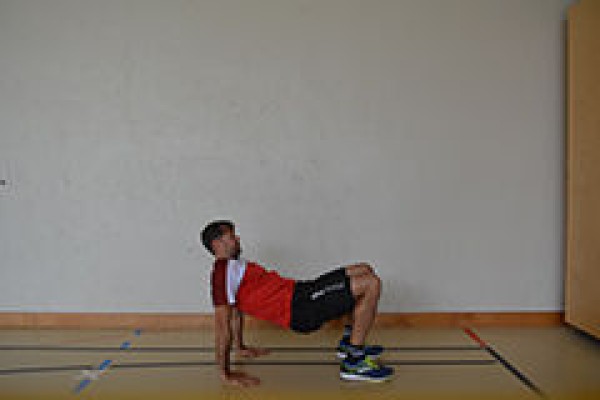


Start on all fours. Place your hands about shoulder-width apart, directly beneath your shoulders. Your fingers should point forwards or slightly outwards, and your hands should be fully supported on the floor. Your knees should be roughly level with your hips and bent at about 90 degrees. Point your toes and lift your knees a few centimetres off the floor. Keep your back as stable and neutral as possible. Your head should be in line with your spine. Actively engage your abdominal muscles and align your pelvis parallel to the floor. From this stable starting position, move one hand and the opposite foot forwards simultaneously, or almost simultaneously. Then repeat the movement with the other hand and the opposite foot. Crawl forwards in this way, moving evenly and in a controlled manner. Keep the steps with your hands and feet as small as possible. Keep your knees just above the floor whilst moving. Keep your upper body as parallel to the floor as possible.
Your hips and shoulders should rotate as little as possible to the side with each step. Distribute your body weight evenly between your arms and legs. Continue to breathe calmly during the movement and maintain constant core tension.
Attention:
From a stable starting position, move one hand and the opposite foot forwards simultaneously, or almost simultaneously; then repeat the movement with the other hand and the opposite foot; in this way, crawl forwards in a steady and controlled manner; keep the steps with your hands and feet as small as possible; keep your knees just above the floor whilst moving; keep your upper body as parallel to the floor as possible; the hips and shoulders should rotate as little as possible to the side with each step; body weight is distributed evenly between the arms and legs; continue to breathe calmly during the movement and maintain constant core tension; in this variation of the exercise, move your hand and the opposite foot together or almost simultaneously; actively tense your abdominal muscles and keep your pelvis and back as stable as possible throughout the movement.
Lighten:
Cover a shorter distance; take smaller, slower steps; hold briefly in the stable starting position between each step; start by performing the exercise statically, keeping your knees just a few centimetres above the floor; pause briefly after a few steps and re-establish the position; Keep your knees slightly higher if you are not yet able to lower yourself into the deep position in a controlled manner.
Harden:
Cover a longer distance without a break; perform the bear crawl backwards; add sideways movements; alternate between forwards, backwards and sideways movements; Use a weight vest for additional resistance; use a light resistance band around the thighs; perform the exercise for a longer, specified duration without interruption; change the direction of movement spontaneously on a signal.
2-4 weight cuffs/1 weight waistcoat ► make the exercise more difficult (additional weight)
Move your arms upwards while standing
Power
Individual work


Standing upright, hold two dumbbells at the side of your body with your arms hanging down, grasp the dumbbells with an underhand grip (palms facing forwards), raise your practically straight arms upwards in a circular motion so that your almost closed arms are pointing diagonally upwards in front of your head (first raise the dumbbells sideways before bringing your arms together slightly above head height at about shoulder height). While raising the dumbbells, turn your arms in so that the backs of your hands are pointing upwards in the end position. Then move your arms back to the starting position in the reverse sequence of movements.
Attention:
Keep your shoulders lowered and your back straight; always keep your arms under tension (do not let them hang completely or bring them fully together).
Lighten:
Without/less weight.
Harden:
More weight or additional weight (on the arms).
2 dumbbells
2 weight cuffs ► Make the exercise more difficult (additional weight)
Move your arms forwards and backwards in the forearm plank position ► ball plank rollout
Power
Individual work
Rest on your forearms on two exercise balls, legs straight, feet hip-width apart. Actively engage your entire body (core, glutes, legs). Roll the balls forward slowly and in a controlled manner (your body will gradually extend as you do so). Stop briefly at the point where you can no longer maintain the tension, then roll back to the starting position. The entire movement should be slow and controlled (no momentum) and the body should remain in a stable line.
Attention:
Do not arch your back when rolling forward; do not lift your bottom too high or let it drop, do not roll too quickly (momentum rather than control), do not let your shoulders roll inwards, do not rely solely on your arms (instead of your core – incorrect movement pattern), do not roll too far forward (loss of control in the lower back).
Lighten:
Smaller rolling motion (just slightly forwards and backwards); keep your knees on the floor instead of your feet (knee plank rollout); start with the ball closer to your body; perform the exercise using a gym ball.
Harden:
Roll further forwards (greater leverage); stand on one leg or with feet closer together; slow down the eccentric phase; hold the stretched position; use a high plank position instead of a forearm plank.
2 exercise balls
Move the arms forwards and backwards in a prone position ► W-extension / W-raise / W-Y-extension
Power
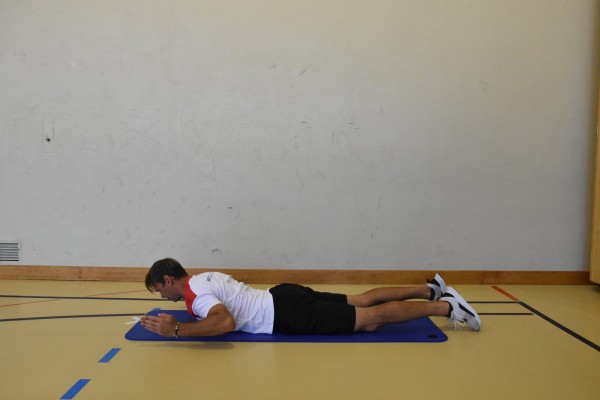
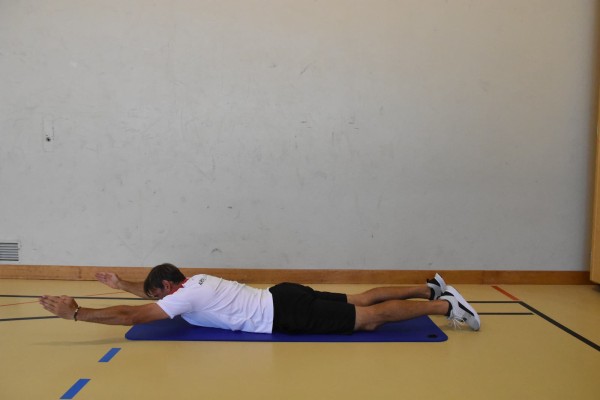
Lying on your stomach with your upper body slightly raised, feet shoulder-width apart, arms bent beside your body (hands at head height - palms facing inwards or downwards - W position), stretch your arms out diagonally forwards as an extension of your body and bend them back to the starting position.
Attention:
Do not lower your upper body and arms completely.
Lighten:
Lower your upper body/arms after each repetition or every now and then.
Harden:
Additional weight on the arms/in the hands.
Note:
The position of the hands is important for the target muscles and the position of the joints.
Palms facing down (pronated grip) = muscle activation: emphasizes the upper trapezius and the external rotators of the shoulder (e.g., infraspinatus, teres minor) / shoulder position: shoulders are more externally rotated / advantage: good posture correction, strengthens the back of the shoulders / disadvantage: can be uncomfortable or restrictive if you have shoulder problems.
Palms facing each other (neutral grip) = muscle activation: activates the middle trapezius, rhomboids, and rear deltoid muscles more strongly / shoulder position: less external rotation, easier on the joints / advantage: often more comfortable for the shoulder joints, better control / disadvantage: less targeted external rotation if that is the goal.
When to choose which: Shoulder health/rehab = neutral (palms facing each other)/focus on external rotators = pronated (palms facing down)/improve posture = both options are useful/keep movement pain-free = neutral is preferable.
Conclusion: The hand position during the W extension influences which parts of the shoulder muscles are used more and how stressful the movement is for the shoulder joints. Both variants are useful – depending on the goal or how it feels, both can be used (or even alternated during training).
Variation I:
Alternately raise one arm (instead of both at the same time).
Variation II:
Position on a flat bench or an incline bench.
2 weight cuffs/weight balls/dumbbells ► Make the exercise more difficult (additional weight)
Move the arms forwards and backwards in a prone position ► W-extension / W-raise / W-Y-extension
Power
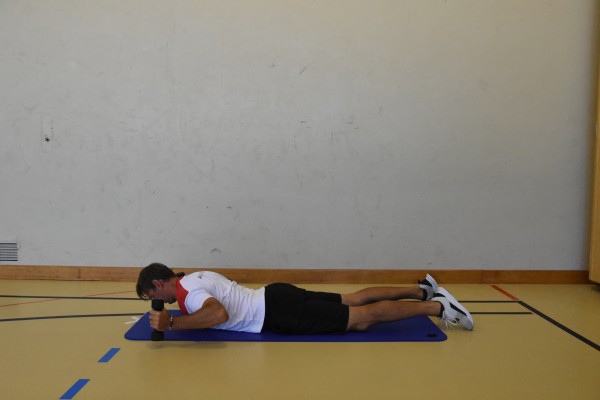
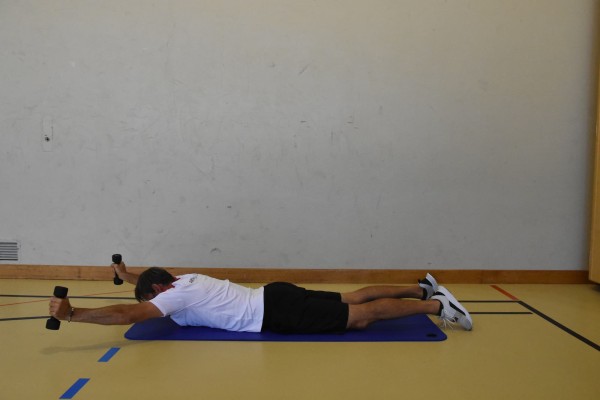
Lying on your stomach with your upper body slightly raised, feet shoulder-width apart, arms bent beside your body (hands at head height - palms facing inwards or downwards - W position), hold a (light) dumbbell in each hand, stretch your arms out diagonally forwards as an extension of your body and bend them back to the starting position.
Attention:
Do not lower your upper body and arms completely.
Lighten:
Lower your upper body/arms after each repetition or every now and then.
Harden:
Additional weight on the arms/in the hands.
Note:
The position of the hands is important for the target muscles and the position of the joints.
Palms facing down (pronated grip) = muscle activation: emphasizes the upper trapezius and the external rotators of the shoulder (e.g., infraspinatus, teres minor) / shoulder position: shoulders are more externally rotated / advantage: good posture correction, strengthens the back of the shoulders / disadvantage: can be uncomfortable or restrictive if you have shoulder problems.
Palms facing each other (neutral grip) = muscle activation: activates the middle trapezius, rhomboids, and rear deltoid muscles more strongly / shoulder position: less external rotation, easier on the joints / advantage: often more comfortable for the shoulder joints, better control / disadvantage: less targeted external rotation if that is the goal.
When to choose which: Shoulder health/rehab = neutral (palms facing each other)/focus on external rotators = pronated (palms facing down)/improve posture = both options are useful/keep movement pain-free = neutral is preferable.
Conclusion: The hand position during the W extension influences which parts of the shoulder muscles are used more and how stressful the movement is for the shoulder joints. Both variants are useful – depending on the goal or how it feels, both can be used (or even alternated during training).
Variation I:
Alternately raise one arm (instead of both at the same time).
Variation II:
Position on a flat bench or an incline bench.
2 weight cuffs/weight balls/dumbbells
Move the arms forwards and backwards in a prone position ► W-extension / W-raise / W-Y-extension
Power
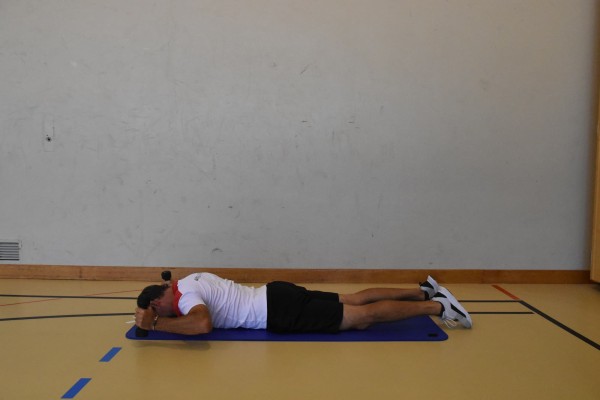
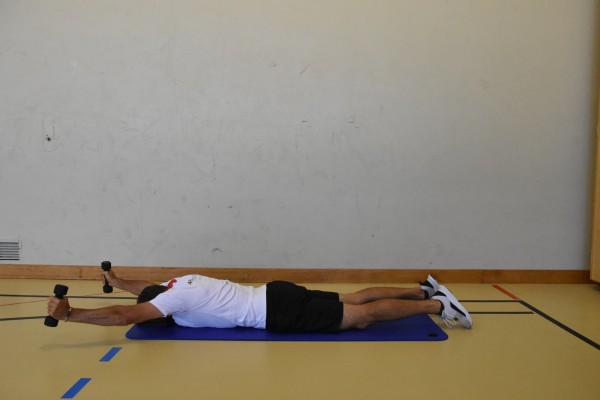
Lying on your stomach with your forehead resting on a folded cloth, feet shoulder-width apart, arms bent beside your body (hands at head height - palms facing inwards or downwards - W position), hold a (light) dumbbell in each hand, stretch your arms out diagonally forwards as an extension of your body and bend them back to the starting position.
Attention:
Do not lower your upper body and arms completely.
Lighten:
Lower your upper body/arms after each repetition or every now and then.
Harden:
Additional weight on the arms/in the hands.
Note:
The position of the hands is important for the target muscles and the position of the joints.
Palms facing down (pronated grip) = muscle activation: emphasizes the upper trapezius and the external rotators of the shoulder (e.g., infraspinatus, teres minor) / shoulder position: shoulders are more externally rotated / advantage: good posture correction, strengthens the back of the shoulders / disadvantage: can be uncomfortable or restrictive if you have shoulder problems.
Palms facing each other (neutral grip) = muscle activation: activates the middle trapezius, rhomboids, and rear deltoid muscles more strongly / shoulder position: less external rotation, easier on the joints / advantage: often more comfortable for the shoulder joints, better control / disadvantage: less targeted external rotation if that is the goal.
When to choose which: Shoulder health/rehab = neutral (palms facing each other)/focus on external rotators = pronated (palms facing down)/improve posture = both options are useful/keep movement pain-free = neutral is preferable.
Conclusion: The hand position during the W extension influences which parts of the shoulder muscles are used more and how stressful the movement is for the shoulder joints. Both variants are useful – depending on the goal or how it feels, both can be used (or even alternated during training).
Variation I:
Alternately raise one arm (instead of both at the same time).
Variation II:
Position on a flat bench or an incline bench.
2 weight cuffs/weight balls/dumbbells
Move the arms forwards and backwards in a prone position ► W-extension / W-raise / W-Y-extension
Power
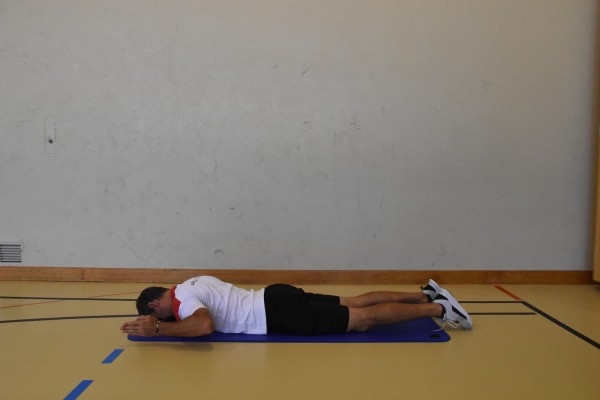
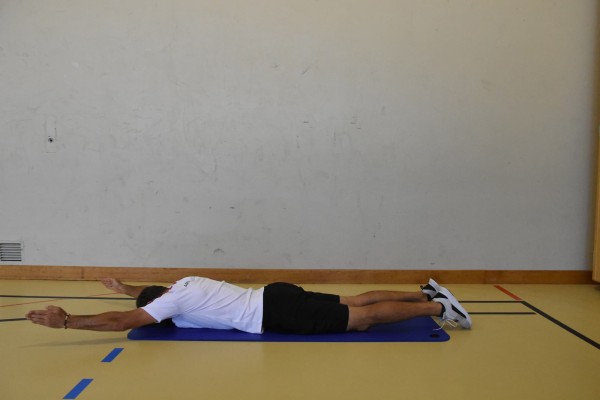
Lying on your stomach with your forehead resting on a folded cloth, feet shoulder-width apart, arms bent beside your body (hands at head height - palms facing inwards or downwards - W position), stretch your arms out diagonally forwards as an extension of your body and bend them back to the starting position.
Attention:
Do not lower your upper body and arms completely.
Lighten:
Lower your upper body/arms after each repetition or every now and then.
Harden:
Additional weight on the arms/in the hands.
Note:
The position of the hands is important for the target muscles and the position of the joints.
Palms facing down (pronated grip) = muscle activation: emphasizes the upper trapezius and the external rotators of the shoulder (e.g., infraspinatus, teres minor) / shoulder position: shoulders are more externally rotated / advantage: good posture correction, strengthens the back of the shoulders / disadvantage: can be uncomfortable or restrictive if you have shoulder problems.
Palms facing each other (neutral grip) = muscle activation: activates the middle trapezius, rhomboids, and rear deltoid muscles more strongly / shoulder position: less external rotation, easier on the joints / advantage: often more comfortable for the shoulder joints, better control / disadvantage: less targeted external rotation if that is the goal.
When to choose which: Shoulder health/rehab = neutral (palms facing each other)/focus on external rotators = pronated (palms facing down)/improve posture = both options are useful/keep movement pain-free = neutral is preferable.
Conclusion: The hand position during the W extension influences which parts of the shoulder muscles are used more and how stressful the movement is for the shoulder joints. Both variants are useful – depending on the goal or how it feels, both can be used (or even alternated during training).
Variation I:
Alternately raise one arm (instead of both at the same time).
Variation II:
Position on a flat bench or an incline bench.
2 weight cuffs/weight balls/dumbbells ► Make the exercise more difficult (additional weight)
Move upper leg forwards in lateral forearm support (left) ► knee raise lateral pillar bridge / side bridge
Power
Individual work

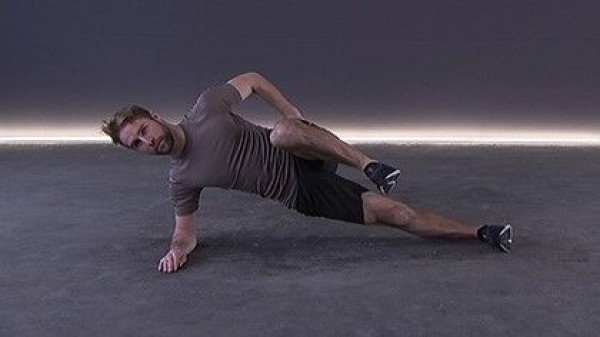
Side support on the (left) forearm, push the thigh of the upper leg straight out forwards (lower leg parallel, thigh bent at approx. 90 degrees to the body/leg) and return to the starting position.
Attention:
Head, torso, hips and knees practically form a line (pelvis does not tilt backwards or forwards), keep the shoulder above the elbow.
Lighten:
Knee on the floor; move your leg less forwards; just hold the position.
Harden:
Additional weight (for the free leg or on the hip); unstable support (possible for both the arm and the leg).
1 weight cuff/weight vest/weight disc/sandbag ► making the exercise more difficult (additional weight)
1 ball/1-2 balance cushions/1 balance board ► making the exercise more difficult (unstable surface)
Move upper leg forwards in lateral forearm support (right) ► knee raise lateral pillar bridge / side bridge
Power
Individual work


Side support on the (right) forearm, push the thigh of the upper leg straight out forwards (lower leg parallel, thigh bent at approx. 90 degrees to the body/leg) and return to the starting position.
Attention:
Head, torso, hips and knees practically form a line (pelvis does not tilt backwards or forwards), keep the shoulder above the elbow.
Lighten:
Knee on the floor; move your leg less forwards; just hold the position.
Harden:
Additional weight (for the free leg or on the hip); unstable support (possible for both the arm and the leg).
1 weight cuff/weight vest/weight disc/sandbag ► making the exercise more difficult (additional weight)
1 ball/1-2 balance cushions/1 balance board ► making the exercise more difficult (unstable surface)
Move upper leg forwards in lateral support (left) ► knee raise lateral pillar bridge / side bridge
Power
Individual work


Lateral support with outstretched (left) arm, push the thigh of the upper leg straight out forwards (lower leg parallel, thigh bent at approx. 90 degrees to the body/leg) and return to the starting position.
Attention:
Head, torso, hips and knees practically form a line (pelvis does not tilt backwards or forwards), keep shoulder above elbow.
Lighten:
Knee on the floor; move your leg less forwards; just hold the position.
Harden:
Additional weight (for the free leg or on the hip); unstable support (possible for both the arm and the leg).
1 weight cuff/weight vest/weight disc/sandbag ► to make the exercise more difficult (additional weight)
1 ball/1-2 balance cushions ► to make the exercise more difficult (unstable surface)
Move upper leg forwards in lateral support (right) ► knee raise lateral pillar bridge / side bridge
Power
Individual work


Lateral support with outstretched (right) arm, push the thigh of the upper leg straight out forwards (lower leg parallel, thigh bent at approx. 90 degrees to the body/leg) and return to the starting position.
Attention:
Head, torso, hips and knees practically form a line (pelvis does not tilt backwards or forwards), keep shoulder above elbow.
Lighten:
Knee on the floor; move your leg less forwards; just hold the position.
Harden:
Additional weight (for the free leg or on the hip); unstable support (possible for both the arm and the leg).
1 weight cuff/weight vest/weight disc/sandbag ► to make the exercise more difficult (additional weight)
1 ball/1-2 balance cushions ► to make the exercise more difficult (unstable surface)
Move upper body forwards and backwards in forearm support ► dynamic pillar bridge
Power
Individual work


Underarm support (the outstretched legs and upper body practically form a line, the legs are supported on the tips of the toes and the upper body on the forearms, the forearms lie flat on the floor parallel to each other, the upper arms are vertical), move the upper body forwards and backwards by changing the angle between the forearm and upper arm.
Attention:
Head, torso, hips and knees practically form a line (do not stretch your buttocks upwards or let them sag, tense your stomach).
Lighten:
Knees on the floor (kneeling shift).
Harden:
Additional weight (on the back); unstable support for the legs and/or arms possible.
1 weight vest/weight disc/sandbag ► make the exercise more difficult (additional weight)
1 ball/1-2 balancing cushions/balance board ► make the exercise more difficult (unstable surface)
Bend your upper body to the side whilst standing (left) ► side bend
Power
Individual work
Stand upright with your feet shoulder-width apart, holding a dumbbell in one hand (left), the other hand resting loosely at your side or on your hip, shoulders back, chest out, and looking straight ahead. Slowly lean your upper body towards the side of the dumbbell without pushing your hips backwards, feeling a gentle stretch in your oblique abdominal muscles, then return to the starting position in a controlled manner. Breathing: Exhale as you straighten up, inhale as you bend to the side.
Attention:
Do not tilt your hips backwards, avoid jerky movements, do not twist your torso (your upper body should lean to the side), do not tense your neck (keep your head in line with your spine).
Lighten:
Less or no weight; knees slightly bent (takes the strain off the lower back and makes it easier to balance); smaller movements (minimal side-to-side tilt); lean against the wall (stabilises the back and hips).
Harden:
Add more weight; stand on a raised or unstable surface (greater balance required); hold the final position for slightly longer and/or slow down the pace.
1 dumbbell/weight plate
1 Step/Box/Balance Pad ► Make the exercise more challenging (raised or unstable surface)
Bend your upper body to the side whilst standing (right) ► side bend
Power
Individual work
Stand upright with your feet shoulder-width apart, holding a dumbbell in one hand (right), the other hand resting loosely at your side or on your hip, shoulders back, chest out, and looking straight ahead. Slowly lean your upper body towards the side of the dumbbell without pushing your hips backwards, feeling a gentle stretch in your oblique abdominal muscles, then return to the starting position in a controlled manner. Breathing: Exhale as you straighten up, inhale as you bend to the side.
Attention:
Do not tilt your hips backwards, avoid jerky movements, do not twist your torso (your upper body should lean to the side), do not tense your neck (keep your head in line with your spine).
Lighten:
Less or no weight; knees slightly bent (takes the strain off the lower back and makes it easier to balance); smaller movements (minimal side-to-side tilt); lean against the wall (stabilises the back and hips).
Harden:
Add more weight; stand on a raised or unstable surface (greater balance required); hold the final position for slightly longer and/or slow down the pace.
1 dumbbell/weight plate
1 Step/Box/Balance Pad ► Make the exercise more challenging (raised or unstable surface)
Pebble walk
Power
Individual work

Place 3 small stones on the floor; balance on two of these stones. Move the third free stone; switch to this stone with one foot. Repeat the process without losing your balance.
Lighten:
Without equipment;
Larger stones.
Harden:
With a backpack;
Smaller stones.
Material per participant: Tenue CNM
Additional material: 3 small stones
Pronation of the forearm in the sitting position (left)
Power
Individual work
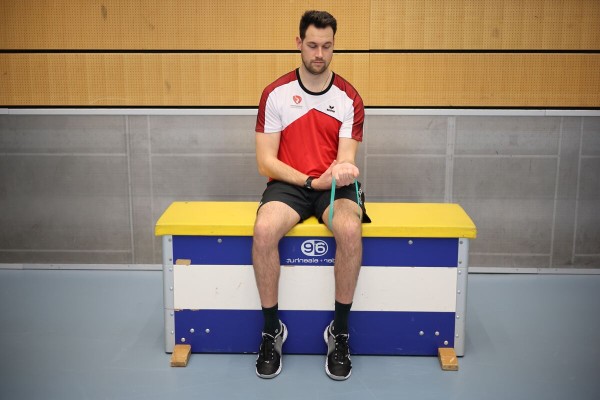
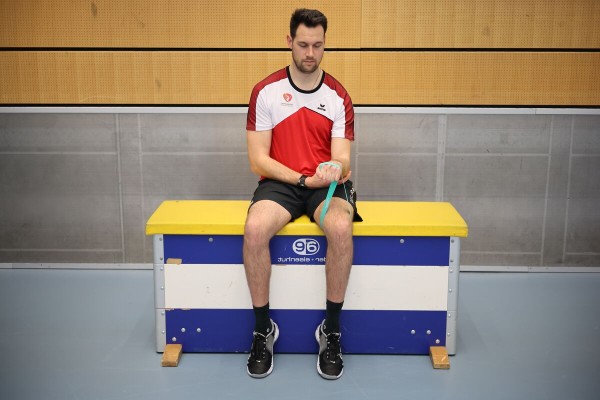
While seated, place an elasticated band around the (left) thigh and grasp the band with the (left) hand, with the back of the hand pointing downwards. The arm holding the band is bent so that the upper arm is against the body and the lower arm is pointing forwards (90 degree angle at the elbow joint). The other (right) arm fixes the training arm by holding the forearm at the elbow. From this position, rotate the arm inwards (pronation) so that the back of the hand is pointing upwards in the end position.
Attention:
The movement only takes place in the forearm, the upper arm remains stable.
Lighten:
Select a rubber band with less resistance.
Harden:
Select a rubber band with greater resistance.
1 mini-band
1 seating option (e.g. chair, plyo box or vaulting box)
Pronation of the forearm in the sitting position (right)
Power
Individual work

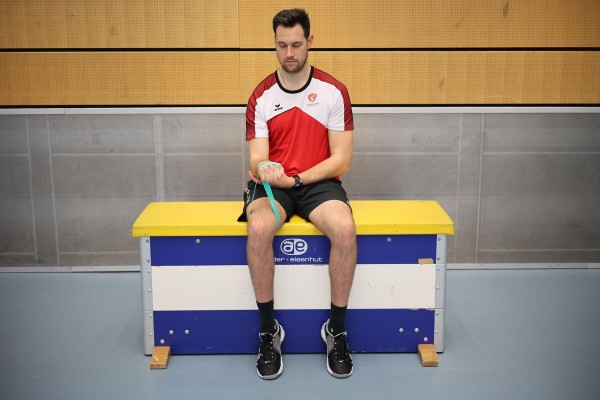
While seated, place an elasticated band around the (right) thigh and grasp the band with the (right) hand, with the back of the hand pointing downwards. The arm holding the band is bent so that the upper arm is against the body and the lower arm is pointing forwards (90 degree angle at the elbow joint). The other (left) arm secures the training arm by holding the forearm at the elbow. From this position, rotate the arm inwards (pronation) so that the back of the hand is pointing upwards in the end position.
Attention:
The movement only takes place in the forearm, the upper arm remains stable.
Lighten:
Select an elastic band with less resistance.
Harden:
Select an elastic band with greater resistance.
1 mini-band
1 seating option (e.g. chair, plyo box or vaulting box)