
Exercises (1874)
Endurance run
Basic training
Group work
In (small) groups according to running speed or individually
An endurance run in (small) groups (based on running speed) or individually on a flat course. The running speed remains constant the whole time (choose the appropriate speed depending on the strength class).
Course: loop; from A to B; from A to B and back again
Intensity level: 2-3 (easy-medium)
Hmax: 70-90%
Rule of speech: chatting - speaking in full sentences
Attention:
The course must be known or clearly signalled to all participants.
Variant:
Change the course of the route (e.g. integrate inclines).
Signalling (e.g. route tape)
Evaluation FTA (group formation)
Participant:
1 heart rate monitor
Endurance run with increased intensity
Basic training
Group work
In (small) groups according to running speed or individually
An endurance run in (small) groups (based on running speed) on a flat course. The running speed is increased from time to time (choose the appropriate pace depending on the strength class), but the specified intensity levels are maintained.
Course: loop; from A to B; from A to B and back again
Intensity level: 1-3 (very easy-loose-medium)
Hmax: 60-90%
Speaking rule: sing-chatter-speak in full sentences
Caution:
The course must be known or clearly signalled to all participants.
Variant:
Change the course (e.g. integrate inclines).
Signalling (e.g. route tape)
Evaluation FTA (group formation)
Participant:
1 heart rate monitor
Daumenjudo
Fighting and roughhousing games
Partner work

Two participants hold hands crosswise with their thumbs in the air. On command, both try to catch the opponent's thumb with their own thumb and press it down. The winner is the one who can hold their opponent's thumb for two seconds. Switch sides after each round.
No material required
Cover work
Light-Contact
Individual work
From the shoulder-width boxing position, a tennis ball is bounced with one hand while the other hand is always held at the temple. The participant moves freely on their feet as if on a track (forwards, backwards, sideways - also in a circle, bouncing the tennis ball at the same point).
Variant:
A fight between everyone (or duel): the participant whose tennis ball touches the floor or is held twice in succession completes an additional task (press-ups, stretch jumps, squats). The opponent's tennis ball may be touched, but there is no physical contact.
1 Tennisball
Cover work
Light-Contact
Group work


Exercise 1:
Static form: From the shoulder-width boxing position, bounce a tennis ball (in a hoop) with one hand, keeping the other hand on your temple at all times. Change which hand is bouncing the tennis ball from time to time.
Exercise 2:
Dynamic form: Move the tennis ball between the rings (bouncing on the feet) without touching them.
Exercise 3:
On a command from the instructor ("top"), swap the tennis ball with a partner.
Exercise 4:
At the instructor's command ("top"), try to steal another participant's tennis ball without losing your own ball.
Exercise 5:
All against all (elimination match): whoever loses their ball is eliminated (possibly perform additional tasks).
Per participant:
1 tennis ball
1 tyre
Move one leg backwards in an alternating squat position
Power
Individual work
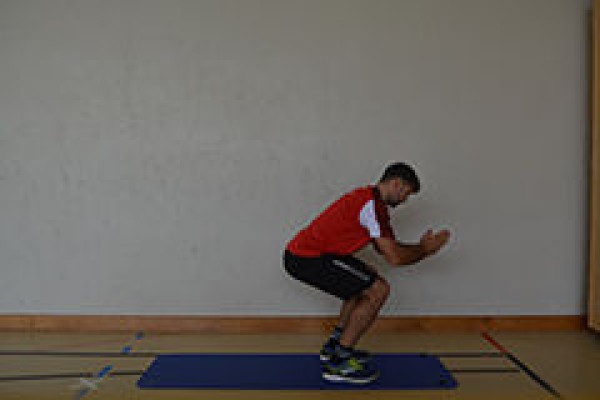
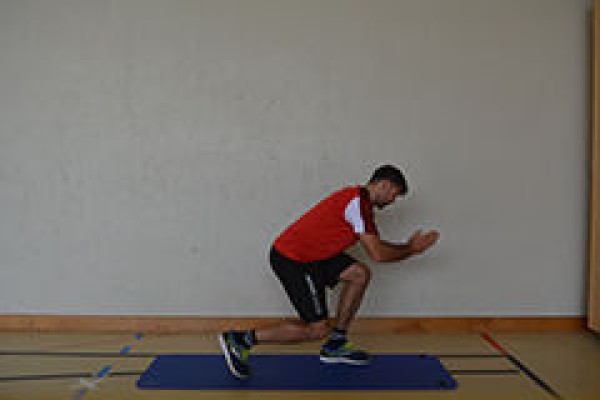
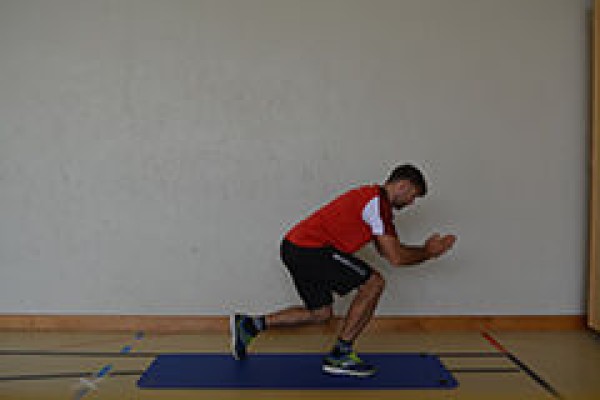
Get into a squat position (deep squat), alternating between moving one leg backwards (toes touching the floor behind the body) and back to the starting position.
Attention:
The starting position in the squat position always remains stable/unchanged.
Lighten:
Move your leg less far back.
Harden:
Tighten an elasticated band between your legs (mid-thigh height).
No material required
1 elasticated rubber band ► to make the exercise more difficult
Move one leg backwards in an alternating squat position
Power
Individual work
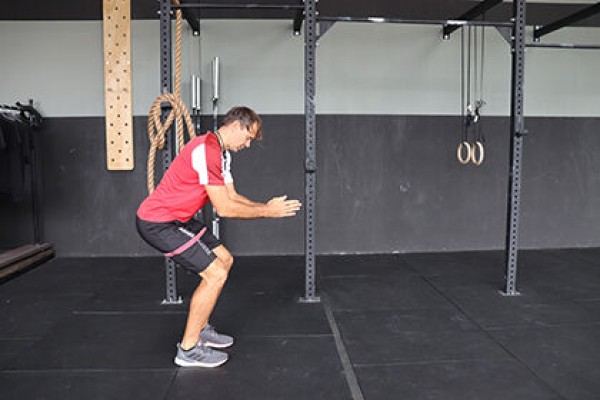
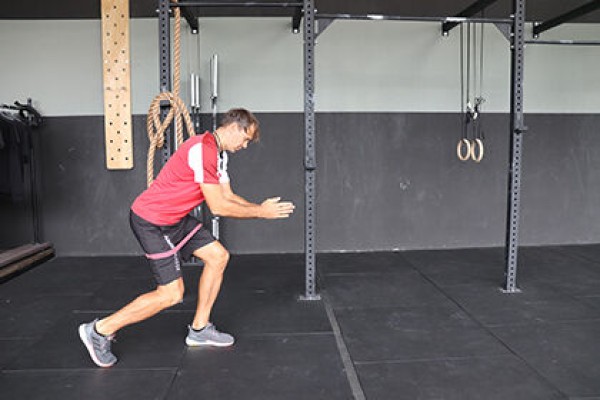
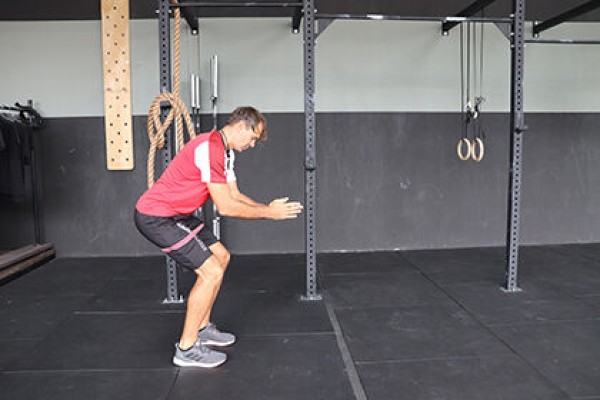
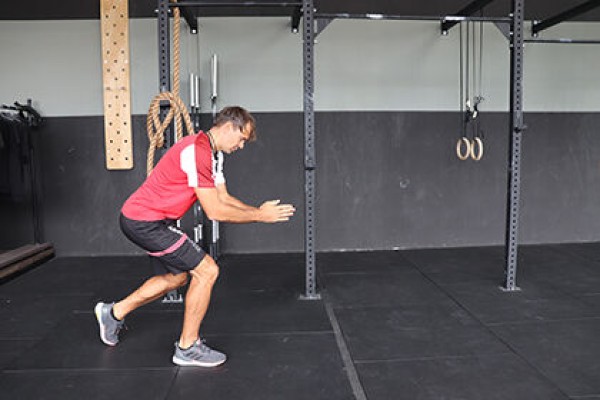
Knee bend position (deep squat) with an elasticated band stretched between the legs (mid-thigh height), alternate between moving one leg backwards (toes touching the floor behind the body) and back to the starting position.
Attention:
The starting position in the squat position always remains stable/unchanged.
Lighten:
Select an elastic band with less resistance.
Harden:
Select an elastic band with greater resistance.
1 elasticated rubber band
Move one leg backwards in a squat position alternating ► monster walk (backwards)
Power
Individual work
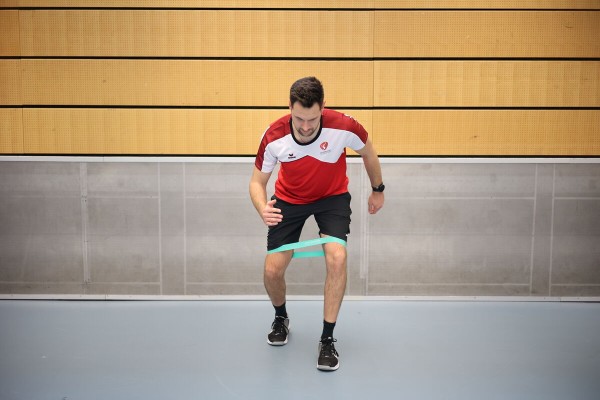
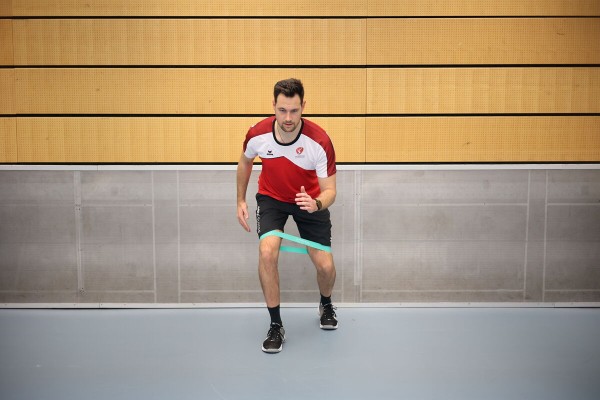
Get into a squat position (deep squat) with an elasticated band stretched between the legs (slightly above the knees), alternate between positioning one leg backwards (foot completely off the ground) and returning to the starting position.
Attention:
The starting position in the squat position always remains stable/unchanged.
Lighten:
Select an elastic band with less resistance.
Harden:
Select an elastic band with greater resistance.
1 mini-band
Move one leg backwards in squat position and stretch jump alternately
Power
Individual work
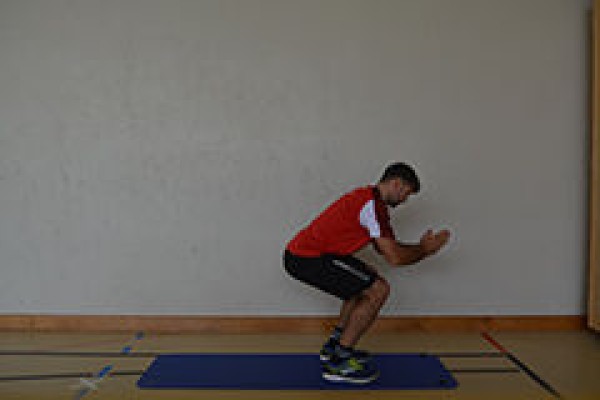


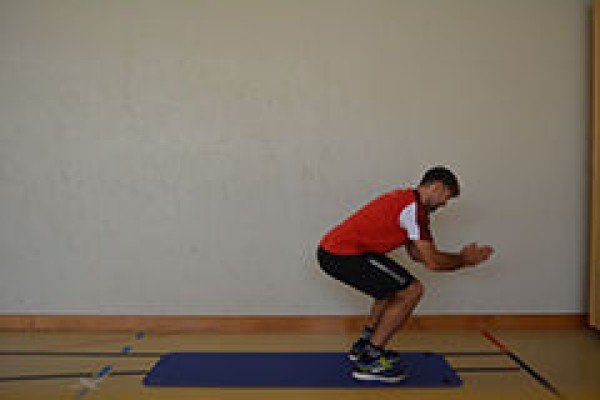
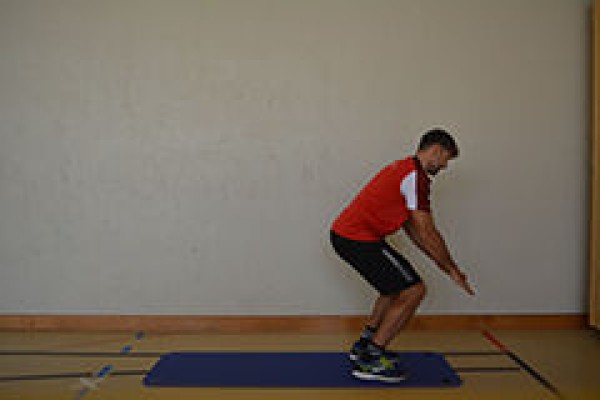
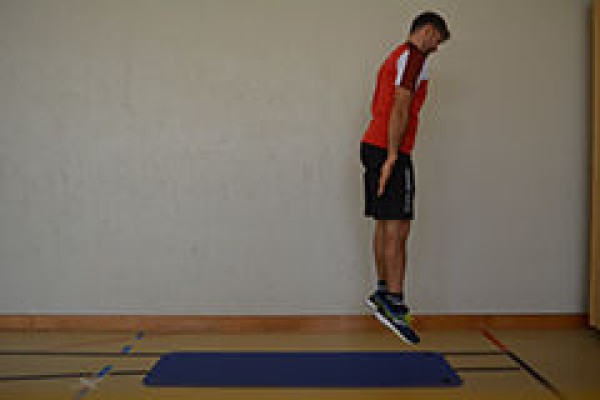
Squat position (deep squat) with arms bent in front of you (palms pressed against each other), alternately move one leg backwards (toes touching the floor behind the body) and back to the starting position, then perform a stretch jump (simultaneously stretch the arms and move them behind the body, palms facing backwards) and return to the starting position (squat position) to start the exercise from the beginning.
Attention:
Starting position in the squat position remains stable/unchanged when moving the leg backwards.
Lighten:
Move the leg less far backwards; stretch jump less high.
Harden:
Tighten an elastic band between the legs.
No material required
1 elasticated rubber band ► to make the exercise more difficult
Move one leg backwards in squat position and stretch jump alternately
Power
Individual work

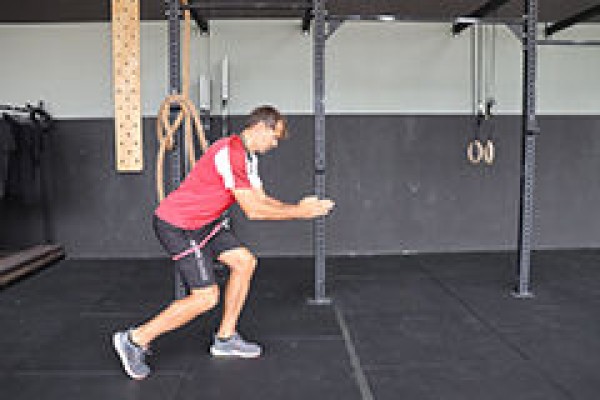


Squat position (deep squat) with arms bent in front of you (palms pressed against each other), with an elasticated rubber band stretched between your legs (mid-thigh height), alternately move one leg backwards (toes touching the floor behind the body) and back to the starting position, then perform a stretch jump (simultaneously stretch your arms and bring them behind your body, palms facing backwards) and return to the starting position (squat position) to start the exercise again.
Attention:
The starting position in the squat position remains stable/unchanged when moving the leg backwards.
Lighten:
Move the leg less far backwards; stretch jump less high; choose an elastic band with less resistance.
Harden:
Choose an elastic band with greater resistance.
1 elasticated rubber band
Move one leg backwards and back in single-leg stance (left) ► kick-back
Power
Individual work
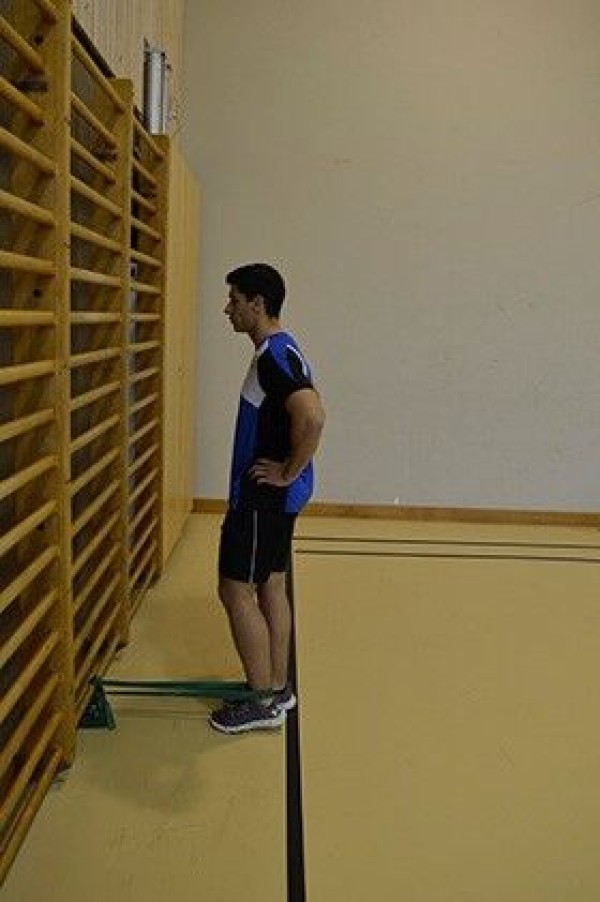
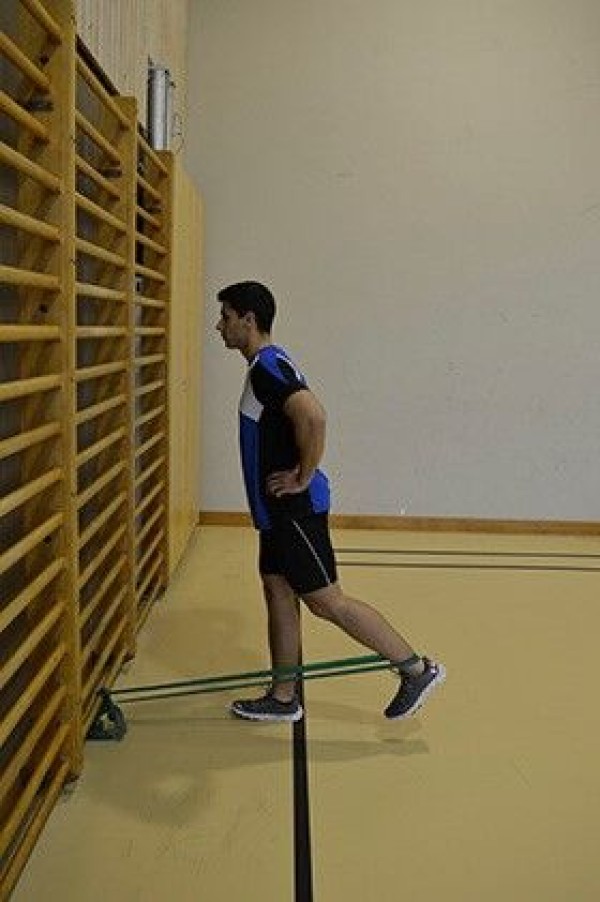
One-legged stand (right), upright position facing the wall bars (or e.g. a tree), tie the elastic band into a loop at ankle height on the wall bars (on the tree), step into the loop with the training leg (left), bend the leg slightly (lifted off the floor) backwards and return to the starting position.
Attention:
The upper body remains stable (arms can support themselves on the wall bars/tree).
Lighten:
Choose a rubber band with less resistance.
Harden:
Choose a rubber band with greater resistance.
1 elasticated rubber band
1 wall bar/tree
Move one leg backwards and back in single-leg stance (left) ► kick-back
Power
Individual work


Stand on one leg (right), with the free leg (left) only slightly raised off the floor, the body position is upright, stretch an elasticated band between the legs (place the band around the ankles). From this position, move the training leg (left) backwards (one-sided hip flexion), leaning the upper body slightly forwards. Then bring the leg and upper body back to the starting position.
Faciliter:
Choose an elastic band with less resistance.
Compliquer:
Choose an elastic band with greater resistance.
1 mini-band
Move one leg backwards and back in single-leg stance (right) ► kick-back
Power
Individual work
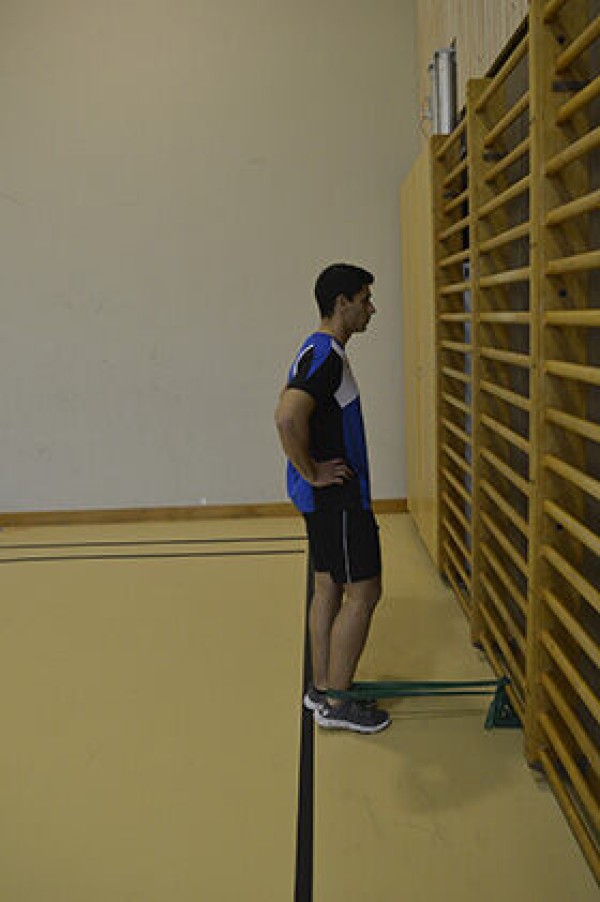
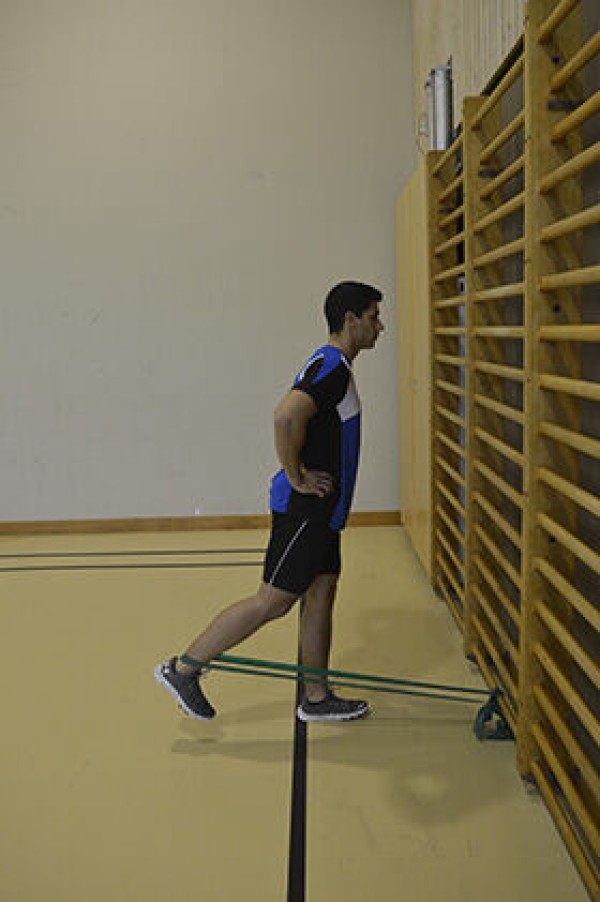
One-legged stand (left), upright position facing the wall bars (or e.g. a tree), tie the elastic band into a loop at ankle height on the wall bars (on the tree), step into the loop with the training leg (right), bend the leg slightly (lifted off the floor) backwards and return to the starting position.
Attention:
The upper body remains stable (arms can support themselves on the wall bars/tree).
Lighten:
Choose a rubber band with less resistance.
Harden:
Choose a rubber band with greater resistance.
1 elasticated rubber band
1 wall bar/tree
Move one leg backwards and back in single-leg stance (right) ► kick-back
Power
Individual work


Stand on one leg (left), with the free leg (right) only slightly raised off the floor, the body position is upright, stretch an elasticated band between the legs (place the band around the ankles). From this position, move the training leg (right) backwards (one-sided hip flexion), leaning the upper body slightly forwards. Then return the leg and upper body to the starting position.
Lighten:
Choose an elastic band with less resistance.
Harden:
Choose an elastic band with more resistance.
1 mini-band
Move one leg forwards in a squat position alternating ► monster walk (forwards)
Power
Individual work

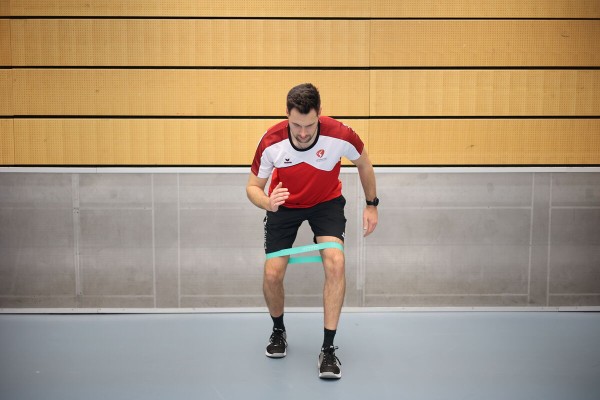
Get into a squat position (deep squat) with an elasticated band stretched between the legs (slightly above the knees), alternate between positioning one leg forwards (foot completely off the ground) and returning to the starting position.
Attention:
The starting position in the squat position always remains stable/unchanged.
Lighten:
Select an elastic band with less resistance.
Harden:
Select an elastic band with greater resistance.
1 mini-band
Alternating one leg to the side while standing ► tall monsterwalk (sideways)
Power
Individual work


Stand upright shoulder-width apart, with an elasticated rubber band stretched between the legs (place the band around the ankles), alternately move one leg to the corresponding side (place the foot completely down) and return to the starting position.
Lighten:
choose a rubber band with less resistance.
Harden:
choose a rubber band with greater resistance.
1 mini-band
Move one leg to the side in an alternating squat position ► monster walk (sideways)
Power
Individual work


Squat position (deep squat), with an elasticated band stretched between the legs (slightly above the knees), alternately move one leg to the corresponding side (put the foot down completely) and return to the starting position.
Attention:
The starting position in the squat position always remains stable/unchanged.
Lighten:
Select an elastic band with less resistance.
Harden:
Select an elastic band with greater resistance.
1 mini-band
Single leg jump (left) ► hop
Power
Partner work
1 trainee & 1 helper ► note change of position
(= double the time required; for lesson planning see organization strength: implementation info button)
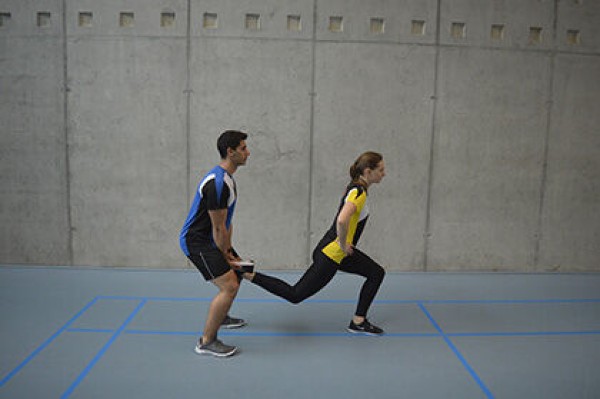
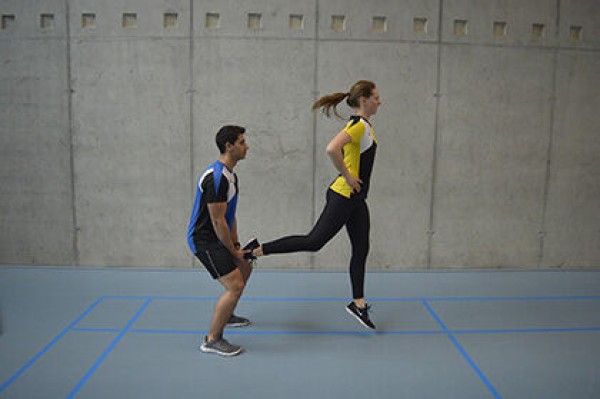
Trainee: Left standing leg bent, right leg also bent but held high, arms supported on the hips, upper body upright, perform single-leg jumps into the air.
Partner: Holds the right foot (the leg held high) of the active participant and accompanies the movement.
Attention:
Knee of the supporting leg always remains behind the tip of the foot and centred over the foot (no tipping inwards), cushion the landing over the entire foot, concentrated work (prevent injuries).
Lighten:
Larger angle in the knee (more upright position) before the jump.
Harden:
Smaller angle in the knee (lower position) before the jump; additional weight (on the shoulders).
1 weight vest/sandbag ► make the exercise more difficult (additional weight)
Single leg jump (right) ► hop
Power
Partner work
1 trainee & 1 helper ► note change of position
(= double the time required; for lesson planner see organization force: Info button execution)
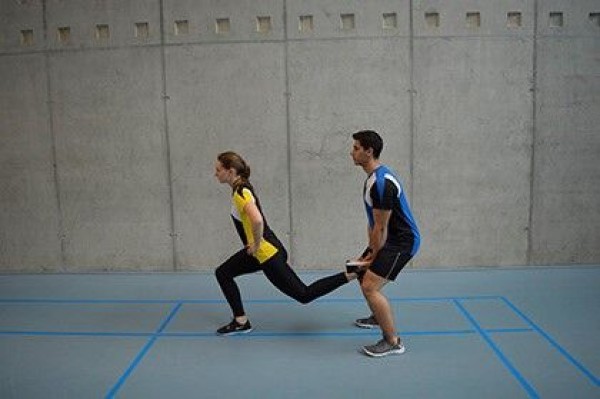
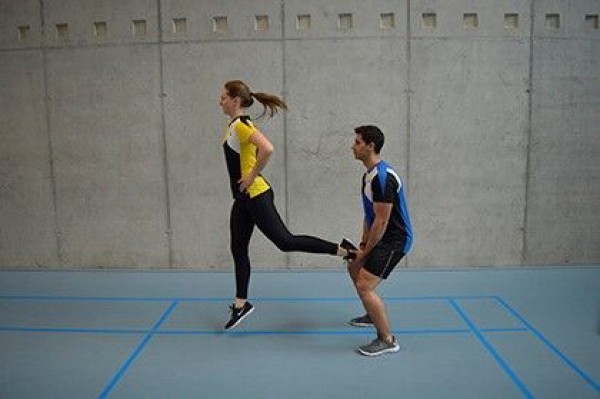
Trainee: Right standing leg bent, left leg also bent but held high, arms supported on the hips, upper body upright, perform single-leg jumps into the air.
Partner: Holds the left foot (the leg held high) of the active participant and accompanies the movement.
Attention:
Knee of the supporting leg always remains behind the tip of the foot and centred over the foot (no tipping inwards), cushion the landing over the entire foot, concentrated work (prevent injuries).
Lighten:
Larger angle in the knee (more upright position) before the jump.
Harden:
Smaller angle in the knee (lower position) before the jump; additional weight (on the shoulders).
1 weight vest/sandbag ► make the exercise more difficult (additional weight)
Einbeinstand (left) ► single leg stability
Power
Individual work
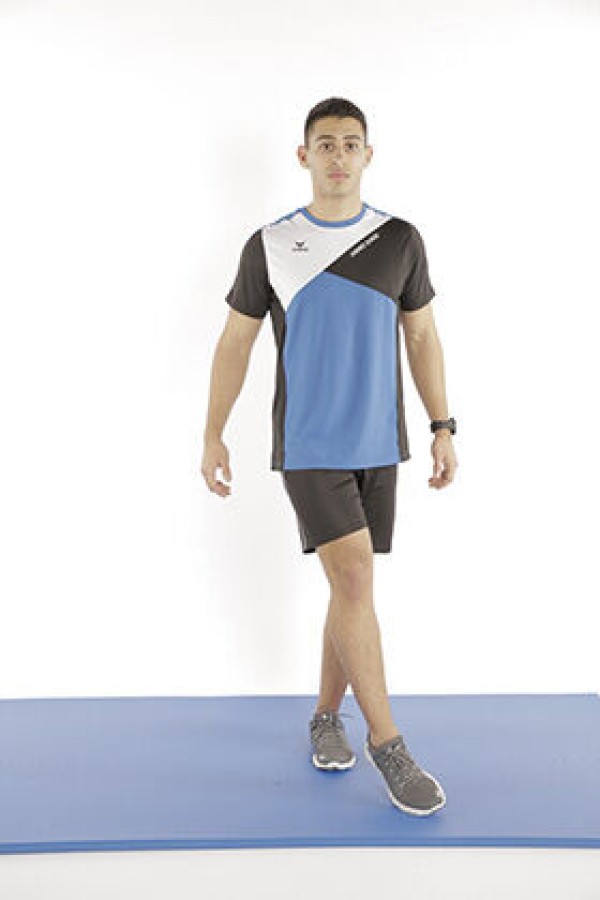
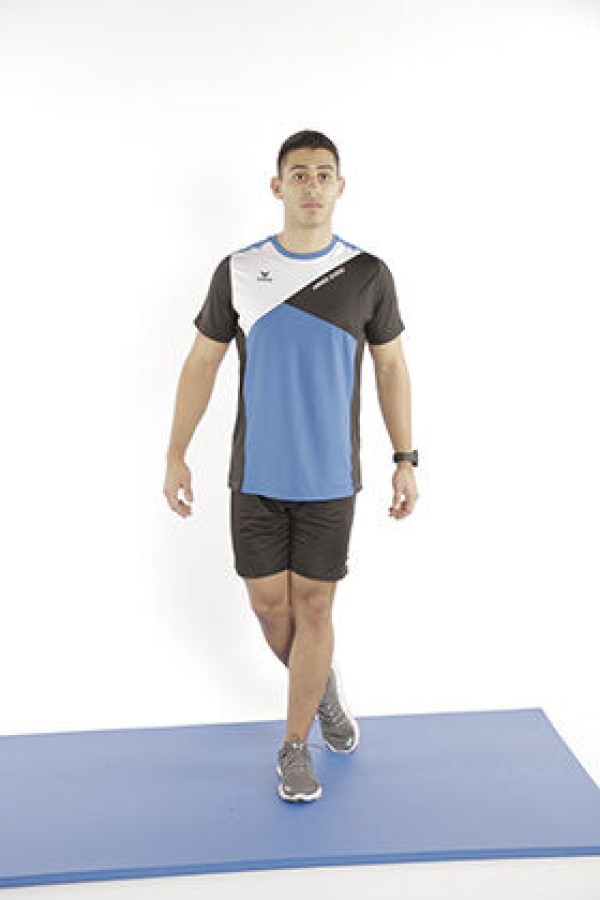
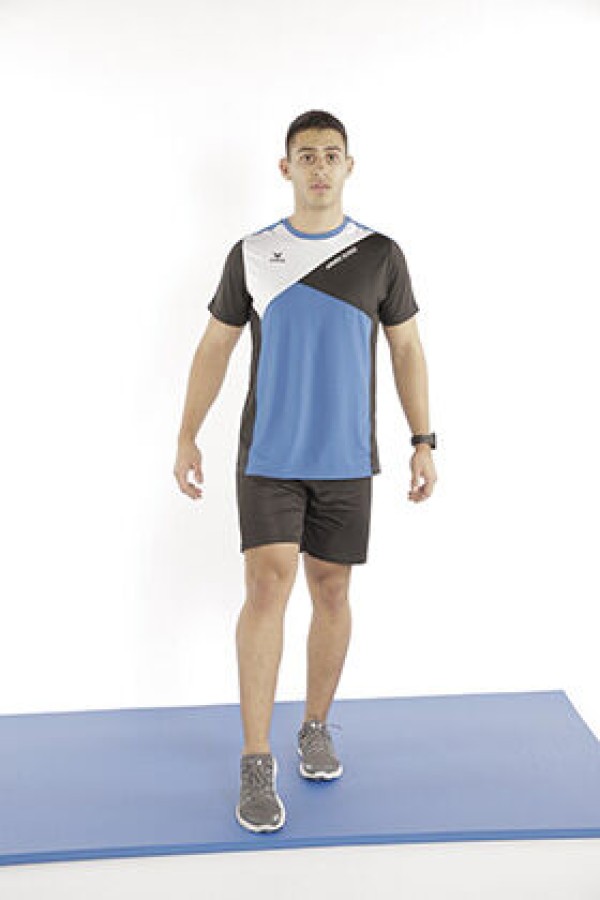

One-legged stand, standing leg (left) slightly bent, bring the other leg around the body in the shape of a pentagonal star (alternatively, only tap the corners of the star with the foot or always bring the foot to the centre in between).
Attention:
Keep the upper body upright (maintain balance).
Lighten:
Bend the supporting leg less (greater angle in the knee).
Harden:
Bend the supporting leg more (smaller angle in the knee); hold additional weight (on the leg or on the chest/shoulders, in the hands).
Variant:
Complete the exercise while jumping.
1 weight cuff/weight vest/weight disc/(medicine) ball/sandbag/fighting backpack/2 dumbbells ► make the exercise more difficult (additional weight)
Einbeinstand (left) ► single leg stability balance board
Power
Individual work

One-legged stand (left) on the balance board (board on the semicircular wedges, wide side of the board in front of the body), tilt forwards/backwards without the balance board touching the floor.
Attention:
Exercise is relatively difficult, at the beginning possibly against a wall for support or with the support of a partner.
Lighten:
Stand on the half-round wedges (without balance board); stand on the balance board with both legs.
Harden:
Balance board on the roller (instead of on the wedges).
Variant:
Tilt the narrow side of the board in front of your body, sideways, without the balance board touching the floor.
1 balance board
2 wedges (semicircular)
1 roller ► to make the exercise more difficult
Einbeinstand (right) ► single leg stability
Power
Individual work


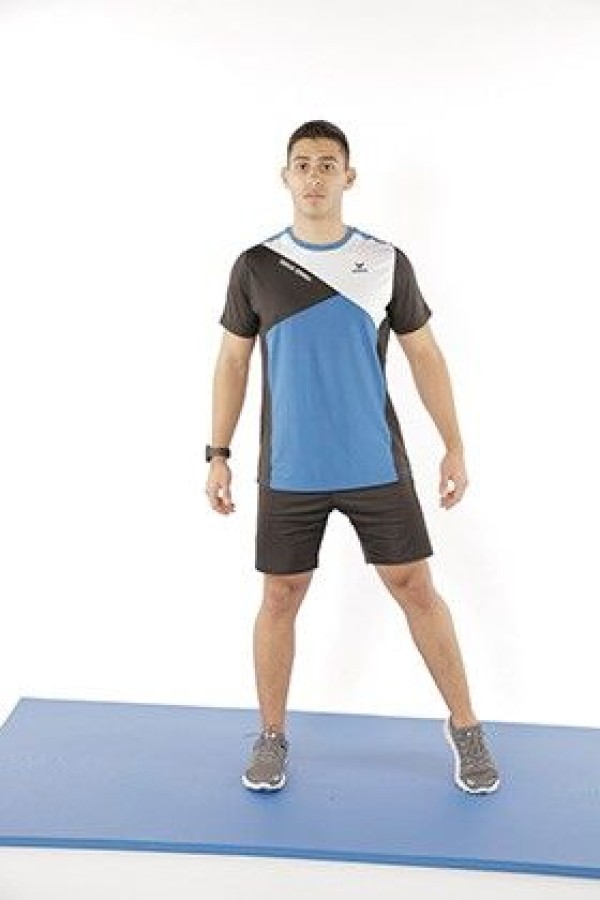
One-legged stand, standing leg (right) slightly bent, bring the other leg around the body in the shape of a pentagonal star (alternatively, only tap the corners of the star with the foot or always bring the foot to the centre in between).
Attention:
Keep the upper body upright (maintain balance).
Lighten:
Bend the supporting leg less (greater angle in the knee).
Harden:
Bend the supporting leg more (smaller angle in the knee); hold additional weight (on the leg or on the chest/shoulders, in the hands).
Variant:
Complete the exercise while jumping.
1 weight cuff/weight vest/weight disc/(medicine) ball/sandbag/fighting backpack/2 dumbbells ► make the exercise more difficult (additional weight)
Einbeinstand (right) ► single leg stability balance board
Power
Individual work
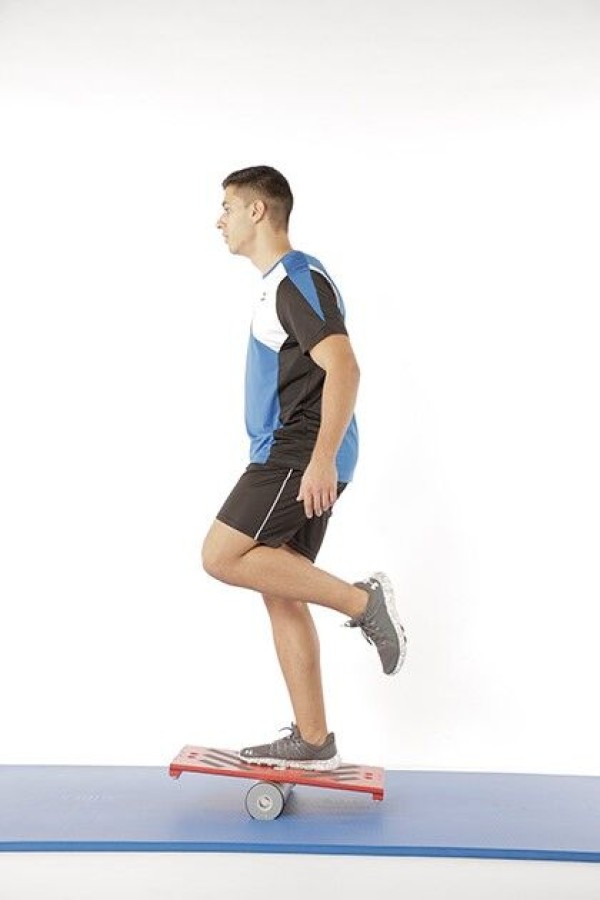
One-legged stand (right) on the balance board (board on the semicircular wedges, wide side of the board in front of the body), tilt forwards/backwards without the balance board touching the floor.
Attention:
Exercise is relatively difficult, at the beginning possibly against a wall for support or with the support of a partner.
Lighten:
Stand on the half-round wedges (without balance board); stand on the balance board with both legs.
Harden:
Balance board on the roller (instead of on the wedges).
Variant:
Tilt the narrow side of the board in front of your body, sideways, without the balance board touching the floor.
1 balance board
2 wedges (semicircular)
1 roller ► to make the exercise more difficult
Move one arm forwards or backwards alternately while kneeling ► front raise
Power
Individual work


Kneeling position, buttocks raised (do not sit on your heels) and upper body leaning slightly forwards. Hold a dumbbell in each hand and alternately stretch one arm straight forwards (parallel to the floor) and one arm backwards. Change arm position directly (arms straight forwards or backwards).
Starting position:
- Kneeling, buttocks slightly raised, upper body tilted forwards
- One arm extended forwards and one backwards
- Straight back, tension in the torso (no hollow back)
Finishing position:
- Other arm extended forwards or backwards than in the starting position. back than in the starting position
- Body position remains stable (straight back)
Variant:
Exercise performed in a standing position with the upper body leaning slightly forwards.
2 dumbbells
Einstein
Light-Contact
Partner work

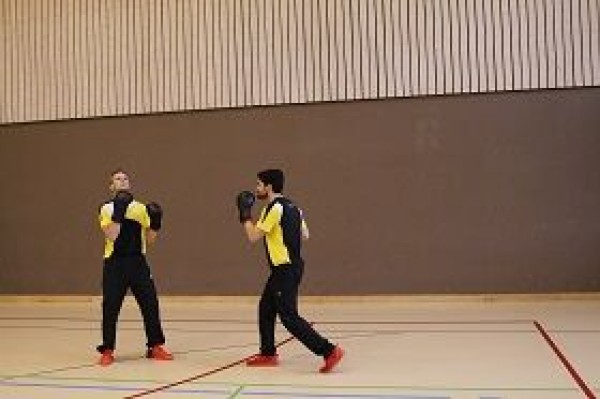

Two participants stand on two lines about 5 metres apart. One participant calls out an addition with two-digit numbers (e.g. "34 plus 23") and then runs to their opponent to score a hit. If he scores before the attacked player can complete the task, he receives one point. The defender receives a point if he states the result before he is hit. In the next round, the roles are swapped. Who has scored a certain number of points first or has scored more points after a certain time?
Variant:
Only shoulder and torso hits are counted.
Participant:
1 pair of boxing gloves