
Exercises (3302)
Lunge backwards (right) ► reverse lunge
Power
Individual work


Stand upright with your feet shoulder-width apart, arms supported on your hips or in front of you, move one foot (left) backwards and place it on the front foot, simultaneously bend the (front) standing leg (right) to approximately a right angle in the knee joint, then straighten the front leg (right) and move the back leg (left) forwards again to return to the starting position.
Attention:
Upright posture, front knee always remains behind the tip of the foot and centred over the foot.
Lighten:
Lower the upper body less (greater angle in the knee)/lead the free leg less far back.
Harden:
Additional weight (hold on the shoulders/in the hands).
1 weight vest/sandbag/barbell/2 dumbbells ► make the exercise more difficult (additional weight)
Lunge backwards alternating ► dumbbell reverse lunge
Power
Individual work
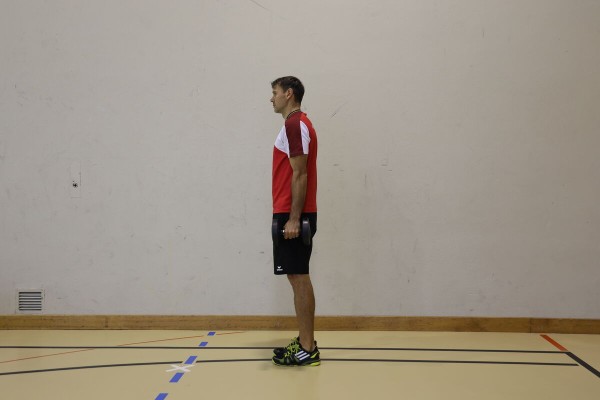
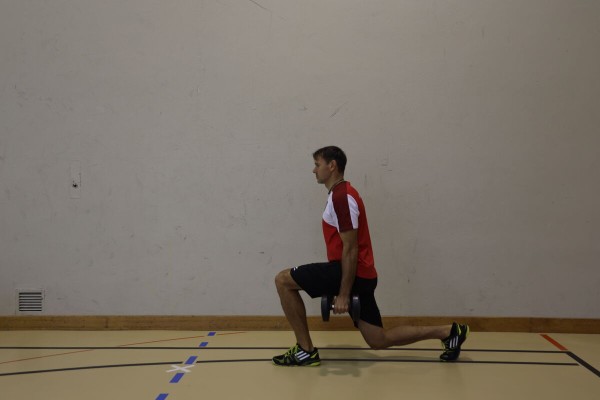
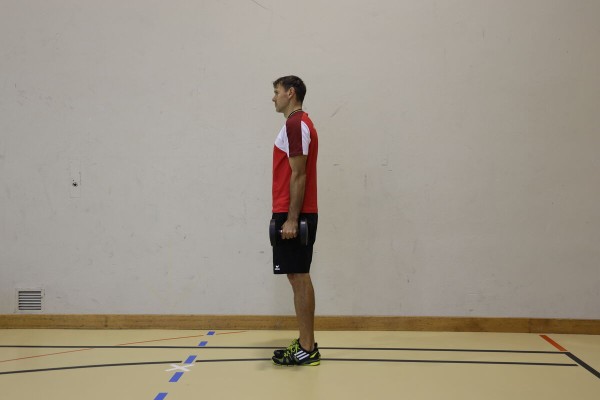
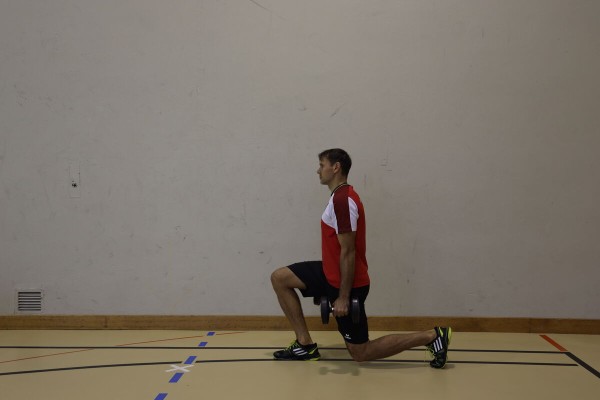
Stand upright shoulder-width apart, arms hanging next to the body, holding the weight (dumbbell or kettlebell) with each hand, move one foot backwards and place it on the front foot, simultaneously bend the (front) supporting leg to approximately a right angle in the knee joint, then straighten the front leg and move the back leg forwards again to return to the starting position. Change sides (the free leg that is moved backwards) after each execution.
Attention:
Upright posture, front knee always remains behind the tip of the foot and centred over the foot.
Lighten:
Lower the upper body less (greater angle in the knee)/lead the free leg less far backwards; hold less or no weight in the hands.
Harden:
More weight; additional weight.
Variation:
While bending the front leg, bend the arms at the same time for additional training of the upper body (arm flexors). While stretching the leg, also return the arms to the starting position.
2 dumbbells/kettlebells
1 weight waistcoat ► to make the exercise more difficult (additional weight)
Lunge backwards alternating ► reverse lunge
Power
Individual work
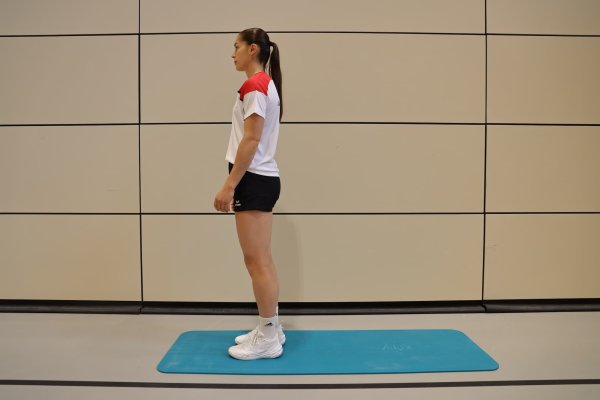
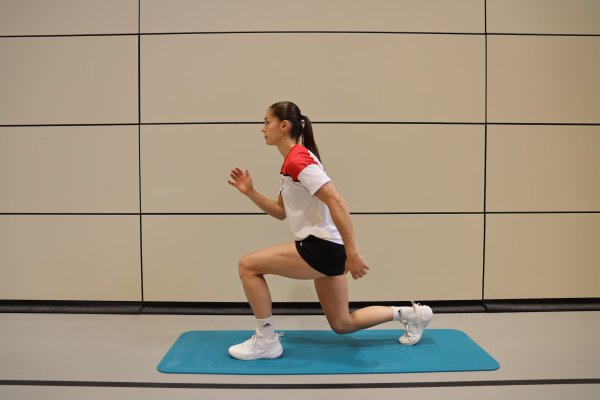
Stand upright with your feet approximately hip- to shoulder-width apart. Your feet should point forwards as much as possible, and your weight should be distributed evenly between them. Keep your upper body upright, look straight ahead and engage your abdominal muscles. Your pelvis should be in a neutral and stable position. The arms can be rested on the hips, held in front of the body or used to aid balance. Move one foot controlledly backwards and land on the front foot or the ball of the foot. Choose a step length that allows both legs to be bent in a controlled manner afterwards. Bend both knees and lower your body as vertically as possible. Bring the back knee towards the floor without letting it drop uncontrollably. The front foot remains fully on the floor and the weight is distributed evenly across it. Guide the front knee towards the tips of the toes in a controlled manner. From the bottom position, press firmly into the floor through the entire front foot. Bring the back leg forwards again and return to the starting position. Switch sides for the next repetition.
Attention:
The front knee falls noticeably inwards; the knee and the tip of the foot of the front leg point clearly in different directions; the upper body leans sharply forwards or to one side; the stride length is too short or too long, thereby preventing stable movement; the heel of the front foot lifts noticeably off the ground. The back knee is placed on the ground in an uncontrolled manner; when pushing up, the movement is generated mainly through the back leg; the pelvis rotates or shifts noticeably to one side; ensure your posture is stable and move your front knee in a controlled manner towards the tips of your toes; the entire front of your foot should remain as stable as possible on the floor during the loading phase.
Lighten:
Reduce the range of motion and lower your body less far; choose a stride length that feels comfortable and stable for you; lean lightly against a wall, pole or other stable object; Perform the movement slowly and return fully to the starting position after each repetition; start by doing several repetitions with the same leg and then switch sides.
Harden:
Hold dumbbells or kettlebells in your hands; use a weighted vest or sandbag; Use a barbell on your shoulders; deliberately slow the downward movement over 3–4 seconds; hold the bottom position steady for 2–3 seconds; combine the reverse lunge with a subsequent knee lift of the rear leg; carry additional weight on one side, thereby increasing the demands on core stability.
1 weight vest/sandbag/barbell/2 dumbbells ► make the exercise more difficult (additional weight)
Backward lunge with knee lift (left) ► reverse lunge to balance
Power
Individual work
Stand firmly with one foot (left) in the centre of the Airex pad/balance cushion. Take a controlled lunge backwards with the other leg (right) and bend both knees to about 90°. Push off powerfully through the heel of your front supporting leg (left), bring your back leg (right) straight forward, and, whilst standing on one leg, hold your knee at a 90° angle at hip height for 1–2 seconds.
Attention:
The front knee (left) remains aligned over the second toe and does not collapse inwards (no dynamic valgus).
The upper body remains stable and upright and does not slump forwards when pushing off.
The main weight remains on the supporting leg (left).
The athlete pushes back into the one-legged stance using strength rather than momentum.
Lighten:
Perform the exercise on a flat, firm indoor floor without an Airex pad or balance cushion.
Between the lunge and the knee lift, briefly place the rear foot in the centre of the floor (intermediate step).
Lean lightly against a wall or marking stick for support (balance).
Harden:
Hold a kettlebell or dumbbell in the rack position (in front of the chest).
In the upper one-legged stance, push down further onto the balls of the standing foot (calf raise).
Also wear a weighted vest.
1 balance cushion/Airex cushion
1 firm surface/floor ► makes the exercise easier
1 kettlebell/dumbbell ► makes the exercise more difficult (additional weight)
Backward lunge with knee lift (right) ► reverse lunge to balance
Power
Individual work
Stand firmly with one foot (right) in the centre of the Airex pad/balance cushion. Take a controlled lunge backwards with the other leg (left) and bend both knees to about 90°. Push off powerfully through the heel of your front supporting leg (right), bring your back leg (left) straight forward, and, whilst standing on one leg, hold your knee at a 90° angle at hip height for 1–2 seconds.
Attention:
The front knee (right) remains aligned over the second toe and does not collapse inwards (no dynamic valgus).
The upper body remains stable and upright and does not slump forwards when pushing off.
The main weight remains on the supporting leg (right).
The athlete pushes back into the one-legged stance using strength rather than momentum.
Lighten:
Perform the exercise on a flat, firm indoor floor without an Airex pad or balance cushion.
Between the lunge and the knee lift, briefly place the back foot in the centre of the floor (intermediate step).
Lean lightly against a wall or marking stick for support (balance).
Harden:
Hold a kettlebell or dumbbell in the rack position (in front of the chest).
In the upper one-legged stance, push down further onto the balls of the standing foot (calf raise).
Also wear a weighted vest.
1 balance cushion/Airex cushion
1 firm surface/floor ► makes the exercise easier
1 kettlebell/dumbbell ► makes the exercise more difficult (additional weight)
Lunge sideways (left) ► lateral lunge
Power
Individual work
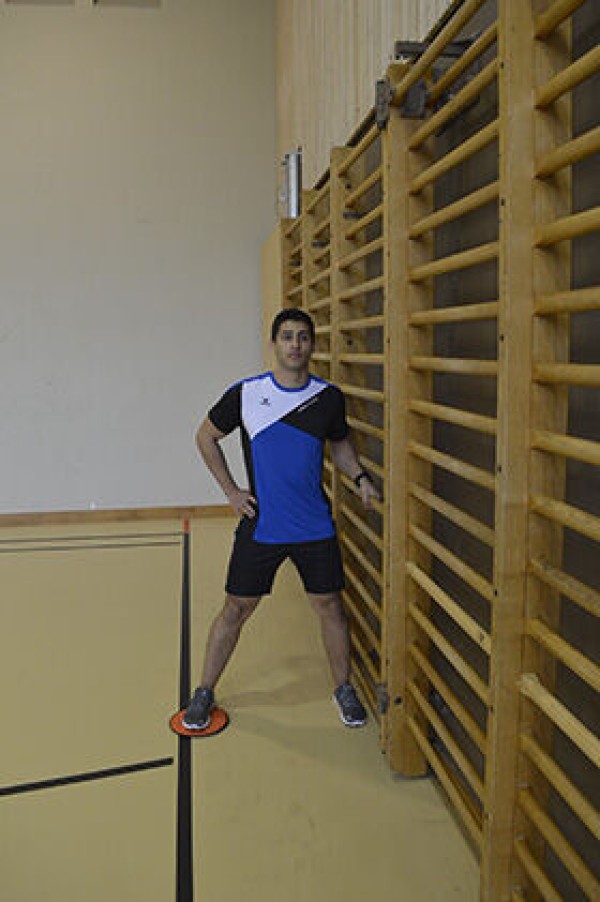

Stand to the side of the wall bars, hold on to the wall bars at chest height with the hand facing the wall bars, the leg facing the wall bars (right) is slightly bent, the other (left) leg is placed on a slippery surface, lead/spread the free leg (left) stretched out to the side as far as possible.
Attention:
Keep the upper body upright, keep the knee of the supporting leg centred over the foot, put weight on the whole foot.
Lighten:
Lower the side of the free leg.
Harden:
Do not hold on to the wall bars; unstable surface for the supporting leg.
1 wall bars/wall
1 carpet remnant/felt slipper/glider
1 ball/balance cushion/balance board ► make the exercise more difficult (unstable surface)
Lunge sideways (left) ► lateral lunge
Power
Individual work


From an upright shoulder-width stance with the dumbbells held in the hanging arms, perform a lunge to the (left) side (leg outstretched, supporting leg bent). Then push off the bent leg to return to the starting position in the standing position.
Starting position:
- Stand shoulder-width apart
- Your back is straight
- Let your arms hang loosely, grasp the dumbbells in a neutral grip
Finishing position:
- Back remains straight
- Look straight ahead
- Leg to be trained is bent, the other leg is stretched out to the side
- Buttocks point backwards, do not bring the knee of the training leg forwards (does not protrude beyond toes)
- Keep the knee of the supporting leg centred over the foot, put weight on the whole foot
- Thigh of the bent leg is parallel to the floor
- Dumbbells (almost) touch the floor
2 dumbbells
Lunge sideways (left) ► lateral lunge
Power
Individual work


Adjust the sling trainer to the length of the centre of the lower leg (when standing), stand on one leg (left) to the side of the attachment point, spread the closer (right) foot with the leg stretched out and fix it in the sling, bend and stretch the knee of the (left) standing leg (raise and lower the upper body).
Attention:
Do not allow the knee to move out to the side (keep it in line with the axis), move the buttocks backwards, not the knee forwards (the tip of the foot should not overhang the supporting leg).
Harden:
The further the supporting leg is to the side of the attachment point, the more challenging the exercise becomes.
1 sling trainer
Lunge sideways (right) ► lateral lunge
Power
Individual work


Stand to the side of the wall bars, hold on to the wall bars at chest height with the hand facing the wall bars, the leg facing the wall bars (left) is slightly bent, the other (right) leg is placed on a slippery surface, lead/spread the free leg (right) stretched out to the side as far as possible.
Attention:
Keep the upper body upright, keep the knee of the supporting leg centred over the foot, put weight on the whole foot.
Lighten:
Lower the side of the free leg.
Harden:
Do not hold on to the wall bars; unstable surface for the supporting leg.
1 wall bars/wall
1 carpet remnant/felt slipper/glider
1 ball/balance cushion/balance board ► make the exercise more difficult (unstable surface)
Lunge sideways (right) ► lateral lunge
Power
Individual work


From an upright shoulder-width stance with the dumbbells held in the hanging arms, perform a lunge to the (right) side (leg outstretched, supporting leg bent). Then push off the bent leg to return to the starting position in the standing position.
Starting position:
- Stand shoulder-width apart
- Your back is straight
- Let your arms hang loosely, grasp the dumbbells in a neutral grip
Finishing position:
- Back remains straight
- Look straight ahead
- Leg to be trained is bent, the other leg is stretched out to the side
- Buttocks point backwards, do not bring the knee of the training leg forwards (does not protrude beyond toes)
- Keep the knee of the supporting leg centred over the foot, put weight on the whole foot
- Thigh of the bent leg is parallel to the floor
- Dumbbells (almost) touch the floor
2 dumbbells
Lunge sideways (right) ► lateral lunge
Power
Individual work


Adjust the sling trainer to the length of the centre of the lower leg (when standing), stand on one leg (right) to the side of the attachment point, spread the nearer (left) foot with the leg stretched out and fix it in the sling, bend and stretch the knee of the (right) standing leg (raise and lower the upper body).
Attention:
Do not allow the knee to move out to the side (keep it in line with the axis), move the buttocks backwards, not the knee forwards (the tip of the foot should not overhang the supporting leg).
Harden:
The further the supporting leg is to the side of the attachment point, the more challenging the exercise becomes.
1 sling trainer
Lunge sideways alternating ► lateral lunge
Power
Individual work


Stand upright with your feet approximately hip- to shoulder-width apart. Your feet should point forwards as much as possible, with your weight distributed evenly between them. Keep your upper body upright and your abdominal muscles slightly tensed. Look straight ahead. Your arms can rest on your hips, be held in front of your chest, or be used to help maintain balance. Take a sufficiently large and controlled step to the side with one leg. Place your foot flat on the floor. Then bend the knee of the leg moved to the side whilst simultaneously moving the hip backwards and downwards. Keep the opposite leg as straight as possible. The entire foot of the bent leg remains on the floor, with weight distributed evenly. The knee should follow the direction of the toes. Keep your upper body as upright as possible, although a slight forward lean from the hips is acceptable. Then press firmly into the floor with the entire foot of the bent leg and return your body to the starting position. Change sides for the next repetition.
Attention:
The knee of the bent leg turns significantly inwards; the knee and the tip of the foot point in distinctly different directions; the heel of the bent leg lifts off the floor; body weight is mainly shifted onto the forefoot; the hips are not moved back far enough; the upper body leans heavily forwards or to one side; the opposite leg is bent unnecessarily sharply; the lateral step is too small, thereby preventing the movement from being performed cleanly; guide the knee of the bent leg in the direction of the toes and bear weight on the whole foot; perform the movement only as deeply as a stable and pain-free position can be maintained.
Lighten:
Reduce your range of motion and bend the affected leg less; Keep your hands on your hips rather than lowering them towards the floor; use a wall, pole or other stable object for light support; perform the movement slowly and in a controlled manner; return fully to the starting position after each repetition; start by performing several repetitions on the same side.
Harden:
Increase the range of motion and lower the hips further, provided the position remains stable; hold dumbbells or kettlebells in your hands; hold a weight plate or medicine ball in front of your chest; Use a weight vest, sandbag or barbell as additional weight; deliberately slow the downward movement over 3–4 seconds; hold the bottom position for 2–3 seconds; hold the additional weight on one side to increase the demands on core stability.
Variation:
Place a slide mat, a piece of carpet or a similar non-slip surface under one foot; let the corresponding leg slide out to the side in a controlled manner, whilst bending the supporting leg and moving the hip backwards; then bring the sliding leg back towards the centre of the body in a controlled manner.
1 weight vest/weight disc/(medicine) ball/barbell/sandbag/fighting backpack/2 dumbbells ► make the exercise more difficult (additional weight)
2 carpet remnants/felt slippers/gliders ► variation of the exercise
Lunge sideways alternating ► lateral lunge
Power
Individual work


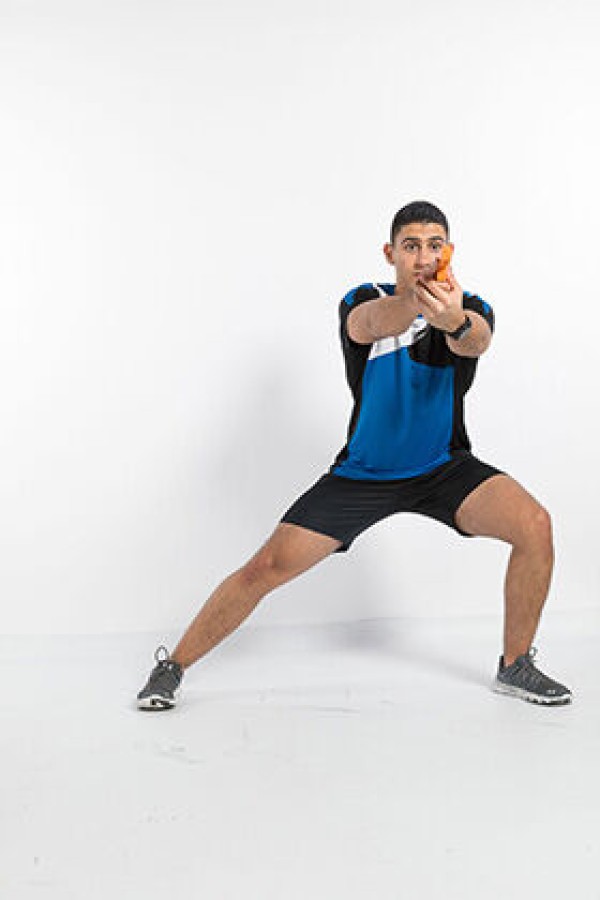
Standing lunge, lunge to the side in contact position with simultaneous bending of the legs and lowering of the upper body to move sideways and return to the standing position (movement as if you were ducking under a height limit). The next exercise is performed in the opposite direction so that you are back at the starting position.
Lighten:
Bend your knees less/barely lower your body.
Harden:
Bend your knees more/Centre of gravity very low.
1 Pistol
Lunge sideways alternating ► lateral lunge
Power
Individual work


Standing lunge, lunge to the side in contact position with simultaneous bending of the legs and lowering of the upper body to move sideways and return to the standing position (movement as if you were ducking under a height limit). The next exercise is performed in the opposite direction so that you are back at the starting position.
Lighten:
Bend your knees less/barely lower your body.
Harden:
Bend your knees more/Centre of gravity very low.
1 assault rifle (neutralised)
Lunge sideways alternating ► lateral lunge
Power
Individual work


Stand upright shoulder-width apart, feet in the loops, hold the gymnastics pole in front of the body with bent, parallel forearms (baby position), lunge to the side (leg stretched out, supporting leg bent), push off the bent leg to return to the starting position. Switch sides after each exercise.
Attention:
Keep your upper body upright, keep the knee of the supporting leg centred over the foot, put weight on the whole foot.
Lighten:
Choose less strong elastic bands; roll up the elastic bands less; bend the training leg less (lower the upper body less).
Harden:
Choose stronger elastic bands; roll up the elastic bands more.
1 gymnastic bar with elasticated straps
Lunge sideways alternating ► lateral lunge
Power
Individual work


From an upright shoulder-width stance with the dumbbells held in the hanging arms, perform a lunge to the side (leg outstretched, supporting leg bent). Then push off the bent leg to return to the starting position in the standing position. Switch sides after each exercise.
Starting position:
- Stand shoulder-width apart
- Your back is straight
- Let your arms hang loosely, grasp the dumbbells in a neutral grip
Finishing position:
- Back remains straight
- Look straight ahead
- Leg to be trained is bent, the other leg is stretched out to the side
- Buttocks point backwards, do not bring the knee of the training leg forwards (does not protrude beyond toes)
- Keep the knee of the supporting leg centred over the foot, put weight on the whole foot
- Thigh of the bent leg is parallel to the floor
- Dumbbells (almost) touch the floor
2 dumbbells
Lunge forwards alternating ► farmer walk
Power
Individual work

Grab an object with both hands (approx. 10kg), arms hanging at your sides. Carry objects back and forth between two fanjons, moving with lunges (back knee just touching the floor).
Attention:
Keep your back straight, your pelvis stable with every step, keep your shoulders fixed (lower towards your hips).
Lighten:
Equipment approx. 5kg
Harden:
Equipment approx. 15kg
2 fanjons
Weight 10kg
Weight 5kg ► make the exercise easier
Weight 15kg ► make the exercise more difficult
Lunge forwards alternating ► forward lunge
Power
Individual work


Stand upright, arms supported on the hips, folded across the chest or in front, lunge forwards, bend the front (and back) leg to a right angle (back knee briefly touches the floor), push off the front leg to return to the starting position. Switch sides for the next exercise.
Attention:
Always keep the front knee behind the tip of the foot and centred over the foot. Distribute your weight over the entire front foot. Keep an upright posture (tense torso), push your front knee outwards (do not tilt it inwards).
Lighten:
Lower your upper body less (greater angle at the knees).
Harden:
Additional weight (on the shoulders, with hanging arms or in a forward or upright position).
Variant I:
Push off the back leg to return to the standing position. The lunge creates locomotion.
Variant II:
Instead of bringing the front leg to a standing position, the back leg is brought directly forwards and the knee is bent (new lunge), creating continuous locomotion.
1 weight vest/weight disc/(medicine) ball/barbell/sandbag/fighting backpack/2 dumbbells ► make the exercise more difficult (additional weight)
Lunge forwards alternating ► forward lunge
Power
Individual work
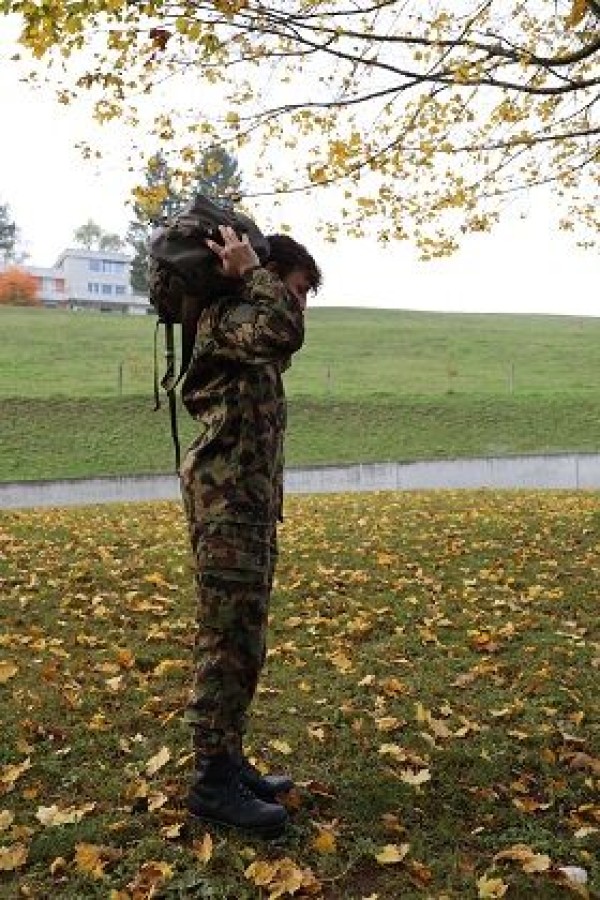
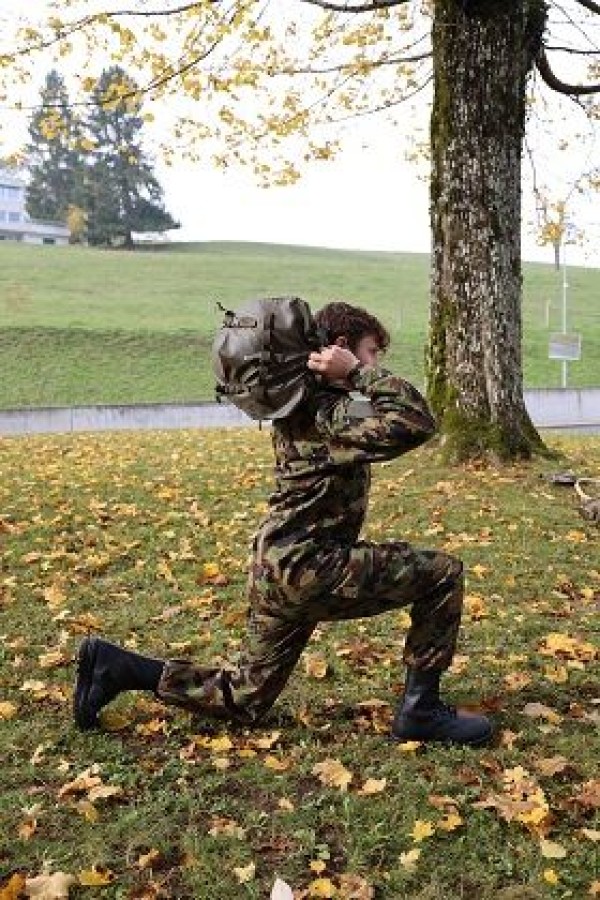
Stand upright, hold an object placed on your shoulder or neck (e.g. sandbag or rucksack) with your hands, lunge forwards, bend your front (and back) leg to a right angle (back knee briefly touches the floor), push off your front leg to return to the starting position. Switch sides for the next exercise.
Attention:
Always keep the front knee behind the tip of the foot and centred over the foot. Distribute your weight over the entire front foot. Keep an upright posture (tense torso), push the front knee outwards (do not tilt inwards).
Lighten:
Less weight/load; lower the upper body less (greater angle in the knees).
Harden:
More weight/increased load.
Variant I:
Push off the back leg to return to the standing position. The lunge creates locomotion.
Variant II:
Instead of bringing the front leg to the standing position, the back leg is brought directly forwards and the knee is bent (new lunge), creating continuous locomotion.
1 combat rucksack/sandbag (medium weight)
1 sandbag (light) ► make the exercise easier
1 weight vest/sandbag (heavy) ► make the exercise more difficult (additional weight)
Lunge forwards alternating with extension and flexion of the arms ► lunge & overhead press
Power
Individual work


Stand upright, place the barbell on your shoulder/neck or hold it in front of your chest and hold it with your hands more than shoulder-width apart. Lunge forwards, bend your front (and back) leg to a right angle (back knee practically on the floor), simultaneously straighten your arms and push the barbell upwards. Then bring the back leg forwards to perform another lunge (forwards movement). With each lunge, the weight is pushed upwards once (in the low lunge position, the arms are extended; in the upright single-leg position, the barbell is in the starting position).
Attention:
Always keep your front knee behind the tip of your foot and centred over your foot. Distribute your weight over the entire front foot. Keep an upright posture (no hollow back, tense torso), push your front knee outwards (do not tilt inwards).
Lighten:
Less weight/load; lower your upper body less (greater angle in the knees).
Harden:
More weight/greater load.
Variant I:
Attach a weight disc to both ends of the barbell with an elastic band. Due to the instability created by the swinging weight, the variation of the exercise also promotes sensorimotor skills and the exercise is significantly more challenging.
Variant II:
Push off the front leg to return to the standing position (no movement).
1 barbell
2 elastic bands and (small) weight discs ► variation of the exercise
Lunge forwards alternating with extension and flexion of the arms ► lunge & overhead press
Power
Individual work


Stand with your hips wide apart, hold the weight in front of your body, lunge forwards (approx. 60-90 cm), lower your hips to the floor until the back of your leg is parallel to the floor, bend your front leg to a right angle. From this position, the front lift is performed by raising the arms so that the weight is finally overhead. After a short pause in the lunge position with the arms held high, the front leg is pushed down to return to the standing position. Switch sides for the next exercise.
Attention:
Always keep the front knee behind the tip of the foot and centred over the foot. Distribute your weight over the entire front foot. Stand upright (tense torso), push the front knee outwards (do not tilt inwards).
Lighten:
Less or no additional weight; lower the upper body less (greater angle in the knees).
Harden:
More weight.
Variant I:
Push off the back leg to return to the standing position. The lunge creates locomotion.
Variant II:
Instead of bringing the front leg to the standing position, the back leg is brought directly forwards and the knee is bent (new lunge), creating continuous locomotion.
1 medicine ball/weight disc/dumbbell
1 weight waistcoat ► to make the exercise more difficult (additional weight)
Lunge forwards alternating with rotation of the upper body
Power
Individual work
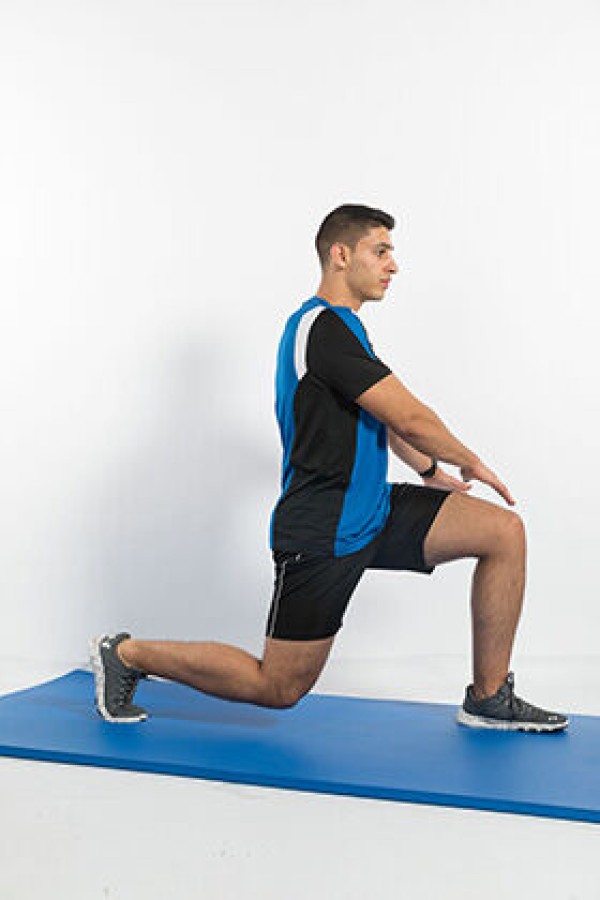
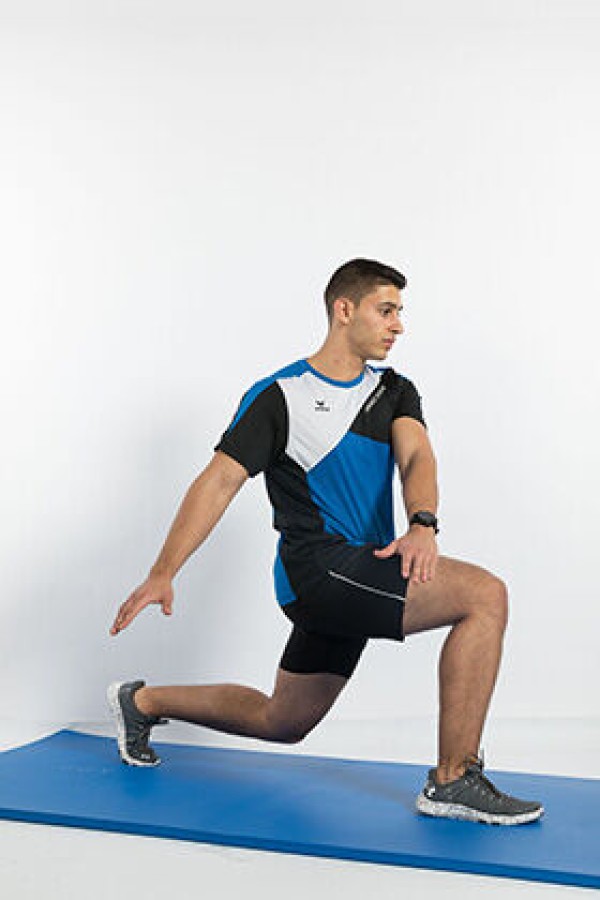
Stand upright, arms stretched as far as possible in front, lunge forwards, bend the front (and back) leg to a right angle, rotate the upper body to the side of the front leg and back in the lunge position (look at the movement), push off the front leg to return to the starting position. Switch sides for the next exercise.
Attention:
Always keep the front knee behind the tip of the foot and centred over the foot. Distribute weight over the entire foot. Stand upright (tense torso), push the front knee outwards (do not tilt inwards).
Lighten:
Lower the upper body less (greater angle in the knees).
Harden:
Additional weight (hold in hands).
Variant I:
Push off the back leg to return to the standing position. The lunge creates locomotion.
Variant II:
Instead of bringing the front leg back to the standing position, the back leg is brought forwards and the knee is bent (new lunge), creating continuous locomotion.
1 weight vest/weight disc/(medicine) ball/1-2 dumbbells ► make the exercise more difficult (additional weight)
Lunge forwards alternating with rotation of the upper body
Power
Individual work


When standing upright, hold an object (e.g. helmet or rucksack) at chest height with arms almost outstretched, lunge forwards, bend the front (and back) leg to a right angle (back knee briefly touches the floor), rotate the upper body/object to the side of the front leg and back in the lunge position (gaze accompanies the movement), push off the front leg to return to the standing position in the starting position. Switch sides for the next exercise.
Attention:
Always keep the front knee behind the tip of the foot and centred over the foot. Distribute your weight over the entire front foot. Keep an upright posture (tense torso), push the front knee outwards (do not tilt inwards).
Lighten:
Less weight/load; lower the upper body less (greater angle in the knees).
Harden:
More weight/increased load.
Variant I:
Push off the back leg to return to the standing position. The lunge creates locomotion.
Variant II:
Instead of bringing the front leg to the standing position, the back leg is brought directly forwards and the knee is bent (new lunge), creating continuous locomotion.
1 combat rucksack/weight plate/dumbbell
1-2 PET bottles (1.5 litres)/helmet ► make the exercise easier
1 tyre (PUCH)weight vest/sandbag ► make the exercise more difficult (additional weight)
Lunge forwards alternating with rotation of the upper body
Power
Individual work


Stand upright with your feet in the loops, hold the gymnastics pole with your hands on your shoulders behind your head, perform a lunge forwards, front leg bent (approximately right angle in the knee joint), back leg almost fully extended on tiptoe, move/rotate your upper body from one side to the other (head accompanies the movement), push off the front leg to return to the starting position. Switch sides after each lunge.
Attention:
The hips and knees point forwards during the entire movement. The front knee always remains behind the toe and centred over the foot. Lower your body in the centre (like a plumb line following the back knee, upper body remains upright, tighten your stomach).
Lighten:
Select less strong elastic bands; roll up the elastic bands less.
Harden:
Choose stronger elastic bands, roll up the elastic bands more.
Variant:
To relieve pressure on the neck, the gymnastic stick can also be held in front of the body at sternum level (baby position).
1 gymnastic bar with elasticated straps
Leakage
Leakage
Group work
One column (distance approx. 1 metre from participant to participant)
The participants move in a circle, the sports leader walks in the opposite direction to demonstrate the movement tasks.
The instructor moves forwards, backwards or sideways in the hall/area and incorporates various relaxation exercises (e.g. shaking out arms and legs). The participants copy the movements identically. If desired, a section can also be covered marching so that you can concentrate on breathing (hold your arms up to inhale and exhale completely when lowering your arms).
No material required