
Exercises (3302)
Blocking
Light-Contact
Partner work
Presentation by leader.
The groups of 2 then practise the movements (including role reversal); the leader corrects them.
One way of blocking from the basic position is simply to turn out the respective hand and bring it forwards (crosswise) in order to ward off/block the attacker's punch with the palm of the hand (fist against palm).
Participant:
1 pair of boxing gloves
Block / evasive manoeuvre with counterattack
Light-Contact
Partner work
Presentation by leader.
The groups of two then practise the movements (including role reversal); the leader corrects. If necessary, an exercise sequence is also performed in the group.
This sequence of movements combines blocking and dodging with a counter (lead hand and punching hand). One participant slowly strikes 4x in the direction of their partner's forehead (2x left/right). The defender blocks the punches twice (left/right) and then dodges twice and simultaneously performs a counter-punch (left/right).
Blocking:
When blocking, the respective hand is turned out from the basic position and brought forward (crosswise) to ward off/block the attacker's punch with the palm of the hand (fist against palm).
Leading hand:
When countering with the leading hand (example left side), the front foot remains stable in place, the weight is shifted to the rear (right) foot (tilt the upper body backwards slightly). To avoid the opponent's punch, the body weight is not only shifted backwards, but the upper body is also tilted to the side (outwards - to the right). Finally, you follow up with your own punch (jab) with the (left) lead hand (on the "inside" side).
Punching hand:
When countering with the punching hand (example right side), you take a step to the (left) side (sidestep), shifting your weight to the front (left) foot. Finally, the own punch (straight) follows with the stronger hand (on the "inner" side).
Exercise:
In groups of 2, the blocking and dodging including the counter punch is practised. This involves blocking and dodging twice on one side and then on the other (lead hand and punching hand). The sequence of movements is practised very slowly at first; the speed can only be increased once the sequence of movements has been completely mastered. The roll can be changed after each pass or after several passes. In order to gain more confidence in the sequence of movements, it is advisable to do several passes in succession. It also makes sense to change partners from time to time (variety and different levels of participants). The instructor can make the exercise more difficult by no longer clearly defining the attacking side (e.g. 2 attacks each to block and evade - side arbitrarily determined by the attacker - change roles - change partners).
Participant A: 2x punch left + right (jab + straight) / Participant B: Block left + right plus dodge with counter (lead hand and punching hand)
Variant:
All participants perform the sequence of movements (= participant B; see above) together (same front - rotate the alignment by 90 degrees after each pass). The instructor counts slowly from 1-4 for the individual steps (block left - block right - dodge incl. counter with the lead hand - dodge incl. counter with the punching hand). The instructor takes the opportunity to make corrections.
Participant:
1 pair of boxing gloves
Blocking with punching hand
Light-Contact
Partner work
Constant role and partner changes
.Position:
Elbows close to the upper body, arms remain where they are in the boxing position, slight shoulder rotation against the punch (3cm).
- Participant A: punch with lead hand
- Participant B: block with punching hand
- Participant A: punch with lead hand, block with punching hand
- Participant B: Block with punching hand, counter with jabbing hand
Variation:
Apply what you have learnt in a short 1:1 match (slowly + carefully; don't hit too hard at the beginning).
Participant:
1 pair of boxing gloves
Boccia
Leakage
Group work
Groups of 4 to 6
Each member of a small group tries to throw one of their shoes as close as possible to a previously defined target (by hand or by foot). The group members receive different numbers of points based on their ranking. Which member of the group collects the most points in a given time.
Variant:
The participants throw one of their shoes as close as possible to the defined target.
Per group:
1 marking cone / cone
Boccia
Leakage
Group work
Groups of 4 to 6
Each participant in a small group tries to pass as close as possible to a previously defined target (e.g. goalpost, tree, candelabra, rings, colouring sticks, cones or similar objects distributed around the room) with their aid. The group members receive different numbers of points based on their ranking. Which member of the group collects the most points in a given time?
Per participant:
1 ball ►FooBaSKILL, futsal/football, intercross/lacrosse, smolball, floorball
1 racket/stick ►badminton/speedminton, intercross/lacrosse, smolball, floorball
1 disc (frisbee) ►Frisbee Ultimate
x targets (e.g. colouring sticks / cones / rings / etc.)
Ground contact
Partner acrobatics
Group work
Groups with 3-10 participants
The participants form groups of 3-10 people. The sports leader specifies the number of limbs that may touch the floor within the group. Through skilful acrobatic exercises and a little ingenuity, the groups fulfil the sports leader's specifications.
No material required
Floor press
Fighting and roughhousing games
Partner work
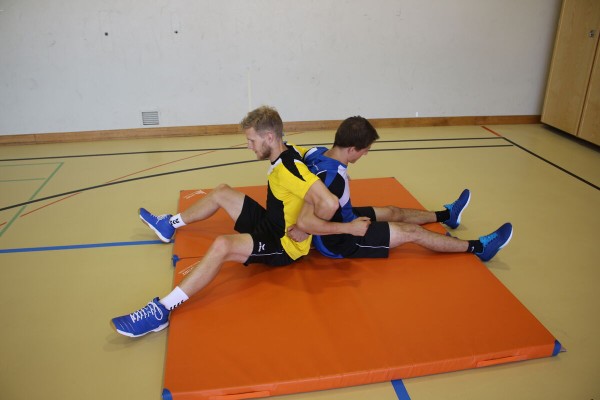
The participants sit back to back with their legs slightly bent in the centre of a mat/lawn area. The participants' arms are interlocked. The aim is to press the opponent's right or left shoulder to the ground. The side is changed with each pass.
2 soft mats (small) ►indoor version
2 tent groundsheets ►outdoor version
Indoor post assembly:
Connect the soft mats to each other on the wide side using Velcro.
body scan
Relaxation
Lying or sitting:
1. 1 min. calm breathing
2. attention to the feet
3. legs
4. hip/abdomen
5. back
6. shoulders
7. arms/Hands
8. neck
9. face
10. 1 min. Perceive the whole body
No special breathing technique required – just breathe calmly and consciously.
Bowling
Leakage
Group work
Groups of 4 to 6
The participants roll balls onto ten clubs/turned over marker cones set up in a triangle. How many attempts do the participants need until all the clubs/marker cones have fallen over? In the meantime, the waiting participants perform some relaxation and stretching exercises.
Per group
3 balls
10 clubs / marking cones
box breathing
Relaxation
4-4-4-4
Inhale 4 sec.
Hold 4 sec.
Exhale 4 sec.
Hold 4 sec.
Repeat for 5 minutes – great after an intense workout or a stressful day.
Boardball
Stimulate circulation
Group work
2 teams
Two teams play against each other in a limited playing area. A point is scored when a pass via a basketball board (alternative: defined zone on a wall) is caught by a teammate. Bouncing with the ball is not allowed and the number of steps with the ball is limited (e.g. maximum 3 steps)
Optional: change of possession when the ball falls to the ground
2 basketball hoops/walls with a defined target zone
1 ball (e.g. basketball, handball, volleyball, football)
4 marking cones/caps ►court boundary (optional)
x game ribbons/bibs ►team identification
Boardball
Stimulate circulation
Group work
2 teams
Two teams play against each other in a limited playing area. A point is scored when a pass via a basketball board (alternative: defined zone on a wall) is caught by a teammate with the racket.
The following rules apply to the game form:
- The ball, which is balanced on the racket, may be carried a maximum of 4 steps and must then be passed immediately.
- The ball may be touched a maximum of 4 times before it is passed on.
- The ball at rest on the racket, without movement of the player, may be held for a maximum of 4 seconds.
- The ball may not be covered with the racket or body, but must be passed on immediately.
- The ball may not be covered with the racket or the body, but must be played on immediately.
- It is not permitted to actively play the ball with the foot or lower leg, with the hand, the arm or the head (free hit).
- If the ball leaves the playing field, it is put back into play by a free hit by the opposing team at the place of action.
Per participant:
1 racket ►smolball
2 basketball hoops/walls with a defined target zone
1 ball ►smolball
4 marking cones/caps ►court boundary (optional)
x playing ribbons/shims ►team identification
Boardball
Stimulate circulation
Group work
2 teams
Two teams play against each other in a limited playing area. A point is scored when a pass via a basketball board (alternative: defined zone on a wall) is caught by a teammate.
The following rules apply to the game:
- The ball may only be handled with a stick. A player may hold the ball in the basket for a maximum of 5 seconds.
- If a ball lands out of bounds, the player who puts the ball back into play can either run into the court with the ball or play a pass from the sideline (observe the 5-second rule).
- If the ball falls to the floor, players have the option of picking it up with their stick or "covering" it. To cover the ball, cover it with the basket of the stick. After covering the ball with the basket, the opponents must keep a distance of 3 metres and the player with the ball must make a pass (it is not possible to continue running after covering).
- An attack must be executed within 30 seconds.
- Intercrosse is played without contact between body/body and body/stick.
- The player with the ball may only run or stand (star step allowed). Walking is prohibited. When running, the stick must be held in both hands. Catching, throwing or "covering" is permitted with one hand.
- The ball may not be touched with the hand.
Per participant:
1 stick ►intercrosse/lacrosse
2 basketball hoops/walls with a defined target zone
1 ball ►intercrosse/lacrosse
4 marking cones/caps ►court boundary (optional)
x game ribbons/bibs ►team identification
Boardball
Increase pulse
Group work
2 teams
Two teams play against each other in a limited playing area. A point is scored when a pass via a basketball board (alternative: defined zone on a wall) is caught by a teammate. Bouncing with the ball is not allowed and the number of steps with the ball is limited (e.g. maximum 3 steps)
Optional: change of possession when the ball falls to the ground
2 basketball hoops/walls with a defined target zone
1 ball (e.g. basketball, handball, volleyball, football)
4 marking cones/caps ►court boundary (optional)
x game ribbons/bibs ►team identification
Boardball
Increase pulse
Group work
2 teams
Two teams play against each other in a limited playing area. A point is scored when a pass via a basketball board (alternative: defined zone on a wall) is caught by a teammate with the racket.
The following rules apply to the game form:
- The ball, which is balanced on the racket, may be carried a maximum of 4 steps and must then be passed immediately.
- The ball may be touched a maximum of 4 times before it is passed on.
- The ball at rest on the racket, without movement of the player, may be held for a maximum of 4 seconds.
- The ball may not be covered with the racket or body, but must be passed on immediately.
- The ball may not be covered with the racket or the body, but must be played on immediately.
- It is not permitted to actively play the ball with the foot or lower leg, with the hand, the arm or the head (free hit).
- If the ball leaves the playing field, it is put back into play by a free hit by the opposing team at the place of action.
Per participant:
1 racket ►smolball
2 basketball hoops/walls with a defined target zone
1 ball ►smolball
4 marking cones/caps ►court boundary (optional)
x playing ribbons/shims ►team identification
Boardball
Increase pulse
Group work
2 teams
Two teams play against each other in a limited playing area. A point is scored when a pass via a basketball board (alternative: defined zone on a wall) is caught by a teammate.
The following rules apply to the game:
- The ball may only be handled with a stick. A player may hold the ball in the basket for a maximum of 5 seconds.
- If a ball lands out of bounds, the player who puts the ball back into play can either run into the court with the ball or play a pass from the sideline (observe the 5-second rule).
- If the ball falls to the floor, players have the option of picking it up with their stick or "covering" it. To cover the ball, cover it with the basket of the stick. After covering the ball with the basket, the opponents must keep a distance of 3 metres and the player with the ball must make a pass (it is not possible to continue running after covering).
- An attack must be executed within 30 seconds.
- Intercrosse is played without contact between body/body and body/stick.
- The player with the ball may only run or stand (star step allowed). Walking is prohibited. When running, the stick must be held in both hands. Catching, throwing or "covering" is permitted with one hand.
- The ball may not be touched with the hand.
Per participant:
1 stick ►intercrosse/lacrosse
2 basketball hoops/walls with a defined target zone
1 ball ►intercrosse/lacrosse
4 marking cones/caps ►court boundary (optional)
x game ribbons/bibs ►team identification
Board disc
Stimulate circulation
Group work
2 teams
Two teams play against each other in a limited playing area. One point is scored when the Frisbee is thrown at the basketball board (alternative: defined zone on a wall), two points are scored when the Frisbee falls through the basket. It is not allowed to run with the Frisbee and physical contact is prohibited. Opponents must keep an arm's length away from the thrower (passer). If the Frisbee leaves the court or falls to the ground, ownership of the disc changes.
Variant:
In order to prevent uncontrolled (dangerous) long throws, a throwing area can be defined from which throws may be made onto the basketball board (e.g. within the 3-point zone of the basketball court).
2 basketball hoops/walls with a defined target zone
1 throwing disc (frisbee) ► Frisbee Ultimate
4 marking cones/caps ►court boundary (optional)
x game ribbons/bibs ►team identification
Letter relay
Increase pulse
Group work
4-5 participants per group
There are numerous letter tokens (letters face down) at the turning point, which are available to all groups. The runners each pick up a token (it is not possible to swap) and bring it to the group. If there are no more tokens available or after a time limit set by the sports leader, the groups have 2 minutes to form (correct) words. Each letter used for a word is worth one point. Which group scores the most points?
Variant:
Which group is the first to have all the necessary letters to form a word defined by the sports instructor? In this variant, the token is looked at at the reversal point, if it can be used, it is taken to the group. If the letter cannot be used (already present in the solution word), the token is left behind and the group returns to the group without a new letter before sending the next runner off to the tokens with a handshake.
Stopwatch
x letters/tokens
Burgball
Stimulate circulation
Group work
6-10 participants per group
One team in possession of the ball forms a circle around a Swedish box. The other team stands in the circle and tries to prevent the box from being hit with the ball. After each hit or catch of the ball by the defenders, the roles of the teams are swapped (if necessary, also swap if the ball is missed or dropped).
Variant:
Place a gym ball on the vaulting box, which must be hit.
1 vaulting box
1 ball (e.g. foam/softball or handball) ►handball
1 exercise ball ►variant
Choreo
Mobilisation of the joints / dynamic stretching
Group work
To the beat of the music, one participant demonstrates a mobilisation exercise for the joints or a dynamic stretching exercise (functional gymnastics with rocking movements). The whole group then performs the exercise together. The next participant (in the group or determined by the sports leader) demonstrates a new exercise. The exercises are combined using the add-on method (exercise 1, then exercise 2, then exercise 1+2 together, etc.). Any number of exercises can be combined to form a small choreography.
1 music system incl. music (various)
Crane Jump
Parkour
Individual work
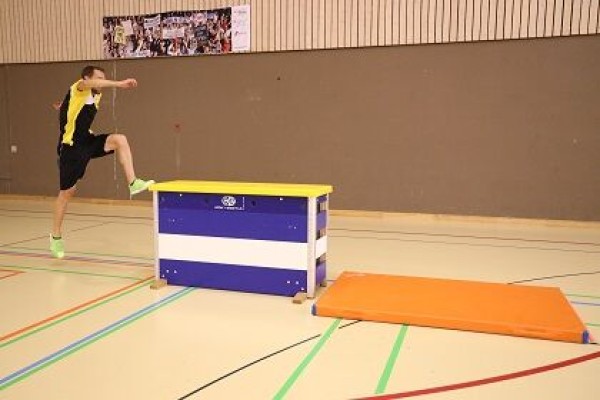
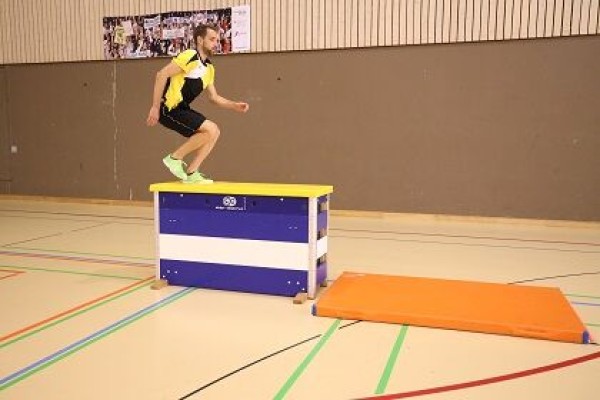
Short run-up to the vaulting box (obstacle - e.g. wall ► outdoor variant), one-legged jump from the run, landing with the other foot on the box (step jump).
Variant:
Place a lower vaulting box in front of the vaulting box (2-3 elements) and jump in a step jump first onto the small box and then onto the large box.
1 vaulting box ►indoor version
1 soft mat (small) ►indoor version
2-3 vaulting box elements incl. top section ►variation of the exercise
Indoor set-up:
Place a soft mat behind a vaulting box.
Variation: Place a lower box in front of the vaulting box.
outdoor:
A raised obstacle (wall or similar).
Endurance run
Basic training
Group work
In (small) groups according to running speed or individually
An endurance run in (small) groups (based on running speed) or individually on a flat course. The running speed remains constant the whole time (choose the appropriate speed depending on the strength class).
Course: loop; from A to B; from A to B and back again
Intensity level: 2-3 (easy-medium)
Hmax: 70-90%
Rule of speech: chatting - speaking in full sentences
Attention:
The course must be known or clearly signalled to all participants.
Variant:
Change the course of the route (e.g. integrate inclines).
Signalling (e.g. route tape)
Evaluation FTA (group formation)
Participant:
1 heart rate monitor
Endurance run with increased intensity
Basic training
Group work
In (small) groups according to running speed or individually
An endurance run in (small) groups (based on running speed) on a flat course. The running speed is increased from time to time (choose the appropriate pace depending on the strength class), but the specified intensity levels are maintained.
Course: loop; from A to B; from A to B and back again
Intensity level: 1-3 (very easy-loose-medium)
Hmax: 60-90%
Speaking rule: sing-chatter-speak in full sentences
Caution:
The course must be known or clearly signalled to all participants.
Variant:
Change the course (e.g. integrate inclines).
Signalling (e.g. route tape)
Evaluation FTA (group formation)
Participant:
1 heart rate monitor
Daumenjudo
Fighting and roughhousing games
Partner work

Two participants hold hands crosswise with their thumbs in the air. On command, both try to catch the opponent's thumb with their own thumb and press it down. The winner is the one who can hold their opponent's thumb for two seconds. Switch sides after each round.
No material required
Cover work
Light-Contact
Individual work
From the shoulder-width boxing position, a tennis ball is bounced with one hand while the other hand is always held at the temple. The participant moves freely on their feet as if on a track (forwards, backwards, sideways - also in a circle, bouncing the tennis ball at the same point).
Variant:
A fight between everyone (or duel): the participant whose tennis ball touches the floor or is held twice in succession completes an additional task (press-ups, stretch jumps, squats). The opponent's tennis ball may be touched, but there is no physical contact.
1 Tennisball