
Exercises (3302)
Alternating push-up and jump into the distance ► burpee broad jump
Power
Individual work


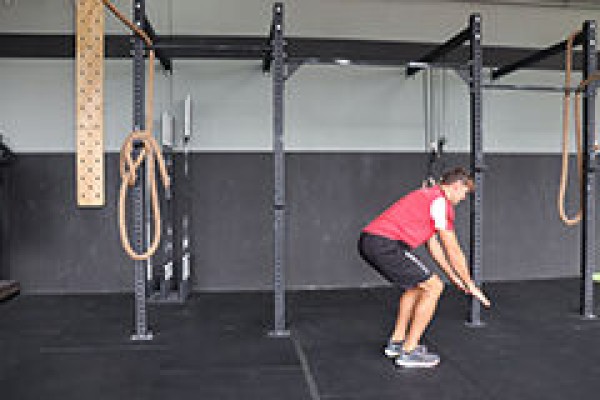


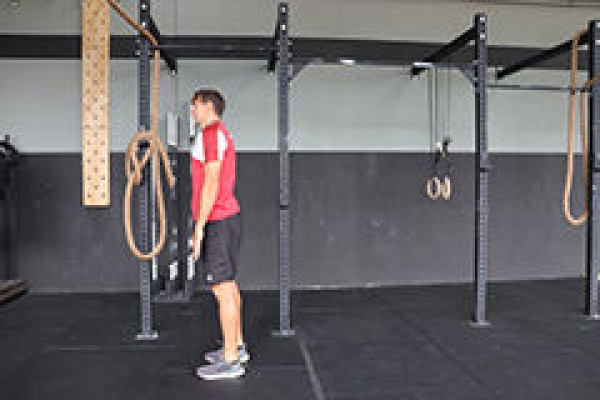
From a standing position, bend your legs and place your hands next to your feet to get into a squat position. Support yourself with your hands, jump backwards with both legs to get into the push-up position. Bend your arms to fully lower your upper body (prone position). From the prone position, push back into the push-up position with both arms and jump back into a squat position. From the squat position, tilt your upper body slightly forwards, stretch your arms backwards at an angle to your body (like a ski jumper on a ski jump), push off the floor powerfully to perform a jump into the air (use the momentum of your arms). Then land in a controlled manner (cushion the jump; bend your knees), stretch your legs and straighten your upper body to get to a standing position. A half turn around your own body axis (180 degrees) before the next exercise ensures that not too much space is required so that you can land again at the original location/starting point.
Attention:
No hollow back in the push-up position (body tension); land as softly as possible on the floor (cushion the jump with your knees) and lower your buttocks backwards (do not move your knees forwards), maintain your balance with bent knees after each landing.
Lighten:
Lower intensity between each execution; less wide/intense jumps.
Harden:
Additional weight; wider/intense jumps; adjust the terrain (incline).
Variation:
Jump over an obstacle.
2-4 weight cuffs/1 weight waistcoat 2-4 weight cuffs/1 weight waistcoat ► Make the exercise more difficult (additional weight)
1 bench/ball/hurdles/kettlebell/fighting backpack/helmet etc. ► Variation of the exercise (obstacle)
Push-ups followed by a broad jump, alternating with a reverse bear crawl ► burpee broad jump to alternating reverse bear crawl
Power
Individual work
From a standing position, the athlete quickly squats down, places their hands on the ground and jumps backwards into a push-up position, with their body lying completely flat on the ground. This is immediately followed by pushing up and bringing the feet alongside the hands into a deep squat. From this position, a two-legged long jump is performed with the arms swinging as far forward as possible, landing softly, quietly and deeply on the full sole of the foot. Directly from the landing position, the hands touch down in front of the body to assume the bear crawl position with the knees close to the ground. The return to the starting point is performed backwards in three to four steps using strict diagonal coordination (right hand with left foot, left hand with right foot), after which the next burpee begins immediately at the starting point.
Attention:
In the long jump, the landing is loud, hard or with the knees straight.
The knees buckle inwards on landing.
The back arches excessively upwards during the bear crawl, or the buttocks rise high into the air.
When pushing up from a prone position, the lumbar spine sags completely.
The landing must be cushioned silently across the entire foot.
When crawling backwards, the opposite limbs must always work together in strict coordination.
During the bear crawl, the back remains as flat as a table.
Lighten:
When doing a burpee, step your feet backwards and forwards one after the other instead of jumping.
Omit the flat push-down onto the floor and simply move into the high push-up position.
Instead of the long jump forwards, take two long lunges forwards.
Harden:
Complete the entire exercise whilst wearing a weighted vest.
Immediately after the long jump, take a second long leap forwards before crawling backwards.
1 Weighted vest ► makes the exercise more difficult (additional weight)
Push-up and stretch jump alternating ► double push up burpee
Power
Individual work


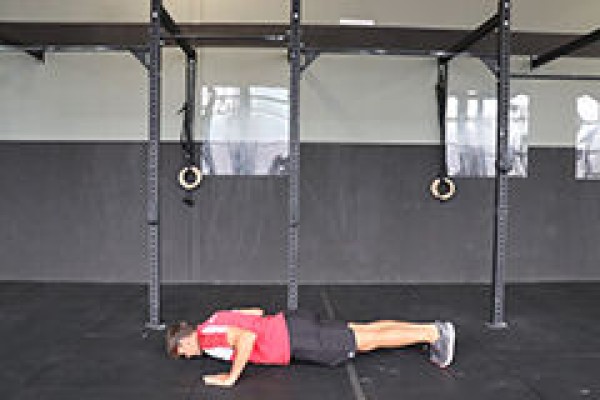
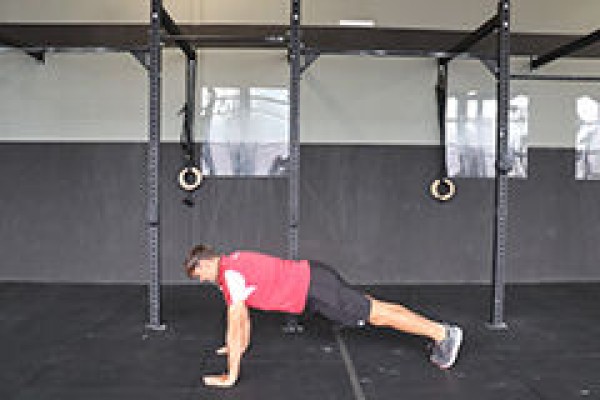


From a standing position, bend your legs, place your hands in front of your feet and hop backwards with both legs at the same time to get into the push-up position. In the push-up position (high support, face/look down), bend and stretch your arms twice (bring your chest to the floor). Then jump back forwards with both legs to the starting position of the legs. From the squatting position, perform a stretch jump (optionally cross your arms briefly behind your head during the flight phase) and land back in the starting position to begin the exercise again.
Attention:
Do not perform a hollow back in the push-up position (body tension).
Lighten:
Lower intensity between the individual exercises; lower height during the stretch jump (or only straighten the upper body); only assume the push-up position without bending or straightening the arms (do not perform push-ups) or integrate only one push-up instead of two.
Harden:
Additional weight.
2-4 weight cuffs/1 weight waistcoat ► Make the exercise more difficult (additional weight)
Alternating push-ups and lifting an object
Power
Individual work
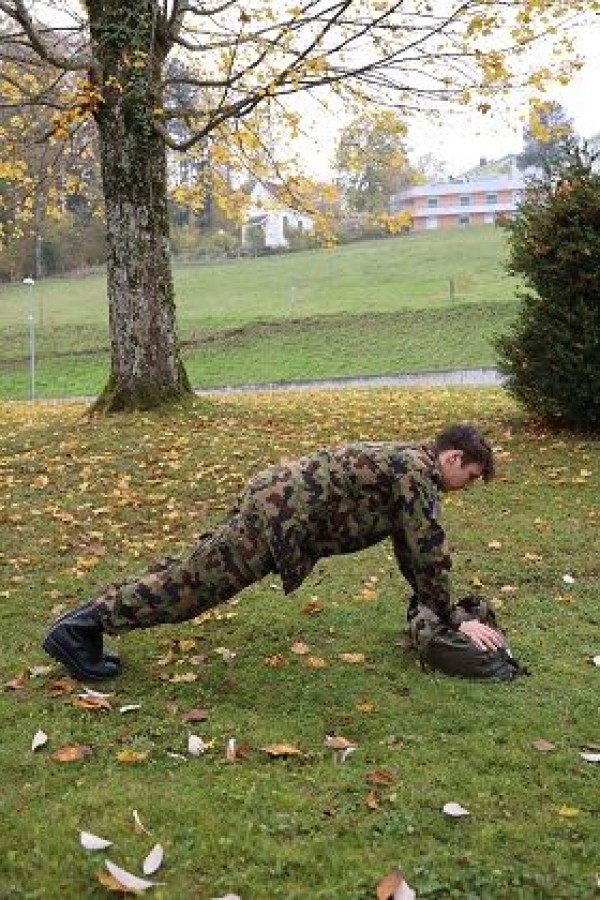
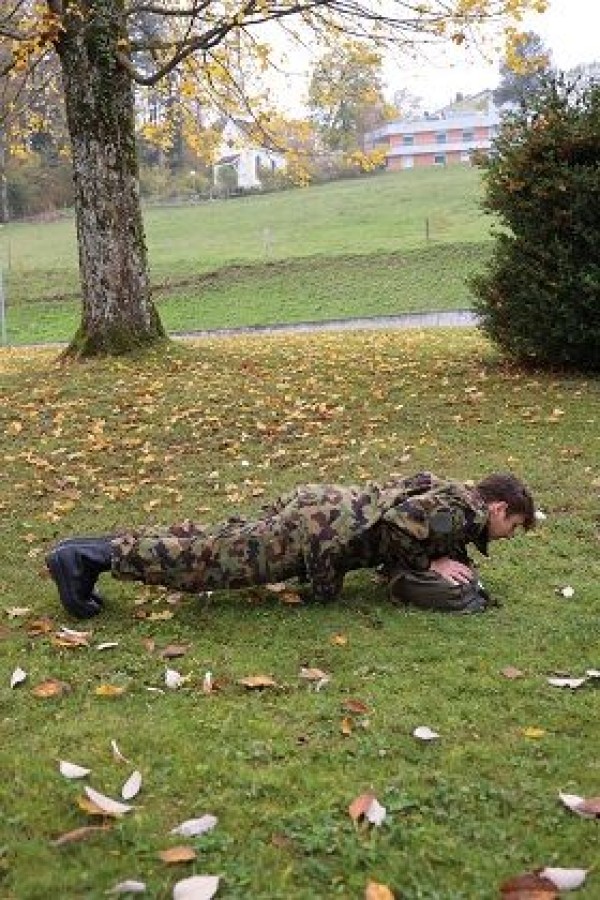
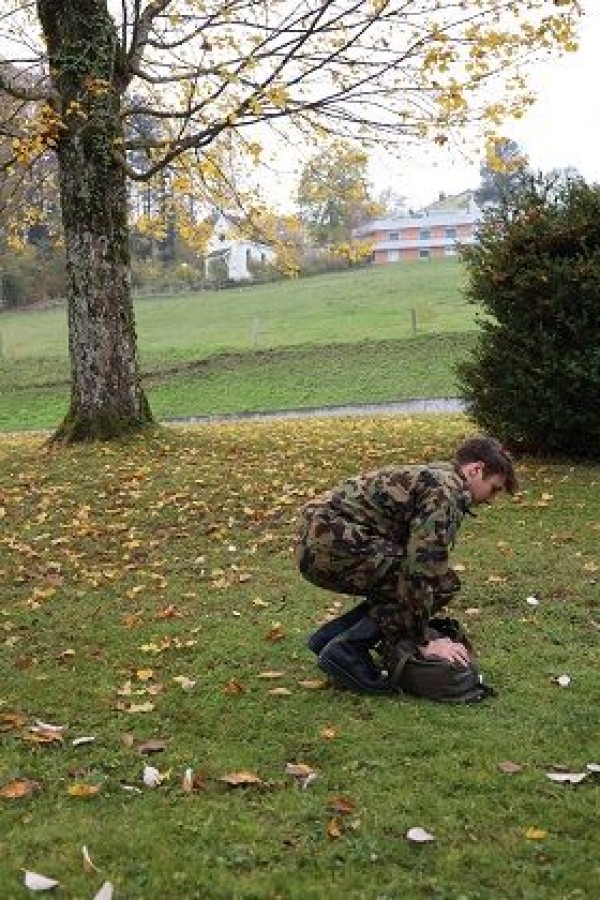
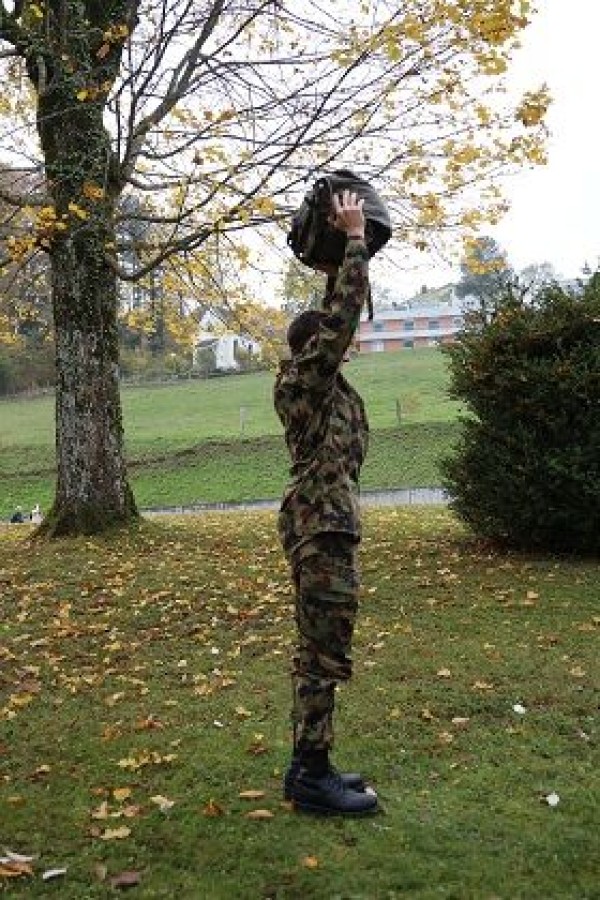
Push-up position with your arms supported on an object (e.g. rucksack), bend and stretch your arms (lower and raise your upper body), stand up (jump with your feet to your hands, then raise your upper body), lift the object and hold it above your head with your arms outstretched, place the object on the floor and return to the push-up position to start the movement sequence again.
Attention:
No hollow back in the push-up position, elbows bent approx. 45 degrees from the upper body ("A" shape with the arms), shoulders are fixed and pushed down towards the hips. Cushion the landing with your feet.
Lighten:
Less weight/load.
Lie down: Place knees on the floor (feet held high); lower upper body less (barely bend arms). Stretch jump: less high/impulsive.
Harden:
More weight/greater load.
Variant:
Vary the position of the hands/arms (e.g.: wide, narrow, together).
1 combat rucksack/(medicine) ball
1 helmet ► make the exercise easier
1 sandbag/tyre (PUCH) ► make the exercise more difficult (additional weight)
Alternating push-ups and lifting an object
Power
Individual work


Push-up position with your arms resting on the assault rifle, bend and stretch your arms (lower and raise your upper body), stand up (jump with your feet to your hands, then raise your upper body), hold the rifle up (arms extended above your head), place the rifle on the floor and return to the push-up position to start the movement sequence from the beginning.
Attention:
No hollow back in the push-up position, elbows bent approx. 45 degrees from the upper body ("A" shape with the arms), shoulders are fixed and pushed down towards the hips. Land with your feet to cushion the landing.
Lighten:
Lie down: Place your knees on the floor (feet held high); lower your upper body less (barely bend your arms). Stretch jump: less high/impulsive.
Variant:
Vary the position of the hands/arms (e.g.: wide, narrow, together).
1 assault rifle (neutralised)
Alternating push-up and jump onto an object ► burpee & box jump
Power
Individual work


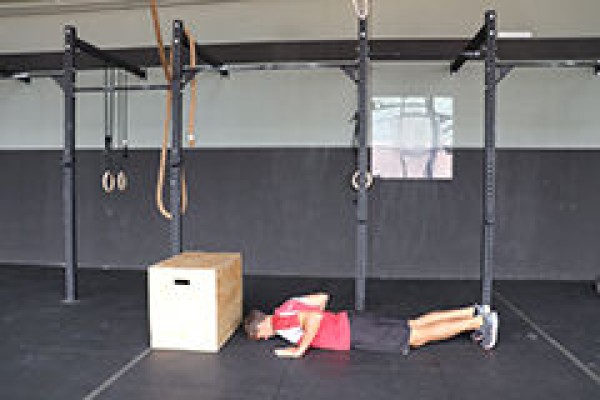


From a standing position, bend your legs and place your hands next to your feet to get into a squat position. Support yourself with your hands and jump backwards with both legs to get into a push-up position. Bend your arms to fully lower your upper body (prone position). From the prone position, push back into the push-up position with both arms and jump back into the squat position. From the squat position, tilt your upper body slightly forwards, stretch your arms backwards at an angle to your body (like a ski jumper on a ski jump), push off the floor powerfully to perform a jump onto the plyo box (using the momentum of your arms), straighten your upper body (standing on the box) and jump back to the starting position (possibly the other side of the box).
Attention:
No hollow back in the push-up position (body tension); land on the box as softly as possible (cushion the jump with your knees).
Lighten:
Lower intensity between the individual exercises; lower the height of the box.
Harden:
Additional weight; higher plyo box.
Variation:
Bouncing from one side of the plyo box to the other by jumping sideways.
1 flat bench/plyo box/swivel box
2-4 weight cuffs/1 weight waistcoat ► Make the exercise more difficult (additional weight)
Push-up and jump over the rower ► burpee over rower
Power
Individual work


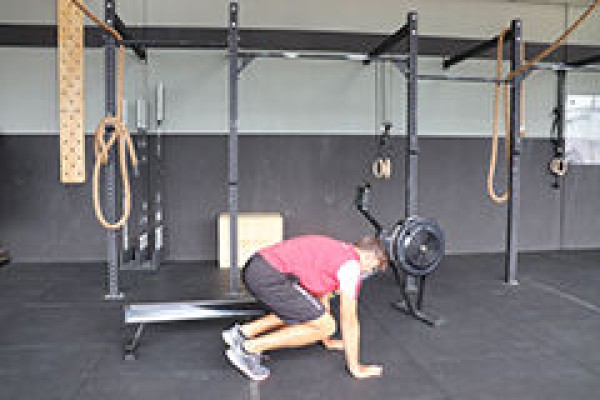


From a standing position, bend your legs and place your hands next to your feet to get into a squat position. Support yourself with your hands and jump backwards with both legs to get into a push-up position. Bend your arms to fully lower your upper body (prone position). From the prone position, push back into the push-up position with both arms and jump back into the squat position. In the squat position, the upper body is tilted slightly forwards, stretch your arms backwards at an angle to your body (like a ski jumper on a ski jump), push off the floor powerfully to perform a jump (lateral-sided) over the back of the rowing machine (use the momentum of the arms). Straighten your upper body and restart the exercise (assume the push-up position) to finally jump back to the starting position.
Attention:
Do not arch your back in the push-up position (body tension); land on the floor as softly as possible (cushion the jump with your knees); be careful with the jump height when jumping over the rowing machine.
Lighten:
Lower intensity between the individual exercises; only jump into the push-up position and back into the squat (without prone position/push-up).
Harden:
Additional weight; higher intensity between the individual exercises.
Variant I:
Jump frontally over the rowing machine.
Variant II:
Integrate rowing units (defined distance, time or watts).
1 rowing machine
2-4 weight cuffs / 1 weight waistcoat ► Make the exercise more difficult (additional weight)
Push-up and jump over the dumbbell ► burpee over dumbbell
Power
Individual work
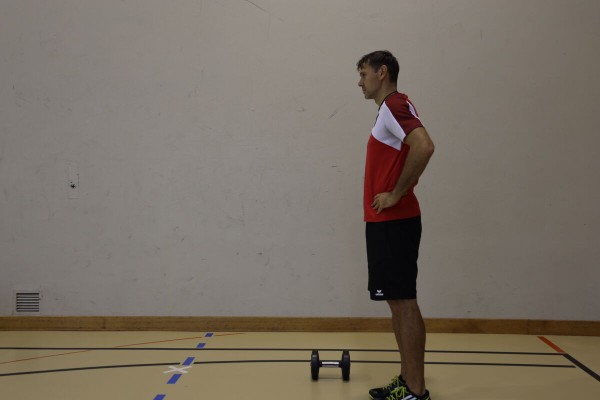
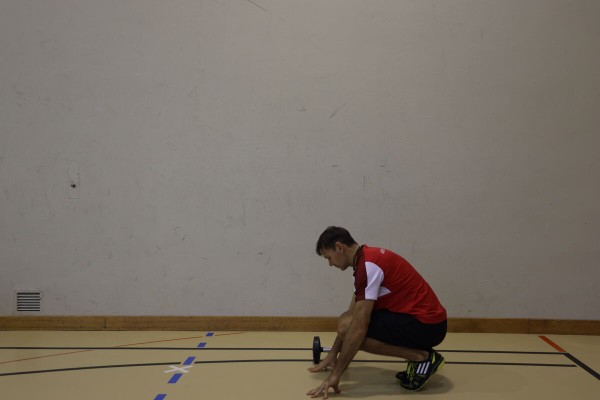
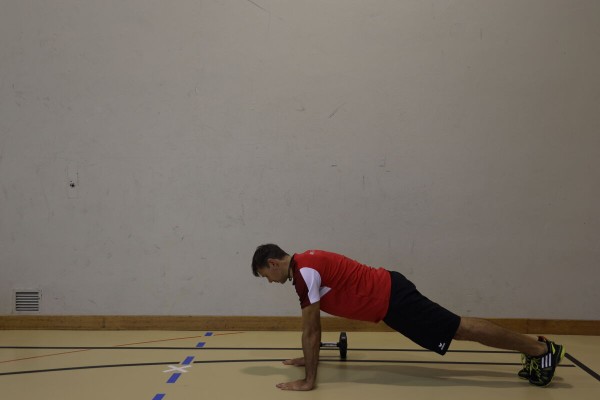
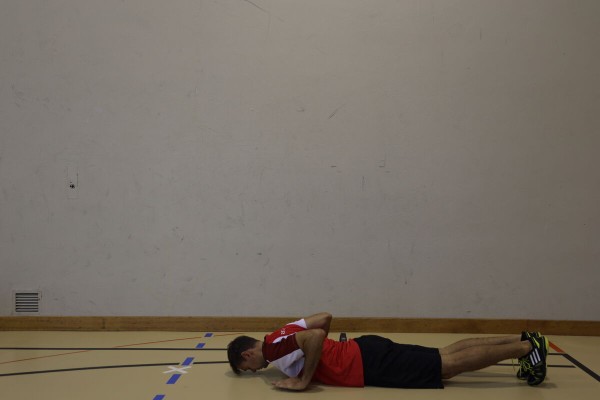
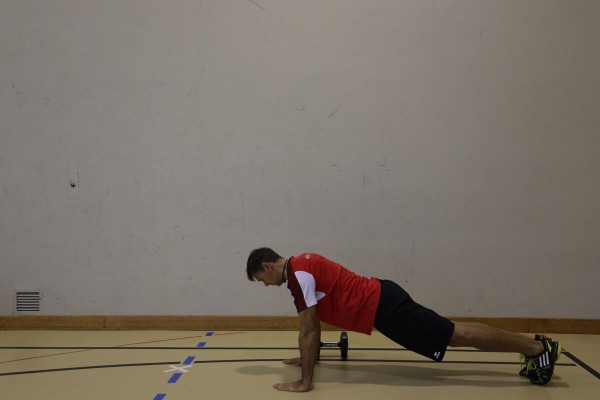
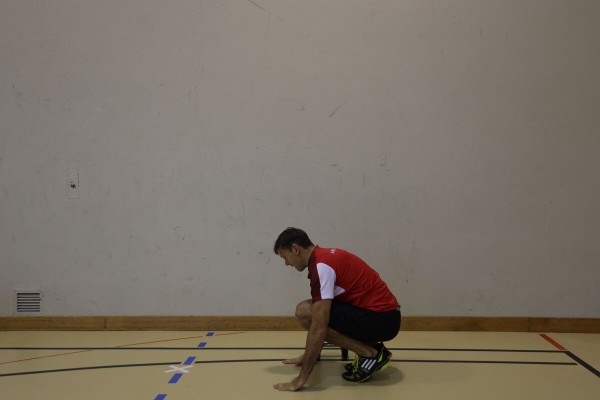
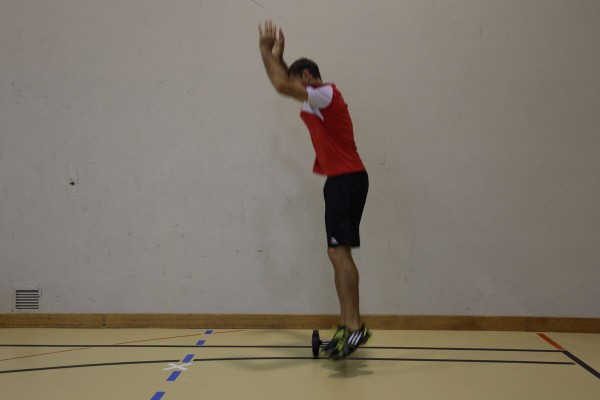
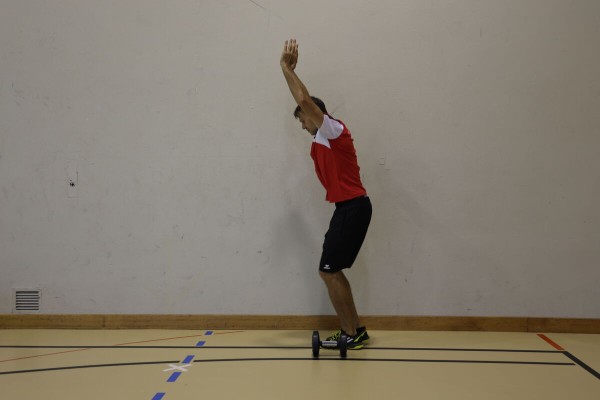
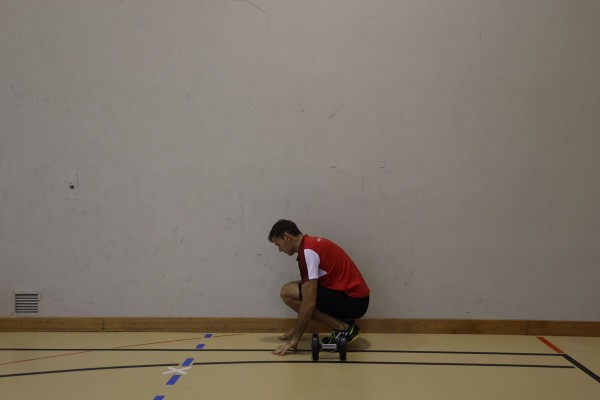
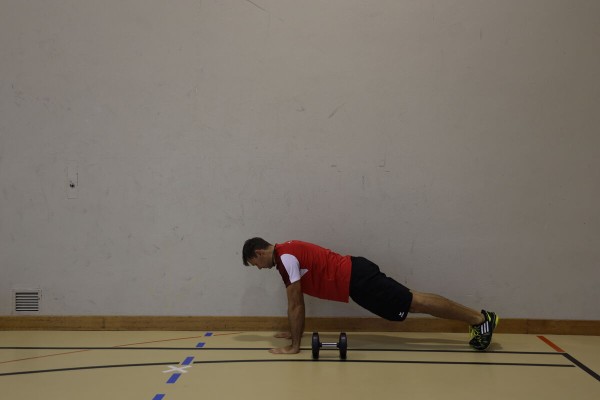
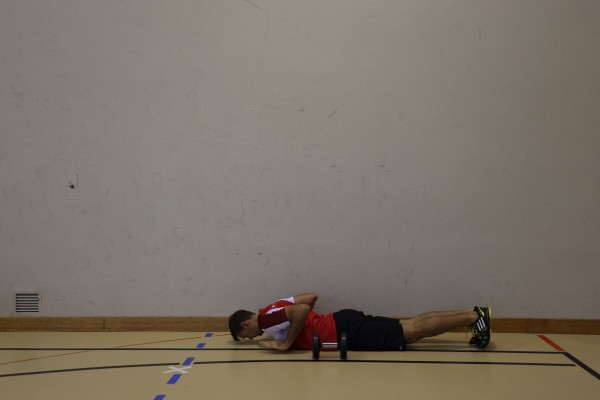

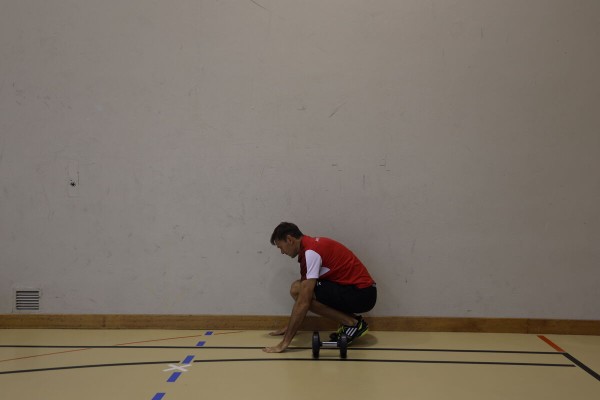
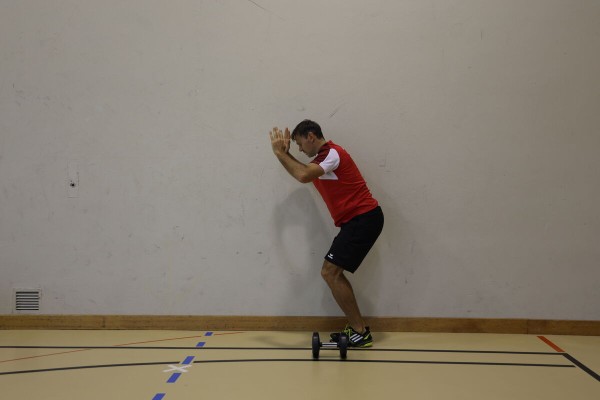
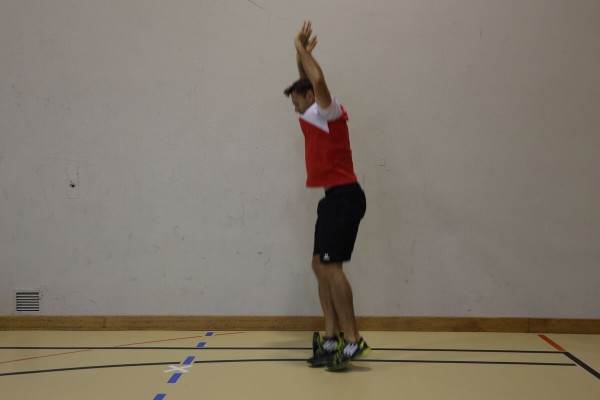
From a standing position, bend your legs and place your hands next to your feet to get into a squat position. Support yourself with your hands and jump backwards with both legs to get into a push-up position. Bend your arms to fully lower your upper body (prone position). From the prone position, push back into the push-up position with both arms and jump back into the squat position. In the squat position, the upper body is tilted slightly forwards, stretch your arms backwards at an angle to your body (like a ski jumper on a ski jump), push off the floor powerfully to perform a jump (lateral-sided) over the dumbbell (use the momentum of the arms). Straighten your upper body and restart the exercise (assume a push-up position) to finally jump back to the starting position.
Attention:
Do not arch your back in the push-up position (body tension); land on the floor as softly as possible (cushion the jump with your knees).
Lighten:
Lower intensity between the individual exercises; only jump into the push-up position and back into the squat (without prone position/push-up).
Harden:
Additional weight; higher intensity between the individual exercises.
Variant I:
Frontal jump over the dumbbell.
1 dumbbell (kettlebell)
2-4 weight cuffs / 1 weight waistcoat ► Make the exercise more difficult (additional weight)
Push-up and jump over the barbell ► burpee over bar
Power
Individual work


From a standing position, bend your legs and place your hands next to your feet to get into a squat position. Support yourself with your hands and jump backwards with both legs to get into a push-up position. Bend your arms to fully lower your upper body (prone position). From the prone position, push back into the push-up position with both arms and jump back into the squat position. In the squat position, the upper body is tilted slightly forwards, stretch your arms backwards at an angle along your body (like a ski jumper on a ski jump), push off the floor powerfully to perform a jump (lateral-sided) over the barbell (use the momentum of the arms). Straighten your upper body and restart the exercise (assume a push-up position) to finally jump back to the starting position.
Attention:
Do not arch your back in the push-up position (body tension); land on the floor as softly as possible (cushion the jump with your knees); be careful with the jump height when jumping over the barbell.
Lighten:
Lower intensity between the individual exercises; only jump into the push-up position and back into the squat (without prone position/push-up).
Harden:
Additional weight; higher intensity between the individual exercises.
Variant I:
Jump over the barbell from the front.
1 barbell
2-4 weight cuffs / 1 weight waistcoat ► Make the exercise more difficult (additional weight)
Alternating push-ups and stretch jumps ► burpee
Power
Individual work


From a standing position, bend your legs and place your hands next to your feet to get into a squat position. Support yourself with your hands, jump backwards with both legs to get into the push-up position. Bend your arms to fully lower your upper body (prone position). From the prone position, push back into the push-up position with both arms and jump back into the squat position. From the squat position, perform a stretch jump and land back in the starting position (standing).
Attention:
Do not arch your back in the push-up position (body tension).
Lighten:
Lower intensity between the individual exercises; lower height for the stretch jump (or just straighten your upper body); place your knees on the floor for the push-ups (feet held high).
Harden:
Additional weight.
2-4 weight cuffs/1 weight waistcoat ► Make the exercise more difficult (additional weight)
Push-up and moving an object to the side in the push-up position ► drag push up position
Power
Individual work


Push-up position, place an object (e.g. combat rucksack) on one side next to the hand (next to the little finger). Perform a push-up, grab the object and pull/push it to the other side, perform another push-up before returning the object to the starting position.
Attention:
Do not arch your back, tense your core.
Lighten:
Support in place; place your knees on the floor; only move the object between your arms.
Harden:
Additional weight (on your shoulders or for moving); unstable support for your legs.
1 combat backpack
1 weight vest/weight disc/sandbag/(additional) combat backpack ► making the exercise more difficult (additional weight)
1 sandbag ► making the exercise more difficult (load)
1 ball/1-2 balance cushions/1 balance board ► making the exercise more difficult (unstable base)
Push-up position
Power
Individual work


Progression I:
Adjust the sling trainer to mid-lower leg length (standing), support position with outstretched arms on the balance board with the feet vertically under the attachment point in the slings, hold position.
Progression II:
Integrate push-ups.
Caution:
Keep body tension, do not let hips sag, back straight, hands under shoulders (for both progressions).
1 sling trainer
1 balance board
Push-up position
Power
Individual work


Push-up position, legs (shins) placed on the exercise ball, alternately lift one leg slightly and return to the starting position.
Attention:
Head, shoulders, buttocks and feet form a line, no hollow back, actively tense the torso. To prevent the ball from rolling away, you can lean it against a wall.
Lighten the load:
Support yourself in place (without lifting and lowering your legs); exercise ball closer to your hips.
Lighten the load:
Additional weight (on your back); unstable support for your arms.
1 exercise ball
1 medicine ball/helmet/balance hemisphere
1 weight vest/weight disc/sandbag ►Make the exercise more difficult (additional weight)
Push-up position ► hand over push up position
Power
Partner work


Both participants stand at a distance of approx. 1 metre from each other in a frontal push-up position with their feet wide apart. The partners pass a ball back and forth (straight or crosswise) without it touching the floor. From time to time or after each pass, the participants change supporting hand.
Attention:
Keep the trunk stable and do not let it sag (constant tension).
Lighten:
Roll the ball on the floor to the partner; lighter ball.
Harden:
Heavier ball; additional weight (on the back).
1 weight ball
1 ball (e.g. volleyball/football/basketball) ► Make the exercise easier
1 weight ball/medicine ball ► Make the exercise more difficult (additional weight)
1 weight vest/weight disc/sandbag ► Make the exercise more difficult (additional weight)
Push-up position on knees low ► knee push up hold / kneeling push up hold (normal grip)
Power
Individual work
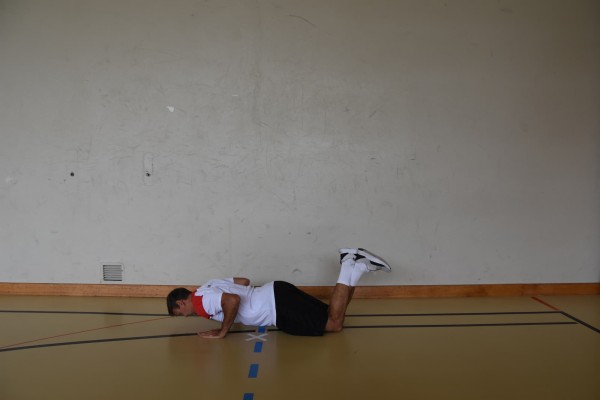
In the knee push-up position (knees on the floor, feet held high with toes raised, body forming a straight line from head to knees, hands slightly more than shoulder-width apart under the shoulders), bend the arms and hold the position. In the deep push-up position, the elbows are at the side of the body (no outward movement of the elbows).
Attention:
No hollow back and elbows bent at an angle of approx. 45° from the upper body ("A" shape with the arms). Keep your shoulders fixed and pull them down towards your hips.
Lighten:
Lower your upper body less (hardly bend your arms); support your arms on a raised surface.
Harden:
Additional weight (on the back); unstable support for the arms and/or legs; perform normal push-ups without knee support.
Variant:
Vary the position of the hands/arms (e.g. wide, narrow, together).
1 weight vest/weight disc/sandbag/fighting backpack ► Make the exercise more difficult (additional weight)
1 ball/1-2 balance cushion/balance board ► Make the exercise more difficult (unstable base)
1 raised base ► Make the exercise easier or more difficult (position)
Push-up position high ► high plank hold
Power
Individual work

Push-up position (high plank), hands directly beneath the shoulders, arms straight, legs straight, feet hip-width apart. Actively engage the core, glutes and legs, keeping the body in a straight line from head to heel. Look down (neck in a neutral position). Continue breathing calmly, hold the position.
Attention:
Do not let your hips sag (this puts strain on your lower back), buttocks too high (reduces core engagement), shoulders do not slump (actively push outwards, stabilise shoulder blades), no hollow back (gently pull navel inwards), head not overextended (keep neck in line with the spine).
Lighten:
Place your knees on the floor (knee plank); rest your hands on a bench or box (less body weight).
Harden:
Lift one leg (less stable base); alternately touch your shoulders with one hand (shoulder tap = dynamic exercise); Place additional weight on the back; plank with arms reaching forwards (plank reach); place legs on a raised surface; unstable surface for the arms and/or legs; hold a lower push-up position.
Variation:
Vary the position of your hands/arms (e.g. wide, narrow, together).
1 weight vest/weight disc/sandbag ► Make the exercise more difficult (additional weight)
1 ball/1-2 balance cushion/balance board ► Make the exercise more difficult (unstable base)
1 raised base ► Make the exercise easier or more difficult (position)
High push-up position with shoulder taps ► plank body-cross tap
Power
Individual work
Get into the high push-up position (plank), with your hands placed on the floor shoulder-width apart and your feet about hip-width apart. Engage your back and abdominal muscles to create a stable, horizontal line. Now, slowly lift your right hand and move it diagonally towards your left shoulder, lightly touching it. Gently lower your hand back down and repeat the movement with the other hand. Your back and core remain stable throughout the exercise and move very little.
Attention:
When using the three-point support, the pelvis must not rotate outwards or sag.
The shoulder girdle must remain actively pushed outwards (no sinking between the shoulder blades).
The head remains in line with the spine.
The back/trunk must not move significantly and must always form a straight line (no hollow back or rounded back).
Lighten:
Stand with your feet significantly wider than hip-width apart (this increases your base of support).
Place your hands on a raised surface (bench/vaulting box/wall).
Harden:
Place your feet on an unstable surface as well.
As you release your hand, lift the opposite leg off the floor at the same time.
Place your hands and/or feet on an unstable surface (balance cushion/balance board).
1 Bench/Sweden box/wall ► make the exercise easier
1 Unstable surface (balance cushion/Sypoba) ► make the exercise more difficult
Alternating push-up position and upright standing position ► jump back
Power
Individual work


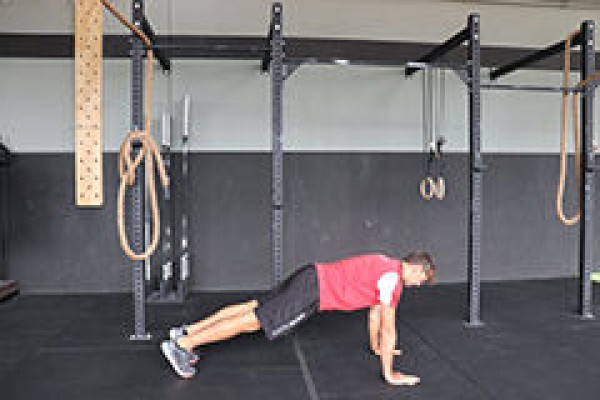


From a standing position, bend your legs, place your hands in front of your feet and jump backwards with both legs at the same time to get into a push-up position. Then jump back forwards with both legs to the starting position of the legs, from this squatting position straighten back up to standing. Cross your arms behind your head and push your pelvis forwards (hollow back) before returning to the starting position in an upright position to start the exercise again.
Attention:
No hollow back in the push-up position (body tension).
Lighten:
Lower intensity between the individual exercises.
Harden:
Additional weight (on the legs).
2 weight cuffs/1 weight waistcoat ► Make the exercise more difficult (additional weight)
Push-up position and jump to the side alternating ► burpee & box jump over / side jump
Power
Individual work


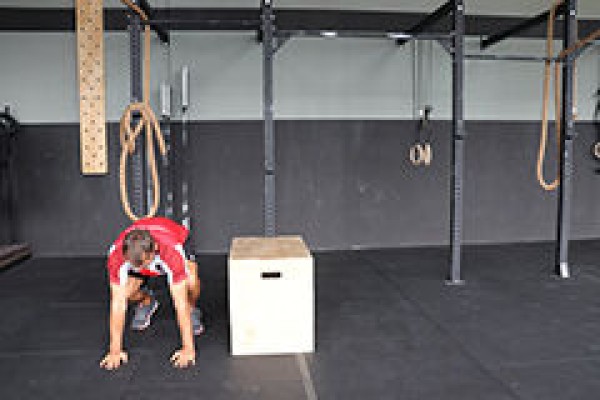


Stand upright and stand next to a raised object (plyo box or vaulting box element incl. top). From a standing position, bend your legs and place your hands next to your feet to get into a squat position. Support yourself with your hands, jump backwards with both legs to get into the push-up position. Bend your arms to fully lower your upper body (prone position). From the prone position, push back into the push-up position with both arms and jump back into the squat position. From the squat position, powerfully push your legs off the floor to perform a sideways jump onto the raised object (use the momentum of your arms). Without straightening the upper body and stretching the legs (again in the squat position), immediately jump again to the other side of the raised object. After landing (no need to stand upright), restart the exercise sequence from the squat position and then jump back to the starting position.
Attention:
Land as softly as possible on the box and then immediately jump again.
Lighten:
Lower intensity between each execution; lower height to jump over.
Harden:
Additional weight; higher object to jump over.
Variation:
Frontal jumps up and down from the object.
1 flat bench/plyo box/swivel box
2-4 weight cuffs/1 weight waistcoat ► Make the exercise more difficult (additional weight)
Push-up position and jump to the side alternating ► burpee & box jump over / side jump
Power
Individual work
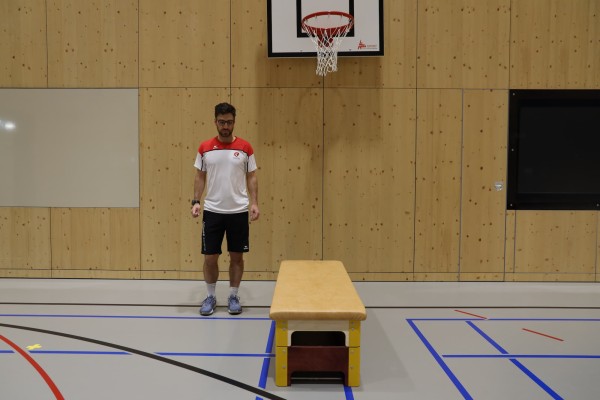
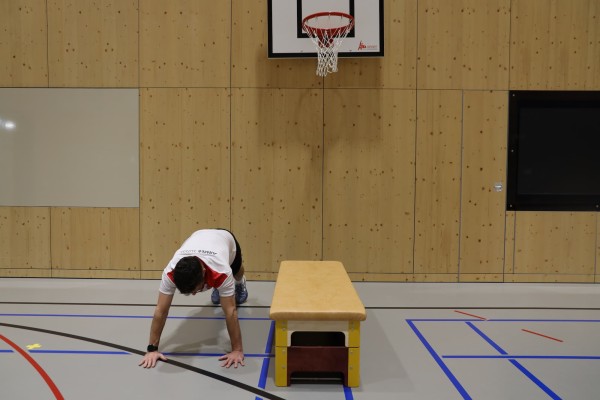
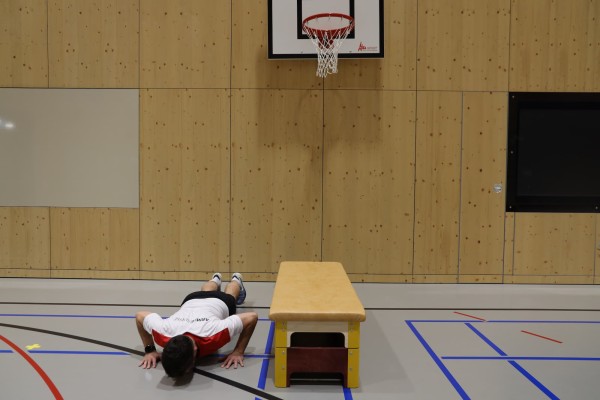
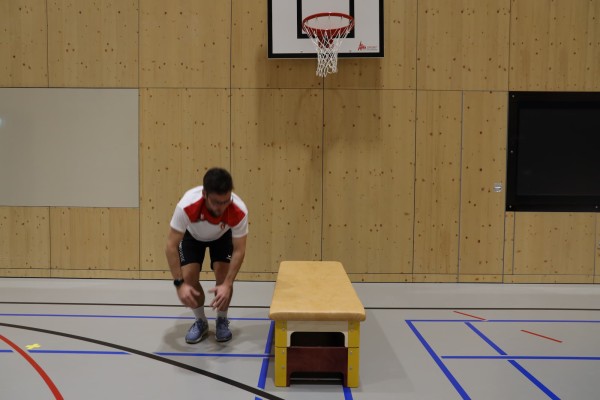
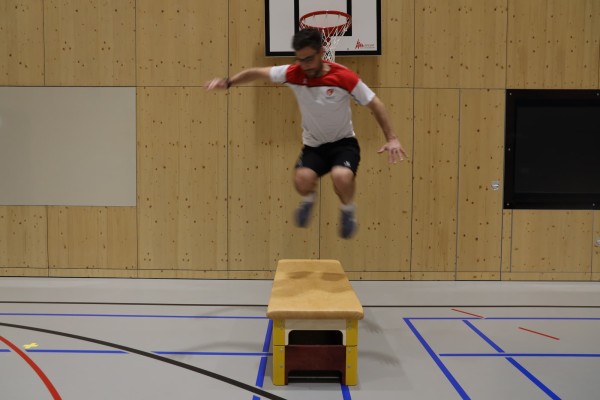
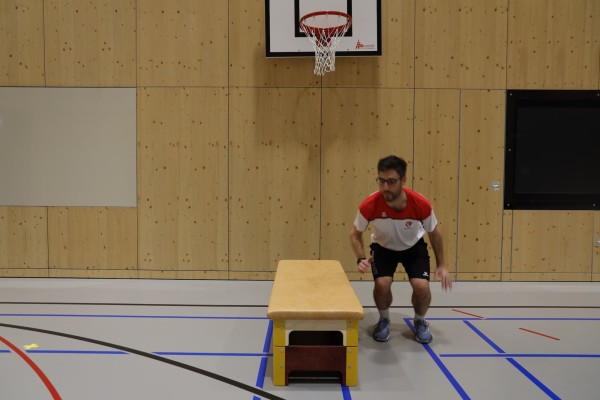
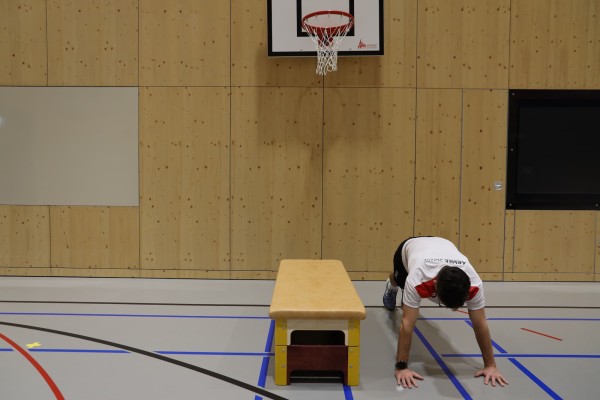
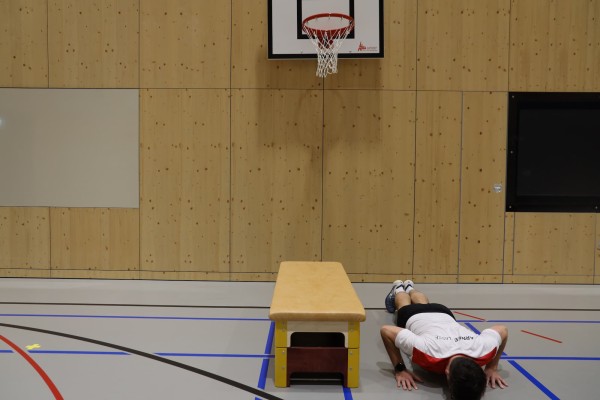
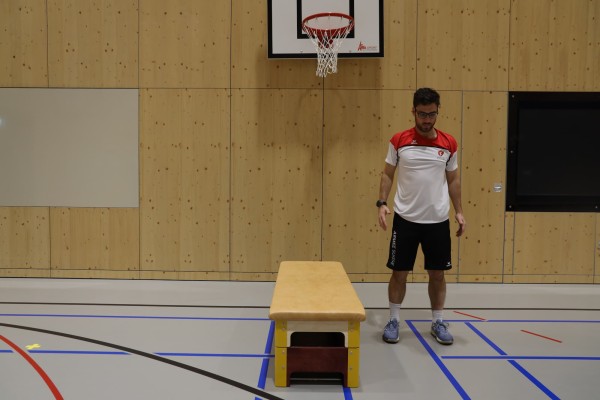
Stand upright to the side of a raised object (plyo box or Swedish box, including the top section). From a standing position, bend your legs and place your hands next to your feet to lower yourself into a squat. Support yourself with your hands, then jump backwards with both legs to move into a push-up position. Lower your upper body completely by bending your arms (prone position). From the prone position, push back up into the push-up position with both arms and jump back into the squat. From the squatting position, push off the floor forcefully with your legs to perform a sideways jump over the raised object (using the momentum of your arms). After landing (no need to stand upright), restart the sequence from the squatting position and then jump back to the starting position.
Attention:
Keep your hands steady and shoulder-width apart when doing a burpee; do not let your back sag when in the plank position; bend your knees slightly on landing; do not let your knees collapse inwards; Adjust the box height to suit your fitness level (reduce jump height and speed if you become tired).
Lighten:
Move your legs forwards and backwards one at a time during the burpee instead of jumping; step over the box (step-over) instead of jumping over it; use a lower box to jump over; perform the burpee without the push-up.
Harden:
Extra weight; a taller object to jump over; a burpee with an extra push-up (without lying fully on your stomach).
Variation:
Frontal jumps onto and off the object.
1 flat bench/plyo box/swivel box
2-4 weight cuffs/1 weight waistcoat ► make the exercise more difficult (additional weight)
Push-up position and stretch jump alternating ► half burpee
Power
Individual work


From a standing position, bend your legs, place your hands in front of your feet and jump backwards with both legs at the same time to get into a push-up position. Then jump back forwards with both legs to the starting position of the legs, perform a stretch jump from this crouching position (optionally cross your arms briefly behind your head during the flight phase) and land back in the starting position to begin the exercise again.
Attention:
No hollow back in the push-up position (body tension).
Lighten:
Lower intensity between the individual exercises; lower height during the stretch jump (or only straighten the upper body).
Harden:
Additional weight.
2-4 weight cuffs/1 weight waistcoat ► Make the exercise more difficult (additional weight)
Alternating push-up position and stretch jump ► scaled burpee
Power
Individual work


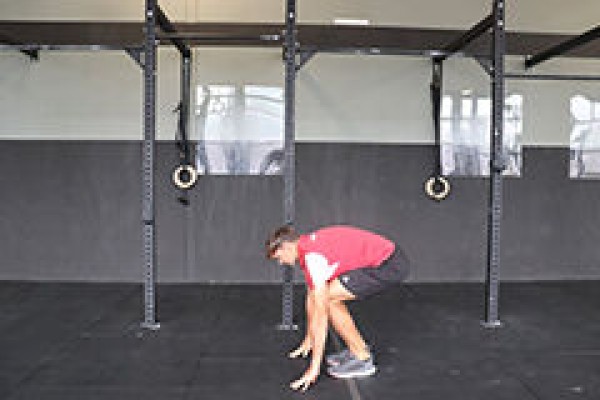

From a standing position, bend your legs and place your hands next to (in front of) your feet to assume the squat position. Support yourself with your hands and alternately move one leg backwards to reach the push-up position. Bend your arms to fully lower your upper body (prone position). From the prone position, use both arms to push yourself back into the push-up position, then alternately move one leg back into the squat position. From this squatting position, perform a stretch jump (optionally cross your arms briefly behind your head during the flight phase) and land back in the starting position to begin the exercise again (change which leg is moved backwards or forwards first for each exercise).
Attention:
No hollow back in the push-up position (body tension).
Lighten:
Lower intensity between the individual exercises; lower height during the stretch jump (or only straighten the upper body).
Harden:
Additional weight.
2-4 weight cuffs/1 weight waistcoat ► Make the exercise more difficult (additional weight)
Deep push-up position ► push up plank hold
Power
Individual work

Deep push-up position, hold position.
Attention:
No hollow back, elbows bent approx. 45° from upper body ("A" shape with arms), shoulders are fixed and pulled down towards hips.
Lighten:
Place knees on floor (feet in high position); lower upper body less (arms barely bent); support arms on raised surface.
Harden:
Additional weight (on the back); place legs on a raised surface; unstable surface for the arms and/or legs.
Variant:
Vary the position of the hands/arms (e.g.: wide, narrow, together).
1 weight vest/weight disc/sandbag ► Make the exercise more difficult (additional weight)
1 ball/1-2 balance cushion/balance board ► Make the exercise more difficult (unstable surface)
1 raised surface Make the exercise easier or ► Make the exercise more difficult (position)
Push-up position and forearm support alternating ► push up position & elbow plank / push up position & front plank / push up position to elbow plank / push up position to front plank
Power
Individual work


Switch from the push-up position to the forearm support and back (bend and stretch one arm at a time).
Attention:
Head, torso, hips and knees practically form a line (do not stretch your buttocks upwards or let them sag, tense your stomach).
Lighten:
Knees on the floor.
Harden:
Additional weight (on the back); unstable base for the legs.
1 weight vest/weight disc/sandbag ► to make the exercise more difficult (additional weight)
1 ball/balance cushion/balance board ► to make the exercise more difficult (unstable surface)
Liegestützposition und Unterarmstütz alternierend ► push up position & elbow plank / push up position & front plank / push up position to elbow plank / push up position to front plank
Power
Individual work

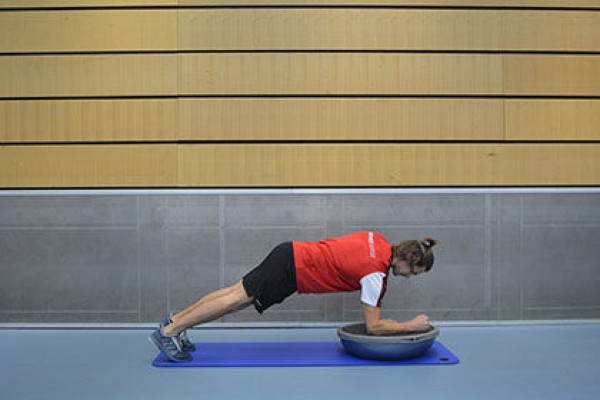
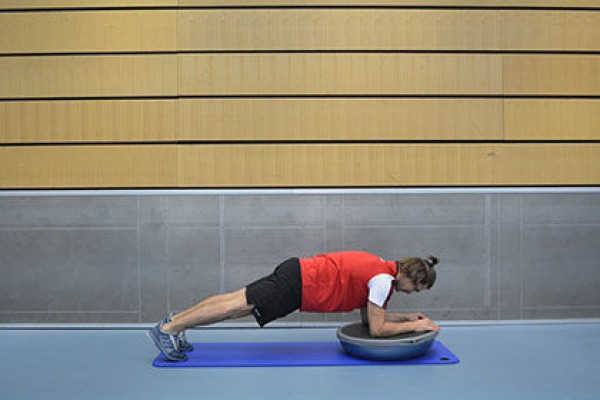

Switch from the push-up position to the forearm support and back (bend and stretch one arm at a time), placing the hands or forearms on a balance ball.
Attention:
Head, torso, hips and knees practically form a line (do not stretch your buttocks upwards or let them sag, tense your stomach).
Lighten:
Perform the exercise without the balancing hemisphere; knees on the floor.
Harden:
Additional weight (on the back); unstable base for the legs.
1 balance hemisphere
1 weight vest/weight disc/sandbag ► to make the exercise more difficult (additional weight)
1 ball/balance cushion/balance board ► to make the exercise more difficult (unstable base)