
Exercises (3274)
Circular movement of the arms in push-up position
Power
Individual work


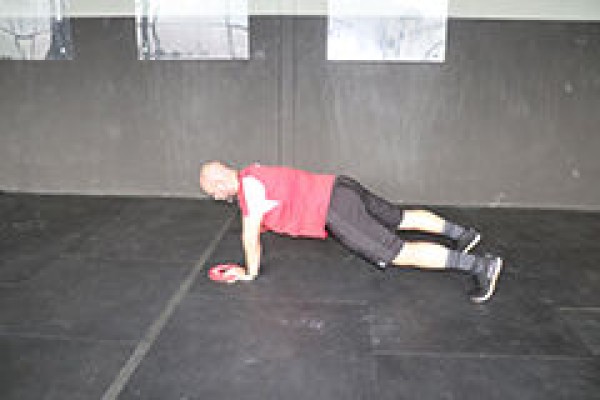


Push-up position (high support, face/gaze downwards) with legs slightly straddling and arms supported on two small weight discs. Slide one arm including the disc forwards along the floor as an extension of the body, then move the outstretched arm to the side (90 degree angle to the body) and return to the starting position (the movement corresponds to drawing a quarter circle, so to speak). Back in the push-up position, perform the same exercise with the other arm/disc.
Attention:
Head, torso, hips and knees form a line (do not let your buttocks sag, tighten your stomach).
Lighten:
Just hold the basic position (push-up position); reduce the range of motion of the playing arm or only move it forwards and back to the starting position.
Harden:
Additional weight (on the back and/or arms).
2 weight discs (small)
1 weight vest/weight disc/sandbag ► Make the exercise more difficult (additional weight)
2 weight cuffs ► Make the exercise more difficult (additional weight)
Circular movement of the legs in supine position ► double leg circle
Power
Individual work


Lie on your back with your arms flat on the floor at your sides or place your hands under your buttocks and your outstretched legs slightly off the floor. Perform circular movements with your legs closed (vary the range of movement and direction).
Attention:
Keep your (lower) back in constant contact with the floor (no hollow back, consciously tense your stomach), do not put your legs down.
Lighten:
Just hold the position (legs stretched out slightly off the floor).
Harden:
Clamp additional weight for the legs/between the legs.
2 weight cuffs/1 (medicine) ball ► Make the exercise more difficult (additional weight)
Circular movements of the arms while standing (frontal) ► arm circles (frontal)
Power
Individual work
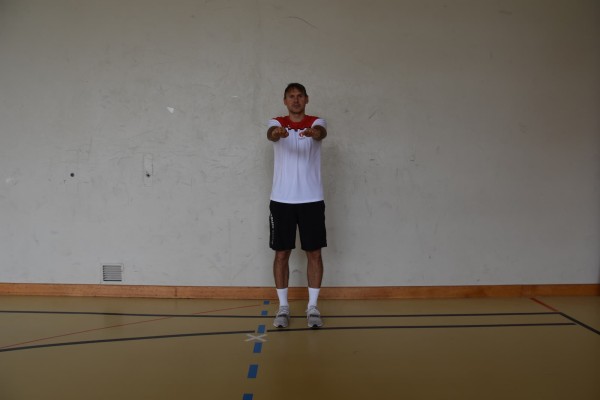
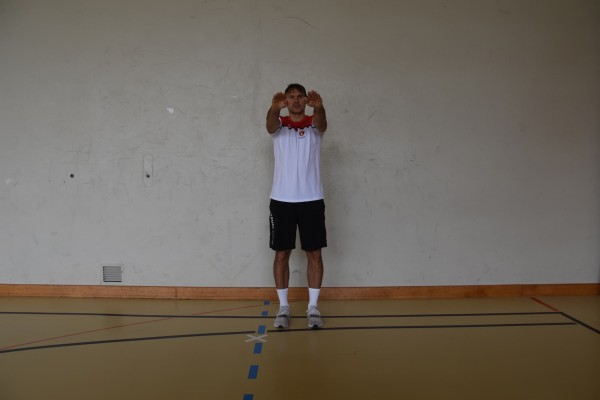
Stand upright with your feet shoulder-width apart, arms extended forwards (frontally) at shoulder height, perform small circles with your arms in both directions (shoulder height).
Attention:
Always keep your arms almost fully extended.
Lighten:
Stretch your arms less/bend them slightly.
Harden:
Hold additional weight on your arms or in your hands.
Variant:
Increase the range of motion (crown and navel height) and increase speed if necessary.
2 weight cuffs/weight balls/dumbbells ► Make the exercise more difficult (additional weight)
Circular movements of the arms while standing ► arm circles (lateral)
Power
Individual work
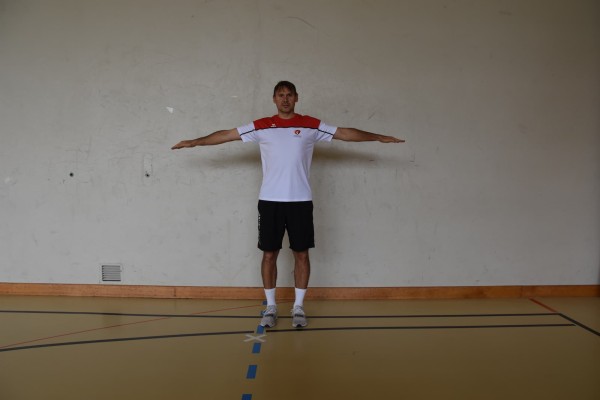
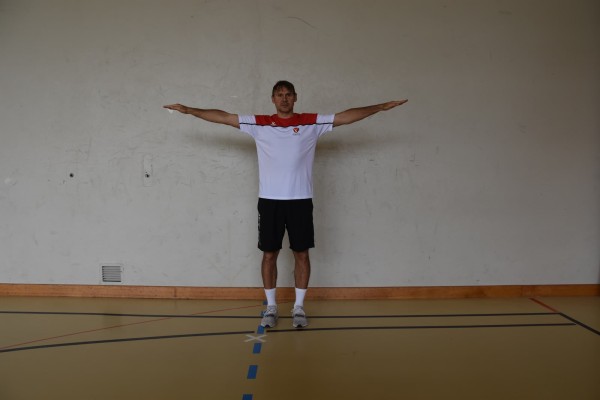
Stand upright with your feet shoulder-width apart, arms outstretched to the side at shoulder height, make small circles with your arms in both directions (shoulder height).
Attention:
Always keep your arms almost fully extended.
Lighten:
Stretch your arms less/bend them slightly.
Harden:
Hold additional weight on your arms or in your hands.
Variant:
Increase the range of motion (crown and navel height) and increase speed if necessary.
2 weight cuffs/weight balls/dumbbells ► Make the exercise more difficult (additional weight)
Brief body awareness
Relaxation
Mobility flow - Conclusion (part 4)
The participants lie on their backs on the mat.
Position
Legs stretched out or raised
Arms relaxed at your sides
Palms facing upwards
Close your eyes if you wish
Implementation
The teacher guides the group through three to five slow breaths:
Breathe in through your nose for four seconds.
Exhale calmly for six to eight seconds.
Consciously relax your jaw, shoulders and hands.
Be aware of the parts of your body in contact with the floor.
The participants then slowly sit up straight.
Final questions
Does your body feel more relaxed than it did at the start?
Which area has benefited most from the mobilisation exercises?
Which two or three exercises could you do on your own after the next walk?
Closing message
“Recovery doesn’t just start when you go to sleep. Even a gentle cool-down, controlled mobility exercises, plenty of fluids, a suitable meal and a restful night’s sleep can help you get back to full performance more quickly after intense exertion.”
Per participant:
1 soft mat
Lacrosse
Games / Tournament
Group work
Game idea:
Two teams with several field players and a goalkeeper play the ball with the intercrosse stick by skilfully attacking the opponent's goal. The aim is to prevent the opponent from scoring goals by playing good defence.
Scoring:
A goal is scored when the ball crosses the goal line completely.
Playing field:
45 m wide and 102 m long. The (floorball) goals are located 14m in front of the end of the pitch.
Number of participants:
10 against 10 (9 outfield players plus 1 goalkeeper), indoors 6 against 6.
Rules of the game:
After the referee's whistle, two players in the centre try to play out the ball between them, capture it or pass it to one of their teammates. The attacker/defender positions change as soon as the defending team has won the ball. Physical contact and knocking the ball away are permitted throughout the game.
Fouls: Personal fouls are pushing using the stick as resistance, blows with the stick that hit the body or head, unnecessary roughness. The penalty time for a personal foul is one to three minutes. Technical fouls include offside, pushing from behind, holding and the active use of the free arm of a player carrying the ball. Penalties for technical fouls are cancelled by a goal.
For safety reasons, however, the same rules as for intercrosse are also used outdoors in sports lessons, i.e. no physical contact is made.
Pull down the load in supine position ► lying behind the neck pull down
Power
Partner work
1 trainee & 1 helper ► Note change of position
(= double the time required; for lesson planner see Organisation Kraft: Info button Execution)


Exerciser: Lie on your back and hold the gymnastics pole above your head with your arms stretched out horizontally (arms parallel to the floor), legs slightly bent and heels up, pull the gymnastics pole into your neck against the resistance of the elasticated straps, raising your head slightly (looking towards the ceiling).
Partner: Hold the loops above the gymnastics pole on the floor.
Attention:
The lower part of the back (lumbar spine) remains on the floor throughout the exercise.
Lighten:
Select less strong elastic bands; roll up the elastic bands less or reduce the distance to your partner.
Harden:
Select stronger elastic bands, roll up the elastic bands more or increase the distance to your partner.
1 gymnastic stick with elasticated strap
Running ABC
Running training
Group work
6-10 participants per group (3-5 participants per side)
Depending on group size: start from both sides simultaneously or alternately.
The participants line up in groups opposite each other at a distance of approx. 15-20 metres. After completing the exercise, the participants line up again behind the opposite group.
The running ABC is a special form of coordination exercises and helps to improve running style. The easy-to-perform exercises promote mobility and muscular balance.
The running ABC should be familiarised with using various running exercises in smaller groups. It is advisable to keep the upper body, especially the head, upright during all exercises. The running ABC should be carried out with concentration and in a rested state. You should start with slow and technically clean movements. After a few repetitions, the speed of the steps can be increased.
Exercise selection (complete each exercise 2-4 times):
- Loose trotting forwards/backwards (perform a half turn in the middle, changing the direction of rotation with each run).
- Hop run
- Powerfully raise the knee of the swing leg, lift the thigh until it is horizontal;
- keep an upright posture, hips remain extended, eyes look straight ahead;
- the arms actively swing upwards (not forwards) and support the jump;
- roll over the entire foot;
- the hop run strengthens body extension and the footprint.
- Walking with a focus on rolling over the whole foot (arms swing along)
- Trotting with a focus on rolling over the whole foot
- Running dribbling (ankle work)
- Trotting with very small steps and high frequency;
- Knee alternately slightly upwards;
- the toe of the lifted leg points to the floor;
- active foot placement, starting on the forefoot, heel briefly touches the floor;
- Knee of the supporting leg remains extended;
- Arms are bent, the arm movement supports the leg movement;
- Hips move with
- Skipping
- Raise the knees alternately at a high frequency up to around 70 degrees;
- tighten the toes and only ever land on the forefoot;
- strong arm use;
- Variant:Insert an intermediate step after two skippings.
- Knee lift
- Bring your knees up to hip height;
- maintain an upright posture;
- Variant: Only lift your knees every third step.
- Lift off your heels
- Increased push-off from the ankle and calf;
- Bend the knee backwards to bring the heel towards the buttocks;
- Hips tilted slightly forwards;
- Arms swing along and support the running movement.
- Variant: Lift the knee only every third step.
- Lifting off your heels/knee lift
- Alternate 4 x heel lifts and 4 x knee lifts
- Alternate 4 x heel lifts and 4 x knee lifts
- Giant wheel
- Slow knee lift, once the knee is lifted, the lower leg is extended forwards and the foot is placed forwards in a circular motion.
- Slow knee lift, once the knee is lifted, the lower leg is extended forwards and the foot is placed forwards in a circular motion.
- Bouncing lunge
- Feet are parallel and in a line;
- one leg is pushed down hard;
- the other leg is bent at the hip;
- to land, bring the feet together again so that they touch the ground at the same time;
- immediately after landing, the other leg is pushed into the air.
- Jump run
- Powerful one-legged push-off (leg maximally extended);
- the other leg swings forwards (not upwards) à jump into the air;
- the arm movement is consciously active forwards and supports the jump;
- the thigh is horizontal in the flight phase.
- Side straddle run
- The body stands sideways to the running direction;
- spread the legs and bring them together again by jumping sideways;
- make sure your posture is upright;
- change direction.
- Crossover running
- The body stands sideways to the running direction;
- Cross your legs alternately in front of and behind your body;
- Turn only from the hips
- The arms are stretched out or resting on the hips;
- Improves hip mobility.
- Forward/backward running with incline running
- Running curves
Per group:
4 marking cones/caps
Running ABC
Stimulate circulation
Group work
6-10 participants per group (3-5 participants per side)
The participants line up in groups facing each other at a distance of approx. 15-20 metres from each other. After the exercise, the participants line up again behind the opposite group.
Depending on the size of the group: start from both sides simultaneously or alternately.
The running ABC is a special form of coordination exercises and helps to improve running style. The easy-to-perform exercises promote mobility and muscular balance.
The running ABC should be familiarised with using various running exercises in smaller groups. It is advisable to keep the upper body, and especially the head, upright during all exercises. The running ABC should be carried out with concentration and in a rested state. You should start with slow and technically clean movements. After a few repetitions, the speed of the steps can be increased.
- Loose trotting forwards / backwards (perform a half turn in the centre, changing the direction of rotation with each run)
- Floose trotting forwards / backwards (perform a half turn in the middle, changing the direction of rotation with each run)
- Floose running
- Knee lift
- Hop run
- Side straddle run (move sideways with leg dragging)
- Crossover run (move sideways with legs crossed)
- Forwards/backward running with incline run
- Running curves
Complete all exercises 2-4x.
Per group:
4 marker cones/caps ►Define walking routes (optional)
Running ABC (activation of the ankle)
Running training
Group work
6-10 people per group.
The exercise is completed with 2-4 repetitions over a distance of 10-15 metres.
If the weather and ground conditions allow, the exercise can also be performed without shoes.
Aim:
The aim is to activate good ground contact with the forefoot by trying to create a "springy" effect on the ankles ("active" foot) while keeping the legs stretched.
Focus:
The foot should remain parallel to the ground through dorsiflexion and be active when it touches the ground. The aim is to keep the heel as close to the ground as possible without touching the ground. The idea is for the feet to "hit" the ground as quickly as possible.
5 key points - running ABC
- The aim is to keep the foot "active" in dorsiflexion. Contact with the ground should not be made with the toe, but with the distal metatarsal area. This should achieve a "springy" effect in the area of the ankles. When landing with the toe or heel, the elastic energy of our muscles is dispersed, which is essential to increase running economy.
- The ground contact takes place just behind the vertical projection of the centre of gravity. The idea should be to bring the foot under the body to support it and not too far forward to avoid braking forces.
- Avoid remaining in a seated position during the exercises. When in contact with the ground, the hip joint should be almost fully extended, as should the knee joint.
- The arms are crucial for coordination. It is therefore important to use them actively and try to keep the shoulders relaxed so that they do not become stiff. The angle of the elbow joint should be around 90°. During the movement, the arms should be parallel to the body and not crossed in front.
- Throughout the exercise, the stability of the torso should be maintained by correctly activating the abdominal muscles. This prevents anteversion of the pelvis, which leads to a later running cycle. The shoulders should remain slightly in front of the body's centre of gravity.
No material required
Lauf-ABC (double switch)
Running training
Group work
6-10 people per group.
The exercise is completed with 2-4 repetitions over a distance of 10-15 metres.
If the weather and ground conditions allow, the exercise can also be performed without shoes.
Objective:
Starting from a one-legged stance with the knee at a 90° angle, reverse the leg position twice in succession as quickly as possible, returning to the starting position and trying to stop and maintain balance after each movement.
Focus:
The idea is to change as quickly as possible. To do this, it is important to remember to lower one leg as quickly as possible while lifting the other leg.
5 key points - running ABC
- The aim is to keep the foot "active" during dorsiflexion. Contact with the ground should not be made with the toe, but with the distal metatarsal area. This should achieve a "springy" effect in the area of the ankles. When landing with the toe or heel, the elastic energy of our muscles is dispersed, which is essential to increase running economy.
- The ground contact takes place just behind the vertical projection of the centre of gravity. The idea should be to bring the foot under the body to support it and not too far forward to avoid braking forces.
- Avoid remaining in a seated position during the exercises. When in contact with the floor, the hip joint should be almost fully extended, as should the knee joint.
- The arms are crucial for coordination. It is therefore important to use them actively and try to keep the shoulders relaxed so that they do not become stiff. The angle of the elbow joint should be around 90°. During the movement, the arms should be parallel to the body and not crossed in front.
- Throughout the exercise, the stability of the torso should be maintained by correctly activating the abdominal muscles. This prevents anteversion of the pelvis, which leads to a later running cycle. The shoulders should remain slightly in front of the body's centre of gravity.
No material required
Running ABC (dribbles one-legged)
Running training
Group work
6-10 people per group.
The exercise is completed with 2-4 repetitions over a distance of 10-15 metres.
If the weather and ground conditions allow, the exercise can also be performed without shoes.
Aim:
One leg remains extended with the "active" foot, the second leg takes alternating small steps. The foot should not be lifted more than 10-15cm.
Focus:
The idea is to make small circles with the foot of the free leg to simulate the cyclical movement of running.
5 key points - running ABC
- The aim is to keep the foot "active" during dorsiflexion. Contact with the ground should not be made with the toe, but with the distal metatarsal area. This should achieve a "springy" effect in the area of the ankles. When landing with the toe or heel, the elastic energy of our muscles is dispersed, which is essential to increase running economy.
- The ground contact takes place just behind the vertical projection of the centre of gravity. The idea should be to bring the foot under the body to support it and not too far forward to avoid braking forces.
- Avoid remaining in a seated position during the exercises. When in contact with the floor, the hip joint should be almost fully extended, as should the knee joint.
- The arms are crucial for coordination. It is therefore important to use them actively and try to keep the shoulders relaxed so that they do not become stiff. The angle of the elbow joint should be around 90°. During the movement, the arms should be parallel to the body and not crossed in front.
- Throughout the exercise, the stability of the torso should be maintained by correctly activating the abdominal muscles. This prevents anteversion of the pelvis, which leads to a later running cycle. The shoulders should remain slightly in front of the body's centre of gravity.
No material required
Lauf-ABC (dribbles)
Running training
Group work
6-10 people per group.
The exercise is completed with 2-4 repetitions over a distance of 10-15 metres.
If the weather and ground conditions allow, the exercise can also be performed without shoes.
Aim:
Take small running steps with the "active" foot and try to lift your feet a maximum of 10-15cm off the ground, keeping the movement as circular as possible.
Focus:
Imagine drawing circles with your feet as if you were riding a pedalo.
5 key points - running ABC
- The aim is to keep the foot "active" during dorsiflexion. Contact with the ground should not be made with the toe, but with the distal metatarsal area. This should achieve a "springy" effect in the area of the ankles. When landing with the toe or heel, the elastic energy of our muscles is dispersed, which is essential to increase running economy.
- The ground contact takes place just behind the vertical projection of the centre of gravity. The idea should be to bring the foot under the body to support it and not too far forward to avoid braking forces.
- Avoid remaining in a seated position during the exercises. When touching the ground, the hip joint should be almost fully extended, as should the knee joint.
- The arms are crucial for coordination. It is therefore important to use them actively and try to keep the shoulders relaxed so that they do not become stiff. The angle of the elbow joint should be around 90°. During the movement, the arms should be parallel to the body and not crossed in front.
- Throughout the exercise, the stability of the torso should be maintained by correctly activating the abdominal muscles. This prevents anteversion of the pelvis, which leads to a later running cycle. The shoulders should remain slightly in front of the body's centre of gravity.
No material required
Lauf-ABC (simple switch)
Running training
Group work
6-10 people per group.
The exercise is completed with 2-4 repetitions over a distance of 10-15 metres.
If the weather and ground conditions allow, the exercise can also be performed without shoes.
Objective:
Starting from a one-legged stance with the knee at a 90° angle, reverse the leg position as quickly as possible, trying to stop and maintain balance after each movement.
Focus:
The idea is to change as quickly as possible. To achieve this, it's important to remember to lower one leg as quickly as possible while lifting the other.
5 key points - running ABC
- The aim is to keep the foot "active" during dorsiflexion. Contact with the ground should not be made with the toe, but with the distal metatarsal area. This should achieve a "springy" effect in the area of the ankles. When landing with the toe or heel, the elastic energy of our muscles is dispersed, which is essential to increase running economy.
- The ground contact takes place just behind the vertical projection of the centre of gravity. The idea should be to bring the foot under the body to support it and not too far forward to avoid braking forces.
- Avoid remaining in a seated position during the exercises. When in contact with the floor, the hip joint should be almost fully extended, as should the knee joint.
- The arms are crucial for coordination. It is therefore important to use them actively and try to keep the shoulders relaxed so that they do not become stiff. The angle of the elbow joint should be around 90°. During the movement, the arms should be parallel to the body and not crossed in front.
- Throughout the exercise, the stability of the torso should be maintained by correctly activating the abdominal muscles. This prevents anteversion of the pelvis, which leads to a later running cycle. The shoulders should remain slightly in front of the body's centre of gravity.
No material required
Running ABC (skipping - 2tap speed in 3 directions)
Running training
Group work
6-10 people per group.
The exercise is completed with 2-4 repetitions over a distance of 10-15 metres.
If the weather and ground conditions allow, the exercise can also be performed without shoes.
Aim:
Skipping in a high kneeling position (hip flexion approx. 90°), with the feet touching the floor at the same time in every second stance and maintaining a steady rhythm. The free leg performs a different movement with each stance. The first movement is a 90° hip flexion, the second is a 90° hip flexion with external rotation and the third is a 90° hip flexion with full knee extension. The series of movements is first performed on one leg and then after the three movements on the other leg.
Focus:
It is important to concentrate on the rhythm of the appoggiaturas in order to be able to perform the movement. The technique can only be perfected once the rhythm has been mastered.
5 key points - running ABC
- In dorsiflexion, it is important to keep the foot "active". Contact with the ground should not be made with the toe, but with the distal metatarsal area. This should achieve a "springy" effect in the area of the ankles. When landing with the toe or heel, the elastic energy of our muscles is dispersed, which is essential to increase running economy.
- The ground contact takes place just behind the vertical projection of the centre of gravity. The idea should be to bring the foot under the body to support it and not too far forward to avoid braking forces.
- Avoid remaining in a seated position during the exercises. When touching the ground, the hip joint should be almost fully extended, as should the knee joint.
- The arms are crucial for coordination. It is therefore important to use them actively and try to keep the shoulders relaxed so that they do not become stiff. The angle of the elbow joint should be around 90°. During the movement, the arms should be parallel to the body and not crossed in front.
- Throughout the exercise, the stability of the torso should be maintained by correctly activating the abdominal muscles. This prevents anteversion of the pelvis, which leads to a later running cycle. The shoulders should remain slightly in front of the body's centre of gravity.
No material required
Running ABC (skipping - 2tap speed with outstretched legs)
Running training
Group work
6-10 people per group.
The exercise is completed with 2-4 repetitions over a distance of 10-15 metres.
If the weather and ground conditions allow, the exercise can also be performed without shoes.
Aim:
Skipping with straight legs, with the feet touching the floor at the same time every other step and maintaining a steady rhythm. At the same time, the arms roll forwards in rhythm with the legs.
Focus:
It is important to concentrate on the rhythm of the touchdown in order to be able to perform the movement. The technique can only be perfected once the rhythm has been mastered.
5 key points - running ABC
- The aim is to keep the foot "active" during dorsiflexion. Contact with the ground should not be made with the toe, but with the distal metatarsal area. This should achieve a "springy" effect in the area of the ankles. When landing with the toe or heel, the elastic energy of our muscles is dispersed, which is essential to increase running economy.
- The ground contact takes place just behind the vertical projection of the centre of gravity. The idea should be to bring the foot under the body to support it and not too far forward to avoid braking forces.
- Avoid remaining in a seated position during the exercises. When in contact with the ground, the hip joint should be almost fully extended, as should the knee joint.
- The arms are crucial for coordination. It is therefore important to use them actively and try to keep the shoulders relaxed so that they do not become stiff. The angle of the elbow joint should be around 90°. During the movement, the arms should be parallel to the body and not crossed in front.
- Throughout the exercise, the stability of the torso should be maintained by correctly activating the abdominal muscles. This prevents anteversion of the pelvis, which leads to a later running cycle. The shoulders should remain slightly in front of the body's centre of gravity.
No material required
Running ABC (skipping - 2tap speed with knees up)
Running training
Group work
6-10 people per group.
The exercise is completed with 2-4 repetitions over a distance of 10-15 metres.
If the weather and ground conditions allow, the exercise can also be performed without shoes.
Objective:
Execute a skipping movement with high knees (hip flexion approx. 45°), with the feet touching the ground at the same time every other touchdown and maintaining a steady rhythm.
Focus:
It is important to concentrate on the rhythm of the appoggiaturas in order to be able to execute the movement. You must first be able to control the rhythm, only then can you perfect the technique.
5 key points - running ABC
- The aim is to keep the foot "active" during dorsiflexion. Contact with the ground should not be made with the toe, but with the distal metatarsal area. This should achieve a "springy" effect in the area of the ankles. When landing with the toe or heel, the elastic energy of our muscles is dispersed, which is essential to increase running economy.
- The ground contact takes place just behind the vertical projection of the centre of gravity. The idea should be to bring the foot under the body to support it and not too far forward to avoid braking forces.
- Avoid remaining in a seated position during the exercises. When in contact with the floor, the hip joint should be almost fully extended, as should the knee joint.
- The arms are crucial for coordination. It is therefore important to use them actively and try to keep the shoulders relaxed so that they do not become stiff. The angle of the elbow joint should be around 90°. During the movement, the arms should be parallel to the body and not crossed in front.
- Throughout the exercise, the stability of the torso should be maintained by correctly activating the abdominal muscles. This prevents anteversion of the pelvis, which leads to a later running cycle. The shoulders should remain slightly in front of the body's centre of gravity.
No material required
Running ABC (skipping - 2tap pace with knees low)
Running training
Group work
6-10 people per group.
The exercise is completed with 2-4 repetitions over a distance of 10-15 metres.
If the weather and ground conditions allow, the exercise can also be performed without shoes.
Aim:
Skipping with knees low (hip flexion approx. 45°), feet touching the ground at the same time every other step and maintaining a steady pace.
Focus:
It is important to concentrate on the rhythm of the appoggiaturas so that you are able to perform the movement. The technique can only be perfected once the rhythm has been mastered.
5 key points - running ABC
- The aim is to keep the foot "active" during dorsiflexion. Contact with the ground should not be made with the toe, but with the distal metatarsal area. This should achieve a "springy" effect in the area of the ankles. When landing with the toe or heel, the elastic energy of our muscles is dispersed, which is essential to increase running economy.
- The ground contact takes place just behind the vertical projection of the centre of gravity. The idea should be to bring the foot under the body to support it and not too far forward to avoid braking forces.
- Avoid remaining in a seated position during the exercises. When in contact with the ground, the hip joint should be almost fully extended, as should the knee joint.
- The arms are crucial for coordination. It is therefore important to use them actively and try to keep the shoulders relaxed so that they do not become stiff. The angle of the elbow joint should be around 90°. During the movement, the arms should be parallel to the body and not crossed in front.
- Throughout the exercise, the stability of the torso should be maintained by correctly activating the abdominal muscles. This prevents anteversion of the pelvis, which leads to a later running cycle. The shoulders should remain slightly in front of the body's centre of gravity.
No material required
Running ABC (skipping - knees up with heel to buttocks)
Running training
Group work
6-10 people per group.
The exercise is completed with 2-4 repetitions over a distance of 10-15 metres.
If the weather and ground conditions allow, the exercise can also be performed without shoes.
Target:
Skipping with high knees with the aim of touching the buttocks with the heel.
Focus:
When making contact with the ground, try to bring the heel to the buttocks as quickly as possible.
5 key points - running ABC
- The aim is to keep the foot "active" during dorsiflexion. Contact with the ground should not be made with the toe, but with the distal metatarsal area. This should achieve a "springy" effect in the area of the ankles. When landing with the toe or heel, the elastic energy of our muscles is dispersed, which is essential to increase running economy.
- The ground contact takes place just behind the vertical projection of the centre of gravity. The idea should be to bring the foot under the body to support it and not too far forward to avoid braking forces.
- Avoid remaining in a seated position during the exercises. When in contact with the floor, the hip joint should be almost fully extended, as should the knee joint.
- The arms are crucial for coordination. It is therefore important to use them actively and try to keep the shoulders relaxed so that they do not become stiff. The angle of the elbow joint should be around 90°. During the movement, the arms should be parallel to the body and not crossed in front.
- Throughout the exercise, the stability of the torso should be maintained by correctly activating the abdominal muscles. This prevents anteversion of the pelvis, which leads to a later running cycle. The shoulders should remain slightly in front of the body's centre of gravity.
No material required
Running ABC (skipping - with legs outstretched to run)
Running training
Group work
6-10 people per group.
The exercise is completed with 2-4 repetitions over a distance of 10-15 metres.
If the weather and ground conditions allow, the exercise can also be performed without shoes.
Aim:
Perform progressive skipping with straight legs and "active" feet. As soon as the maximum speed is reached, a transition to normal running is made. The aim is to optimally activate the gluteal muscles and hamstrings.
Focus:
Keep your legs as straight as possible and actively use your feet. The idea is to "pull" the leg downwards while activating the gluteal muscles.
5 key points - running ABC
- The aim is to keep the foot "active" during dorsiflexion. Contact with the ground should not be made with the toe, but with the distal metatarsal area. This should achieve a "springy" effect in the area of the ankles. When landing with the toe or heel, the elastic energy of our muscles is dispersed, which is essential to increase running economy.
- The ground contact takes place just behind the vertical projection of the centre of gravity. The idea should be to bring the foot under the body to support it and not too far forward to avoid braking forces.
- Avoid remaining in a seated position during the exercises. When in contact with the ground, the hip joint should be almost fully extended, as should the knee joint.
- The arms are crucial for coordination. It is therefore important to use them actively and try to keep the shoulders relaxed so that they do not become stiff. The angle of the elbow joint should be around 90°. During the movement, the arms should be parallel to the body and not crossed in front.
- Throughout the exercise, the stability of the torso should be maintained by correctly activating the abdominal muscles. This prevents anteversion of the pelvis, which leads to a later running cycle. The shoulders should remain slightly in front of the body's centre of gravity.
No material required
Running ABC (skipping one-legged alternating)
Running training
Group work
6-10 people per group.
The exercise is completed with 2-4 repetitions over a distance of 10-15 metres.
If the weather and ground conditions allow, the exercise can also be performed without shoes.
Aim:
While one leg remains extended with the "active" foot, the knee of the free leg is raised at a 90° angle to bend the hip and knee joints. With every second contact with the floor, the use of the legs is reversed, always trying to maintain a steady rhythm.
Focus:
It is important to concentrate on the rhythm of the touchdown in order to be able to perform the gesture. You must first be able to control the rhythm before you can perfect the technique.
5 key points - running ABC
- The aim is to keep the foot "active" during dorsiflexion. Contact with the ground should not be made with the toe, but with the distal metatarsal area. This should achieve a "springy" effect in the area of the ankles. When landing with the toe or heel, the elastic energy of our muscles is dispersed, which is essential to increase running economy.
- The ground contact takes place just behind the vertical projection of the centre of gravity. The idea should be to bring the foot under the body to support it and not too far forward to avoid braking forces.
- Avoid remaining in a seated position during the exercises. When touching the ground, the hip joint should be almost fully extended, as should the knee joint.
- The arms are crucial for coordination. It is therefore important to use them actively and try to keep the shoulders relaxed so that they do not become stiff. The angle of the elbow joint should be around 90°. During the movement, the arms should be parallel to the body and not crossed in front.
- Throughout the exercise, the stability of the torso should be maintained by correctly activating the abdominal muscles. This prevents anteversion of the pelvis, which leads to a later running cycle. The shoulders should remain slightly in front of the body's centre of gravity.
No material required
Running ABC (skipping one-legged)
Running training
Group work
6-10 people per group.
The exercise is completed with 2-4 repetitions over a distance of 10-15 metres.
If the weather and ground conditions allow, the exercise can also be performed without shoes.
Aim:
With the leg extended and the foot active, the knee of the free leg is lifted up to a flexion angle of 90° for the hip and knee joints.
Focus:
The aim is to maintain the right speed between the two supports. The idea is that the foot of the free leg draws circles that simulate the frontal cyclical movement of running.
5 key points - running ABC
- The aim is to keep the foot "active" during dorsiflexion. Contact with the ground should not be made with the toe, but with the distal metatarsal area. This should achieve a "springy" effect in the area of the ankles. When landing with the toe or heel, the elastic energy of our muscles is dispersed, which is essential to increase running economy.
- The ground contact takes place just behind the vertical projection of the centre of gravity. The idea should be to bring the foot under the body to support it and not too far forward to avoid braking forces.
- Avoid remaining in a seated position during the exercises. When in contact with the ground, the hip joint should be almost fully extended, as should the knee joint.
- The arms are crucial for coordination. It is therefore important to use them actively and try to keep the shoulders relaxed so that they do not become stiff. The angle of the elbow joint should be around 90°. During the movement, the arms should be parallel to the body and not crossed in front.
- Throughout the exercise, the stability of the torso should be maintained by correctly activating the abdominal muscles. This prevents anteversion of the pelvis, which leads to a later running cycle. The shoulders should remain slightly in front of the body's centre of gravity.
No material required
Running ABC (skipping and changing to running)
Running training
Group work
6-10 people per group.
The exercise is completed with 2-4 repetitions over a distance of 10-15 metres.
If the weather and ground conditions allow, the exercise can also be performed without shoes.
Target:
Skipping with high knees. After 10 metres, a transition to running is made. The aim is to increase the speed and stride length without changing the body position and leg movement.
Focus:
The shoulders are kept in the correct position and the circular movement of the legs is maintained. Avoid a backward cycle while running.
5 key points - running ABC
- Keep the foot "active" during dorsiflexion. Contact with the ground should not be made with the toe, but with the distal metatarsal area. This should achieve a "springy" effect in the area of the ankles. When landing with the toe or heel, the elastic energy of our muscles is dispersed, which is essential to increase running economy.
- The ground contact takes place just behind the vertical projection of the centre of gravity. The idea should be to bring the foot under the body to support it and not too far forward to avoid braking forces.
- Avoid remaining in a seated position during the exercises. When in contact with the ground, the hip joint should be almost fully extended, as should the knee joint.
- The arms are crucial for coordination. It is therefore important to use them actively and try to keep the shoulders relaxed so that they do not become stiff. The angle of the elbow joint should be around 90°. During the movement, the arms should be parallel to the body and not crossed in front.
- Throughout the exercise, the stability of the torso should be maintained by correctly activating the abdominal muscles. This prevents anteversion of the pelvis, which leads to a later running cycle. The shoulders should remain slightly in front of the body's centre of gravity.
No material required
Running ABC (skipping)
Running training
Group work
6-10 people per group.
The exercise is completed with 2-4 repetitions over a distance of 10-15 metres.
If the weather and ground conditions allow, the exercise can also be performed without shoes.
Target:
Skipping with the knees extended upwards (hip and knee flexion ~90°).
Focus:
The core stability must be maintained when lifting the knees to avoid finding yourself in a seated position in which the shoulders are behind the vertical projection of the body's centre of gravity.
5 key points - running ABC
- The aim is to keep the foot "active" during dorsiflexion. Contact with the ground should not be made with the toe, but with the distal metatarsal area. This should achieve a "springy" effect in the area of the ankles. When landing with the toe or heel, the elastic energy of our muscles is dispersed, which is essential to increase running economy.
- The ground contact takes place just behind the vertical projection of the centre of gravity. The idea should be to bring the foot under the body to support it and not too far forward to avoid braking forces.
- Avoid remaining in a seated position during the exercises. When in contact with the ground, the hip joint should be almost fully extended, as should the knee joint.
- The arms are crucial for coordination. It is therefore important to use them actively and try to keep the shoulders relaxed so that they do not become stiff. The angle of the elbow joint should be around 90°. During the movement, the arms should be parallel to the body and not crossed in front.
- Throughout the exercise, the stability of the torso should be maintained by correctly activating the abdominal muscles. This prevents anteversion of the pelvis, which leads to a later running cycle. The shoulders should remain slightly in front of the body's centre of gravity.
No material required
Running ABC (triple switch to running)
Running training
Group work
6-10 people per group.
The exercise is completed with 2-4 repetitions over a distance of 10-15 metres.
If the weather and ground conditions allow, the exercise can also be performed without shoes.
Aim:
Starting from a one-legged stance with the knee at a 90° angle, the leg position should be changed as quickly as possible three times in succession. Try to stop after each movement and keep your balance. After the third execution, there should be a direct transition to running.
Focus:
The idea is to change as quickly as possible. To achieve this, remember to move one leg down as quickly as possible and the other leg up at the same time. The basic idea is to make contact with the ground as quickly as possible. The position of the upper body is maintained during the transition.
5 key points - running ABC
- The aim is to keep the foot "active" during dorsiflexion. Contact with the ground should not be made with the toe, but with the distal metatarsal area. This should achieve a "springy" effect in the area of the ankles. When landing with the toe or heel, the elastic energy of our muscles is dispersed, which is essential to increase running economy.
- The ground contact takes place just behind the vertical projection of the centre of gravity. The idea should be to bring the foot under the body to support it and not too far forward to avoid braking forces.
- Avoid remaining in a seated position during the exercises. When in contact with the ground, the hip joint should be almost fully extended, as should the knee joint.
- The arms are crucial for coordination. It is therefore important to use them actively and try to keep the shoulders relaxed so that they do not become stiff. The angle of the elbow joint should be around 90°. During the movement, the arms should be parallel to the body and not crossed in front.
- Throughout the exercise, the stability of the torso should be maintained by correctly activating the abdominal muscles. This prevents anteversion of the pelvis, which leads to a later running cycle. The shoulders should remain slightly in front of the body's centre of gravity.
No material required