
Exercises (3274)
Royal tournament
Stimulate circulation
Group work
The playing field is divided into 3-4 zones. First, all participants dribble (bounce the ball, guide it with their foot/toy, juggle it on the stick) with their ball in the lowest/first zone. Whoever captures (plays away) an opponent's ball moves up, whoever loses the ball with or without the opponent's influence (the ball leaves the playing field) moves down (if possible).
Per participant:
1 ball ►basketball, FooBaSKILL, futsal/football, handball, smolball, floorball
1 stick ►floor hockey
8-10 marking cones/caps ►field markings (3-4 zones)
Royal tournament
Forms of play / exercises
Group work
The playing field is divided into 3-4 zones. First, all participants dribble (bounce the ball, guide it with their foot/toy, juggle it on the stick) with their ball in the lowest/first zone. Whoever captures (plays away) an opponent's ball moves up, whoever loses the ball with or without the opponent's influence (the ball leaves the playing field) moves down (if possible).
Per participant:
1 ball ►basketball, FooBaSKILL, futsal/football, handball, floorball
1 stick ►floorball
8-10 marking cones/caps ►field markings (3-4 zones)
Koordinationstest (KT)
Examinations
Time ratios (60 min.) correspond to a group size of approx. 30 participants.
Of course, each participant is tested individually.
The coordination test corresponds to the Vienna coordination course (with the exception of the figure-of-eight run and scoring table) and is used to test coordination skills. This test checks whether the participants can move within the specifications under time pressure.
Execution regulations
Facility:
The KT must always be carried out indoors and cannot be moved outside. In the KT, all posts are precisely prescribed and are located in a clearly defined place. A volleyball court should be marked out in the hall, as the controls are distributed from this court according to certain measurement specifications. The controls are located within the volleyball court. Securing the bar to minimise the risk of injury is the responsibility of the test leader and has the highest priority.
Post description:
Backward roll-forward roll: A small soft mat is placed in the corner of the volleyball court for the backward roll. For the forward roll, a mat is placed next to the first one.
360° turn: The turn is performed on another small soft mat. The mat is attached to the mat track, which is ready for the rolls.
Balancing: The narrow side of the long bench faces upwards. A line is marked with adhesive tape 0.5 m in front of the end of the narrow side of the long bench.
Figure-eight run: A rope is stretched between two painting sticks (distance 1.5 m) at a height of 0.5 m.
Slalom: Five clubs are used for the slalom. A medicine ball (2 kg, Ø 28 cm) is placed in a tyre.
Cross jump: A rectangle 40 cm wide and 1 m long is stuck to the floor with adhesive tape. Lines on the rectangle at 25 cm intervals serve as orientation (see sketch).
Cross jump: A square (side 0.4 m) is stuck to the floor with adhesive tape, which serves as orientation for the jumps.
Low jump: The bar height from the floor is 1.20 m for the front bars and 1.70 m for the rear bars. The greatest possible distance is set between the bars. Two small soft mats are placed behind the parallel bars to cushion the competitor's low jump (fix the mats with adhesive tape, long side in the direction of movement). There is no small soft mat on the floor of the parallel bars (risk of tripping).
Execution:
Roll backwards-Roll forwards: The roll backwards and forwards is performed on a small soft mat.
360° turn: Jump or step over with a 360° turn around the longitudinal axis of the body (valid from 270 degrees).
Balancing: The participant balances over the narrow side of the long bench up to the mark.
Run of eight: The two painting sticks are run round in the shape of a figure eight. The aim is to run/crawl under the rope on the first loop and jump over it on the second. If the rope is touched, the entire exercise must be repeated.
Slalom: The medicine ball (2 kg, Ø 28 cm) provided in the (gymnastics) tyre is passed through the clubs in a slalom with the hands or feet. The medicine ball is then placed back into the tyre. If a club is tipped over, the participant must stand it up again before the slalom can be continued.
Cross jump: The participant jumps over the centre field 8 times with the outer leg, i.e. crosswise. Finally, a jump is made to the end of the field, landing on both legs. If a mistake is made, the jump combination must be restarted from the beginning.
Square jump: The participant jumps over the square a total of 5 times on one leg. The jumping sequence is: forwards, backwards, right, left (or left, right) and forwards again. In the event of a mistake, the jump combination must be restarted from the beginning.
Lower jump: The participant jumps over/climbs over/climbs the second bar, whereby the first bar must be passed underneath (climbing underneath) in order to reach the floor of the bar between the two bars first. The most common variant for jumping over the bar is for the participant to hold on to one bar with each hand and jump off the floor of the bar, with the arms acting as a support, in order to get onto the lower bar with one leg. The supported leg is then used to push off from the bars, allowing the participant to cross the upper bar with the support of the free-swinging leg. However, there are also other ways to move the body over the upper bar (see overcoming the bar obstacle on the obstacle course in the field).
Target: The landing after the low jump corresponds to the target.
Attempts:
Two, the better attempt is scored.
Measurement:
The running time is measured to the nearest second (round the result mathematically).
The measurement starts with the (start) command of the test leader and ends with the landing after the lower jump (acoustic and/or visual perception).
Control:
The test leader explains all the execution regulations to the participants in advance and shows the controls if necessary (however, all participants should be familiar with the test). During the KT, the test leader accompanies the participant and checks the execution of the exercise. If a mistake is made, the test leader instructs the participant to repeat the entire exercise (except for the slalom, where the participant sets up the club again himself and continues the exercise). If a second test leader is available, the next participant can only be sent onto the course as soon as the participant in front has passed the slalom. There are never more than two competitors on the course. When landing from the low jump, the test leader stops the time. The result is recorded directly electronically or transferred later from an evaluation sheet to an electronic device.
Evaluation:
Evaluation forms and electronic evaluation programmes are available for all sports tests:
www.armee.ch/sportausbildung
-> Downloads -> Sports tests -> Evaluation -> KT
2 stakes, 1 long bench, 1 parallel bar, 5 small soft mats, 1 rope/tape, 1 (gymnastics) tyre, 1 medicine ball (2 kg, Ø 28 cm), 5 clubs, adhesive tape, 1 measuring tape, 1-2 stopwatches, evaluation form including writing materials or device for electronic data collection.
Headstand
Floor and apparatus gymnastics


A triangle is formed on the floor using the head and both hands. The larger the area of the triangle (i.e. the further apart the vertices are), the greater the stability. The body is stretched vertically upwards (bend the legs first, then bring them upwards).
The participants practise the movement form independently using series of pictures or based on the exercise being demonstrated by the instructor. The instructor (or a partner) gives feedback, provides support and checks that the exercise is being performed correctly.
2 soft mats (small) ► indoor version
1 row
outdoor:
turf field
Headstand to support ► tripod to plank kip
Power
Individual work


In a kneeling position, the head and bent arms are supported on the floor; a triangle is formed on the floor with the head and both hands. The larger the area of the triangle (i.e. the further apart the corners are), the greater the stability. This basic position is also the starting position for getting into the headstand. Now lift your knees off the floor and stretch your legs so that they are only resting on the tips of your toes (the position roughly corresponds to the letter "V"). Then lift one leg at a time off the floor and bend it (lower legs/soles of the feet pointing upwards, thighs pointing diagonally downwards); now the body is supported only by the head and hands (maintain balance). From this position, the legs are pushed out together at an angle backwards and upwards, while at the same time the arms are stretched, finally landing in the push-up position (high support, face/gaze downwards).
Attention:
When landing in the high support position (push-up position), consciously tense your torso so that you assume the position immediately (without sagging beforehand).
Lighten:
Lift and bend only one leg off the floor, the other leg remains stretched out on the floor (tiptoe position), making it easier to keep your balance. From this position, push yourself into a high support position.
Harden:
Additional weight (on the feet if necessary)
1 soft mat (small)
2 weight cuffs ► to make the exercise more difficult (additional weight)
Basket collector
Forms of play / exercises
Group work
Exercise description:
The aim is to practise technical/tactical elements intensively, with each participant assuming the position of attacker or defender depending on the game situation. During the exercise, half of the participants are in possession of the ball (= attackers). The remaining players without the ball are defenders. The attackers can shoot at all available baskets, but only once in succession at the same basket. Each defender can get a ball by defending in accordance with the rules (e.g. by stealing the ball or successfully grabbing a rebound). After a successful basket shot, the attacker retains possession of the ball. Each participant counts the baskets scored within a specified time.
Variant:
Vary the ratio of attackers to defenders.
Per 2 participants:
1 basketball/FooBaSKILL ball
Court:
4-6 basketball hoops
Basket collector
Stimulate circulation
Group work
All participants move clockwise or anti-clockwise. The direction can be changed at a signal from the sports director.
The participants dribble from basketball hoop to basketball hoop. The participants have one final attempt at each basket. The winner is the player who has scored the most baskets after a certain time.
Court:
4-6 basketball hoops
Participant:
1 ball (basketball)
Sport leader:
1 signalling instrument (e.g. hand whistle, tambourine)
Body hit (one touch)
Light-Contact
Partner work
Regular partner exchange.

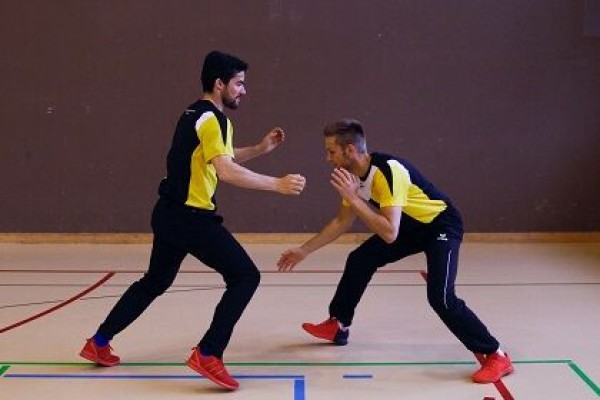
Two participants stand opposite each other and try to touch each other with their flat hands. The target area is the shoulder (safety note: only hit from the outside, not crosswise) and the knees (possibly also the stomach). Play for time or a certain number of points (possibly integrate partner changes).
Variant:
As a league game/royal tournament (winner advances, loser relegated).
No material required
Body hit (one touch)
Fighting and roughhousing games
Partner work
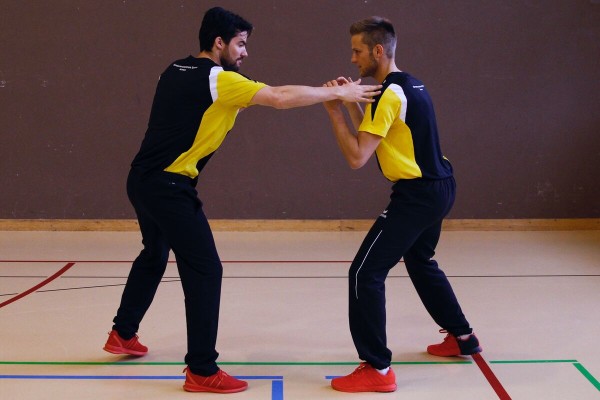
Two participants stand opposite each other and try to touch each other with their flat hands. The target area is the shoulder (safety note: only hit from the outside, not crosswise) and the knees (possibly also the stomach). Play for time or a certain number of points (possibly integrate partner change).
No material required
Crab fight
Fighting and roughhousing games
Partner work

Two participants lie face to face on their stomachs and lift their arms and upper body off the floor. Now both try to grab their opponent's hands and push them to the floor. The winner is the one who can keep their opponent's hands on the floor for two seconds.
2 soft mats (small) ►indoor version
2 tent sheets ►outdoor version
Indoor post set-up:
Connect the soft mats to each other on the narrow side using Velcro (exercise can also be carried out without mats)
Strength: Raising the upper body in prone position
Light-Contact
Partner work
The participants lie in a prone position facing each other (head facing their partner). At the same time, they raise their upper body and hand each other a medicine ball. The upper body is lowered and the participant with the ball brings it to their forehead and then stretches their arms forwards again. The partners perform the exercise again (raising the upper body), with the other participant now bringing the ball to their forehead.
2 soft mats (small)
1 medicine ball
Strength: Ball kicking in boxing position
Light-Contact
Individual work
From the boxing position, the medicine ball is pushed against the wall and caught again at head height.
1 wall
1 medicine ball
Strength: trunk flexion
Light-Contact
Partner work
Two participants lie on their backs with their legs bent opposite each other (legs pointing towards their partner; possibly hook each other's feet). At the same time, the participants perform a torso bend (raise/lower upper body) and hand each other a medicine ball (easy to difficult: hold ball in front, hold ball in front of chest, hold ball up with arms outstretched).
Variant:
One participant holds the claw with raised upper body towards the partner, who in turn also hits two straight lines on the claw with raised upper body. Both participants then perform a torso bend so that the claw can be handed over when the upper body is raised again. During the next exercise (trunk bend), the other participant now hits the claw, etc.
2 soft mats (small)
1 medicine ball
Variant:
1 claw
Strength: trunk flexion and ball kicking
Light-Contact
Partner work

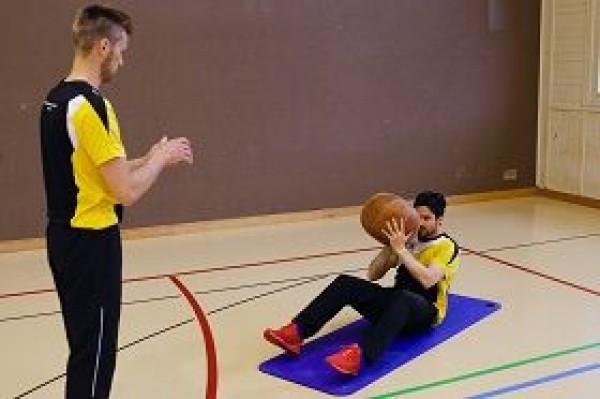

Participant A lies on their back with their legs bent and feet up. The shoulder blades are raised off the floor and the medicine ball is held in a boxing position in front of the head (one hand under the ball, one hand resting on the side of the ball). Participant B is standing approx. 1-2 metres away from their partner. Participant A pushes the ball towards their partner by simultaneously lifting their torso and stretching out their throwing arm. The partner holds the ball briefly and then throws it back again. Participant A changes throwing arm with each pass and does not touch the floor with their shoulders during the entire exercise (do not raise their upper body too high to ensure constant tension in their torso).
Variations:
- Heavier medicine ball
- Participant B throws the ball back immediately.
- Participant B stands further away.
Pro Gruppe:
1 Medizinball
1 Weichmatte (klein)
Strength: trunk flexion and straight stroke
Light-Contact
Partner work


Participant A lies on their back with their legs bent and feet up. The shoulder blades are raised off the floor and the fists are doubled in front of the head (hands at chin height). Participant B stands upright at his partner's head height with bent forearms (90 degrees at the elbow joint). Participant A raises his upper body explosively, rotates his upper body slightly and strikes crosswise against the hand of participant B (strikes with the left and right fist alternately). The upper body is lowered between repetitions, but the shoulder blades do not touch the floor.
Variant:
Lift the upper body, perform 3 alternating punches (e.g. li-re-li) and lower the upper body again.
Per participant
1 pair of boxing gloves
Per group
1 soft mat (small)
Power: Types of impact
Light-Contact
Partner work


Two participants stand one behind the other in front of the raised (large) soft mat. For 10-15 seconds, the person in front boxes a predetermined punch or punch combination against the mat (really exhausting themselves). Once the time has elapsed, he makes room for his partner and lines up behind him. The second participant now begins to hit the mat. The sports director specifies the number of passes.
Participant:
1 pair of boxing gloves
Pro group:
1 soft mat (large)
Strength: Skipping rope
Light-Contact
Individual work
Skipping rope:
- bipedal
- jumping on one leg (left/right)
- right/left leg first (variation: lift leg/knee correctly or jump only lightly on the ball of the foot)
- alternating right/left leg first (variation: lift leg/knee correctly or jump only lightly on the ball of the foot)
- alternating left/right heel on the floor
1 skipping rope
Strength/duel: abduction and adduction of the legs in push-up position and push-up
Light-Contact
Partner work
In the push-up position, support your arms with your hands on an inverted long bench and place your legs on the floor. Spread your legs apart in small jumps and bring them back together in the starting position. However, a push-up (bending and stretching the arms) is also integrated into the exercise in the position with the legs apart before the legs are brought together.
Variant:
Vary the position of the hands/arms (e.g. wide, narrow, together).
Duelling:
After the strengthening exercise, a light contact fight takes place on the wide or narrow side of the inverted long bench.
Per group of 2:
1 long bench
Participant:
1 pair of boxing gloves
Strength/duel: alternating raising and lowering of one leg in forearm support
Light-Contact
Partner work
In the forearm support, the outstretched legs and upper body practically form a line. The legs are supported by the tips of the toes on an inverted long bench and the upper body is supported by the forearms on the floor. The forearms lie flat and parallel to each other with the upper arms resting vertically on the floor (90 degree angle at the elbow joint). Alternately, one leg is raised slightly (foot approximately at heel height).
Duelling:
After the strengthening exercise, a light contact fight takes place on the wide or narrow side of the inverted long bench.
Per group of 2:
1 long bench
Participant:
1 pair of boxing gloves
Strength/duel: Push-up
Light-Contact
Partner work
Push-up position, legs placed on the inverted long bench; bend and stretch arms (lower and raise upper body).
Variant:
Vary the position of the hands/arms (e.g.: wide, narrow, together).
Duelling:
After the strengthening exercise, a light contact fight takes place on the wide or narrow side of the inverted long bench.
Per group of 2:
1 long bench
Participant:
1 pair of boxing gloves
Strength/duel: push-up and jump over an object
Light-Contact
Partner work
From a standing position, bend your legs and place your hands next to your feet to get into a squat position. Support yourself with your hands and jump backwards with both legs to get into a push-up position. Bend your arms to fully lower your upper body (prone position). From the prone position, push back into the push-up position with both arms and jump back into the squat position. In the squat position, the upper body is slightly tilted forwards, stretch your arms backwards at an angle along your body (like a ski jumper on a ski jump), push off the floor powerfully to perform a jump (lateral-sided) over the long bench (use the momentum of the arms). Straighten the upper body and restart the exercise (assume a push-up position) to finally jump back to the starting position.
Variant:
Jump frontally over the long bench.
Duelling:
After the strengthening exercise, a light contact fight takes place on the wide or narrow side of the inverted long bench.
Per group of 2:
1 long bench
Participant:
1 pair of boxing gloves
Strength/duel: Jumping over an object from the side with the upper body supported
Light-Contact
Partner work
Support your upper body with your arms on the inverted long bench. Jump with both legs from one side of the long bench to the other.
Variant:
Land and jump with the outer leg only.
Duelling:
After the strengthening exercise, a light contact fight takes place on the wide or narrow side of the inverted long bench.
Per group of 2:
1 long bench
Participant:
1 pair of boxing gloves
Strength/duel: alternating jump on an object
Light-Contact
Partner work
Stand with one leg on the inverted long bench and the other leg on the floor. Alternate the foot position while jumping.
Duelling:
After the strengthening exercise, a light contact fight takes place on the wide or narrow side of the inverted long bench.
Per group of 2:
1 long bench
Participant:
1 pair of boxing gloves
Strength endurance test (KAT)
Examinations
Time ratios (25 min.) correspond to a group size of approx. 30 participants.
Of course, each participant is tested individually.
The strength endurance test (KAT) is used to test the conditional substance.
Execution regulations
Appendix:
The KAT must always be carried out indoors and cannot be moved outside. At the KAT, all posts are precisely prescribed and are located at a clearly defined location. A volleyball court should be marked out in the hall, as the controls are distributed from this court according to certain measurement specifications. The control posts are located within the volleyball court.
Post description:
Run: 4 painting sticks are required for the circuit.
Row: The poles are set at two different heights. Low spars 1.20 m and high spars 1.30 m. The distance between the bars is 60 cm.
Bench seats: The wide side of the bench faces upwards.
Push-up: A halved foam ball defines how low the upper body must be lowered (height 15 cm).
Torso bend: The wide side of the bench faces upwards. Optionally, fitness mats can be provided for the participants.
Execution:
Run: The run takes place around the entire volleyball court. Start in the corner behind the painting stick of the assigned partial volleyball court (1/3) by the parallel bars.
Row pull: The participant holds on to the bars in a heel position and in a strong back position (legs under the bars). The backs of the hands point towards the face (overhand grip). The upper body is raised and lowered by bending and stretching the arms (without losing the full body extension). The chest must touch the bars 12 times. Participants taller than 1.80 m choose the higher bar.
Bench sit: The participant sits on the long bench (one leg on each side). By jumping off with both legs, the participant reaches a standing position on the long bench. The participant jumps back to the starting position. The standing position on the bench must be reached 12 times (buttocks always touch the bench between jumps).
Push-up: The participant assumes the push-up position. The upper body is raised and lowered by bending and stretching the arms. The chest must touch the foam ball 12 times. Female participants assume the push-up position with their knees supported on the floor and feet held high.
Torso bend: The participant lies on their back. The legs are bent with the calves resting on the bench (heel not on the edge of the bench to support the movement). The participant must raise their upper body 12 times so that both hands touch the bench surface completely (wrist overhanging the front edge of the bench).
Female participants and male participants aged 41 and over must complete the strengthening exercises 10 times (instead of 12). Female participants aged 41 and over repeat the individual exercises 8 times (instead of 10).
The participant always has 2 minutes to complete the five exercises (= 1 round). The faster the exercises are completed, the more time is available for recovery (it is not possible to "run ahead"). The test leader gives the participant the start signal for the next round (every 2 minutes). The participant tries to complete as many rounds as possible.
A participant must stop the test if the required number of repetitions (12/10/8) is no longer achieved in an exercise; it takes more than 2 minutes to complete a round.
Attempts:
One.
Measurement:
Time: The participant has 2 minutes to complete a round.
Points: Each completed lap scores one point. The aim is to score as many points as possible. Half a point is awarded if the second strengthening exercise (bench sitting) is completed in full.
The participant counts the number of repetitions of the strengthening exercises independently. If more than one participant needs to be checked, the test leader will carry out spot checks. If a participant does not complete the correct number of repetitions, the test leader ends the test. If the test leader only checks one participant, he/she can count the number of repetitions out loud.
Control:
The test leader explains all the execution regulations to the participants in advance and demonstrates the exercises if necessary (however, all participants should be familiar with the test). During the strengthening exercises, the test leader stays with the participants and carries out spot checks on the number of repetitions of the individual exercises (ideally, one test leader checks one participant). The test leader sends the participants to a new round every 2 minutes. A test leader can control a maximum of 3 participants (a maximum of 9 participants per volley-ball field with 3 test leaders). As soon as a participant no longer achieves the required exercises within the 2 minutes, the test leader notes the completed rounds. Completed rounds result in half a point if the second strengthening exercise (bench sitting) is completed. The result is recorded directly electronically or transferred later from an evaluation sheet to an electronic device.
Evaluation:
Evaluation forms and electronic evaluation programmes are available for all sports tests:
www.armee.ch/sportausbildung
-> Downloads -> Sportprüfungen -> Auswertung -> KAT
For 3 participants and 1 test leader (9 participants and 3 test leaders):
1 (3) stopwatch(es), 4 (8) stakes, 1 (3) parallel bars, 2 (6) long benches, 3 (9) halved foam balls, 3 (9) fitness mats
Circular movement of the arms while standing upright
Power
Individual work
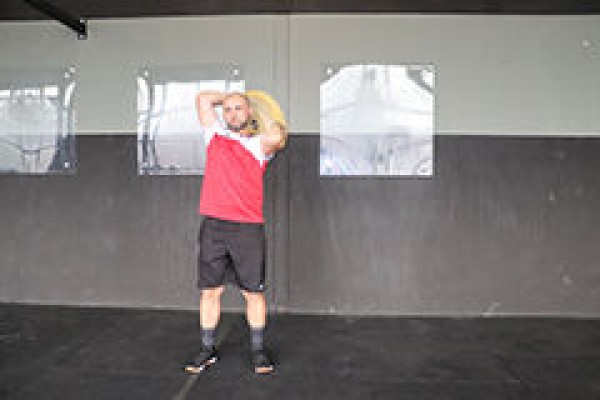


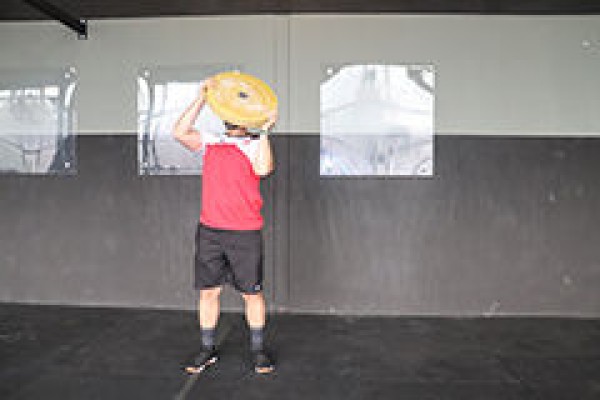

When standing upright, hold a weighted disc in front of your head with your arms bent and move the disc around your head with your arms bent, keeping the rest of your body stable except for your arms. The weight must be kept at head height throughout the exercise. Change the direction of rotation after one or more rounds.
Attention:
Upright posture.
Lighten:
Less weight.
Harden:
More weight.
1 weight disc