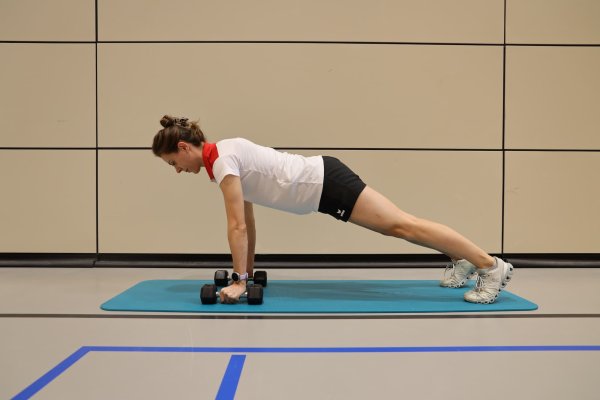
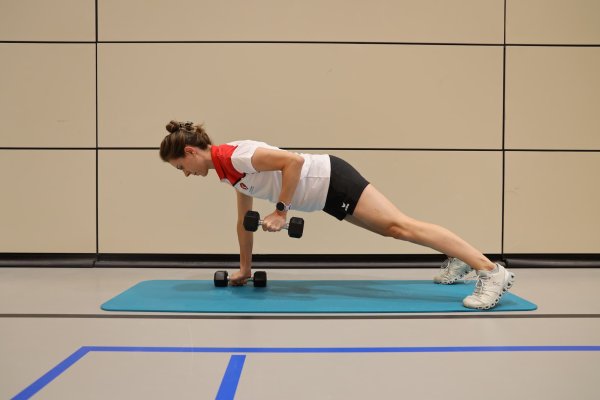
Place two dumbbells with flat edges on the floor, shoulder-width apart and parallel to each other, grip them firmly and assume a high push-up position (plank). Your wrists should be directly beneath your shoulders, your body should form a straight line, and your feet should be slightly wider than hip-width apart to ensure a stable base. Tighten your core and glutes, look down and shift your body weight in a controlled manner to one side. Pull the free dumbbell upwards, keeping it close to your chest, towards your chest or lower ribs. Your elbow should guide the movement close to your body, and your shoulder blade should be actively drawn towards your spine. Briefly stabilise the dumbbell at the top and lower it back down silently. Throughout the entire pull, keep the pelvis absolutely parallel to the floor and do not allow it to tilt sideways. After a brief pause to realign, repeat the movement smoothly with the other arm.
Achtung:
The pelvis rotates sharply to the side with every rowing stroke.
The buttocks rise too high or the lower back sags.
The dumbbell is jerked upwards from the torso with momentum, rather than being lifted cleanly.
The wrists bend inwards at the sides of the dumbbells.
The shoulder of the supporting arm sags and loses its active stability.
Lighten:
Perform the exercise on your knees (knee plank), keep your pelvis stable and extended forwards.
Widen your feet even further to increase your base of support.
Perform the exercise without dumbbells as a ‘plank with shoulder taps’.
Place your hands on a raised, stable plyo box or bench (higher upper body = less leverage).
Harden:
Insert a push-up on the dumbbells after every second row.
Bring your feet closer together.
Increase the dumbbell weight.
Hold the dumbbell statically in the top position for 2–3 seconds.
Wear a weight vest.