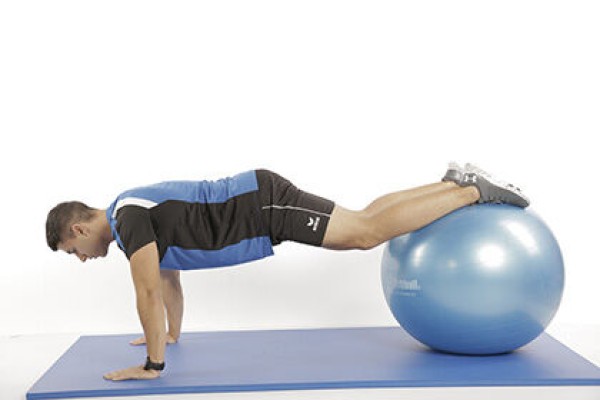
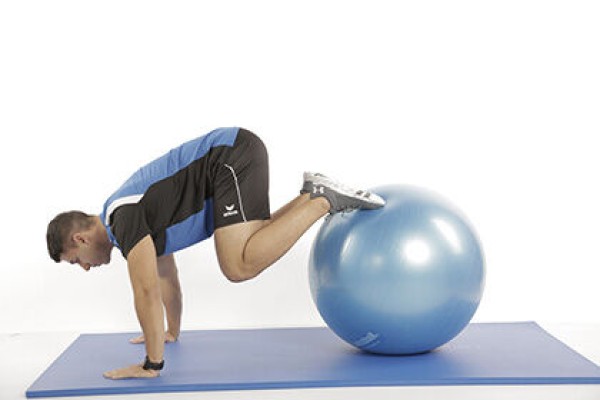
Assume a push-up position (plank), with your hands on the floor shoulder-width apart directly beneath your shoulders; your lower legs or feet rest on the exercise ball; your body forms a straight line (head-hips-feet); actively engage your core; keep your back neutral. Bend your legs in a controlled manner and pull the ball towards your upper body; keep your hips as stable as possible (do not lift them sharply); bring your knees towards your chest (crunch movement). Then slowly extend your legs back to the starting position. Breathing: breathe out as you pull the ball in, breathe in as you return to the starting position.
Attention:
Avoid arching your back (lower back sagging), do not let your hips shoot upwards (the movement becomes a pike rather than a crunch), roll the ball in a controlled manner (maintain sufficient stability), keep your shoulders stable (actively push from your shoulders, maintain a stable push-up position, no jerky movements).
Lighten:
Position the ball closer to the knees; reduce the range of motion (only bend the knees slightly); secure the exercise against a wall (ball against the wall – less instability); simply hold the position without moving (static work to start with).
Harden:
Additional weight (on your back); unstable support for your arms; actively lift your hips upwards (legs straight – the pike is significantly more challenging than the crunch); one-legged variation (lift one leg off the ball).