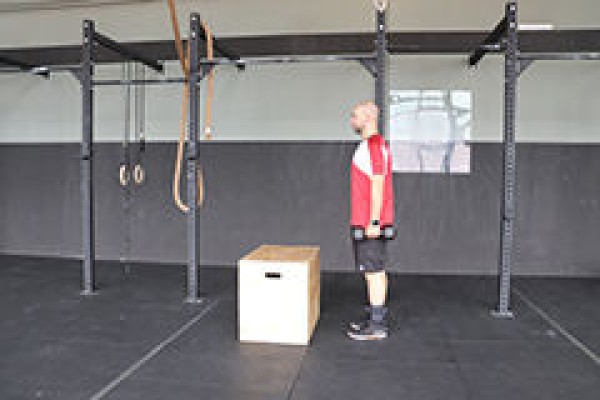
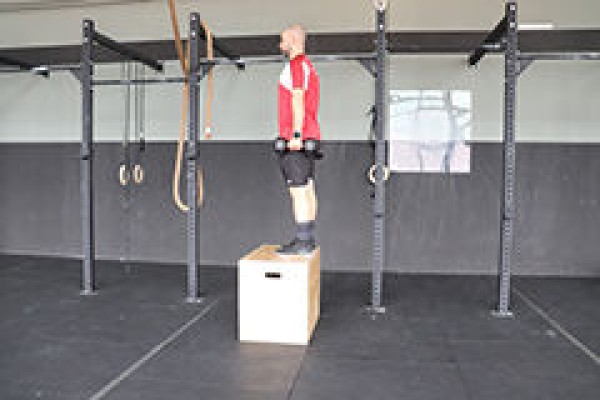
Stand upright with your feet about shoulder-width apart in front of a plyo box, a Swedish box, or a similarly stable raised surface. Keep your feet pointing forward as much as possible and distribute your weight evenly. Keep your upper body upright, look straight ahead, and engage your abdominal muscles slightly. Hold a weight in both hands or across your arms (dumbbells, kettlebells, medicine ball). Position yourself at a distance from the raised surface such that you can place your foot completely on it without leaning your upper body forward excessively. Place one foot completely and steadily on the raised surface, ensuring that both the ball of the foot and the heel are firmly planted. Gradually shift your body weight onto the raised leg. Press firmly into the surface with your entire foot and lift your body upward in a controlled manner. The knee of the rising leg remains stable throughout the movement and follows the direction of the toes. Then place the second leg on the raised surface as well and briefly stabilize the top position. Next, lower yourself back down in a controlled manner on one leg, then bring the second leg back down. Begin the next repetition with the other leg. Throughout the entire movement, keep the upper body, pelvis, and leg axis as stable as possible.
Attention:
The foot is not placed fully on the step, and the heel hangs over the edge; the knee of the stepping leg falls noticeably inward or swings sharply outward; the upper body leans sharply forward or to the side while stepping up; the arms are used to generate momentum. The lower leg pushes off the ground too forcefully, thereby relieving pressure on the actual working leg; when rising, the pelvis rotates or shifts noticeably to the side; the descent is too fast or uncontrolled; the heel of the raised leg lifts significantly off the surface during the push-up; the chosen elevation is so high that the movement can only be performed with compensatory movements; choose only a height at which the entire foot can be placed securely and the movement can still be performed in a controlled and pain-free manner; especially when lowering, actively slow down the movement and do not simply let yourself fall to the ground.
Lighten:
Use a lower plyo box or a lower Swedish box. Reduce the range of motion by using a lower platform. If you have balance issues, lightly support yourself against a wall, bar, or partner. Start by performing the exercise slowly and holding a short pause at the top of the movement. Perform the exercise without additional weight. First, perform several repetitions with the same leg and only then switch sides.
Harden:
Choose a higher platform, provided that your form remains stable. Increase the weight of the dumbbells, kettlebells, or medicine ball. Use a weight vest or sandbag as additional weight. Place an unstable support surface under the standing leg. Consciously slow down the downward movement over 2–4 seconds. Hold the top position for 2–3 seconds and stabilize your balance. Raise the free leg at the top with a controlled knee lift without setting it down on the platform. Perform the exercise on one leg in a more controlled manner by using the free leg for support as little as possible.