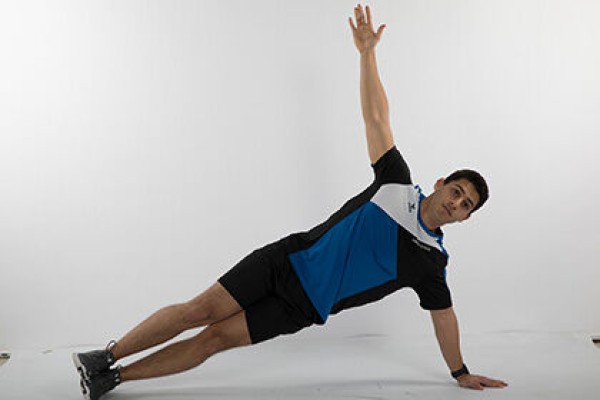
High side plank on the extended (left) arm, with the hand positioned directly beneath the shoulder; the wrist, elbow and shoulder should be in a straight line, with the legs either crossed or slightly offset. Lift the body until the head, torso and legs also form a straight line. First stretch the free arm upwards, then slowly rotate the upper body forwards/downwards and bring the free arm under the torso (rotation). Keep the hips stable; the movement should come from the thoracic spine, not the pelvis.
Attention:
The hips do not tilt or rotate (loss of stability), momentum rather than control (training effect is lost), rotation is too fast, the shoulder ‘sags’ in the supporting arm, the neck rotates instead of the thoracic spine, do not hold your breath.
Lighten:
Knee on the floor (modified side plank); rotation without bringing the arm all the way under the body (smaller range of motion); feet staggered rather than one on top of the other; open the hand of the free arm only to shoulder height (no full rotation).
Harden:
Stack your feet on top of each other (less stable base); perform a slow, controlled eccentric phase (rotate very slowly); additional weight in the top hand; unstable surface under the supporting hand; pause at the end of the rotation (isometric hold under tension); combine with leg lifts (e.g. lift the top leg in the side plank).