
Exercises (1641)
Extension and flexion of the arms and leg in single-leg stance (left) ► 1-leg romanian deadlift
Power
Individual work

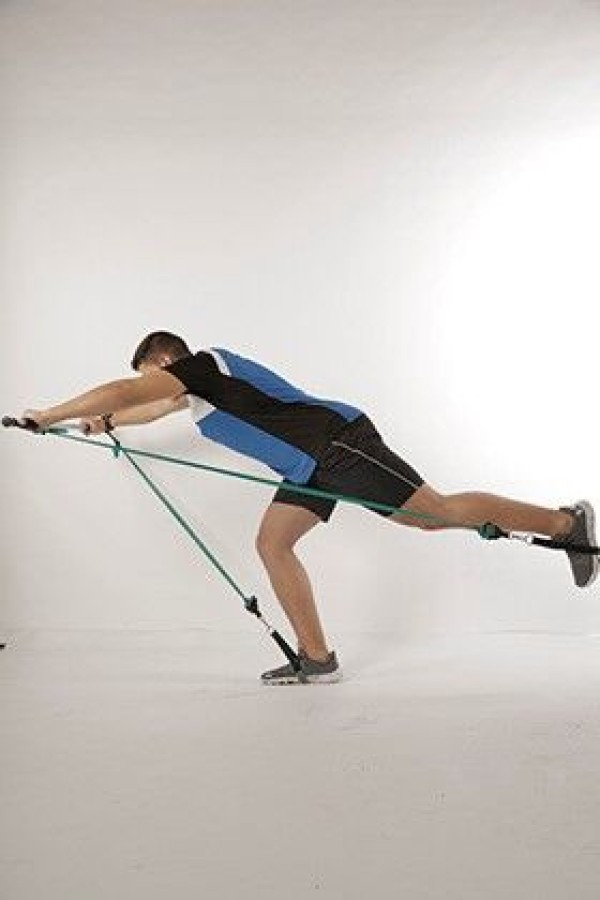
One-legged stand (right), upper body leaning forwards, both loops are attached to the slightly backwards and raised (left) foot (or only the loop on the side of the free leg and the other is attached to the supporting leg), the gymnastics pole is held with both hands in an overhand grip in front of the shoulders (palms pointing towards the floor) with tightened arms, At the same time, both arms and the free leg are stretched out horizontally against the resistance of the elastic bands and the upper body is leaned more forwards (standing balance), then the arms, free leg and upper body are returned to the starting position.
Attention:
No hollow back, tense the torso.
Lighten:
Select less strong elastic bands; roll up the elastic bands less.
Harden:
Select stronger elastic bands; roll up the elastic bands more.
Variation:
Attach the loops to both feet, alternating between stretching out the left and right leg at the same time with the arms (reach a standing position between each exercise).
1 gymnastic bar with elasticated straps
Extension and flexion of the arms and leg in single-leg stance (right) ► 1-leg romanian deadlift
Power
Individual work

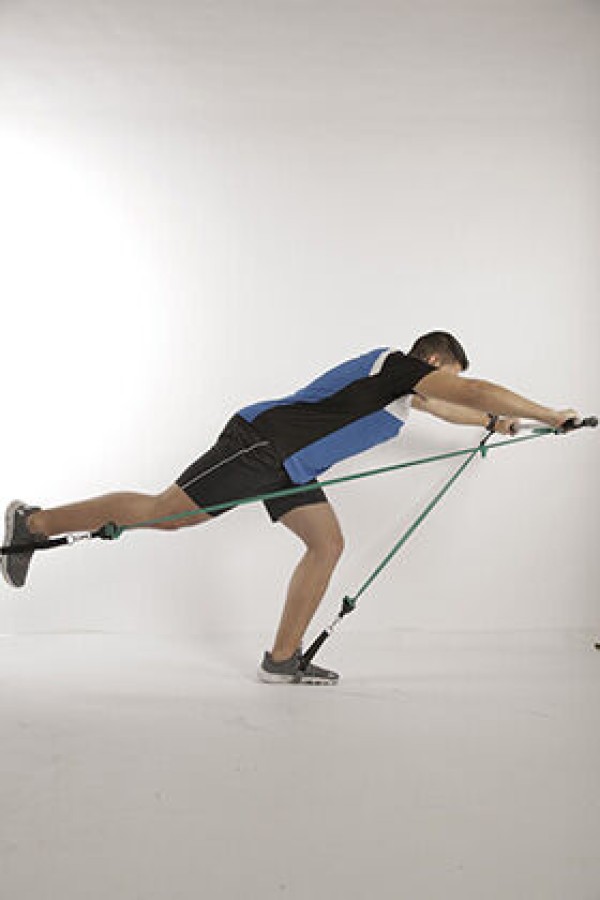
One-legged stand (left), upper body leaning forwards, both loops are attached to the slightly backwards and raised (right) foot (or only the loop on the side of the free leg and the other is attached to the supporting leg), the gymnastics pole is held in front of the shoulders with both hands in an overhand grip (palms facing the floor), At the same time, both arms and the free leg are stretched out horizontally against the resistance of the elastic bands and the upper body is leaned more forwards (standing balance), then the arms, free leg and upper body are returned to the starting position.
Attention:
No hollow back, tense the torso.
Lighten:
Select less strong elastic bands; roll up the elastic bands less.
Harden:
Select stronger elastic bands; roll up the elastic bands more.
Variation:
Attach the loops to both feet, alternating between stretching out the left and right leg at the same time with the arms (reach a standing position between each exercise).
1 gymnastic bar with elasticated straps
Extension and flexion of the arms and running in place
Power
Individual work
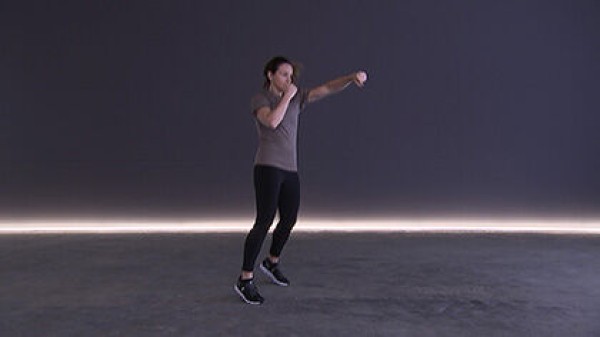
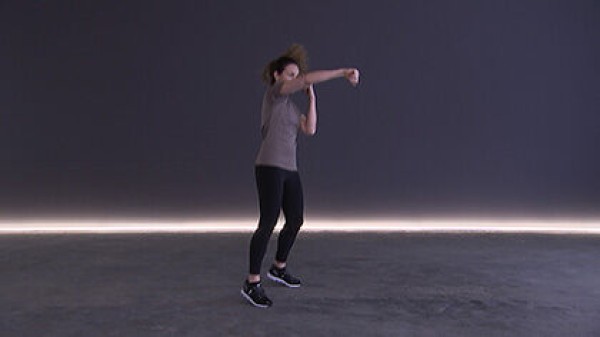
A distinction is made between the left-handed and right-handed stance. Right-handers take the left stance (left foot in front), while left-handers take the right stance (right foot in front). The left-hand stance: The left foot is placed one step forwards from a parallel stance approximately shoulder-width apart so that the right hand is behind. The right hand corresponds to the striking hand, the left hand to the leading hand. The distance between the two feet is approximately one shoulder width, with the feet on a diagonal to each other. Both feet point forwards and the weight is evenly distributed over both legs, with only the balls of the feet in contact with the floor (heels raised). The front shoulder is turned slightly inwards. The whole body is slightly crouched, the knees are slightly bent and soft. The striking hand is placed in front of the chin and rests against the body. The lead hand is in front at eye level. The fists point outwards with the back. The arms are in front of the body and the elbows point downwards so that the arms cover the body. The punching or leading hand is extended straight forwards alternately at a high frequency (fast, straight punching movements). The upper body always remains stable and faces forwards. During the punching movements, the legs are in motion all the time/standing trotting in place (punching hand and supporting leg on the same side).
Attention:
Always keep your arms up (chin or eye level), do not put your heels down.
Lighten:
Smaller movements/lower intensity of the punching movement.
Harden:
Hold additional weight on the arms or in the hands.
2 weight cuffs/weight balls/dumbbells ► Make the exercise more difficult (additional weight)
Alternating extension and flexion of the arms crosswise while standing ► hammer curl
Power
Individual work

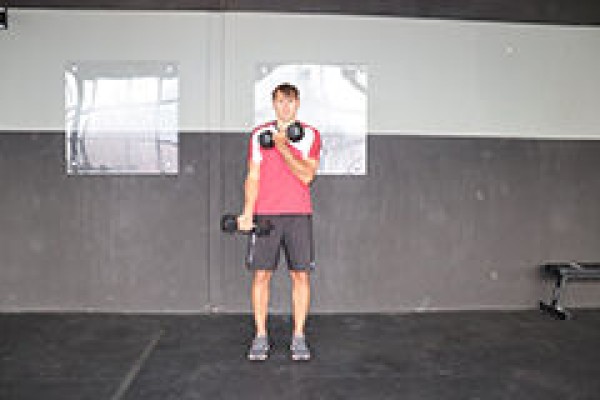

Stand upright, arms hanging with the dumbbells in your hands (neutral grip), the backs of your hands pointing to the respective side (away from your body), bend/bend your arms alternately to bring the dumbbell to the opposite chest/shoulder (back of your hands pointing forwards). The movement is performed using only the arm without support from the upper body. Lower the dumbbell back to the starting position by stretching the arm before starting the exercise with the other arm.
Attention:
Keep a straight back, do not lean backwards/forwards (you may need to do the exercise with your back against a wall). perform the exercise with your back against a wall to maintain the position), keep your elbows slightly in front of your body, work without momentum.
Lighten:
Less weight.
Harden:
More weight.
2 dumbbells
Extension and flexion of the leg and upward movement of the arms while standing (snatch) ► snatch
Power
Individual work
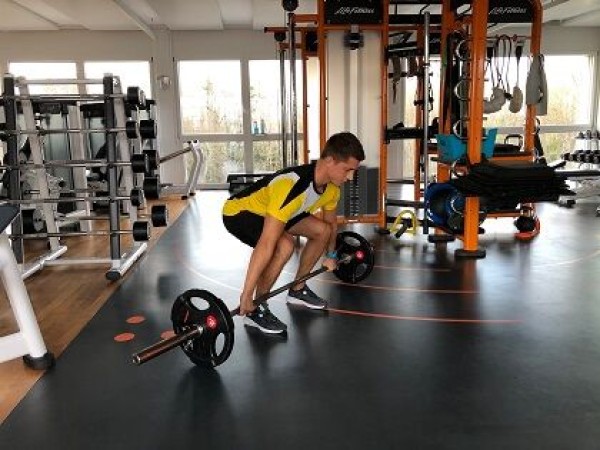
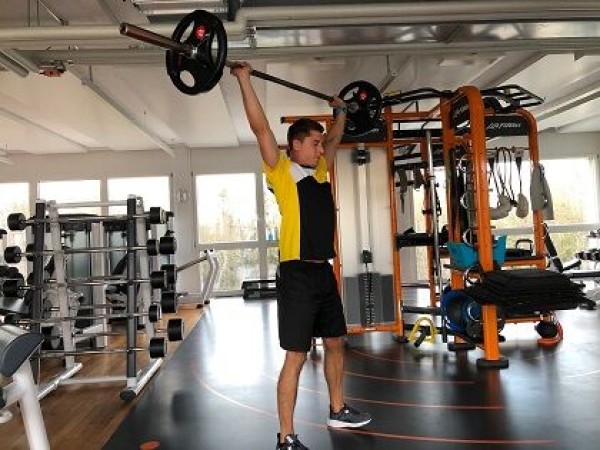
Squat down and grasp the barbell about shoulder-width apart (position the barbell over your midfoot), arms straight. By stretching your legs and moving your arms upwards, pull the barbell overhead (especially pushing it out of your legs) and stabilise the position with the weight held high.
Starting position:
- Squat, standing hip-width apart
- Upper body slightly bent forwards
- Grasp the barbell so wide that the bar is directly level with the hip crease when standing with arms extended
Finishing position:
- Stand upright
- Hold the bar overhead, arms outstretched in a slight V-position and held high
Attention:
This exercise is for advanced users only and requires a high level of knowledge, mobility and stability. Always make sure your back is straight (torso tension).
1 Langhantel
Extension and flexion of the legs in upright forearm support ► bent knee leg raise
Power
Individual work


Move your legs as slowly and controlled as possible to the squat position (pull your knees towards your upper body) and then return to the starting position at the same speed.
Starting position:
- Forearm support (back resting against the pad)
- Legs stretched
- No hollow back (tense abdomen)
Finishing position:
- Legs pulled up into squat position
- Buttocks slightly away from the pad
Attention:
Do not work with momentum and do not start from a hyperextended position. Be careful if you have problems in the lumbar spine.
Lighten:
Just hold the end position; lift your legs less.
Harden:
Exercise with straight legs; add weight on or between the legs.
1 strength tower/machine ► forearm support
2 weight cuffs/1 (medicine) ball ► make the exercise more difficult (additional weight)
Extension and flexion of the legs in lunge (left)
Power
Individual work
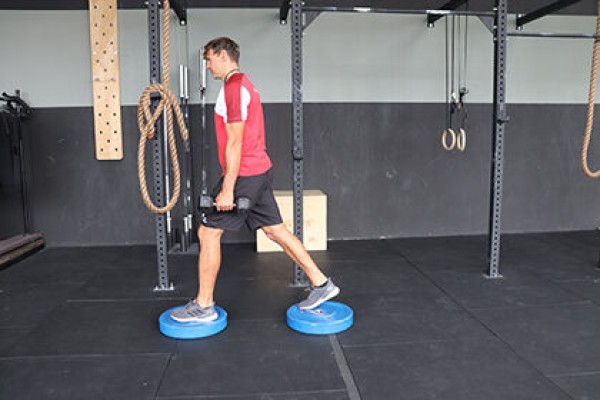

Two weight plates are placed on the floor at some distance so that each foot can be placed in the centre of the plate (left leg in front) in a (long) lunge. The heel of the rear leg is lifted from this V-position with the legs stretched out and the upper body upright (standing on tiptoe). Hold a weight (dumbbell or kettlebell) in both hands with hanging arms. Bend the front (and back) leg to approximately a right angle (buttocks at knee height of the front leg, knee of the back leg almost touching the floor), then straighten both legs to return to the starting position.
Attention:
Always keep the front knee behind the tip of the foot and centred over the foot.
Lighten:
Lower your upper body less (greater angle at the knees); stand on the floor (without weight plates); less or no weight.
Harden:
Additional weight.
Variant:
Weight(s) with arms outstretched at chest height in front of you (if necessary, rotate your upper body to the side and back in a lunge).
2 weight discs
2 dumbbells/kettlebells
1 weight waistcoat ► to make the exercise more difficult (additional weight)
Extension and flexion of the legs in lunge (left)
Power
Individual work
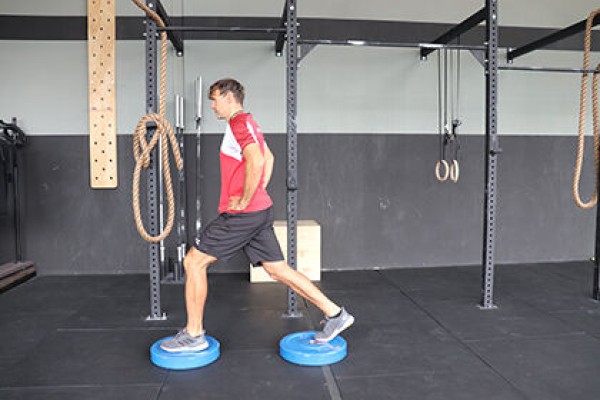

Two weight plates are placed on the floor at some distance so that each foot can be placed in the centre of the plate (left leg in front) in a (long) lunge. The heel of the rear leg is lifted from this V-position with the legs stretched out and the upper body upright (standing on tiptoe). The arms are supported on the hips or are at chest height in a holding position. Bend the front (and back) leg to approximately a right angle (buttocks at knee height of the front leg, knee of the back leg almost touching the floor), then straighten both legs to return to the starting position.
Attention:
Always keep the front knee behind the tip of the foot and centred over the foot.
Lighten:
Lower your upper body less (greater angle at the knees); stand on the floor (without weight plates).
Harden:
Additional weight (hold in your hands with hanging arms or in front of you).
Variant:
Hold your arms in front of you (possibly with weight), rotate your upper body to the side and back in a lunge.
2 weight discs
2 dumbbells/kettlebells/1 weight waistcoat ► Make the exercise more difficult (additional weight)
Extension and flexion of the legs in lunge (right)
Power
Individual work
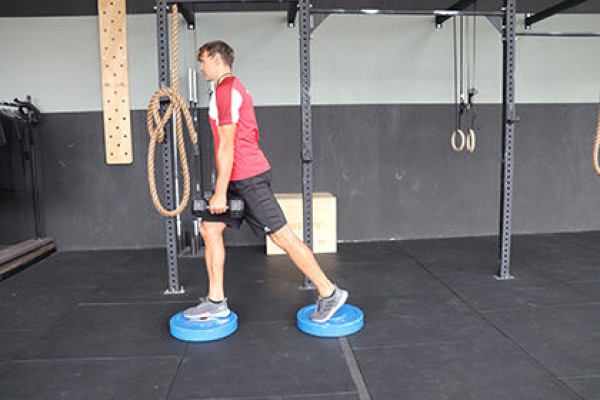
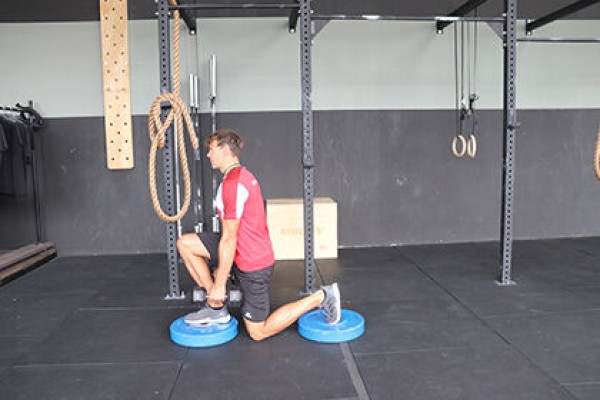
Two weight plates are placed on the floor at some distance so that each foot can be placed in the centre of the plate (right leg in front) in a (long) lunge. The heel of the rear leg is lifted from this V-position with the legs stretched out and the upper body upright (standing on tiptoe). Hold a weight (dumbbell or kettlebell) in both hands with hanging arms. Bend the front (and back) leg to approximately a right angle (buttocks at knee height of the front leg, knee of the back leg almost touching the floor), then straighten both legs to return to the starting position.
Attention:
Always keep the front knee behind the tip of the foot and centred over the foot.
Lighten:
Lower your upper body less (greater angle at the knees); stand on the floor (without weight plates); less or no weight.
Harden :
Additional weight.
Variant:
Weight(s) with arms outstretched at chest height in front of you (if necessary, rotate your upper body to the side and back in a lunge).
2 weight discs
2 dumbbells/kettlebells
1 weight waistcoat ► to make the exercise more difficult (additional weight)
Extension and flexion of the legs in lunge (right)
Power
Individual work
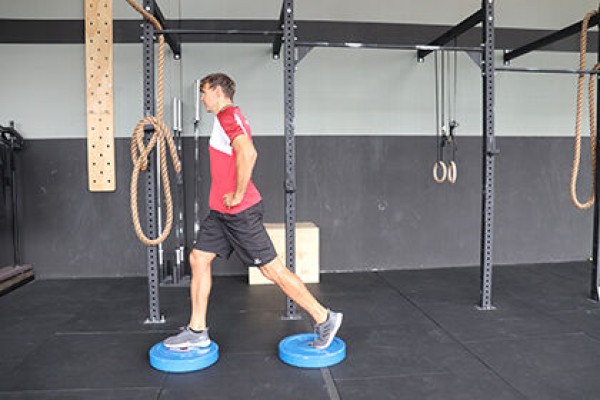

Two weight plates are placed on the floor at some distance so that each foot can be placed in the centre of the plate (right leg in front) in a (long) lunge. The heel of the rear leg is lifted from this V-position with the legs stretched out and the upper body upright (standing on tiptoe). The arms are supported on the hips or are at chest height in a holding position. Bend the front (and back) leg to approximately a right angle (buttocks at knee height of the front leg, knee of the back leg almost touching the floor), then straighten both legs to return to the starting position.
Attention:
Always keep the front knee behind the tip of the foot and centred over the foot.
Lighten:
Lower your upper body less (greater angle at the knees); stand on the floor (without weight plates).
Harden:
Additional weight (hold in your hands with hanging arms or in front of you).
Variant:
Hold your arms in front of you (possibly with weight), rotate your upper body to the side and back in a lunge.
2 weight discs
2 dumbbells/kettlebells/1 weight waistcoat ► Make the exercise more difficult (additional weight)
Extension and flexion of the legs in an elevated position ► leg extension
Power
Partner work
1 trainee & 1 helper ► Note change of position
(= double the time required; for lesson planner see Organisation Kraft: Info button Execution)

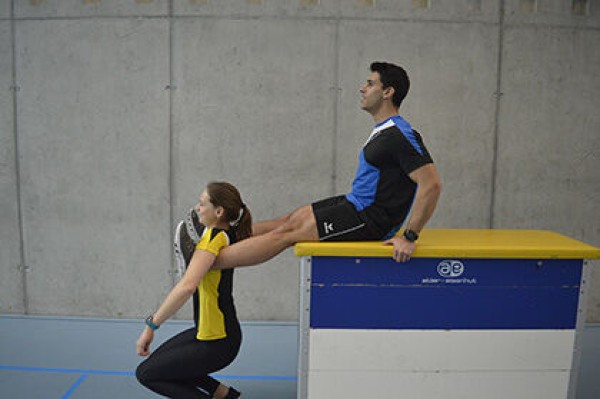
Exerciser: Sit upright on the edge of the vaulting box, straighten and bend your legs.
Partner: Hang on to the active participant's feet with your armpits and use part of your own body weight to counter the extension of the exerciser's legs.
Attention:
Always listen to/respond to your partner (adjust pressure/intensity). Do not push your knees all the way through.
Lighten:
More support from your partner (less weight/resistance).
Harden:
Less help from your partner (more weight/resistance).
1 Swedish box
Extension and flexion of the legs while seated (leg curl) ► leg curl
Power
Individual work
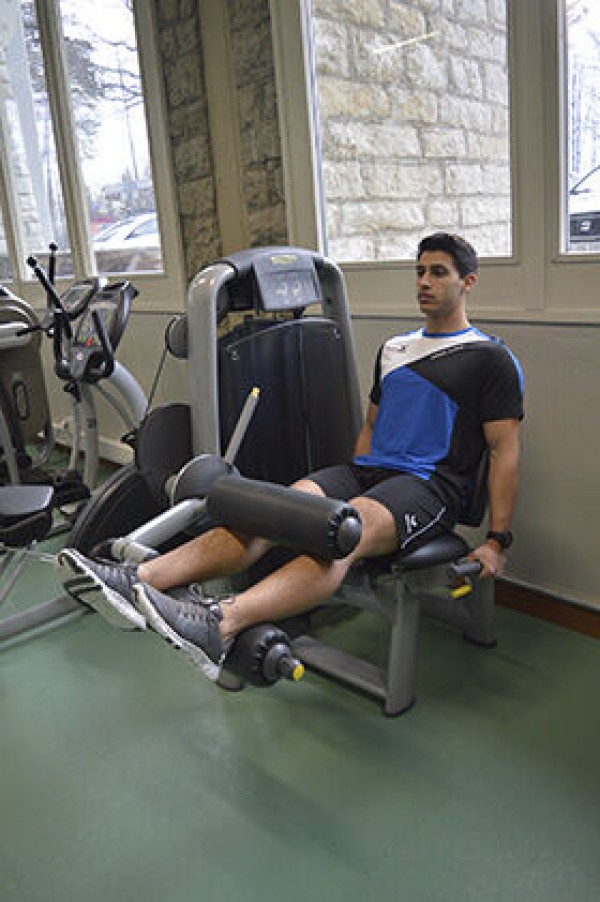
In a seated position, move the lower legs towards the buttocks and back to the starting position in a controlled movement without momentum.
Starting position:
- Sitting, legs pointing almost straight ahead
- The knees are level with the axis of rotation of the device
- The foot pad is level with the ankle
- Buttocks and back fully seated, torso tensed
Final position:
- Knees bent, heels slightly behind the knees
- Press against the pad using the handles, the back does not move.
Attention:
No hollow back, the movement takes place exclusively in the knee joint (lower leg).
Variant I:
Perform the exercise on one leg to counteract any muscular imbalance.
Variant II:
The exercise can also be performed using the 2:1 method: push down with two legs and alternately bring only one leg back up.
1 strength tower/machine ► leg curl
Extension and flexion of the legs while seated (leg extension) ► leg extension
Power
Individual work
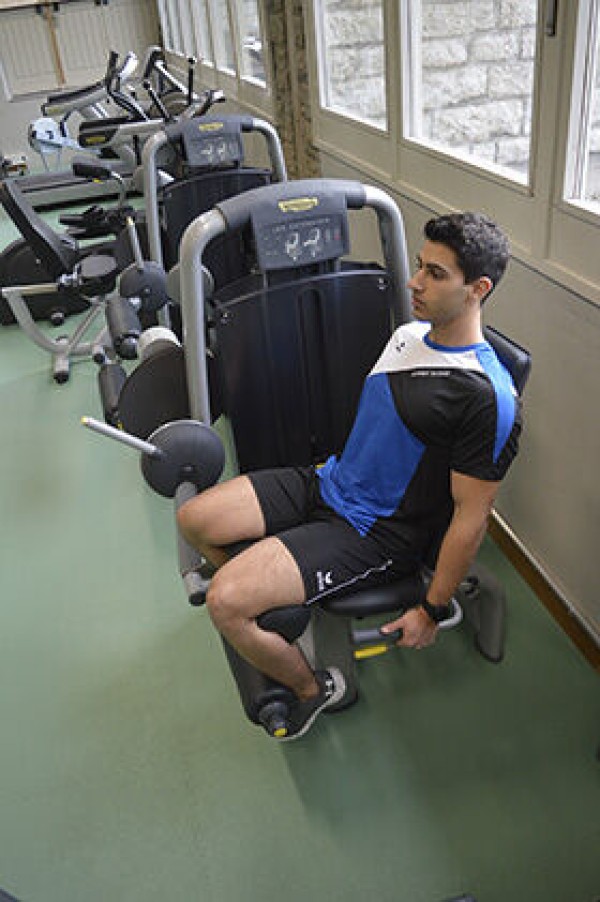
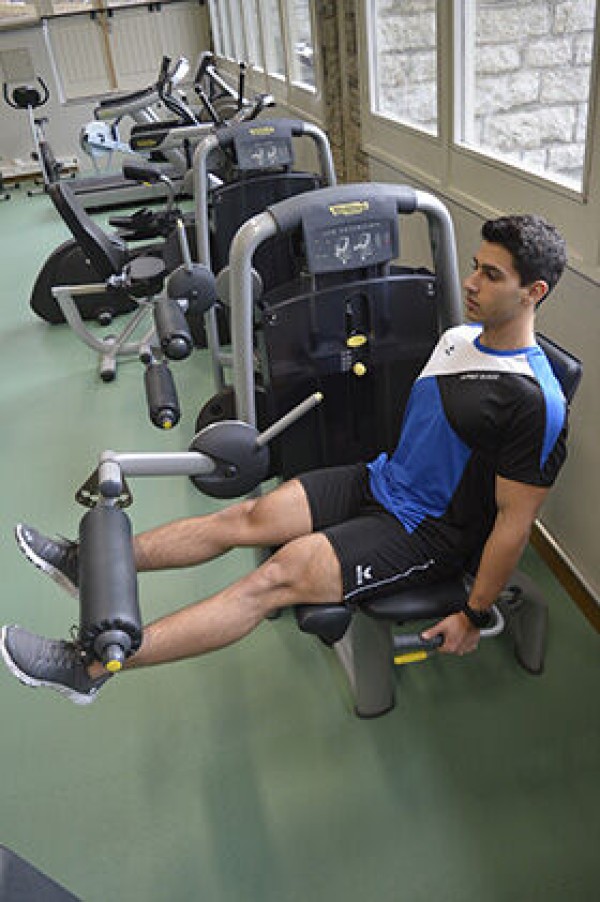
In a seated position, push your lower legs up in a controlled movement without momentum and return to the starting position.
Starting position:
- Sitting, knees at right angles, heels slightly behind the knees
- The knees are level with the axis of rotation of the device
- The foot pad is level with the ankle joint
- Buttocks and back fully seated, torso tensed
Final position:
- Press your lower legs up until they are parallel to the floor and your legs are almost stretched out and pointing forwards
- Keep your back and buttocks firmly in the seat
Attention:
Do not make a hollow back, the movement only takes place in the knee joint (lower leg), do not fully extend your knees.
Variant I:
Perform the exercise on one leg to counteract any muscular imbalance.
Variant II:
The exercise can also be performed using the 2:1 method: push down with two legs and alternately bring only one leg back up.
1 strength tower/machine ► leg stretcher
Extension and flexion of the legs while seated ► crunch kick
Power
Individual work


Sitting on a chair with your upper body leaning slightly backwards, lift your legs off the floor and bend them (pull your knees towards your body). To hold the position better, hold on to the chair with your hands (e.g. grasp the seat, grip the armrest or cross your arms behind the backrest). From this position, stretch your legs out so that they are pointing diagonally forwards (the further horizontally towards the floor, the more difficult) and bend back into the starting position.
1 (office) chair
Extension and flexion of the legs while seated ► crunch kick / knee in
Power
Individual work
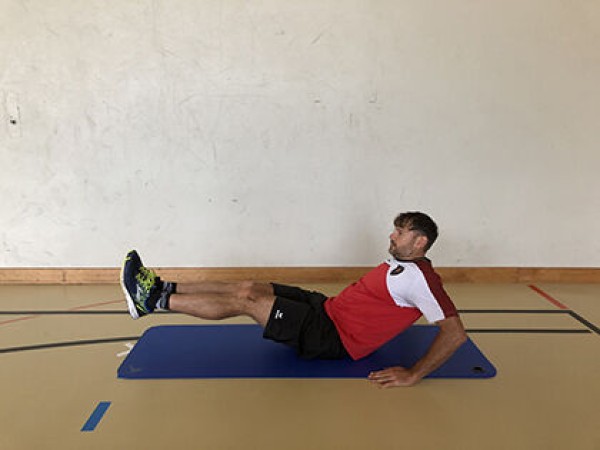
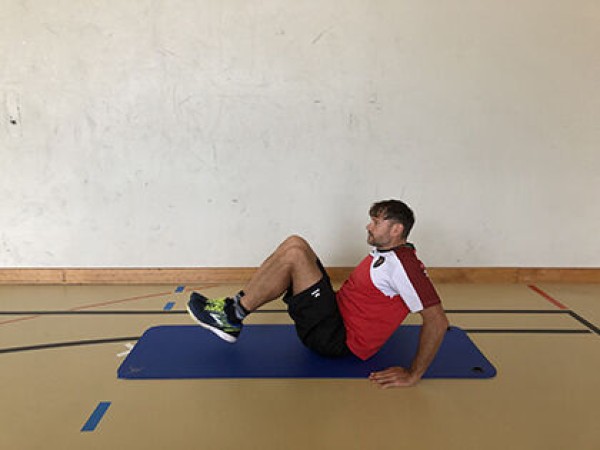
When seated, use your arms to support your upper body, which is leaning slightly backwards, bend your outstretched, raised legs (knees at buttock height) and stretch them forwards back to the starting position (bend and stretch your legs).
Attention:
Do not put your legs down completely.
Lighten:
Just hold the position with slightly bent legs (without stretching the legs), stretch the legs out less.
Harden:
Additional weight on, between or on the legs.
2 weight cuffs/1 weight disc/(medicine) ball/sandbag ► Make the exercise more difficult (additional weight)
Extension and flexion of the legs while seated ► leg press
Power
Individual work
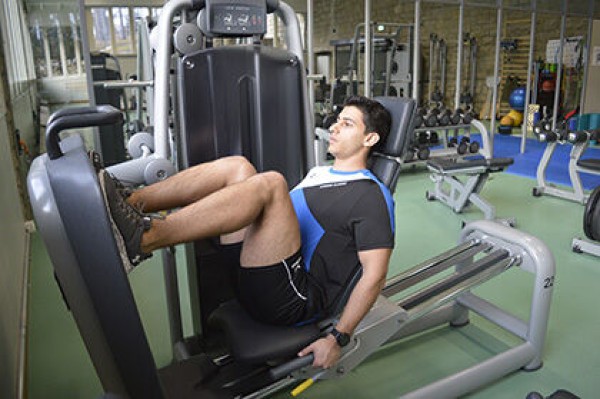
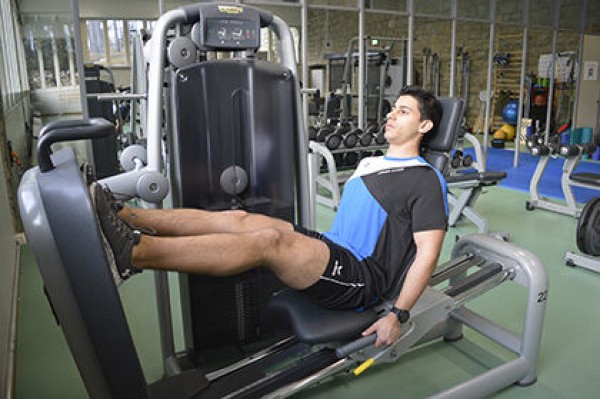
In a slow and controlled movement, press the weight away from the body and then bring it back again.
Starting position:
- Feet rest with the whole sole hip-width apart
- Knee angle is at least 90 degrees
- Back lies flat on the seat (no hollow back)
Finishing position:
- Do not fully extend the knees
- Lower back remains firmly in the seat
- Ankle, knee joint and hip are in line
Attention:
Push the knee outwards (do not allow it to tilt inwards), distribute pressure over the entire foot, do not fall into a hollow back.
Variant I:
The target muscles are changed by changing the position of the feet. The higher the feet are, the more the gluteal muscles are used. If the stance is widened and the feet point outwards, the inner thighs are trained more.
Variant II:
The exercise can also be performed with one leg.
1 weight tower/machine ► leg press
Extension and flexion of the legs while standing (deadlift) ► deadlift
Power
Individual work
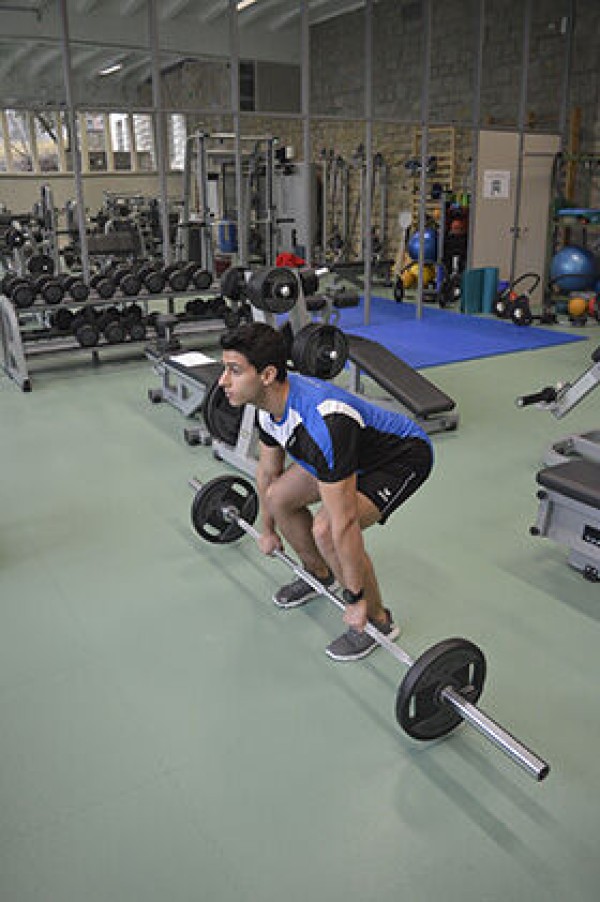
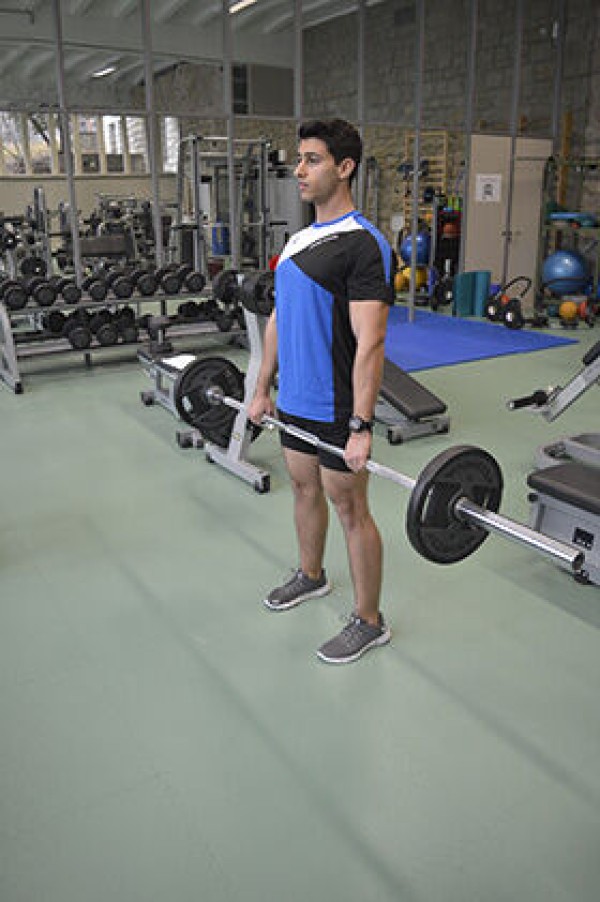
Grab the barbell lying on the floor with an overhand grip (or cross grip) from a squat position, keeping your arms straight and your back straight. By stretching your legs and straightening your upper body, pull the barbell up close to your legs to hip height (arms always straight). Then, when lowering the weight, first bring your hips back and down before bending your knees back to the starting position.
Starting position:
- Squat position, outstretched arms grasp the barbell at shin height, feet under the barbell
- Grasp the barbell shoulder-width apart with an overhand or cross grip
- Back is straight and tense, buttocks pushed back (hip hinge)
- Keep your head straight
Finishing position:
- Stand upright, arms and legs stretched
- Back straight (abdomen tensed)
- Shoulder blades pulled back in a fixed position
Attention:
In the starting position, the floor should be pushed away, creating more tension in the back and buttocks. Never lift the bar with a hunched back, otherwise there is a risk of strain injuries (always keep your back straight). If you are unsure, only train with the bar without (or with little) weight until you have learnt the movement sequence.
1 Langhantel
Extension and flexion of the legs in support ► knee tuck
Power
Individual work

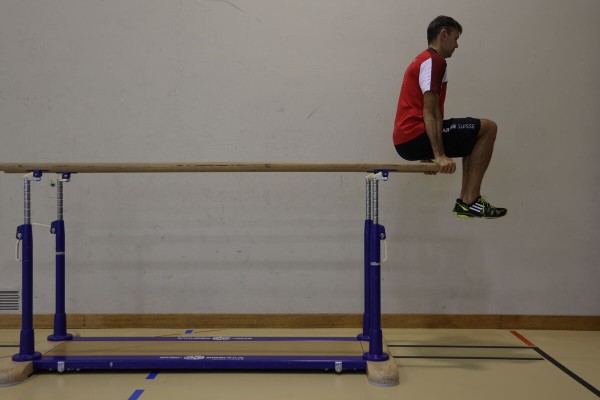
Support yourself on the bar (end), body stretched out, legs pointing (closed) towards the floor, bend both legs at the same time and raise your knees to the height of your belly button. Then stretch your legs back to the starting position (raise and lower your legs).
Attention:
Maintain a stable upper body/arm position during the exercise (elbows close to the body), slightly forward with the upper body, perform the movement in a controlled manner.
Lighten:
Lift your legs less.
Harden:
Add weight (on/between the legs).
Variation:
Bend one leg alternately.
1 parallel bars
2 weight cuffs/1 (medicine) ball/dumbbell ► Make the exercise more difficult (additional weight)
Extension and flexion of the legs in forearm support ► leg press
Power
Individual work
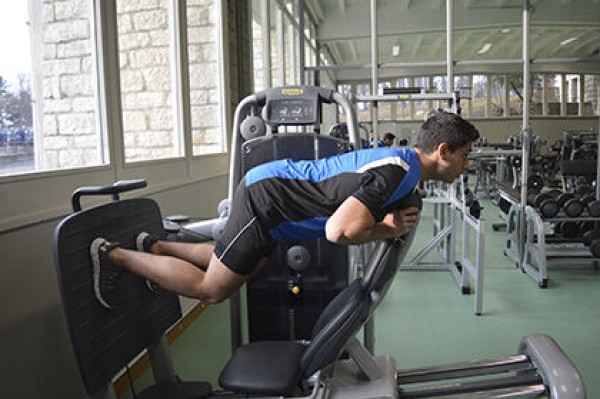

Forearm support on the flat bench, feet on the plate, in a slow and controlled movement, press the weight away from the body and return to the starting position.
Starting position:
- Forearm support on the flat bench (face down)
- Feet are hip-width apart and rest with the entire sole on the footplate
- The knee angle is at least 90 degrees
Finishing position:
- Knees not fully extended
- Back remains straight
- Ankle joint, knee joint and hip are in line
Attention:
Push your knees outwards (do not allow them to tilt inwards), distribute pressure over the whole foot, do not fall into a hollow back.
1 weight tower/machine ► leg press
Extension and flexion of the legs in forearm support ► suspended crunch
Power
Individual work
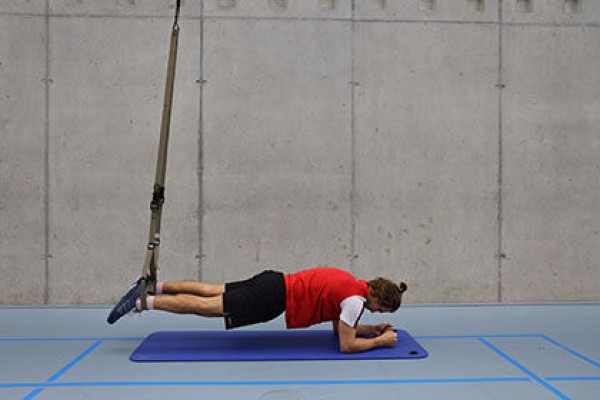

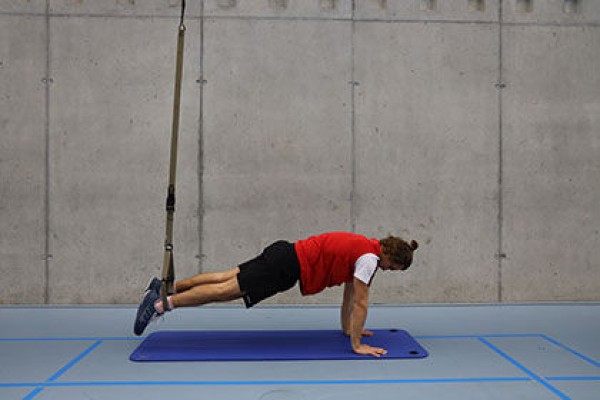
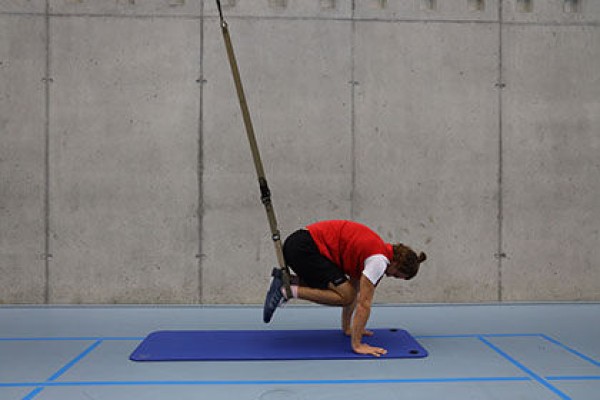

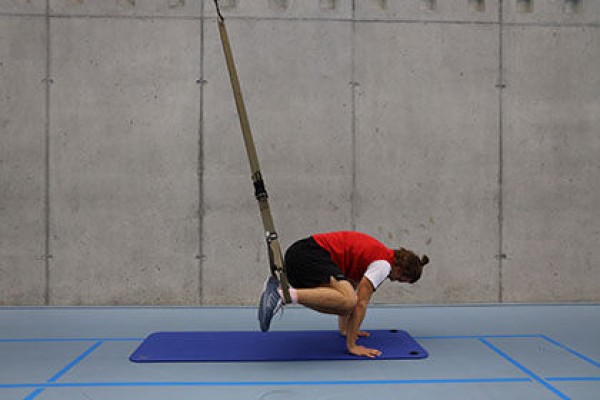
Progression I:
Adjust the sling trainer to mid-lower leg length (standing), support the forearms with the feet vertically under the attachment point in the slings, lift the buttocks and simultaneously pull the knees towards the chest, lower the buttocks and stretch the legs to return to the starting position.
Progression II:
Analogue to progression I, but supported on the hands.
Progression III:
Analogue to progression I, but bring the knees alternately to the left and right elbow.
Progression IV:
Analogue to progression II, but bring the knees alternately to the left and right elbow. In addition, a push-up can be integrated after each repetition.
Attention:
Keep body tension, do not let hips sag, back straight, forearms under shoulders (for all progressions).
Harden:
The further the hands are from the attachment point, the more challenging the exercise becomes.
1 sling trainer
Extension and flexion of the legs in the prone position ► hamstring curl
Power
Individual work
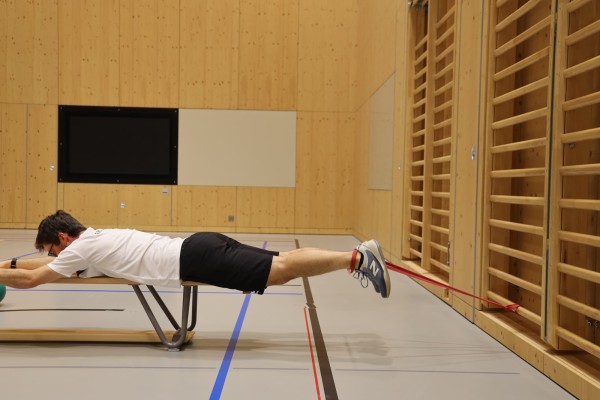
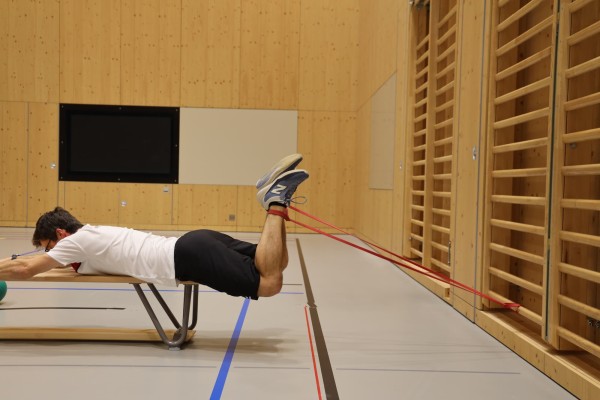
Lie face down on a long bench, with your hips close to the end of the bench. The elastic band is attached to the wall bars and is placed around your lower legs or legs. Start by keeping your legs almost fully extended. At the same time (or alternately), bend your knees and pull your heels towards your bottom in a controlled manner. Then slowly straighten your legs again.
Attention:
Keep your hips and upper body stable on the bench; do not shift your weight or arch your back by lifting your pelvis; perform the movement in a controlled manner without using momentum; keep your knees in line with your hip joints as far as possible; do not pull the resistance band taut abruptly.
Lighten:
Use a lighter elastic band; reduce the range of motion.
Harden:
Use a stiffer elastic band; perform the movement more slowly (particularly during the stretching phase); hold the end position briefly; additionally, hold a ball between your knees (squeeze it).
1 long bench
1 wall bars
1 resistance band
1 ball ► to make the exercise more challenging
Extension and flexion of the legs in prone position ► lying leg curl
Power
Individual work

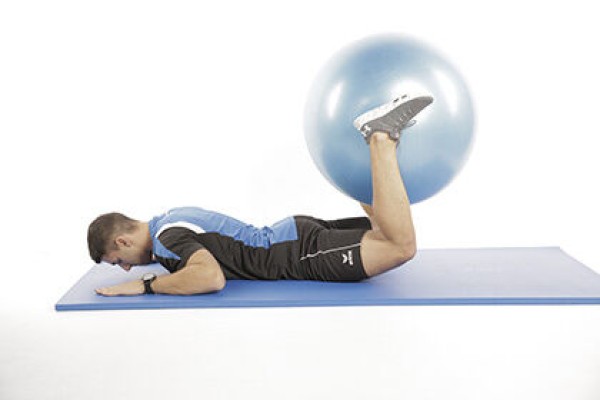
Prone position (upper body slightly raised or flat on the floor), arms bent (elbows approx. 90° at head height or slightly below), clamp the exercise ball between the legs, raise the lower legs (bring the exercise ball to the buttocks) and lower back to the starting position (movement only in the knee joint).
Attention:
Do not lower your legs completely (thigh remains flat on the floor).
Lighten:
Bend your legs less.
Harden:
Add weight to the legs.
1 exercise ball
2 weight sleeves ► to make the exercise more difficult (additional weight)
Extension and flexion of the legs in prone position ► lying leg curl
Power
Individual work
Lying on your stomach on the flat bench, bring your lower legs to your buttocks and back to the starting position in a controlled movement without momentum.
Starting position:
- Prone position, legs almost straight
- The knees are level with the axis of rotation of the machine
- The foot pad is level with the ankle
Finishing position:
- Knees bent, bring the heel towards the buttocks
- The abdomen and hips remain on the pad, the back does not move.
Attention:
Do not arch your back.
Variant:
Perform the exercise on one leg to counteract any muscular imbalance.
1 strength tower/machine ► leg curl
Extension and flexion of the legs in a hanging position ► bent knee leg raise
Power
Individual work

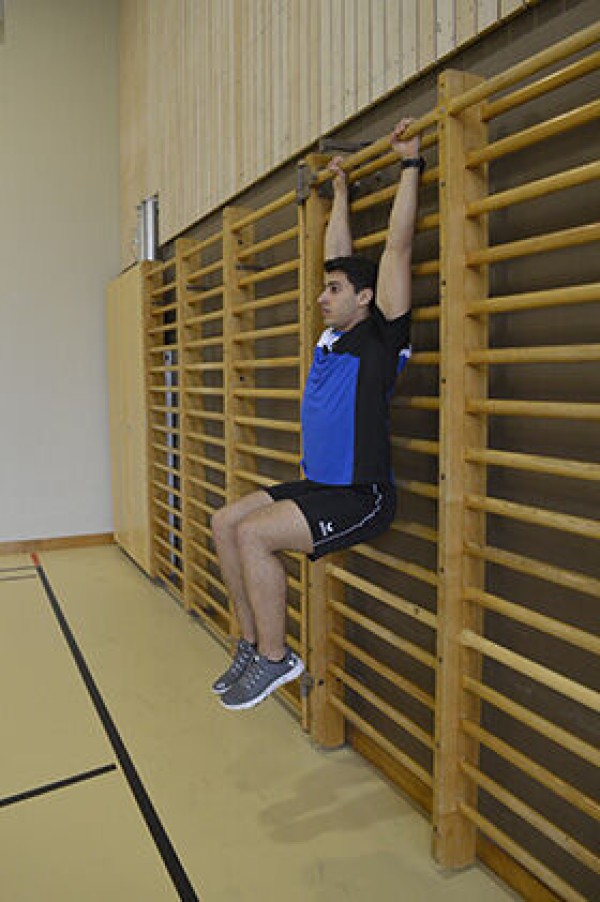
Hanging on the wall bars (back facing the wall bars), body stretched, legs bent and stretched (knees raised to hip height).
Attention:
Back always remains on the wall bars (movement as controlled as possible, without momentum).
Lighten:
Just hold the position with bent legs; lift your knees less high.
Harden:
Additional weight for the legs; stretch the legs.
1 wall bars
2 weight cuffs/1 (medicine) ball (e.g. football, volleyball, basketball) ► Make the exercise more difficult (additional weight)
Extension and flexion of the legs in push-up position ► suspended crunch
Power
Individual work
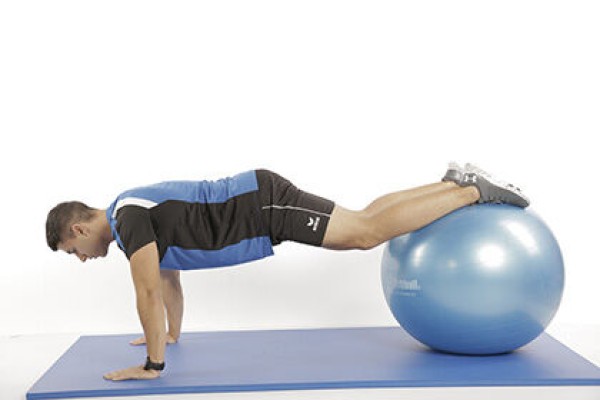
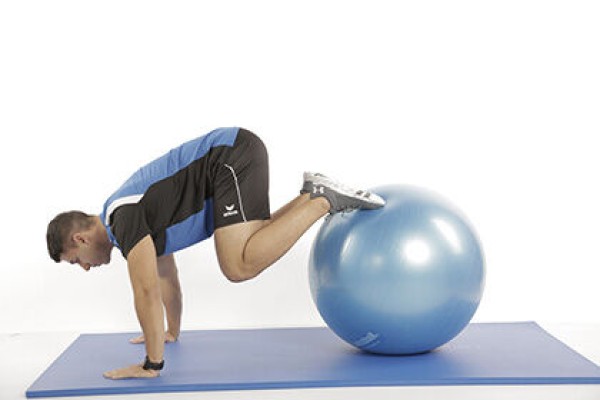
Assume a push-up position (plank), with your hands on the floor shoulder-width apart directly beneath your shoulders; your lower legs or feet rest on the exercise ball; your body forms a straight line (head-hips-feet); actively engage your core; keep your back neutral. Bend your legs in a controlled manner and pull the ball towards your upper body; keep your hips as stable as possible (do not lift them sharply); bring your knees towards your chest (crunch movement). Then slowly extend your legs back to the starting position. Breathing: breathe out as you pull the ball in, breathe in as you return to the starting position.
Attention:
Avoid arching your back (lower back sagging), do not let your hips shoot upwards (the movement becomes a pike rather than a crunch), roll the ball in a controlled manner (maintain sufficient stability), keep your shoulders stable (actively push from your shoulders, maintain a stable push-up position, no jerky movements).
Lighten:
Position the ball closer to the knees; reduce the range of motion (only bend the knees slightly); secure the exercise against a wall (ball against the wall – less instability); simply hold the position without moving (static work to start with).
Harden:
Additional weight (on your back); unstable support for your arms; actively lift your hips upwards (legs straight – the pike is significantly more challenging than the crunch); one-legged variation (lift one leg off the ball).
1 exercise ball
1 weight vest/weight disc/sandbag ► to make the exercise more difficult (additional weight)
1 balance cushion/balance board ► to make the exercise more difficult (unstable base)