
Exercises (1641)
Cross your hand over your bent leg while standing
Power
Individual work


Bend your legs in a standing position, upper body tilted forwards, bend one leg alternately and touch the tip of each foot with your hand crosswise.
Attention:
Knees always remain behind the tips of the feet and point forwards.
Lighten:
Lower your upper body less (touch your knees instead of the top of your feet).
Harden:
Add weight to your arms and/or legs.
2-4 weight cuffs/2 weight balls to make the exercise more difficult (additional weight)
Bring your hand crosswise to your knee in push-up position ► knee touch / knee tap push up position
Power
Individual work


Push-up position (high support, face/gaze downwards), buttocks slightly raised, touch the opposite foot or knee with one hand, without lifting the legs. Switch sides after each exercise.
Attention:
Keep your upper body stable (tense your stomach).
Lighten:
Just hold the basic position (push-up position).
Harden:
Additional weight on the arms; unstable support.
2 weight cuffs ► making the exercise more difficult (additional weight)
2 balance cushions/1 balance board ► making the exercise more difficult (unstable base)
Bring your hand crosswise to your shoulder in push-up position ► Shoulder tap push up position
Power
Individual work


Push-up position (high support, face/look down), bring one hand crosswise to the shoulder. Switch sides after each exercise.
Attention:
Head, torso, hips and knees practically form a line (do not stretch your buttocks upwards or let them sag, tense your stomach).
Lighten:
Just hold the basic position (push-up position); place your knees on the floor.
Harden:
Additional weight (on your back or arms); unstable base.
2 weight cuffs/1 weight vest/weight disc/sandbag ► Make the exercise more difficult (additional weight)
1-2 balance cushions/1 balance board ► Make the exercise more difficult (unstable surface)
Bring hand and foot together crosswise while standing
Power
Individual work


Stand upright on the balls of your feet, shoulder-width apart, alternately lift one foot while hopping and touch it with your hand crosswise in front of your body at hip level.
Attention:
Do not put your heels down completely (keep jumping on your toes).
Lighten:
Lift your foot less (possibly without touching it with your hand).
Harden:
Lift your foot higher; additional weight (on your legs).
2 weight cuffs/1 weight waistcoat ► Make the exercise more difficult (additional weight)
Bring hand and foot together crosswise in four-footed stance backwards alternating ► toe tap / toe touch
Power
Individual work
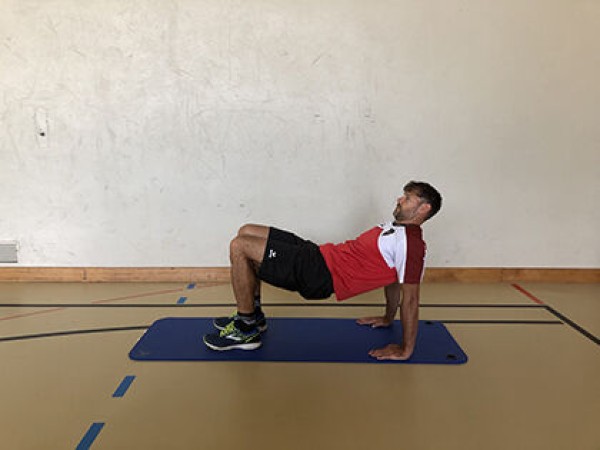

Inverted four-foot stance (chest pointing upwards, body supported on hands and feet, fingertips pointing forwards). Raise one arm and one leg crosswise and bring the hand and foot together. Switch sides after each exercise.
Lighten:
Just hold the position or raise your arm and leg only slightly (without bringing your hand and foot together).
Harden:
Additional weight.
2-4 weight cuffs/1 weight waistcoat ► Make the exercise more difficult (additional weight)
Bring hand and foot together crosswise in push-up position ► mountain climber toe touch / toe tap (climber tap)
Power
Individual work


Push-up position (high support, face/gaze downwards), bring one hand and one foot together crosswise, keeping the arm stretched and the leg bent (knee approximately at chest height). Switch sides after each exercise.
Attention:
Keep your upper body as stable as possible (tense your stomach).
Lighten:
Just hold the basic position (push-up position).
Harden:
Additional weight on arms and legs; unstable base.
Variant:
Cross your elbows to your knees.
2-4 weight cuffs ► Make the exercise more difficult (additional weight)
1-2 balance cushions ► Make the exercise more difficult (unstable base)
Bring hand and knee together in lateral forearm support (left) ► knee raise lateral pillar bridge / side bridge
Power
Individual work


Side support on the (right) forearm (possibly on a wall for the correct straight position), bring the upper hand (or elbow) and upper knee together (approximately at the level of the navel) and back to the starting position.
Attention:
Head, torso, hips and knees practically form a line (pelvis does not tilt backwards or forwards), keep the shoulder above the elbow.
Lighten:
Place the lower knee on the floor; bend the leg less; only hold the position.
Harden:
Additional weight for the arm and/or training leg; unstable base (possible for both the supporting arm and the supporting leg).
2 weight cuffs/1 weight ball/dumbbell ► Make the exercise more difficult (additional weight)
1 ball/1-2 balance cushions/1 balance board ► Make the exercise more difficult (unstable surface)
Bring hand and knee together in lateral forearm support (right) ► knee raise lateral pillar bridge / side bridge
Power
Individual work

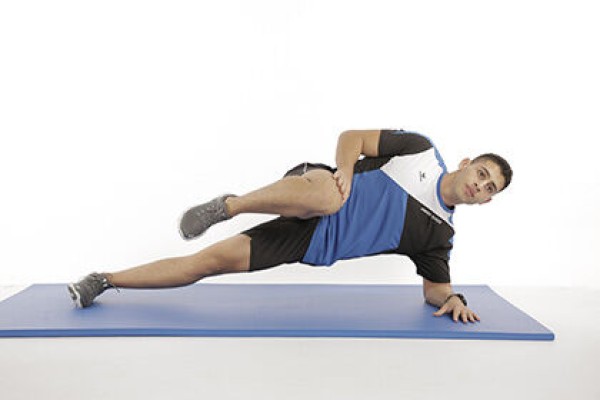
Side support on the (left) forearm (possibly on a wall for the correct straight position), bring the upper hand (or elbow) and upper knee together (approximately at the level of the navel) and back to the starting position.
Attention:
Head, torso, hips and knees practically form a line (pelvis does not tilt backwards or forwards), keep the shoulder above the elbow.
Lighten:
Place the lower knee on the floor; bend the leg less; only hold the position.
Harden:
Additional weight for the arm and/or training leg; unstable base (possible for both the supporting arm and the supporting leg).
2 weight cuffs/1 weight ball/dumbbell ► Make the exercise more difficult (additional weight)
1 ball/1-2 balance cushions/1 balance board ► Make the exercise more difficult (unstable surface)
Move hand to heel in supine position alternating ► heel touch / heel tap
Power
Individual work

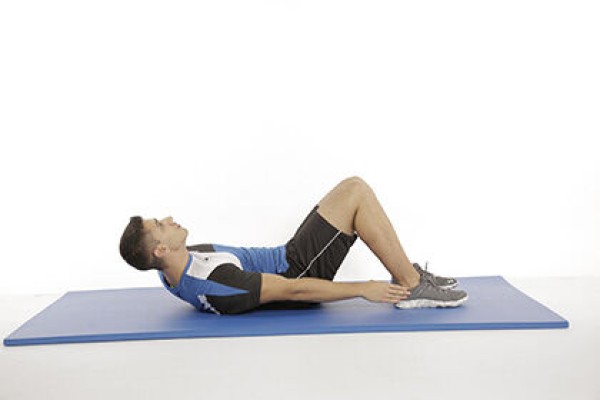
Lie on your back with your legs bent (feet also bent or flat on the floor), arms outstretched and slightly raised next to your body, hands alternately on your left and right heels (tilt your upper body sideways).
Attention:
Do not lower your shoulders completely (constant tension).
Lighten:
Lower your hands forward; only hold the centre position with your upper body raised.
Harden:
Hold additional weight on your arms/in your hands.
2 weight cuffs/weight balls/dumbbells ► Make the exercise more difficult (additional weight)
Bring hand to shoulder crosswise in push-up position alternating ► biceps curl push up position
Power
Individual work


In the push-up position, hold a dumbbell in each hand and alternately move one dumbbell to the opposite shoulder by bending one arm (return to the push-up position in between).
Caution:
Keep the torso stable and don't let it sag (actively tense the torso muscles).
Lighten:
Less weight.
Harden:
More weight; additional weight (on the back).
Variant:
Combine exercise with push-ups (i.e. bend and stretch left arm, push-up, bend and stretch right arm, push-up, etc.).
2 dumbbells
1 weight vest/weight disc/sandbag ► Make the exercise more difficult (additional weight)
Place your hands further forward than your shoulders in a push-up position ► extended plank hold
Power
Individual work
Push-up position, but with hands placed well in front of the shoulders (10–30 cm or more, depending on your level). Arms are straight, elbows ‘soft’, legs also straight, feet hip-width apart or closer together. Abdomen, buttocks and legs actively tensed. Push actively from the shoulders (protraction), maintain a straight body line as far as possible (head in a neutral position – gaze towards the floor) and continue to breathe calmly.
Attention:
Avoid arching your back too much, do not let your shoulders slump or sag, do not raise your hips too high (compensatory movement), do not lean forward too far without control, do not overextend your elbows, and do not lift your head or look straight ahead.
Lighten:
Place your hands further back or simply hold a push-up position (high plank); keep your knees on the floor (knee plank); place your hands on a raised surface (e.g. a bench or box); widen your stance.
Harden:
Move your hands further forward; bring your feet closer together; shift your weight onto your back: hold the position on one leg, one arm, or with an arm and leg crossed; move dynamically forwards and backwards; transition into a proper planche lean (hands remain under the shoulders, but actively lean your body forwards).
1 Weight vest/weight plate ► To make the exercise more challenging (additional weight)
Bring your hands to your feet from the push-up position ► hand walk
Power
Individual work


Push-up position (high support, face/look down), walk backwards with your hands and slowly straighten up until you can touch your feet, bring your hands forwards back to the starting position (possibly even further than head height).
Attention:
Do not let your upper body sag (actively tense your core), do not wiggle your hips back and forth.
Lighten:
Do not move your hands so far backwards/forwards.
Harden:
Stable surface (for your feet).
1 balance cushion/balance board ► Make the exercise more difficult (unstable surface)
Bring your hands to your shoulder while standing (horizontally) ► shoulder tap (lateral)
Power
Individual work
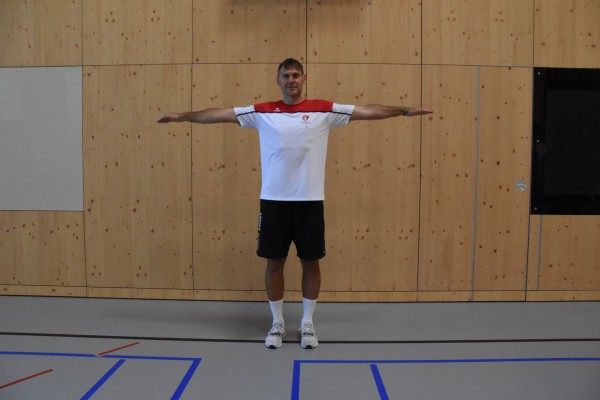
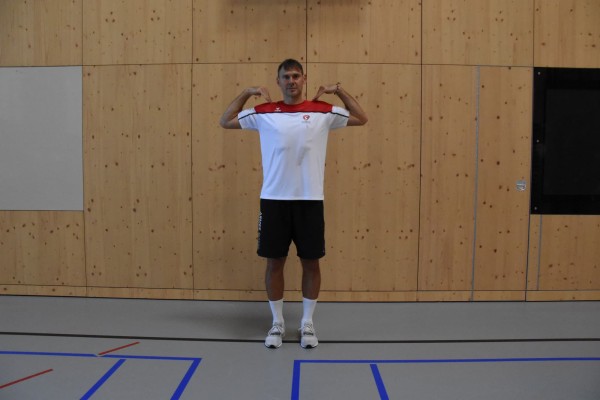
Stand upright with your feet shoulder-width apart, arms stretched out to the side (shoulder height - palms facing the floor), bend your arms and touch your shoulders with your hands, stretch your arms back to the starting position.
Harden:
Hold additional weight on your arms or in your hands.
Variant:
Arms held out in front instead of stretched out to the side. A combination of arm positions is also possible: after touching the shoulders, extend the arms alternately frontally or laterally.
2 weight cuffs/weight balls/dumbbells ► make the exercise more difficult (additional weight)
Bring your hands to your shoulder while standing (vertically) ► shoulder tap (vertical)
Power
Individual work


Stand upright with your feet shoulder-width apart, arms stretched out overhead (palms facing inwards), bend your arms and touch your shoulders with your hands, stretch your arms back to the starting position.
Harden:
Hold additional weight on your arms or in your hands.
Variant:
Arms held out in front or to the side. A combination of arm positions is also possible: after touching the shoulders, extend the arms alternately frontally, laterally or upwards.
2 weight cuffs/weight balls/dumbbells ► make the exercise more difficult (additional weight)
Alternating squat and kneeling position
Power
Individual work


While kneeling, hold a ball with your arms stretched out in front of you (chest height), upper body upright, toes pointing towards the floor, raise one leg at a time from the starting position to get into a deep squat (place foot flat on the floor, maintain an angle of approximately 90 degrees in the knee joint - end position of a squat), then return to the kneeling position.
Attention:
The medicine ball practically does not move and is always held at the same height. Accordingly, you really need to make sure that you adopt a low squatting position.
Lighten:
Arms in front without additional weight; more upright squatting position (greater angle in the knee joint).
1 (medicine) ball
Jumping in place (rope skipping double jump) ► double under
Power
Individual work

Stand upright on the balls of your feet with your feet shoulder-width apart, holding a skipping rope in your hands. Jump steadily in place and simultaneously swing the rope (under your feet and overhead), with the rope making two complete rotations during one jump (double jump).
Attention:
Do not put your heels down (jump on the balls of your feet/tips of your toes). Keep your upper body upright (tense your core). The rope is accelerated from the wrists (very fast circling) so that two rope rotations are possible during a jump.
Lighten:
Simple jumps (slower swinging - one rope rotation per jump).
Harden:
Additional weight (on the feet).
Variant I:
Pull the tips of your feet towards your knees (bend your feet) with each jump.
Note:
Two single jumps replace one double jump (1 double under = 2 x single rope jumps) in training. Instead of jumping rope, the knee lift (skipping) is often chosen as a substitute (no material required).
1 skipping rope
2 weight cuffs/1 weight waistcoat ► Make the exercise more difficult (additional weight)
Jumping in place (rope skipping double jump) ► double under (30sec)
Power
Individual work
Stand upright on the balls of your feet with your feet shoulder-width apart, holding a skipping rope in your hands. Jump steadily in place and simultaneously swing the rope (under your feet and overhead), with the rope making two complete rotations during one jump (double jump).
Attention:
Do not put your heels down (jump on the balls of your feet/tips of your toes). Keep your upper body upright (tense your core). The rope is accelerated from the wrists (very fast circling) so that two rope rotations are possible during a jump.
Lighten:
Simple jumps (slower swinging - one rope rotation per jump).
Harden:
Additional weight (on the feet).
Variant I:
Pull the tips of your feet towards your knees (bend your feet) with each jump.
Note:
Two single jumps replace one double jump (1 double under = 2 x single rope jumps) in training. Instead of jumping rope, the knee lift (skipping) is often chosen as a substitute (no material required).
1 skipping rope
2 weight cuffs/1 weight waistcoat ► Make the exercise more difficult (additional weight)
Jumping in place (jumping rope)
Power
Individual work

Stand upright on the balls of your feet with your feet shoulder-width apart, holding a skipping rope in your hands. Jump steadily in place and simultaneously swing the rope (under your feet and overhead).
Attention:
Without putting your heels down (jumping on the balls of your feet/tips of your toes). Keep your upper body upright (tense your core).
Lighten:
Lower intensity (slower swinging).
Harden:
Higher intensity (very fast jumping); additional weight (on the feet).
Variant I:
Pull the tips of your feet towards your knees with each jump (bend your feet).
Variant II:
Integrate jump shapes: Double jumps, crossing arms, alternating left/right heel taps on the floor, straddle jumps, jumping in step position, alternating jumps, etc.
Note:
Two single jumps replace one double jump in training (1 double under = 2 x single rope jumps). Instead of jumping rope, the knee lift (skipping) is often chosen as a substitute (no material required).
1 skipping rope
2 weight cuffs/1 weight waistcoat ► Make the exercise more difficult (additional weight)
Jumping in place (jumping rope) (30sec)
Power
Individual work
Stand upright on the balls of your feet with your feet shoulder-width apart, holding a skipping rope in your hands. Jump steadily in place and simultaneously swing the rope (under your feet and overhead).
Attention:
Without putting your heels down (jumping on the balls of your feet/tips of your toes). Keep your upper body upright (tense your core).
Lighten:
Lower intensity (slower swinging).
Harden:
Higher intensity (very fast jumping); additional weight (on the feet).
Variant I:
Pull the tips of your feet towards your knees with each jump (bend your feet).
Variant II:
Integrate jump shapes: Double jumps, crossing arms, alternating left/right heel taps on the floor, straddle jumps, jumping in step position, alternating jumps, etc.
Note:
Two single jumps replace one double jump in training (1 double under = 2 x single rope jumps). Instead of jumping rope, the knee lift (skipping) is often chosen as a substitute (no material required).
1 skipping rope
2 weight cuffs/1 weight waistcoat ► Make the exercise more difficult (additional weight)
Bounce in place ► hop
Power
Individual work
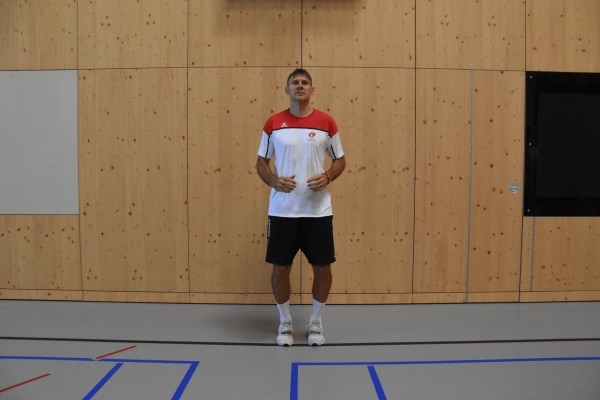
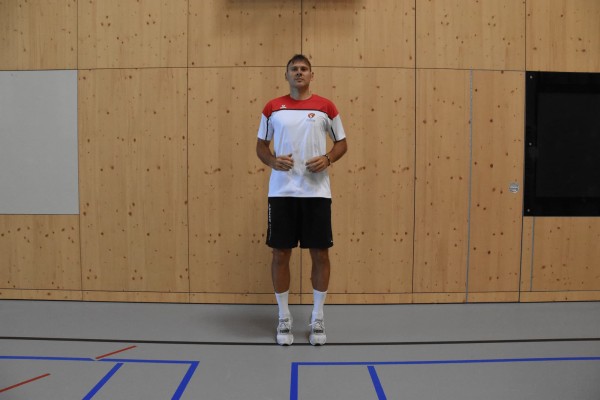
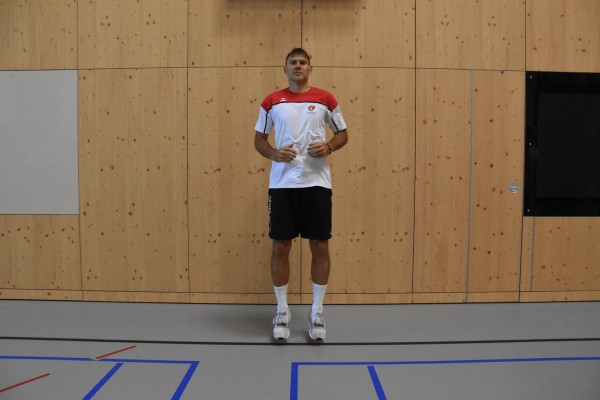
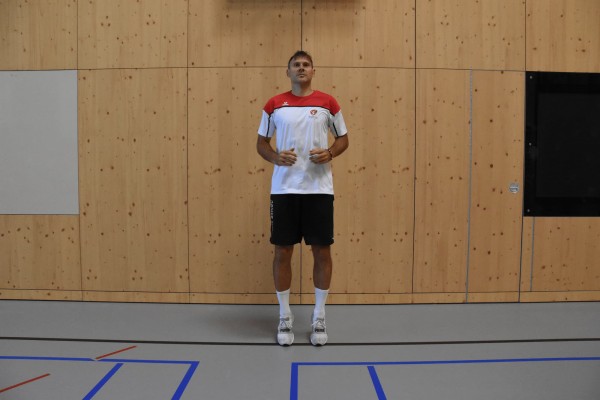
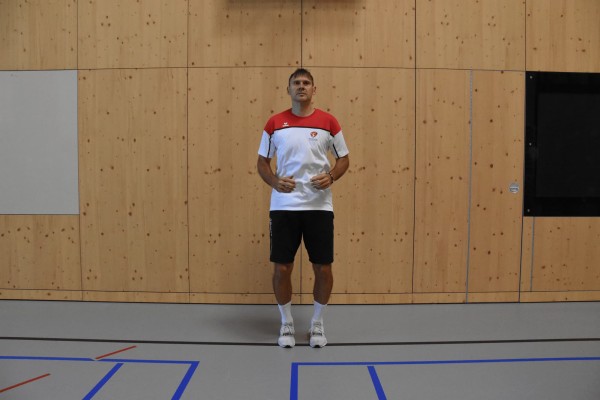
Stand upright on the balls of your feet with your knees slightly bent and your arms bent in front of your body or supported on your hips. Bounce steadily in place (fast frequency) without putting your heels down (bounce on your toes).
Attention:
Keep your upper body upright (keep your core tensed).
Lighten:
Smaller/less intense jumps.
Harden:
Larger/intensive jumps; additional weight (on the chest/shoulders, hold in the hands, hold in front).
Variation:
Pull the tips of your feet towards your knees (bend your feet) with each jump.
2 weight cuffs/short dumbbells/1 weight vest/weight disc/(medicine) ball/sandbag/fighting backpack ► Make the exercise more difficult (additional weight)
Jumping on the spot with one leg (left) (jumping rope)
Power
Individual work

Stand upright on one leg (left), standing only on the front foot/ball of the foot, holding a skipping rope in your hands. Continuous one-legged hopping in place and simultaneous swinging of the rope (under the standing leg and overhead).
Attention:
Without putting down the heel (jumping on the ball of the foot/tips of the toes). Keep your upper body upright (tense your core).
Lighten:
Lower intensity (slower swing).
Harden:
Higher intensity (very fast jumping); additional weight (on the supporting leg).
Variant I:
Pull the tip of the foot towards the knee (bend the foot) with every jump.
Variant II:
Integrate jump forms: Double jumps, crossing your arms, tapping your heel on the floor, etc.
1 skipping rope
1 weight cuff/weight waistcoat ► to make the exercise more difficult (additional weight)
Bounce in place one-legged (left) ► one-leg hop
Power
Individual work
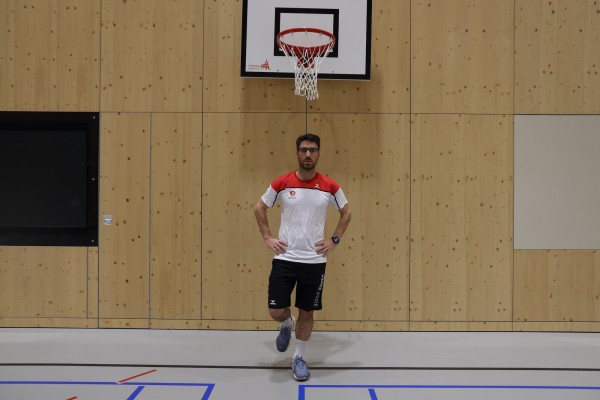
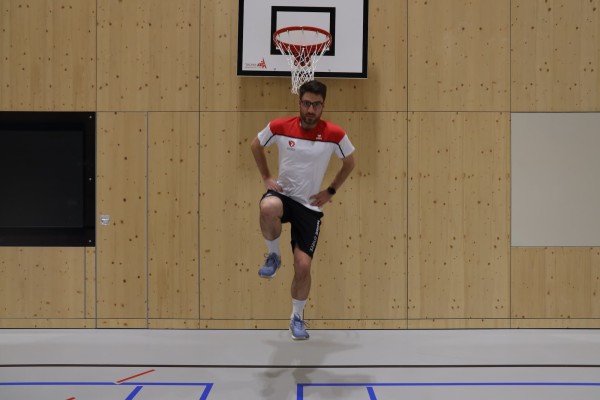
One-legged stand (left) on the balls of the feet with the knees slightly bent, arms bent in front of the body or supported on the hips. Continuous hopping in place (fast frequency) without putting your heels down (jumping off on your toes).
Attention:
Keep your upper body upright (tense your core).
Lighten:
Smaller/less intense jumps.
Harden:
Bigger/more intense jumps; additional weight (on your chest/shoulders, hold in your hands, in front of you).
Variation:
With each jump, pull the tips of your feet towards your knees (bend your feet).
1 weight cuff/weight vest/weight disc/(medicine) ball/sandbag/fighting backpack/2 dumbbells ► Make the exercise more difficult (additional weight)
Jumping in place one-legged (right) (jumping rope)
Power
Individual work

Stand upright on one leg (right), standing only on the front foot/ball of the foot, holding a skipping rope in your hands. Continuous one-legged hopping in place and simultaneous swinging of the rope (under the standing leg and overhead).
Attention:
Jump without putting your heel down (on the ball of your foot/tips of your toes). Keep your upper body upright (tense your core).
Lighten:
Lower intensity (slower swing).
Harden:
Higher intensity (very fast jumping); additional weight (on the supporting leg).
Variant I:
Pull the tip of the foot towards the knee (bend the foot) with every jump.
Variant II:
Integrate jump forms: Double jumps, crossing your arms, tapping your heel on the floor, etc.
1 skipping rope
1 weight cuff/weight waistcoat ► to make the exercise more difficult (additional weight)
Bounce in place one-legged (right) ► one-leg hop
Power
Individual work
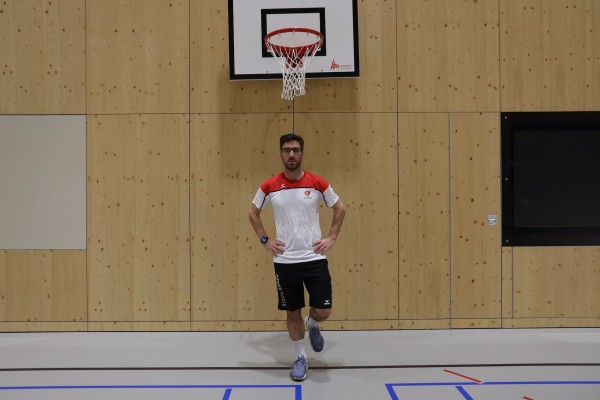
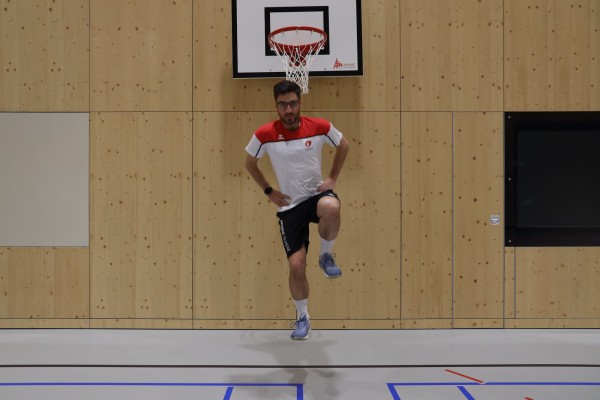
One-legged stand (right) on the balls of the feet with the knees slightly bent, arms bent in front of the body or supported on the hips. Continuous hopping in place (fast frequency) without putting your heels down (jumping off on your toes).
Attention:
Keep your upper body upright (tense your core).
Lighten:
Smaller/less intense jumps.
Harden:
Bigger/more intense jumps; additional weight (on your chest/shoulders, hold in your hands, in front of you).
Variation:
With each jump, pull the tips of your feet towards your knees (bend your feet).
1 weight cuff/weight vest/weight disc/(medicine) ball/sandbag/fighting backpack/2 dumbbells ► Make the exercise more difficult (additional weight)
Indoor cycling
Power
Individual work

Indoor cycling involves cycling indoors, whereby the workout on the indoor bike is even slightly more efficient than cycling outside. Whether for burning fat, strengthening the cardiovascular system, ergo for health or for the muscles, training with the indoor bike offers a holistic workout and entails hardly any risks.
Variant:
Choose a constant basic speed or vary the intensity by constantly changing speed (interval training).
1 Fahrradergometer/Indoor-Bike/Spinning-Bike