
Exercises (1641)
Single-leg squat in raised single-leg stance (right)
Power
Individual work


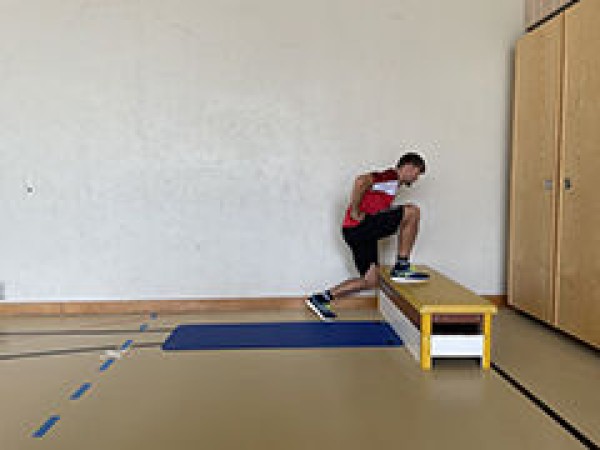

Stand on one leg (right) on an elevated surface (e.g. flat bench, vaulting box element incl. top, long bench), with the supporting leg on the elevation strongly bent (one-legged knee bend with less than 90 degrees in the knee joint) and the other leg also bent with the front foot slightly offset to the side on the floor, resting the arms on the hips. From this position, push the (lower) foot off the floor and stretch it, while at the same time stretching the raised foot so that the body is stretched in a one-legged stance (right). In a fluid movement, the raised leg (right) is bent back to the starting position and the free leg is moved to the other side of the body (again standing on the front foot with the leg bent). In a continuous alternation, the free leg is spread slightly to the side and then crossed over/backwards behind the supporting leg to the other side.
Attention:
Always keep the front knee behind the tip of the foot and centred over the foot. Lower your body in the centre (follow the back knee like a plumb line, keep your upper body upright, tense your stomach).
Lighten:
Lower your upper body less (greater angle in the knees); no or less high support.
Harden:
Additional weight (on the shoulders).
Variation:
Lift the hands from the hips while stretching the body and extend them backwards along the body; when bending the supporting leg again, bring the hands back to the hips.
1 raised base ► flat bench, vaulting box element incl. upper section, long bench
1 weight vest/sandbag/fighting backpack/2 dumbbells ► to make the exercise more difficult (additional weight)
Single-leg squat with swing from supine position (left) ► candlestick roll to pistol
Power
Individual work


From the shoulder-width stance, move into a squat position (arms pointing diagonally downwards in front) and then drop into a supine position. The outstretched arms are extended overhead (along the floor) and the bent legs are stretched out so that they are pointing towards the sky (upwards). The arms are then brought in front of the body again in a flowing movement so that the momentum can be utilised to return to the standing position. When standing up, however, only one leg (left) is bent and placed on the floor, the other leg (right) remains practically straight and lifted off the floor. Finally, the standing leg (left) is also extended from the deep one-legged high position to reach the standing position. During the low squat position, the leg lifted off the floor (right) points horizontally forwards (low one-legged squat position) and in the subsequent upright stance points diagonally downwards forwards before the leg is brought back to the training leg (left) in the starting position in the shoulder-width stance on both legs.
Attention:
Knee of the training leg remains as centred as possible over the foot.
Lighten:
Arms support the movement more clearly (more momentum); the extended free leg is brought to the floor with the heel to support the standing up movement.
Harden:
Use less momentum (hardly any support from the arms).
No material required
Single-leg squat with swing from supine position (right) ► candlestick roll to pistol
Power
Individual work


From the shoulder-width stance, move into a squat position (arms pointing diagonally downwards in front) and then drop into a supine position. The outstretched arms are extended overhead (along the floor) and the bent legs are stretched out so that they are pointing towards the sky (upwards). The arms are then brought in front of the body again in a flowing movement so that the momentum can be utilised to return to the standing position. When standing up, however, only one leg (right) is bent and placed on the floor, the other leg (left) remains practically straight and lifted off the floor. Finally, the standing leg (right) is also extended from the deep one-legged high position to reach the standing position. During the low squat position, the leg lifted off the floor (left) points horizontally forwards (low one-legged squat position) and in the subsequent upright stance points diagonally downwards forwards before the leg is brought back to the training leg (right) in the starting position in the shoulder-width stance on both legs.
Attention:
Knee of the training leg remains as centred as possible over the foot.
Lighten:
Arms support the movement more clearly (more momentum); the extended free leg is brought to the floor with the heel to support the standing up movement.
Harden:
Use less momentum (hardly any support from the arms).
No material required
Squat one-legged with swing from supine position alternating ► candlestick roll to pistol
Power
Individual work


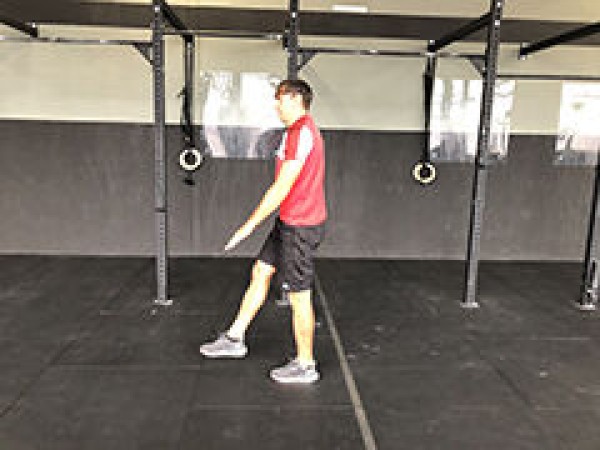
From the shoulder-width stance, move into a squat position (arms pointing diagonally downwards in front) and then drop into a supine position. The outstretched arms are extended overhead (along the floor) and the bent legs are stretched out so that they are pointing towards the sky (upwards). The arms are then brought in front of the body again in a flowing movement so that the momentum can be utilised to return to the standing position. When standing up, however, only one leg is bent and placed on the floor; the other leg remains practically straight and lifted off the floor. Finally, the standing leg is also extended from the deep one-legged high position to reach the standing position. During the low squat position, the leg lifted off the floor points horizontally forwards (low one-legged squat position) and in the subsequent upright stance points diagonally downwards forwards before the leg is brought back to the training leg in the starting position in the shoulder-width stance on both legs. For the next exercise, change the standing or free leg.
Attetion:
Knee of the training leg should remain as centred as possible over the foot.
Lighten:
Arms support the movement more clearly (more momentum); the extended free leg is brought to the ground with the heel to support the standing up movement.
Harden:
Use less momentum (hardly any support from the arms).
No material required
Squat in contact position ► squat
Power
Individual work


Starting position, bend your knees to approximately a right angle in the knee joints (buttocks at about knee height) and at the same time bring the pistol into the contact position (including scanning), straighten your legs to return to the starting position.
Attention:
Bring your buttocks backwards, not your knees forwards. Keep your back straight at all times (keep your torso tensed), distribute your weight over your entire foot, push your knees outwards (do not tilt them inwards). A support for the heels makes the exercise easier.
The weapon remains parallel to the floor at all times.
Lighten:
Do not lower your buttocks too low (greater angle in the knees).
Harden:
Stable support.
1 pistol (neutralised)
1 soft mat (small)/raised base ► make the exercise easier (position)
1 balance cushion/balance board ► make the exercise more difficult (unstable base)
Squat with leaning back (standing position) ► wall sit
Power
Individual work
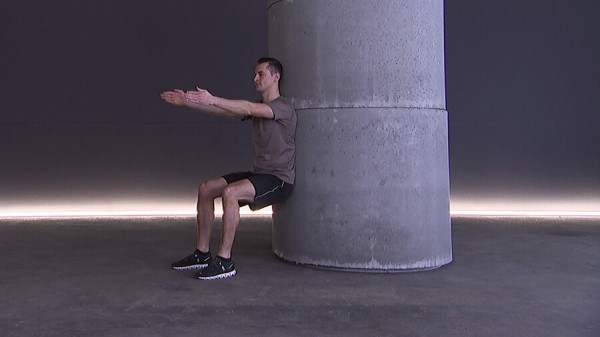
Stand with your back leaning against a wall (approximately a right angle in the knee joints), arms in front of you, crossed in front of your chest or hanging next to your body, hold the position.
Attention:
Back is constantly in contact with the wall, keep your knees behind the tips of your feet.
Lighten:
Increase the angle in the knees (more upright position).
Harden:
Additional weight (hold on the thighs/shoulders or with arms hanging in the hands); reduce the angle in the knees (lower buttocks); unstable surface; one-legged (lift leg slightly or stretch forward; organisation = 2 exercises/train both sides).
1 wall
1 weight vest/weight disc/sandbag/2 dumbbells ► Make the exercise more difficult (additional weight)
1-2 balance cushions/1 balance board ► Make the exercise more difficult (unstable surface)
Squat with leaning back (standing position) ► wall sit
Power
Individual work


Stand with your back leaning against a wall/tree (approximately a right angle in the knee joints), arms in front of you, crossed in front of your chest or hanging next to your body, hold the position.
Attention:
Back is in constant contact with the wall/tree, keep your knees behind the tips of your feet.
Lighten:
Increase the angle in the knees (more upright position).
Harden:
Additional weight (hold on thighs/shoulders or with arms hanging in hands); decrease the angle in the knees (lower buttocks); unstable base; one-legged (lift leg slightly or stretch forward; organisation = 2 exercises/train both sides).
1 wall/tree
1 weight vest/weight disc/sandbag to make the exercise more difficult (additional weight)
1-2 balance cushions/1 balance board to make the exercise more difficult (unstable surface)
Squat with one leg raised behind you ► bulgarian split squat
Power
Individual work
With your back to the raised surface (plyo box / crate), take a large step forwards and place the instep of one foot firmly and centrally on the edge. The front foot should be flat on the floor, with the toes pointing forwards. Keep your upper body upright, engage your core and align your pelvis straight forwards. Let your arms hang loosely at your sides or rest them on your hips. Now bend your front knee and hip and lower your body in a controlled, vertical motion until your thigh is roughly parallel to the floor, whilst your back knee moves towards the floor. The upper body may lean slightly forwards, but should remain straight. Push powerfully upwards through the entire front foot and keep the front knee stable and in line with the tip of the foot throughout the movement. Only lower yourself as far as your knees and pelvis can be stabilised in alignment, and always actively control the descent using your thighs and buttocks.
Attention:
The front knee bends inwards (valgus) or deviates significantly outwards; the heel of the front foot lifts off the floor and the weight rests exclusively on the forefoot; the pelvis tilts upwards or sags downwards at the back during the movement; the upper body leans far forwards or adopts an extreme hollow back or rounded back posture; the distance from the bench is either too short, causing the front knee to be extremely overloaded, or too long; the front knee is forced through with momentum at the top of the movement.
Lighten:
Perform the exercise as a classic lunge on a flat surface without a raised platform (split squat); choose a lower platform for the rear foot; reduce the range of motion (do not lower yourself quite as far); use one hand to support yourself lightly against a wall, wall bars or a pole to maintain your balance.
Harden:
Hold dumbbells in both hands at your sides; wear a weight vest; Consciously slow down the downward movement over 3–4 seconds (emphasising the eccentric phase); hold a 2-second static pause at the lowest position before standing up again; place your front foot on an unstable surface (e.g. a balance pad).
1 plyo-box
2 dumbbells ► make the exercise more challenging (additional weight)
1 weighted vest ► makes the exercise more challenging (additional weight)
1 unstable surface ► makes the exercise more difficult (balance component)
Squat with arm extension and flexion (shoulder press) ► wall ball squat to press
Power
Individual work
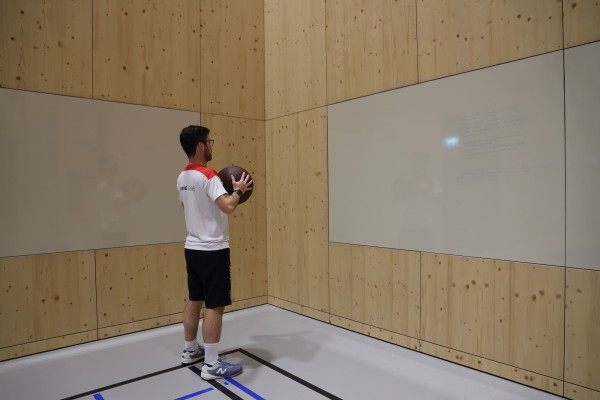
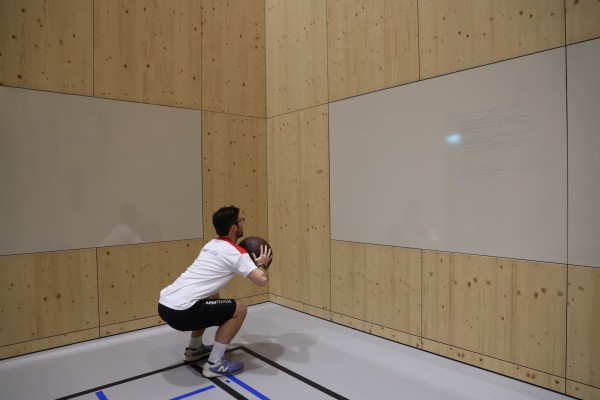
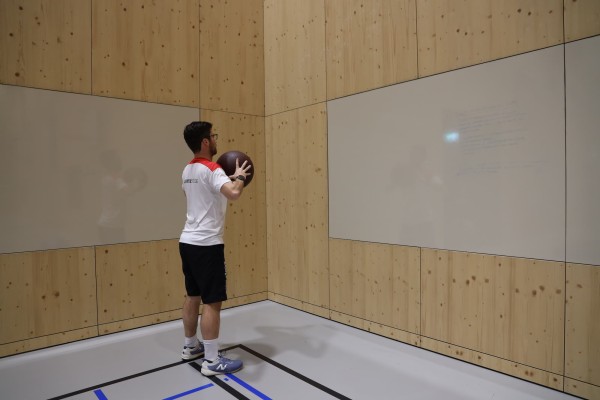
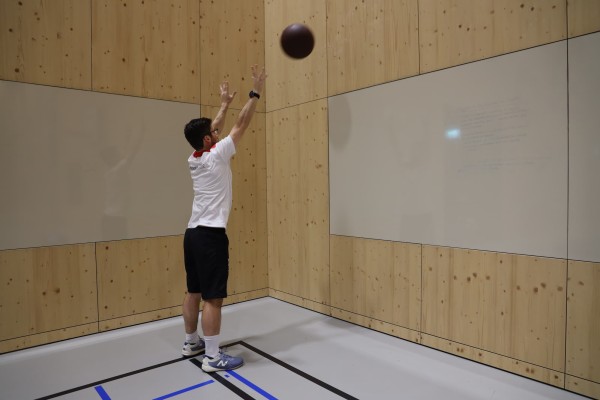
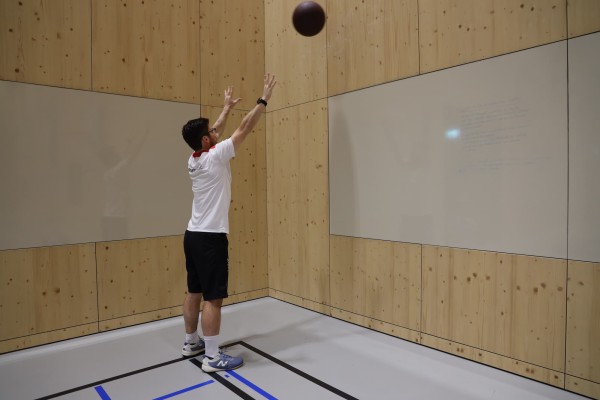
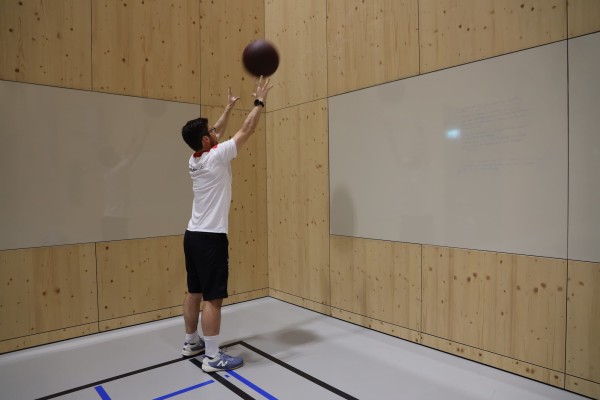
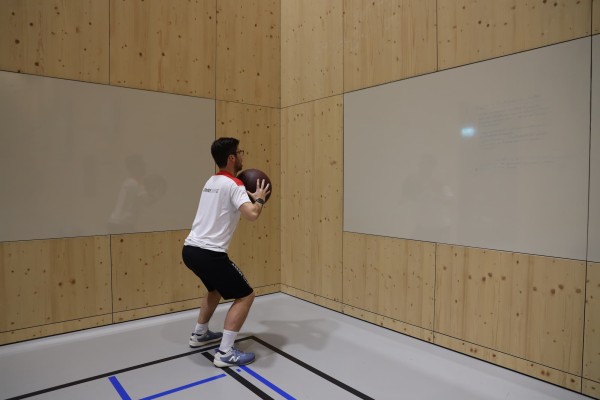
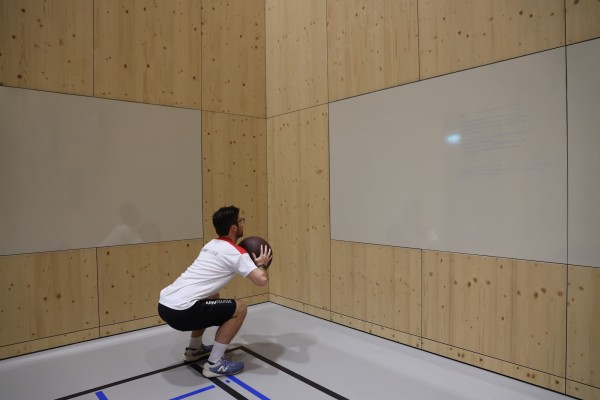
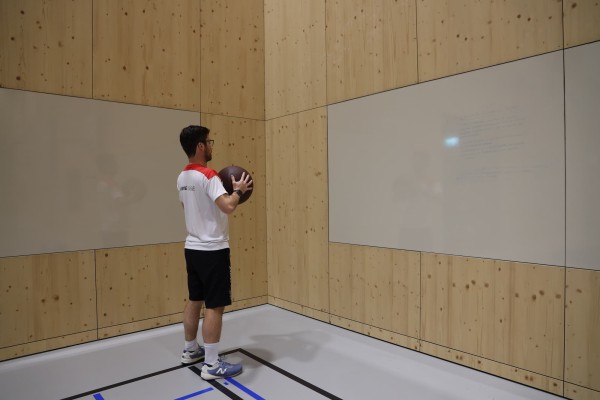
Aufrechter schulterbreiter Stand vor einer Wand (Blick zur Wand gerichtet), Füsse zeigen leicht nach aussen. Vor der Brust wird mit angewinkelten Armen ein Medizinball gehalten (Ellenbogen liegen eng am Körper, beide Hände unter dem Ball platzieren). Die Knie beugen und das Gesäss so weit als möglich absenken, ohne dass das Becken nach hinten kippt. Blick stets in neutraler Position nach vorne in Richtung Wand gerichtet. Anschliessend die Beine wieder strecken, gleichzeitig ebenfalls die Arme strecken, um den Ball kraftvoll nach oben gegen die Wand wegzustossen. Im aufrechten Stand mit nach oben ausgestreckten Armen den Ball fangen und durch Beugen der Arme zurück in die Ausgangslage führen, um die Übung neu zu starten.
Achtung:
Knie in Richtung der Fussspitzen führen, nicht nach innen fallen lassen; Füsse vollständig am Boden halten; Rücken während der gesamten Bewegung möglichst neutral halten; Oberkörper nicht übermässig nach vorne neigen; Kniebeuge kontrolliert ausführen (nicht in die Tiefe fallen); Ball beim Pressen nicht hinter den Kopf führen; beim Aufrichten nicht ins Hohlkreuz ausweichen; Bewegung von Beinen/Hüfte und Armen koordiniert ausführen; Ball sicher greifen und kontrolliert absenken.
Erleichtern:
Kniebeuge weniger tief ausführen; Kniebeuge und Schulterdrücken getrennt ausführen; leichteren (oder kein) Medizinball verwenden.
Erschweren:
Kniebeuge tiefer ausführen; schwereren Medizinball verwenden / Zusatzgewicht.
1 wall
1 medicine ball
2 weight cuffs/1 weight waistcoat ► make the exercise more difficult (additional weight)
Squat with rotation of the upper body (left) ► overhead rotational squat
Power
Individual work


Stand upright with the weight (dumbbell or kettlebell) with one arm (left) stretched out overhead (arm almost stretched out in an upright position), bend the knees and lower the buttocks as far as possible without losing stability in the back. While lowering the upper body (bending the knees), always look towards the weight and rotate the upper body slightly. The weight is then pushed back up in a controlled manner to the starting position in the standing position (stretch your legs).
Starting position:
- Stand upright with shoulders shoulder-width apart, feet pointing slightly outwards
- Stabilise the weight with one arm overhead in an upright position
- Tense the abdominal and gluteal muscles
- Look forward
Finishing position:
- Knees bent
- Buttocks back, not knees forward (sitting backwards)
- Back remains stretched
- Gaze directed towards the weight, upper body rotated/turned in towards the weight
Attention:
This exercise requires extremely high levels of mobility and stability, which is why it is only suitable for advanced exercisers. Distribute the weight over the entire foot, push the knee outwards (do not tilt inwards).
1 dumbbell/kettlebell
Squat with rotation of the upper body (right) ► overhead rotational squat
Power
Individual work


Stand upright with the weight (dumbbell or kettlebell) with one arm (right) stretched out overhead (arm almost stretched out in an upright position), bend the knees and lower the buttocks as far as possible without losing stability in the back. While lowering the upper body (bending the knees), always look towards the weight and rotate the upper body slightly. The weight is then pushed back up in a controlled manner to the starting position in the standing position (stretch your legs).
Starting position:
- Stand upright with shoulders shoulder-width apart, feet pointing slightly outwards
- Stabilise the weight with one arm overhead in an upright position
- Tense the abdominal and gluteal muscles
- Look forward
Finishing position:
- Knees bent
- Buttocks back, not knees forward (sitting backwards)
- Back remains stretched
- Gaze directed towards the weight, upper body rotated/turned in towards the weight
Attention:
This exercise requires extremely high levels of mobility and stability, which is why it is only suitable for advanced exercisers. Distribute the weight over the entire foot, push the knee outwards (do not tilt inwards).
1 dumbbell/kettlebell
Squat with side jump into a one-legged stance and one-legged side jump ► squat with side jump to the one-legged position / one legged side jump
Power
Individual work
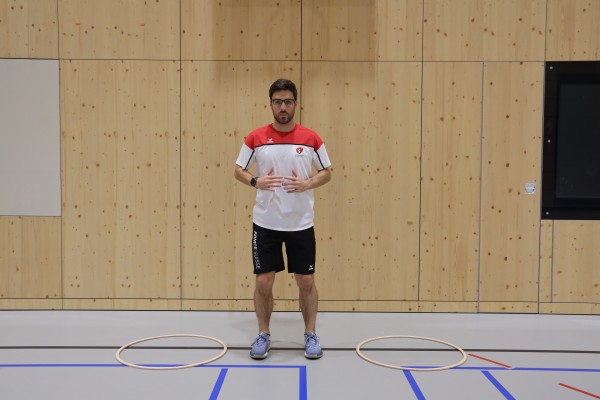
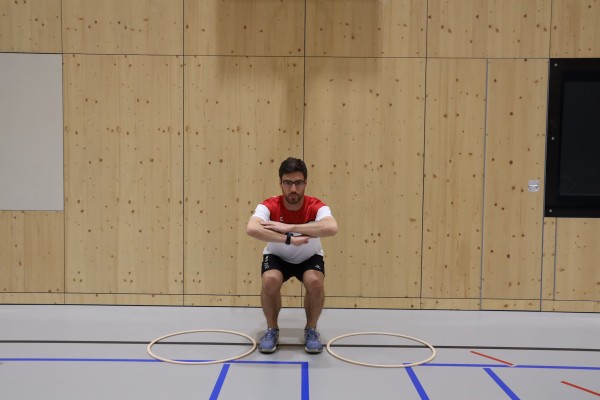
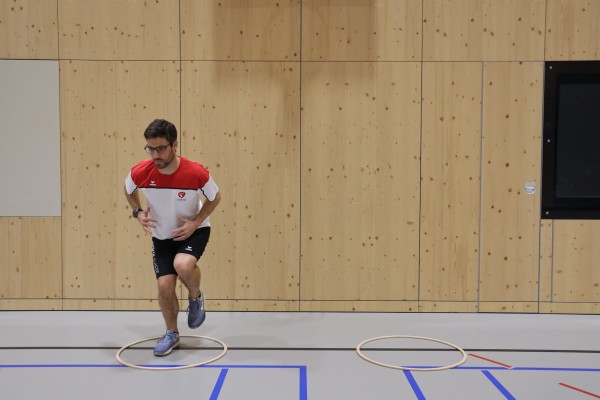
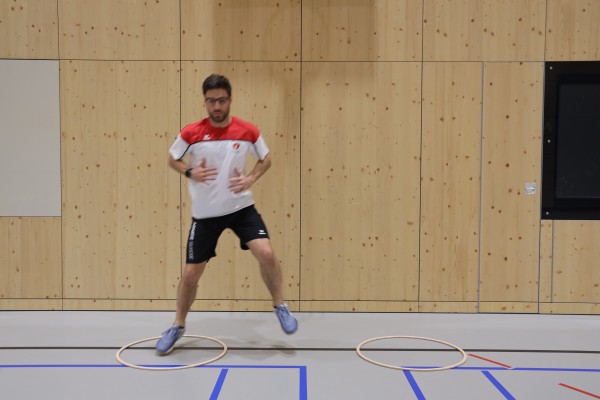
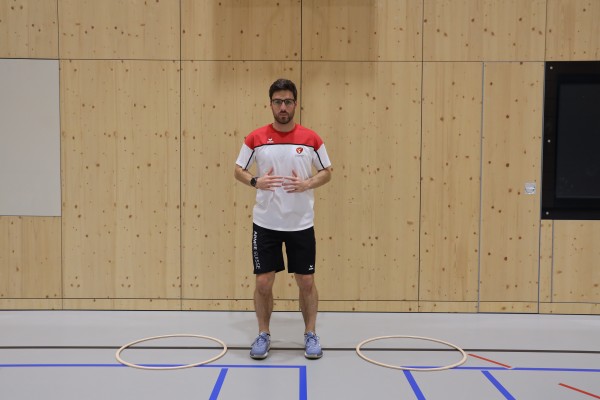
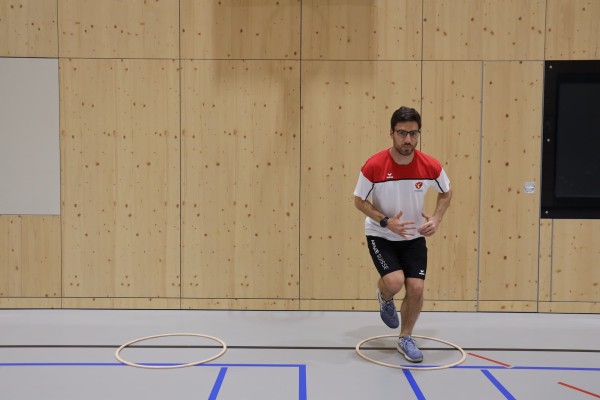
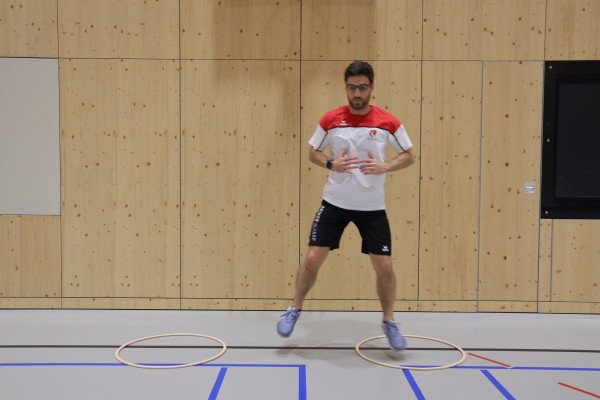
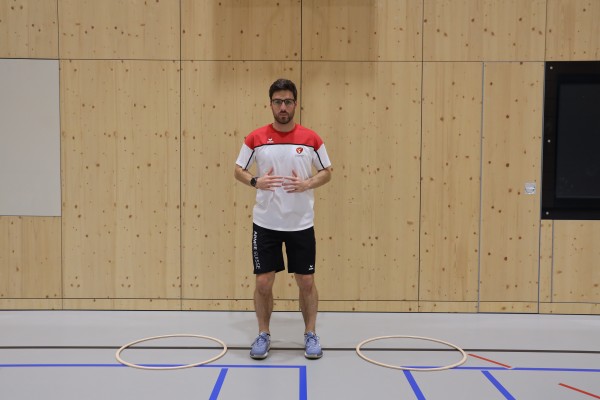
From a stance with your feet hip- to shoulder-width apart, perform a squat. Jump explosively to the side and land on one leg. Briefly stabilise and hold the landing position. Then, from the one-legged stance, jump back to the starting side and land in a controlled manner on both legs. Immediately perform another squat. Then repeat the movement on the other side.
Attention:
On landing, bring your knee towards the tip of your foot; cushion the landing softly and in a controlled manner; keep your pelvis and upper body stable; briefly stabilise your stance on one leg (do not jump straight away); Perform the squat with a straight back and a stable core.
Lighten:
Take a side step instead of a jump; reduce the distance of the jump; practise standing on one leg for longer, or put your foot down briefly if necessary.
Harden:
Increase the jump distance, squat deeper; hold the one-legged stance for longer;·Perform the movement without a break and with greater dynamism; use additional weight (held in your arms).
2 hoops
1 medicine ball/weight ► make the exercise more difficult (additional weight)
Squat and raise your arms upwards ► squat
Power
Individual work
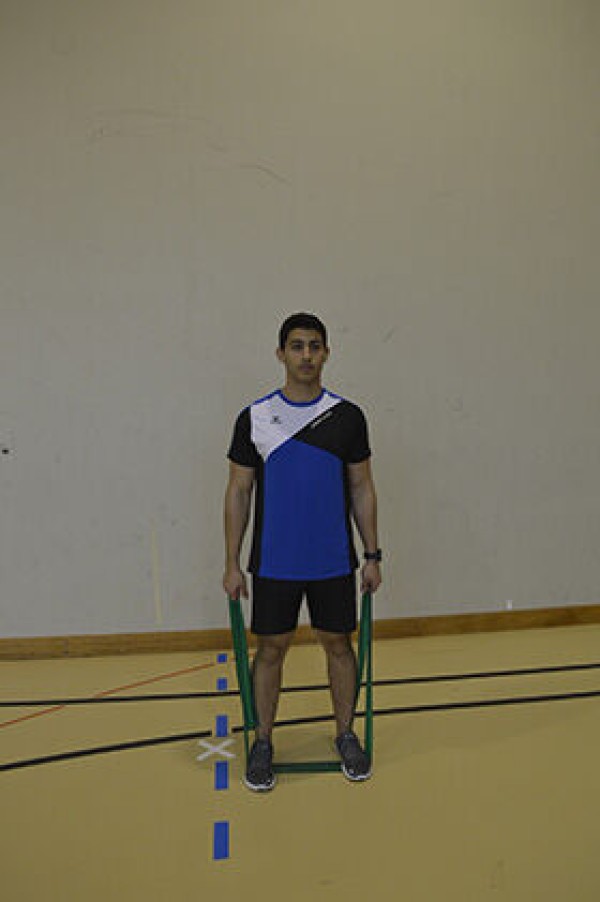

Stand upright hip-width apart in the centre of the elastic band, hold one end of the elastic band with your hands at approximately hip height, move your outstretched arms in an arching motion in front of your body upwards over your head (arms in a high fold), bend your legs at the same time as your arms move until your knees are at approximately a right angle (squat; In the end position, you are in a squat with the upper body slightly forward, then lower your arms to the starting position and straighten your legs again at the same time.
Attention:
Lower your buttocks backwards, do not bring your knees forwards. Keep your back straight at all times (tense your core), distribute your weight over your entire foot, push your knees outwards (do not tilt them inwards). A pad for the heels makes the exercise easier.
Lighten:
Choose a rubber band with less resistance.
Harder:
Choose a rubber band with more resistance.
1 elasticated rubber band
Squat and step up onto an object alternately ► squat & step up
Power
Individual work
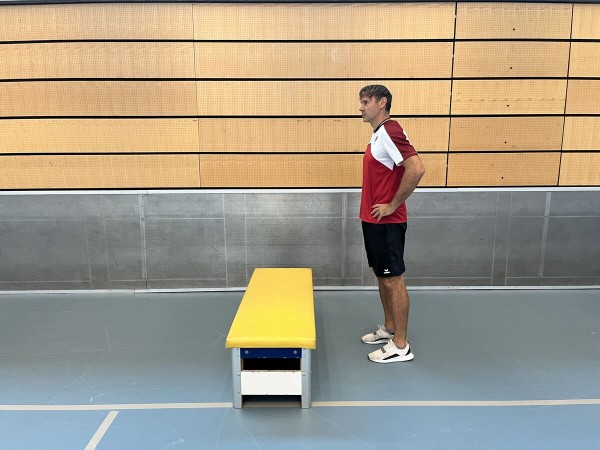
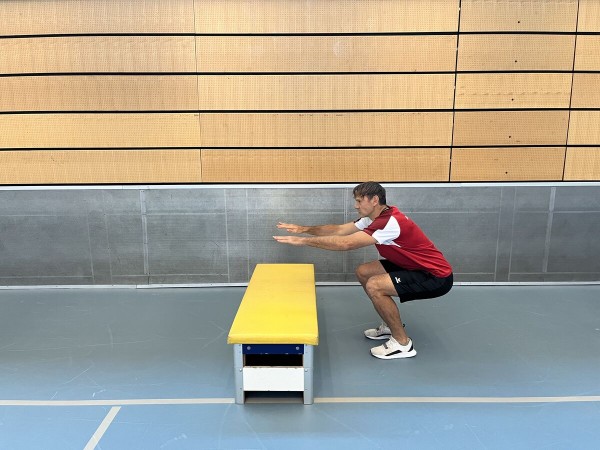
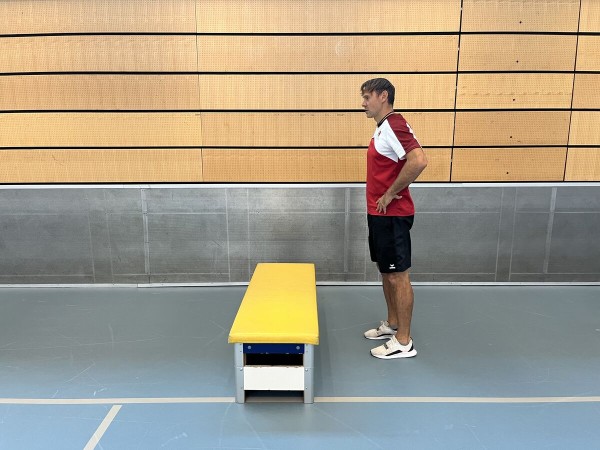

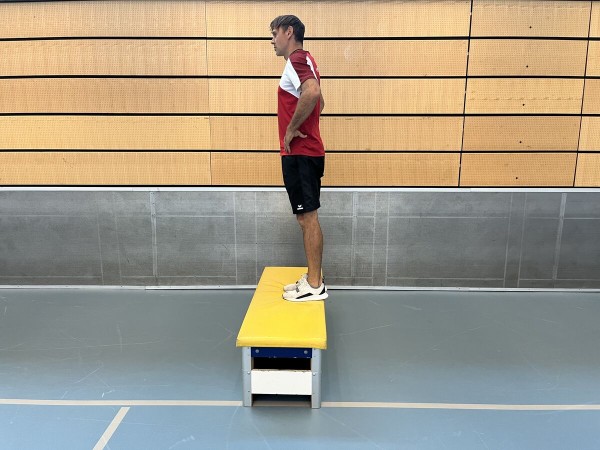
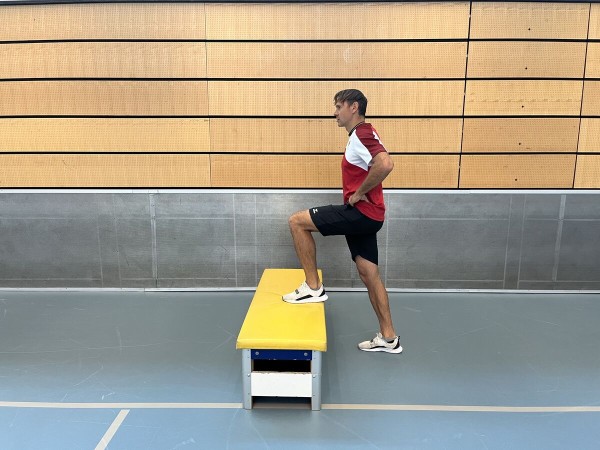
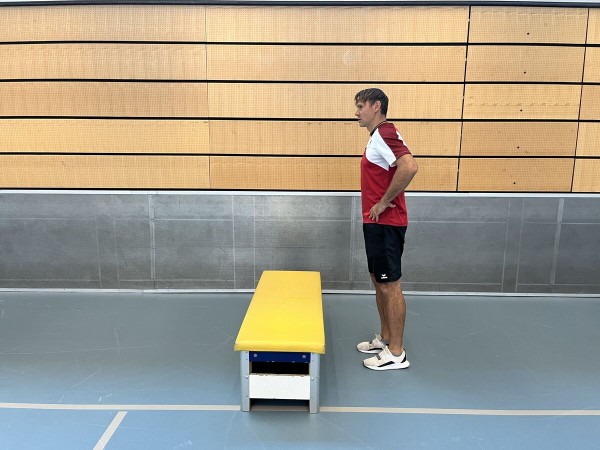
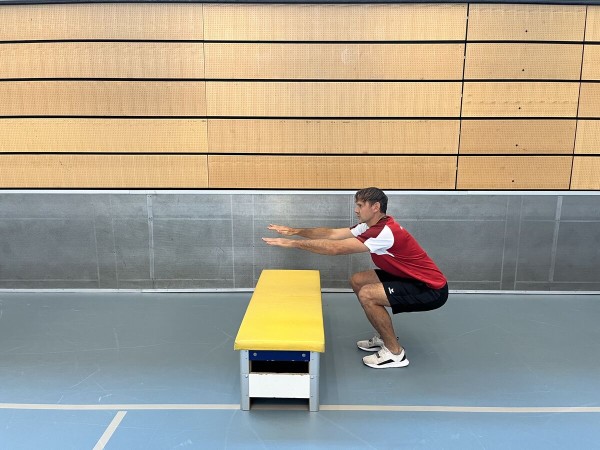
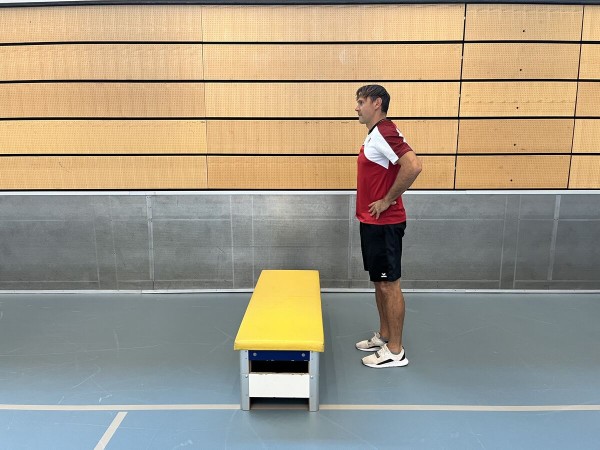
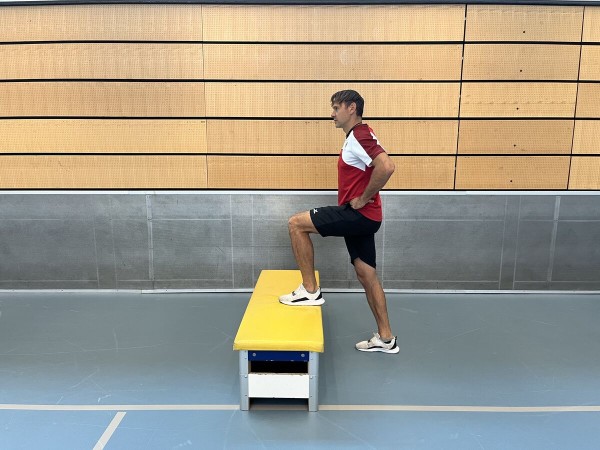
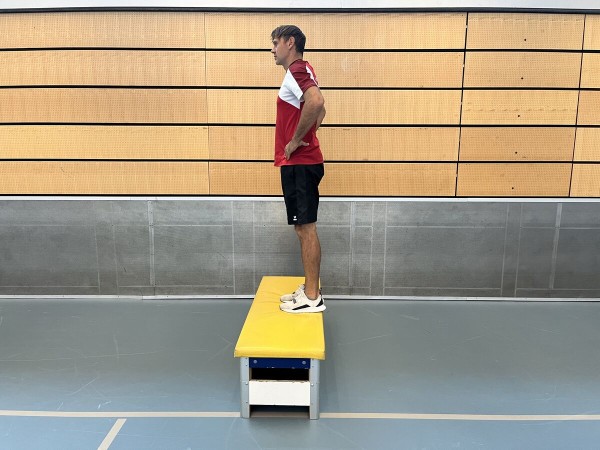

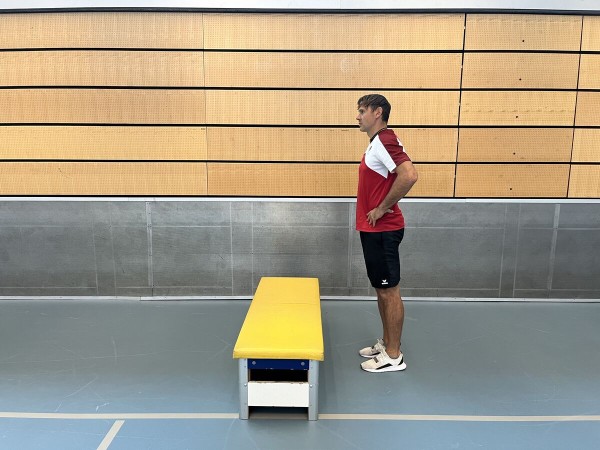
Stand shoulder-width apart in front of the plyo box (the vaulting box - 1 intermediate element plus top), arms supported on the hips, bent or in front at chest height, bend the knees to approximately a right angle in the knee joints (buttocks at about knee height) and stretch back to the starting position. Then step first with one leg, then with the other leg onto the object and back down to the starting position (climbing stairs). Then perform another squat before climbing the stairs again (change the starting leg after each exercise).
Attention:
When squatting, move your buttocks backwards, not your knees forwards. Keep your knees behind your toes. Keep your back straight at all times (keep your torso tensed), distribute your weight over your entire foot, push your knees outwards (do not tilt them inwards). Keep your upper body upright when climbing stairs.
Lighten:
Select a lower element; lower cadence.
Harden:
Select a higher element; higher cadence; hold the weight in both hands; additional weight (on the back/at the feet).
1 plyo box/swinging box
2 dumbbells/kettlebells/1 (medicine) ball/barbell ► Make the exercise more difficult (additional weight)
2 weight cuffs/1 weight waistcoat ► Make the exercise more difficult (additional weight)
Squat and upright stance alternating ► in to out squat hops / in & out squat
Power
Individual work
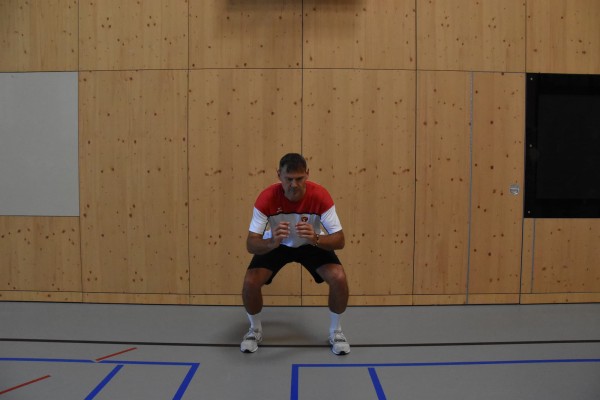
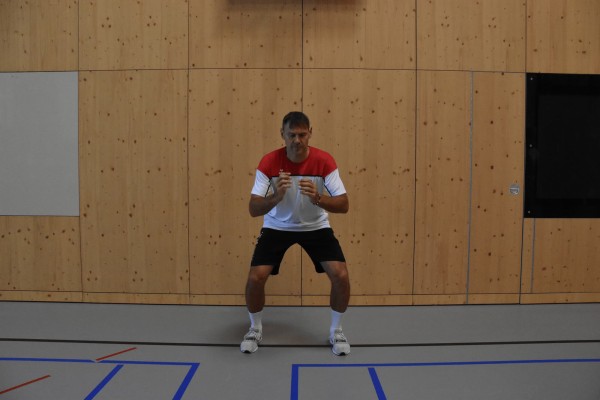
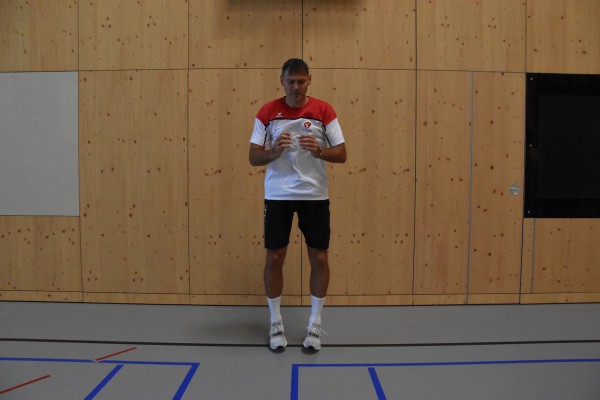
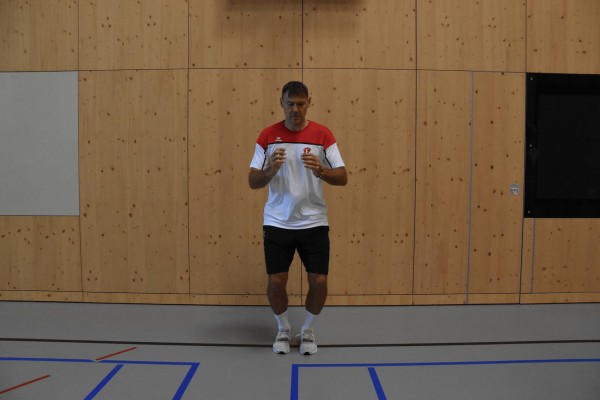
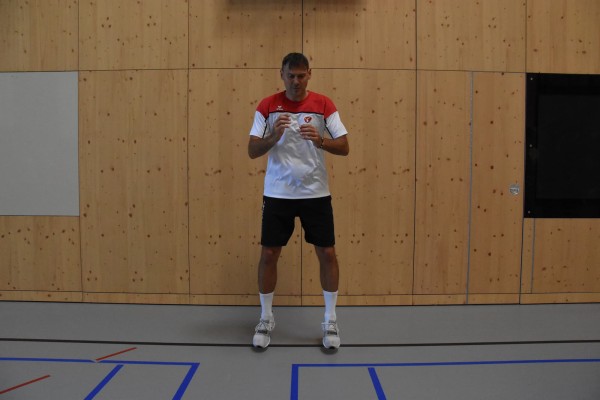
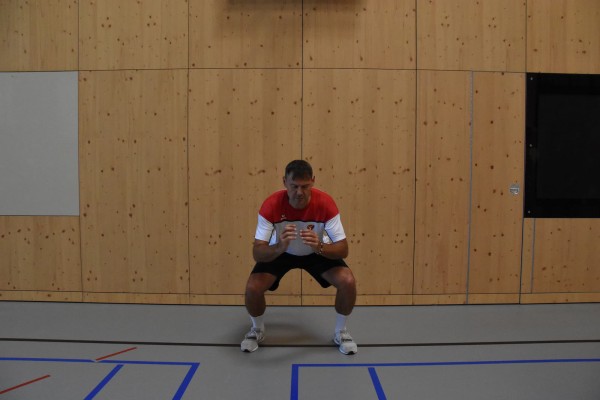
Stand upright with your feet shoulder-width apart, arms bent in front of your body (possibly holding hands), take a small jump to bring both legs to a wide stance (feet pointing slightly to each side at an angle), at the same time as landing, bend your legs to an angle of approximately 90 degrees at the knee joint (buttocks almost at knee height). Return to the starting position in an upright position with another small hop. Keep hopping between the two positions.
Attenion:
Land and squat with your whole foot on the floor. Keep your back as straight as possible at all times.
Lighten:
Do not lower your body too low (greater angle in the knees); smaller jumps (open your legs less).
Harden:
Additional weight (hold in your hands).
1 weight vest/2 dumbbells/weight cuffs/weight balls ► Make the exercise more difficult (additional weight)
Squat as well as bring elbow and knee together crosswise in standing position alternating ► squat & knee to elbow
Power
Individual work
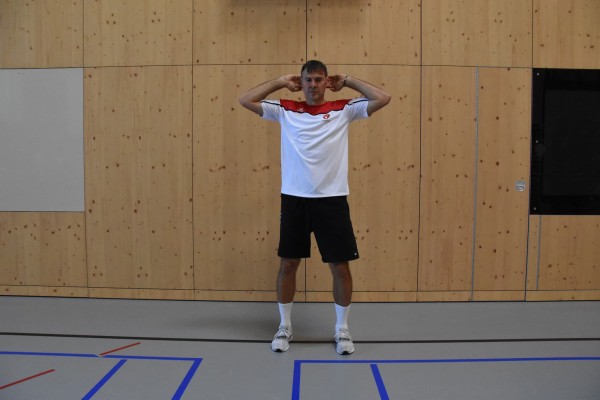
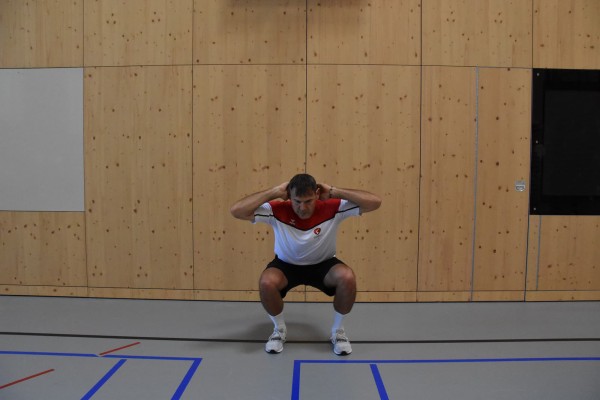
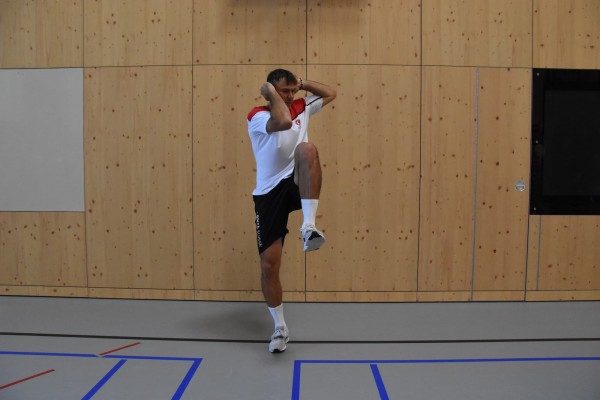
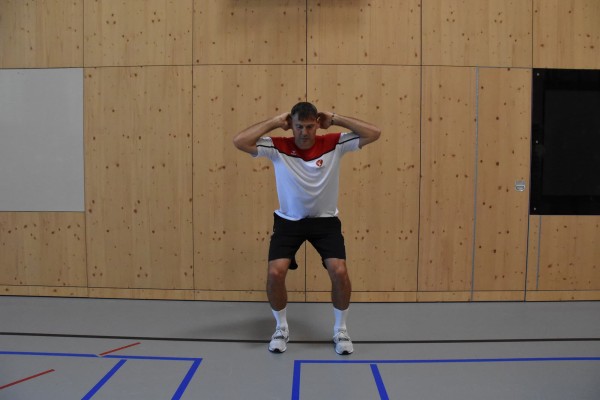
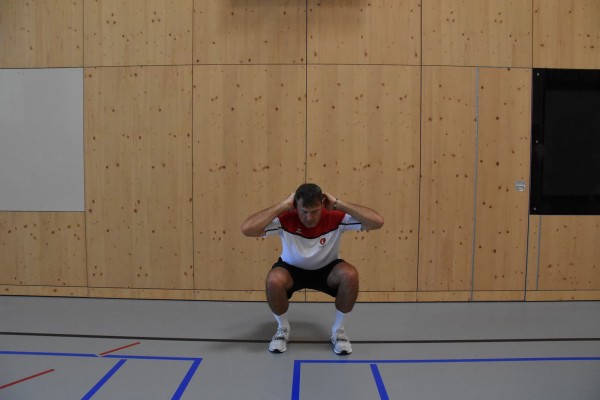
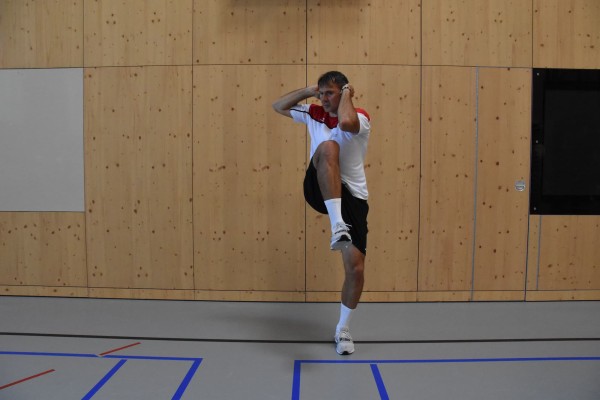
Stand shoulder-width apart, arms bent and hands locked behind your head (elbows pointing to the side), bend and raise one leg and simultaneously rotate the upper body to move the elbow crosswise to the raised knee (upper body remains upright). Return to the starting position and perform the exercise with the other arm and leg. Then bend your knees until you have a right angle in the knee joints (buttocks approximately at knee height) and stretch back to the starting position. Repeat the exercise sequence from the front.
Attention:
Squat: Move your buttocks backwards, not your knees forwards. Keep your knees behind your toes. Keep your back straight at all times (tense your core), distribute your weight over your entire foot, push your knees outwards (do not tilt them inwards).
Lighten:
Raise your leg less high (without bringing your elbows and knees together). Squat: Do not lower your buttocks too low (greater angle in the knees).
Harden:
Additional weight on the feet (additional load on the centre of the body).
2 weight cuffs ► make the exercise more difficult (additional weight)
Squat and extension and flexion of the arms (shoulder press) ► thruster
Power
Individual work


Stand upright with your feet pointing slightly outwards, the barbell is placed on your shoulders in the front position (pick up the barbell with an overhand grip and place it on your shoulders by bending your arms so that your palms are facing upwards, your forearms are horizontal and your elbows are pointing towards the floor). Bend your knees and lower your buttocks as far as possible without losing stability in your back (always look forwards in a neutral position). Then straighten your legs again and at the same time straighten your arms to press the weight powerfully upwards overhead (utilise the momentum of the legs). Standing upright with your arms not fully extended and holding them up, return the weight to the starting position in a controlled manner by bending your arms (place the dumbbell on your shoulders in the front position).
Starting position:
- Deep squat, feet pointing slightly outwards
- Barbell rests on the shoulders (front position)
- Abdominal and gluteal muscles are tensed, back straight (no hollow back)
- Gaze is (always) straight ahead in a neutral position
Finishing position:
- Stand upright with shoulders shoulder-width apart, legs straight
- Weight is held overhead with arms almost fully extended (held high)
- Back (still) straight
Attention:
Distribute weight over the entire foot, push knees outwards (do not tilt inwards). This exercise is only for advanced users and requires a high level of knowledge, mobility and stability. Always make sure your back is straight (torso tension).
1 Langhantel
Squat and extension and flexion of the arms (shoulder press) ► thruster
Power
Individual work


Stand upright with your feet pointing slightly outwards, grasp a dumbbell/kettlebell with both hands (neutral grip), hold the weight at shoulder height with your arms bent (forearms horizontal, elbows pointing downwards and close to your body so that the weights are right next to your shoulders on the same side of your body). Bend your knees and lower your buttocks as far as possible without losing stability in your back (always look forwards in a neutral position). Then straighten your legs again and at the same time straighten your arms to push the weights powerfully up overhead (utilise the momentum of your legs). Standing upright with your arms not fully extended and holding them up, return the weights to the starting position in a controlled manner by bending your arms (place the weights next to your shoulders).
Starting position:
- Deep squat, feet pointing slightly outwards
- Weights in neutral grip at shoulder height (arms bent)
- Abdominal and gluteal muscles are tensed, back straight
- Gaze is (always) straight ahead in neutral position
Finishing position:
- Stand upright with feet shoulder-width apart, legs straight
- Weights are held overhead with arms almost fully extended (held high)
- Back (still) straight
Attention:
Distribute weight over the entire foot, push knees outwards (do not tilt inwards). This exercise is only for advanced users and requires a high level of knowledge, mobility and stability. Always make sure your back is straight (torso tension).
2 dumbbells/kettlebells
Squat and extension and flexion of the arms (shoulder press) ► thruster
Power
Individual work


Squat in a low position with your feet pointing slightly outwards, holding a weighted disc between your legs with your arms stretched out (disc almost horizontal to the floor). In the squat position, look forwards in a neutral position and ensure that you do not lose stability in your back. From the squat position, straighten your legs to stand upright and simultaneously bend your arms to move the upper edge of the weight disc to approximately chin height (elbows close to the body, forearms pointing upwards, disc aligned horizontally to the floor). In a flowing movement, benefit from the momentum of the legs as you stand up so that the weight disc can immediately be raised further (arms extended overhead). After pushing the weight upwards, move the disc back down to the floor in the squat position in the reverse sequence of movements.
Attention:
Distribute the weight over the entire foot, push the knees outwards (do not tilt them inwards). Always make sure your back is straight (torso tension).
Lighten:
Less weight.
Harden:
More weight.
1 weight disc
Squat as well as extension and flexion of the arms ► squat & shoulder press
Power
Individual work


Squat in a low position with your feet pointing slightly outwards, holding a weighted disc between your legs with your arms stretched out (disc horizontal to the floor). When squatting, look forwards in a neutral position and ensure that you do not lose stability in your back. From the squat position, straighten your legs to stand upright and simultaneously bend your arms to move the upper edge of the weight disc to approximately chin height (elbows close to the body, forearms pointing upwards, disc aligned horizontally to the floor). Then extend your arms overhead (hold them up), keeping the disc horizontal to the floor. Under certain circumstances, the weight can also be pushed upwards in a fluid movement in order to benefit from the momentum of the legs (thruster). Reverse the sequence of movements to return to the starting position in the squat.
Attetion:
Distribute the weight over the entire foot, push the knees outwards (do not tilt inwards). Always make sure your back is straight (torso tension).
Lighten:
Less weight.
Harden:
More weight.
1 weight disc
Squat and extension and flexion of the arms ► wall ball
Power
Individual work


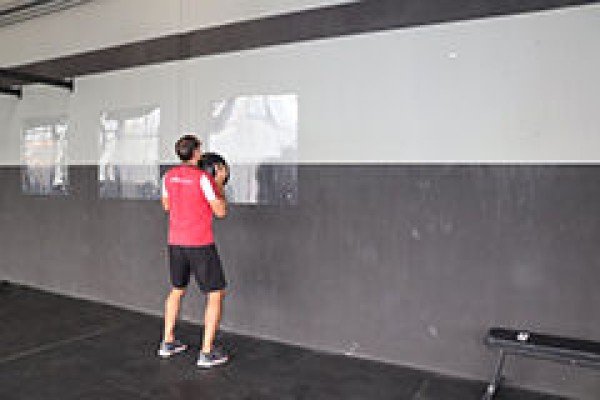

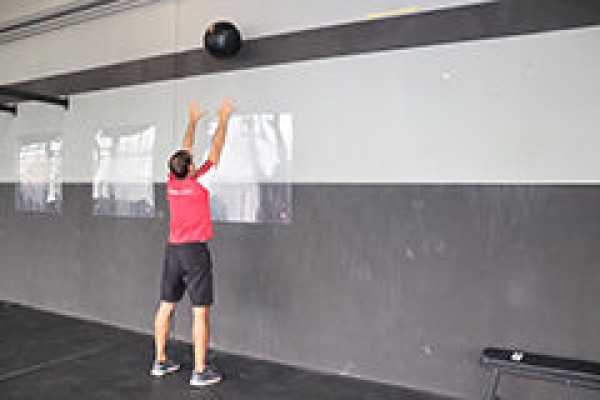


Stand upright shoulder-width apart in front of a wall (facing the wall) with your feet pointing slightly outwards, holding a medicine ball in front of your chest with your arms bent (elbows close to your body and pointing backwards, place both hands under the ball). Bend your knees and lower your buttocks as far as possible without losing stability in your back (always look forwards towards the wall in a neutral position). Then straighten your legs again and at the same time straighten your arms to powerfully push the ball upwards against the wall (utilise the momentum of your legs). Standing upright with your arms stretched upwards, catch the ball and return to the starting position by bending your arms to restart the exercise.
Attention:
Distribute the weight over the entire foot, push your knees outwards (do not tilt inwards). Always keep your back straight (torso tension).
Lighten:
Do not lower your buttocks too low (greater angle in the knees); lighter medicine ball.
Harden:
Additional weight (on the arms).
1 wall
1 medicine ball
2 weight cuffs/1 weight waistcoat ► Make the exercise more difficult (additional weight)
Squat and extension and flexion of one arm (shoulder press) (left) ► thruster
Power
Individual work


Stand upright with your feet pointing slightly outwards, grasp the weight (kettlebell or dumbbell) with one hand (left) (neutral grip) and hold it at shoulder height with your arm bent (forearm horizontal, elbow pointing downwards and close to your body so that the weight is right next to your shoulder). Bend your knees and lower your buttocks as far as possible without losing stability in your back (always look forwards in a neutral position). Then straighten your legs again and at the same time straighten your arm to push the weight powerfully up overhead (utilise the momentum of your legs). Standing upright with your arm not fully extended and holding it up, return the weight to the starting position in a controlled manner by bending your training arm (left).
Starting position:
- Deep squat, feet pointing slightly outwards
- Weight in neutral grip at shoulder height (arm bent)
- Abdominal and gluteal muscles tensed, back straight
- Gaze (always) straight ahead in neutral position
Finishing position:
- Stand upright shoulder-width apart, legs stretched
- Weight is held overhead with one arm almost fully extended (held high)
- Back (still) straight
Attention:
Distribute weight over the whole foot, push knees outwards (no tipping inwards). This exercise is only for advanced users and requires a high level of knowledge, mobility and stability. Always make sure your back is straight (torso tension).
1 dumbbell/kettlebell
Squat and extension and flexion of one arm (shoulder press) (right) ► thruster
Power
Individual work


Stand upright with your feet pointing slightly outwards, grasp the weight (kettlebell or dumbbell) with one hand (right) (neutral grip) and hold it at shoulder height with your arm bent (forearm horizontal, elbow pointing downwards and close to your body so that the weight is right next to your shoulder). Bend your knees and lower your buttocks as far as possible without losing stability in your back (always look forwards in a neutral position). Then straighten your legs again and at the same time straighten your arm to push the weight powerfully up overhead (utilise the momentum of your legs). Standing upright with your arm not fully extended and holding it up, return the weight to the starting position in a controlled manner by bending your training arm (right).
Starting position:
- Deep squat, feet pointing slightly outwards
- Weight in neutral grip at shoulder height (arm bent)
- Abdominal and gluteal muscles tensed, back straight
- Gaze (always) straight ahead in neutral position
Finishing position:
- Stand upright shoulder-width apart, legs stretched
- Weight is held overhead with one arm almost fully extended (held high)
- Back (still) straight
Attention:
Distribute weight over the whole foot, push knees outwards (no tipping inwards). This exercise is only for advanced users and requires a high level of knowledge, mobility and stability. Always make sure your back is straight (torso tension).
1 dumbbell/kettlebell
Squat and jump in the air (squat jump) alternating ► squat tuck jump
Power
Individual work


Stand upright shoulder-width apart with your arms outstretched in front of you at chest height, bend your knees to approximately a right angle at the knee joints (squat position, buttocks approximately at knee height), push your legs off the floor to jump upwards (raise your arms horizontally as a swing). During the jump, pull your knees up towards your chest as far as possible (squat jump). Then land in a controlled manner (cushion the jump; bend your knees), straighten your legs and straighten your upper body to return to the starting position.
Attention:
Keep your back straight, cushion the jump when landing, keep your whole foot on the ground without bending your knees and keep your knees behind your toes while your legs are in contact with the floor. The palms of your hands touch your knees with every jump.
Lighten:
Smaller/less intense jumps, pull your knees up less.
Harder:
Additional weight; jump on a soft surface.
2-4 weight cuffs/shorter weights/1 weight waistcoat ► making the exercise more difficult (additional weight)
1 small/large soft mat ► making the exercise more difficult (base)
Squat and jump to the side alternating ► squat & side jump
Power
Individual work


Get into a squat position with one leg on the balance half sphere, straighten your legs and simultaneously jump to the other side of the half sphere so that you change your standing leg on the sphere. With the landing movement, perform another squat and then jump back to the starting position in a fluid transition. In this way, the trainee jumps continuously from one side of the balance half-ball to the other and changes their standing leg on the training device with each exercise. In the lower squat position, the arms are bent and brought together in front of the body (landing), while the arms hang next to the body (flight phase) when the body is extended.
1 balance hemisphere