
Exercises (1882)
Butt slapping
Fighting and roughhousing games
Group work
The participants try to slap another participant on the buttocks. Whoever gets a "hit" is eliminated and performs an additional exercise (e.g. wall sit, push-ups, forearm support). Which participant is never touched?
No material required
Alternating squat and kneeling position
Power
Individual work


While kneeling, hold a ball with your arms stretched out in front of you (chest height), upper body upright, toes pointing towards the floor, raise one leg at a time from the starting position to get into a deep squat (place foot flat on the floor, maintain an angle of approximately 90 degrees in the knee joint - end position of a squat), then return to the kneeling position.
Attention:
The medicine ball practically does not move and is always held at the same height. Accordingly, you really need to make sure that you adopt a low squatting position.
Lighten:
Arms in front without additional weight; more upright squatting position (greater angle in the knee joint).
1 (medicine) ball
Dog ticks
Fighting and roughhousing games
Group work
Depending on the size of the group, one or more participants are selected to represent the "dogs". Their task is to catch the other participants running around on all fours by bringing them to the ground. If a participant touches the ground with at least one knee, they also become a "dog". The participant who is still standing on their feet at the end wins the game.
Variant:
For safety reasons, touching the participants (e.g. on the legs) can also be sufficient to catch them.
No material required
Jumping in place (rope skipping double jump) ► double under
Power
Individual work

Stand upright on the balls of your feet with your feet shoulder-width apart, holding a skipping rope in your hands. Jump steadily in place and simultaneously swing the rope (under your feet and overhead), with the rope making two complete rotations during one jump (double jump).
Attention:
Do not put your heels down (jump on the balls of your feet/tips of your toes). Keep your upper body upright (tense your core). The rope is accelerated from the wrists (very fast circling) so that two rope rotations are possible during a jump.
Lighten:
Simple jumps (slower swinging - one rope rotation per jump).
Harden:
Additional weight (on the feet).
Variant I:
Pull the tips of your feet towards your knees (bend your feet) with each jump.
Note:
Two single jumps replace one double jump (1 double under = 2 x single rope jumps) in training. Instead of jumping rope, the knee lift (skipping) is often chosen as a substitute (no material required).
1 skipping rope
2 weight cuffs/1 weight waistcoat ► Make the exercise more difficult (additional weight)
Jumping in place (rope skipping double jump) ► double under (30sec)
Power
Individual work
Stand upright on the balls of your feet with your feet shoulder-width apart, holding a skipping rope in your hands. Jump steadily in place and simultaneously swing the rope (under your feet and overhead), with the rope making two complete rotations during one jump (double jump).
Attention:
Do not put your heels down (jump on the balls of your feet/tips of your toes). Keep your upper body upright (tense your core). The rope is accelerated from the wrists (very fast circling) so that two rope rotations are possible during a jump.
Lighten:
Simple jumps (slower swinging - one rope rotation per jump).
Harden:
Additional weight (on the feet).
Variant I:
Pull the tips of your feet towards your knees (bend your feet) with each jump.
Note:
Two single jumps replace one double jump (1 double under = 2 x single rope jumps) in training. Instead of jumping rope, the knee lift (skipping) is often chosen as a substitute (no material required).
1 skipping rope
2 weight cuffs/1 weight waistcoat ► Make the exercise more difficult (additional weight)
Jumping in place (jumping rope)
Power
Individual work

Stand upright on the balls of your feet with your feet shoulder-width apart, holding a skipping rope in your hands. Jump steadily in place and simultaneously swing the rope (under your feet and overhead).
Attention:
Without putting your heels down (jumping on the balls of your feet/tips of your toes). Keep your upper body upright (tense your core).
Lighten:
Lower intensity (slower swinging).
Harden:
Higher intensity (very fast jumping); additional weight (on the feet).
Variant I:
Pull the tips of your feet towards your knees with each jump (bend your feet).
Variant II:
Integrate jump shapes: Double jumps, crossing arms, alternating left/right heel taps on the floor, straddle jumps, jumping in step position, alternating jumps, etc.
Note:
Two single jumps replace one double jump in training (1 double under = 2 x single rope jumps). Instead of jumping rope, the knee lift (skipping) is often chosen as a substitute (no material required).
1 skipping rope
2 weight cuffs/1 weight waistcoat ► Make the exercise more difficult (additional weight)
Jumping in place (jumping rope) (30sec)
Power
Individual work
Stand upright on the balls of your feet with your feet shoulder-width apart, holding a skipping rope in your hands. Jump steadily in place and simultaneously swing the rope (under your feet and overhead).
Attention:
Without putting your heels down (jumping on the balls of your feet/tips of your toes). Keep your upper body upright (tense your core).
Lighten:
Lower intensity (slower swinging).
Harden:
Higher intensity (very fast jumping); additional weight (on the feet).
Variant I:
Pull the tips of your feet towards your knees with each jump (bend your feet).
Variant II:
Integrate jump shapes: Double jumps, crossing arms, alternating left/right heel taps on the floor, straddle jumps, jumping in step position, alternating jumps, etc.
Note:
Two single jumps replace one double jump in training (1 double under = 2 x single rope jumps). Instead of jumping rope, the knee lift (skipping) is often chosen as a substitute (no material required).
1 skipping rope
2 weight cuffs/1 weight waistcoat ► Make the exercise more difficult (additional weight)
Bounce in place ► hop
Power
Individual work
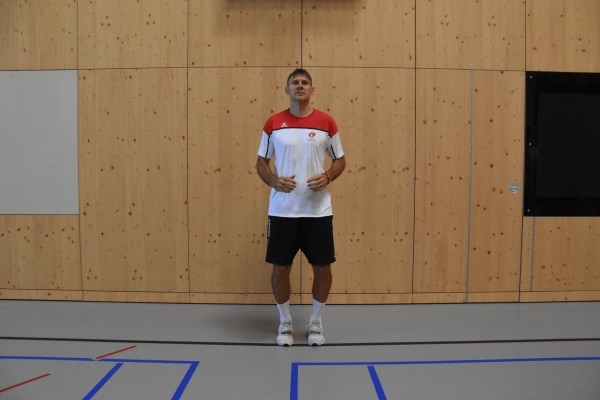
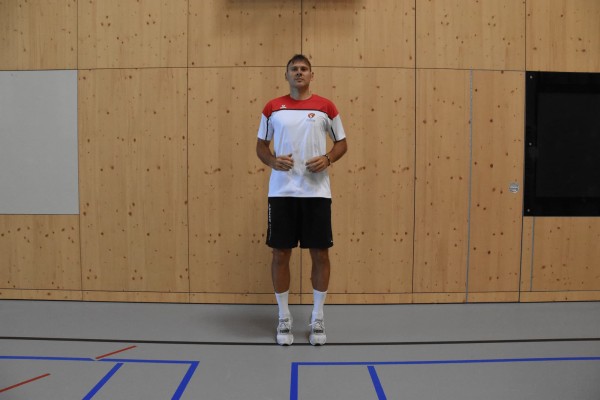
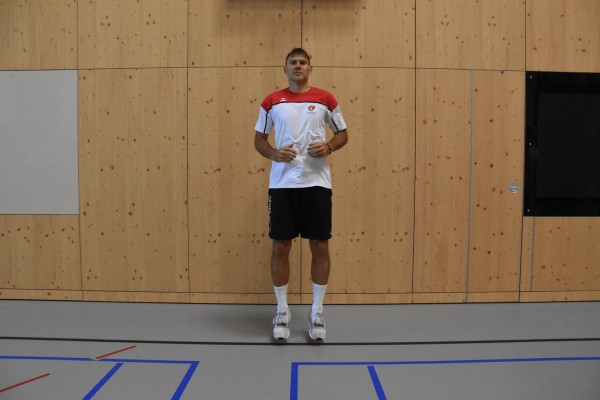
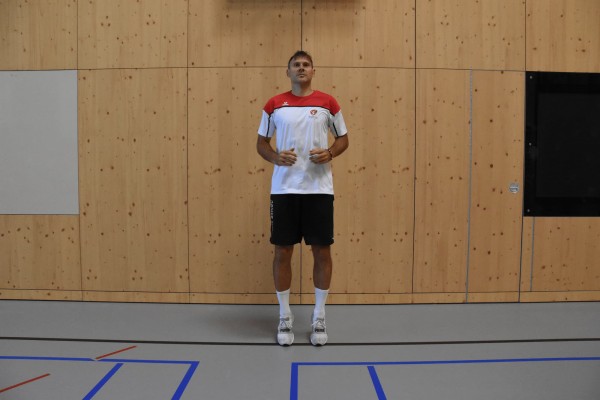
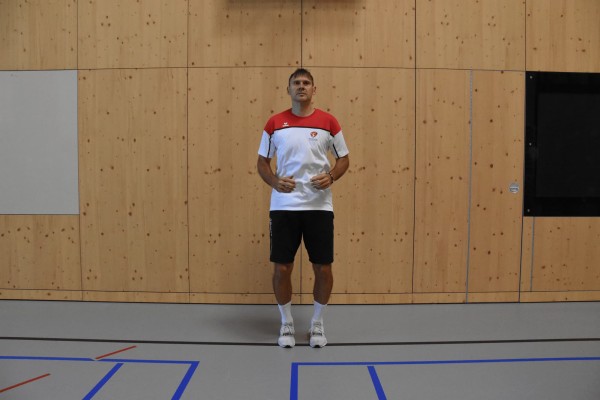
Stand upright on the balls of your feet with your knees slightly bent and your arms bent in front of your body or supported on your hips. Bounce steadily in place (fast frequency) without putting your heels down (bounce on your toes).
Attention:
Keep your upper body upright (keep your core tensed).
Lighten:
Smaller/less intense jumps.
Harden:
Larger/intensive jumps; additional weight (on the chest/shoulders, hold in the hands, hold in front).
Variation:
Pull the tips of your feet towards your knees (bend your feet) with each jump.
2 weight cuffs/short dumbbells/1 weight vest/weight disc/(medicine) ball/sandbag/fighting backpack ► Make the exercise more difficult (additional weight)
Jumping on the spot with one leg (left) (jumping rope)
Power
Individual work

Stand upright on one leg (left), standing only on the front foot/ball of the foot, holding a skipping rope in your hands. Continuous one-legged hopping in place and simultaneous swinging of the rope (under the standing leg and overhead).
Attention:
Without putting down the heel (jumping on the ball of the foot/tips of the toes). Keep your upper body upright (tense your core).
Lighten:
Lower intensity (slower swing).
Harden:
Higher intensity (very fast jumping); additional weight (on the supporting leg).
Variant I:
Pull the tip of the foot towards the knee (bend the foot) with every jump.
Variant II:
Integrate jump forms: Double jumps, crossing your arms, tapping your heel on the floor, etc.
1 skipping rope
1 weight cuff/weight waistcoat ► to make the exercise more difficult (additional weight)
Bounce in place one-legged (left) ► one-leg hop
Power
Individual work
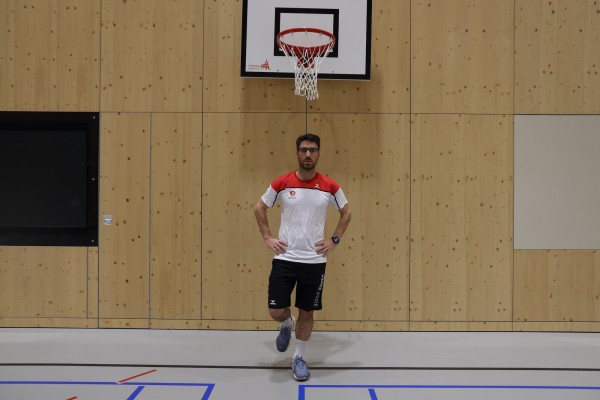
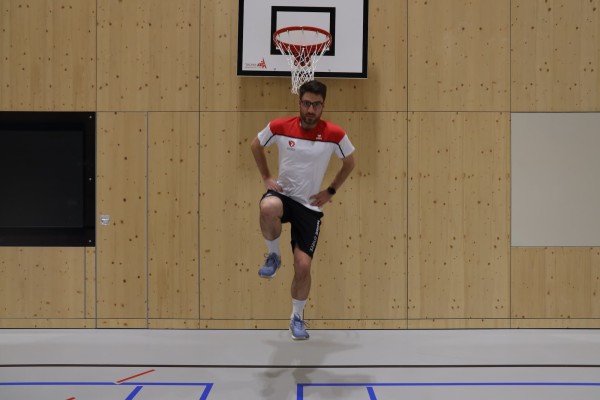
One-legged stand (left) on the balls of the feet with the knees slightly bent, arms bent in front of the body or supported on the hips. Continuous hopping in place (fast frequency) without putting your heels down (jumping off on your toes).
Attention:
Keep your upper body upright (tense your core).
Lighten:
Smaller/less intense jumps.
Harden:
Bigger/more intense jumps; additional weight (on your chest/shoulders, hold in your hands, in front of you).
Variation:
With each jump, pull the tips of your feet towards your knees (bend your feet).
1 weight cuff/weight vest/weight disc/(medicine) ball/sandbag/fighting backpack/2 dumbbells ► Make the exercise more difficult (additional weight)
Jumping in place one-legged (right) (jumping rope)
Power
Individual work

Stand upright on one leg (right), standing only on the front foot/ball of the foot, holding a skipping rope in your hands. Continuous one-legged hopping in place and simultaneous swinging of the rope (under the standing leg and overhead).
Attention:
Jump without putting your heel down (on the ball of your foot/tips of your toes). Keep your upper body upright (tense your core).
Lighten:
Lower intensity (slower swing).
Harden:
Higher intensity (very fast jumping); additional weight (on the supporting leg).
Variant I:
Pull the tip of the foot towards the knee (bend the foot) with every jump.
Variant II:
Integrate jump forms: Double jumps, crossing your arms, tapping your heel on the floor, etc.
1 skipping rope
1 weight cuff/weight waistcoat ► to make the exercise more difficult (additional weight)
Bounce in place one-legged (right) ► one-leg hop
Power
Individual work
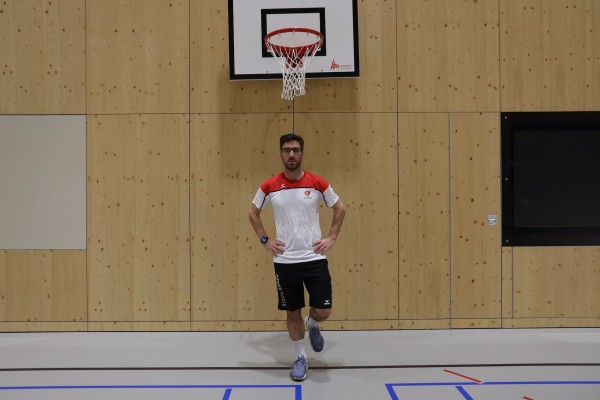
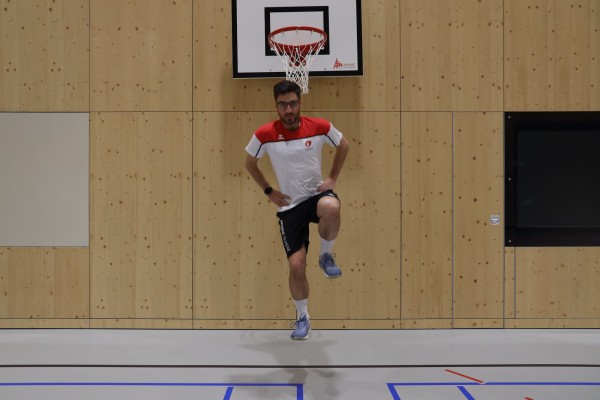
One-legged stand (right) on the balls of the feet with the knees slightly bent, arms bent in front of the body or supported on the hips. Continuous hopping in place (fast frequency) without putting your heels down (jumping off on your toes).
Attention:
Keep your upper body upright (tense your core).
Lighten:
Smaller/less intense jumps.
Harden:
Bigger/more intense jumps; additional weight (on your chest/shoulders, hold in your hands, in front of you).
Variation:
With each jump, pull the tips of your feet towards your knees (bend your feet).
1 weight cuff/weight vest/weight disc/(medicine) ball/sandbag/fighting backpack/2 dumbbells ► Make the exercise more difficult (additional weight)
Indoor cycling
Power
Individual work

Indoor cycling involves cycling indoors, whereby the workout on the indoor bike is even slightly more efficient than cycling outside. Whether for burning fat, strengthening the cardiovascular system, ergo for health or for the muscles, training with the indoor bike offers a holistic workout and entails hardly any risks.
Variant:
Choose a constant basic speed or vary the intensity by constantly changing speed (interval training).
1 Fahrradergometer/Indoor-Bike/Spinning-Bike
Indoor Cycling (m: 10000m/10km - 240kal; w: 8000m/8km - 180kal)
Power
Individual work

Indoor cycling involves cycling indoors, whereby the workout on the indoor bike is even slightly more efficient than cycling outside. Whether for burning fat, strengthening the cardiovascular system, ergo for health or for the muscles, training with the indoor bike offers a holistic workout and entails hardly any risks.
Variant:
Choose a constant basic speed or vary the intensity by constantly changing speed (interval training).
1 Fahrradergometer/Indoor-Bike/Spinning-Bike
Indoor Cycling (m: 1000m/1km - 24kal; w: 800m - 18kal)
Power
Individual work

Indoor cycling involves cycling indoors, whereby the workout on the indoor bike is even slightly more efficient than cycling outside. Whether for burning fat, strengthening the cardiovascular system, ergo for health or for the muscles, training with the indoor bike offers a holistic workout and entails hardly any risks.
Variant:
Choose a constant basic speed or vary the intensity by constantly changing speed (interval training).
1 Fahrradergometer/Indoor-Bike/Spinning-Bike
Indoor Cycling (m: 1600m/1.6km/1 mile - 36kal; w: 1200m/1.2km - 27kal)
Power
Individual work

Indoor cycling involves cycling indoors, whereby the workout on the indoor bike is even slightly more efficient than cycling outside. Whether for burning fat, strengthening the cardiovascular system, ergo for health or for the muscles, training with the indoor bike offers a holistic workout and entails hardly any risks.
Variant:
Choose a constant basic speed or vary the intensity by constantly changing speed (interval training).
1 Fahrradergometer/Indoor-Bike/Spinning-Bike
Indoor Cycling (m: 2000m/2km - 48kal; w: 1600m/1.6km - 36kal)
Power
Individual work

Indoor cycling involves cycling indoors, whereby the workout on the indoor bike is even slightly more efficient than cycling outside. Whether for burning fat, strengthening the cardiovascular system, ergo for health or for the muscles, training with the indoor bike offers a holistic workout and entails hardly any risks.
Variant:
Choose a constant basic speed or vary the intensity by constantly changing speed (interval training).
1 Fahrradergometer/Indoor-Bike/Spinning-Bike
Indoor Cycling (m: 2500m/2.5km - 60kal; w: 2000m/2km - 45kal)
Power
Individual work

Indoor cycling involves cycling indoors, whereby the workout on the indoor bike is even slightly more efficient than cycling outside. Whether for burning fat, strengthening the cardiovascular system, ergo for health or for the muscles, training with the indoor bike offers a holistic workout and entails hardly any risks.
Variant:
Choose a constant basic speed or vary the intensity by constantly changing speed (interval training).
1 Fahrradergometer/Indoor-Bike/Spinning-Bike
Indoor Cycling (m: 250m - 6kal; w: 200m - 4kal)
Power
Individual work

Indoor cycling involves cycling indoors, whereby the workout on the indoor bike is even slightly more efficient than cycling outside. Whether for burning fat, strengthening the cardiovascular system, ergo for health or for the muscles, training with the indoor bike offers a holistic workout and entails hardly any risks.
Variant:
Choose a constant basic speed or vary the intensity by constantly changing speed (interval training).
1 Fahrradergometer/Indoor-Bike/Spinning-Bike
Indoor Cycling (m: 4000m/4km - 96kal; w: 3200m/3.2km/2 Meile - 72kal)
Power
Individual work

Indoor cycling involves cycling indoors, whereby the workout on the indoor bike is even slightly more efficient than cycling outside. Whether for burning fat, strengthening the cardiovascular system, ergo for health or for the muscles, training with the indoor bike offers a holistic workout and entails hardly any risks.
Variant:
Choose a constant basic speed or vary the intensity by constantly changing speed (interval training).
1 Fahrradergometer/Indoor-Bike/Spinning-Bike
Indoor Cycling (m: 500m - 12kal; w: 400m - 9kal)
Power
Individual work

Indoor cycling involves cycling indoors, whereby the workout on the indoor bike is even slightly more efficient than cycling outside. Whether for burning fat, strengthening the cardiovascular system, ergo for health or for the muscles, training with the indoor bike offers a holistic workout and entails hardly any risks.
Variant:
Choose a constant basic speed or vary the intensity by constantly changing speed (interval training).
1 Fahrradergometer/Indoor-Bike/Spinning-Bike
Indoor Cycling (m: 750m - 18kal; w: 600m - 14kal)
Power
Individual work

Indoor cycling involves cycling indoors, whereby the workout on the indoor bike is even slightly more efficient than cycling outside. Whether for burning fat, strengthening the cardiovascular system, ergo for health or for the muscles, training with the indoor bike offers a holistic workout and entails hardly any risks.
Variant:
Choose a constant basic speed or vary the intensity by constantly changing speed (interval training).
1 Fahrradergometer/Indoor-Bike/Spinning-Bike
Interval training (short - playful): figure-eight run
Interval training
Group work
6-24 participants per post
At the corner points of the route (the route symbolises a square number "8"; this results in 6 corner points, as the intersection/intersection point is not included), the participants spread out as individual runners or in small groups of 2-4 people. The running direction is the same for all participants and is predetermined (it may be necessary to change direction from time to time, e.g. after a complete lap). The runners at the corner points 1/4 start simultaneously to the next corner point, where a handover to the next runner/group takes place (in the case of group work, the start only takes place as soon as all previous runners have reached the corner point). Note: When meeting at the centre point, keep right of way. The figure-eight run is repeated as often as specified by the sports leader (1 lap = 6 intervals) before a slightly longer break is taken. The exercise form can then be repeated.
Variant:
Integrate additional tasks for the waiting runners at the corner points: e.g. push-ups, squats, trunk bends, jumps, etc.
Distance: 400m distance in the form of a square number "8" (approx. 50m per section)
Exercise duration: 6 x approx. 50m
Break: 1-3 minutes (easy run back to the starting point or wait in place)
Repeats: 2-10 times
Intensity level: 3 (medium) / 4 (hard)
Hmax: 80-90% (extensive interval method) / 90-95% (intensive interval method)
Rule of speech: speak in full sentences / short exchanges
Both beginners to running training and experienced runners will benefit from the extensive interval method. Ideally, you should choose the extensive variant before the intensive interval units, but the runner should already have a good basic training programme. The breaks between the workouts are relatively short and the running pace is somewhat slower than during intensive interval training (80-90% HRmax). It is important that the heart rate does not fall below 120 beats per minute so that the body does not slow down too much. Extensive interval training takes place slightly below the anaerobic threshold and aims to increase aerobic performance (ideal training for longer competitions such as half marathons or marathons). Intensive interval training is used by ambitious runners to work on their basic speed. The heart rate range is 90-95% of the maximum heart rate. The training takes place at or above the anaerobic threshold, i.e. in the "red zone". This requires the activation of fast-twitch muscle fibres and improves maximum oxygen uptake, lactate tolerance and pace hardness. The pace is fast (at competition speed or slightly below) and the breaks between efforts are longer than with the intensive form (suitable as training for shorter competitions such as 5km or 10km runs).
8 marking cones/caps
Interval training (short - playful): Bingo relay
Interval training
Group work
4-5 participants per group
Each group has a bingo card at the starting point. At the turning point there are corresponding number cards (numbers face down). The runners each pick up a number card (it is not possible to swap) and bring it to the group. The number card is placed on the corresponding field of the bingo card at the starting point. Which group is the first to have a complete row (horizontally, vertically or diagonally)?
Per group:
1 marking cone/cap/colouring stick
1 bingo card (5 x 5)
25 number cards
Interval training (short - playful): Letter relay
Interval training
Group work
4-5 participants per group
At the turning point of the relay there are numerous letter tokens (letters face down), which are available to all groups. The runners each pick up a token (it is not possible to swap) and bring it to the group. If there are no more tokens available or after a time limit set by the sports leader, the groups have 2 minutes to form (correct) words. Each letter used for a word is worth one point. Which group scores the most points?
Variant:
Which group is the first to have all the necessary letters to create a solution word defined by the sports instructor? In this variant, the token is looked at at the reversal point, if it can be used, it is taken to the group. If the letter cannot be used (already present in the solution word), the token is left behind and the group returns to the group without a new letter before sending the next runner off to the tokens with a handshake.
x game pieces (letters)
1 stopwatch