
Exercises (3302)
Jumping in place (rope skipping double jump) ► double under (30sec)
Power
Individual work

Stand upright on the balls of your feet with your feet shoulder-width apart, holding a skipping rope in your hands. Jump steadily in place and simultaneously swing the rope (under your feet and overhead), with the rope making two complete rotations during one jump (double jump).
Attention:
Do not put your heels down (jump on the balls of your feet/tips of your toes). Keep your upper body upright (tense your core). The rope is accelerated from the wrists (very fast circling) so that two rope rotations are possible during a jump.
Lighten:
Simple jumps (slower swinging - one rope rotation per jump).
Harden:
Additional weight (on the feet).
Variant I:
Pull the tips of your feet towards your knees (bend your feet) with each jump.
Note:
Two single jumps replace one double jump (1 double under = 2 x single rope jumps) in training. Instead of jumping rope, the knee lift (skipping) is often chosen as a substitute (no material required).
1 skipping rope
2 weight cuffs/1 weight waistcoat ► Make the exercise more difficult (additional weight)
Jumping in place (jumping rope)
Power
Individual work

Stand upright on the balls of your feet with your feet shoulder-width apart, holding a skipping rope in your hands. Jump steadily in place and simultaneously swing the rope (under your feet and overhead).
Attention:
Without putting your heels down (jumping on the balls of your feet/tips of your toes). Keep your upper body upright (tense your core).
Lighten:
Lower intensity (slower swinging).
Harden:
Higher intensity (very fast jumping); additional weight (on the feet).
Variant I:
Pull the tips of your feet towards your knees with each jump (bend your feet).
Variant II:
Integrate jump shapes: Double jumps, crossing arms, alternating left/right heel taps on the floor, straddle jumps, jumping in step position, alternating jumps, etc.
Note:
Two single jumps replace one double jump in training (1 double under = 2 x single rope jumps). Instead of jumping rope, the knee lift (skipping) is often chosen as a substitute (no material required).
1 skipping rope
2 weight cuffs/1 weight waistcoat ► Make the exercise more difficult (additional weight)
Jumping in place (jumping rope) (30sec)
Power
Individual work
Stand upright on the balls of your feet with your feet shoulder-width apart, holding a skipping rope in your hands. Jump steadily in place and simultaneously swing the rope (under your feet and overhead).
Attention:
Without putting your heels down (jumping on the balls of your feet/tips of your toes). Keep your upper body upright (tense your core).
Lighten:
Lower intensity (slower swinging).
Harden:
Higher intensity (very fast jumping); additional weight (on the feet).
Variant I:
Pull the tips of your feet towards your knees with each jump (bend your feet).
Variant II:
Integrate jump shapes: Double jumps, crossing arms, alternating left/right heel taps on the floor, straddle jumps, jumping in step position, alternating jumps, etc.
Note:
Two single jumps replace one double jump in training (1 double under = 2 x single rope jumps). Instead of jumping rope, the knee lift (skipping) is often chosen as a substitute (no material required).
1 skipping rope
2 weight cuffs/1 weight waistcoat ► Make the exercise more difficult (additional weight)
Bounce in place ► hop
Power
Individual work
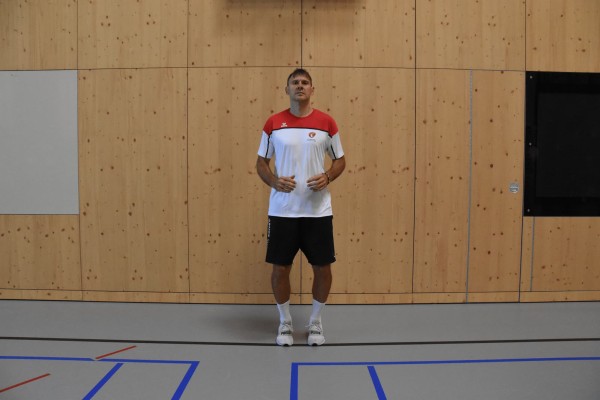
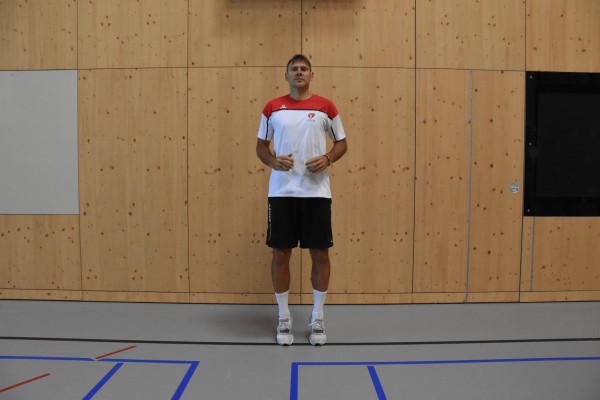
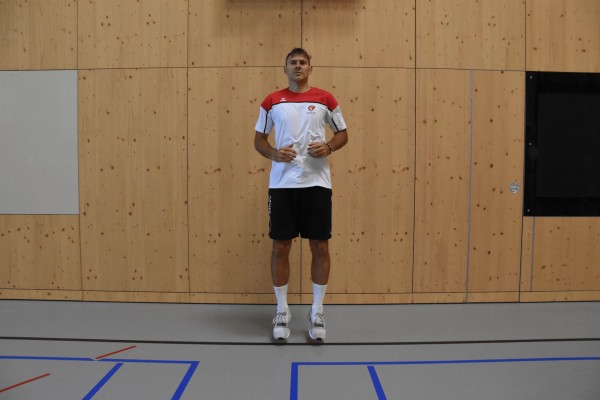
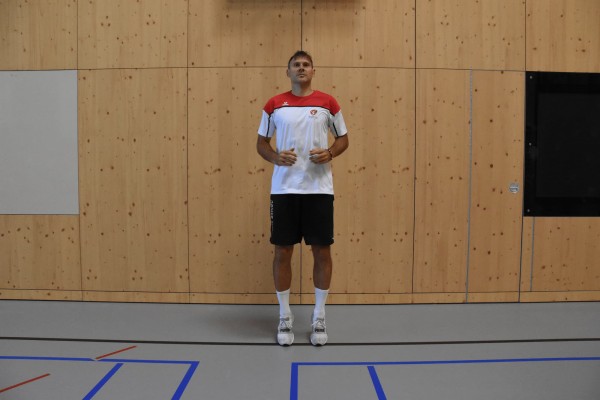
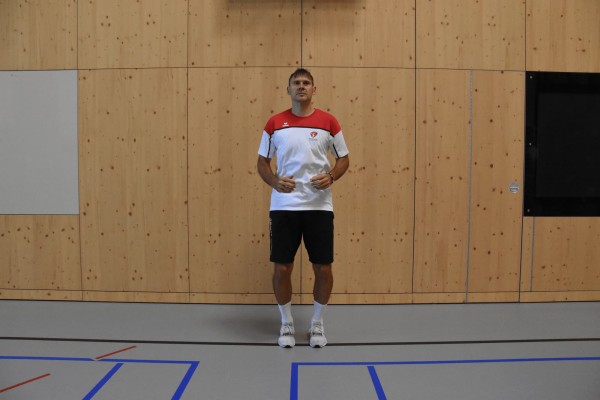
Stand upright on the balls of your feet with your knees slightly bent and your arms bent in front of your body or supported on your hips. Bounce steadily in place (fast frequency) without putting your heels down (bounce on your toes).
Attention:
Keep your upper body upright (keep your core tensed).
Lighten:
Smaller/less intense jumps.
Harden:
Larger/intensive jumps; additional weight (on the chest/shoulders, hold in the hands, hold in front).
Variation:
Pull the tips of your feet towards your knees (bend your feet) with each jump.
2 weight cuffs/short dumbbells/1 weight vest/weight disc/(medicine) ball/sandbag/fighting backpack ► Make the exercise more difficult (additional weight)
Jumping on the spot with one leg (left) (jumping rope)
Power
Individual work

Stand upright on one leg (left), standing only on the front foot/ball of the foot, holding a skipping rope in your hands. Continuous one-legged hopping in place and simultaneous swinging of the rope (under the standing leg and overhead).
Attention:
Without putting down the heel (jumping on the ball of the foot/tips of the toes). Keep your upper body upright (tense your core).
Lighten:
Lower intensity (slower swing).
Harden:
Higher intensity (very fast jumping); additional weight (on the supporting leg).
Variant I:
Pull the tip of the foot towards the knee (bend the foot) with every jump.
Variant II:
Integrate jump forms: Double jumps, crossing your arms, tapping your heel on the floor, etc.
1 skipping rope
1 weight cuff/weight waistcoat ► to make the exercise more difficult (additional weight)
Bounce in place one-legged (left) ► one-leg hop
Power
Individual work
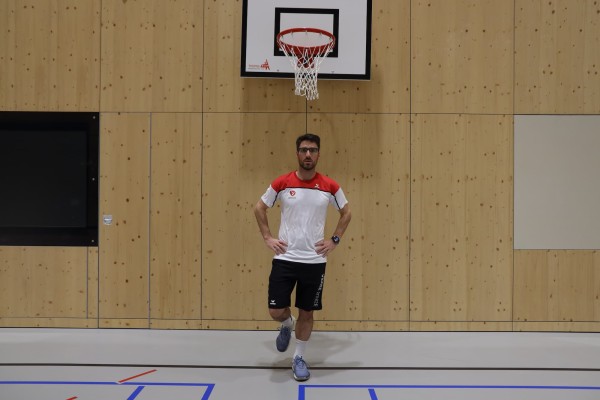
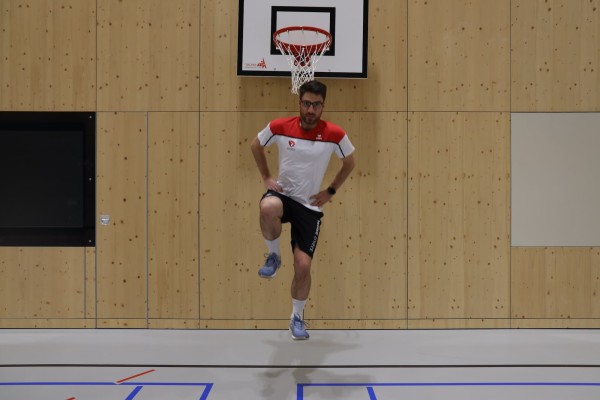
One-legged stand (left) on the balls of the feet with the knees slightly bent, arms bent in front of the body or supported on the hips. Continuous hopping in place (fast frequency) without putting your heels down (jumping off on your toes).
Attention:
Keep your upper body upright (tense your core).
Lighten:
Smaller/less intense jumps.
Harden:
Bigger/more intense jumps; additional weight (on your chest/shoulders, hold in your hands, in front of you).
Variation:
With each jump, pull the tips of your feet towards your knees (bend your feet).
1 weight cuff/weight vest/weight disc/(medicine) ball/sandbag/fighting backpack/2 dumbbells ► Make the exercise more difficult (additional weight)
Jumping in place one-legged (right) (jumping rope)
Power
Individual work

Stand upright on one leg (right), standing only on the front foot/ball of the foot, holding a skipping rope in your hands. Continuous one-legged hopping in place and simultaneous swinging of the rope (under the standing leg and overhead).
Attention:
Jump without putting your heel down (on the ball of your foot/tips of your toes). Keep your upper body upright (tense your core).
Lighten:
Lower intensity (slower swing).
Harden:
Higher intensity (very fast jumping); additional weight (on the supporting leg).
Variant I:
Pull the tip of the foot towards the knee (bend the foot) with every jump.
Variant II:
Integrate jump forms: Double jumps, crossing your arms, tapping your heel on the floor, etc.
1 skipping rope
1 weight cuff/weight waistcoat ► to make the exercise more difficult (additional weight)
Bounce in place one-legged (right) ► one-leg hop
Power
Individual work
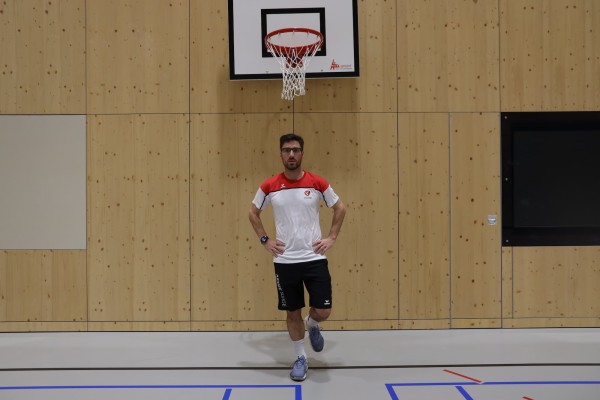
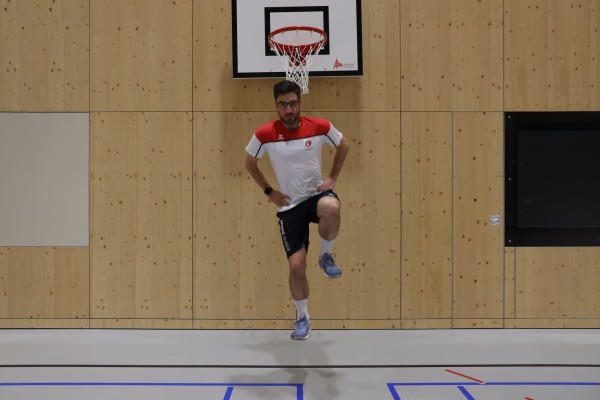
One-legged stand (right) on the balls of the feet with the knees slightly bent, arms bent in front of the body or supported on the hips. Continuous hopping in place (fast frequency) without putting your heels down (jumping off on your toes).
Attention:
Keep your upper body upright (tense your core).
Lighten:
Smaller/less intense jumps.
Harden:
Bigger/more intense jumps; additional weight (on your chest/shoulders, hold in your hands, in front of you).
Variation:
With each jump, pull the tips of your feet towards your knees (bend your feet).
1 weight cuff/weight vest/weight disc/(medicine) ball/sandbag/fighting backpack/2 dumbbells ► Make the exercise more difficult (additional weight)
Jumping relay
Stimulate circulation
Group work
5-7 participants per group
All participants in a group hop together in a chain to a defined point (e.g. around a turnaround, to the hall wall or over a certain line) and back. The person in front holds the left knee of the person behind (or the right knee in the second round). In another form, the person behind holds the left or right foot of the person in front. The two forms can also be combined (different outward and return routes).
Variant:
The group transports a long bench between their legs.
Per group:
2 colouring sticks/marking cones/cones ►start and reversal mark (optional)
Per group:
1 long bench ►Variant
Indiaca
Games / Tournament
Game idea:
Two teams face each other on a field. The aim of the game is to play the Indiaca pad over the net so that it falls to the ground in the opponent's field.
Scoring:
A point is scored when the Indiaca lands in the opponent's field or the opposing team is unable to return it in accordance with the rules.
Playing field:
Field size 6mx18m or volleyball court (9mx18m), net height: 2m
Number of participants:
5 against 5.
Playing rules:
The face-off takes place behind the baseline. The net must not be touched during the service. The team that won the last point is awarded the right to play the ball.
The Indiaca pad may only be played with the hand or forearm. The Indiaca pad may not be held, caught or thrown.
If the Indiaca pad is in play, the team in possession of the playing equipment has the right to hit the pad three times without it touching the ground.
If the right to play is regained by scoring a point, the players change positions in a clockwise direction. A set goes to 25 points with a difference of at least 2 points, otherwise the game continues until a 2-point lead has been established. If a team can win 3 sets, the game is won.
Indiaca: Trench game
Forms of play / exercises
2 teams of 2-4 players each

Two teams of 2-4 players play Indiaca against each other. However, the ball must not fall to the ground before the attack line (3m line). The aim is to keep the rally going for as long as possible. The Indiaca must always be touched by two players of a team before it can be played over the net.
Aim: Fast movement; communication; precision.
Variant:
After each touch of the ball, a push-up must be completed.
1 (volleyball) net
Pitch:
1 Indiaca pad
Indiaca: Joker-Spiel
Forms of play / exercises
2 Teams

Two teams play normal Indiaca against each other. In this game variant, however, both teams appoint a joker before each service (marked by a ribbon/cap etc.). If the joker scores a point, it counts double.
Objective: Focus on a specific player.
Variant:
If one of the jokers is successful, both teams swap teams.
1 (volleyball) net
Pitch:
1 Indiaca pad
1 game ribbon / cover
Indiaca: Pad passen
Forms of play / exercises
Groups of 2
Two players stand opposite each other on both sides of the net and pass the Indiaca pad to each other (or also possible without a net; possibly define playing fields and a restricted area in the centre zone using lines). The aim is to play with the stronger hand as well as the weaker hand.
1 (volleyball) net
Per group:
1 Indiaca pad
Indiaca: Pad over the string
Forms of play / exercises
2 teams of 2-4 players each

Two teams of 2-3 players each play an Indiaca over the net into the opponent's court in such a way that it is not possible for the opponent to catch it. A point is scored when the Indiaca falls to the ground in the opponent's court. If the Indiaca can be caught, it must be thrown back from the same point.
Objective: Fast movement; communication; precision.
Variant 2:2:
After each throw, an additional task must be completed, e.g. touching the baseline, a lie.e.g. touch the baseline, do a push-up, etc.
Variant 3:3:
Play with 2 Indiacas; additional tasks may be required.
1 (volleyball) net
Pitch:
1 Indiaca pad
Indoor cycling
Stimulate circulation
Individual work
Indoor cycling involves cycling indoors, whereby the workout on the indoor bike is even slightly more efficient than cycling outside. Whether for burning fat, strengthening the cardiovascular system, ergo for health or for the muscles, training with the indoor bike offers a holistic workout and entails hardly any risks. At a moderate speed with correspondingly low resistance, indoor cycling is an ideal way to stimulate the circulatory system during the run-in.
1 Fahrradergometer/Indoor-Bike/Spinning-Bike
Indoor cycling
Increase pulse
Individual work
Indoor cycling involves cycling indoors, whereby the workout on the indoor bike is even slightly more efficient than cycling outside. Whether for burning fat, strengthening the cardiovascular system, ergo for health or for the muscles, training with the indoor bike offers a holistic workout and entails hardly any risks. This holistic workout makes indoor cycling ideal for getting the heart rate up at the end of the warm-up. A high basic speed can be selected or constant changes of pace provide the necessary intensity.
1 Fahrradergometer/Indoor-Bike/Spinning-Bike
Indoor cycling
Power
Individual work

Indoor cycling involves cycling indoors, whereby the workout on the indoor bike is even slightly more efficient than cycling outside. Whether for burning fat, strengthening the cardiovascular system, ergo for health or for the muscles, training with the indoor bike offers a holistic workout and entails hardly any risks.
Variant:
Choose a constant basic speed or vary the intensity by constantly changing speed (interval training).
1 Fahrradergometer/Indoor-Bike/Spinning-Bike
Indoor Cycling (m: 10000m/10km - 240kal; w: 8000m/8km - 180kal)
Power
Individual work

Indoor cycling involves cycling indoors, whereby the workout on the indoor bike is even slightly more efficient than cycling outside. Whether for burning fat, strengthening the cardiovascular system, ergo for health or for the muscles, training with the indoor bike offers a holistic workout and entails hardly any risks.
Variant:
Choose a constant basic speed or vary the intensity by constantly changing speed (interval training).
1 Fahrradergometer/Indoor-Bike/Spinning-Bike
Indoor Cycling (m: 1000m/1km - 24kal; w: 800m - 18kal)
Power
Individual work

Indoor cycling involves cycling indoors, whereby the workout on the indoor bike is even slightly more efficient than cycling outside. Whether for burning fat, strengthening the cardiovascular system, ergo for health or for the muscles, training with the indoor bike offers a holistic workout and entails hardly any risks.
Variant:
Choose a constant basic speed or vary the intensity by constantly changing speed (interval training).
1 Fahrradergometer/Indoor-Bike/Spinning-Bike
Indoor Cycling (m: 1600m/1.6km/1 mile - 36kal; w: 1200m/1.2km - 27kal)
Power
Individual work

Indoor cycling involves cycling indoors, whereby the workout on the indoor bike is even slightly more efficient than cycling outside. Whether for burning fat, strengthening the cardiovascular system, ergo for health or for the muscles, training with the indoor bike offers a holistic workout and entails hardly any risks.
Variant:
Choose a constant basic speed or vary the intensity by constantly changing speed (interval training).
1 Fahrradergometer/Indoor-Bike/Spinning-Bike
Indoor Cycling (m: 2000m/2km - 48kal; w: 1600m/1.6km - 36kal)
Power
Individual work

Indoor cycling involves cycling indoors, whereby the workout on the indoor bike is even slightly more efficient than cycling outside. Whether for burning fat, strengthening the cardiovascular system, ergo for health or for the muscles, training with the indoor bike offers a holistic workout and entails hardly any risks.
Variant:
Choose a constant basic speed or vary the intensity by constantly changing speed (interval training).
1 Fahrradergometer/Indoor-Bike/Spinning-Bike
Indoor Cycling (m: 2500m/2.5km - 60kal; w: 2000m/2km - 45kal)
Power
Individual work

Indoor cycling involves cycling indoors, whereby the workout on the indoor bike is even slightly more efficient than cycling outside. Whether for burning fat, strengthening the cardiovascular system, ergo for health or for the muscles, training with the indoor bike offers a holistic workout and entails hardly any risks.
Variant:
Choose a constant basic speed or vary the intensity by constantly changing speed (interval training).
1 Fahrradergometer/Indoor-Bike/Spinning-Bike
Indoor Cycling (m: 250m - 6kal; w: 200m - 4kal)
Power
Individual work

Indoor cycling involves cycling indoors, whereby the workout on the indoor bike is even slightly more efficient than cycling outside. Whether for burning fat, strengthening the cardiovascular system, ergo for health or for the muscles, training with the indoor bike offers a holistic workout and entails hardly any risks.
Variant:
Choose a constant basic speed or vary the intensity by constantly changing speed (interval training).
1 Fahrradergometer/Indoor-Bike/Spinning-Bike
Indoor Cycling (m: 4000m/4km - 96kal; w: 3200m/3.2km/2 Meile - 72kal)
Power
Individual work

Indoor cycling involves cycling indoors, whereby the workout on the indoor bike is even slightly more efficient than cycling outside. Whether for burning fat, strengthening the cardiovascular system, ergo for health or for the muscles, training with the indoor bike offers a holistic workout and entails hardly any risks.
Variant:
Choose a constant basic speed or vary the intensity by constantly changing speed (interval training).
1 Fahrradergometer/Indoor-Bike/Spinning-Bike
Indoor Cycling (m: 500m - 12kal; w: 400m - 9kal)
Power
Individual work

Indoor cycling involves cycling indoors, whereby the workout on the indoor bike is even slightly more efficient than cycling outside. Whether for burning fat, strengthening the cardiovascular system, ergo for health or for the muscles, training with the indoor bike offers a holistic workout and entails hardly any risks.
Variant:
Choose a constant basic speed or vary the intensity by constantly changing speed (interval training).
1 Fahrradergometer/Indoor-Bike/Spinning-Bike