
Exercises (3274)
Raising and lowering one leg alternately in a push-up position
Power
Individual work

Push-up position, hands placed on the exercise ball, legs (and arms) stretched, alternately lift one leg slightly and return to the starting position.
Attention:
No hollow back, head in extension of the spine, shoulders remain above the elbows. To prevent the ball from rolling away, you can lean it against a wall.
Lighten:
Support yourself in place (without lifting and lowering your legs).
Harden:
Additional weight (on your back).
1 exercise ball
1 weight vest/weight disc/sandbag ► Make the exercise more difficult (additional weight)
Raising and lowering one leg alternately in a push-up position
Power
Individual work


Push-up position, legs (shins) placed on the exercise ball, alternately lift one leg slightly and return to the starting position.
Attention:
Head, shoulders, buttocks and feet form a line, no hollow back, actively tense the torso. To prevent the ball from rolling away, you can lean it against a wall.
Lighten:
Support yourself in place (without lifting and lowering your legs); exercise ball closer to your hips.
Harden:
Additional weight (on your back); unstable support for your arms.
1 exercise ball
1 weight vest/weight disc/sandbag ► to make the exercise more difficult (additional weight)
1 balance cushion/balance board/2 wedges ► to make the exercise more difficult (unstable base)
Raising and lowering one leg in a push-up position alternately
Power
Individual work


Push-up position (high support, face/look down), alternately raise and lower one leg.
Attention:
Keep your upper body stable, no hollow back (tighten your stomach).
Lighten:
Just hold the basic position (push-up position); lift your legs less off the floor.
Harden:
Additional weight (on the legs and/or on the back); unstable support for the arms.
Variant:
Underarm support (instead of push-up position).
2 weight cuffs/1 weight vest/weight disc/sandbag ► making the exercise more difficult (additional weight)
1 balance cushion/balance board ► making the exercise more difficult (unstable surface)
Raising and lowering one leg alternately in a push-up position
Power
Individual work
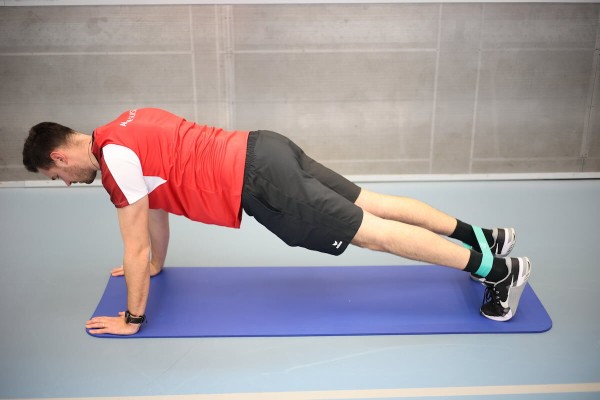
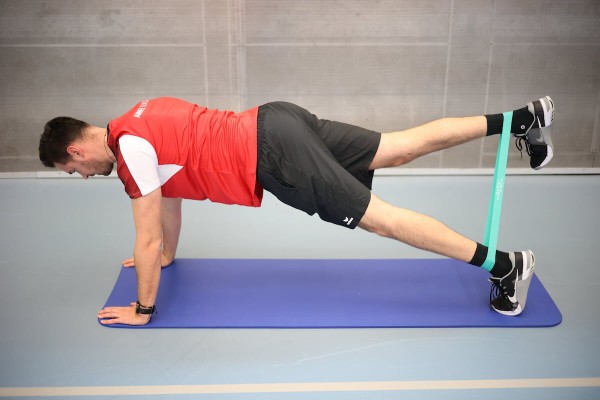
Push-up position (high plank, face/look down), stretch an elasticated band between your legs (place the band around your ankles), alternately raise and lower one leg (alternating hip extension).
Attention:
Keep your upper body stable, no hollow back (tighten your stomach).
Lighten:
Choose a rubber band with less resistance.
Harden:
Choose a rubber band with greater resistance; additional weight (on the legs and/or back); unstable support for the arms.
Variant:
Underarm support (instead of push-up position).
1 mini band
2 weight cuffs/1 weight vest/weight disc/sandbag ► to make the exercise more difficult (additional weight)
1 balance cushion/balance board ► to make the exercise more difficult (unstable base)
Raising and lowering one leg in supine position (left) ► one leg raise
Power
Individual work


Lie on your back, one leg stretched out slightly off the floor (left), the other leg (right) lying flat on the floor or bent with the foot flat on the floor. Place your arms flat on the floor at your sides or place your hands under your buttocks. Raise the slightly raised leg as straight as possible upwards and back to the starting position. The greater the flexibility, the more vertically the leg can be raised to the holding position.
Attention:
Keep your (lower) back in constant contact with the floor (no hollow back, consciously tense your stomach), do not put your leg down.
Lighten:
Just hold the position (leg extended slightly off the floor); lower the leg completely after each exercise.
Harden:
Additional weight for the leg.
Variant I:
Execute circular movements with the free leg or spread the leg out and bring it back to the centre.
1 weight cuff ► Make the exercise more difficult (additional weight)
Raising and lowering one leg in supine position (right) ► one leg raise
Power
Individual work


Lie on your back, one leg stretched out slightly off the floor (right), the other leg (left) lying flat on the floor or bent with the foot flat on the floor. Place your arms flat on the floor at your sides or place your hands under your buttocks. Raise the slightly raised leg as straight as possible upwards and back to the starting position. The greater the flexibility, the more vertically the leg can be raised to the holding position.
Attention:
Keep your (lower) back in constant contact with the floor (no hollow back, consciously tense your stomach), do not put your leg down.
Lighten:
Just hold the position (leg extended slightly off the floor); lower the leg completely after each exercise.
Harden:
Additional weight for the leg.
Variant I:
Execute circular movements with the free leg or spread the leg out and bring it back to the centre.
1 weight cuff ► Make the exercise more difficult (additional weight)
Raising and lowering one leg in supine position alternately ► one leg raise / lying scissor raise / lying single leg raise
Power
Individual work
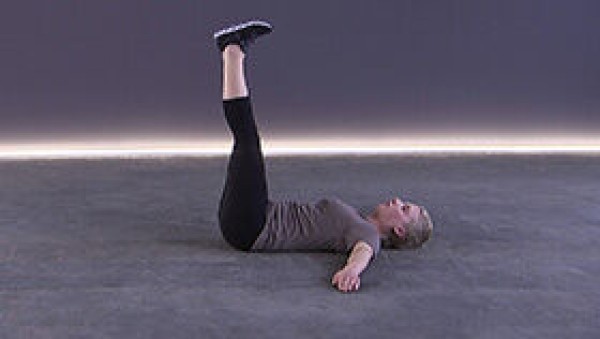


Lie on your back, legs stretched and slightly raised, arms at your sides on the floor, legs crossed alternately (scissor movement).
Attention:
Keep your back in constant contact with the floor (no hollow back, consciously tense your stomach), do not put your legs down.
Lighten:
Spread your legs less; keep your legs slightly higher; just hold the position.
Harden:
Add weight to your legs.
Variant I:
Move your legs up and down instead of sideways (lift and lower slightly).
Variant II:
Make circular movements with your legs.
2 weight cuffs ► Make the exercise more difficult (additional weight)
Raising and lowering an object while standing ► hammer slam
Power
Individual work
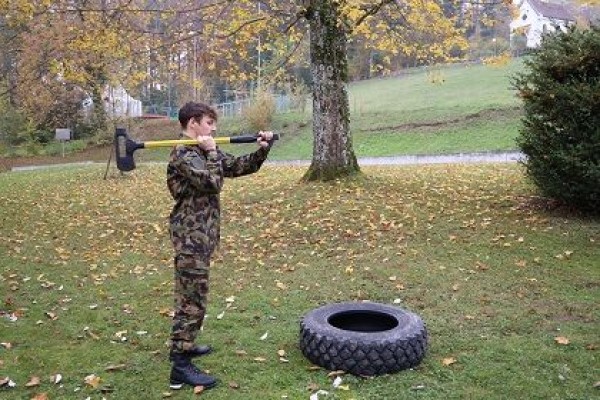
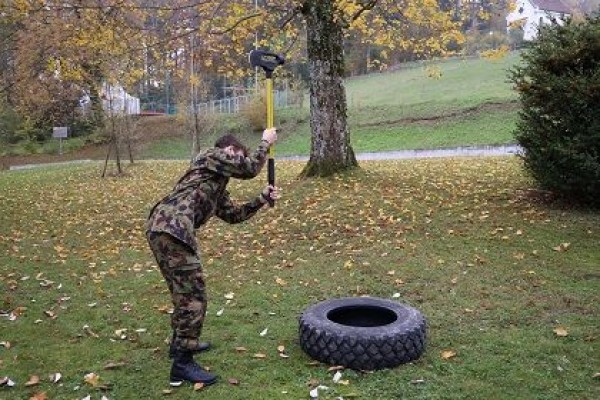
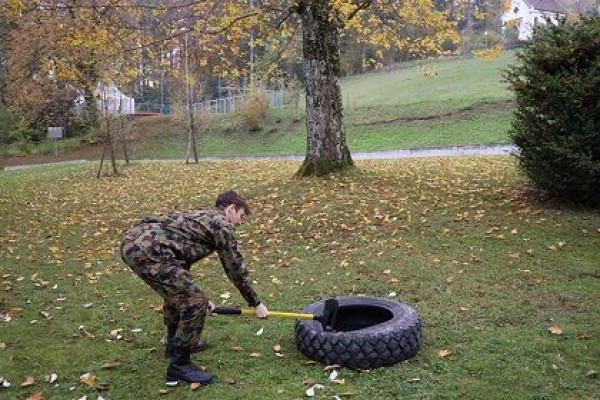
Grab the sledgehammer with both hands and strike the tyre lying on the ground (start the lunging motion behind your back).
Attention:
Brake the hammer on the tyre and do not let it bounce.
Lighten:
Lower cadence/impact intensity.
Harden:
Higher cadence/impact intensity.
1 tyre (10DM)
1 sledgehammer
Raising and lowering an object while standing ► wrist curl
Power
Individual work
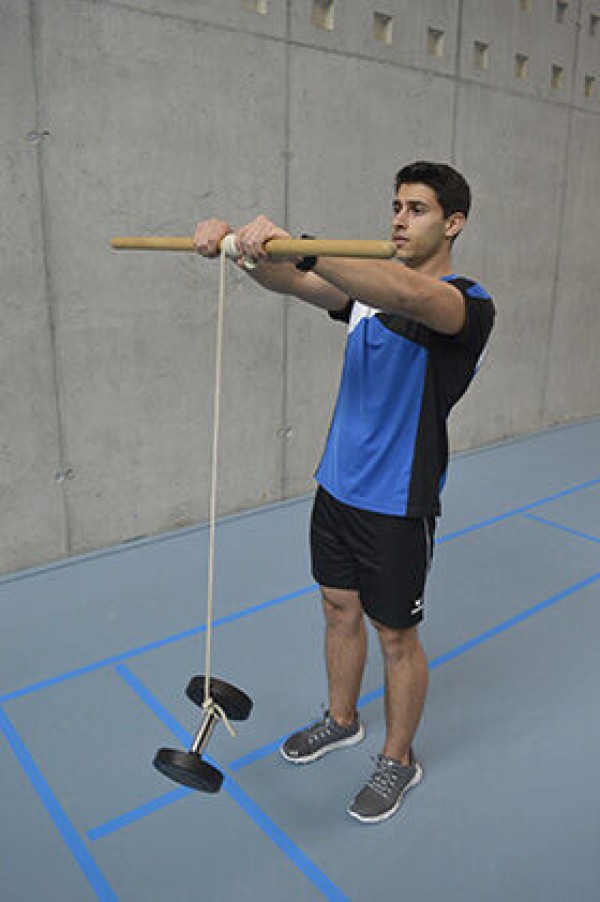

Stand upright, arms (almost) shoulder-width apart in front of you (chest height), hold a pole in your hands (overhand grip), attach a weight to the pole with a cord/rope, roll up the cord/rope by turning the pole and roll it back to the starting position in a controlled/slow manner (lift and lower the weight).
Lighten:
Less weight.
Harden:
More weight.
Variant I:
Arms bent.
Variant II:
Arms bent and elbows resting on a swinging box.
1 gymnastics pole/wooden stick
1 weight disc/dumbbell
Cord or rope to attach the object to the pole
1 vaulting box ► Variation of the exercise
Raising and lowering as well as extension and flexion of one arm crosswise in supine position alternating (trunk bend) ► rotational sit up / sitting punches / boxing crunch
Power
Individual work


Lie on your back with your legs bent (feet also bent or flat on the floor), arms also bent and resting against your body (upper arms flat on the floor, forearms pointing upwards, both hands clenched into fists). Straighten the upper body and at the same time extend one arm crosswise past the knee to the side (strike a straight line). When the upper body is lowered back to the starting position, bend the punching arm again. As you raise your upper body again, change the side of the punching arm.
Attention:
Do not lower your upper body completely (constant tension).
Lighten:
Bend your legs less (almost stretched); work more with momentum.
Harden:
Hold additional weight in your hands.
2 weight cuffs/weight balls/dumbbells ► Make the exercise more difficult (additional weight)
Raising and lowering as well as extension and flexion of one arm crosswise in supine position alternating ► rotational sit up / sitting punches / boxing crunch
Power
Individual work
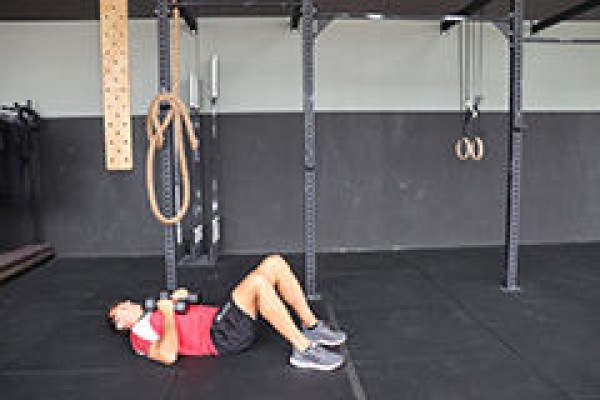


Lie on your back with your legs bent (feet also bent or flat on the floor - possibly even clamped for more stability/hold), grasp a dumbbell with both hands, hold the weight in front of your chest with your arms bent (upper arms flat on the floor against your body, forearms pointing horizontally upwards - approx. 90 degree angle at the elbow joint). Raise your upper body, alternately stretch one arm diagonally across the front and back to the starting position (two straight punches - one to the left, one to the right). After the two punches, lower your upper body back to the supine position.
Attention:
Upper body/gaze accompanies the punching movement (body turned out to the side). Keep your head in a neutral position.
Lighten:
Less or no weight; legs/feet fixed.
Harden:
More weight.
2 dumbbells
Raising and lowering as well as rotation of the upper body in push-up position ► push up & rotation
Power
Individual work


Assume a high push-up position (plank), with your hands and feet positioned approximately shoulder-width apart and your head, torso, hips and legs forming a stable, straight line. Actively pull your shoulder blades back and down, and tighten your abdominal muscles and buttocks. Lower your body as a single, solid unit until your chest is just above the floor. As you do so, your elbows move diagonally backwards and outwards at an angle of approximately 45°, passing alongside your body. Then push yourself forcefully back up to the starting position. Once at the top, seamlessly release one hand, lead the arm in a wide arc perpendicular to the ceiling and rotate your entire body in unison into a stable T-position (side plank). Keep your gaze on your upper hand; your pelvis remains high and does not sag. After a brief moment, return to the starting position in a controlled manner, immediately follow up with the next push-up and rotate to the other side.
Attention:
The lumbar spine sags and the torso slumps into a hollow back (loss of abdominal tension); the buttocks rise high (roof position); the elbows splay outwards at a 90° angle during the push-up (high shoulder strain); the pelvis sags downwards during rotation, instead of being held in an active, straight line; the movement is frantic or performed with momentum, resulting in a loss of stability at the upper turning point; the supporting shoulder is passively pushed upwards towards the ears, instead of remaining actively stabilised.
Lighten:
Perform on your knees; omit the push-up: Perform a pure rotational movement from the static push-up position (alternating between the push-up and T-support positions); Place your feet slightly wider apart; place your hands on a raised, stable bench (this reduces the leverage load).
Harden:
In the push-up position, rest both hands on a dumbbell with flat edges; as you push up, raise the dumbbell in a controlled manner towards the ceiling; wear a weighted vest; slow the downward movement of the push-up to 3 seconds.
1 Plyo box/vaulting box ► makes the exercise easier (reduces the load on the lever)
2 dumbbells ► make the exercise more challenging (additional weight)
1 weighted vest ► makes the exercise more challenging (additional weight)
Raising and lowering as well as rotation of the upper body in supine position (trunk bend) (left) ► cross sit up
Power
Individual work


Lie on your back with your legs bent (feet also bent or flat on the floor), arms bent so that each hand is placed next to the nearest ear. Raise and rotate the upper body to move the elbow (left) crosswise to the knee (right). Lower your upper body and return to the starting position.
Attention:
Do not lower your upper body completely (constant tension), do not pull on your head with your hands (really keep your hand next to your ear).
Lighten:
Lift your upper body less; cross your arms over your chest.
Harden:
Stretch your arms above your head (holding them up) and move your hand (possibly even with additional weight) crosswise to your knee (work without momentum).
1 weight cuff/weight ball/weight disc (small)/dumbbell ► Make the exercise more difficult (additional weight)
Raising and lowering as well as rotation of the upper body in supine position (trunk bend) (right) ► cross sit up
Power
Individual work
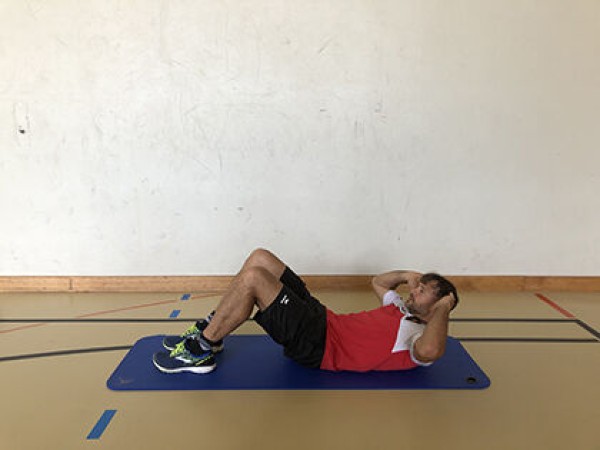

Lie on your back with your legs bent (feet also bent or flat on the floor), arms bent so that each hand is placed next to the nearest ear. Raise and rotate the upper body to move the elbow (right) crosswise to the knee (left). Lower your upper body and return to the starting position.
Attention:
Do not lower your upper body completely (constant tension), do not pull on your head with your hands (really keep your hand next to your ear).
Lighten:
Lift your upper body less; cross your arms over your chest.
Harden:
Stretch your arms above your head (holding them up) and move your hand (possibly even with additional weight) crosswise to your knee (work without momentum).
1 weight cuff/weight ball/weight disc (small)/dumbbell ► Make the exercise more difficult (additional weight)
Lifting and lowering as well as rotating the upper body in supine position alternately (trunk bend) ► cross sit up
Power
Individual work


Lie on your back with your legs bent (feet also bent or flat on the floor), arms bent so that each hand is placed next to the nearest ear. Raise and rotate the upper body to move the elbow crosswise to the knee. Lower your upper body and return to the starting position. Switch sides with each repetition.
Attention:
Do not lower your upper body completely (constant tension), do not pull your head with your hands (really keep your hand next to your ear).
Lighten:
Lift your upper body less; cross your arms over your chest.
Harden:
Stretch your arms above your head (holding them up) and move your hand (possibly even with additional weight) crosswise to your knee (work without momentum).
2 weight cuffs/weight balls/weight discs (small)/dumbbells ► Make the exercise more difficult (additional weight)
Lifting and lowering as well as rotating the upper body in supine position alternately (trunk bend) ►rotational sit up
Power
Individual work


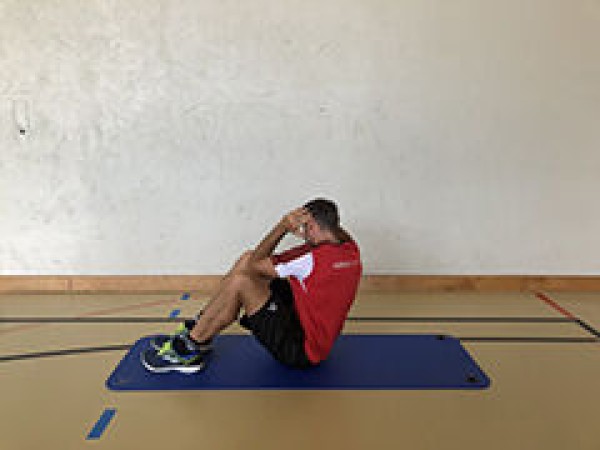
Lie on your back with your legs bent (and feet - possibly tucked in for a better hold of the position), place your arms bent next to your head (hands by your ears, elbows pointing to the side). Raise the upper body, then turn the upper body out to the side so that each elbow is brought crosswise to the corresponding knee. Lower the upper body back to the starting position. Switch sides after each exercise.
Attention:
Do not lower your upper body completely and do not raise it too high (constant tension), keep your head in a neutral position (no double chin).
Lighten:
Raise your upper body less; cross your arms over your chest.
Harden:
Raise your arm forwards/upwards and bring your hand crosswise to your knee.
No material required
Lifting and lowering as well as rotating the upper body in supine position alternately ► cross crunch
Power
Individual work


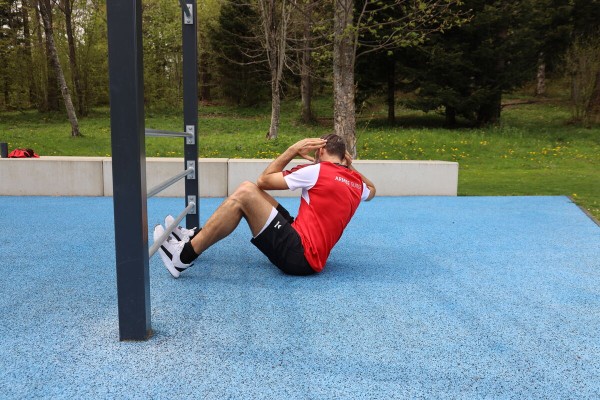
Lie on your back with your legs bent and your feet hooked onto the (very low) horizontal bar (or wall bars) (instep on the bar/bar), arms bent so that each hand is placed next to the nearest ear. Raise and rotate the upper body to move the elbow crosswise to the knee. Lower your upper body and return to the starting position. Switch sides with each repetition.
Attention:
Do not lower your upper body completely (constant tension), do not pull your head with your hands (really keep your hand next to your ear).
Lighten:
Lift your upper body less; cross your arms over your chest.
Harden:
Stretch your arms above your head (holding them up) and move your hand (possibly even with additional weight) crosswise to your knee (work without momentum).
2 weight cuffs/weight balls/weight discs (small)/dumbbells ► Make the exercise more difficult (additional weight)
Raising and lowering as well as rotation of the upper body with the leg on the back (left) ► rotational crunch
Power
Individual work


Lying on your back, place one foot (left) on the other bent leg (knee), one arm (left) stretched out to the side, the other arm (side of the bent leg) bent next to your head, raise and lower your upper body (move your elbow to the knee of the supported leg/lead it diagonally upwards).
Attention:
Do not lower your upper body completely (constant tension), do not pull your head with your hand (place your hand next to your ear).
Lighten:
Lift your upper body less.
Harden:
Lift your arm outstretched (not bent next to your ear), possibly even diagonally upwards with additional weight.
1 weight cuff/dumbbell ► Make the exercise more difficult (additional weight)
Raising and lowering as well as rotation of the upper body with the leg on the back (right) ► rotational crunch
Power
Individual work


Lying on your back, place one foot (right) on the other bent leg (knee), one arm (right) stretched out to the side, the other arm (side of the bent leg) bent next to your head, raise and lower your upper body (move your elbow to the knee of the supported leg/lead it diagonally upwards).
Attention:
Do not lower your upper body completely (constant tension), do not pull your head with your hand (place your hand next to your ear).
Lighten:
Lift your upper body less.
Harden:
Lift your arm outstretched (not bent next to your ear), possibly even diagonally upwards with additional weight.
1 weight cuff/dumbbell ► Make the exercise more difficult (additional weight)
Lifting and lowering as well as rotation of the upper body with extension and flexion of one leg in the seated position alternately (elbow and knee together) ► knee to elbow V2
Power
Individual work


Sit on the floor, upper body leaning slightly backwards, legs stretched out and raised off the floor, arms bent next to the head (hands by the ears, elbows pointing to the side). Raise your upper body and bend one leg at the same time, then turn your upper body out to the side so that your elbow crosses over your knee. Lower the upper body back to the starting position and stretch out the free leg again. Switch sides after each exercise.
Attention:
Do not lower your upper body completely (constant tension), keep your head in a neutral position (no double chin).
Lighten:
Lift/untwist the upper body less (without bringing the elbows and knees together; fully lower the extremities after each exercise.
Harden:
Additional weight (on the legs).
2 weight cuffs ► Make the exercise more difficult (additional weight)
Lifting and lowering as well as rotation of the upper body with extension and flexion of one leg in supine position alternating (elbows and knees together) ► bicycle kicks / bicycle crunch
Power
Individual work


Lie on your back, legs almost stretched out and raised off the floor, arms bent next to your head (hands by your ears, elbows pointing to the side). Raise the upper body and bend one leg at the same time, then turn the upper body out to the side so that the elbow is brought crosswise to the corresponding knee (or close to the knee). Lower the upper body back to the starting position and extend the free leg again. Switch sides after each exercise.
Attention:
Do not lower your upper body completely (constant tension), keep your head in a neutral position (no double chin).
Lighten:
Lift/untwist the upper body less (without bringing the elbows and knees together; fully lower the extremities after each exercise.
Harden:
Additional weight (on the legs).
2 weight cuffs ► Make the exercise more difficult (additional weight)
Raising and lowering as well as rotating the upper body with the leg extended upwards in a supine position (left) ► rotational crunch
Power
Individual work


Supine position, one leg bent, the other (left leg) is stretched out in an upright position and points upwards accordingly (approx. 45 degrees between the thighs), the (right) arm on the side of the bent leg is bent and placed next to the head, the other arm is placed on the stomach, raise and lower the upper body (right elbow pulls towards the outstretched left leg).
Attention:
Do not lower your upper body completely (constant tension), do not pull your head with your hand (place your hand next to your ear), the arm placed on your stomach prevents you from resting on the opposite shoulder.
Lighten:
Lift the upper body less; arm outstretched in front instead of bent next to the ear.
Harden:
Arm outstretched (not bent next to the ear) with additional weight.
1 weight cuff/dumbbell ► Make the exercise more difficult (additional weight)
Raising and lowering as well as rotating the upper body with the leg extended upwards in a supine position (r) ► rotational crunch
Power
Individual work


Supine position, one leg bent, the other (right leg) is stretched out in an upright position and points upwards accordingly (approx. 45 degrees between the thighs), the (left) arm on the side of the bent leg is bent and placed next to the head, the other arm is placed on the stomach, raise and lower the upper body (left elbow pulls towards the stretched-out right leg).
Attention:
Do not lower your upper body completely (constant tension), do not pull your head with your hand (place your hand next to your ear), the arm placed on your stomach prevents you from resting on the opposite shoulder.
Lighten:
Lift the upper body less; arm outstretched in front instead of bent next to the ear.
Harden:
Arm outstretched (not bent next to the ear) with additional weight.
1 weight cuff/dumbbell ► Make the exercise more difficult (additional weight)
Raising and lowering and lifting the upper body sideways in a supine position (left) ►rotational crunch
Power
Individual work


Position yourself in a supine position with your left leg bent over (or next to) the other outstretched leg (knee height). Hold your outstretched arms next to your bent knee and raise and lower your upper body next to your bent knee towards your feet (lift your shoulder blades off the floor).
Attention:
Do not lower your upper body (support it on your shoulders).
Lighten:
Lift your upper body less; just hold the position (without pulling your upper body towards your feet).
Harden:
Hold additional weight in your hands.
2 weight cuffs/weight balls/1 (medicine) ball/weight disc/dumbbell ► Make the exercise more difficult (additional weight)
Raising and lowering as well as lateral lifting of the upper body in supine position (right) ► rotational crunch
Power
Individual work


Sit on your back with your right leg bent over (or next to) the other outstretched leg (knee height). Hold your outstretched arms next to your bent knee and raise and lower your upper body next to your bent knee towards your feet (lift your shoulder blades off the floor).
Attention:
Do not lower your upper body (rest it on your shoulders).
Lighten:
Lift your upper body less; just hold the position (without pulling your upper body towards your feet).
Harden:
Hold additional weight in your hands.
2 weight cuffs/weight balls/1 (medicine) ball/weight disc/dumbbell ► Make the exercise more difficult (additional weight)