
Exercises (3288)
Abduction and adduction of the leg in standing position (right) ► abduction / adduction
Power
Individual work


Stand with your feet shoulder-width apart and stretch an elasticated band between your legs (place the band around your ankles). Move your right leg to the corresponding side/spread it out to stretch the elastic band further. Then return the leg to the starting position.
Lighten:
Select an elastic band with less resistance.
Harden:
Select an elastic band with greater resistance.
1 mini-band
Abduction and adduction of the leg in standing position (right) ► abduction / adduction
Power
Individual work


Stand upright shoulder-width apart next to a wall (chest parallel to the wall), fix an elasticated band at ankle height, step into the loop of the band with the leg closer to the wall (right). Spread the training leg (right) out to the side in the direction of the attachment. Then return the leg to the starting position to stretch/tension the elastic band again.
Attention:
Do not lower the training leg completely (to a standing position) or keep it raised off the floor at all times.
Lighten:
Choose an elastic band with less resistance.
Harden:
Choose an elastic band with greater resistance.
1 elasticated rubber band
1 fastening elasticated rubber band
Abduction and adduction of the leg in standing position (right) ► abduction / adduction
Power
Individual work


Stand upright shoulder-width apart next to a wall (chest parallel to the wall), fix an elasticated rubber band at ankle height, step into the loop of the band with the leg further away from the wall (right). Spread the training leg (right) out to the side to stretch/tension the elastic band (move the leg away from the wall). Then bring the leg back to the starting position.
Attention:
Do not lower the training leg completely (to a standing position) or keep it lifted off the floor at all times.
Lighten:
Choose an elastic band with less resistance.
Harden:
Choose an elastic band with greater resistance.
1 elasticated rubber band
1 fastening elasticated rubber band
Abduction and adduction of the leg in standing position (right) ► skater pushes
Power
Individual work


Easy squat position (legs shoulder-width apart) with upper body leaning forwards, arms bent (approx. 90 degree angle at the elbow joint - upper arms close to the body, forearms pointing forwards at the level of the navel, possibly clasp hands / or rest hands on the hips), stretch an elasticated rubber band between the legs (place band around the ankles). From this position, push one leg (right) backwards at an angle (abduction of the leg and extension of the hip) and return to the starting position.
Attention:
The movement only takes place in the leg/hip (upper body remains stable).
Lighten:
Select a rubber band with less resistance.
Harden:
Select a rubber band with greater resistance.
1 mini-band
Abduction and adduction of the leg in quadruped stance (left) ► abduction / adduction
Power
Individual work


Stand on four feet (face/look down), raise/spread one leg (left) sideways to buttock height and lower it back to the starting position. The angle in the knee joint remains stable (approx. 90 degrees).
Attention:
Keep the pelvis and spine straight, do not put the training leg down between repetitions.
Lighten:
Lift/spread the leg less.
Harden:
Additional weight on the leg.
1 weight cuff ► Make the exercise more difficult (additional weight)
Abduction and adduction of the leg in quadruped stance (right) ► abduction / adduction
Power
Individual work


Stand on four feet (face/look down), raise/spread one leg (right) sideways to buttock height and lower it back to the starting position. The angle in the knee joint remains stable (approx. 90 degrees).
Attention:
Keep the pelvis and spine straight and do not put the training leg down between repetitions.
Lighten:
Lift/spread the leg less.
Harden:
Additional weight on the leg.
1 weight cuff ► Make the exercise more difficult (additional weight)
Abduction and adduction of the leg in shoulder position (left) ► glute bridge & abduction
Power
Individual work


Shoulder position, one leg (right) bent with the foot/heel on the floor (place the heel in front of the knee, approx. 90 degree angle in the knee joint), the other (left) leg stretched out and pointing diagonally forwards in extension of the body, place the arms on the floor at the side of the body. The pelvis is raised so that the upper body and thigh (and outstretched leg) practically form a line. Stretch an elasticated band between the legs (place the band around the thighs slightly above the knees). From this position, push the training leg (left) outwards to the side away from the body (one-sided leg abduction) and bring it back to the centre of the other leg.
Attention:
Upper body, thigh and outstretched leg practically form a line, upper body only rests on the shoulders, keep pelvis parallel to the floor (do not let it hang sideways).
Lighten:
Choose a rubber band with less resistance.
Harden:
Choose a rubber band with greater resistance; additional weight (on the hips).
1 mini band
1 weight vest/weight disc/dumbbell/sandbag ► Make the exercise more difficult (additional weight)
Abduction and adduction of the leg in shoulder position (right) ► glute bridge & abduction
Power
Individual work


Shoulder position, one leg (left) bent with the foot/heel on the floor (place the heel in front of the knee, approx. 90 degree angle in the knee joint), the other (right) leg stretched out and pointing diagonally forwards in extension of the body, place the arms on the floor at the side of the body. The pelvis is raised so that the upper body and thigh (and outstretched leg) practically form a line. Stretch an elasticated band between the legs (place the band around the thighs slightly above the knees). From this position, push the training leg (right) outwards to the side away from the body (one-sided leg abduction) and bring it back to the centre of the other leg.
Attention:
Upper body, thigh and outstretched leg practically form a line, upper body only rests on the shoulders, keep pelvis parallel to the floor (do not let it hang sideways).
Lighten:
Choose a rubber band with less resistance.
Harden:
Choose a rubber band with greater resistance; additional weight (on the hips).
1 mini band
1 weight vest/weight disc/dumbbell/sandbag ► Make the exercise more difficult (additional weight)
Abduction and adduction of the leg in lateral position (left) ► abduction / adduction sidelying
Power
Individual work


Lying on your side, bend your left leg and place it on the vaulting box element. Raise and lower your leg.
Attention:
Keep your lower leg parallel to the support. When raising and lowering the leg, always keep the knee and ankle at the same height.
Lighten:
Lift the training leg less.
Harden:
Do not lower the active leg completely; add weight to the leg.
1 vaulting box top
1 weight cuff ► to make the exercise more difficult (additional weight)
Abduction and adduction of the leg in lateral position (right) ► abduction / adduction sidelying
Power
Individual work

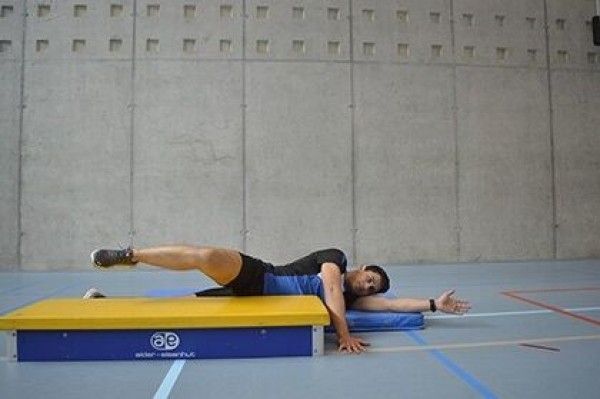
Lying on your side, place your right leg bent on the vaulting box element. Raise and lower the leg.
Attention:
The lower leg remains parallel to the support. When raising and lowering the leg, always keep the knee and ankle at the same height.
Lighten:
Lift the training leg less.
Harden:
Do not lower the active leg completely; add weight to the leg.
1 vaulting box top
1 weight cuff ► to make the exercise more difficult (additional weight)
Abduction and adduction of the ankle joint in the sitting position
Power
Individual work
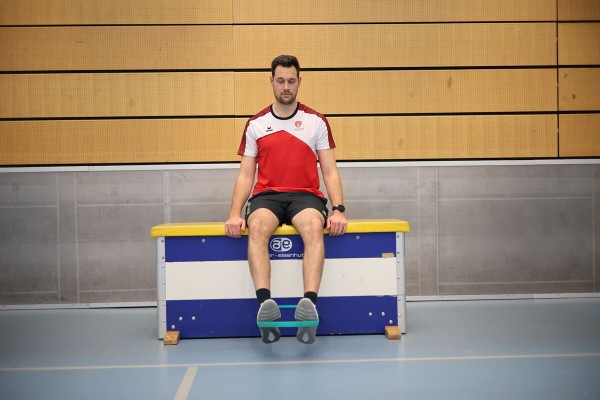
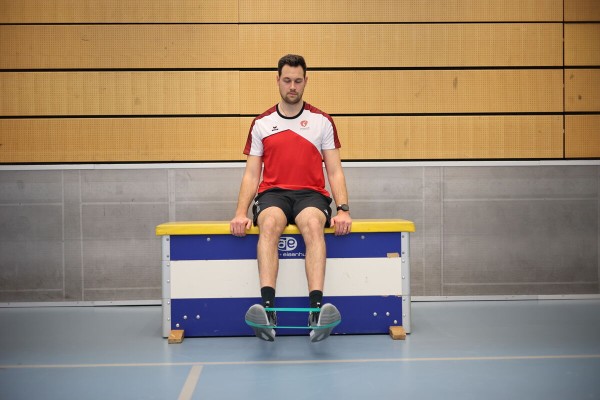
In the seated position, the upper body is tilted slightly backwards, both feet are lifted off the floor and the slightly bent legs are pointing diagonally forwards. Stretch an elasticated band between the legs (place the band around the instep/soles of the feet). From this position, rotate the ankles so that the feet point towards each other (big toes together) and away from each other (toes pointing diagonally upwards away from the body).
Attention:
The movement only takes place in the ankle joint (both legs and upper body remain stable).
Lighten:
Choose a rubber band with less resistance.
Harden:
Choose a rubber band with greater resistance.
1 mini-band
1 seating option (e.g. chair, plyo box or vaulting box)
Alternating abduction and adduction of one leg while standing ► skater pushes
Power
Individual work


Easy squat position (legs shoulder-width apart) with upper body leaning forwards, arms bent (approx. 90 degree angle at the elbow joint - upper arms close to the body, forearms pointing forwards at the level of the navel, possibly clasp hands / or rest hands on the hips), stretch an elasticated rubber band between the legs (place band around the ankles). From this position, alternately push one leg out diagonally backwards (abduction of the leg and extension of the hip) and return to the starting position. The movement can be compared to speed skating (skater pushes).
Attention:
The movement takes place exclusively in the leg/hip (upper body remains stable).
Lighten:
Choose a rubber band with less resistance.
Harden:
Choose a rubber band with more resistance.
1 mini-band
Abduction and adduction of one leg in supine position (circular movement) (left) ► one leg circle
Power


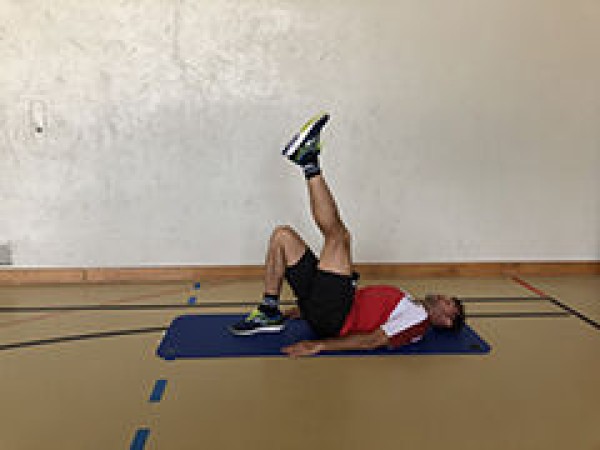
Back position, one leg stretched out in a high hold (left), the other leg (right) lying flat on the floor or bent with the foot flat on the floor. The greater the mobility, the more vertically the leg can be raised into the hold-up position. Place your arms flat on the floor at your sides or place your hands under your buttocks. Perform circular movements (in both directions) with the raised leg (spread the leg apart and bring it back to the centre).
Attention:
Keep the (lower) back in constant contact with the floor (no hollow back, consciously tense the abdomen), do not put the leg down.
Lighten:
Just hold the position (leg extended slightly off the floor); smaller range of motion.
Harden:
Additional weight for the leg.
Variant I:
Spread the leg without circular movements and bring it back to the centre.
Variant II:
Move the leg up and down.
1 weight cuff ► Make the exercise more difficult (additional weight)
Abduction and adduction of one leg in supine position (circular movement) (right) ► one leg circle
Power
Individual work

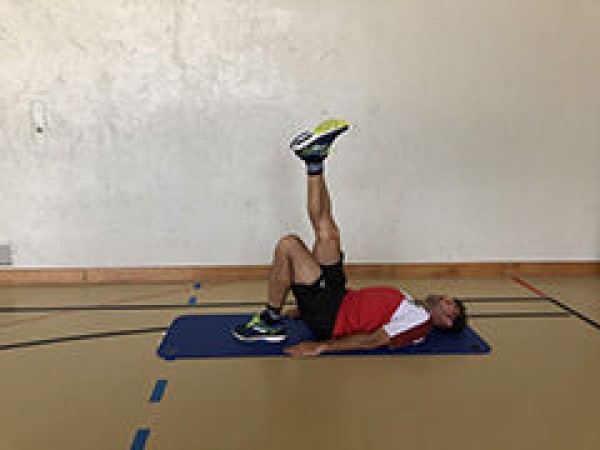

Supine position, one leg stretched out in an upright position (right), the other leg (left) lying flat on the floor or bent with the foot flat on the floor. The greater the mobility, the more vertically the leg can be raised into the hold-up position. Place your arms flat on the floor at your sides or place your hands under your buttocks. Perform circular movements (in both directions) with the raised leg (spread the leg apart and bring it back to the centre).
Attention:
Keep the (lower) back in constant contact with the floor (no hollow back, consciously tense the abdomen), do not put the leg down.
Lighten:
Just hold the position (leg extended slightly off the floor); smaller range of motion.
Harden:
Additional weight for the leg.
Variant I:
Spread the leg without circular movements and bring it back to the centre.
Variant II:
Move the leg up and down.
Weight cuff ► Make the exercise more difficult (additional weight)
Abduction and adduction of a leg in supine position (left)
Power
Individual work


Lie on your back, one leg (left) raised off the floor (pointing diagonally upwards in front), the other leg (right) lying flat on the floor or bent with the foot flat on the floor. Place your arms flat on the floor at your sides or place your hands under your buttocks. Spread the raised leg apart and return to the starting position. The greater the flexibility, the more vertical the leg can be brought into the raised position.
Attention:
Keep your (lower) back in constant contact with the floor (no hollow back, consciously tense your abdomen), do not put your leg down.
Lighten:
Just hold the position (leg extended slightly off the floor); smaller range of motion.
Harden:
Additional weight for the leg.
Variant I:
Execute circular movements with the free leg.
Variant II:
Move the leg up and down.
1 weight cuff ► Make the exercise more difficult (additional weight)
Abduction and adduction of a leg in supine position (right)
Power
Individual work

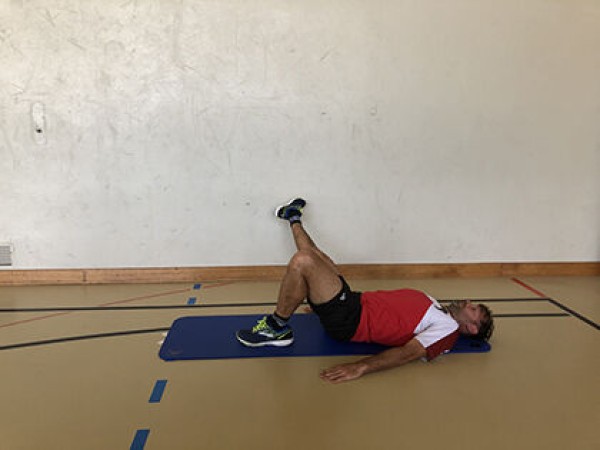
Lie on your back, one leg (right) raised off the floor (pointing diagonally upwards in front), the other leg (left) lying flat on the floor or bent with the foot flat on the floor. Place your arms flat on the floor at your sides or place your hands under your buttocks. Spread the raised leg apart and return to the starting position. The greater the flexibility, the more vertical the leg can be brought into the raised position.
Attention:
Keep your (lower) back in constant contact with the floor (no hollow back, consciously tense your abdomen), do not put your leg down.
Lighten:
Just hold the position (leg extended slightly off the floor); smaller range of motion.
Harden:
Additional weight for the leg.
Variant I:
Execute circular movements with the free leg.
Variant II:
Move the leg up and down.
1 weight cuff ► Make the exercise more difficult (additional weight)
Abduction and adduction of a leg in lateral position (left) ► clamshell
Power
Individual work
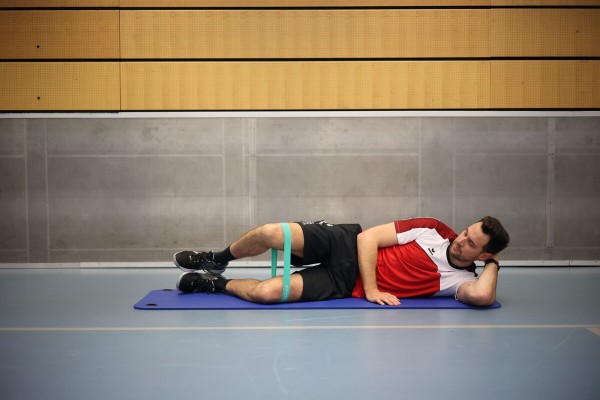
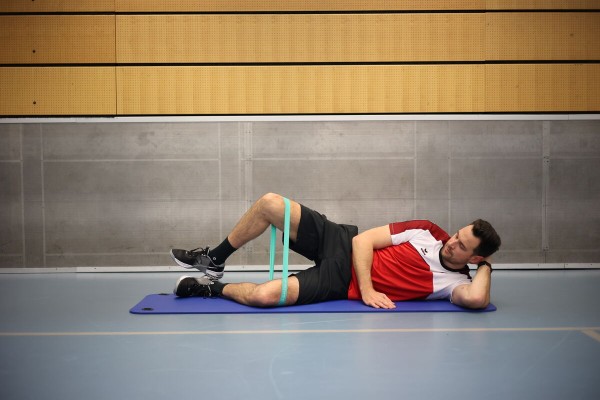
Sideways position on the left side of the body, with the legs pointing diagonally backwards. The upper (right) leg is supported on the lower leg (or slightly lifted off the lower leg). An elasticated band is stretched between the legs (place the band around the thighs slightly above the knees). The lower arm supports the head, the upper bent arm supports the upper body by placing the hand on the floor at the level of the navel. From this position, spread the upper (slightly bent) leg apart (stretch/stretch the band further) to perform an external rotation in the hip. Then lower the upper leg back to the starting position.
Attention:
For greater intensity, do not rest the upper leg completely on the lower leg (always at a slight angle).
Lighten:
Choose a rubber band with less resistance.
Harden:
Choose a rubber band with more resistance.
1 mini-band
Abduction and adduction of a leg in lateral position (right) ► clamshell
Power
Individual work
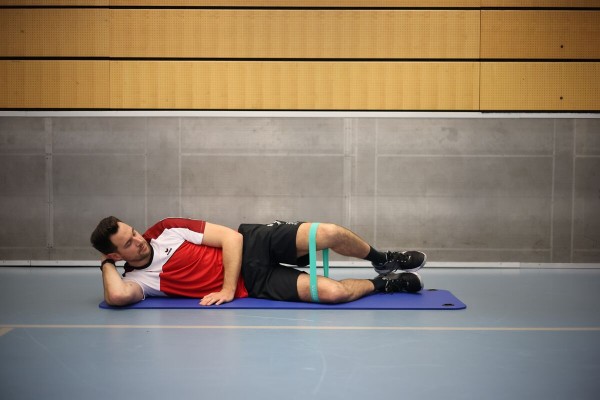
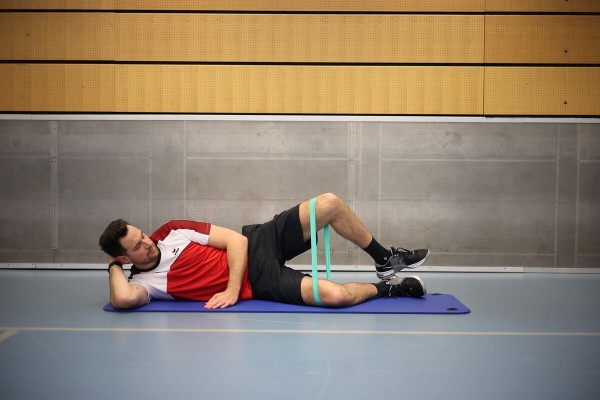
Lying on your side on the right side of your body with your legs pointing diagonally backwards. The upper (left) leg is supported on the lower leg (or slightly lifted off the lower leg). An elasticated band is stretched between the legs (place the band around the thighs slightly above the knees). The lower arm supports the head, the upper bent arm supports the upper body by placing the hand on the floor at the level of the navel. From this position, spread the upper (slightly bent) leg apart (stretch/stretch the band further) to perform an external rotation in the hip. Then lower the upper leg back to the starting position.
Attention:
For greater intensity, do not rest the upper leg completely on the lower leg (always at a slight angle).
Lighten:
Choose a rubber band with less resistance.
Harden:
Choose a rubber band with more resistance.
1 mini-band
Ricochet
Coordination exercises
Partner work

One participant stands one to four metres in front of a wall. The partner throws a ball at the wall behind their back. The participant in front tries to catch the rebound before the pass hits the floor. Change roles after a few (successful) attempts.
► Reactivity
1 wall
1 volleyball
Ricochet
Coordination exercises
Partner work

Both participants stand in the corner of a wall and pass a ball to each other over two walls. The partner catches the ball and passes it back.
► Differentiation ability, reaction ability
1 wall corner
1 handball
Ricochet
Coordination exercises
Individual work

Stand on the narrow side of the long bench. Push the medicine ball against the wall with both arms without losing your balance. Catch the ball bouncing off the wall directly (or after touching the floor).
► Balance ability
1 wall
1 long bench
1 medicine ball
Post set-up:
Place the long bench parallel in front of a wall with the narrow side facing upwards at some distance.
Lowering and raising the upper body, and raising and lowering the free leg from a standing position (single-leg forward bend with one leg extended) (left) ► single-leg romanian deadlift
Power
Individual work
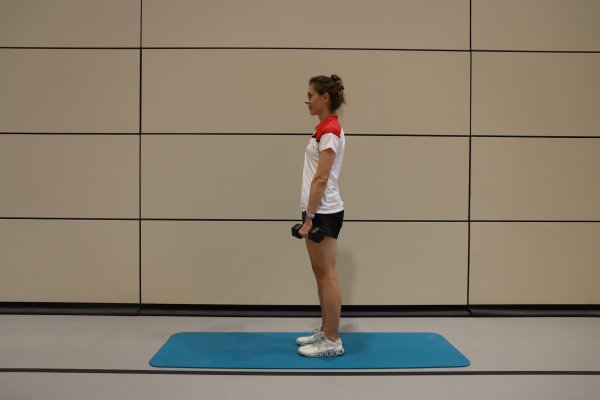
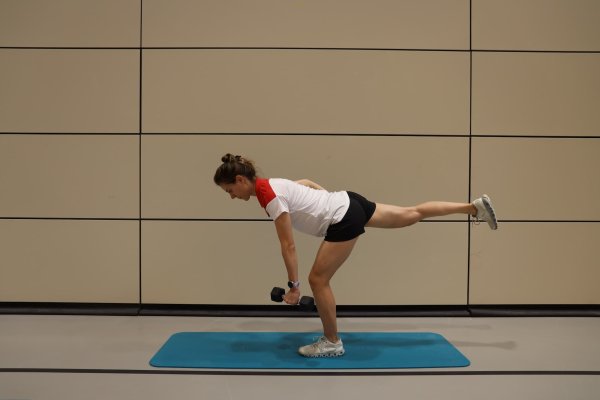
Stand upright, shift your weight onto your supporting leg (left) and hold a dumbbell in the opposite hand (right). Keep the knee of your supporting leg slightly bent, your upper body upright, your core tightly engaged and your pelvis aligned exactly parallel to the floor. Initiate the movement by pushing your hips back (hip hinge) and leaning your upright upper body forwards in a controlled manner, whilst the free leg moves backwards and upwards in a straight line, like a pendulum. Lower the dumbbell vertically. Only bend forwards as far as your back remains straight and your pelvis does not rotate to the side. The toes of your back leg should point towards the floor. Using pressure from the heel, as well as the back of the thigh and the glutes of the supporting leg, powerfully extend the hips forwards and stand up in a controlled manner. Ideally, move the free leg directly into the next repetition without touching the floor.
Attention:
The back rounds, particularly in the lumbar and thoracic spine.
The pelvis tilts upwards or tilts downwards on the side of the raised leg, instead of remaining parallel to the floor.
The supporting leg is either fully extended or bends far too deeply, as in a squat.
The barbell moves far away from the body towards the front; the knee of the supporting leg buckles inwards.
The movement is performed hastily or with momentum from the upper body.
The head is hyperextended towards the nape of the neck.
Lighten:
The toes of the rear foot remain set back by about half a step, lightly touching the floor like a ‘training wheel’.
Perform the exercise without additional weight, extend your arms out to the sides for balance.
Gently support yourself with your free hand against a wall or pole.
Reduce the angle of forward lean.
Harden:
Increase the dumbbell weight or hold a dumbbell in each hand.
Place your supporting leg on a balance pad (Airex) to maximise the challenge to your ankle and foot stability.
Slow the downward movement to 3–4 seconds.
Pause in the horizontal position for 2 seconds before returning to an upright position.
1 dumbbell
2 dumbbells ► make the exercise more difficult (additional weight)
1 unstable surface ► makes the exercise more difficult (balance component)
Lowering and raising the upper body, and raising and lowering the free leg from a standing position (single-leg forward bend with one leg extended) (right) ► single-leg romanian deadlift
Power
Individual work
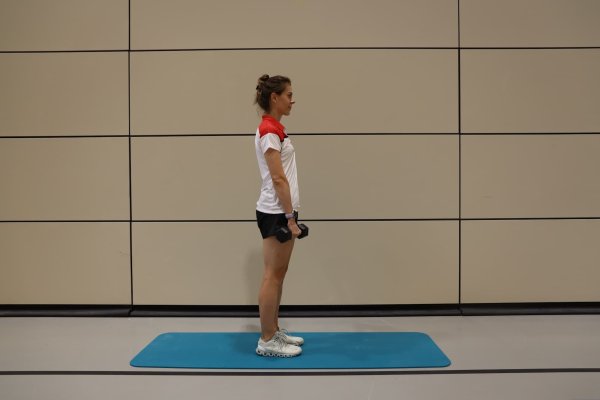
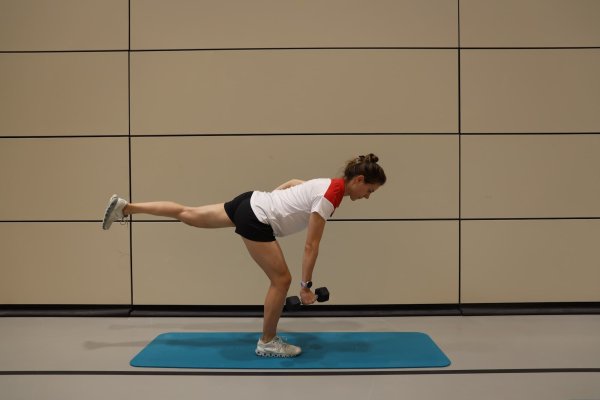
Stand upright, shift your weight onto your supporting leg (right) and hold a dumbbell in the opposite hand (left). Keep the knee of your supporting leg slightly bent, your upper body upright, your core firmly engaged and your pelvis aligned exactly parallel to the floor. Initiate the movement by pushing your hips back (hip hinge) and leaning your upright upper body forwards in a controlled manner, whilst the free leg moves backwards and upwards in a straight line, like a pendulum. Lower the dumbbell vertically. Only bend forwards as far as your back remains straight and your pelvis does not rotate to the side. The toes of your back leg should point towards the floor. Using pressure from the heel, as well as the back of the thigh and the glutes of the supporting leg, powerfully extend the hips forwards and stand up in a controlled manner. Ideally, move the free leg directly into the next repetition without touching the floor.
Attention:
The back rounds, particularly in the lumbar and thoracic spine.
The pelvis tilts upwards or tilts downwards on the side of the raised leg, instead of remaining parallel to the floor.
The supporting leg is either fully extended or bends far too deeply, as in a squat.
The barbell moves far away from the body towards the front; the knee of the supporting leg buckles inwards.
The movement is performed hastily or with momentum from the upper body.
The head is hyperextended towards the nape of the neck.
Lighten:
The toes of the rear foot remain set back by about half a step, lightly touching the floor like a ‘training wheel’.
Perform the exercise without additional weight, extend your arms out to the sides for balance.
Gently support yourself with your free hand against a wall or pole.
Reduce the angle of forward lean.
Harden:
Increase the dumbbell weight or hold a dumbbell in each hand.
Place your supporting leg on a balance pad (Airex) to maximise the challenge to your ankle and foot stability.
Slow the downward movement to 3–4 seconds.
Pause in the horizontal position for 2 seconds before returning to an upright position.
1 dumbbell
2 dumbbells ► make the exercise more difficult (additional weight)
1 unstable surface ► makes the exercise more difficult (balance component)
Lowering and raising the upper body and the free leg from the standing balance position (left)
Power
Individual work
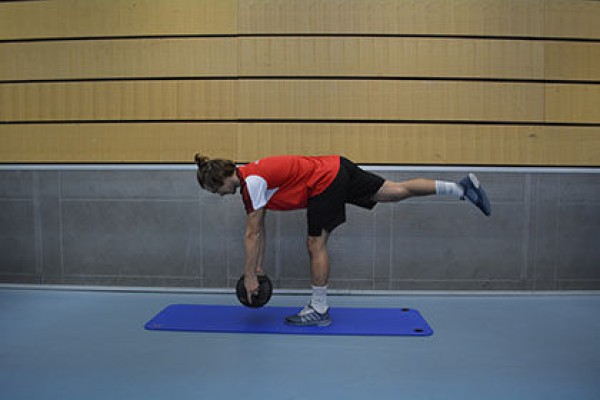


Standing balance (single-leg stance with upper body leaning forwards and free leg stretched out in extension of the body), grasp the weight with outstretched arms in an overhand grip (arms pointing towards the floor), lower the upper body and simultaneously bring the free leg to the standing leg to then return to the starting position.
Attention:
Keep your back straight at all times (tense your core), distribute the weight over your entire foot.
Lighten:
Lower your upper body less; no additional weight.
Harden:
More weight.
Variation:
Grab the weight with one hand only.
1 dumbbell/kettlebell/weight disc/sandbag
Lowering and raising the upper body and the free leg from the standing balance position (right)
Power
Individual work


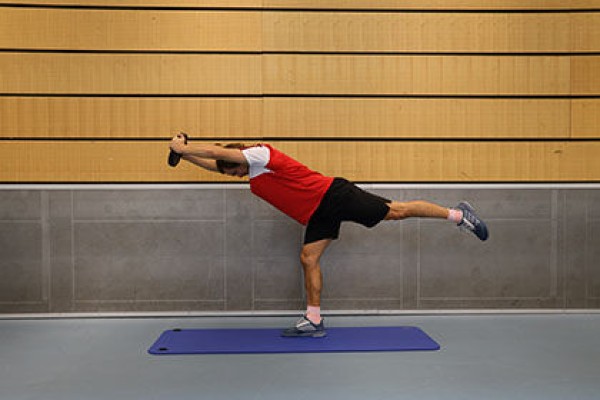

Standing balance (single-leg stance with upper body leaning forwards and free leg stretched out in extension of the body), grasp the weight with outstretched arms in an overhand grip (arms pointing towards the floor), lower the upper body and simultaneously bring the free leg to the standing leg to then return to the starting position.
Attention:
Keep your back straight at all times (tense your core), distribute the weight over your entire foot.
Lighten:
Lower your upper body less; no additional weight.
Harden:
More weight.
Variation:
Grab the weight with one hand only.
1 dumbbell/kettlebell/weight disc/sandbag