English
  • en
    • Deutsch
    • Français
    • Italiano
    • English
  • Theoretical basics
  • Exercise collection
  • Lesson planner
  • Sample lessons
  • Downloads
  • en
    • Deutsch
    • Français
    • Italiano
    • English
English
  • Home page
  • Exercise collection
  • Main part
  • Conditional substance
  • Power
Conditional substance

Power

Exercises (1598)

  • ‹
  • 1
  • 2
  • ...
  • 59
  • 60
  • 61
  • 62
  • 63
  • 64
  • ›

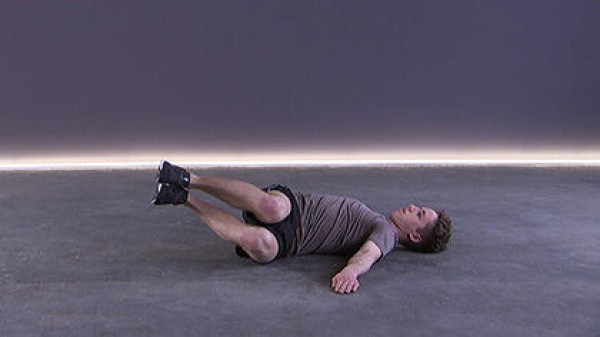
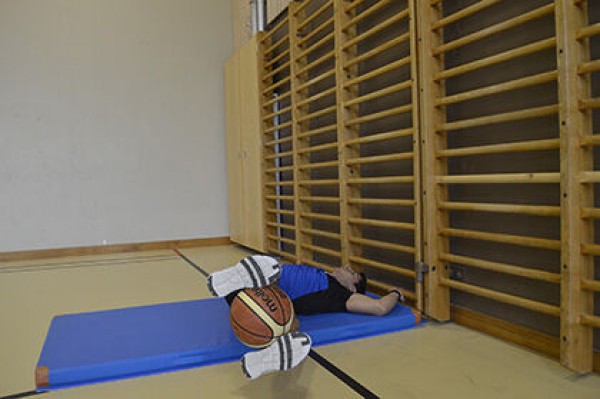
Alternating lowering and raising of one leg in supine position ► alternating bent knee raise

Power

00:00
Auxiliary means
Weight disc
Body part
Centre of the body
Muscle group
Abdominal muscles (straight)
Organization

Individual work

Pictures
View
Topic description

Lie on your back with your upper body slightly raised (shoulder blades lifted off the floor), legs bent and held high (slightly more than 90 degrees at the knee joint, lower leg parallel to the floor), outstretched arms pointing slightly backwards at an angle, grasp the weight with both hands. Lower one leg so that the heel briefly touches the floor and return to the starting position (the angle in the knee joint remains practically unchanged). Switch sides after each exercise.

Attention:
Always keep your shoulder blades off the floor (constant tension), head in a neutral position (no double chin).

Lighten:
Hold your arms at chest height or even further forwards; do not hold any additional weight in your hands.

Harden:
Hold your arms further back at an angle; more weight.

Material

1 weight disc

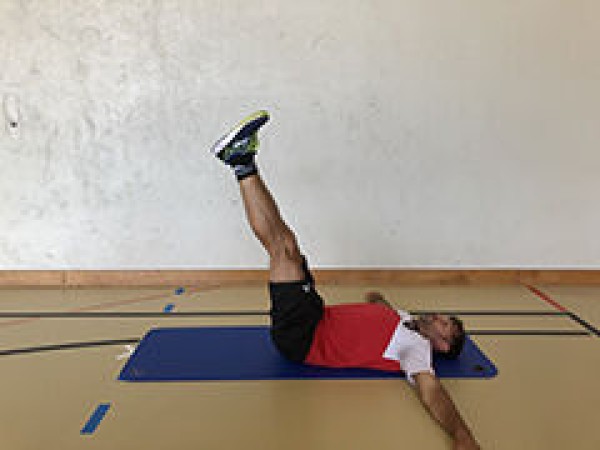
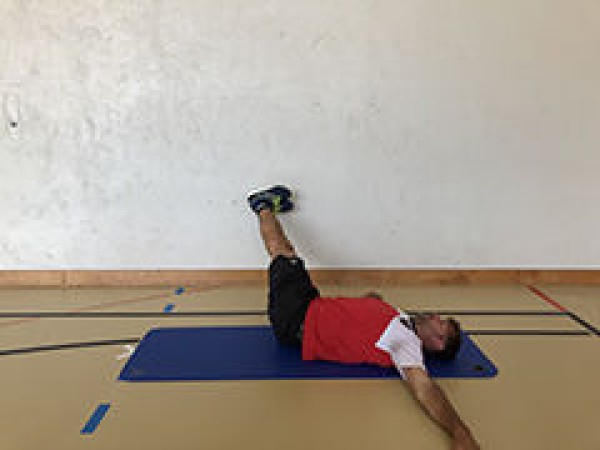
Lowering and raising one leg in shoulder position

Power

00:00
Auxiliary means
Without aids / classic / own body weight
Body part
Centre of the body
Muscle group
Abdominal muscles (straight)
Organization

Partner work

1 trainee & 1 helper ► Note change of position
(= double the time required; for lesson planner see Organisation Kraft: Info button Execution)

Pictures
View
Topic description

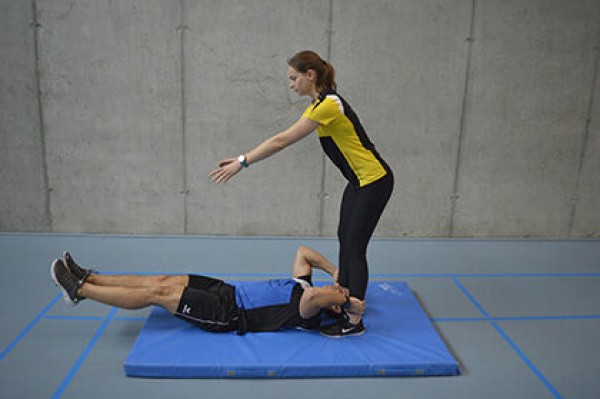
Practitioner: Shoulder position and arms at the side of the body. Slow down the leg dropped by the partner as quickly as possible and bring it back up to the starting position.
Partner: Stand upright and hold the active participant's legs at about hip height. Alternately drop one leg.

Attention:
Always listen to/respond to your partner (adjust intensity). No sagging in the hips (tense position); rest on the shoulder blades and not on the neck.

Lighten:
Just hold the position (without letting go of one leg).

Harden:
Additional weight on the legs.

Variant:
Let go of the leg unknown to the exerciser (not alternating, legs released by the partner in random order).

Material

2 weight cuffs ► Make the exercise more difficult (additional weight)

  • G_Senken_und_Anheben_eines_Beines_in_Schulterlage.pdf
  • G_Abaissement_et_elevation_d'une_jambe_en_appui_sur_les_epaules.pdf

Cross-country ski ergometer

Power

00:00
Auxiliary means
Cross-country skiing ergometer
Body part
Whole body
Muscle group
Abdominal muscles (straight), Arm stretcher, Back muscles (below), Back muscles (top), Gluteal muscles, Lower leg muscles (back), Shoulder muscles, Thigh muscles (back), Thigh muscles (front)
Organization

Individual work

Pictures
View
Topic description

Working with the cross-country ski ergometer does not require any prior knowledge of winter sports, the technique is beginner-friendly and quick to learn. However, there are a few points to bear in mind: Firstly, stand with your feet slightly more than shoulder-width apart (how close you stand to the device is a matter of taste, although taller people usually prefer a greater distance in order to achieve a full arm extension at the starting point and therefore ultimately a longer stroke). The hands should also be just outside the shoulders when gripping the handles. As the handles of the device are attached to freely movable hinges, you can easily rotate them to your optimum position. The edges of the hand, including the little finger, should be placed on the thickened end of the handle, allowing more pressure to be applied. At the beginning of the pull, the entire body is stretched, only the arms remain slightly bent, the handles are now pulled downwards at an angle until the hands are just below the knees (a V-shaped curve, where the hands move sideways away from the body, is avoided). At the lowest point, the elbows are fully extended while the knees are minimally bent (comparable to the starting position of a jump). In the return phase, the body straightens up again completely, synchronised with the backswing of the arms. Lifting your heels off the ground is perfectly fine, especially at higher speeds.

Attention:
Do not turn every repetition into a squat, as this will tire your legs too quickly. Take a deep breath before each pull on the machine and keep the abdominal muscles under constant tension.

Lighten/Harden:
The intensity is controlled by adjusting the air valve. The higher the lever is moved on the scale (1-10), the wider the flap opens and the more air can flow into the bike. More air means more resistance in the initial phase of the pull (comparable to a higher pedalling resistance in the higher gears on a bicycle). It is important to find a setting at which a continuous and controlled pressure can be maintained. If the setting is too high, the air resistance initially has to be overcome with an excessively strong pull and the remaining range of motion "runs into nothing", which is a waste of energy. If you pay attention to the background noise, you will get a suitable indicator: the aim should be to achieve the smoothest possible whirring with only slight peaks in the initial phase of the pull. Most exercisers tend to over-optimise the resistance setting. As is so often the case, less is more; levels 6-7 work well for men and 4-6 for women, with exceptions for particularly heavy and strong athletes.

Variant:
The double pole technique is usually used for training, which means that both arms work in synchronisation with each other. The diagonal technique, in which the arms are used alternately, is less common but can be used as a variation. It achieves lower speeds than the simultaneous use of the arms, but is certainly suitable as an occasional training stimulus, which above all creates a healthy rotation of the spine and a strain on the lateral trunk muscles. The diagonal technique can also correct imbalances in unevenly developed back and arm muscles (e.g. after injuries).

Material

1 cross-country ski ergometer

  • Umrechnungstabelle_Meter_Kalorien.pdf
  • Umrechnungstabelle_Meter_Kalorien_2.pdf

Skilanglauf-Ergometer (m: 1000m/1km - 80kal; w: 800m - 60kal)

Power

00:00
Auxiliary means
Cross-country skiing ergometer
Body part
Whole body
Muscle group
Abdominal muscles (straight), Arm stretcher, Back muscles (below), Back muscles (top), Gluteal muscles, Lower leg muscles (back), Shoulder muscles, Thigh muscles (back), Thigh muscles (front)
Organization

Individual work

Pictures
View
Topic description

Working with the cross-country ski ergometer does not require any prior knowledge of winter sports, the technique is beginner-friendly and quick to learn. However, there are a few points to bear in mind: Firstly, stand with your feet slightly more than shoulder-width apart (how close you stand to the device is a matter of taste, although taller people usually prefer a greater distance in order to achieve a full arm extension at the starting point and therefore ultimately a longer stroke). The hands should also be just outside the shoulders when gripping the handles. As the handles of the device are attached to freely movable hinges, you can easily rotate them to your optimum position. The edges of the hand, including the little finger, should be placed on the thickened end of the handle, allowing more pressure to be applied. At the beginning of the pull, the entire body is stretched, only the arms remain slightly bent, the handles are now pulled downwards at an angle until the hands are just below the knees (a V-shaped curve, where the hands move sideways away from the body, is avoided). At the lowest point, the elbows are fully extended while the knees are minimally bent (comparable to the starting position of a jump). In the return phase, the body straightens up again completely, synchronised with the backswing of the arms. Lifting your heels off the ground is perfectly fine, especially at higher speeds.

Attention:
Do not turn every repetition into a squat, as this will tire your legs too quickly. Take a deep breath before each pull on the machine and keep the abdominal muscles under constant tension.

Lighten/Harden:
The intensity is controlled by adjusting the air valve. The higher the lever is moved on the scale (1-10), the wider the flap opens and the more air can flow into the bike. More air means more resistance in the initial phase of the pull (comparable to a higher pedalling resistance in the higher gears on a bicycle). It is important to find a setting at which a continuous and controlled pressure can be maintained. If the setting is too high, the air resistance initially has to be overcome with an excessively strong pull and the remaining range of motion "runs into nothing", which is a waste of energy. If you pay attention to the background noise, you will get a suitable indicator: the aim should be to achieve the smoothest possible whirring with only slight peaks in the initial phase of the pull. Most exercisers tend to over-optimise the resistance setting. As is so often the case, less is more; levels 6-7 work well for men and 4-6 for women, with exceptions for particularly heavy and strong athletes.

Variant:
The double pole technique is usually used for training, which means that both arms work in synchronisation with each other. The diagonal technique, in which the arms are used alternately, is less common but can be used as a variation. It achieves lower speeds than the simultaneous use of the arms, but is certainly suitable as an occasional training stimulus, which above all creates a healthy rotation of the spine and a strain on the lateral trunk muscles. The diagonal technique can also correct imbalances in unevenly developed back and arm muscles (e.g. after injuries).

Material

1 cross-country ski ergometer

  • Umrechnungstabelle_Meter_Kalorien.pdf
  • Umrechnungstabelle_Meter_Kalorien_2.pdf

Skilanglauf-Ergometer (m: 1250m/1.25km - 100kal; w: 1000m/1km - 75kal)

Power

00:00
Auxiliary means
Cross-country skiing ergometer
Body part
Whole body
Muscle group
Abdominal muscles (straight), Arm stretcher, Back muscles (below), Back muscles (top), Gluteal muscles, Lower leg muscles (back), Shoulder muscles, Thigh muscles (back), Thigh muscles (front)
Organization

Individual work

Pictures
View
Topic description

Working with the cross-country ski ergometer does not require any prior knowledge of winter sports, the technique is beginner-friendly and quick to learn. However, there are a few points to bear in mind: Firstly, stand with your feet slightly more than shoulder-width apart (how close you stand to the device is a matter of taste, although taller people usually prefer a greater distance in order to achieve a full arm extension at the starting point and therefore ultimately a longer stroke). The hands should also be just outside the shoulders when gripping the handles. As the handles of the device are attached to freely movable hinges, you can easily rotate them to your optimum position. The edges of the hand, including the little finger, should be placed on the thickened end of the handle, allowing more pressure to be applied. At the beginning of the pull, the entire body is stretched, only the arms remain slightly bent, the handles are now pulled downwards at an angle until the hands are just below the knees (a V-shaped curve, where the hands move sideways away from the body, is avoided). At the lowest point, the elbows are fully extended while the knees are minimally bent (comparable to the starting position of a jump). In the return phase, the body straightens up again completely, synchronised with the backswing of the arms. Lifting your heels off the ground is perfectly fine, especially at higher speeds.

Attention:
Do not turn every repetition into a squat, as this will tire your legs too quickly. Take a deep breath before each pull on the machine and keep the abdominal muscles under constant tension.

Lighten/Harden:
The intensity is controlled by adjusting the air valve. The higher the lever is moved on the scale (1-10), the wider the flap opens and the more air can flow into the bike. More air means more resistance in the initial phase of the pull (comparable to a higher pedalling resistance in the higher gears on a bicycle). It is important to find a setting at which a continuous and controlled pressure can be maintained. If the setting is too high, the air resistance initially has to be overcome with an excessively strong pull and the remaining range of motion "runs into nothing", which is a waste of energy. If you pay attention to the background noise, you will get a suitable indicator: the aim should be to achieve the smoothest possible whirring with only slight peaks in the initial phase of the pull. Most exercisers tend to over-optimise the resistance setting. As is so often the case, less is more; levels 6-7 work well for men and 4-6 for women, with exceptions for particularly heavy and strong athletes.

Variant:
The double pole technique is usually used for training, which means that both arms work in synchronisation with each other. The diagonal technique, in which the arms are used alternately, is less common but can be used as a variation. It achieves lower speeds than the simultaneous use of the arms, but is certainly suitable as an occasional training stimulus, which above all creates a healthy rotation of the spine and a strain on the lateral trunk muscles. The diagonal technique can also correct imbalances in unevenly developed back and arm muscles (e.g. after injuries).

Material

1 cross-country ski ergometer

  • Umrechnungstabelle_Meter_Kalorien.pdf
  • Umrechnungstabelle_Meter_Kalorien_2.pdf

Cross-country ergometer (m: 125m - 10cal; w: 100m - 7cal)

Power

00:00
Auxiliary means
Cross-country skiing ergometer
Body part
Whole body
Muscle group
Abdominal muscles (straight), Arm stretcher, Back muscles (below), Back muscles (top), Gluteal muscles, Lower leg muscles (back), Shoulder muscles, Thigh muscles (back), Thigh muscles (front)
Organization

Individual work

Pictures
View
Topic description

Working with the cross-country ski ergometer does not require any prior knowledge of winter sports, the technique is beginner-friendly and quick to learn. However, there are a few points to bear in mind: Firstly, stand with your feet slightly more than shoulder-width apart (how close you stand to the device is a matter of taste, although taller people usually prefer a greater distance in order to achieve a full arm extension at the starting point and therefore ultimately a longer stroke). The hands should also be just outside the shoulders when gripping the handles. As the handles of the device are attached to freely movable hinges, you can easily rotate them to your optimum position. The edges of the hand, including the little finger, should be placed on the thickened end of the handle, allowing more pressure to be applied. At the beginning of the pull, the entire body is stretched, only the arms remain slightly bent, the handles are now pulled downwards at an angle until the hands are just below the knees (a V-shaped curve, where the hands move sideways away from the body, is avoided). At the lowest point, the elbows are fully extended while the knees are minimally bent (comparable to the starting position of a jump). In the return phase, the body straightens up again completely, synchronised with the backswing of the arms. Lifting your heels off the ground is perfectly fine, especially at higher speeds.

Attention:
Do not turn every repetition into a squat, as this will tire your legs too quickly. Take a deep breath before each pull on the machine and keep the abdominal muscles under constant tension.

Lighten/Harden:
The intensity is controlled by adjusting the air valve. The higher the lever is moved on the scale (1-10), the wider the flap opens and the more air can flow into the bike. More air means more resistance in the initial phase of the pull (comparable to a higher pedalling resistance in the higher gears on a bicycle). It is important to find a setting at which a continuous and controlled pressure can be maintained. If the setting is too high, the air resistance initially has to be overcome with an excessively strong pull and the remaining range of motion "runs into nothing", which is a waste of energy. If you pay attention to the background noise, you will get a suitable indicator: the aim should be to achieve the smoothest possible whirring with only slight peaks in the initial phase of the pull. Most exercisers tend to over-optimise the resistance setting. As is so often the case, less is more; levels 6-7 work well for men and 4-6 for women, with exceptions for particularly heavy and strong athletes.

Variant:
The double pole technique is usually used for training, which means that both arms work in synchronisation with each other. The diagonal technique, in which the arms are used alternately, is less common but can be used as a variation. It achieves lower speeds than the simultaneous use of the arms, but is certainly suitable as an occasional training stimulus, which above all creates a healthy rotation of the spine and a strain on the lateral trunk muscles. The diagonal technique can also correct imbalances in unevenly developed back and arm muscles (e.g. after injuries).

Material

1 cross-country ski ergometer

  • Umrechnungstabelle_Meter_Kalorien.pdf
  • Umrechnungstabelle_Meter_Kalorien_2.pdf

Skilanglauf-Ergometer (m: 2000m/2km - 160kal; w: 1600m/1.6km/1 Mile - 120kal)

Power

00:00
Auxiliary means
Cross-country skiing ergometer
Body part
Whole body
Muscle group
Abdominal muscles (straight), Arm stretcher, Back muscles (below), Back muscles (top), Gluteal muscles, Lower leg muscles (back), Shoulder muscles, Thigh muscles (back), Thigh muscles (front)
Organization

Individual work

Pictures
View
Topic description

Working with the cross-country ski ergometer does not require any prior knowledge of winter sports, the technique is beginner-friendly and quick to learn. However, there are a few points to bear in mind: Firstly, stand with your feet slightly more than shoulder-width apart (how close you stand to the device is a matter of taste, although taller people usually prefer a greater distance in order to achieve a full arm extension at the starting point and therefore ultimately a longer stroke). The hands should also be just outside the shoulders when gripping the handles. As the handles of the device are attached to freely movable hinges, you can easily rotate them to your optimum position. The edges of the hand, including the little finger, should be placed on the thickened end of the handle, allowing more pressure to be applied. At the beginning of the pull, the entire body is stretched, only the arms remain slightly bent, the handles are now pulled downwards at an angle until the hands are just below the knees (a V-shaped curve, where the hands move sideways away from the body, is avoided). At the lowest point, the elbows are fully extended while the knees are minimally bent (comparable to the starting position of a jump). In the return phase, the body straightens up again completely, synchronised with the backswing of the arms. Lifting your heels off the ground is perfectly fine, especially at higher speeds.

Attention:
Do not turn every repetition into a squat, as this will tire your legs too quickly. Take a deep breath before each pull on the machine and keep the abdominal muscles under constant tension.

Lighten/Harden:
The intensity is controlled by adjusting the air valve. The higher the lever is moved on the scale (1-10), the wider the flap opens and the more air can flow into the bike. More air means more resistance in the initial phase of the pull (comparable to a higher pedalling resistance in the higher gears on a bicycle). It is important to find a setting at which a continuous and controlled pressure can be maintained. If the setting is too high, the air resistance initially has to be overcome with an excessively strong pull and the remaining range of motion "runs into nothing", which is a waste of energy. If you pay attention to the background noise, you will get a suitable indicator: the aim should be to achieve the smoothest possible whirring with only slight peaks in the initial phase of the pull. Most exercisers tend to over-optimise the resistance setting. As is so often the case, less is more; levels 6-7 work well for men and 4-6 for women, with exceptions for particularly heavy and strong athletes.

Variant:
The double pole technique is usually used for training, which means that both arms work in synchronisation with each other. The diagonal technique, in which the arms are used alternately, is less common but can be used as a variation. It achieves lower speeds than the simultaneous use of the arms, but is certainly suitable as an occasional training stimulus, which above all creates a healthy rotation of the spine and a strain on the lateral trunk muscles. The diagonal technique can also correct imbalances in unevenly developed back and arm muscles (e.g. after injuries).

Material

1 cross-country ski ergometer

  • Umrechnungstabelle_Meter_Kalorien.pdf
  • Umrechnungstabelle_Meter_Kalorien_2.pdf

Cross-country ergometer (m: 200m - 16cal; w: 150m - 12cal)

Power

00:00
Auxiliary means
Cross-country skiing ergometer
Body part
Whole body
Muscle group
Abdominal muscles (straight), Arm stretcher, Back muscles (below), Back muscles (top), Gluteal muscles, Lower leg muscles (back), Shoulder muscles, Thigh muscles (back), Thigh muscles (front)
Organization

Individual work

Pictures
View
Topic description

Working with the cross-country ski ergometer does not require any prior knowledge of winter sports, the technique is beginner-friendly and quick to learn. However, there are a few points to bear in mind: Firstly, stand with your feet slightly more than shoulder-width apart (how close you stand to the device is a matter of taste, although taller people usually prefer a greater distance in order to achieve a full arm extension at the starting point and therefore ultimately a longer stroke). The hands should also be just outside the shoulders when gripping the handles. As the handles of the device are attached to freely movable hinges, you can easily rotate them to your optimum position. The edges of the hand, including the little finger, should be placed on the thickened end of the handle, allowing more pressure to be applied. At the beginning of the pull, the entire body is stretched, only the arms remain slightly bent, the handles are now pulled downwards at an angle until the hands are just below the knees (a V-shaped curve, where the hands move sideways away from the body, is avoided). At the lowest point, the elbows are fully extended while the knees are minimally bent (comparable to the starting position of a jump). In the return phase, the body straightens up again completely, synchronised with the backswing of the arms. Lifting your heels off the ground is perfectly fine, especially at higher speeds.

Attention:
Do not turn every repetition into a squat, as this will tire your legs too quickly. Take a deep breath before each pull on the machine and keep the abdominal muscles under constant tension.

Lighten/Harden:
The intensity is controlled by adjusting the air valve. The higher the lever is moved on the scale (1-10), the wider the flap opens and the more air can flow into the bike. More air means more resistance in the initial phase of the pull (comparable to a higher pedalling resistance in the higher gears on a bicycle). It is important to find a setting at which a continuous and controlled pressure can be maintained. If the setting is too high, the air resistance initially has to be overcome with an excessively strong pull and the remaining range of motion "runs into nothing", which is a waste of energy. If you pay attention to the background noise, you will get a suitable indicator: the aim should be to achieve the smoothest possible whirring with only slight peaks in the initial phase of the pull. Most exercisers tend to over-optimise the resistance setting. As is so often the case, less is more; levels 6-7 work well for men and 4-6 for women, with exceptions for particularly heavy and strong athletes.

Variant:
The double pole technique is usually used for training, which means that both arms work in synchronisation with each other. The diagonal technique, in which the arms are used alternately, is less common but can be used as a variation. It achieves lower speeds than the simultaneous use of the arms, but is certainly suitable as an occasional training stimulus, which above all creates a healthy rotation of the spine and a strain on the lateral trunk muscles. The diagonal technique can also correct imbalances in unevenly developed back and arm muscles (e.g. after injuries).

Material

1 cross-country ski ergometer

  • Umrechnungstabelle_Meter_Kalorien.pdf
  • Umrechnungstabelle_Meter_Kalorien_2.pdf

Cross-country ergometer (m: 250m - 20cal; w: 200m - 15cal)

Power

00:00
Auxiliary means
Cross-country skiing ergometer
Body part
Whole body
Muscle group
Abdominal muscles (straight), Arm stretcher, Back muscles (below), Back muscles (top), Gluteal muscles, Lower leg muscles (back), Shoulder muscles, Thigh muscles (back), Thigh muscles (front)
Organization

Individual work

Pictures
View
Topic description

Working with the cross-country ski ergometer does not require any prior knowledge of winter sports, the technique is beginner-friendly and quick to learn. However, there are a few points to bear in mind: Firstly, stand with your feet slightly more than shoulder-width apart (how close you stand to the device is a matter of taste, although taller people usually prefer a greater distance in order to achieve a full arm extension at the starting point and therefore ultimately a longer stroke). The hands should also be just outside the shoulders when gripping the handles. As the handles of the device are attached to freely movable hinges, you can easily rotate them to your optimum position. The edges of the hand, including the little finger, should be placed on the thickened end of the handle, allowing more pressure to be applied. At the beginning of the pull, the entire body is stretched, only the arms remain slightly bent, the handles are now pulled downwards at an angle until the hands are just below the knees (a V-shaped curve, where the hands move sideways away from the body, is avoided). At the lowest point, the elbows are fully extended while the knees are minimally bent (comparable to the starting position of a jump). In the return phase, the body straightens up again completely, synchronised with the backswing of the arms. Lifting your heels off the ground is perfectly fine, especially at higher speeds.

Attention:
Do not turn every repetition into a squat, as this will tire your legs too quickly. Take a deep breath before each pull on the machine and keep the abdominal muscles under constant tension.

Lighten/Harden:
The intensity is controlled by adjusting the air valve. The higher the lever is moved on the scale (1-10), the wider the flap opens and the more air can flow into the bike. More air means more resistance in the initial phase of the pull (comparable to a higher pedalling resistance in the higher gears on a bicycle). It is important to find a setting at which a continuous and controlled pressure can be maintained. If the setting is too high, the air resistance initially has to be overcome with an excessively strong pull and the remaining range of motion "runs into nothing", which is a waste of energy. If you pay attention to the background noise, you will get a suitable indicator: the aim should be to achieve the smoothest possible whirring with only slight peaks in the initial phase of the pull. Most exercisers tend to over-optimise the resistance setting. As is so often the case, less is more; levels 6-7 work well for men and 4-6 for women, with exceptions for particularly heavy and strong athletes.

Variant:
The double pole technique is usually used for training, which means that both arms work in synchronisation with each other. The diagonal technique, in which the arms are used alternately, is less common but can be used as a variation. It achieves lower speeds than the simultaneous use of the arms, but is certainly suitable as an occasional training stimulus, which above all creates a healthy rotation of the spine and a strain on the lateral trunk muscles. The diagonal technique can also correct imbalances in unevenly developed back and arm muscles (e.g. after injuries).

Material

1 cross-country ski ergometer

  • Umrechnungstabelle_Meter_Kalorien.pdf
  • Umrechnungstabelle_Meter_Kalorien_2.pdf

Cross-country ski ergometer (m: 375m - 30kal; w: 300m - 22kal)

Power

00:00
Auxiliary means
Cross-country skiing ergometer
Body part
Whole body
Muscle group
Abdominal muscles (straight), Arm stretcher, Back muscles (below), Back muscles (top), Gluteal muscles, Lower leg muscles (back), Shoulder muscles, Thigh muscles (back), Thigh muscles (front)
Organization

Individual work

Pictures
View
Topic description

Working with the cross-country ski ergometer does not require any prior knowledge of winter sports, the technique is beginner-friendly and quick to learn. However, there are a few points to bear in mind: Firstly, stand with your feet slightly more than shoulder-width apart (how close you stand to the device is a matter of taste, although taller people usually prefer a greater distance in order to achieve a full arm extension at the starting point and therefore ultimately a longer stroke). The hands should also be just outside the shoulders when gripping the handles. As the handles of the device are attached to freely movable hinges, you can easily rotate them to your optimum position. The edges of the hand, including the little finger, should be placed on the thickened end of the handle, allowing more pressure to be applied. At the beginning of the pull, the entire body is stretched, only the arms remain slightly bent, the handles are now pulled downwards at an angle until the hands are just below the knees (a V-shaped curve, where the hands move sideways away from the body, is avoided). At the lowest point, the elbows are fully extended while the knees are minimally bent (comparable to the starting position of a jump). In the return phase, the body straightens up again completely, synchronised with the backswing of the arms. Lifting your heels off the ground is perfectly fine, especially at higher speeds.

Attention:
Do not turn every repetition into a squat, as this will tire your legs too quickly. Take a deep breath before each pull on the machine and keep the abdominal muscles under constant tension.

Lighten/Harden:
The intensity is controlled by adjusting the air valve. The higher the lever is moved on the scale (1-10), the wider the flap opens and the more air can flow into the bike. More air means more resistance in the initial phase of the pull (comparable to a higher pedalling resistance in the higher gears on a bicycle). It is important to find a setting at which a continuous and controlled pressure can be maintained. If the setting is too high, the air resistance initially has to be overcome with an excessively strong pull and the remaining range of motion "runs into nothing", which is a waste of energy. If you pay attention to the background noise, you will get a suitable indicator: the aim should be to achieve the smoothest possible whirring with only slight peaks in the initial phase of the pull. Most exercisers tend to over-optimise the resistance setting. As is so often the case, less is more; levels 6-7 work well for men and 4-6 for women, with exceptions for particularly heavy and strong athletes.

Variant:
The double pole technique is usually used for training, which means that both arms work in synchronisation with each other. The diagonal technique, in which the arms are used alternately, is less common but can be used as a variation. It achieves lower speeds than the simultaneous use of the arms, but is certainly suitable as an occasional training stimulus, which above all creates a healthy rotation of the spine and a strain on the lateral trunk muscles. The diagonal technique can also correct imbalances in unevenly developed back and arm muscles (e.g. after injuries).

Material

1 cross-country ski ergometer

  • Umrechnungstabelle_Meter_Kalorien.pdf
  • Umrechnungstabelle_Meter_Kalorien_2.pdf

Cross-country ski ergometer (m: 500m - 40k; w: 400m - 30k)

Power

00:00
Auxiliary means
Cross-country skiing ergometer
Body part
Whole body
Muscle group
Abdominal muscles (straight), Arm stretcher, Back muscles (below), Back muscles (top), Gluteal muscles, Lower leg muscles (back), Shoulder muscles, Thigh muscles (back), Thigh muscles (front)
Organization

Individual work

Pictures
View
Topic description

Working with the cross-country ski ergometer does not require any prior knowledge of winter sports, the technique is beginner-friendly and quick to learn. However, there are a few points to bear in mind: Firstly, stand with your feet slightly more than shoulder-width apart (how close you stand to the device is a matter of taste, although taller people usually prefer a greater distance in order to achieve a full arm extension at the starting point and therefore ultimately a longer stroke). The hands should also be just outside the shoulders when gripping the handles. As the handles of the device are attached to freely movable hinges, you can easily rotate them to your optimum position. The edges of the hand, including the little finger, should be placed on the thickened end of the handle, allowing more pressure to be applied. At the beginning of the pull, the entire body is stretched, only the arms remain slightly bent, the handles are now pulled downwards at an angle until the hands are just below the knees (a V-shaped curve, where the hands move sideways away from the body, is avoided). At the lowest point, the elbows are fully extended while the knees are minimally bent (comparable to the starting position of a jump). In the return phase, the body straightens up again completely, synchronised with the backswing of the arms. Lifting your heels off the ground is perfectly fine, especially at higher speeds.

Attention:
Do not turn every repetition into a squat, as this will tire your legs too quickly. Take a deep breath before each pull on the machine and keep the abdominal muscles under constant tension.

Lighten/Harden:
The intensity is controlled by adjusting the air valve. The higher the lever is moved on the scale (1-10), the wider the flap opens and the more air can flow into the bike. More air means more resistance in the initial phase of the pull (comparable to a higher pedalling resistance in the higher gears on a bicycle). It is important to find a setting at which a continuous and controlled pressure can be maintained. If the setting is too high, the air resistance initially has to be overcome with an excessively strong pull and the remaining range of motion "runs into nothing", which is a waste of energy. If you pay attention to the background noise, you will get a suitable indicator: the aim should be to achieve the smoothest possible whirring with only slight peaks in the initial phase of the pull. Most exercisers tend to over-optimise the resistance setting. As is so often the case, less is more; levels 6-7 work well for men and 4-6 for women, with exceptions for particularly heavy and strong athletes.

Variant:
The double pole technique is usually used for training, which means that both arms work in synchronisation with each other. The diagonal technique, in which the arms are used alternately, is less common but can be used as a variation. It achieves lower speeds than the simultaneous use of the arms, but is certainly suitable as an occasional training stimulus, which above all creates a healthy rotation of the spine and a strain on the lateral trunk muscles. The diagonal technique can also correct imbalances in unevenly developed back and arm muscles (e.g. after injuries).

Material

1 cross-country ski ergometer

  • Umrechnungstabelle_Meter_Kalorien.pdf
  • Umrechnungstabelle_Meter_Kalorien_2.pdf

Cross-country ski ergometer (m: 750m - 60k; w: 600m - 45k)

Power

00:00
Auxiliary means
Cross-country skiing ergometer
Body part
Whole body
Muscle group
Abdominal muscles (straight), Arm stretcher, Back muscles (below), Back muscles (top), Gluteal muscles, Lower leg muscles (back), Shoulder muscles, Thigh muscles (back), Thigh muscles (front)
Organization

Individual work

Pictures
View
Topic description

Working with the cross-country ski ergometer does not require any prior knowledge of winter sports, the technique is beginner-friendly and quick to learn. However, there are a few points to bear in mind: Firstly, stand with your feet slightly more than shoulder-width apart (how close you stand to the device is a matter of taste, although taller people usually prefer a greater distance in order to achieve a full arm extension at the starting point and therefore ultimately a longer stroke). The hands should also be just outside the shoulders when gripping the handles. As the handles of the device are attached to freely movable hinges, you can easily rotate them to your optimum position. The edges of the hand, including the little finger, should be placed on the thickened end of the handle, allowing more pressure to be applied. At the beginning of the pull, the entire body is stretched, only the arms remain slightly bent, the handles are now pulled downwards at an angle until the hands are just below the knees (a V-shaped curve, where the hands move sideways away from the body, is avoided). At the lowest point, the elbows are fully extended while the knees are minimally bent (comparable to the starting position of a jump). In the return phase, the body straightens up again completely, synchronised with the backswing of the arms. Lifting your heels off the ground is perfectly fine, especially at higher speeds.

Attention:
Do not turn every repetition into a squat, as this will tire your legs too quickly. Take a deep breath before each pull on the machine and keep the abdominal muscles under constant tension.

Lighten/Harden:
The intensity is controlled by adjusting the air valve. The higher the lever is moved on the scale (1-10), the wider the flap opens and the more air can flow into the bike. More air means more resistance in the initial phase of the pull (comparable to a higher pedalling resistance in the higher gears on a bicycle). It is important to find a setting at which a continuous and controlled pressure can be maintained. If the setting is too high, the air resistance initially has to be overcome with an excessively strong pull and the remaining range of motion "runs into nothing", which is a waste of energy. If you pay attention to the background noise, you will get a suitable indicator: the aim should be to achieve the smoothest possible whirring with only slight peaks in the initial phase of the pull. Most exercisers tend to over-optimise the resistance setting. As is so often the case, less is more; levels 6-7 work well for men and 4-6 for women, with exceptions for particularly heavy and strong athletes.

Variant:
The double pole technique is usually used for training, which means that both arms work in synchronisation with each other. The diagonal technique, in which the arms are used alternately, is less common but can be used as a variation. It achieves lower speeds than the simultaneous use of the arms, but is certainly suitable as an occasional training stimulus, which above all creates a healthy rotation of the spine and a strain on the lateral trunk muscles. The diagonal technique can also correct imbalances in unevenly developed back and arm muscles (e.g. after injuries).

Material

1 cross-country ski ergometer

  • Umrechnungstabelle_Meter_Kalorien.pdf
  • Umrechnungstabelle_Meter_Kalorien_2.pdf

Sprinting/throwing an object

Power

00:00
Body part
Whole body
Muscle group
Abdominal muscles (lateral), Abdominal muscles (straight), Arm stretcher, Gluteal muscles, Lower leg muscles (back), Shoulder muscles, Thigh muscles (back), Thigh muscles (front)
Organization

Individual work

Pictures
View
Topic description

Purpose
Training and testing of the throwing technique

Additional equipment
5 HG 85 throwing gun

Starting position
lying down, Stgw with empty magazine

Procedure

  1. Sprint 50 m into a throwing position (target time 15 s)

  2. 5 throws from different throwing distances


Conditions
4 hits and 3 different freely selectable throwing distances

Notes

  • If no realistic HG targets are available, marked target areas can also be used (e.g.

  • for reasons of efficiency, several throwers should be able to practise at the same time.

  • with an increased routine, the requirements in terms of throwing distance should be increased.

Material

Material per participant: Tenue CNM

Additional material: 6 G-discs with posts, 3 fanjons, 2 red/white marking tapes, 2 boxes with 16 HG 85 clay pellets

  • GAD-Sprint_Werfen_eines_Gegenstandes.pdf
  • ISB-sprint_lancer_gren_main.pdf

Sprinting

Power

00:00
Auxiliary means
Without aids / classic / own body weight
Body part
Lower body
Muscle group
Gluteal muscles, Lower leg muscles (back), Thigh muscles (back), Thigh muscles (front)
Organization

Individual work

Pictures
View
Topic description

Cover a given distance (between 10-20 metres) as quickly as possible/at a sprint (if necessary, shuttle back and forth between the markers several times).

Lighten:
Lower speed.

Harden:
Higher speed.

Variant:
Do not sprint but change your gait between the markers (e.g. backwards, on all fours, crawling, etc.).

Material

2 marinating cones/caps/colouring sticks

  • 6Sprinten_-_out.pdf
  • 2Sprinten_-_out.pdf
  • 2Sprints_-_out.pdf
  • 6Sprints_-_out.pdf

Jump in place

Power

00:00
Auxiliary means
Without aids / classic / own body weight
Body part
Lower body
Muscle group
Lower leg muscles (back), Thigh muscles (back), Thigh muscles (front)
Organization

Individual work

Pictures
View
Topic description

Stand upright with your feet shoulder-width apart, arms supported on your hips or bent in front of your body. Powerful jump vertically into the air.

Attention:
Keep your upper body upright (keep your core tensed).

Lighten:
Smaller/less intense jumps.

Harden:
Larger/intensive jumps; additional weight (on the chest/shoulders, hold in the hands, hold in front).

Variation:
With each jump, pull the tips of your feet towards your knees (bend your feet).

Material

2 weight cuffs/short dumbbells/1 weight vest/weight disc/(medicine) ball/sandbag/fighting backpack ► Make the exercise more difficult (additional weight)

Jump in place one-legged (left)

Power

00:00
Auxiliary means
Without aids / classic / own body weight
Body part
Lower body
Muscle group
Lower leg muscles (back), Thigh muscles (back), Thigh muscles (front)
Organization

Individual work

Pictures
View
Topic description

One-legged stand (left), arms supported on the hips or bent in front of the body. Powerful jump vertically into the air.

Attention:
Keep your upper body upright (tense your core).

Lighten:
Smaller/less intense jumps.

Harden:
Bigger/more intense jumps; additional weight (on your chest/shoulders, hold in your hands, in front of you).

Variation:
With each jump, pull the tips of your feet towards your knees (bend your feet).

Material

1 weight cuff/weight vest/weight disc/(medicine) ball/sandbag/fighting backpack/2 dumbbells ► Make the exercise more difficult (additional weight)

Jump on the spot one-legged (left) (one-legged jump) ► pogo tuck jump

Power

00:00
Auxiliary means
Without aids / classic / own body weight
Body part
Lower body
Muscle group
Lower leg muscles (back), Thigh muscles (back), Thigh muscles (front)
Organization

Individual work

Pictures
View
Topic description

Steady hopping in place on one leg (left) without putting your heel down completely. Every few repetitions (e.g. always after 5 small hops) perform a jump upwards (one-legged jump). The arms can support the jump by pulling them up and overhead when jumping from hip height.

Attention:
Keep your upper body upright (tense your core).

Lighten:
Smaller/less intense jumps into the air.

Harden:
Higher/intensive jumps; additional weight (on your chest/shoulders, hold in your hands, hold in front of you).

Variation:
Pull the tip of your foot towards your knee (bend your foot) with each jump.

Material

1 weight cuff/weight vest/weight disc/(medicine) ball/sandbag/fighting backpack/2 dumbbells ► Make the exercise more difficult (additional weight)

Jump on the spot one-legged (left) (one-legged jump) ► rudiment hop

Power

00:00
Auxiliary means
Without aids / classic / own body weight
Body part
Lower body
Muscle group
Lower leg muscles (back), Thigh muscles (back), Thigh muscles (front)
Organization

Individual work

Pictures
View
Topic description

Stand on one leg (left), with the free (right) leg raised (approximately right angle in the knee joint so that the knee is at about hip height in front of the body). Jump steadily in place, putting your heel down completely with each repetition.

Attention:
Keep your upper body upright (keep your core tensed).

Lighten:
Smaller/less intense jumps.

Material

1 weight cuff/weight vest/weight disc/(medicine) ball/sandbag/fighting backpack/2 dumbbells ► Make the exercise more difficult (additional weight)

Jump in place one-legged (right)

Power

00:00
Auxiliary means
Without aids / classic / own body weight
Body part
Lower body
Muscle group
Lower leg muscles (back), Thigh muscles (back), Thigh muscles (front)
Organization

Individual work

Pictures
View
Topic description

One-legged stand (right), arms supported on the hips or bent in front of the body. Powerful jump vertically into the air.

Attention:
Keep your upper body upright (keep your core tensed).

Lighten:
Smaller/less intense jumps.

Harden:
Bigger/more intense jumps; additional weight (on your chest/shoulders, hold in your hands, in front of you).

Variation:
With each jump, pull the tips of your feet towards your knees (bend your feet).

Material

1 weight cuff/weight vest/weight disc/(medicine) ball/sandbag/fighting backpack/2 dumbbells ► Make the exercise more difficult (additional weight)

Jump on the spot one-legged (right) (one-legged jump) ► pogo tuck jump

Power

00:00
Auxiliary means
Without aids / classic / own body weight
Body part
Lower body
Muscle group
Lower leg muscles (back), Thigh muscles (back), Thigh muscles (front)
Organization

Individual work

Pictures
View
Topic description

Steady hopping in place on one leg (right) without putting your heel down completely. Every few repetitions (e.g. always after 5 small hops) perform a jump upwards (one-legged jump). The arms can support the jump by pulling them up and overhead when jumping from hip height.

Attention:
Keep your upper body upright (tense your core).

Lighten:
Smaller/less intense jumps into the air.

Harden:
Higher/intensive jumps; additional weight (on your chest/shoulders, hold in your hands, hold in front of you).

Variation:
Pull the tip of your foot towards your knee (bend your foot) with each jump.

Material

1 weight cuff/weight vest/weight disc/(medicine) ball/sandbag/fighting backpack/2 dumbbells ► Make the exercise more difficult (additional weight)

Jump on the spot one-legged (right) (one-legged jump) ► rudiment hop

Power

00:00
Auxiliary means
Without aids / classic / own body weight
Body part
Lower body
Muscle group
Lower leg muscles (back), Thigh muscles (back), Thigh muscles (front)
Organization

Individual work

Pictures
View
Topic description

Stand on one leg (right), with the free (left) leg raised (approximately right angle in the knee joint so that the knee is at hip height in front of the body). Jump steadily in place, putting your heel down completely with each repetition.

Attention:
Keep your upper body upright (keep your core tensed).

Lighten:
Smaller/less intense jumps.

Material

1 weight cuff/weight vest/weight disc/(medicine) ball/sandbag/fighting backpack/2 dumbbells ► Make the exercise more difficult (additional weight)

Jump in place with extension and flexion of one leg alternating ► runner hop

Power

00:00
Auxiliary means
Without aids / classic / own body weight
Body part
Lower body
Muscle group
Lower leg muscles (back), Thigh muscles (back), Thigh muscles (front)
Organization

Individual work

Pictures
View
Topic description

Stand upright with your feet shoulder-width apart, hopping steadily in place. Alternately bend one leg during the two-legged small jump (raise the knee in front of the body to approximately hip height). Land on both legs (heels completely off the ground), keeping the ground contact time as short as possible before the next repetition. Support your arms on your hips or support the movement with your arms (arms bent and stretched - arm bent on the opposite side where the knee is raised - sprinter position).

Caution:
Keep your upper body upright (tense your core).

Lighten:
Smaller/less intense jumps (lift your knees less).

Harden:
Higher/more intense jumps; additional weight (on your chest/shoulders, hold in your hands, in front of you).

Material

2 weight cuffs/short dumbbells/1 weight vest/weight disc/(medicine) ball/sandbag/fighting rucksack ► Make the exercise more difficult (additional weight)

Jump in place and flexion and extension of the legs

Power

00:00
Auxiliary means
Without aids / classic / own body weight
Body part
Whole body
Muscle group
Abdominal muscles (straight), Lower leg muscles (back), Thigh muscles (back), Thigh muscles (front)
Organization

Individual work

Pictures
View
Topic description

Stand upright on the balls of your feet with your knees slightly bent and your arms bent in front of your body (or supported on your hips). Jump up into the air and bend your legs (raise your knees approximately to navel height). Bounce steadily in place (fast frequency) without putting your heels down (jump on your toes).

Attention:
Keep your upper body upright (keep your core tensed).

Lighten:
Lift your knees less, smaller/less intense jumps.

Harden:
Lift your knees further; bigger/more intense jumps; additional weight (on your chest/shoulders, hold in your hands, hold in front of you).

Material

2 weight cuffs/short dumbbells/1 weight vest/weight disc/(medicine) ball/sandbag/fighting backpack ► Make the exercise more difficult (additional weight)

Jump in place and hip rotation ► jump + hip rotation

Power

00:00
Auxiliary means
Without aids / classic / own body weight
Body part
Lower body
Muscle group
Lower leg muscles (back)
Organization

Individual work

Pictures
View
Topic description

Continuous jumping with both legs in place (feet closer than shoulder width), with the hips alternately turned out to one side (feet pointing to the respective side). The upper body and gaze always remain directed forwards, the heels are never fully lowered.

Attention:
The upper body remains upright (tense the torso).

Harden:
Additional weight (on the chest/shoulders, hold in the hands, hold in front).

Material

2 weight cuffs/short dumbbells/1 weight vest/weight disc/(medicine) ball/sandbag/fighting backpack ► Make the exercise more difficult (additional weight)

Jump onto an object

Power

00:00
Auxiliary means
Long bench
Body part
Lower body
Muscle group
Lower leg muscles (back), Thigh muscles (back), Thigh muscles (front)
Organization

Individual work

Pictures
View
Topic description

Jump onto the long bench on both legs and back down again.

Attention:

Keep your upper body upright, cushion your landing.

Lighten:
Jump over a line (omit the long bench); choose a lower element (e.g. vaulting box top); lower cadence.

Harden:
After standing on the long bench, jump upwards; choose a higher element; keep additional weight on your feet/shoulder; higher cadence.

Material

1 long bench

1 vaulting box top section ► Make the exercise easier (position)

2 vaulting box elements (incl. top section) ► Make the exercise more difficult (position)
2 weight cuffs/1 weight vest/sandbag ► Make the exercise more difficult (additional weight)

  • ‹
  • 1
  • 2
  • ...
  • 59
  • 60
  • 61
  • 62
  • 63
  • 64
  • ›
  • Stay informed

  • Downloads
    • Presentations
    • Instruction documents
  • Main menu

    • Theoretical basics
    • Exercise collection
    • Lesson planner
    • Sample lessons
    • Downloads
  • Further information

    • Terms and conditions
    • Imprint
    • Contact us
English

© 2024, Federal Department of Defence, Civil Protection and Sport

All rights reserved