
Exercises (1882)
Raising and lowering the upper leg in lateral position (right) ► leg abduction / side lying leg raise / side lying leg lift
Power
Individual work

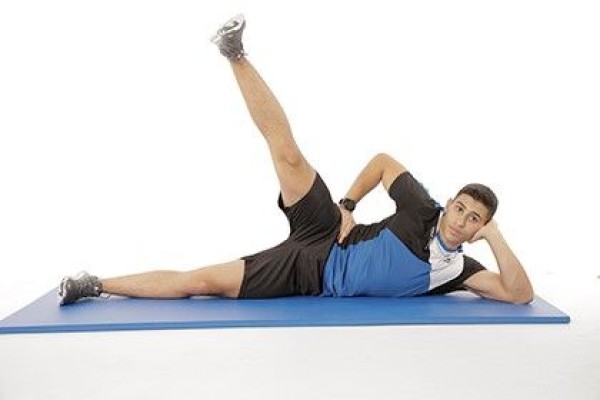
Lying on your side (left), head resting on the lower (upper) arm or the hand of the bent lower arm supporting the head, the upper arm stabilising the upper body (bent at stomach height), both legs stretched in extension of the body, raise the training leg at the top (right) and lower it back to the starting position.
Attention:
Do not lower the training leg completely.
Lighten:
Just hold the position with the training leg slightly raised (without raising and lowering the leg); raise the leg less.
Harden:
Add weight to the leg.
Variant:
Move the training leg forwards (instead of upwards) and backwards or perform circular movements.
1 weight cuff ► Make the exercise more difficult (additional weight)
Raising and lowering the upper body by pushing the elbows towards the floor in supine position ► supine push up
Power
Individual work


Lie on your back, arms bent (palms facing forwards), elbows supporting the slightly raised upper body, legs bent at the heels on the floor, raise and lower the upper body by pushing the elbows backwards.
Attention:
Never lower your upper body completely, place your elbows below your shoulders.
Lighten:
Just hold the position (without raising and lowering your upper body); lift your upper body less.
Harden:
Additional weight (on your chest).
1 weight vest/weight disc ► Make the exercise more difficult
Raising and lowering the upper body while kneeling
Power
Individual work


While standing, fasten the elastic band at head height. The exercise takes place in a kneeling position (chest facing the wall). Hold the elastic band with both hands in an overhand grip with your arms stretched out (arms parallel to the floor). Lower your upper body towards the floor with your back straight, keeping your arms straight (back, head and arms practically form a line in the end position) so that the elastic band is stretched/tensioned. Then raise your upper body back up to the starting position.
Attention:
Keep your back straight.
Lighten:
Choose a rubber band with lower resistance.
Harden:
Choose a rubber band with greater resistance.
1 elasticated rubber band
1 fastening elasticated rubber band
Raising and lowering the upper body while kneeling ► good mornings kneeling
Power
Individual work
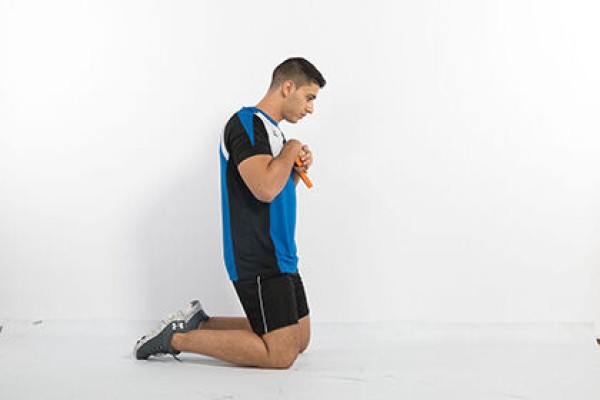

Start kneeling (on both knees), bring your upper body slightly forward with a straight back, curl your upper body and stretch back to the starting position.
Attention:
Start the stretch consciously in the lower back and try to roll up/stretch vertebra by vertebra, do not rest your buttocks on your heels.
Lighten:
Hold the position with your upper body slightly forward.
Harden:
Hold the pistol high.
1 pistol (neutralised)
Raising and lowering the upper body while kneeling ► good mornings kneeling
Power
Individual work


Kneeling position (upper body slightly forward with back straight), place arms bent next to head, curl upper body and stretch back to starting position.
Attention:
Start stretching consciously in the lower back and try to curl up/stretch vertebra by vertebra, do not rest buttocks on heels.
Lighten:
Arms folded across your chest; hold the position with your upper body slightly forward.
Harden:
Keep additional weight on your chest; hold your arms up (possibly with additional weight).
1 weight disc/dumbbell ► Make the exercise more difficult (additional weight)
Raising and lowering the upper body while kneeling ► good mornings kneeling
Power
Individual work


Kneeling position (upper body slightly forward with back straight), hold assault rifle at chest height with arms crossed, curl upper body and stretch back to starting position.
Attention:
Start stretching consciously in the lower back and try to curl up/stretch vertebra by vertebra, do not rest your buttocks on your heels.
Lighten:
Hold the position with your upper body slightly forward.
Harden:
Place the assault rifle on the back of your neck.
1 assault rifle (neutralised)
Raising and lowering the upper body in a sitting position (trunk bend) ► ghd sit up
Power
Individual work

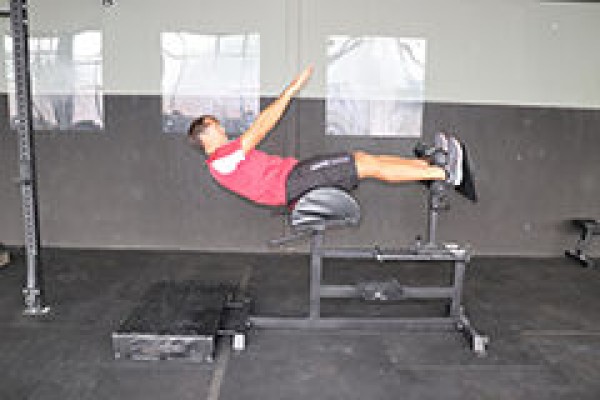

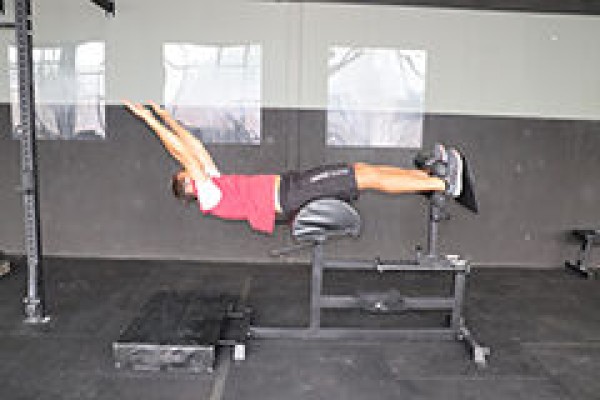


When sitting upright on the cushion, the feet are fixed in the holder with the knees slightly bent (feet pointing upwards), the outstretched arms are held diagonally forwards towards the feet (or only up to the shins). The torso bend (sit up) is performed with the knees initially slightly bent on the way down, with the upper body lowered as far as the training level allows (into the horizontal plane or even lower towards the floor). As the upper body is lowered, the arms are extended overhead at the same time (hold them up). Once you have reached the end position (e.g. horizontal or hands touching the floor), quickly straighten your knees and catapult your upper body upwards to return to the seated position (bring your arms to your shins/to the support at the same time).
Attention:
The GHD sit up is a great exercise for training the abdominal muscles statically and the hip flexors dynamically. When setting up, ensure that the hip joint can move freely. It is important to extend the knees on the way up in order to engage the straight muscle of the thigh (m. rectus femoris) as the primary hip flexor. Those who do not force knee extension will not use the m. rectus femoris primarily as a hip flexor and will therefore work via other hip flexors such as the m. iliopsoas. However, as this attaches to the spine, stress can be placed on the back and pain can be felt. With the GHD sit up, it is important to understand that it is not the bending of the spine (as with the crunch), but the active keeping of the spine straight (static working of the abdominal muscles) during the movement that should provide the training stimulus for the abdomen.
Lighten:
Caution is advised with the GHD sit up: Firstly, 30+ regular trunk bends should be mastered. The next step is to be able to hold the horizontal on the GHD for 30+ seconds. Then practise the GHD sit ups slowly with increasing ROM (range of motion), if necessary with the support of a partner. A maximum of 10 repetitions per set is sufficient for the first training sessions.
Harden:
Execution down to the floor (lowering the upper body beyond the horizontal); additional weight (in the hands).
1 glute-ham developer (GHD)
2 weight cuffs ► making the exercise more difficult (additional weight)
1 weight disc/ball/dumbbell ► making the exercise more difficult (additional weight)
Raising and lowering the upper body in a sitting position (trunk bend) ► ghd sit up to parallel
Power
Individual work
When sitting upright on the cushion, the feet are fixed in the holder with the knees slightly bent (feet pointing upwards), the outstretched arms are held diagonally forwards towards the feet (or only up to the shins). The torso bend (sit up) is performed with the knees initially slightly bent on the way down, whereby the upper body is lowered with a straight back to a position approximately parallel to the floor (or even lower with a good level of training). As the upper body is lowered, the arms are folded across the chest at the same time. Once you have reached the end position, quickly straighten your knees and catapult your upper body upwards to return to the seated position (stretch your arms out again at the same time and bring them to your legs/to the rack).
Attention:
The GHD sit up is a great exercise for training the abdominal muscles statically and the hip flexors dynamically. When setting up, ensure that the hip joint can move freely. It is important to extend the knees on the way up in order to engage the straight muscle of the thigh (m. rectus femoris) as the primary hip flexor. Those who do not force knee extension will not use the m. rectus femoris primarily as a hip flexor and will therefore work via other hip flexors, such as the m. iliopsoas. However, as this attaches to the spine, stress can be placed on the back and pain can be felt. With the GHD sit up, it is important to understand that it is not the bending of the spine (as with the crunch), but the active keeping of the spine straight (static working of the abdominal muscles) during the movement that should provide the training stimulus for the abdomen.
Lighten:
Caution is advised with the GHD sit up: Firstly, 30+ regular trunk bends should be mastered. The next step is to be able to hold the horizontal on the GHD for 30+ seconds. Then practise the GHD sit ups slowly with increasing ROM (range of motion), if necessary with the support of a partner. For the first few training sessions, a maximum of 10 repetitions per set will suffice.
Harden:
Execution down to the floor (lower your upper body beyond the horizontal); stretch your arms above your head (held high instead of folded on your chest); hold additional weight in your hands.
1 glute-ham developer (GHD)
2 weight cuffs ► making the exercise more difficult (additional weight)
1 weight disc/ball/dumbbell ► making the exercise more difficult (additional weight)
Raising and lowering the upper body in a sitting position (trunk bend) ► sit up
Power
Partner work

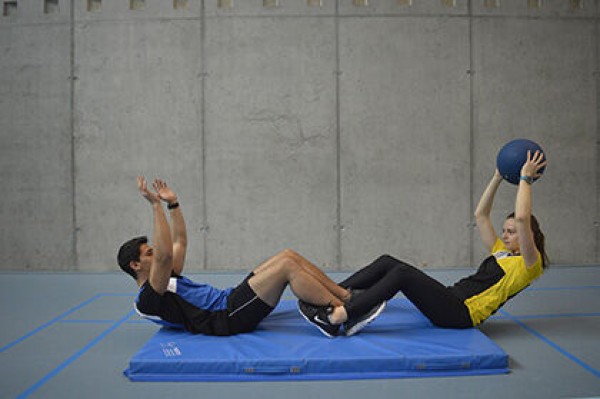
The exercisers sit facing each other, legs slightly bent and feet hooked onto their partner's lower legs. The participants pass a ball back and forth, with their arms practically stretched out and held high. When catching the ball, the momentum of the ball is absorbed and the upper body is lowered as far back as possible (bring the ball over the head towards the floor) without the shoulder blades touching the floor. As you raise your upper body back to the starting position, use the momentum to throw the ball back to your partner.
Attention:
Always keep your stomach tensed and your back straight. Never lower your upper body completely.
Lighten:
Lighter ball or no ball; hold the ball in front of your chest instead of holding it up or in front of you.
Harden:
Heavier ball.
1 medicine ball/weight ball/gymnastics ball
1 ball (e.g. volleyball/football/basketball) ► Make the exercise easier
1 medicine ball/weight ball ► Make the exercise more difficult (additional weight)
Raising and lowering the upper body in the seat ► good mornings
Power
Individual work
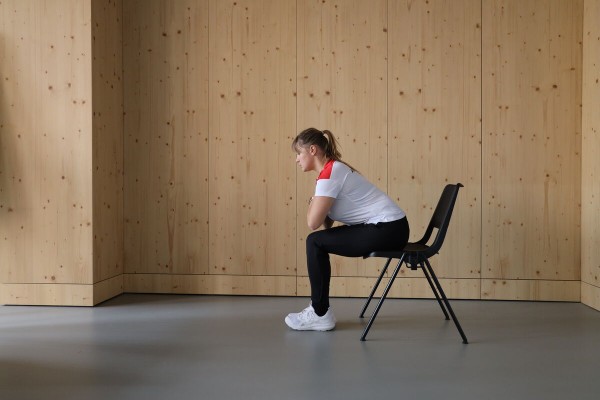
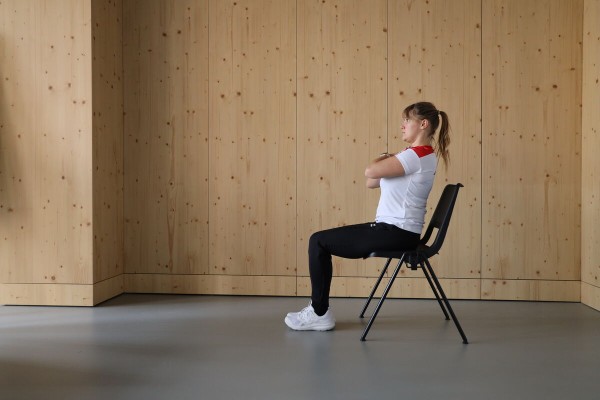
Sitting upright on a chair (sitting on the front edge of the chair), cross your arms across your chest or place your hands on either side of your ears. With your back straight, tilt your upper body back towards the backrest and forwards towards your knees.
1 (office) chair
Raising and lowering the upper body while standing ► romanian deadlift
Power
Individual work

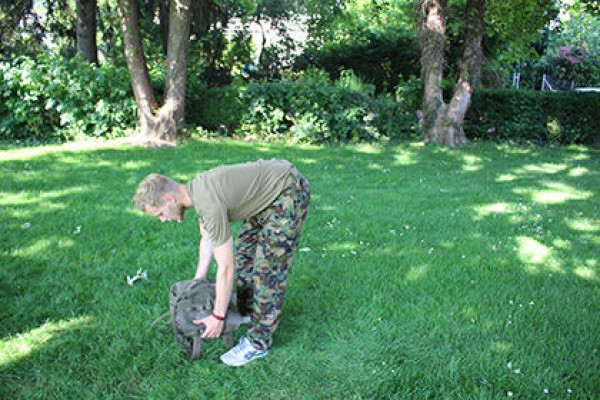
Stand upright with your feet shoulder-width apart, knees slightly bent, hold an object (e.g. rucksack or sandbag) in front of your body with your arms hanging straight out in front of you, tilt your upper body forwards so that the object can be brought to the floor in front of your feet. Raise your upper body to return to the starting position.
Attention:
Leg position remains unchanged.
Lighten:
Less/no weight.
Harden:
Hold the weight in front of your chest, on your neck or holding it up; more weight.
Variant:
Lower your upper body with a straight back (lower the object less far to the floor).
1 sandbag/fighting rucksack
1 helmet ► Make the exercise easier
1 weight disc/tyre (PUCH) ► Make the exercise more difficult (additional weight)
Raising and lowering the upper body while standing ► romanian deadlift
Power
Individual work


Stand upright on the elastic band with your shoulders shoulder-width apart, your outstretched arms pointing towards the floor and close to your body, your hands clasping the respective end of the elastic band on the corresponding side at hip height. Tilt your upper body forwards, bending your knees only slightly (hands at knee height - arms still stretched out). Then stretch your legs again and straighten your upper body back to the starting position (tighten/stretch the band).
Attention:
The back remains stretched throughout the exercise.
Lighten:
Choose an elastic band with less resistance.
Harden:
Choose an elastic band with more resistance.
1 elasticated rubber band
Raising and lowering the upper body while standing ► sumo deadlift
Power
Individual work
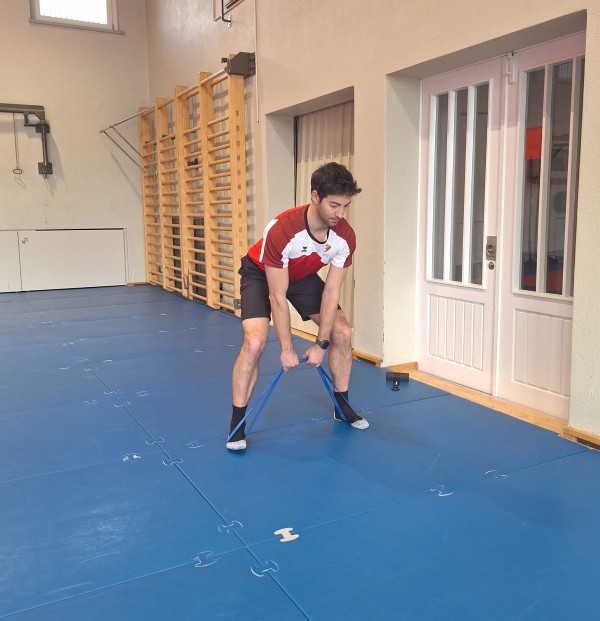

Stand very wide upright (more than shoulder-width apart) with one foot in each loop of the elastic band, feet turned outwards (pointing diagonally forwards), outstretched arms close to the body, with the hands holding the elastic band in the centre at thigh height (in this position, the elastic band has the shape of the letter "V"). Tilt your upper body forwards, bending your knees only slightly (hands below knee height - arms still stretched). Then straighten your legs again and raise your upper body back up to the starting position (tighten/stretch the band).
Attention:
The back remains stretched during the entire exercise.
Lighten:
Choose a rubber band with less resistance.
Harden:
Choose a rubber band with more resistance.
1 elasticated rubber band
Raising and lowering the upper body while standing ► swing
Power
Individual work
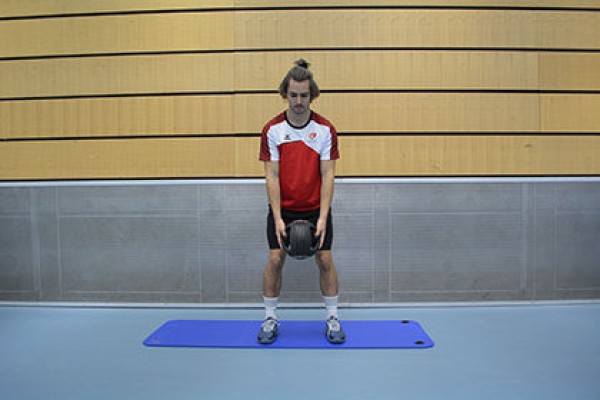

Stand shoulder-width apart, knees slightly bent, upper body leaning slightly forwards, hold an object (e.g. sandbag, rucksack or kettlebell) between your legs with both hands and arms outstretched. Raise the object to chest height with outstretched arms and momentum (straighten your body) and swing it back between your legs (return your body to the starting position).
Attention:
Keep your back straight, initiate the movement from the pelvis and not from the legs.
Lighten:
Less weight/load.
Harden:
More weight/greater load.
1 sandbag/fighting backpack/kettlebell (medium weight)
1 sandbag/fighting backpack/kettlebell (light) ► Make the exercise easier
1 sandbag/fighting backpack/kettlebell (heavy) ► Make the exercise more difficult
Raising and lowering the upper body in prone position ► hyperextension
Power
Partner work
1 trainee & 1 helper ► Note change of position
(= double the time required; for lesson planner see Organisation Kraft: Info button Execution)


Practitioner: Prone position on the Swedish box (lengthwise, hips at the end of the box), arms crossed over the chest, raise and lower the upper body.
Partner: Holds the legs of the active participant.
Attention:
Always listen to/respond to the partner (safety); straight back/no hollow back.
Lighten:
Lift your upper body less; keep your arms stretched out at the side of your body.
Harden:
Place your arms at an angle next to your head or even hold them up; hold additional weight (on your chest).
1 vaulting box
1 medicine ball/weight ball/weight vest/weight disc/dumbbell/sandbag ► Make the exercise more difficult (additional weight)
Raising and lowering the upper body in prone position ► hyperextension
Power
Individual work


Prone position, arms slightly raised and stretched out as an extension of the body, hold the pistol in both hands (lying down), move the pistol up and down by raising and lowering the upper body.
Attention:
Do not lower the upper body completely.
Lighten:
Only hold the starting position.
1 pistol (neutralised)
Raising and lowering the upper body in prone position ► hyperextension
Power
Individual work


Prone position, arms slightly raised and stretched out in extension of the body, hold the assault rifle in both hands (one hand on the butt, the other on the hand guard), move the rifle up and down by raising and lowering the upper body.
Attention:
Do not lower the upper body completely.
Lighten:
Just hold the starting position.
1 assault rifle (neutralised)
Raising and lowering the upper body in prone position ► hyperextension
Power
Individual work


Prone position, arms bent beside your head (elbows at shoulder height), raise and lower your upper body.
Attention:
Do not lower your upper body completely.
Lighten:
Cross your arms over your chest; raise your upper body less; only hold the position with your upper body raised.
Harden:
Stretch out your arms, hold additional weight up, hold on your arms/in your hands/on your chest.
Variant:
Alternate lifting and lowering your upper body with bent and outstretched arms.
2 weight cuffs/weight balls/1-2 dumbbells/1 weight disc/sandbag ► Make the exercise more difficult (additional weight)
Raising and lowering the upper body in prone position ► hyperextension
Power
Individual work

Prone position, arms and legs stretched out and slightly raised from the floor (legs can also be put down), hold an object (e.g. helmet) in your hands and raise and lower it slightly (raise and lower your upper body).
Attention:
Do not lower your upper body completely.
Lighten:
Do not hold an object in your hands; lift the object/upper body less; bend your arms; only hold the position with the object/upper body raised.
Harden:
Additional weight (e.g. place stones in the helmet/hold a rucksack).
1 helmet
1 combat rucksack/3-4 stones ► Make the exercise more difficult (additional weight)
Raising and lowering the upper body in prone position ► hyperextension
Power
Individual work


Prone position on the exercise ball, arms bent next to the head, toes on the floor to stabilise the body, raise and lower the upper body.
Attention:
Do not rest your chest completely on the exercise ball.
Lighten:
Cross your arms on your chest; lift your upper body less; only hold the position with your upper body raised.
Harden:
Stretch out your arms; hold additional weight in a high position, on your arms/in your hands/on your chest.
1 exercise ball
2 weight cuffs/weight balls/1-2 dumbbells/1 weight disc/sandbag ► Make the exercise more difficult (additional weight)
Raising and lowering the upper body in the standing balance (left)
Power
Individual work
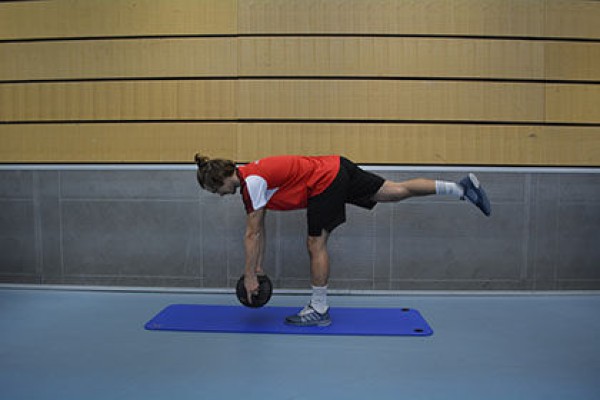


Standing balance (single-leg stance with upper body leaning forwards and free leg stretched out in extension of the body), grasp the weight with outstretched arms in an overhand grip (arms pointing towards the floor), lower the upper body and simultaneously bring the free leg to the standing leg to then return to the starting position.
Attention:
Keep your back straight at all times (tense your core), distribute the weight over your entire foot.
Lighten:
Lower your upper body less; no additional weight.
Harden:
More weight.
Variation:
Grab the weight with one hand only.
1 dumbbell/kettlebell/weight disc/sandbag
Raising and lowering the upper body in the standing position (right)
Power
Individual work


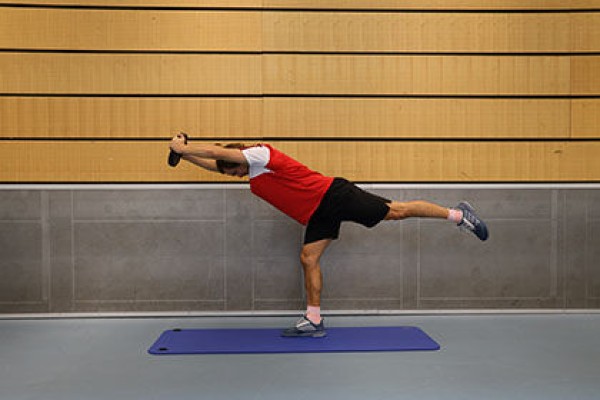

Standing balance (single-leg stance with upper body leaning forwards and free leg stretched out in extension of the body), grasp the weight with outstretched arms in an overhand grip (arms pointing towards the floor), lower the upper body and simultaneously bring the free leg to the standing leg to then return to the starting position.
Attention:
Keep your back straight at all times (tense your core), distribute the weight over your entire foot.
Lighten:
Lower your upper body less; no additional weight.
Harden:
More weight.
Variation:
Grab the weight with one hand only.
1 dumbbell/kettlebell/weight disc/sandbag
Raising and lowering the upper body in a hanging position (trunk bend) ► sit up
Power
Partner work
1 trainee & 1 helper ► Note change of position
(= double the time required; for lesson planner see Organisation Kraft: Info button Execution)
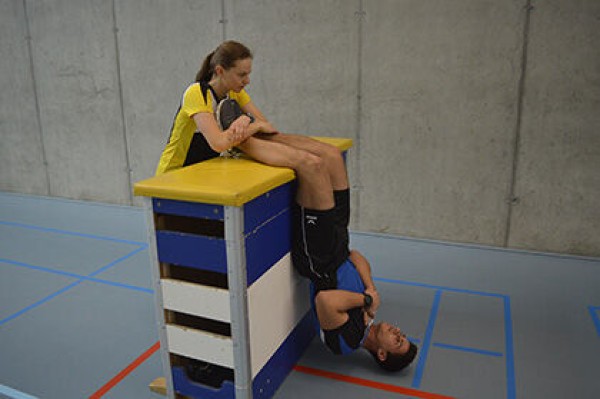

Trainee: Lower legs on the top of the vaulting box, upper body hanging down along the vaulting box, arms folded across the chest or in front, upper body raised and lowered (torso bend).
Partner: Holds the legs of the active participant.
Attention:
Always listen to/respond to the partner (safety); head is in a neutral position (no double chin).
Lighten:
Arms resting against the side of the body.
Harden:
Arms bent next to the head or even held high; additional weight (hold on to the chest).
1 vaulting box
1 weight disc/dumbbell/sandbag ► Make the exercise more difficult (additional weight)
Raising and lowering the upper body in supine position
Power
Individual work
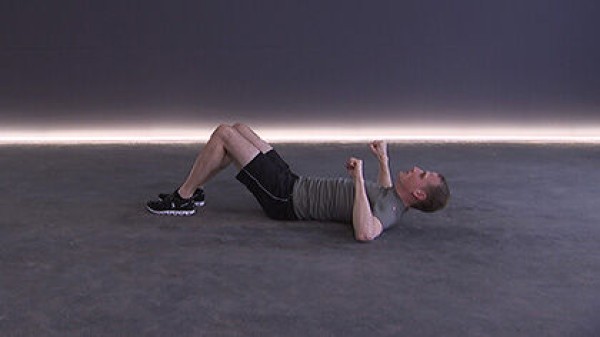
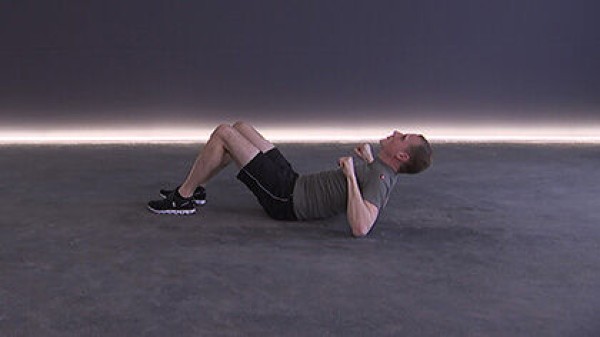
Lying on your back, arms bent (palms facing forwards), elbows supporting the slightly raised upper body (elbows at shoulder height), legs bent with heels on the floor, raise and lower the upper body by pushing the elbows backwards.
Attention:
Do not fully lower the upper body.
Lighten:
Lift your upper body less (push your elbows back less); only hold the position with your upper body slightly raised (without raising and lowering your upper body).
Harden:
Additional weight (on your chest).
1 weight disc/sandbag ► Make the exercise more difficult (additional weight)
Raising and lowering the upper body in a supine position ► crunch
Power
Individual work


Lie on your back with your legs bent (heels touching the floor), your feet in the loops, hold the gymnastics bar with an overhand grip on your thighs (palms facing your body), slowly roll up your upper body, but only so far that your lower back (lumbar spine) is not lifted, lower your upper body back to the starting position.
Attention:
Never fully lower your upper body, always keep your shoulder blades slightly raised (constant tension) and your head in a neutral position (no double chin).
Lighten:
Select stronger elastic bands; roll up the elastic bands more.
Harden:
Select less strong elastic bands; roll up the elastic bands less.
Variant:
Hold the gymnastics bar with an underhand grip (palms facing upwards towards your face), roll your upper body up to the seat and straighten up (bend your elbows when straightening up).
1 gymnastic bar with elasticated straps