
Exercises (2337)
Knee lift from lunge (right) with extension and flexion of the arms (chest press) ► lunge & knee lift with chest press
Power
Individual work
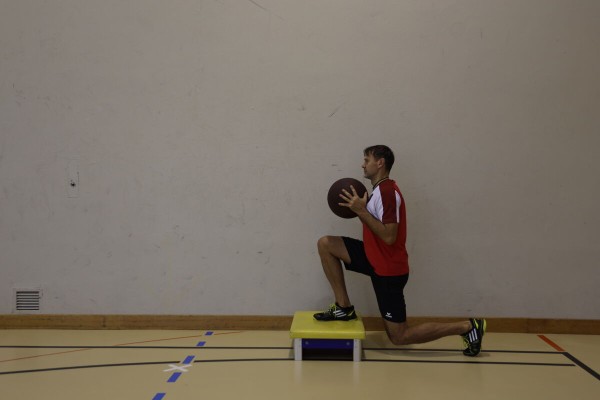
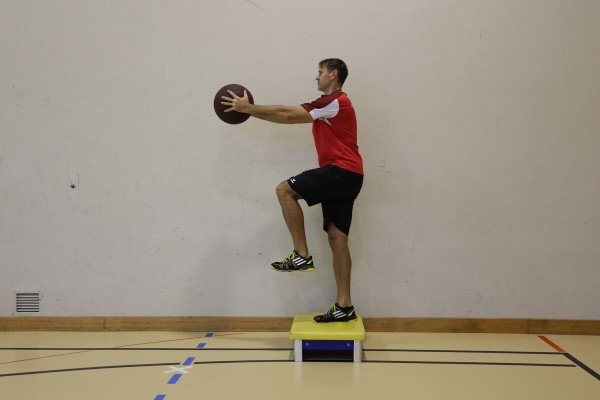
Lunge, with the front (right) leg placed at a right angle in the knee joint on a small raised surface (e.g. weight disc) and the back (left) leg placed on the floor on tiptoe only, with the thigh and lower leg also at approximately a 90 degree angle. The bent arms hold a medicine ball in front of the chest. From this position, straighten the front leg and simultaneously push the back leg off the floor and bend the knee in a fluid movement to reach a one-legged stance on the raised surface. Whilst performing the movement, stretch your arms out in a holding position (arms horizontal to the floor). Then bring the bent knee back to a high holding position and place it on the floor and bend the supporting leg to return to the starting position in a lunge. The arms are also bent back to the starting position.
Attention:
Always keep the front knee behind the toe and centred over the foot, upper body upright and abdomen tensed.
Lighten:
Lift the knees less, lower the upper body less (greater angle in the knees); without additional weight (medicine ball).
Harden:
Higher base; additional weight (on the foot); perform a small one-legged jump on the raised base.
1 weight disc
1 medicine ball
1 long bench/swinging box ► Make the exercise more difficult (position)
1 weight cuff ► Make the exercise more difficult (additional weight)
Knee lift from lunge (right) with extension and flexion of the arm (shoulder press) ► lunge & knee lift with shoulder press
Power
Individual work
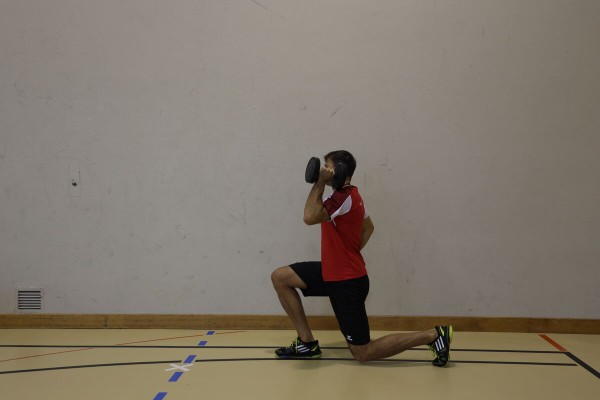
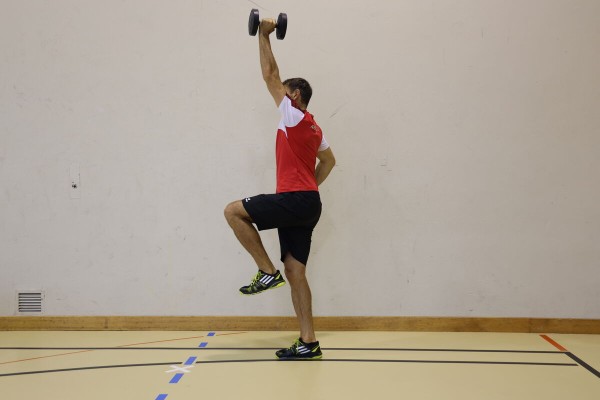
Lunge, the front (right) leg is placed on the floor with a right angle at the knee joint, the back (left) leg is placed on the floor on tiptoe only, with the thigh and lower leg also at approximately a 90 degree angle. One arm (right) is supported on the hip, the left arm is bent and holding the weight in the hand (dumbbell or kettlebell) so that the weight is next to the head at ear level. From this position, straighten the front leg and simultaneously push the back leg off the floor and bend the knee in a fluid movement to reach a one-legged stance. While performing the movement, push the bent arm with the weight in your hand vertically upwards (hold your arm up). The other arm remains supported on the hip. Then move the bent knee backwards in the hold-up position and place it on the floor and bend the supporting leg to return to the starting position in the lunge. The playing arm is also bent back to the starting position.
Attention:
Always keep the front knee behind the tip of the foot and centred over the foot, upper body upright and abdomen tensed.
Lighten:
Lift the knees less, lower the upper body less (greater angle in the knees); without additional weight (dumbbell or kettlebell).
Harden:
Raise the (front) supporting leg; additional weight (on the back foot); perform a small one-legged jump.
1 dumbbell/kettlebell
1 weight disc/long bench/swinging box ► Make the exercise more difficult (position)
1 weight cuff ► Make the exercise more difficult (additional weight)
Lifting the knee and jumping in place from the lunge (left) ► lunge hop
Power
Individual work
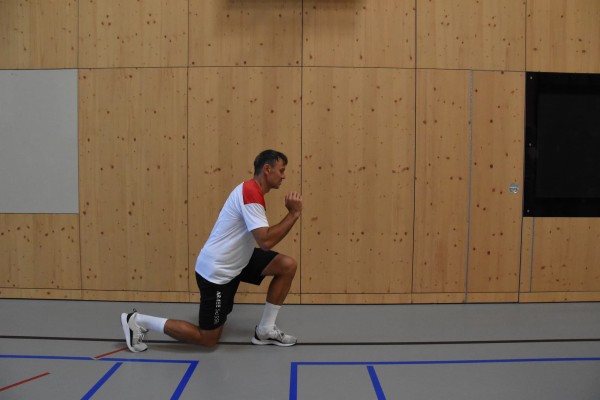
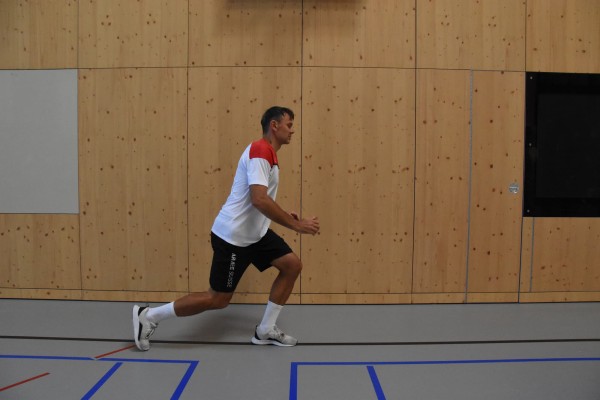
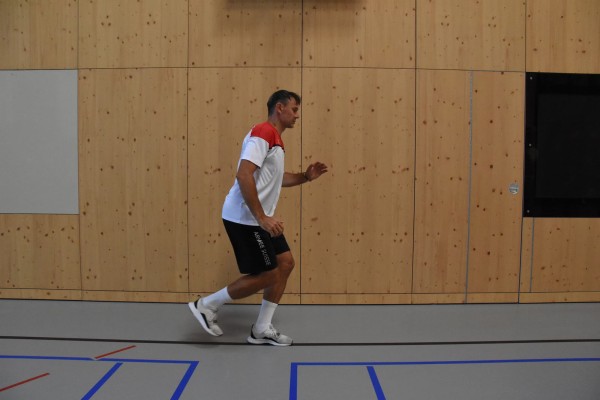
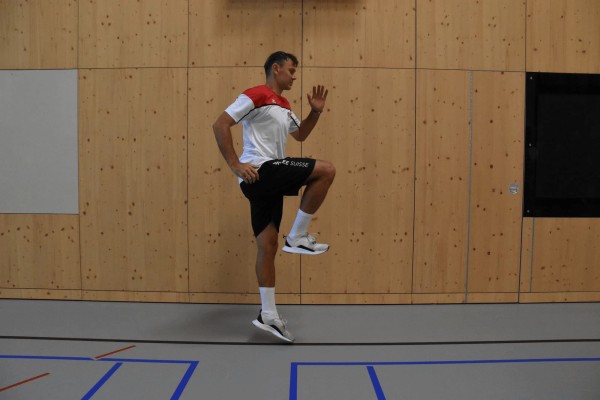
Lunge, the front (left) leg is placed on the floor with a right angle at the knee joint, the back (right) leg is placed on the floor on tiptoe only, with the thigh and lower leg also at approximately a 90 degree angle. The left arm on the body points diagonally downwards at the back, the right arm is bent (hold the hand approximately at ear level). From this position, stretch the front leg and perform a small (one-legged) jump in place. At the same time, push the back leg off the floor and bend the knee in a fluid movement so that the knee is approximately at hip height. Change the position of the arms during the movement. Land on the jumping leg, bringing the free leg directly back to the starting position. The arms are also moved back to the starting position at the same time.
Attention:
Always keep the front knee behind the tip of the foot and centred over the foot, upper body upright and stomach tensed.
Lighten:
Lift the knee without jumping.
Harden:
Additional weight (on the chest/shoulders, hold in the hands, hold in front).
2 weight cuffs/short dumbbells/1 weight vest/weight disc/(medicine) ball/sandbag/fighting backpack ► Make the exercise more difficult (additional weight)
Lifting the knee and jumping in place from the lunge (right) ► lunge hop
Power
Individual work
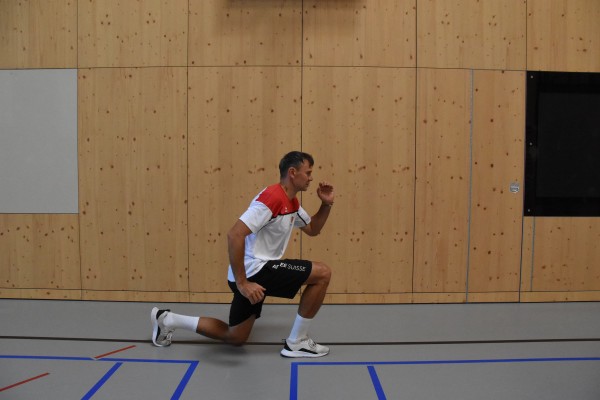
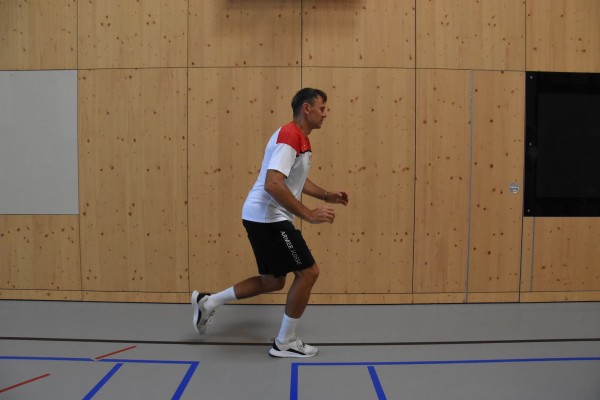
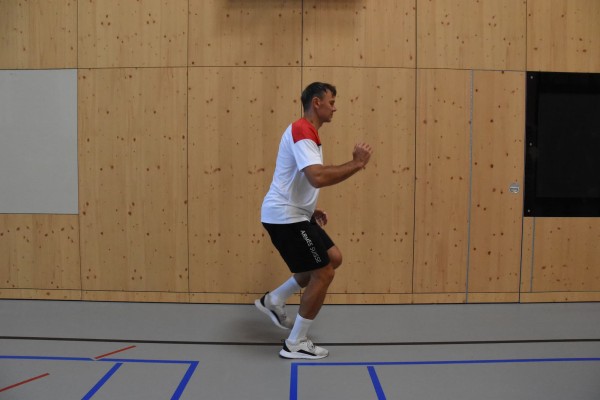
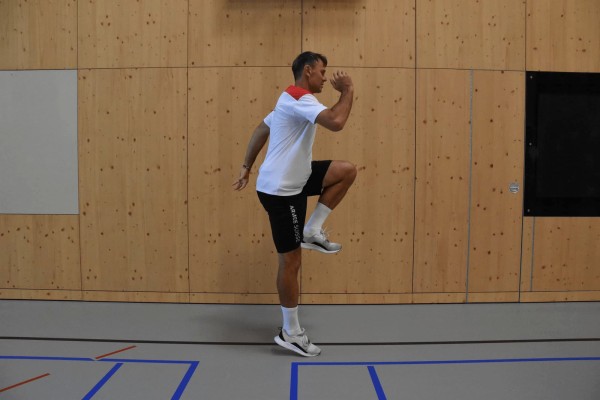
Lunge, the front (right) leg is placed on the floor with a right angle at the knee joint, the back (left) leg is placed on the floor on tiptoe only, with the thigh and lower leg also at approximately a 90 degree angle. The left arm on the body points diagonally downwards at the back, the right arm is bent (hold the hand approximately at ear level). From this position, stretch the front leg and perform a small (one-legged) jump in place. At the same time, push the back leg off the floor and bend the knee in a fluid movement so that the knee is approximately at hip height. Change the position of the arms during the movement. Land on the jumping leg, bringing the free leg directly back to the starting position. The arms are also moved back to the starting position at the same time.
Attention:
Always keep the front knee behind the tip of the foot and centred over the foot, upper body upright and stomach tensed.
Lighten:
Lift the knee without jumping.
Harden:
Additional weight (on the chest/shoulders, hold in the hands, hold in front).
2 weight cuffs/short dumbbells/1 weight vest/weight disc/(medicine) ball/sandbag/fighting backpack ► Make the exercise more difficult (additional weight)
Lifting the body out of the seat with the arms
Power
Individual work

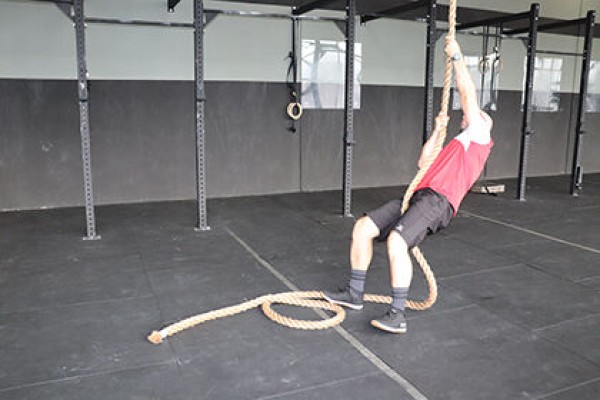
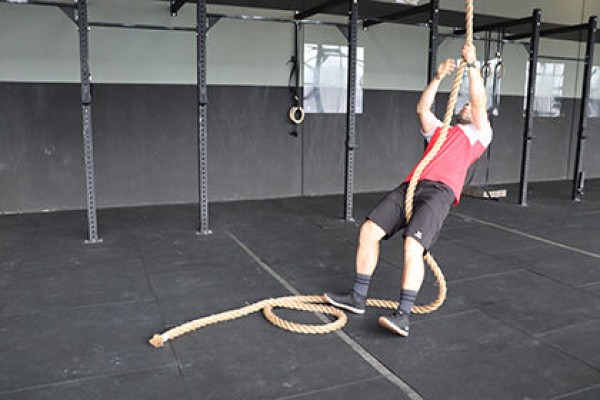

Sit on the floor with your legs stretched out and your upper body leaning slightly backwards, your outstretched arms in a raised position gripping the rope and preventing you from falling backwards (arms in front of your body, hands approximately at chest/leg height above your head). By moving one arm after the other upwards along the rope and alternately gripping the rope higher and higher, the body is continuously raised until the upright standing position is finally reached.
Attention:
The work is done with the arms (no support from the legs if possible).
Lighten:
The legs provide additional support when standing up.
Harden:
Additional weight (on the arms).
1 climbing rope
2 weight cuffs/1 weight waistcoat ► Make the exercise more difficult (additional weight)
Raising the upper body in prone position ► superman
Power
Individual work
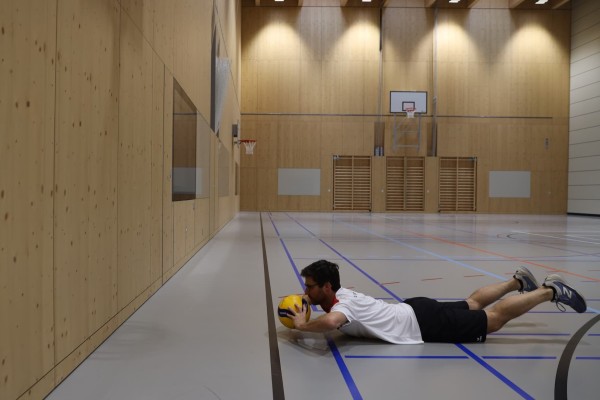
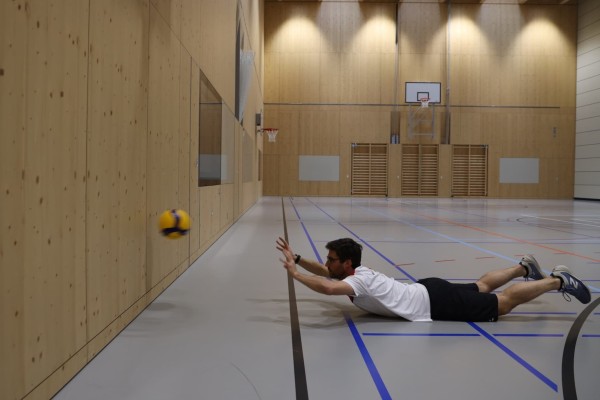
In a prone position approx. 1 metre in front of a wall, hold a ball in front of your head with your arms bent. Raise your upper body slightly and throw the ball against the wall with both arms (movement from the elbows, stretching the arms) and catch it again. The ball never touches the floor.
Attention:
Keep your upper body (incl. arms/elbows) raised at all times.
Lighten:
Just hold the position with your upper body slightly raised (without throwing the ball); hold your arms without the ball in front of you and bring them back sideways next to your body and back to the starting position.
Harden:
Additional weight.
Variant:
Hold a gymnastic stick in your hands with your upper body slightly raised (arms stretched), bring it to your chest (arms bent) and return to the starting position.
1 wall
1 soft mat (small)
1 ball (e.g. football, volleyball, basketball)
1 medicine ball ► Make the exercise more difficult (additional weight)
1 gymnastics stick/wooden stick ► Variation of the exercise
Raising the upper body in prone position ► superman
Power
Individual work
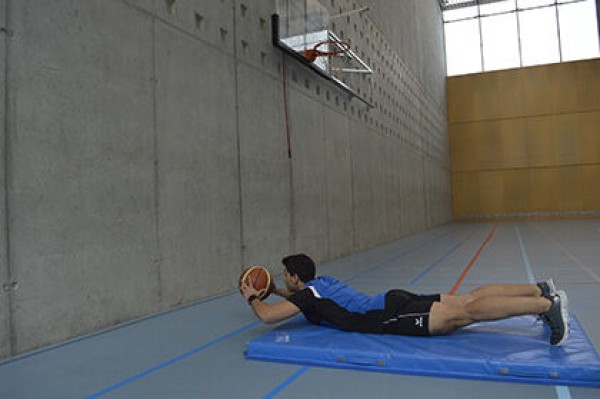
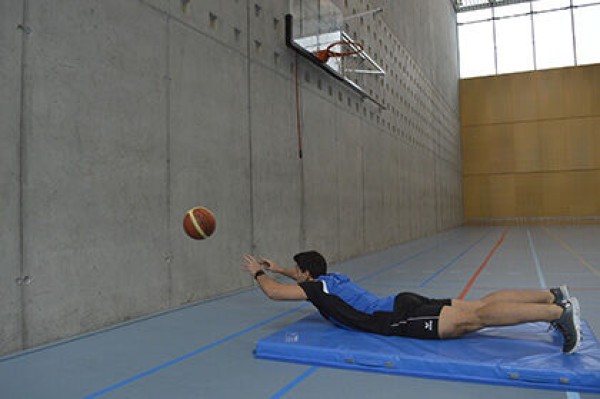
In a prone position approx. 1 metre in front of a wall, hold a ball in front of your head with your arms bent. Raise your upper body slightly and throw the ball against the wall with both arms (movement from the elbows, stretching the arms) and catch it again. The ball never touches the floor.
Attention:
Keep your upper body (incl. arms/elbows) raised at all times.
Lighten:
Just hold the position with your upper body slightly raised (without throwing the ball); hold your arms without the ball in front of you and bring them back sideways next to your body and back to the starting position.
Harden:
Additional weight.
Variant:
Hold a gymnastic stick in your hands with your upper body slightly raised (arms stretched), bring it to your chest (arms bent) and return to the starting position.
1 wall
1 soft mat (small)
1 ball (e.g. football, volleyball, basketball)
1 medicine ball ► Make the exercise more difficult (additional weight)
1 gymnastics stick/wooden stick ► Variation of the exercise
Raising the upper body in supine position
Power
Individual work
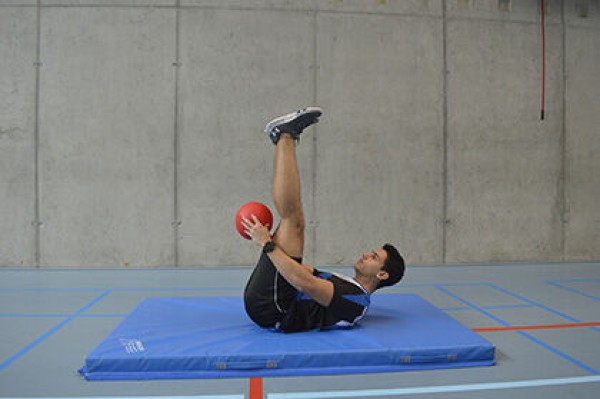
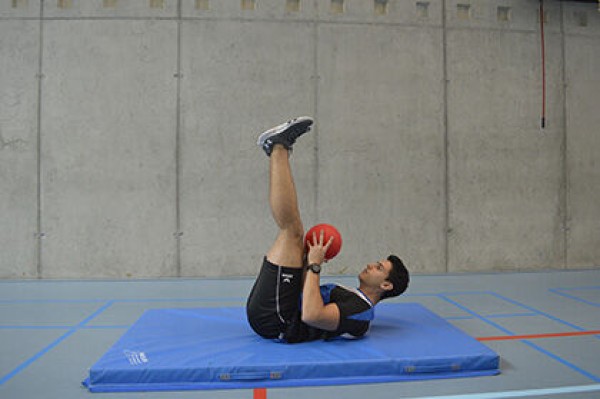
Lie on your back with both legs raised. Raise your upper body and circle a ball around your legs in this position (in both directions).
Attention:
Do not lower your shoulders completely (constant tension), head in a neutral position (no double chin).
Lighten:
Just hold the position with your upper body raised (without spinning a ball).
Harden:
Additional weight (heavy ball).
1 ball (e.g. football, volleyball, basketball)
1 medicine ball ► Make the exercise more difficult (additional weight)
Raising the upper body with outstretched arms in the seat (L-sit) ► L-sit
Power
Individual work
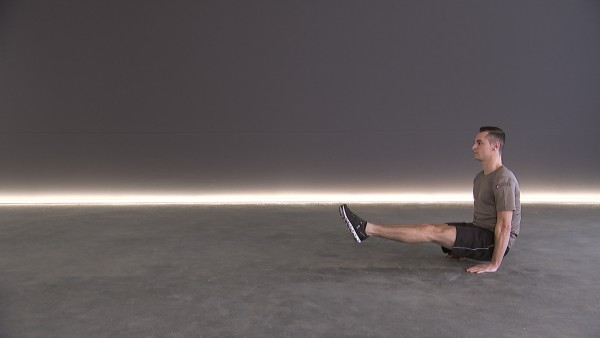
Sit on the floor with your legs straight, hands placed directly next to your hips and elbows pointing backwards, holding your body in a 90 degree position (upper body leaning slightly forwards) and pushing away from the floor with your arms stretched out straight (your entire body weight resting on your hands). Ideally, the toes should be pointed to ensure a straight line in the legs. The L-sit requires good arm and shoulder strength, but also good body tension and flexibility.
No material required
Lifting the upper body whilst bringing the hand and knee together with the leg extended in a supine position (left) ► isometric knee press
Power
Individual work
Lie on your back with one leg (the left) raised (knee bent at about 90°), whilst the other (right) leg remains either straight or resting loosely. Lift your upper body slightly (into a crunch position, but do not sit up fully), and place one hand (the left) on the raised knee. Actively press the knee against the hand, and the hand against the knee. Hold this tension isometrically without moving. Keep the head and neck in a neutral position (do not strain).
Attention:
Do not pull with your neck; instead, engage your core. If your knees or hands bear the load, movement occurs – this is not true isometric tension. Do not lift your upper body too high (as this puts too much strain on your hip flexors). Avoid arching your lower back, and ensure your shoulders remain relaxed.
Lighten:
Lift your upper body only slightly (mini-crunch); press your hand only lightly against your knee (no maximum pressure – focus on control rather than strength); keep your head on the floor and press only isometrically.
Harden:
Apply more pressure (maximum isometric tension); angle the leg further outwards or higher (greater leverage).
1 soft mat (small)
Lifting the upper body whilst bringing the hand and knee together with the leg extended in a supine position (right) ► isometric knee press
Power
Individual work
Lie on your back with one leg (the right) raised (knee bent at about 90°), whilst the other (left) leg remains either straight or resting loosely. Lift your upper body slightly (into a crunch position, but do not sit up fully), and place one hand (the right) on the raised knee. Actively press the knee against the hand, and the hand against the knee. Hold this tension isometrically without moving. Keep the head and neck in a neutral position (do not strain).
Attention:
Do not pull with your neck; instead, engage your core. If your knees or hands bear the load, movement occurs – this is not true isometric tension. Do not lift your upper body too high (as this puts too much strain on your hip flexors). Avoid arching your lower back, and ensure your shoulders remain relaxed.
Lighten:
Lift your upper body only slightly (mini-crunch); press your hand only lightly against your knee (no maximum pressure – focus on control rather than strength); keep your head on the floor and press only isometrically.
Harden:
Apply more pressure (maximum isometric tension); angle the leg further outwards or higher (greater leverage).
1 soft mat (small)
Lifting the upper body and bent legs whilst bringing the elbows and knees together whilst lying on your back ► isometric dead bug
Power
Individual work
Lie on your back with your legs at a 90° angle (hips and knees bent, ‘tabletop position’); with your arms bent, clamp an object (e.g. a foam roller or ball) between your elbows and knees. Engage your core (gently pull your navel inwards, press your lower back into the floor), press the object firmly between your arms and knees, and hold the isometric tension.
Attention:
Do not arch your back; continue to breathe normally (do not hold your breath).
Lighten:
Increase the angle at the hip joint (move the thigh further away from the upper body) and press the object against your knees with your hands; rest your heels on the floor instead of keeping them raised; without an object, just do the classic dead bug without applying pressure.
Harden:
Reduce the angle at the hip joint (bring the thigh closer to the torso) and press your elbows against your knees (without the object); apply more pressure to the object; use an unstable surface (e.g. a balance pad).
1 soft mat (small)
1 foam roller/ball
1 Balance Pad ► Make the exercise more challenging (unstable base)
Lifting the upper body and bent legs whilst bringing the hands and knees together whilst lying on your back ► isometric dead bug
Power
Partner work
Lie on your back with your legs raised (hips and knees bent at approximately 90 degrees), whilst simultaneously raising your upper body slightly (crunch position). Bring your hands and knees together (making contact), pressing your hands gently against your knees and your knees against your hands. Hold this position isometrically and continue to breathe calmly.
Attention:
Keep the lower back flat on the floor (avoid arching the back), do not strain the neck, do not place the knees too close together or too far apart (this causes you to lose the optimal tension), maintain active counter-pressure between your hands and knees, and do not let your shoulders drop again.
Lighten:
Keep your head and shoulders on the floor (hold only your legs + apply light pressure with your hands and knees); lift just one leg (unilateral for less strain); apply less pressure between your hands and knees (focus on technique); pull your legs closer to your body (shorter lever = easier).
Harden:
Apply stronger isometric pressure (maximum tension); move your legs further away from your body (greater leverage = more intense); gently ‘push’ your arms away from your knees (anti-extension); lift one leg at a time (a more unstable variation for greater anti-rotation).
Soft mat (small)
Lifting the upper body and legs whilst lying on your back ► c-position hold
Power
Individual work
Lie on your back with your legs slightly bent, feet lifted off the floor, arms stretched out in front of you so that your upper body and legs form a ‘C’ shape. Tighten your abdominal muscles actively, lift your shoulder blades slightly off the floor, and hold the position still. Breathe calmly and evenly; do not hold your breath.
Attention:
Your lower back should not arch (reason: too much tension, legs too high or too straight); do not tense your neck or push your head forwards (keep your head in a neutral position, neck relaxed).
Lighten:
Keep your legs slightly extended (feet on the floor, only the upper body in a C-shape); bend your legs more; keep your arms closer to your body (arms in front of your chest instead of outstretched); adopt a partial C-shape by lifting only your shoulders slightly off the floor (focus on the upper abdominal muscles, less tension in the lower back).
Harden:
Straighten your legs completely; stretch your arms upwards (holding them above your head); hold your weight in your hands and/or on your legs.
1 soft mat (small)
2–4 weight cuffs/2 medicine balls/dumbbells/1–2 weight plates ► Make the exercise more challenging (additional weight)
Lifting the upper body and bringing one leg across to meet the opposite elbow whilst lying on your back (left) ► unilateral dead bug hold
Power
Individual work
Lie on your back with one leg (right) raised at a 90° angle and the other leg (left) stretched out flat on the floor. With your right arm bent, place an object (e.g. a foam roller or ball) across your body and wedge it between your elbow and the knee of your raised leg (right). Actively engage your core (press your lower back into the floor), press the object firmly between your arm and knee, and maintain isometric tension. Continue to breathe evenly; do not hold your breath.
Attention:
The lower back does not arch (sign: abdominal muscles not engaged enough), the ball does not fall out/the elbow or knee does not tilt (focus on position required, hips remain stable), do not tense the neck (head neutral, neck relaxed).
Lighten:
Only apply light pressure (hold the object loosely, use less pressure); press the object against your knee with your hand.
Harden:
Use a heavier object to clamp; apply more pressure to the object; reduce the angle at the hip joint (bring the thigh closer to the torso) and press the elbows against the knees (without the object); perform a slight movement by moving the clamped ball up and down minimally (dynamic variation – maintain tension).
1 soft mat (small)
1 foam roller/ball
1 medicine ball/weight ball ► To make the exercise more challenging (additional weight)
Lifting the upper body and bringing one leg across to meet the opposite elbow whilst lying on your back (right) ► unilateral dead bug hold
Power
Individual work
Lie on your back with one leg (left) raised at a 90° angle and the other leg (right) stretched out flat on the floor. With your right arm bent, place an object (e.g. a foam roller or ball) across your body and wedge it between your elbow and the knee of your raised leg (left). Actively engage your core (press your lower back into the floor), press the object firmly between your arm and knee, and maintain isometric tension. Continue to breathe evenly; do not hold your breath.
Attention:
The lower back does not arch (sign: abdominal muscles not engaged enough), the ball does not fall out/the elbow or knee does not tilt (focus on position required, hips remain stable), do not tense the neck (head neutral, neck relaxed).
Lighten:
Only apply light pressure (hold the object loosely, use less pressure); press the object against your knee with your hand.
Harden:
Use a heavier object to clamp; apply more pressure to the object; reduce the angle at the hip joint (bring the thigh closer to the torso) and press the elbows against the knees (without the object); perform a slight movement by moving the clamped ball up and down minimally (dynamic variation – maintain tension).
1 soft mat (small)
1 foam roller/ball
1 medicine ball/weight ball ► To make the exercise more challenging (additional weight)
Lifting the upper body and bringing one leg across to the opposite side using the hand and knee whilst lying on your back (left) ► oblique isometric knee press
Power
Individual work
Lie on your back, lift one leg (the right one) (hip and knee at approx. 90°), and place the opposite hand (the left one) against the knee (crossed over). Press the hand and knee together without moving (isometric). Optional: Lift your upper body slightly (crunch position) to increase the tension.
Attention:
Do not arch your back (keep your lower back flat on the floor); do not apply too little pressure (lack of tension makes the exercise ineffective); do not strain your neck when lifting (only tilt your head slightly, do not pull); do not tilt or rotate your pelvis (keep it stable); do not hold your breath (continue to breathe calmly).
Lighten:
Keep your head on the floor (no crunches); reduce the pressure between your hand and knee; raise your supporting leg for greater stability; keep the movement shorter (just find the position, don’t push all the way down).
Harden:
Lift your upper body (hold the crunch position); increase the pressure between your hand and knee; keep your free leg straight, just above the floor.
1 soft mat (small)
Lifting the upper body and bringing one leg across to the opposite side using the hand and knee whilst lying on your back (right) ► oblique isometric knee press
Power
Individual work
Lie on your back, lift one leg (the left one) (hip and knee at approx. 90°), and place the opposite hand (the right one) against the knee (crossed over). Press the hand and knee together without moving (isometric). Optional: Lift your upper body slightly (crunch position) to increase the tension.
Attention:
Do not arch your back (keep your lower back flat on the floor); do not apply too little pressure (lack of tension makes the exercise ineffective); do not strain your neck when lifting (only tilt your head slightly, do not pull); do not tilt or rotate your pelvis (keep it stable); do not hold your breath (continue to breathe calmly).
Lighten:
Keep your head on the floor (no crunches); reduce the pressure between your hand and knee; raise your supporting leg for greater stability; keep the movement shorter (just find the position, don’t push all the way down).
Harden:
Lift your upper body (hold the crunch position); increase the pressure between your hand and knee; keep your free leg straight, just above the floor.
1 soft mat (small)
Lifting one arm in a push-up position alternating ► pillar bridge
Power
Individual work

In the push-up position, alternate between raising one arm and bringing the hand next to the head/to the ear (same side of the body).
Attention:
Keep the torso stable and do not let it sag (actively tense the torso muscles).
Lighten:
Just hold the push-up position.
Harden:
Add weight (on the arms/on the back).
Variant I:
Combine the exercise with push-ups (i.e. lift the left arm and stretch it out). raise and extend your left arm, push-up, raise and extend your right arm, push-up, etc.).
Variant II:
Hold a dumbbell in both hands in the push-up position.
2 weight cuffs/1 weight vest/weight disc/sandbag ► Make the exercise more difficult (additional weight)
2 dumbbells ► Variation of the exercise
Lifting one arm in a push-up position alternating ► pillar bridge
Power
Individual work

In the push-up position, alternate between raising one arm and bringing it to the hip/thigh (same side of the body).
Attention:
Keep the torso stable and don't let it sag (actively tense the torso muscles).
Lighten:
Only hold the push-up position.
Harden:
Additional weight (on the arms/back).
Variant I:
Combine exercise with push-ups (i.e. raise left arm and move to the side, push-up, raise right arm and move to the side, push-up, etc.).
Variant II:
Hold a dumbbell in both hands in the push-up position.
2 weight cuffs/1 weight vest/weight disc/sandbag ► Make the exercise more difficult (additional weight)
2 dumbbells ► Variation of the exercise
Raising one arm and leg crosswise in forearm support (left-right) ► pillar bridge / star plank
Power
Individual work

Underarm support, raise one arm (left) and one leg (right) crosswise and stretch out in the body extension, hold position.
Attention:
Head, torso, hips and knees form a line (do not stretch your buttocks upwards or let them sag, tense your stomach).
Lighten:
Place one knee (left) on the floor; hold the position in forearm support without lifting an arm or leg.
Harden:
Additional weight (on the back or on the arms/legs).
Variation:
Bring your elbow and knee together under your body, then stretch your arm and leg out again.
2-4 weight cuffs/1 weight vest/weight disc/sandbag ► Make the exercise more difficult (additional weight)
Raising one arm and leg crosswise in forearm support (right-left) ► pillar bridge / star plank
Power
Individual work

Underarm support, raise one arm (right) and one leg (left) crosswise and stretch out in the body extension, hold position.
Attention:
Head, torso, hips and knees form a line (do not stretch your buttocks upwards or let them sag, tense your stomach).
Lighten:
Place one knee (right) on the floor; hold the position in forearm support without lifting an arm or leg.
Harden:
Additional weight (on the back or on the arms/legs).
Variation:
Bring your elbow and knee together under your body, then stretch your arm and leg out again.
2-4 weight cuffs/1 weight vest/weight disc/sandbag ► Make the exercise more difficult (additional weight)
Lifting one arm and the opposite leg while on all fours (left/right) ► bird dog hold
Power
Individual work
Get down on all fours, with your hands directly beneath your shoulders and your knees directly beneath your hips. Keep your spine in a neutral position (no arch in the lower back, no rounded back) and actively engage your core. Extend your left arm forwards and your right leg backwards, holding the position isometrically. Keep your hips and shoulders parallel to the floor, look down at the floor (neck in a neutral position), and maintain tension throughout your body.
Attention:
Do not arch your lower back (lower back sagging – lack of core tension), do not rotate your hips to the side, do not lift your leg too high (compensatory movement through the lower back), do not let your arm hang or keep it passively extended (lack of tension in the upper body), do not lift your head or let it droop (strain on the neck).
Lighten:
Extend only the arm or only the leg (on one side); reduce the range of motion (do not fully extend the arm or leg); keep the hand or foot closer to the floor.
Harden:
Unstable surface (e.g. balance pad); additional resistance (e.g. band around the foot or arm); dead bug hold (different position, similar core engagement).
1 soft mat (small)
1 balance pad ► Makes the exercise more challenging (unstable surface)
1 elastic resistance band ► Makes the exercise more challenging (additional resistance)
Lifting one arm and the opposite leg while on all fours (right/left) ► bird dog hold
Power
Individual work
Get down on all fours, with your hands directly beneath your shoulders and your knees directly beneath your hips. Keep your spine in a neutral position (no arch in the lower back, no rounded back) and actively engage your core. Extend your right arm forwards and your left leg backwards, holding the position isometrically. Keep your hips and shoulders parallel to the floor, look down at the floor (neck in a neutral position), and maintain tension throughout your body.
Attention:
Do not arch your lower back (lower back sagging – lack of core tension), do not rotate your hips to the side, do not lift your leg too high (compensatory movement through the lower back), do not let your arm hang or keep it passively extended (lack of tension in the upper body), do not lift your head or let it droop (strain on the neck).
Lighten:
Extend only the arm or only the leg (on one side); reduce the range of motion (do not fully extend the arm or leg); keep the hand or foot closer to the floor.
Harden:
Unstable surface (e.g. balance pad); additional resistance (e.g. band around the foot or arm); dead bug hold (different position, similar core engagement).
1 soft mat (small)
1 balance pad ► Makes the exercise more challenging (unstable surface)
1 elastic resistance band ► Makes the exercise more challenging (additional resistance)
Raise one arm and leg crosswise in a push-up position (left-right)
Power
Individual work


Lie down in the push-up position, raising one arm (left) and one leg (right) crosswise and stretching them out in the extension of the body, hold the position.
Attention:
Head, torso, hips and knees form a line (do not stretch your buttocks upwards or allow them to sag, tense your stomach).
Lighten:
Hold the position with raised arm and foot only briefly before returning to the push-up position.
Harden:
Additional weight (on the back or on the arms/legs).
Variant:
Bring the elbow and knee together under the body, then extend the arm and leg again.
2-4 weight cuffs/1 weight vest/weight disc/sandbag ► Make the exercise more difficult (additional weight)