
Exercises (2337)
Volleyball: Manchette - Conveyor belt
Forms of play / exercises
Group work
Half of the tn (red) line up sideways on a line about 1-2 metres apart. The other half of the Tn (blue), equipped with a volleyball, line up in a column of one at a distance of 2-3 metres from the front Tn of the first group. The teammates in the blue group now play a handball one after the other to the first teammate in the red group, who plays the ball straight back using the handball. After each pass, the teammates in the blue group move by one until they have completed the whole row. They then join up again at the front. Switch groups
.Per group of 2:
1 volleyball
Volleyball: Manchette - for two
Forms of play / exercises
Partner work
After a short instruction by the sports leader on the cuff (stretched arms, impulse from the legs), the participants carry out the following exercises:
- A passes (throws) the ball to B from below, B passes back with the cuff, A catches the ball and throws it back again - switch tasks.
- Free passing in pairs - use upper passes and cuffs adapted to the situation.
Per group of 2:
1 volleyball
Volleyball: Upper pass - alone
Forms of play / exercises
Individual work
After a short instruction by the sports leader on the top pass, the participants perform the following exercises:
- Bounce the ball on the floor with both hands, run underneath it - catch the ball above your head with both hands;
- Ditto, but pass the ball straight back up, 1x on the floor - pass it up - 1x on the floor, etc.
- Juggle the ball (own top pass)
Juggling the ball, go to a basketball hoop and score a basket there with the volleyball (top pass); then change the basket.
Pro Tn:
1 volleyball
3-6 basketball hoops
Volleyball: Upper pass - conveyor belt
Forms of play / exercises
Group work

Half of the tn (red) line up sideways on a line about 1-2 metres apart. The other half of the teammates (blue), equipped with a volleyball, line up in a column of one at a distance of 2-3 metres from the front teammate of the first group. The teammates in the blue group now play an upward pass one after the other to the first teammate in the red group, who plays the ball straight back using the upward pass. After each pass, the teammates in the blue group move by one until they have completed the whole row. They then join up again at the front. Switch groups
.Per group of 2:
1 volleyball
Volleyball: Upper pass - in pairs
Forms of play / exercises
Partner work
After a brief instruction from the sports leader on the top pass, the participants perform the following exercises in teams of two:
- Throw the volleyball to each other inaccurately (too short, too long, etc.) Partner must catch the ball over their head before it falls to the floor.
- Pass the ball to each other with the top pass; in between, pass the ball to yourself once each time.
- Top pass to partner A, partner A passes the ball up to himself several times (juggling) while B quickly touches A's shoes and returns to his place. Now he receives an upper pass and must juggle the ball until A has touched his shoes, etc.
- Direct upper pass in pairs. Play together with the most accurate passes possible.
Per group of 2:
1 volleyball
Weapons range orienteering
Orienteering
Single run or 2/3 groups
Posts (some of which are fixed) are distributed around the weapons range, which the participants approach individually or in small groups with/without a map. The Waffenplatz orienteering run is particularly suitable for familiarising participants with the terrain (practice form), but can also be carried out as a competition form.
There are various options for carrying out the orienteering run:
- Line run:
The posts are approached in numerical order using a map. To ensure that not all participants run in the same direction at the start, the first control is marked on the orienteering map. - Numbered run:
According to the 1st marked control, all even or odd controls are approached using a map. Depending on the time conditions, the 3-way rule could also be an option. - Memory run:
A poster with all the marked controls is displayed at the start. The participants memorise a route and try to collect the controls. Depending on how many posts the participants can memorise, they have to return to the starting position sooner or later to take another look at the map. - Filling station run:
A poster with all the posts is displayed at the start and at some posts. After the start, each participant orientates themselves at the "petrol stations" about the control locations. - Star run:
The start forms the centre of the run. Each control is approached individually (in a star shape) (variant: clockwise or anti-clockwise). After each control, the runners return to the centre before moving on to the next control (if necessary, have the controls checked by the sports director). The controls can be approached using a map or the runners must memorise the route using a poster (cf. memory run).
Variant:
Run in groups of 2 (3). The person in front holds the map (except for the memory run) and runs to the next control. The person behind observes the running behaviour of the person in front and gives feedback on the running style. The roles are swapped at each control point. Of course, this form of exercise requires a prior introduction to the topic of running style analysis by the sports leader.
Orienteering posts (permanently mounted, but always checked, or for unplugging)
2-3 Wpl-OL posters (only necessary for memory, petrol station and possibly star run)
1 stopwatch
Participant/group:
1 orienteering map (prepared in advance by sports director)
1 running map form 30.063
(depending on the variant, e.g. line and number run, mark the first controls on the different running maps beforehand)
Variation of the exercise:
1 poster "Running error pictures"
Wall Drill 2 (Switch)
Power
Individual work

Wall Drill 3 (Double Switch)
Power
Individual work
Wall Drill 4 (Continuous Switch)
Power
Individual work
Wall Jump (360 degrees)
Parkour
Individual work
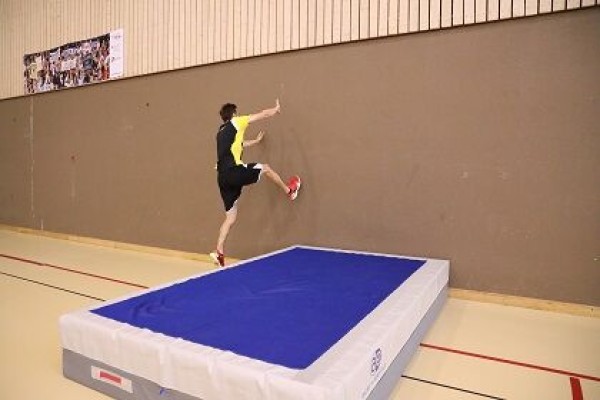
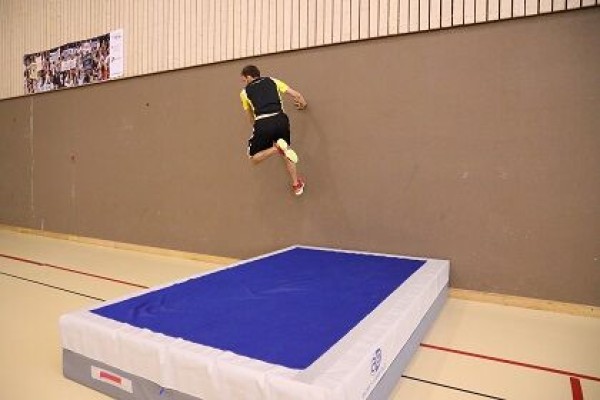
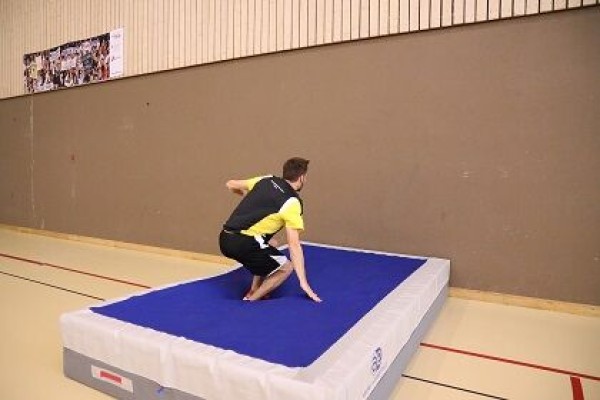
Approach at a 45 degree angle to the wall, jump high against the wall, push off with one or both feet on the wall, (360 degree) turn (over the shoulder facing away from the mat ► indoor variant), two-legged landing.
Variants:
Landing with roll;
540 degree turn in the air.
1 wall
1 soft mat (large) ►Indoor version
Indoor post setup:
Place a large soft mat on a wall.
Wall Run I
Parkour
Individual work
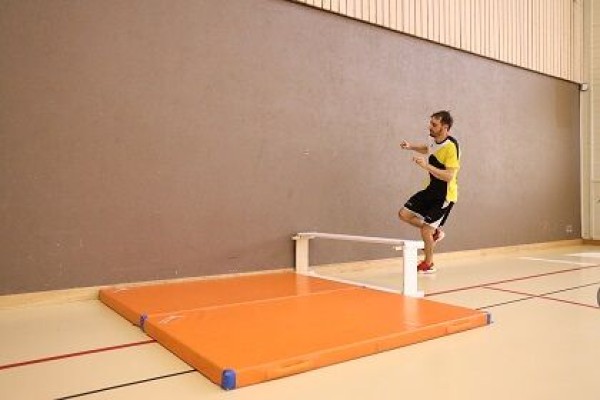

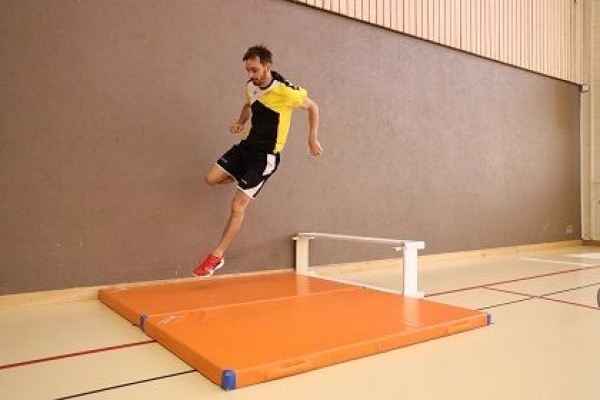
Approach at a 45 degree angle, jump off the obstacle (vaulting box element ► indoor version) with the leg facing away from the wall and push off from the wall with the leg facing the wall for a safe landing (on the soft mat ► indoor version).
Make it easier:
To improve the grip on the wall, a small soft mat can be set up at the point of contact with the wall from which the participants can push off.
Variant:
Higher obstacle (if necessary, support yourself with your hand on the obstacle as an aid).
1 vaulting box element ► indoor version
1 soft mat (small) ► indoor version
1 wall
Indoor post setup:
Place a vaulting box element on a wall (long edge pointing upwards), place a soft mat behind it.
Outdoor:
Place an obstacle (or participant) on a wall.
Wall Run II
Parkour
Individual work
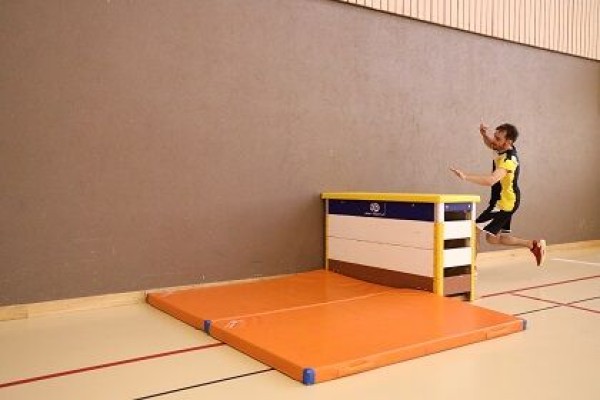
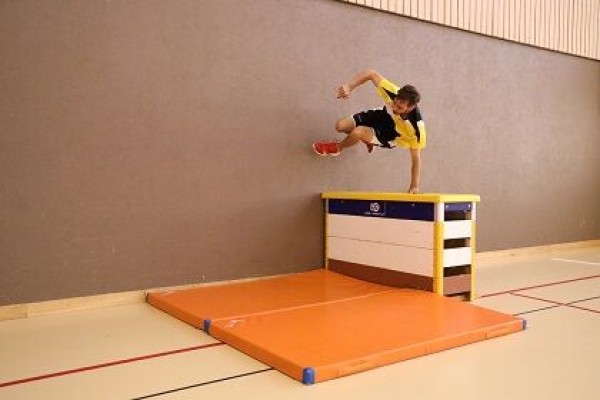
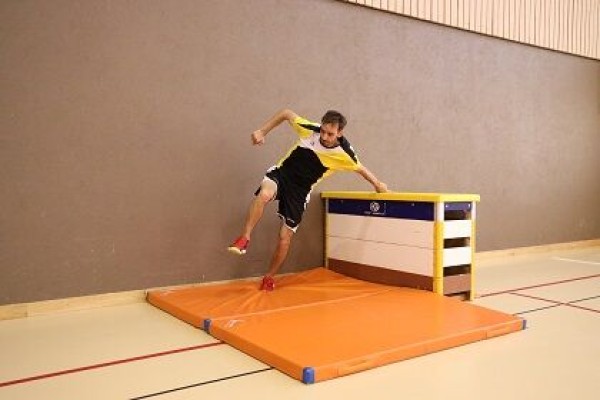
Approach at a 45 degree angle, jump off in front of the vaulting box with the leg facing away from the wall and push off from the wall over the box with the leg facing the wall, landing on the soft mat.
Make it easier:
To improve the grip on the wall, a small soft mat can be set up at the point of contact with the wall from which the participant can push off.
Variant I:
After the jump, support yourself on the vaulting box with the hand facing away from the wall. Walk over the vaulting box with your feet.
Variant II:
After the jump, support yourself on the vaulting box with your hand facing away from the wall. Walk along the wall with your feet.
1 swing box
1 soft mat (small)
1 wall
Post structure:
Place the swing box (4 elements incl. top section) against a wall, place a soft mat behind it.
Wall Run III
Parkour
Individual work
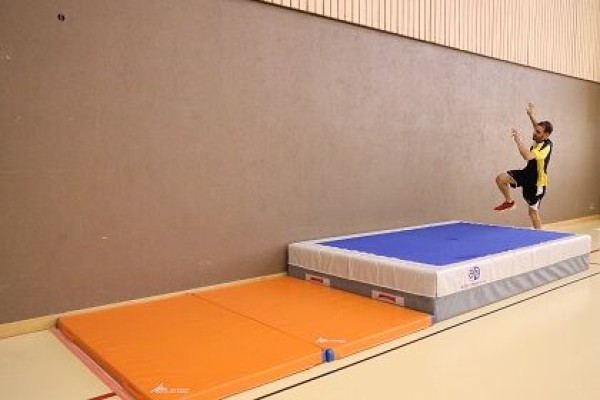
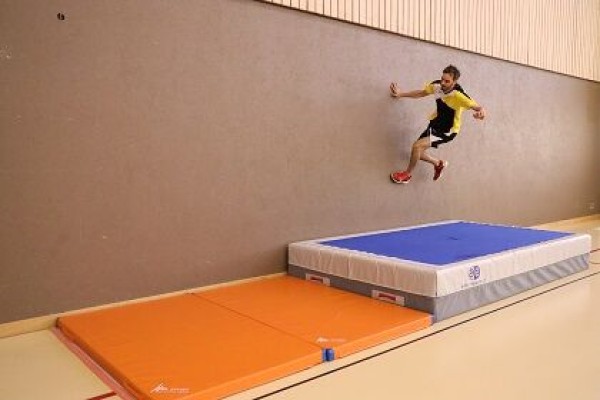
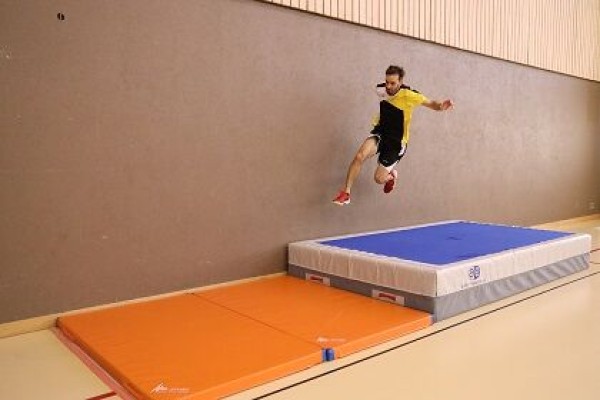
Approach at a 45-degree angle to the wall, jump off with the leg facing away from the wall (in front of the large soft mat ► indoor version), take as many steps as possible against the wall, then push off strongly to land (on the small soft mats ► indoor version).
1 soft mat (large) ► indoor version
2 soft mats (small) ► indoor version
1 wall
Indoor post setup:
Place a large soft mat (lengthwise) on the hall wall, behind it place two small soft mats.
outdoor:
One wall (with grass surface if possible)
Wall Run IV
Parkour
Individual work
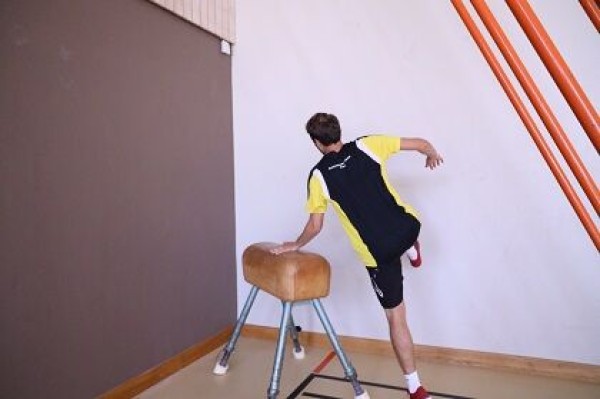

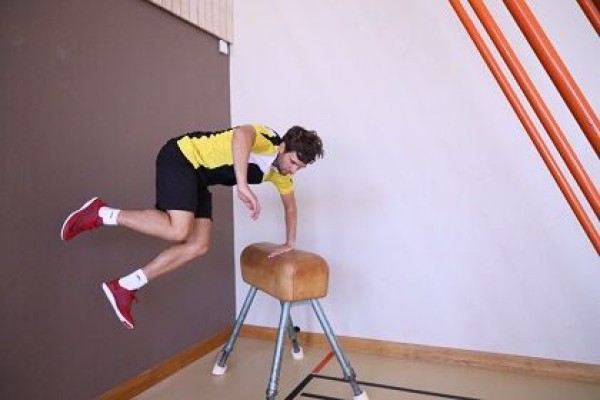
Approach at a 45 degree angle, jump off with the leg facing the wall, the hand facing away from the wall turned forwards (fingers pointing away from the wall), support on the horse, run over both walls (2 steps on the first wall, 1 step on the second wall), jump into the standing position.
1 pommel horse
1 wall corner
Post setup:
Place the pommel horse in a corner of two walls.
Alternating jump on an object
Power
Individual work


Stand with one leg on the tyre and one on the floor, alternating the foot position as you jump.
Attention:
Keep your upper body upright, cushion your landing.
Lighten:
Start the exercise standing in front of the object, alternating one foot on the object and back to the starting position (no jumps - similar to climbing stairs); choose a lower element; lower cadence.
Harden:
Higher cadence; additional weight (on the feet); jump on the tyre (helmet) upwards to change legs.
1 tyre (10DM)
1 tyre (DURO)/helmet ► Make the exercise easier
2 weight cuffs/1 weight waistcoat ► Make the exercise more difficult (additional weight)
Alternating jump on an object
Power
Individual work

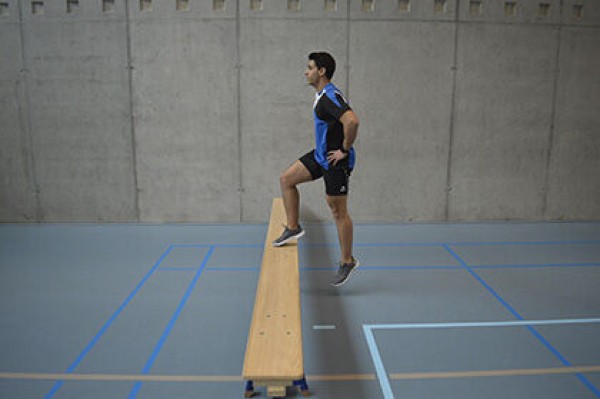
Stand with one leg on the long bench/swinging box top and the other leg on the floor. Alternate the foot position during the jump.
Caution:
Keep your upper body upright, cushion the landing.
Lighten:
Start the exercise standing in front of the element, alternating one foot on the object and back to the starting position (no jumps); choose a lower element; lower cadence.
Harden:
Select a higher element; higher cadence; additional weight (on the feet); jump on the element to change legs.
1 long bench
1 vaulting box top section ► Easier exercise (position)
2 vaulting box elements (incl. top section) ► More difficult exercise (position)
2 weight cuffs/1 weight waistcoat ► More difficult exercise (additional weight)
Competition
Obstacle course in the hall
The obstacle course in the hall is set up in the specified standard size (volleyball court). All participants complete at least two runs for time (competition format according to technical instructions). Depending on the time conditions, additional runs may be guaranteed (voluntary).
11 stakes
10 soft mats (small)
1 soft mat (large)
3 vaulting boxes
3 long benches
1 parallel bars
2 horses
2-3 stopwatches
1 competition sheet (for noting down times)
1 flipchart (optional for noting down times)
Competition
Obstacle course in the terrain
All participants will complete at least one timed run (competition format in accordance with the technical instructions). Depending on the time conditions, additional runs may be guaranteed (voluntary).
2-3 stopwatches
1 evaluation sheet (to record the times)
1 flipchart (optional for recording the times)
Obstacle course in the terrain
Before each use of the HiBa terrain, the elements must be checked for their suitability and the course must be cleaned/cleared of foreign objects. Minimising the risk of injury (e.g. avenging gravel pits on the climbing wall) is the responsibility of the sports manager and has top priority
Wippen ► bouncen
Coordination exercises
Individual work
Bob up and down on a slightly longer, tautly stretched slackline.
Ease:
Bob/bounce less intensively; help a partner by holding their hand (always go with the balancing movement and only stabilise if the slackliner is about to fall).
Easthen:
Walk at the same time and bob/bounce with every step.
1 Slackline
Dice relay
Forms of play / exercises
Group work
4-5 participants per group
A runner runs to a turning point (e.g. colouring stick, marker cone or cone) or to the wall of the hall to throw a show dice. The result of the number rolled multiplied by four corresponds to the number of jumps that must be performed with the skipping rope (max. 24x, min. 4x) before running back to the group. Which group finishes first (each participant runs once)?
Replacement: Run around the group, shake hands and send the next runner onto the course.
Per group:
2 colouring sticks
1 foam cube
1 skipping rope
Throwing body (howler): Target throw
Forms of play / exercises
Group work
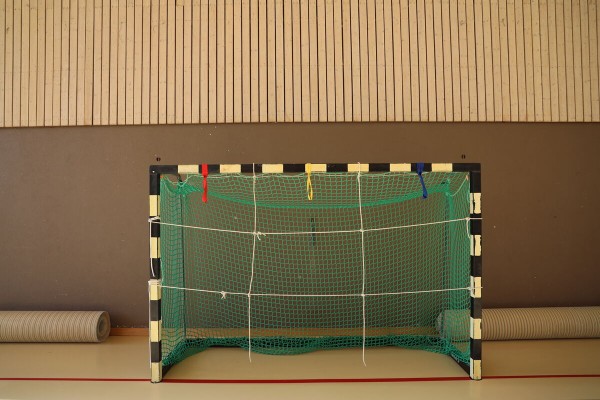
One participant defines a target zone (e.g. target zones divided with skipping ropes in a handball goal -> 3 colours with top-middle-bottom). The entire group then tries to hit the specific target (e.g. yellow-bottom) by throwing the howler (3 attempts per participant from a specific line).
Additional strengthening task:
Those who have not scored a hit complete a strength exercise: 20x jumping jacks
1 handball goal
6-8 skipping ropes (demarcate target zones)
3 marking tapes (define target zones using colours)
3 throwing objects (howlers)
Number run
Basic training
In (small) groups according to running speed or individually
The participants/(small) groups begin in the starting field (in the centre of the field) and run to the numbers in the specified order (ascending or descending) in an endless loop. In order to achieve a stagger, the participants/groups are assigned a different number at the start. After touching a number, they return to the starting field before they can run to the next number (variant: run directly to the next number).
Exercise field: approximately the size of half a football pitch; the numbers from 1-9 (possibly including posters) on the field.
Intensity level: 3 (medium)
HFmax: 80-90%
Speech rule: speak in complete sentences.
Variants:
- Specify shift forms:
- Reduce intensity for running ABC exercises (e.g. knee lift, sideways run).
- Select a strengthening form for the shift (e.g. four-footed gait, double jumps, lunges).
- Integrate strengthening exercises:
- A strengthening exercise corresponding to the number must be repeated for each number (e.g. seven jumping jacks for number 7);
- A strengthening exercise is performed for each number according to a postcard (e.g. 20 push-ups).
1 number boards (no. 1-9) or 9 numbered whey cones
4 marking cones or route tape (starting field)
FTA evaluation (group formation)
Per participant:
1 heart rate monitor
9 control posters ►Variation of the exercise
Time estimation run
Basic training
Groups of 2 (integrate new group formations)
A circuit (e.g. athletics track) should be completed several times in the same time. In the first run, one participant completes the course at as constant a pace as possible in accordance with the specified intensity range. The partner stops the time needed for this, but does not tell the runner. The roles are then swapped and the partner runs the course. The time is also recorded here.
The first runner then starts the second/next run with the aim of completing the course in exactly the same time as their first run. The partner stops the time and calculates the difference to the first run. The tasks are switched again and the differences are compared.
Course: Circular run; from A to B and back again
Intensity level: 3 (medium)
HFmax: 80-90%
Speech rule: Speak in complete sentences
Variant:
Complete the same course a certain amount of time faster or slower
.
Per participant:
1 heart rate monitor
Per group:
1 stopwatch
Zen
Light-Contact
Partner work


One participant closes their eyes, lets their arms hang loosely and accepts being hit by their partner. The partner touches the forehead and stomach of their opponent as often as possible within a set time without the opponent tensing up. The arm must be fully extended and the fist brought back to the cheek after each hit. Switch roles after a while.
Participant:
1 pair of boxing gloves
Pulling an object while standing
Power
Individual work
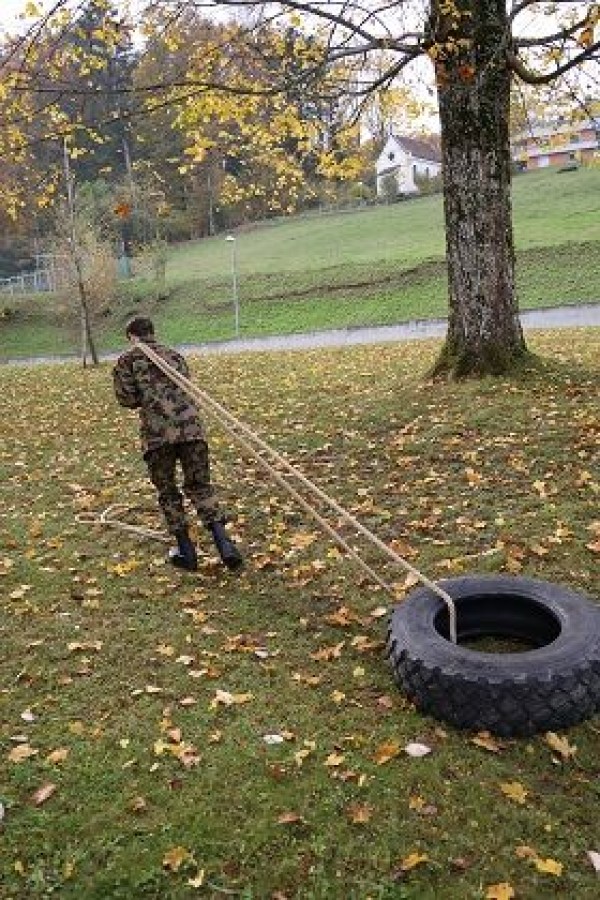
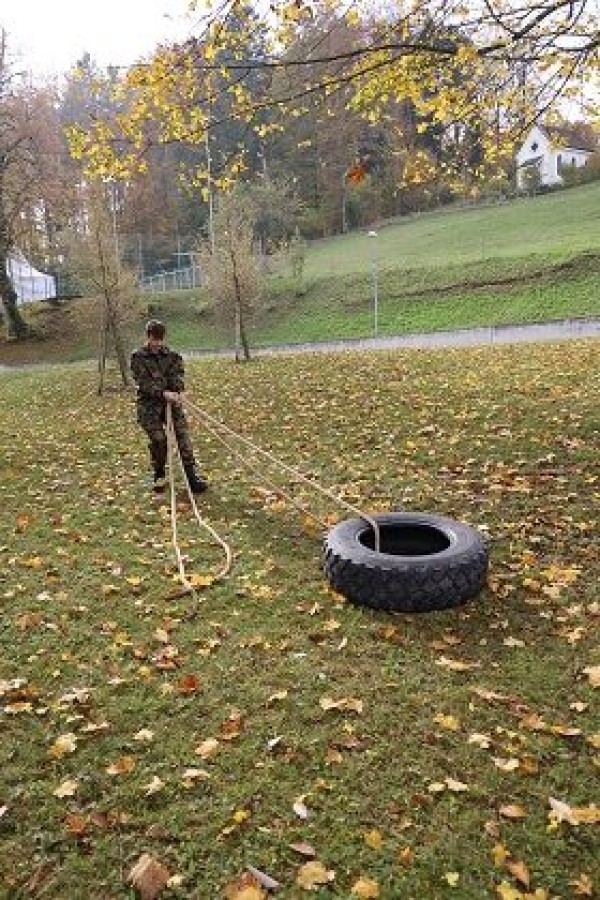
Pull the tyre attached to a rope/rope over a certain distance, transport options:
Back to the tyre, grasp the rope/rope over one shoulder with both hands;
Look towards the tyre, grasp the rope in front of the body with both hands and run backwards.
Attention:
Keep your upper body upright (tense your torso).
Lighten:
Less weight/load.
Harden:
More weight/greater load.
1 tyre (DURO)
1 rope/rope
1 tyre (PUCH) ► Make the exercise easier
1 tyre (10DM) ► Make the exercise more difficult