
Exercises (3274)
Rudern (m: 750m - 60kal; w: 600m - 45kal) ► row
Power
Individual work


Sitting with your legs bent and arms stretched forwards, first push off and stretch your legs, then pull your arms towards your head with your upper body leaning slightly backwards. Return to the starting position in exactly the opposite way: first stretch your arms, then move your upper body forwards and finally pull your legs forwards. In theory, the rowing movement sequence sounds complicated, but many of the individual movement sequences are already performed correctly unconsciously:
Starting position:
Upper body bent forwards towards the thighs.
Back muscles relaxed.
Lower back straight, upper back (trapezius muscle) may make a slight hump.
Arms stretched (triceps remain relaxed).
Tummy muscles slightly tensed.
Starting the pull-through:
Legs lead the movement by stretching them.
At the same time as stretching your legs, slightly tense your lower back and bring it into a straight position.
The phase ends when your legs are almost fully extended.
Middle phase of the pull-through:
From this phase, the upper body also comes into play.
The arms and back now dictate the movement, with both parts of the body being pulled backwards almost simultaneously (between the chest and belly button). The strength comes from the back and not the arms.
The abdominal muscles and thigh muscles remain tensed the whole time.
The phase ends with the upper body leaning slightly backwards and the arms slightly raised. The back shoulder is already working slightly.
Final move:
Pull your arms completely towards your body.
The upper body leans back a little further in the same move. The back shoulder is now even more involved.
Tighten all the muscles involved (buttocks, thighs, abdomen, arms and shoulders).
Rolling:
Arms lead the way.
Stretch your arms forwards again. The upper body and legs follow the arms.
The buttocks pull the seat forwards.
The phase ends in the starting position.
1 rowing machine
Rowing ► row
Power
Individual work


Sitting with your legs bent and arms stretched forwards, first push off and stretch your legs, then pull your arms towards your head with your upper body leaning slightly backwards. Return to the starting position in exactly the opposite way: first stretch your arms, then move your upper body forwards and finally pull your legs forwards. In theory, the rowing movement sequence sounds complicated, but many of the individual movement sequences are already performed correctly unconsciously:
Starting position:
Upper body bent forwards towards the thighs.
Back muscles relaxed.
Lower back straight, upper back (trapezius muscle) may make a slight hump.
Arms stretched (triceps remain relaxed).
Tummy muscles slightly tensed.
Starting the pull-through:
Legs lead the movement by stretching them.
At the same time as stretching your legs, slightly tense your lower back and bring it into a straight position.
The phase ends when your legs are almost fully extended.
Middle phase of the pull-through:
From this phase, the upper body also comes into play.
The arms and back now dictate the movement, with both parts of the body being pulled backwards almost simultaneously (between the chest and belly button). The strength comes from the back and not the arms.
The abdominal muscles and thigh muscles remain tensed the whole time.
The phase ends with the upper body leaning slightly backwards and the arms slightly raised. The back shoulder is already working slightly.
Final move:
Pull your arms completely towards your body.
The upper body leans back a little further in the same move. The back shoulder is now even more involved.
Tighten all the muscles involved (buttocks, thighs, abdomen, arms and shoulders).
Rolling:
Arms lead the way.
Stretch your arms forwards again. The upper body and legs follow the arms.
The buttocks pull the seat forwards.
The phase ends in the starting position.
1 rowing machine
Rowing ► row (300m)
Power
Individual work
Sitting with your legs bent and arms stretched forwards, first push off and stretch your legs, then pull your arms towards your head with your upper body leaning slightly backwards. Return to the starting position in exactly the opposite way: first stretch your arms, then move your upper body forwards and finally pull your legs forwards. In theory, the rowing movement sequence sounds complicated, but many of the individual movement sequences are already performed correctly unconsciously:
Starting position:
Upper body bent forwards towards the thighs.
Back muscles relaxed.
Lower back straight, upper back (trapezius muscle) may make a slight hump.
Arms stretched (triceps remain relaxed).
Tummy muscles slightly tensed.
Starting the pull-through:
Legs lead the movement by stretching them.
At the same time as stretching your legs, slightly tense your lower back and bring it into a straight position.
The phase ends when your legs are almost fully extended.
Middle phase of the pull-through:
From this phase, the upper body also comes into play.
The arms and back now dictate the movement, with both parts of the body being pulled backwards almost simultaneously (between the chest and belly button). The strength comes from the back and not the arms.
The abdominal muscles and thigh muscles remain tensed the whole time.
The phase ends with the upper body leaning slightly backwards and the arms slightly raised. The back shoulder is already working slightly.
Final move:
Pull your arms completely towards your body.
The upper body leans back a little further in the same move. The back shoulder is now even more involved.
Tighten all the muscles involved (buttocks, thighs, abdomen, arms and shoulders).
Rolling:
Arms lead the way.
Stretch your arms forwards again. The upper body and legs follow the arms.
The buttocks pull the seat forwards.
The phase ends in the starting position.
1 rowing machine
Lap run
Increase pulse
Group work
4-6 participants per group
The groups run against each other on a set running lap. One runner from each group runs the first lap alone. On each subsequent lap, an additional runner is taken along until all group members are on their way. After that, one member can be left behind at each start/finish. The team decides independently who will be eliminated. Which final runner will be the first to return to the group?
Per group:
4 colouring sticks
Concentricity
Coordination exercises
Individual work

The participants complete the following obstacles in a circuit:
Balancing over a long bench (forwards, backwards, crawling);
Roll forwards over a small mat;
Roll backwards over a small mat;
Slalom around stakes;
Balancing over a rope;
Hanging from one side to the other on the climbing pole without touching the ground;
Balancing over a tilt (long bench on two vaulting box elements).
► Balance ability, rhythmisation ability, orientation ability
1 climbing pole
2-7 soft mats (small)
2 long benches
1 vaulting box
7 stakes
1 rope
Post set-up:
Set up the following posts in a circuit: Upside-down long bench; small soft mat on the floor; position 7 stakes in a slalom; small soft mat on the floor; rope laid out on the floor; climbing pole pulled out to the maximum (soft mats placed underneath if necessary); tipping point consisting of a long bench and two elements of a vaulting box.
Concentricity
Coordination exercises
Individual work

The participant climbs over the wall bars without touching the forbidden zone (marked with ropes). The participants then jump over the tyres distributed on the floor. If two tyres are at the same height, both legs are stalled. Individual hoops are passed with the leg corresponding to the respective side. The hoops can be jumped through forwards or backwards. To make hoop jumping more difficult, the respective arm on the same or even opposite side can be raised or stretched to the side at the same time as standing. Jumping over the hurdles, the participant returns to the wall bars.
► Rhythmisation ability, orientation ability, balance ability
1 wall bars
3-5 ropes
4-5 hurdles
20-30 tyres
Post set-up:
Arrange the following posts to form a circuit: Use ropes to mark a forbidden zone on the wall bars; lay out tyres to form a jumping course; place hurdles one behind the other
Concentricity
Increase pulse
Group work
6-10 participants per group
The group lines up in a single file facing the person in front (distance between participants approx. one arm's length). At a signal from the sports leader, the runner at the back runs around the group until he/she has returned to his/her original position. The next runner is sent off by slapping the back of the person in front, who in turn runs round the group. Which group is the quickest to get all the runners back to the starting position? If several rounds are to be completed, the last runner in the round (the person in front of the single column) triggers the next round by shouting or passing their hand to the back (the last runner in the group starts again).
Variant I:
The participants in the single column alternate between standing and crouching (or kneeling) positions. When running round, the runner jumps over the participants who are crouching by means of a straddle jump and crawls between the legs of the standing participants. As soon as the competitor has reached the starting position, he/she sends the competitor in front onto the track by shaking hands on his/her back. In a possible second run, the positions (standing, crouching or kneeling) must be changed.
Variant II:
The standing group is run around in a slalom (alternating left/right past the group members until you have completed a whole lap and arrive back at the starting position). It is possible to run round the group members either only when moving forwards or both when moving forwards and backwards.
No material required
Shadow boxing
Light-Contact
Individual work


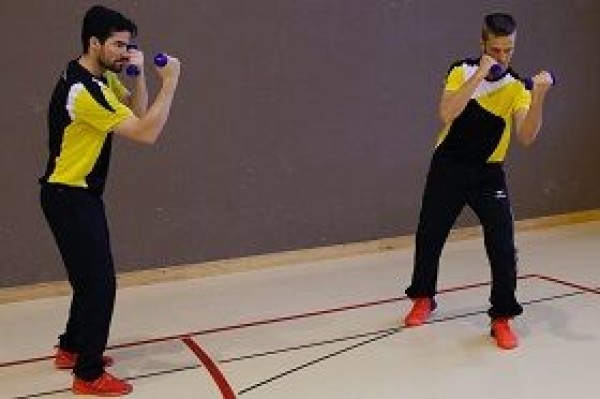
Stand dynamically on the balls of the feet. The participants hold weights (approx. 1 kg) in both hands, move freely around the room (look at all four walls/corners once) and perform the learnt punches (straight, sideways, uppercuts) against imaginary opponents. The fists are in the starting position in front of the face. The arms are never fully extended (maintain tension in the muscles and keep the elbow joint slightly bent). The fists are pulled back horizontally. Throughout the entire exercise unit, quality is more important than quantity (technically clean punches)!
Variant:
Only punch straight lines/sideways hooks/upward hooks.
Per participant:
2 dumbbells/filled pet bottles
Shadow boxing
Leakage
Individual work
Loose shadow boxing including sideways and upward hooks so that the shoulders are always in motion.
No material required
Shadow run
Stimulate circulation
Group work
2-4 groups
Change partners/groups on the sports director's signal
The person in front moves freely (forwards, backwards or sideways, with variations in speed) in the hall and incorporates various forms of exercise (e.g. lifting the ball over a line, balancing the ball on the shovel, wall passes). The partner/group members imitate the movements identically. Swap positions from time to time (e.g. at the whistle of the sports leader) or even change partners.
Per participant:
1 stick (floorball)
2 ball (floorball)
Sports leader:
1 signalling instrument (e.g. hand whistle, tambourine)
Shadow run
Stimulate circulation
Group work
2-4 groups
Change partners/groups on the sports director's signal
The person in front moves freely (forwards, backwards or sideways, with speed variation) in the hall/area and incorporates various forms of exercise (e.g. bouncing the ball high/low, rolling the ball, juggling the ball, playing the ball up, wall passes). The partner/group members imitate the movements identically. From time to time (e.g. at the whistle of the sports leader) swap positions or even change partners.
Per participant:
1 bat (smolball)
1 ball (smolball)
Sport leader:
1 signalling instrument (e.g. hand whistle, tambourine)
Shadow run
Stimulate circulation
Group work
2-4 groups
Change partners/groups on the sports director's signal
The person in front moves freely (forwards, backwards or sideways, with speed variation) in the hall/area and incorporates various forms of movement (e.g. crossing legs, circling arms, crouching, touching the floor, etc.). The partner/group members imitate the movements identically. From time to time (e.g. at the whistle of the sports leader), swap positions or even change partners.
Sport leader:
1 signalling instrument (e.g. hand whistle, tambourine)
Shadow run
Stimulate circulation
Group work
2-4 groups
Change partners/groups on the sports director's signal
The person in front moves freely (forwards, backwards or sideways, with speed variation) in the hall/area and incorporates various exercises with the ball (e.g. bouncing the ball high/low, rolling the ball, various dribbles/tricks). The partner/group members imitate the movements identically. Swap positions from time to time (e.g. at the whistle of the sports leader) or even change partners.
Per participant:
1 ball
Sport leader:
1 signalling instrument (e.g. hand whistle, tambourine)
Shadow run
Stimulate circulation
Group work
2-4 groups
Change partners/groups on the sports director's signal
The person in front moves freely with a skipping rope (forwards or backwards, with speed variation) in the hall/area and incorporates various exercise forms (e.g. two-legged, one-legged, only right/left leg first, etc.). The partner/group members imitate the movements identically. Swap positions from time to time (e.g. at the whistle of the sports instructor) or even incorporate partner changes.
Per participant:
1 skipping rope
Sport leader:
1 signalling device (e.g. hand whistle, tambourine)
Shadow run
Stimulate circulation
Group work
3-5 groups
Group change on signal from the sports director
The person in front moves freely around the area and incorporates various exercise or movement forms (diagonal step, hop walk, double pole, duck walk, arms held high or in front, etc.). The group members imitate the movements identically. On a signal from the sports leader (e.g. 1-3 whistles), various exercises are incorporated. Possible exercise forms are:
- The first two runners kneel down and hold the poles at chest height, the next runners jump over the hurdle.
- The first two runners hold the poles at chest height, the next runners run under the poles (limbo).
- The first two runners hold the poles at knee height, the next runners crawl under the poles.
Swap positions from time to time (e.g. at the call of the sports leader) or even change groups.
Per participant:
1 pair of poles (Nordic walking)
Sport leader:
1 signalling instrument (e.g. hand whistle, tambourine)
Shadow run
Stimulate circulation
Group work
2-4 groups
Change partners/groups on the sports director's signal
The person in front moves freely (forwards, backwards or sideways, with speed variation) in the hall/area and incorporates various forms of movement (e.g. crossing legs, circling arms, crouching, touching the floor, etc.). The partner/group members imitate the movements identically. The participants try to set impulses on the music bow (2x8), accents on certain beats (e.g. 1,3,5) or simply move to the music. Swap positions from time to time (e.g. at the whistle of the instructor) or even change partners.
1 music system incl. music (various)
Sports director:
1 signalling device (e.g. hand whistle, tambourine)
Shadow run
Light-Contact
Partner work
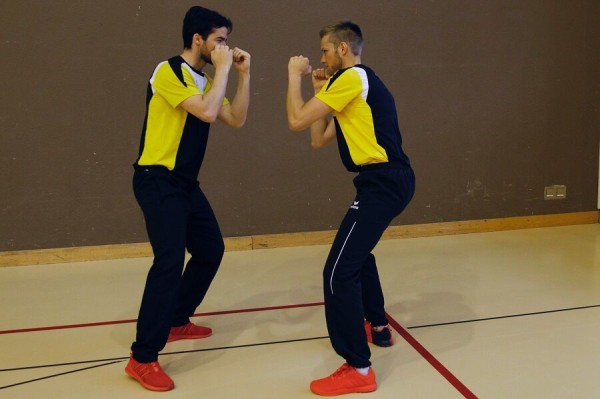
One participant moves into a boxing stance with a follow-through step. The feet remain shoulder-width apart, the foot that is closer to the direction of movement initiates the movement. The weight is on the balls of the feet, the steps are springy and gliding. The partner opposite always tries to keep the same distance and performs the same movements in mirror image (shadow walk).
Variant:
Touch the knuckle of your partner's little finger at eye level with every step.
No material required
Shadow run
Leakage
Partner work
Groups of 2
The person in front moves freely forwards, backwards or sideways in the hall/area and incorporates various relaxation exercises (e.g. shaking out arms and legs). The partner imitates the movements identically. Swap roles from time to time or even switch partners.
No material required
Shadow run with touch
Light-Contact
Partner work
Regular change of roles and partners
.
One participant moves into a boxing stance with a follow-through step and sets the pace and direction. The feet remain shoulder-width apart, with the foot closest to the direction of movement initiating the movement. The weight is on the balls of the feet, the steps are springy and gliding. The partner opposite always tries to keep the same distance and performs the same movements in mirror image (shadow walk). As soon as the leading participant stands still, the other participant tries to touch the partner's shoulders twice crosswise with the respective palm (leading hand/punching hand).
Key points: move slowly to acquire the technique, maintain the same distance, keep your guard up, punch from the hip (metaphor: putting out a cigarette with your foot), reduce the distance when attacking (into the opponent) and then immediately move back again (detach yourself from the opponent).
Variant:
Acquisition of punch combinations by the instructor demonstrating different sequences:
1. lead hand
2. lead hand + punching hand
3. lead hand + punching hand + sideways hook (left)
4. lead hand + punching hand + sideways hook (left) + uppercut (right)
No material required
Shooting gallery
Stimulate circulation
Group work
2 teams
Two teams face each other behind two defined lines. In the centre of the lines are vaulting boxes or long benches on which there are various targets (e.g. medicine balls or small huts). The participants try to hit the targets with targeted shots/throws so that they land in the opponent's field behind the vaulting boxes or long benches. The target shots may only be made from behind the throwing line. The baseline, but not the centre line, may be crossed to retrieve new throwing objects. There are numerous throwing objects (e.g. balls, frisbees or Indiacas) in both zones at the start of the game.
Variant I:
The sports director can specify various throwing/striking techniques.
Variant II:
Throws at the targets are made while standing on an unstable surface.
Per participant:
1 stick/stick ►intercrosse/lacrosse, smolball, floorball
1 medicine ball/foam/softball/balance cushion/balance board ►unstable surface
2-3 long benches/swinging box ►platform for targets
x cones/marking cones/cups/medicine balls/stakes ►targets
x balls/throwing discs ►basketball, Frisbee Ultimate, FooBaSKILL, Futsal/Football, Handball, Intercrosse/Lacross, Smolball, Tchoukball, Floorball
Shooting position - crouching
Power
Individual work

From the patrol position to the crouch position in accordance with regulation 53.096:
1. position the hips at an angle of 35° to the direction of fire, the weak shoulder to the front;
2. bend both knees simultaneously and move into the crouch position;
3. the feet remain flat on the ground;
4. place the weapon against the shoulder;
5. the strong hand grasps the pistol grip without tensing, the strong arm pulls the stock into the shoulder cavity;
6. both elbows rest in front of the knees;
7. the weak hand grasps the hand guard and presses the weapon against the shoulder;
8. The body is slightly bent forwards.
Lighten:
Without a combat backpack
Harden:
Combat backpack loaded with an additional 3kg (water bottles)
Material per participant: Tenue CNK 420
Additional material: 1 F-disc with peg, 2 PET bottles (1.5l)
Shooting position - kneeling
Power
Individual work

From the patrol position to the kneeling shooting position according to regulation 53.096:
1. Take a step forward with the weak foot, crossing the imaginary line between the tip of the strong foot and the target;
2. Bend both knees simultaneously;
3. If possible, sit on the strong heel;
4. Align the strong knee at a 45° angle to the direction of the shot;
5. Support the weak elbow slightly in front of or behind the weak knee. Avoid resting the elbow exactly on it, as the elbow and knee joints are round and this affects stability. Support the weapon at the shoulder;
6. The strong arm pulls the stock into the shoulder cavity, the strong hand grips the pistol grip without cramping;
7. The weak hand grips the hand guard and presses the weapon against the shoulder.
Lighten:
Without a combat backpack
Harden:
Combat backpack loaded with an additional 3kg (water bottles)
Material per participant: Tenue CNK 420
Additional material: 1 F-disc with peg, 2 PET bottles (1.5l)
Shooting position - prone
Power
Individual work

From the patrol position to the kneeling shooting position in accordance with regulation 53.096:
1. Bend both knees simultaneously;
2. Kneel in line with the hips;
3. Bend the upper body forwards and support it with the weak hand;
4. Lie down so that the weapon and the body form a line (avoid contact between the weapon and the ground);
5. the strong hand grips the pistol grip without tensing, the strong arm pulls the stock into the shoulder cavity;
6. the weak forearm is as vertical as possible, the weak hand clasps the hand guard and presses the weapon against the shoulder;
7. Place your feet on the ground if possible.
Lighten:
Start from point 2 (see above)
Harden:
With a protective waistcoat;
With the weapon shouldered.
Material per participant: Tenue CNK 420
Additional material: 1 F-disc with peg; 1 protective vest
Shooting position - sitting
Power
Individual work

Lying on your back, assume the seated shooting position with legs apart according to regulation 53.096:
1. The strong hand grasps the pistol grip without tensing, the strong arm pulls the stock into the shoulder cavity;
2. Both elbows rest on the inside of the knees;
3. the weak hand grasps the hand guard and presses the weapon against the shoulder;
4. the body is slightly bent forwards.
Repeat the exercise without resting the shoulders on the ground.
Lighten:
Without material
Harden:
With combat backpack
Material per participant: Tenue CNK 420
Additional material: 1 F-disc with peg
Type of stroke: Uppercut
Light-Contact
Individual work

Stance offset frontally to the soft mat placed on a bar. With both arms, alternate strikes from bottom to top (uppercuts) to the mat (underside of the opponent's chin). The elbows remain in front of the body and the opposite hand on the face for protection/defence. The legs and upper body are straightened simultaneously for the punch (use the power from the legs).
Uppercut:
The uppercut is the most difficult punch in terms of structure. It is triggered by hip rotation. In preparation, the fist and upper body are dropped slightly. The forearm is then brought up vertically in front of the body and the legs, hips and torso are stretched at the same time. The fist should hit the chin from below.
1 pair of boxing gloves
1 soft mat
1 parallel bars