
Exercises (1882)
Lunge sideways (right) ► lateral lunge
Power
Individual work


From an upright shoulder-width stance with the dumbbells held in the hanging arms, perform a lunge to the (right) side (leg outstretched, supporting leg bent). Then push off the bent leg to return to the starting position in the standing position.
Starting position:
- Stand shoulder-width apart
- Your back is straight
- Let your arms hang loosely, grasp the dumbbells in a neutral grip
Finishing position:
- Back remains straight
- Look straight ahead
- Leg to be trained is bent, the other leg is stretched out to the side
- Buttocks point backwards, do not bring the knee of the training leg forwards (does not protrude beyond toes)
- Keep the knee of the supporting leg centred over the foot, put weight on the whole foot
- Thigh of the bent leg is parallel to the floor
- Dumbbells (almost) touch the floor
2 dumbbells
Lunge sideways (right) ► lateral lunge
Power
Individual work


Adjust the sling trainer to the length of the centre of the lower leg (when standing), stand on one leg (right) to the side of the attachment point, spread the nearer (left) foot with the leg stretched out and fix it in the sling, bend and stretch the knee of the (right) standing leg (raise and lower the upper body).
Attention:
Do not allow the knee to move out to the side (keep it in line with the axis), move the buttocks backwards, not the knee forwards (the tip of the foot should not overhang the supporting leg).
Harden:
The further the supporting leg is to the side of the attachment point, the more challenging the exercise becomes.
1 sling trainer
Lunge sideways alternating ► lateral lunge
Power
Individual work


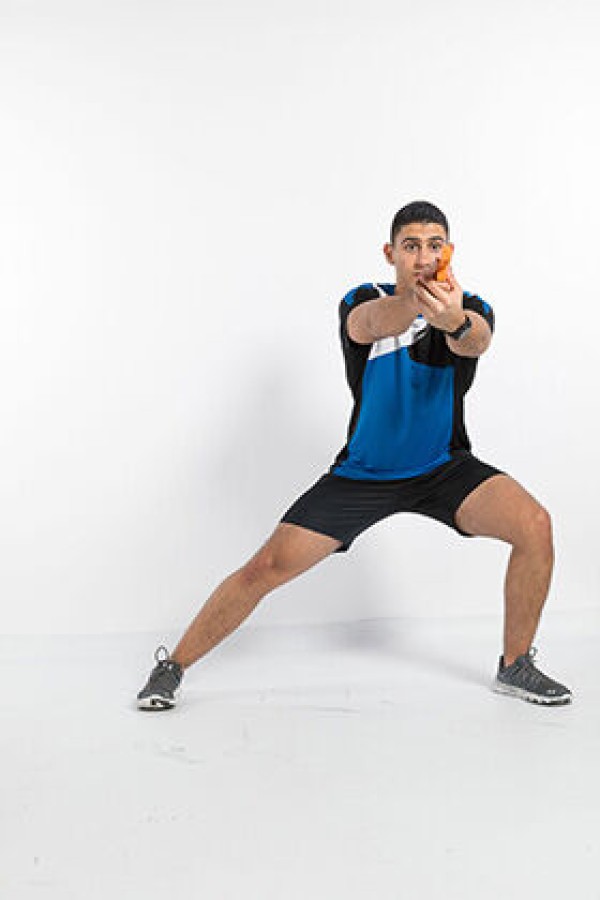
Standing lunge, lunge to the side in contact position with simultaneous bending of the legs and lowering of the upper body to move sideways and return to the standing position (movement as if you were ducking under a height limit). The next exercise is performed in the opposite direction so that you are back at the starting position.
Lighten:
Bend your knees less/barely lower your body.
Harden:
Bend your knees more/Centre of gravity very low.
1 Pistol
Lunge sideways alternating ► lateral lunge
Power
Individual work


Standing lunge, lunge to the side in contact position with simultaneous bending of the legs and lowering of the upper body to move sideways and return to the standing position (movement as if you were ducking under a height limit). The next exercise is performed in the opposite direction so that you are back at the starting position.
Lighten:
Bend your knees less/barely lower your body.
Harden:
Bend your knees more/Centre of gravity very low.
1 assault rifle (neutralised)
Lunge sideways alternating ► lateral lunge
Power
Individual work


Stand upright shoulder-width apart, feet in the loops, hold the gymnastics pole in front of the body with bent, parallel forearms (baby position), lunge to the side (leg stretched out, supporting leg bent), push off the bent leg to return to the starting position. Switch sides after each exercise.
Attention:
Keep your upper body upright, keep the knee of the supporting leg centred over the foot, put weight on the whole foot.
Lighten:
Choose less strong elastic bands; roll up the elastic bands less; bend the training leg less (lower the upper body less).
Harden:
Choose stronger elastic bands; roll up the elastic bands more.
1 gymnastic bar with elasticated straps
Lunge sideways alternating ► lateral lunge
Power
Individual work


From an upright shoulder-width stance with the dumbbells held in the hanging arms, perform a lunge to the side (leg outstretched, supporting leg bent). Then push off the bent leg to return to the starting position in the standing position. Switch sides after each exercise.
Starting position:
- Stand shoulder-width apart
- Your back is straight
- Let your arms hang loosely, grasp the dumbbells in a neutral grip
Finishing position:
- Back remains straight
- Look straight ahead
- Leg to be trained is bent, the other leg is stretched out to the side
- Buttocks point backwards, do not bring the knee of the training leg forwards (does not protrude beyond toes)
- Keep the knee of the supporting leg centred over the foot, put weight on the whole foot
- Thigh of the bent leg is parallel to the floor
- Dumbbells (almost) touch the floor
2 dumbbells
Lunge forwards alternating ► farmer walk
Power
Individual work

Grab an object with both hands (approx. 10kg), arms hanging at your sides. Carry objects back and forth between two fanjons, moving with lunges (back knee just touching the floor).
Attention:
Keep your back straight, your pelvis stable with every step, keep your shoulders fixed (lower towards your hips).
Lighten:
Equipment approx. 5kg
Harden:
Equipment approx. 15kg
2 fanjons
Weight 10kg
Weight 5kg ► make the exercise easier
Weight 15kg ► make the exercise more difficult
Lunge forwards alternating ► forward lunge
Power
Individual work


Stand upright, arms supported on the hips, folded across the chest or in front, lunge forwards, bend the front (and back) leg to a right angle (back knee briefly touches the floor), push off the front leg to return to the starting position. Switch sides for the next exercise.
Attention:
Always keep the front knee behind the tip of the foot and centred over the foot. Distribute your weight over the entire front foot. Keep an upright posture (tense torso), push your front knee outwards (do not tilt it inwards).
Lighten:
Lower your upper body less (greater angle at the knees).
Harden:
Additional weight (on the shoulders, with hanging arms or in a forward or upright position).
Variant I:
Push off the back leg to return to the standing position. The lunge creates locomotion.
Variant II:
Instead of bringing the front leg to a standing position, the back leg is brought directly forwards and the knee is bent (new lunge), creating continuous locomotion.
1 weight vest/weight disc/(medicine) ball/barbell/sandbag/fighting backpack/2 dumbbells ► make the exercise more difficult (additional weight)
Lunge forwards alternating ► forward lunge
Power
Individual work
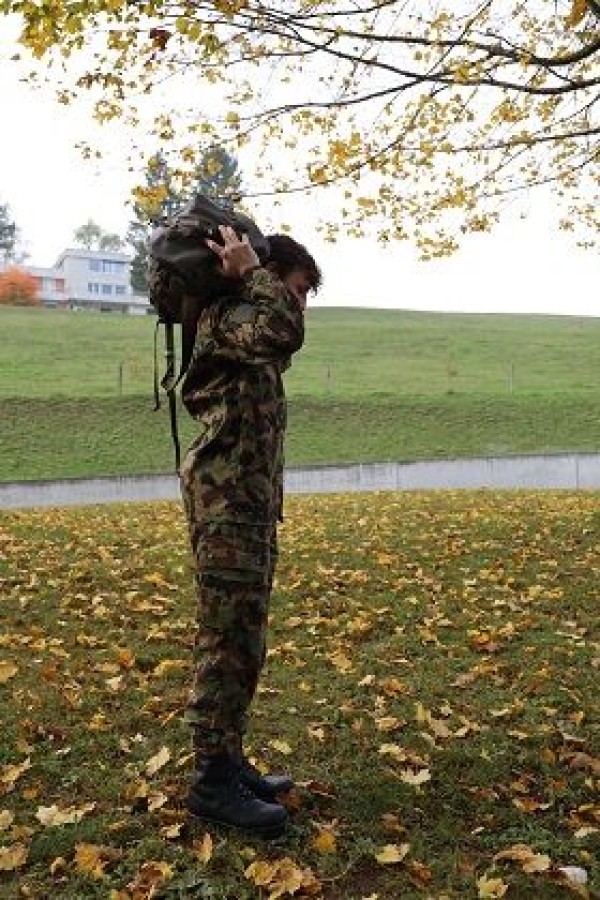
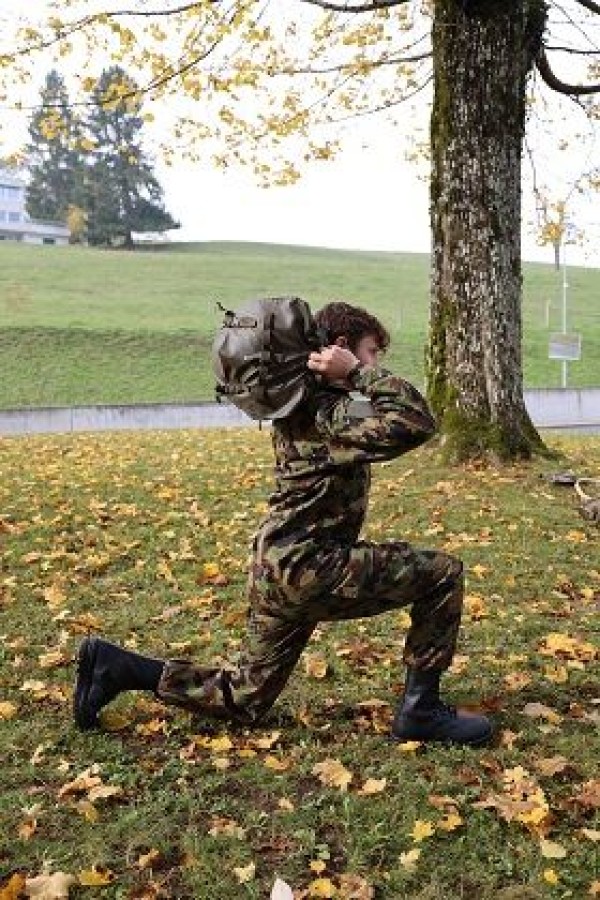
Stand upright, hold an object placed on your shoulder or neck (e.g. sandbag or rucksack) with your hands, lunge forwards, bend your front (and back) leg to a right angle (back knee briefly touches the floor), push off your front leg to return to the starting position. Switch sides for the next exercise.
Attention:
Always keep the front knee behind the tip of the foot and centred over the foot. Distribute your weight over the entire front foot. Keep an upright posture (tense torso), push the front knee outwards (do not tilt inwards).
Lighten:
Less weight/load; lower the upper body less (greater angle in the knees).
Harden:
More weight/increased load.
Variant I:
Push off the back leg to return to the standing position. The lunge creates locomotion.
Variant II:
Instead of bringing the front leg to the standing position, the back leg is brought directly forwards and the knee is bent (new lunge), creating continuous locomotion.
1 combat rucksack/sandbag (medium weight)
1 sandbag (light) ► make the exercise easier
1 weight vest/sandbag (heavy) ► make the exercise more difficult (additional weight)
Lunge forwards alternating with extension and flexion of the arms ► lunge & overhead press
Power
Individual work


Stand upright, place the barbell on your shoulder/neck or hold it in front of your chest and hold it with your hands more than shoulder-width apart. Lunge forwards, bend your front (and back) leg to a right angle (back knee practically on the floor), simultaneously straighten your arms and push the barbell upwards. Then bring the back leg forwards to perform another lunge (forwards movement). With each lunge, the weight is pushed upwards once (in the low lunge position, the arms are extended; in the upright single-leg position, the barbell is in the starting position).
Attention:
Always keep your front knee behind the tip of your foot and centred over your foot. Distribute your weight over the entire front foot. Keep an upright posture (no hollow back, tense torso), push your front knee outwards (do not tilt inwards).
Lighten:
Less weight/load; lower your upper body less (greater angle in the knees).
Harden:
More weight/greater load.
Variant I:
Attach a weight disc to both ends of the barbell with an elastic band. Due to the instability created by the swinging weight, the variation of the exercise also promotes sensorimotor skills and the exercise is significantly more challenging.
Variant II:
Push off the front leg to return to the standing position (no movement).
1 barbell
2 elastic bands and (small) weight discs ► variation of the exercise
Lunge forwards alternating with extension and flexion of the arms ► lunge & overhead press
Power
Individual work


Stand with your hips wide apart, hold the weight in front of your body, lunge forwards (approx. 60-90 cm), lower your hips to the floor until the back of your leg is parallel to the floor, bend your front leg to a right angle. From this position, the front lift is performed by raising the arms so that the weight is finally overhead. After a short pause in the lunge position with the arms held high, the front leg is pushed down to return to the standing position. Switch sides for the next exercise.
Attention:
Always keep the front knee behind the tip of the foot and centred over the foot. Distribute your weight over the entire front foot. Stand upright (tense torso), push the front knee outwards (do not tilt inwards).
Lighten:
Less or no additional weight; lower the upper body less (greater angle in the knees).
Harden:
More weight.
Variant I:
Push off the back leg to return to the standing position. The lunge creates locomotion.
Variant II:
Instead of bringing the front leg to the standing position, the back leg is brought directly forwards and the knee is bent (new lunge), creating continuous locomotion.
1 medicine ball/weight disc/dumbbell
1 weight waistcoat ► to make the exercise more difficult (additional weight)
Lunge forwards alternating with rotation of the upper body
Power
Individual work
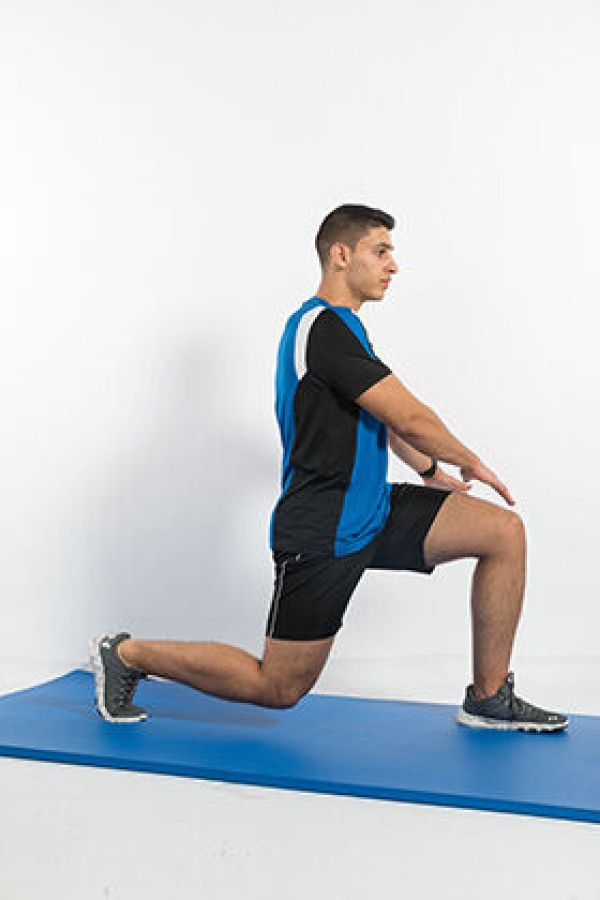
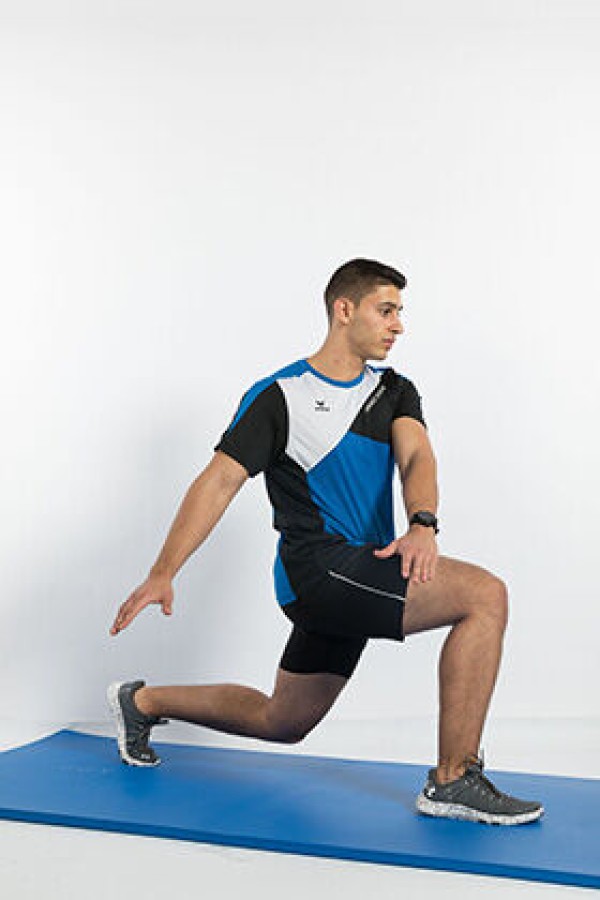
Stand upright, arms stretched as far as possible in front, lunge forwards, bend the front (and back) leg to a right angle, rotate the upper body to the side of the front leg and back in the lunge position (look at the movement), push off the front leg to return to the starting position. Switch sides for the next exercise.
Attention:
Always keep the front knee behind the tip of the foot and centred over the foot. Distribute weight over the entire foot. Stand upright (tense torso), push the front knee outwards (do not tilt inwards).
Lighten:
Lower the upper body less (greater angle in the knees).
Harden:
Additional weight (hold in hands).
Variant I:
Push off the back leg to return to the standing position. The lunge creates locomotion.
Variant II:
Instead of bringing the front leg back to the standing position, the back leg is brought forwards and the knee is bent (new lunge), creating continuous locomotion.
1 weight vest/weight disc/(medicine) ball/1-2 dumbbells ► make the exercise more difficult (additional weight)
Lunge forwards alternating with rotation of the upper body
Power
Individual work


When standing upright, hold an object (e.g. helmet or rucksack) at chest height with arms almost outstretched, lunge forwards, bend the front (and back) leg to a right angle (back knee briefly touches the floor), rotate the upper body/object to the side of the front leg and back in the lunge position (gaze accompanies the movement), push off the front leg to return to the standing position in the starting position. Switch sides for the next exercise.
Attention:
Always keep the front knee behind the tip of the foot and centred over the foot. Distribute your weight over the entire front foot. Keep an upright posture (tense torso), push the front knee outwards (do not tilt inwards).
Lighten:
Less weight/load; lower the upper body less (greater angle in the knees).
Harden:
More weight/increased load.
Variant I:
Push off the back leg to return to the standing position. The lunge creates locomotion.
Variant II:
Instead of bringing the front leg to the standing position, the back leg is brought directly forwards and the knee is bent (new lunge), creating continuous locomotion.
1 combat rucksack/weight plate/dumbbell
1-2 PET bottles (1.5 litres)/helmet ► make the exercise easier
1 tyre (PUCH)weight vest/sandbag ► make the exercise more difficult (additional weight)
Lunge forwards alternating with rotation of the upper body
Power
Individual work


Stand upright with your feet in the loops, hold the gymnastics pole with your hands on your shoulders behind your head, perform a lunge forwards, front leg bent (approximately right angle in the knee joint), back leg almost fully extended on tiptoe, move/rotate your upper body from one side to the other (head accompanies the movement), push off the front leg to return to the starting position. Switch sides after each lunge.
Attention:
The hips and knees point forwards during the entire movement. The front knee always remains behind the toe and centred over the foot. Lower your body in the centre (like a plumb line following the back knee, upper body remains upright, tighten your stomach).
Lighten:
Select less strong elastic bands; roll up the elastic bands less.
Harden:
Choose stronger elastic bands, roll up the elastic bands more.
Variant:
To relieve pressure on the neck, the gymnastic stick can also be held in front of the body at sternum level (baby position).
1 gymnastic bar with elasticated straps
Evasive manoeuvre with counterattack
Light-Contact
Partner work
Presentation by leader.
The groups of two then practise the movements (including role reversal and changing partners from time to time); the leader corrects them.
One participant slowly strikes a straight line towards their partner's forehead. The opponent dodges and strikes back:
Leading hand:
When countering with the leading hand (example left side), the front foot remains stable in place, the weight is shifted to the rear (right) foot (tilt the upper body slightly backwards). To avoid the opponent's punch, the body weight is not only shifted backwards, but the upper body is also tilted to the side (outwards - to the right). Finally, you follow up with your own punch (jab) with the (left) lead hand (on the "inside" side).
Punching hand:
When countering with the punching hand (right side example), you take a step to the (left) side (sidestep), shifting your weight to the front (left) foot. Finally, the own punch (straight) follows with the stronger hand (on the "inner" side).
Exercise:
In groups of 2, the evasion including the counter punch is practised. This involves dodging twice to one side and then to the other (lead hand and punching hand). The sequence of movements is practised very slowly at first; the speed can only be increased once the sequence of movements has been completely mastered. The roll can be changed after each pass (twice on the left and right side) or after several passes. In order to gain more confidence in the sequence of movements, several passes in succession are suitable. It also makes sense to change partners from time to time (variety and different levels of participants). The instructor can make the exercise more difficult by no longer clearly defining the attacking side (e.g. 5 attacks - side arbitrarily determined by the attacker - role change - partner change).
Participant:
1 pair of boxing gloves
Evasive manoeuvre: Avoid straight line
Light-Contact
Partner work


One participant strikes a straight line at their partner's forehead height. The opponent dodges to the side with a quick sideways movement of the upper body (punch with the right, dodge to the left). When avoiding, both fists remain up to cover, the boxer maintains eye contact with the opponent throughout the exercise. Perform the exercise on both sides and switch roles after a while.
No material required
Evasive manoeuvre: Combination
Light-Contact
Partner work


Participant A slowly executes various punches against participant B and gives him enough time to adapt his defence. Strikes and their defence:
- Straight to the head ►Head cover (inside hand block) / Side avoidance
- Straight to the body ►Elbow block
- Side chop ►Rolling avoidance
After some time, switch roles.
Variant:
Discuss the sequence of punches together and execute the punches faster accordingly.
Participant:
1 pair of boxing gloves
Evasive manoeuvre: step backwards
Light-Contact
Partner work
Presentation by leader.
The groups of 2 then practise the movements (including role reversal); the leader corrects them.
One participant slowly strikes a straight line towards their partner's forehead. The partner evades by taking a long step backwards. The movement impulse is created by a powerful kick backwards with the front foot, at the same time the back foot is moved back significantly and finally the front foot is pulled in. After the backward step, make sure that the distance between the feet matches the starting position again.
Exercise 1a:
Participant A: left/right punch - step backwards / participant B: 2x block left/right - straight -> constant role reversal
Exercise 1b:
Participant A: analogue 1a plus straight / participant B: analogue 1a plus step backwards -> constant role reversal
Variant:
The groups of 2 are constantly in motion (shifting in the basic position forwards/backwards, left/right). On the command "top" from the leader, the combination (exercise 1a/1b) is performed.
Participant:
1 pair of boxing gloves
Evasive manoeuvres: avoid sideways hooks
Light-Contact
Partner work


One participant throws a "slap" (a sideways punch) at their partner's forehead. The partner dodges by ducking and moving slightly sideways towards the punching arm (the nose draws a circle in the air). When avoiding, both fists must be held at the temple and the boxer must maintain eye contact with the opponent throughout the exercise. Perform the exercise on both sides and switch roles after a while.
No material required
Evasive manoeuvre: sideways step
Light-Contact
Partner work
Presentation by leader.
The groups of 2 then practise the movements (including role reversal); the leader corrects them.
One participant slowly strikes a straight line towards their partner's forehead. The partner evades by taking a step to the side:
Variant 1:
In a staggered stance (starting position), move the rear foot by approx. 90 degrees to one side or the other (correct step to the side, foot is lifted off the floor), then perform the same movement with the front foot (distance between the legs again corresponds to that of the starting position) and turn the upper body (chest finally points in the same direction as the feet - displacement corresponds to a quarter circle). The evasive manoeuvre can also be performed with the front foot, which is moved first (the back leg is pulled behind).
Variant 2:
Practically identical movement as described above, except that the front foot is always moved first. It is placed on the tips of the toes in order to rotate the body and the rear foot into the new position (with momentum, so to speak). This movement is called a "pivot" and, as a metaphor, you can imagine that the front foot is used to stub out a cigarette on the floor or remove chewing gum from the sole.
No material required
Capturing the ball
Fighting and roughhousing games
Partner work
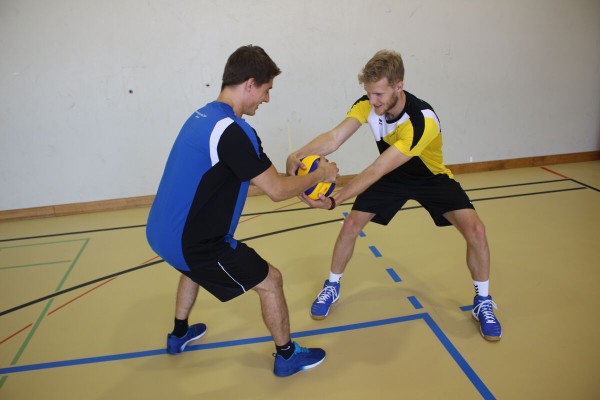
Two participants grab a ball with both hands. The participants try to snatch the ball from their opponent. Whoever captures the ball wins.
1 ball (e.g. volleyball, softball, handball, basketball, football)
Capturing the ball
Fighting and roughhousing games
Partner work
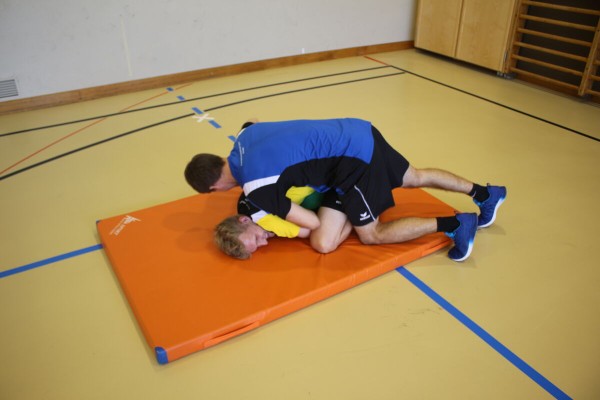
One participant tries to shield a ball as well as possible from their opponent (e.g. burying the ball underneath them in a four-footed stance). The opponent tries to steal/steal the ball from them.
Variant:
Stop time until the ball is successfully captured or set a time limit for the attempt.
1 soft mat (small) ►indoor version
1 ball (e.g. volleyball, softball, handball, basketball, football)
1 rash tent sheet ►outdoor version
1 stopwatch ►variations of the exercise
Step-up to balance ► step-up to balance
Power
Individual work
Stand upright, facing the Swedish bench with your feet hip-width apart, engage your core and hold a dumbbell in the hand on the side of your supporting leg. Place your foot completely and firmly in the centre of the bench, ensuring that the ball of your foot and your heel are in full contact with it. Shift your body weight onto your front leg and push yourself up powerfully. Once at the top, bring your free leg straight up in a controlled knee lift (at least 90° at the hip and knee), whilst the opposite arm moves forwards and upwards in a runner’s arm swing. "Freeze" in this end position on one leg for 1–2 seconds, keeping your pelvis level and your shoulders relaxed. Then, in a controlled and decelerated manner, bring the free leg back and down towards the floor, reset the supporting leg and repeat the movement fluidly, or switch sides.
Attention:
The lower leg pushes off the floor with momentum (a jump rather than relying on the supporting leg for power); the knee of the rising leg buckles inwards as it is pushed upwards; the final position at the top is not stabilised, but is immediately released; the pelvis sags downwards on the side of the free leg whilst standing on one leg (Trendelenburg sign); only the forefoot rests on the edge of the bench, whilst the heel hangs in the air; the descent is uncontrolled and unchecked (‘plopping down’).
Lighten:
Choose a lower box height or bench; in the top position, let the free leg tap lightly onto the bench with the tips of the toes, rather than holding it freely in the air; Slow down the pace of the movement; use your fingertips to hold onto a wall or bar for lateral support; choose lighter dumbbells.
Harden:
Wear a weighted vest or increase the weight of the dumbbells; deliberately slow down the downward movement (eccentric phase) significantly to 3–4 seconds before your foot touches the floor; place the foot of your supporting leg on a balance pad on the bench; seamlessly incorporate a light calf raise on your supporting leg from the top of the knee lift.
1 plyo box / vaulting box
1 dumbbell ► makes the exercise more challenging (additional weight)
1 weighted vest ► makes the exercise more challenging (additional weight)
1 unstable surface ► makes the exercise more difficult (balance component)
Bench push
Fighting and roughhousing games
Partner work
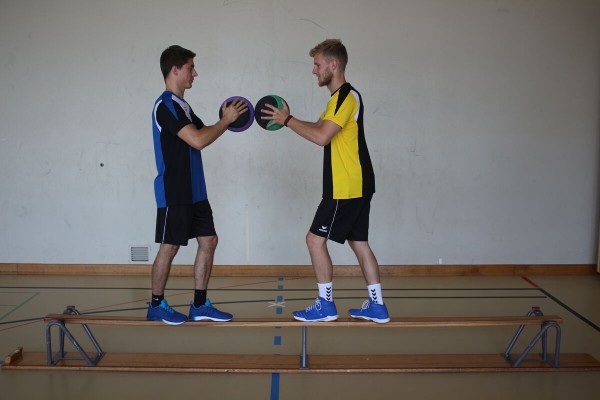
Two participants stand opposite each other on the narrow side of a long bench (possibly raised using Swedish boxes) and each hold a medicine ball in their hands. The participants try to push each other off the long bench with the medicine balls. Whoever touches the ground first loses.
1 long bench
2 medicine balls
2 vaulting boxes ►Variation/making the exercise more difficult (post set-up)
Post set-up:
Position the long bench with the narrow side facing up (possibly hang it on the side of two vaulting boxes so that the long bench is raised off the ground).
Prone position (push-up) and upright position alternating ► db burpee deadlift
Power
Individual work
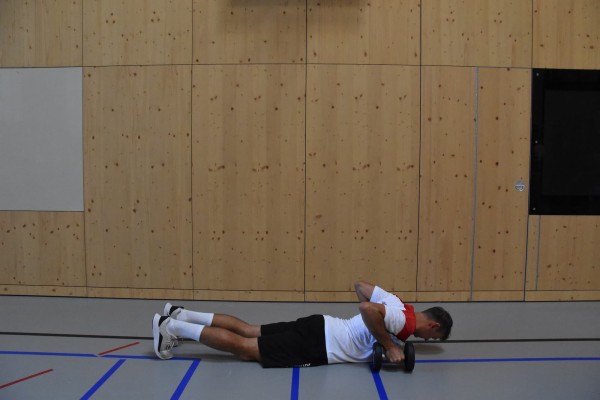
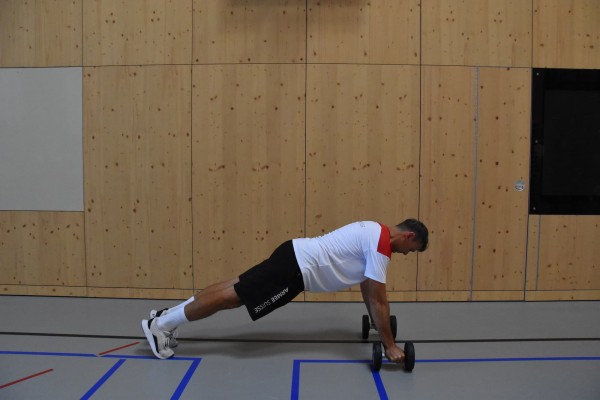
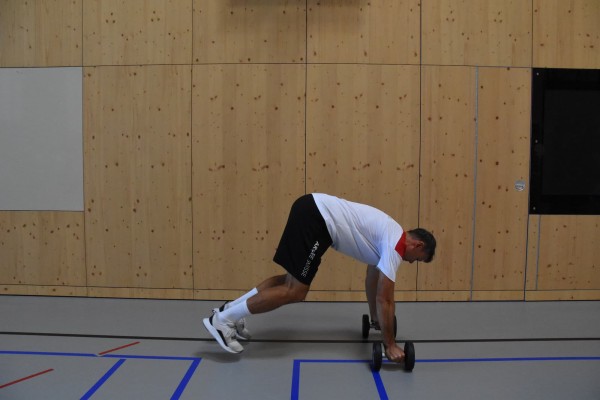
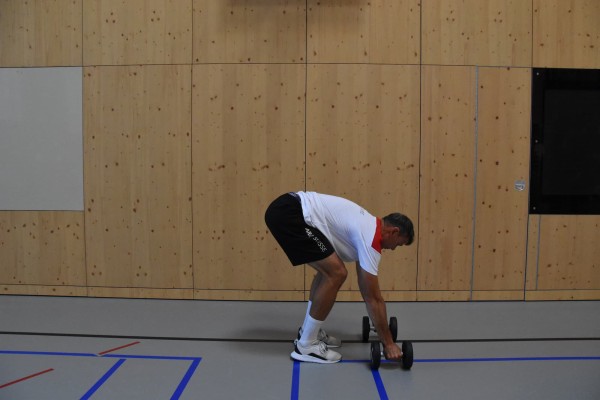
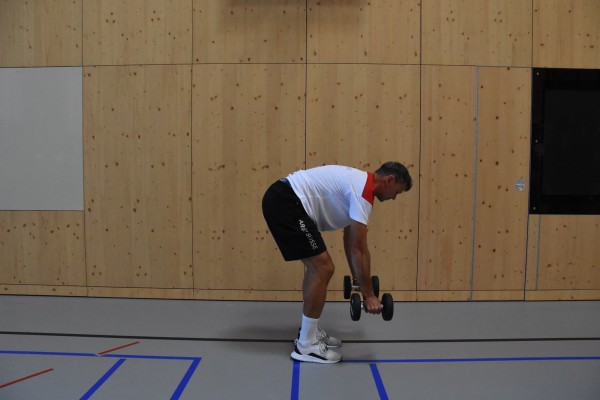
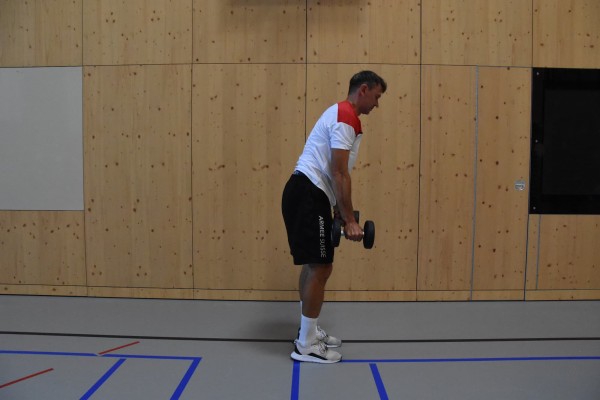
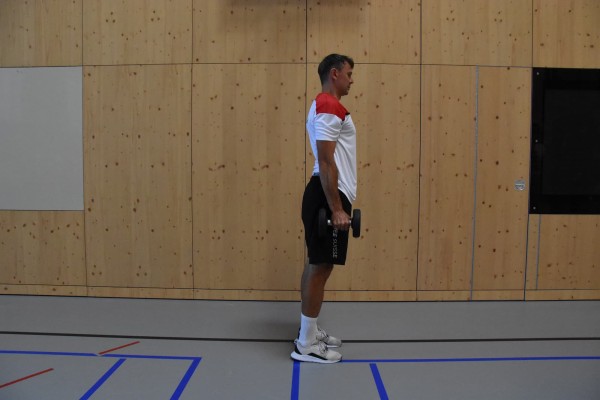
Stomach position, grasp a dumbbell with both hands (back of each hand pointing to the respective side), these are placed on the floor at chest height, the arms are bent accordingly. From this position, stretch your arms to push your upper body away from the floor, your knees are also no longer in contact with the floor and your slightly bent legs are only supported on the tips of your feet. With a small jump forwards, bring your legs approximately shoulder-width apart towards the dumbbells (place your feet slightly inwards behind the dumbbells on each side). The upper body is tilted forwards as the outstretched arms are still holding the weights on the floor (back as straight as possible). Now straighten your legs, push your hips forwards and raise your upper body to a standing position. The arms remain stretched and point sideways along the body towards the floor in the end position so that the weights are approximately at hip height. Then lower your upper body back down to place the weights on the floor again with your arms straight (with the tips of your feet slightly offset outwards). Support your upper body with your arms (hands gripping the dumbbells) to perform a two-legged jump backwards so that you reach the push-up position. Lower your upper body back to the starting position in the prone position (bend your arms, hold the weights next to your chest, knees on the floor, straight legs resting on the tips of your feet).
Lighten:
Less/no weight.
Harden:
Execute a push-up instead of lowering your body to the prone position; more weight.
2 dumbbells