
Exercises (1882)
One-legged jump into the air (right)
Power
Individual work


Stand upright on one leg (left leg slightly raised off the ground or bent) with your arms supported on your hips. Take a powerful jump with the training leg (right) straight up into the air (stretch your foot during the flight phase).
Attention:
Maintain an upright position (body tension).
Lighten:
Smaller/less intense jumps.
Harden:
Hold additional weight (on the leg, on the shoulders, in the hands); jump on a soft surface.
Variant I:
Pause between jumps (complete stance) or continuous jumping.
Variant II:
Tighten the knees to the height of the navel at the same time as jumping.
1 weight cuff/weight vest/sandbag/fighting backpack/2 dumbbells ► making the exercise more difficult (additional weight)
1 small/large soft mat ► making the exercise more difficult (base)
Jumping up and flexing the arms on a slope (pull-up) ► jumping pull up
Power
Individual work


Stand upright and position yourself slightly offset backwards under a high bar. With a small hop, bring your outstretched arms to the bar with an overhand grip (back of hand pointing towards your face). As soon as you have grasped the bar, bend your arms in one smooth movement to pull your upper body up as vertically as possible until your chin is over the bar (arms almost at shoulder height). Then release your hands from the bar to land on the floor in a standing position.
Attention:
Pull your body up as vertically as possible.
Lighten:
Stand with both feet or one foot in the loop of an elasticated rubber band attached to the horizontal bar.
Harden:
Additional weight.
Variant:
Grab the bar with an underhand grip (palm facing your face).
1 horizontal bar
1 elasticated rubber band ► Make the exercise easier (support)
2 weight cuffs/1 weight waistcoat ► Make the exercise more difficult (additional weight)
Leap into the distance
Power
Individual work
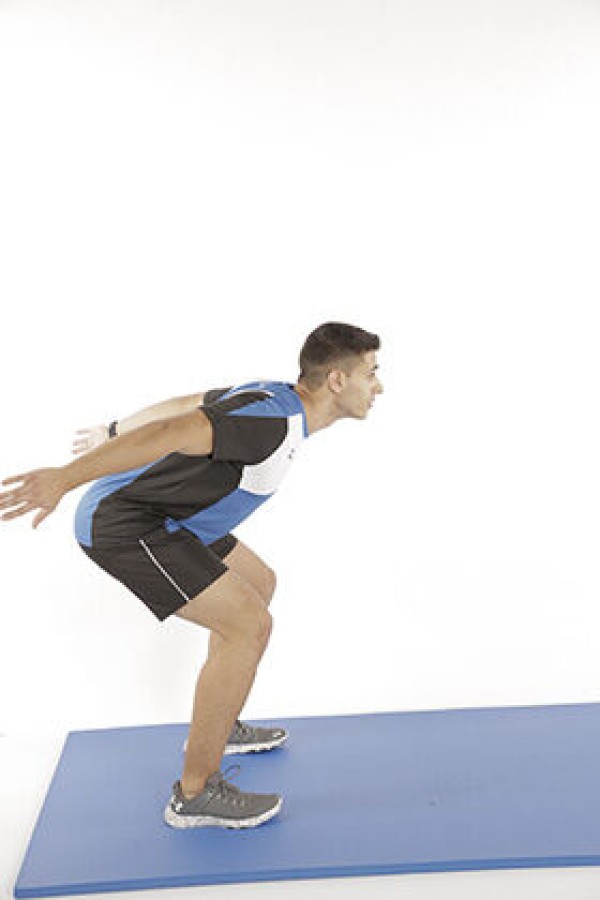

Stand with your hips wide apart, legs slightly bent and arms supported on your hips. Jump forwards with both legs, then hop backwards to the starting position.
Attention:
Lower your buttocks backwards when landing (do not move your knees forwards), pause briefly with your knees bent after each landing.
Lighten:
Bend your knees less (greater angle); less wide/intense jumps.
Harden:
Bend your knees more (smaller angle); hold your arms in front of you; hold additional weight (on your shoulders, in front of your chest or in your hands).
Variant:
Arms support the movement by swinging with you (lead from back to front when jumping forwards).
2-4 weight cuffs/2 weight balls/dumbbells/1 weight vest/weight disc/sandbag/fighting rucksack ► Make the exercise more difficult (additional weight)
Jump to the side
Power
Individual work
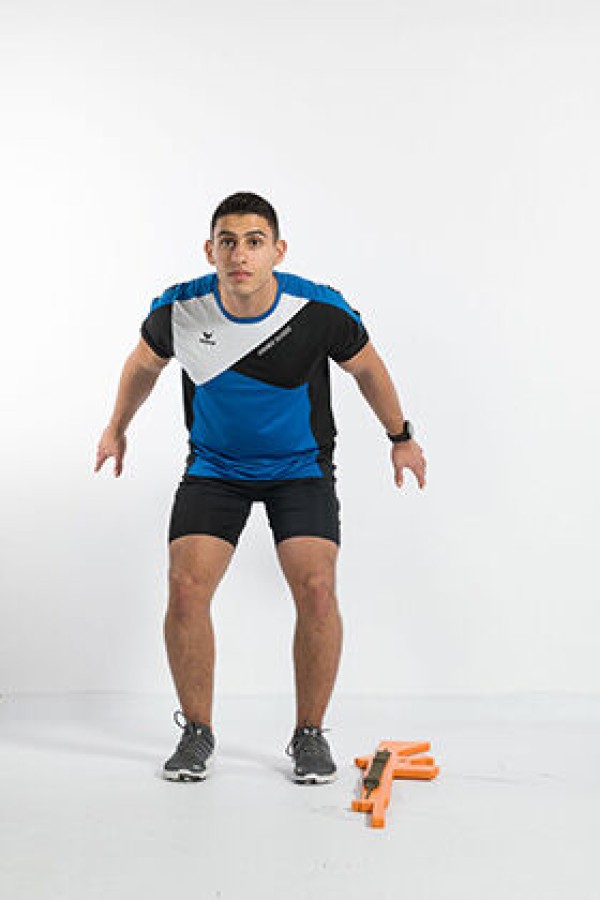

Assault rifle lying flat on the ground or placed on the bipod rest. Stand upright next to the weapon, facing in the direction of travel, and then perform two-legged jumps sideways over the rifle.
Lighten:
With the rifle resting on the bipod support, perform deeper jumps closer to the butt.
Harden:
Rifle placed on the bipod rest: perform higher jumps over the barrel.
Variant:
Launch/land with the leg facing away from the assault rifle (single-leg jumps).
1 assault rifle (neutralised)
One-legged jump to the side
Power
Individual work
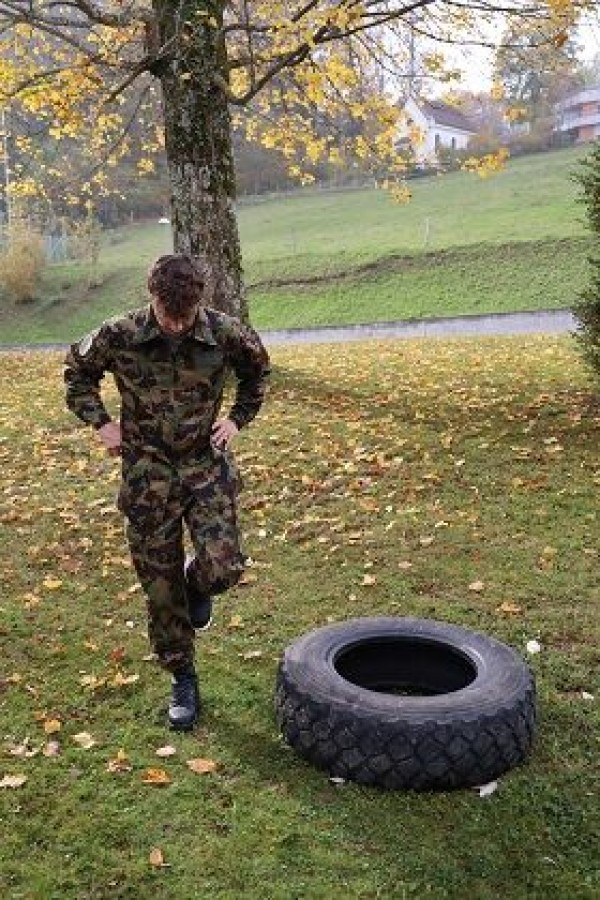
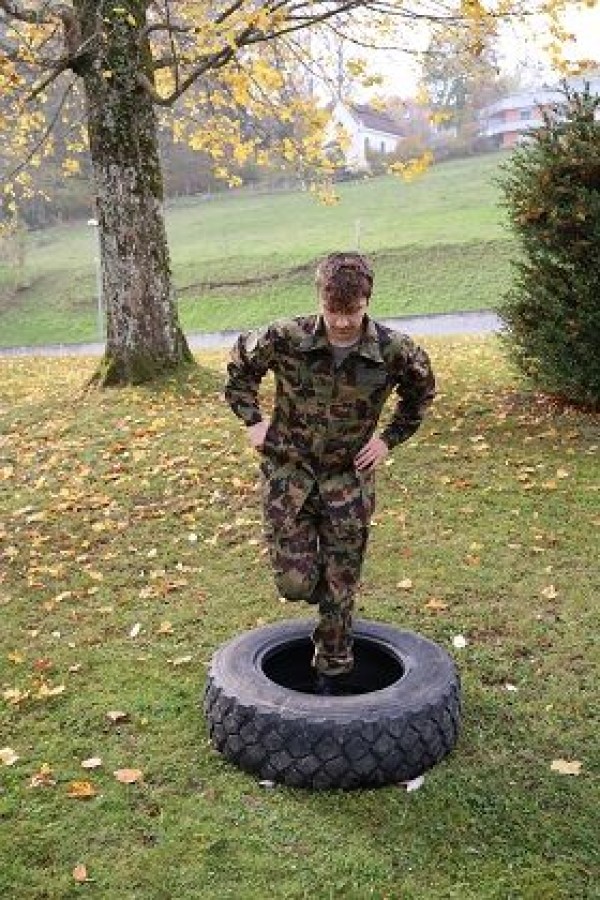
Stand on one leg outside the object (e.g. tyre) with the leg slightly bent. Tilt your upper body slightly forwards and jump onto the other leg inside the object and then jump back to the starting position.
Attention:
Risk of tripping.
Keep your knees stable and always behind your toes.
Lighten:
Jump without an object; jump over an object (e.g. combat backpack or helmet); lower cadence.
Harden:
Higher cadence; additional weight (on the feet).
1 tyre (10DM)
1 combat backpack/helmet ► make the exercise easier
2 weight cuffs/1 weight waistcoat ► make the exercise more difficult (additional weight)
One-legged jump to the side ► skater jump
Power
Individual work
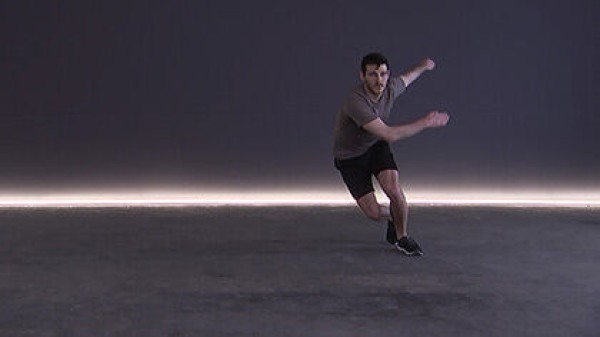

Stand on one leg with the leg slightly bent. Tilt your upper body forwards slightly and jump sideways onto the other leg. Hold your balance briefly in this position and then jump back to the other side.
Attention:
Keep your knees stable and always behind your toes.
Lighten:
Bend your knees less (greater angle); jump less to the side.
Harden:
Bend your knees more (smaller angle); hold additional weight (on your legs, shoulders, in front of your chest or in your hands).
2-4 weight cuffs/2 weight balls/dumbbells/1 weight vest/weight disc/sandbag/fighting rucksack ► Make the exercise more difficult (additional weight)
Relay race
Basic training
Group work
Groups of 4
Relay race in teams of 4 in the arena: Each group appoints a starting runner who carries a handover stick/ribbon or similar. A runner from each team stands ready in each corner. The starting runner completes the first part of the course before handing over the baton/ribbon to the next runner, who in turn hands over the relay item to the next runner, etc. The starting runner has the task of handing over the baton/ribbon to the next runner. The starting runner has the task of counting how many times he/she has returned to the starting point in the specified time (number of laps). The sports director starts 2 runs of 9 minutes each with a break of 1-2 minutes between the runs (change of direction). The team goal for the second round is to complete more laps than in the first round.
Course: square (max. size of a football pitch). size of a football pitch)
Intensity level: 3 (medium)
HFmax: 80-90%
Speech rule: speak in full sentences
Variant:
The participants run at different speeds (e.g. participant A: intensity 3; participant B: intensity 2).
4 marking cones/caps
1 handover stick/tape
Sports manager:
1 stopwatch
Standing and prone position alternating
Power
Individual work


From the standing position, assume the prone position freely, observing the correct stance (see regulation 53.103: bend both knees simultaneously; kneel on the line of the hips; bend the upper body forwards and catch it with the weak hand; lie down without the weapon touching the ground, weapon and body form a line). Then stand up (reverse sequence of movements) and return to the standing position.
Attention:
The weapon is always pointed forwards.
1 pistol (neutralised)
Standing and prone position alternating
Power
Individual work


From the standing position, assume the prone position freely, observing the correct stance (see regulation 53.096: bend both knees simultaneously; kneel on the line of the hips; bend the upper body forwards and catch it with the weak hand; lie down so that the weapon and the body form a line). Then stand up (reverse movement sequence) and return to the standing position.
Attention:
The weapon is always pointed forwards.
1 assault rifle (neutralised)
Alternating standing and crouching position
Power
Individual work


From the standing position, assume the crouching position, observing the correct stance (see regulation 53.096: bend both knees evenly, squat down; place feet flat on the ground; strike the weapon; both elbows are placed in front of the knees; the body is tilted slightly forwards). Then straighten up by stretching your legs and return to the standing position.
Attention:
The weapon is always pointed forwards.
1 assault rifle (neutralised)
Standing and kneeling position alternating
Power
Individual work


From the standing position, take up the position kneeling (on one knee), observing the correct stance (see regulation 53.103: take a step forwards with the weak leg over an imaginary line pointing from the tip of the strong foot to the target; bend both knees simultaneously; sit on the strong heel; bend the strong knee 45° from the direction of the shot; rest the weak elbow in front of or behind the weak knee). Then stand up by pushing off the front foot and return to the standing position.
Attention:
Weapon is always pointed forwards.
1 pistol (neutralised)
Standing and kneeling position alternating
Power
Individual work
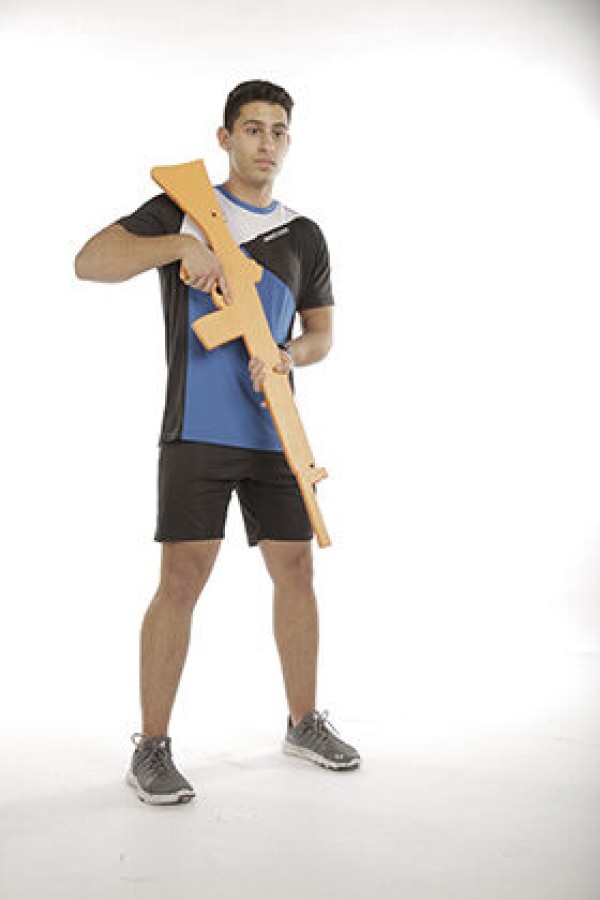

From the standing position, assume the kneeling position, observing the correct stance (see regulation 53.096: take a step forward in front of the strong leg with the weak leg, crossing the imaginary line from the strong leg to the target; bend both knees simultaneously, sit on the strong heel; the strong knee is bent 45 degrees from the direction of the shot; support the weak elbow slightly in front of or behind the weak knee). Then stand up by pushing off the front foot and return to the standing position.
Attention:
The weapon is always pointed forwards.
1 assault rifle (neutralised)
Standing and kneeling alternately
Power
Individual work


From the standing position, assume the kneeling position (on both knees), observing the correct stance (see regulation 53.103: starting position is the standing position; straighten the back and bend both knees at the same time; go to the ground with both knees). Then return to the standing position.
Attention:
The weapon is always pointed forwards.
1 pistol (neutralised)
Standing and supine position alternating (left) ► turkish get up
Power
Individual work


From the lying position (supine position), you move through various intermediate positions to the upright position, whereby the main focus is on holding the weight (dumbbell or kettlebell) in one hand overhead in a stable position and always working with a stretched back.
As a starting position, the weight is held in a supine position with one arm (left) almost outstretched at chest height (arm pointing upwards), the leg (left) on the same side where the weight is held is bent (foot placed on the floor). Firstly, the shoulders are lifted using the forearm of the arm resting on the floor (right). Then rest the free arm on the hand to lift the whole upper body away from the floor. The hips are then pushed upwards and the outstretched leg (right) is pulled under the body and brought backwards into a kneeling position (half kneeling position with one hand resting on the floor). The arm that is currently still supporting you (right) is then finally lifted off the floor to a half-kneeling position with the upper body upright. A lunge is used to assume the final standing position. Reverse the sequence of movements to return to the starting position lying on the floor.
Starting position:
- Supine position
- Leg bent and positioned on the side of the weight
- Weight held in front of you with one arm almost straight (arm pointing firmly upwards)
- Abdominal and gluteal muscles are tensed
- Gaze is directed towards the weight
Final position:
- Stand upright with a straight back
- Stabilise the weight overhead with an almost outstretched arm
Attention:
This exercise places extremely high demands on mobility and stability, which is why it is only suitable for advanced exercisers. Distribute the weight over the entire foot during the movement sequence
1 dumbbell/kettlebell
Standing and supine position alternating (left) ► turkish get up
Power
Individual work
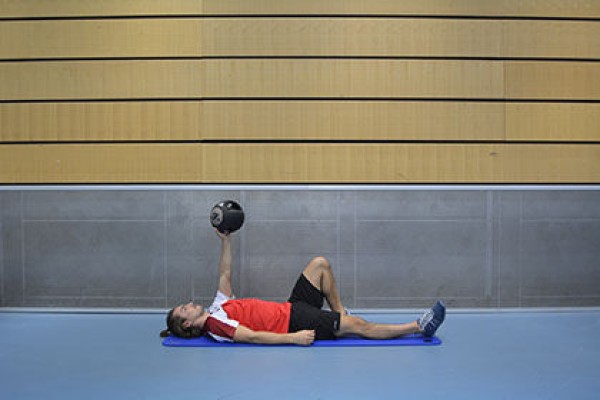


From the lying position (supine position), you move through various intermediate positions to the upright position, whereby the main focus is on holding the weight (dumbbell or kettlebell) in one hand overhead in a stable position and always working with a stretched back.
As a starting position, the weight is held in a supine position with one arm (right) almost outstretched at chest height (arm facing upwards), the leg (right) on the same side where the weight is held is bent (foot on the floor). Firstly, the shoulders are lifted using the forearm of the arm resting on the floor (left). Then rest the free arm on the hand to lift the whole upper body away from the floor. The hips are then pushed upwards and the outstretched leg (left) is pulled under the body and brought backwards into a kneeling position (half kneeling position with one hand resting on the floor). The arm that is currently still supporting you (left) is then finally lifted off the floor to a half-kneeling position with the upper body upright. A lunge is used to assume the final standing position. Reverse the sequence of movements to return to the starting position lying on the floor.
Starting position:
- Supine position
- Leg bent and positioned on the side of the weight
- Weight held in front of you with one arm almost straight (arm pointing firmly upwards)
- Abdominal and gluteal muscles are tensed
- Gaze is directed towards the weight
Final position:
- Stand upright with a straight back
- Stabilise the weight overhead with an almost outstretched arm
Attention:
This exercise places extremely high demands on mobility and stability, which is why it is only suitable for advanced exercisers. Distribute the weight over the entire foot during the movement sequence
1 dumbbell/kettlebell
Standing and supine position alternating (right) ► turkish get up
Power
Individual work
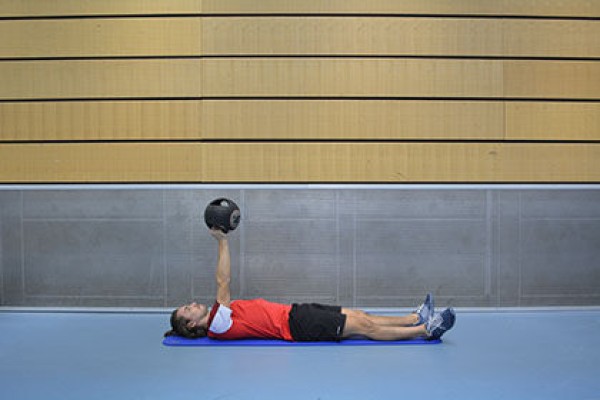


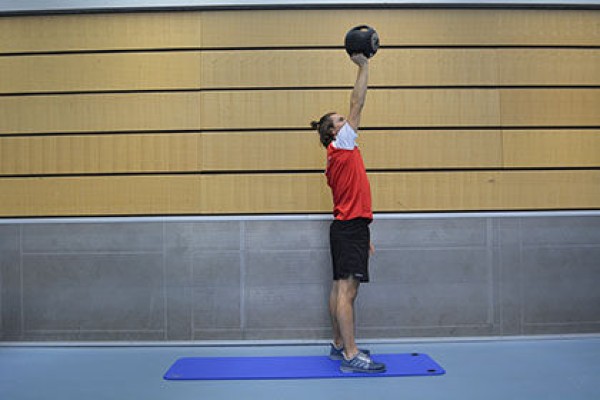
From the lying position (supine position), you move through various intermediate positions to the upright position, whereby the main focus is on holding the weight (dumbbell or kettlebell) in one hand overhead in a stable position and always working with a stretched back.
As a starting position, the weight is held in a supine position with one arm (right) almost outstretched at chest height (arm facing upwards), the leg (right) on the same side where the weight is held is bent (foot on the floor). Firstly, the shoulders are lifted using the forearm of the arm resting on the floor (left). Then rest the free arm on the hand to lift the whole upper body away from the floor. The hips are then pushed upwards and the outstretched leg (left) is pulled under the body and brought backwards into a kneeling position (half kneeling position with one hand resting on the floor). The arm that is currently still supporting you (left) is then finally lifted off the floor to a half-kneeling position with the upper body upright. A lunge is used to assume the final standing position. Reverse the sequence of movements to return to the starting position lying on the floor.
Starting position:
- Supine position
- Leg bent and positioned on the side of the weight
- Weight held in front of you with one arm almost straight (arm pointing firmly upwards)
- Abdominal and gluteal muscles are tensed
- Gaze is directed towards the weight
Final position:
- Stand upright with a straight back
- Stabilise the weight overhead with an almost outstretched arm
Attention:
This exercise places extremely high demands on mobility and stability, which is why it is only suitable for advanced exercisers. Distribute the weight over the entire foot during the movement sequence
1 dumbbell/kettlebell
Standwaage
Power
Individual work


Stand upright, facing the chair. At the same time, tilt your upper body forwards (keep your upper body horizontal to the floor) and raise your practically stretched free leg up to the height of your buttocks. To keep your balance better, support your upper body with your arms on the seat of the chair. In the end position, the leg and upper body are roughly in line. The position in the shape of the letter "T" is also known as the standing balance. Then raise the upper body and lower the leg back to the starting position. Switch sides after each execution (change the supporting leg/playing leg).
Attention:
Keep your back straight at all times (tense your torso), distribute your weight over the entire foot (supporting leg).
1 (office) chair
Standing scale (left)
Power
Individual work
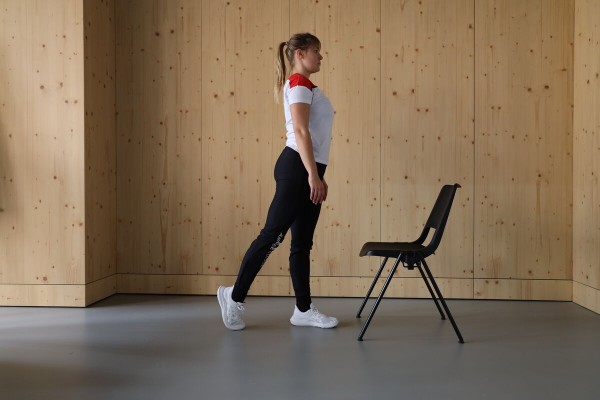
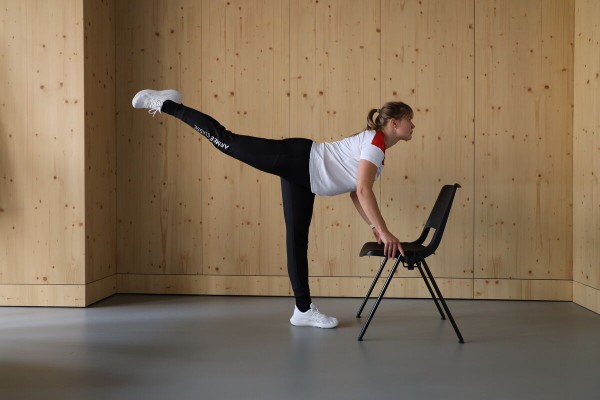
Stand upright, slightly offset, with the free leg (right) slightly further back than the supporting leg (left) and facing the chair. At the same time, tilt the upper body forwards (keep the upper body horizontal to the floor) and raise the practically stretched free leg to the height of the buttocks. To keep your balance better, support your upper body with your arms on the seat of the chair. In the end position, the leg and upper body are roughly in line. The position in the shape of the letter "T" is also known as the standing balance. Then raise your upper body and lower your leg back to the starting position.
Attention:
Keep your back straight at all times (tense your core) and distribute your weight over your entire foot (standing leg).
1 (office) chair
Standwaage (right)
Power
Individual work


Stand upright, slightly offset, with the free leg (left) slightly further back than the supporting leg (right) and facing the chair. At the same time, tilt the upper body forwards (keep the upper body horizontal to the floor) and lift the practically stretched free leg up to the height of the buttocks. To keep your balance better, support your upper body with your arms on the seat of the chair. In the end position, the leg and upper body are roughly in line. The position in the shape of the letter "T" is also known as the standing balance. Then raise your upper body and lower your leg back to the starting position.
Attention:
Keep your back straight at all times (tense your core) and distribute your weight over your entire foot (standing leg).
1 (office) chair
Static leg flexion with trunk rotation whilst lying on your back (left) ► bicycle hold
Power
Individual work
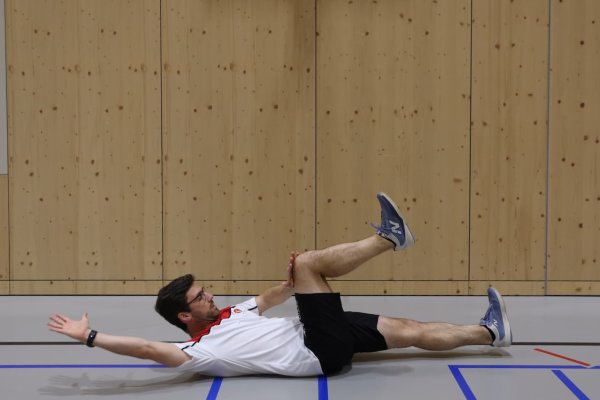
Lie on your back, lift your right leg and bend both your hip and knee to about 90 degrees. Rotate your upper body slightly towards the opposite side so that you can apply pressure to the raised knee with your left hand. Hold the position whilst keeping your body taut. Your head, shoulder blades, the leg extended in line with your upper body and the outstretched arm should be slightly raised off the floor.
Attention:
Do not let your lumbar vertebrae arch backwards; keep your shoulders off the floor as much as possible; do not hold your breath.
Lighten:
Bend your left leg and place it on the floor; place your right foot on top of the bent leg; extend your right arm out to the side for support; bend your left arm and place your hand loosely behind your head. From this position, lift your upper body slightly and twist so that your left elbow moves towards your right knee. Hold the position.
Harden:
Assume a similar position to the basic form, but position the foam roller between your elbow (left) and knee (right).
1 fascia roller ► make the exercise more challenging (additional weight)
Static leg flexion with trunk rotation whilst lying on your back (right) ► bicycle hold
Power
Individual work
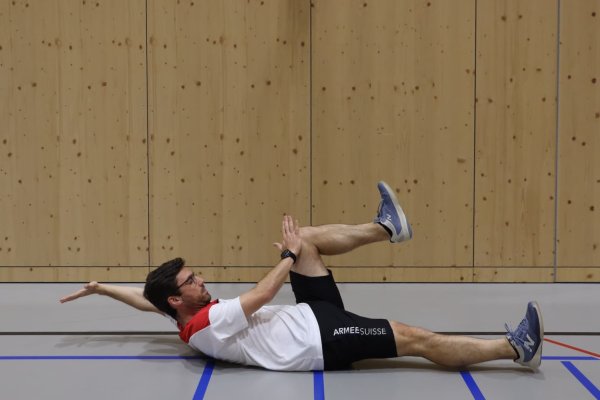
Lie on your back, lift your left leg and bend both your hip and knee to about 90 degrees. Rotate your upper body slightly towards the opposite side so that you can apply pressure to the raised knee with your right hand. Hold the position whilst keeping your body taut. Your head, shoulder blades, the leg extended in line with your upper body and the outstretched arm should be slightly raised off the floor.
Attention:
Do not let your lumbar vertebrae arch backwards; keep your shoulders off the floor as much as possible; do not hold your breath.
Lighten:
Bend your right leg and place it on the floor; place your left foot on top of the bent leg; extend your left arm out to the side for support; bend your right arm and place your hand loosely behind your head. From this position, lift your upper body slightly and twist so that your right elbow moves towards your left knee. Hold the position.
Harden:
Assume a similar position to the basic form, but position the foam roller between your elbow (right) and knee (left).
1 fascia roller ► make the exercise more challenging (additional weight)
Stubborn buck
Fighting and roughhousing games
Partner work
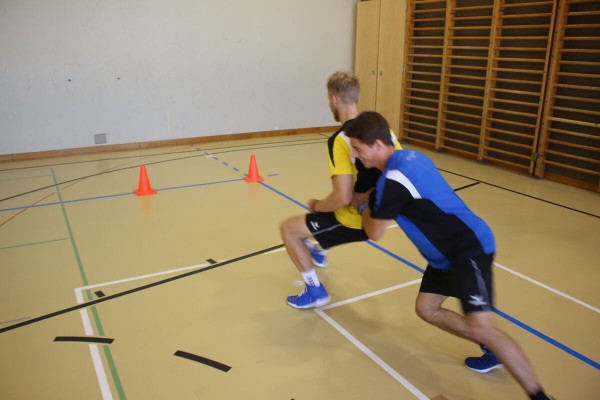
Two participants stand behind each other and look in the same direction. The person behind now tries to push the person in front over a previously agreed line. The roles are then switched.
Variant:
Stop time until the line is crossed.
2 marking cones/caps (optional) ►Field markings
1 stopwatch ►Variation of the exercise
Post setup:
Place caps on a defined baseline.
Pushing an object while stationary
Power
Individual work

Push an object lying on the ground (e.g. a tyre) over a certain distance (back and forth). Choose a short distance for multiple pushes (5-10m),
Attention:
Keep your back straight.
Lighten:
Less resistance.
Harden:
More resistance.
1 tyre (DURO)
1 tyre (PUCH) ► Make the exercise easier
1 tyre (10DM) ► Make the exercise more difficult
Pushing an object while stationary
Power
Individual work


Push an inverted vaulting box top including a centre section (possibly filled with medicine balls) over a certain distance (back and forth) (push the bob). Choose a short distance for multiple pushes (5-10m).
Attention:
Keep your back straight.
Lighten:
Less (no) additional weight (medicine balls).
Harden:
Additional weight (medicine balls).
2 vaulting box elements (incl. upper part)
x medicine balls
Stretch jump with momentum from supine position ► reverse burpee
Power
Individual work

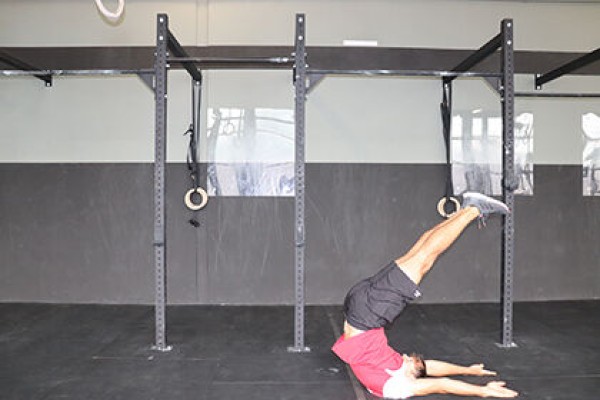


From a shoulder-width stance, move into a squat position (arms pointing diagonally downwards in front) and then drop into a supine position. The outstretched arms are extended overhead (along the floor) and the bent legs are stretched out so that they are pointing towards the sky (upwards). The arms are then brought back in front of the body in a flowing movement so that the momentum can be utilised to return to the standing position. Once in the standing position, immediately perform a stretch jump into the air, landing in the starting position to begin the exercise again.
Attention:
Knee of the training leg should remain as centred as possible over the foot.
Lighten:
Arms support the movement more clearly (more momentum); lower height during the stretch jump (or just straighten the upper body).
Harden:
Additional weight.
2-4 weight cuffs ► Make the exercise more difficult (additional weight)