
Exercises (3274)
Frontal and lateral raising and lowering of the arms in prone position ► front raise/lateral raise (side raise)
Power
Individual work


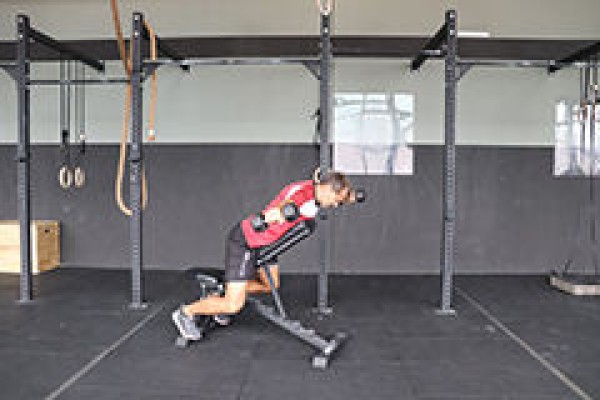


Stomach position on the inclined flat bench, arms almost stretched out towards the floor (hanging), grasp a dumbbell with each hand (overhand grip, palms facing forwards). In one movement, raise your arms frontally to approximately chin height (palms facing down), spread your arms out to the side (T-position, arms parallel to the floor), then bring your arms to the floor (palms facing your body). Now perform the movement in reverse order: Raise your arms sideways, bring them together in front of your head, then lower your arms to the floor back to the starting position.
Attention:
Despite the reduced possibility of falsification due to the upper body being fixed on the incline bench, ensure that the movement is performed slowly and evenly (jerking the weights upwards always leads to poorer training results and increases the risk of injury).
Lighten:
Less weight.
Harden:
More weight.
1 flat bench
2 dumbbells
Fruit salad
Stimulate circulation
Group work
4 groups
Four groups each spread out in a corner of a square (e.g. corners of a hall). The participants handle a ball there (dribbling or juggling is also possible). Each group chooses a "fruit name". If the sports leader calls out two "fruits", these two groups have to change/swap corners. On the command "fruit salad", all groups change corners diagonally.
Variant:
The sports leader can specify the type of ball guidance for moving from corner to corner (e.g. pinch the ball between the legs and bounce, roll the ball, guide the ball with the weaker leg only, etc.)
Per participant:
1 stick ► Smolball, floorball
1 ball ► Basketball, FooBaSKILL, Futsal/Football, Handball, Smolball, Tchoukball, floorball
full body flow
Stretching
2 rounds (dynamic design)
1. Cat & cow (× 8)
2. Downward dog → plank (× 6)
3. World’s greatest stretch (× 4/side)
4. Deep squat → stand (× 8)
5. 90/90 hip switch (× 8)
6. Lunge with upper body rotation (× 5/side)
7. Child’s pose (30sec.)
8. Calm supine position (60sec.)
Football
Games / Tournament
Game idea:
Two teams with several outfield players and a goalkeeper each shoot the ball into the opponent's goal by attacking skilfully. Good defensive behaviour should prevent the opponent from scoring goals.
Scoring:
A goal is scored when the ball crosses the opponent's goal line in its entirety.
Playing field:
120 x 90m (maximum), or 90 x 45m (minimum).
The pitch size can be adjusted for sports lessons.
Number of participants:
11:11 (incl. one goalkeeper per team).
Adjust the number of players if the pitch size is changed.
Playing rules:
The game is opened at the start of each period by a kick-off by one team in the centre of the pitch. The same applies after a goal has been scored, whereby the team that has conceded a goal has the right to kick-off. The ball may be played with any part of the body except the arms. Within the penalty area (rectangular area with a width of 16.50 metres from the respective post and the same depth), the goalkeeper may take the ball in his hands. Handball and fouls (holding, clutching, punching, pushing, putting the leg down, kicking the legs, leaning, etc.) outside the penalty area are penalised with a direct free kick for the opposing team (i.e. possession of the ball at a distance of 9m from the opponent). If the offence takes place inside the penalty area, the opposing team is awarded a penalty from a distance of 11m from the goal.
If a player kicks the ball out of bounds over a touchline, the opposing team is awarded a throw-in, whereby the ball is thrown back into the field to a team-mate with a two-handed throw over the head from outside the touchline. If the ball leaves the field of play over the outer goal line, a goal kick (last touch of the ball by the attacker) or a corner kick (last touch of the ball by the defender) is awarded, depending on who last touched the ball.
Football/Futsal: Carousel
Forms of play / exercises
Group work
Simple standard pass and shot exercise: The players stand in both corners next to the goal. The foremost player runs in a high arc into the centre in front of the goal (around the marker stick). There he receives the ball from the other side and shoots (at the height of the two cones). The passer runs up next and shoots at the goal.
Variations:
Shooting at the empty goal or whoever has shot then stands in the goal themselves.
The sports leader can request different types of passes/shots (direct shots are also possible).
Per group:
1 goal
x footballs
4 cones (incl. starting markers)
1 colouring stick
Football/Futsal: Pass
Forms of play / exercises
Groups of 2
Two participants face each other and pass the football to each other. The distances, types of pass and ball reception are varied (instep, outstep, full instep, direct play, etc.). After the static form, the participants move freely around the hall/grounds and pass the ball to each other while moving.
Per group:
1 football
Football/Futsal: Passing in the group
Forms of play / exercises
Group work
All participants move freely around the hall/grounds. Within the group, the participants pass a football to each other. The exercise is then reorganised so that one group (e.g. blue) passes the ball to the other group (e.g. red) and in turn receives the ball from another group (e.g. green). The sports leader can integrate additional balls into the exercise.
Per group:
1 football
4 additional balls
x wristbands / overcoats ►team identification
Football/Futsal: Goalball
Forms of play / exercises
2 Teams
Two teams play against each other on a limited playing field. The team with the football tries to pass the ball between the goals (e.g. colouring sticks, cones or marker cones) as often as possible. The ball must be caught/received by a team-mate behind the goal. If the opposing team captures the ball, they can try to score goals.
Pitch:
8 goals
1 football
16 colouring sticks
16 cones
16 marker cones
x game ribbons / covers
Footsteps
Fighting and roughhousing games
Partner work

Two participants stand opposite each other and grab each other by the shoulders. The participants try to step on their opponent's feet. Who collects more kicks?
No material required
Futsal
Games / Tournament
Game idea:
Two teams with several outfield players and a goalkeeper each shoot the ball into the opponent's goal by attacking skilfully. Good defensive behaviour should prevent the opponent from scoring goals.
Scoring:
A goal is scored when the ball crosses the opponent's goal line in its entirety.
In the hall, long benches can also be used as goals. On the one hand, the bench can be turned over and the ball must be played between the seat and the support surface, or on the other hand, the bench can be tilted and a goal is scored when the ball is played against the seat surface.
Playing field:
22 x 42 metres (e.g. handball field or hall wall).
Number of participants:
5:5 (incl. one goalkeeper per team)
Game rules:
The game is opened at the start of each period by a face-off by one team in the centre of the field. The same applies after a goal has been scored, whereby the team that has conceded a goal has the right to kick-off. The ball may be played with any part of the body except the arms. Inside the penalty area, the goalkeeper may take the ball in his hands.
Any physical contact is considered a foul. Tackling - regardless of whether the ball is played or not - is also prohibited and results in a free kick for the opposing team. After a predetermined number of fouls (adapted to the length of the game), the opposing team is awarded a penalty for each additional foul.
Variation:
A penalty is awarded after three fouls, after which the number of fouls is reset to zero.
If a player kicks the ball out of bounds over a touchline, the opposing team gains possession of the ball. The ball is put back into play with a "kick-in" (no direct shots on goal allowed)
Memory run
Orienteering
Single run or 2/3 groups
In the terrain, the sports director distributes posts in advance, which the participants then run to individually or in small groups during the memory run. For this purpose, a poster (or several posters - depending on the number of participants) with all the posts marked on it is put up at the start. The participants memorise a route and try to collect the posts. Depending on how many posts the participants can memorise, they have to return to the starting position sooner or later to take another look at the map. The memory run is more suitable as a form of exercise than a competition. The map is distributed to the runners/groups before the start. For the memory run, each participant/group has a defined amount of time to find as many or all of the posts as possible.
OL posts (to be unplugged)
2-3 posters with post overview
1 (stop) clock
Participant/group:
1 running map form 30.063
1 bussole
Memory run
Leakage
Partner work
Groups of 2
Each participant draws two cards from the sports director. Various running routes are marked on the cards. The nine cones set up in a square must be run in a specific order. The participants form groups of 2 to run out. One participant shows their card to their partner, who then memorises the route and completes it by heart. The participant who has shown their card to their partner waits in place and checks their partner. During the check, the waiting participant performs some relaxation and/or stretching exercises independently. When the runner returns, they receive feedback from their partner as to whether they have run the course correctly. The roles are then swapped. Each participant completes a running route twice and has two times to perform some exercises.
Note: The running route serves as a cool-down and is therefore completed at a relaxed pace (trotting). If there are a large number of participants, 2 or more fields should be set up for space reasons.
x running cards
9 cones
Memory relay
Increase pulse
Group work
4-5 participants per group
A solution sheet (e.g. key words, a section of a poem, rules of the game, grade badges, etc.) is placed at the turning point of the relay. The runners run to the solution sheet and memorise as much information as possible so that it can be transferred to an answer sheet at the start. The next runner is therefore well advised not to start immediately, but to communicate with the previous runner in order to organise the solution process as ideally as possible. The group that is the first to complete the answer sheet correctly or is furthest along with the solution after a certain time wins the relay.
Per group:
1 solution sheet
1 answer sheet
Writing materials
Pulling an object towards you while standing ► row battle rope
Power
Individual work
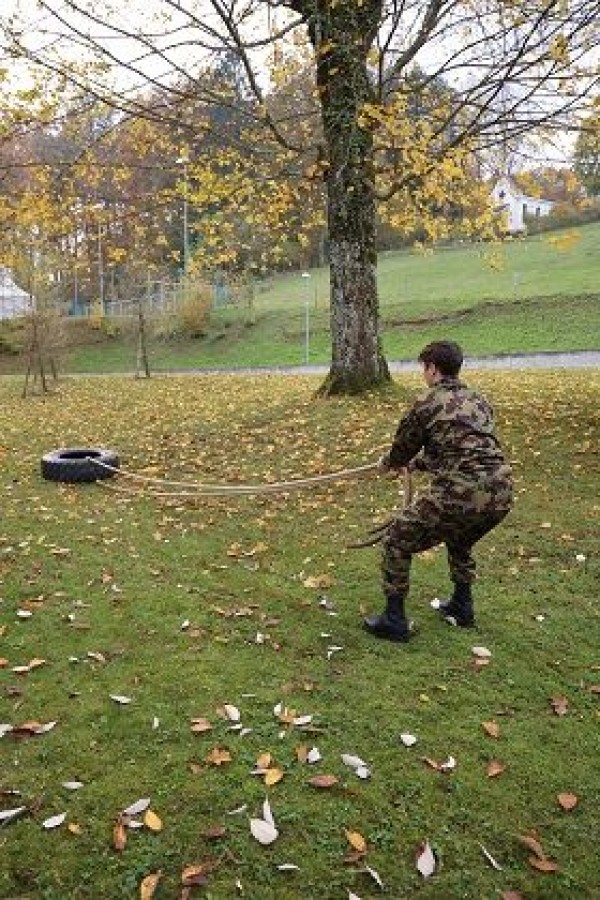
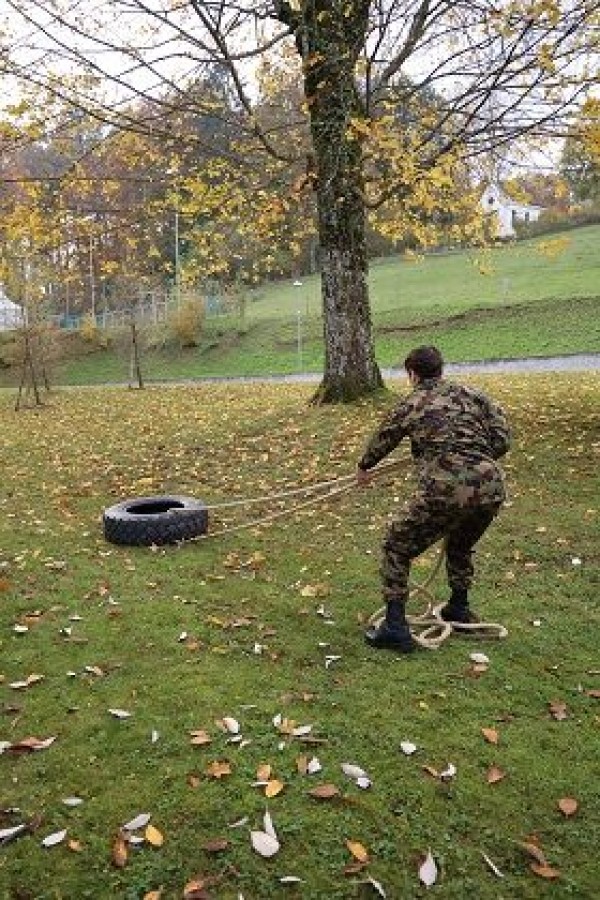
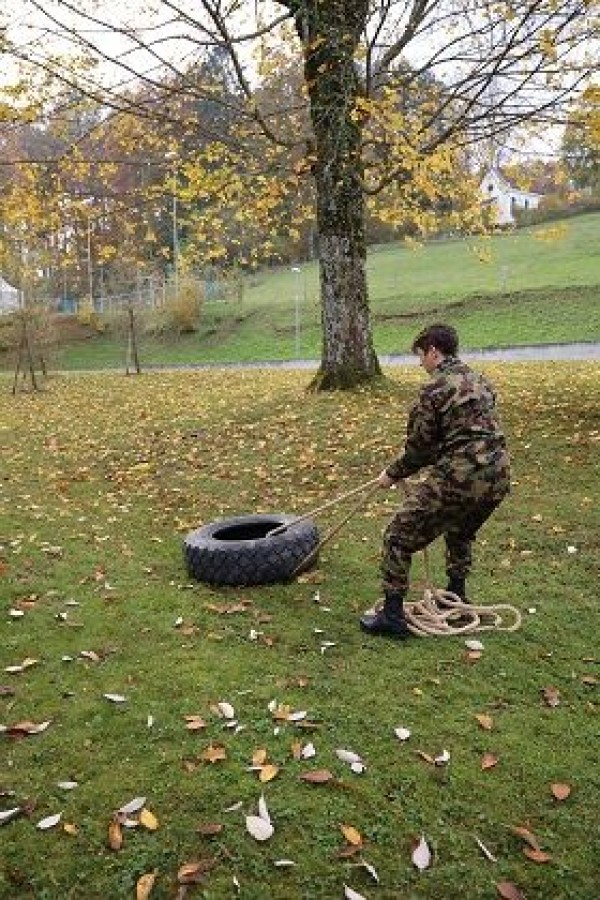
Stand shoulder-width apart at the ends of the rope (facing the tyre), bend your knees slightly, grasp both ends of the rope with your hands and pull the tyre attached to the rope towards you. Once you have pulled the tyre up to your feet, sprint to the other side until the rope is taut again to restart the exercise.
Attention:
Keep your back straight.
Lighten:
Less weight/load.
Harden:
More weight/greater load.
1 rope/rope
1 tyre (DURO)
1 tyre (PUCH) ► Make the exercise easier
1 tyre (10DM) ► Make the exercise more difficult (additional weight)
Gehen ► suitcase carry
Power
Individual work
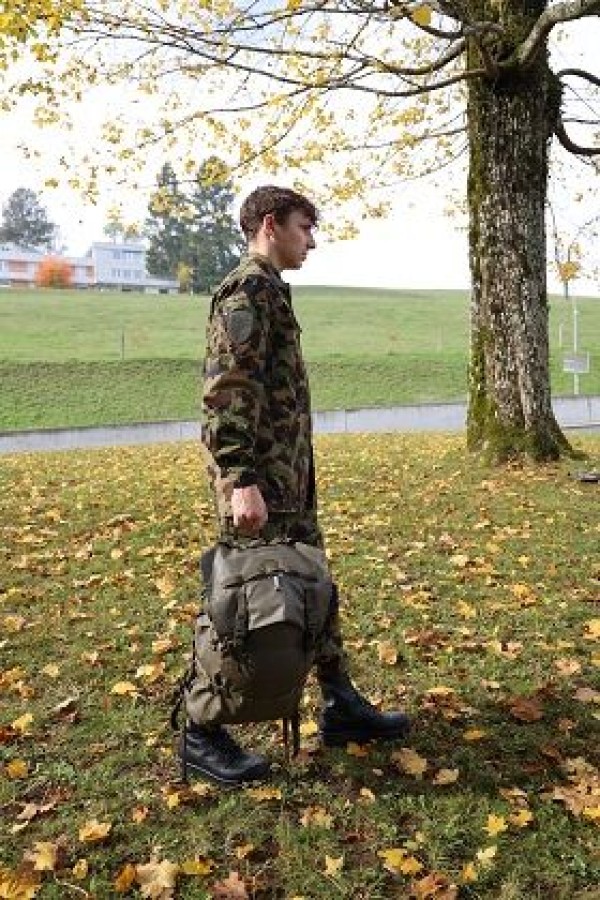
Bend your knees whilst keeping your back straight, lift a heavy dumbbell from the floor with one arm, and stand up in a controlled manner. The weight hangs at your side, next to your thigh, like a suitcase, whilst both shoulders remain at exactly the same height, without slumping towards the side bearing the weight or leaning back towards the opposite side. The upper body is upright, your gaze is directed straight ahead and the lateral core muscles are tensed to the maximum to compensate for the asymmetrical load. The free arm can be held out slightly for stabilisation. Now walk straight ahead at a steady, controlled pace. The torso remains absolutely vertical and stable, without swaying sideways or buckling, and the weight does not shift onto the leg. Halfway through the exercise, set the leg down in a controlled manner with a straight back and change sides. The aim is to achieve a completely composed, upright gait.
Attention:
The upper body tilts towards the side of the weight (lateral flexion); the exerciser leans extremely far to the free side in order to balance the weight purely through leverage; the shoulder on the side bearing the weight sags passively downwards and loses muscular control; the dumbbell swings back and forth like a pendulum; the gait is sloppy, hurried or shuffling; the head is thrust forward or held at an angle; the barbell is lifted and lowered with a rounded back.
Lighten:
Reduce the weight of the dumbbell; shorten the walking distance or take breaks to realign your posture; Slow down your walking pace; carry the weight with both arms (Farmer’s Walk) if stabilising your core on one side is still too challenging.
Harden:
Choose a significantly heavier weight (combat rucksack/sandbag); carry the weight overhead with your arm fully extended (Waiter Walk / Overhead Carry); balance on a line (e.g. walk along the narrow edge of an upturned Swedish bench); wear a weight vest as well.
1 dumbbell/kettlebell (medium weight)
2 dumbbells/kettlebells (light weights in both hands) ► make the exercise easier (less weight/better balance)
1 combat rucksack/sandbag (very heavy) ► make the exercise more difficult (additional weight)
1 place the Swedish box upside down ► to make the exercise more difficult (balance component)
Gehen ► suitcase carry
Power
Individual work

Take an object in one hand (e.g. military equipment or a combat rucksack), let your arms hang at the side of your body and carry the object over a certain distance.
Attention:
Keep your back straight, your pelvis stable with every step and your shoulders fixed (lower towards your hips).
Variant:
Hold an object in both hands.
Lighten:
Equipment approx. 5kg
Harden:
Heavier equipment (add 3 litres of water to the backpack)
Material per participant: Tenue CNK 420, 2 x material of approx. 5kg/10kg/15kg
Additional material: 2 fanjons, 2 PET bottles (1.5l)
Walking on an elevation
Power
Individual work
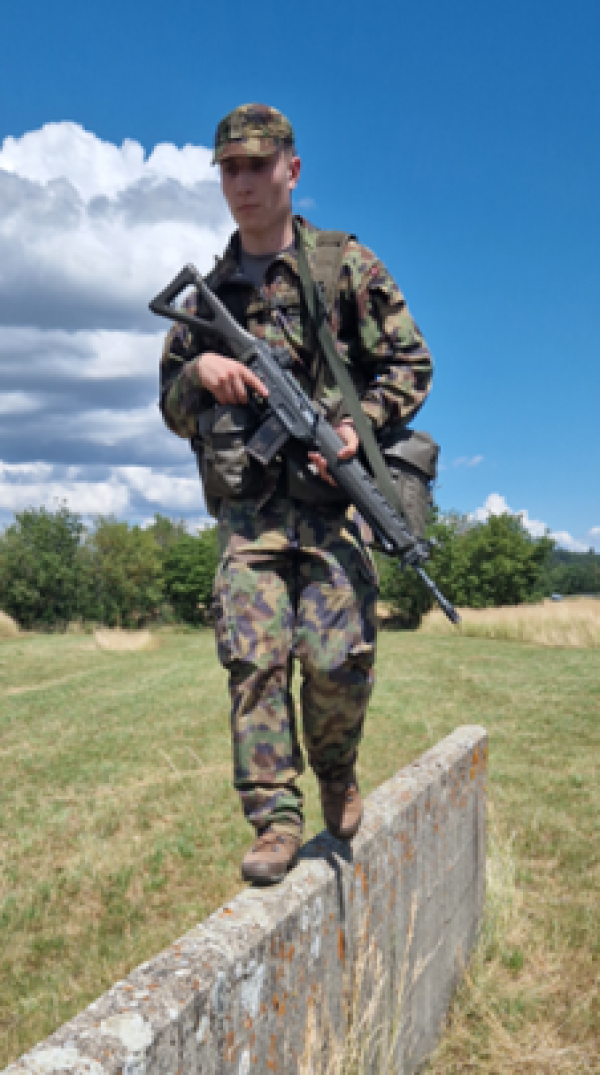
In the CNG 428 tenue, step onto a raised area (e.g. wall); start alternately with the left or right leg (support from a team mate is possible). Run back and forth without stepping off/losing your balance.
Lighten:
Without equipment;
Wider wall.
Harden:
With combat backpack;
Narrower wall.
Material per participant: Tenue CNG 428
Additional material: 1 wall/ruins (station 6 of the outdoor obstacle course)
Buttock rocker ► buttbounce
Coordination exercises
Individual work
Fasten the slackline over a long distance (12-15m) at a height of approx. 1m. Sit in an upside-down position so that your eyes and shoulders are aligned with the end point. From this position, rock downwards and upwards, with the momentum coming from the arms. You can touch the ground with your feet, but you should not actively push off, as the energy should come from the slackline.
Lighten the load:
Help a partner by holding their hand; a helper pushes the slackline down slightly while bobbing.
1 Slackline
Equal numbers: 2 against 2
Forms of play / exercises
Group work
Groups of 4 ► 2 vs. 2
Exercise description:
Players A and B pass a ball/disc to each other in a given space. Players C and D try to gain possession of the ball/disc themselves by intercepting the ball/disc in order to pass the ball/disc to each other. Which team has achieved more passes within a certain time? It is possible to change both partners and opponents regularly (more time required).
Variant:
Which team is the first to complete 10 passes in a row (= 1 point)?
Participant:
1 bat/stick ►intercross/lacrosse, smolball, floorball
Pitch:
1 ball/throwing disc ►basketball, Frisbee Ultimate, FooBaSKILL, futsal/football, handball, intercross/lacrosse, smolball, tchoukball, floorball
4 marking cones/caps (optional) ►pitch boundary
Goaltime
Increase pulse
Group work
2 teams
The teams collect points by throwing the frisbee through a goal and a teammate catches the disc in the zone behind the goal. At the start of the game, one player from each team stands behind the clear line, where the frisbee is thrown into the air by the sports director. All other players spread out in the playing area. Whoever catches the disc has the right to attack on their side and now passes the frisbee into the field to a teammate. If a pass is made through the goal arc and the disc is caught within the catch zone, the team is awarded one point. Two points are awarded if the pass is made from behind the clear line.
After a successful attack, the frisbee remains in possession, but must first be played behind the clear line before the next attack can be attempted. Likewise, after a turnover (frisbee falls to the ground, frisbee or player leaves the field of play or a pass attempt is intercepted), you must first cross the clear line before you can go on the hunt for points.
A bar with offset uprights (a handball goal without a net or two high jump poles/mobile net stands with a rope as a crossbar) can be used as a goal arch. The catch zone can be defined with cones, colouring sticks or marker cones. The clear line should be approx. 15-20 metres away from the goal.
1 frisbee
x bibs
6 cones
1 bar (or similar as a goal)
Golf
Leakage
Group work
Groups of 4 to 6
Each participant in a small group tries to hit a self-defined target (e.g. goalpost, tree, candelabra, rings, colouring sticks, cones or similar objects distributed around the room) with as few attempts as possible. The next attempt is made from the place where the aid remains. Once everyone has hit the target, a new target is chosen together in the group (or the winner of the round chooses). Which participant has the fewest attempts after a certain time?
Per participant:
1 ball ►FooBaSKILL, futsal/football, intercross/lacrosse, smolball, floorball
1 racket/stick ►badminton/speedminton, intercross/lacrosse, smolball, floorball
1 disc (frisbee) ►Frisbee Ultimate
x targets (e.g. colouring sticks / cones / rings / etc.)
Straddle jump
Floor and apparatus gymnastics


Frontal run-up onto the mini trampoline (from the long bench), one-legged horizontal jump from the run to the two-legged jump on the trampoline vertically into the air.
Grab jump:
Launch with arm pull forwards upwards, legs stretched out as horizontally as possible forwards after the push-off and touch the feet with the hands (if mobility allows). Extend the body again and come to a safe stance.
The participants practise the form of movement independently using series pictures or based on the demonstration of the exercise by the sports leader. The instructor (or a partner) gives feedback, provides support and checks that the exercise is being performed correctly.
1 mini-trampoline
1 long bench (possibly to mark out the run-up)
2 soft mats (large)
5 soft mats (small)
1 row
Straddle jump / squat jump
Floor and apparatus gymnastics


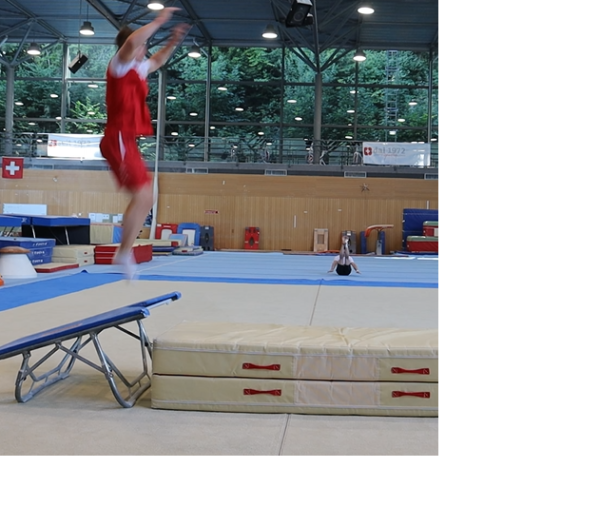


Frontal run-up onto the mini trampoline (from the long bench), one-legged horizontal jump from the run to the two-legged jump on the trampoline vertically into the air.
Grace jump:
Jump off with arm pull forwards, stretch your legs as horizontally as possible forwards after the push-off and touch your feet with your hands (if your mobility allows it). Extend your body again and come to a safe standing position.
Squat jump:
Jump off with your arms pulled forwards, squat your legs (pull your knees towards your chest) and grasp your knees with your hands. Release the squat position and extend the legs to a safe standing position.
The participants practise the movement form independently using series pictures or based on the demonstration of the exercise by the sports instructor. The instructor (or a partner) gives feedback, provides support and checks that the exercise is being performed correctly.
1 mini-trampoline
1 long bench (possibly to mark out the run-up)
2 soft mats (large)
5 soft mats (small)
2 row pictures
Basic position
Coordination exercises
Individual work
Before attempting the first steps, you should be able to stand on the slackline on just one leg for 5-10 seconds. This has the advantage that you can balance with the second leg. Both the left and right leg must be trained.
Pay attention to the following points:
- Looking forwards;
- Arms above shoulder height;
- Feet straight on the slackline;
- Knees slightly bent;
- Hips upright.
Easing:
Perform the exercise close to the attachment; stretch the slackline taut over a short distance (3-5m); sit a partner in the middle of the slackline to dampen the initial shaking; help a partner by holding their hand (always go with the balancing movement and only stabilise if the slackliner is about to fall).
Hardening:
Cross your arms (in front of your stomach, behind your back or over your head)
1 Slackline
Basic position (boxing position)
Light-Contact
Individual work
The participants practise adopting the basic stance:
The boxing stance is the starting and finishing position for all attack and defence techniques. From a shoulder-width stance, one foot is moved slightly forwards and the knees are bent slightly. The foot that is on the opposite side to the stronger hand is moved forwards (e.g. right-handers have the left leg in front). As an exercise, the participants can stand on a line to place one foot forwards from there. The correct distance between the feet is achieved when the heel of the front foot is just in front of the line (the back foot remains in place - toe on the line). At the same time as stepping forwards, the hanging arms are bent, the hands are clenched into fists and raised to head height. The strong hand (on the side of the back leg) is practically on the cheek, the weaker hand (on the side of the front leg) is held slightly in front of the head at approximately eye level. The weaker side corresponds to the lead hand (jab) and the stronger to the punching hand (straight).
Variant:
To assume the basic stance, you can also simply take two steps forwards from a shoulder-width stance and then stop and assume the basic stance. It is only important that the first step is taken on the side where the stronger hand is located.
Exercise:
From the shoulder-width stance with hanging arms, assume the basic position several times. Small shifts are incorporated in between.
No material required