
Exercises (1882)
Move your arms backwards while standing ► pull down
Power
Individual work


Step stance or shoulder-width stance facing the wall bars (or a tree, for example), fix the elastic band at shoulder height on the wall bars (on the tree), upper body slightly bent forward, arms stretched diagonally forwards/downwards, stretched arms behind the body (pulling the shoulder blades together) and return to the starting position.
Attention:
Keep your upper body stable.
Lighten:
Choose a rubber band with less resistance.
Harden:
Choose a rubber band with more resistance.
1 elasticated rubber band
1 wall bar/tree
Move arms backwards/downwards while standing ► pull down
Power
Individual work
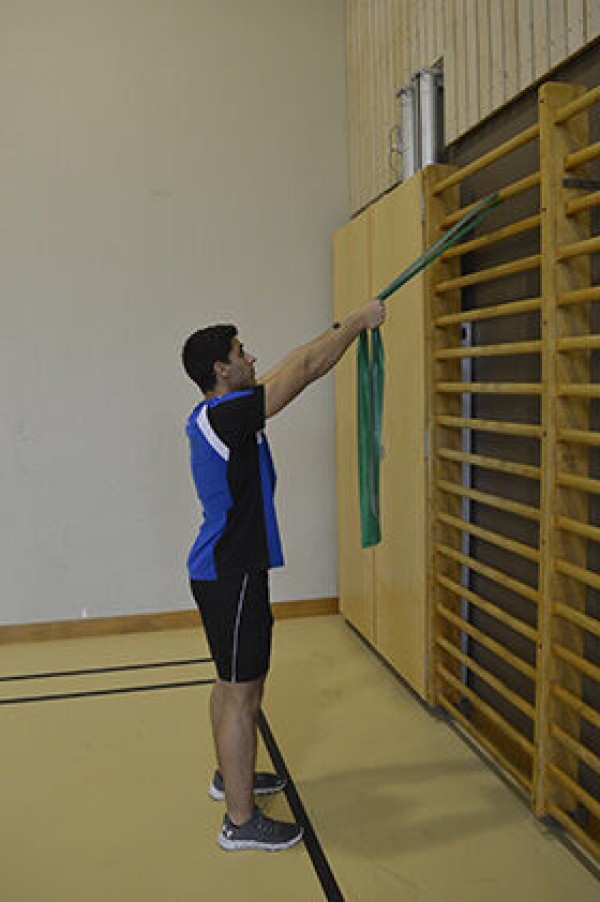

Stand with a light step or upright, shoulder-width stance facing the wall bars (or a tree, for example), fix the elastic band slightly above head height on the wall bars (on the tree), stretch your arms out diagonally upwards (hands at eye level), bring your outstretched arms down behind your body and back to the starting position.
Attention:
Do not arch your back (tighten your stomach).
Lighten:
Select a rubber band with less resistance.
Harden:
Select a rubber band with greater resistance.
1 elasticated rubber band
1 wall bar/tree
Move your arms upwards while standing ► shoulder press
Power
Individual work
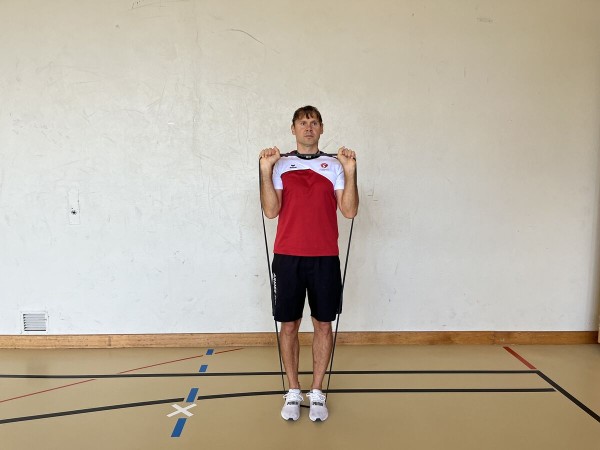

Stand upright, shoulder-width apart in the centre of the elastic band, with your hands gripping the band at chest height (backs of hands pointing towards your face), elbows of bent arms pointing downwards, arms stretched straight up next to your ears and bent back to the starting position.
Attention:
Do not arch your back (tighten your stomach).
Lighten:
Choose a rubber band with less resistance.
Harden:
Choose a rubber band with more resistance.
Variant:
Step with your front foot on the centre of the band.
1 elasticated rubber band
Move arms upwards with rotation of the upper body in half kneeling position (left) ► cable chop / wood chop / cable upward woodchop
Power
Individual work


Half kneeling position with the upper body straight and the left knee on the floor (cable pulley side). The cable is positioned to the side of the body at approximately the height of the standing leg (appropriate distance). The cable is attached at the bottom. Hold the rope with your arms practically stretched out next to your body (cable pulley side) at about shoulder width. The arms should be pointing downwards at an angle of approximately 45 degrees. From this position, rotate your arms diagonally upwards over your shoulders to the other side of your body.
Attention:
Keep your upper body upright and your torso tensed. Do not put your weight down at any time to keep the tension high.
Lighten:
Less weight.
Harden:
More weight.
Variant:
Changing the aid: Grasp the one-handed handle with both hands.
1 weight tower/machine ► cable pulley (deep)
Move arms upwards with rotation of the upper body in half kneeling position (left) ► wood chop / upward woodchop
Power
Individual work


Half kneeling with the upper body straight and the left knee on the floor. Grasp the weight (weight plate, dumbbell or kettlebell) with your arms practically straight beside your body. The arms should be pointing downwards at an angle of approximately 45 degrees so that the weight is next to the hip of the kneeling leg. From this position, bring the practically stretched arms over the shoulder to the other side of the body with the torso rotating diagonally upwards.
Attention:
Keep your upper body upright and your torso tensed.
Lighten:
Less weight.
Harden:
More weight.
Variant:
Perform the exercise with one arm.
1 weight disc/dumbbell/kettlebell
Move arms upwards with rotation of the upper body in half kneeling position (right) ► cable chop / wood chop / cable upward woodchop
Power
Individual work


Half kneeling position with the upper body straight and the right knee on the floor (cable pulley side). The cable is positioned to the side of the body at approximately the height of the standing leg (appropriate distance). The cable is attached at the bottom. Hold the rope with your arms practically stretched out next to your body (cable pulley side) at about shoulder width. The arms should be pointing downwards at an angle of approximately 45 degrees. From this position, rotate your arms diagonally upwards over your shoulders to the other side of your body.
Attention:
Keep your upper body upright and your torso tensed. Do not put your weight down at any time to keep the tension high.
Lighten:
Less weight.
Harden:
More weight.
Variant:
Changing the aid: Grasp the one-handed handle with both hands.
1 weight tower/machine ► cable pulley (deep)
Move arms upwards with rotation of the upper body in half kneeling position (right) ► wood chop / upward woodchop
Power
Individual work


Half kneeling with the upper body straight and the right knee on the floor. Grasp the weight (weight plate, dumbbell or kettlebell) with your arms practically straight beside your body. The arms should be pointing downwards at an angle of approximately 45 degrees so that the weight is next to the hip of the kneeling leg. From this position, bring the practically stretched arms over the shoulder to the other side of the body with the torso rotating diagonally upwards.
Attention:
Keep your upper body upright and your torso tensed.
Lighten:
Less weight.
Harden:
More weight.
Variant:
Perform the exercise with one arm.
1 weight disc/dumbbell/kettlebell
Move arms downwards with rotation of the upper body in half kneeling position (left) ► cable chop / wood chop / cable downward woodchop
Power
Individual work


Half kneeling position with the upper body straight and the left knee on the floor (cable pulley side). The cable pull is positioned to the side of the body at approximately the height of the supporting leg (appropriate distance). The cable pull is attached at the top. Hold the rope with your arms practically stretched out next to your body (cable pulley side) at about shoulder width. The arms should be pointing diagonally upwards (at an angle of approximately 45 degrees). From this position, rotate your arms diagonally downwards over your shoulders to the other side of your body at hip level.
Attention:
Keep your upper body upright and your torso tensed. Do not put your weight down at any time to keep the tension high.
Lighten:
Less weight.
Harden:
More weight.
Variant:
Changing the aid: Grasp the one-handed handle with both hands.
1 weight tower/machine ► cable pulley (high)
Move arms downwards with rotation of the upper body in half kneeling position (right) ► cable chop / wood chop / cable downward woodchop
Power
Individual work


Half kneeling position with the upper body straight and the right knee on the floor (cable pulley side). The cable pull is positioned to the side of the body at approximately the height of the supporting leg (appropriate distance). The cable pull is attached at the top. Hold the rope with your arms practically stretched out next to your body (cable pulley side) at about shoulder width. The arms should be pointing diagonally upwards (at an angle of approximately 45 degrees). From this position, rotate your arms diagonally downwards over your shoulders to the other side of your body at hip level.
Attention:
Keep your upper body upright and your torso tensed. Do not put your weight down at any time to keep the tension high.
Lighten:
Less weight.
Harden:
More weight.
Variant:
Changing the aid: Grasp the one-handed handle with both hands.
1 weight tower/machine ► cable pulley (high)
Bring your arms in front of your body while standing (left) ► internal rotation
Power
Individual work
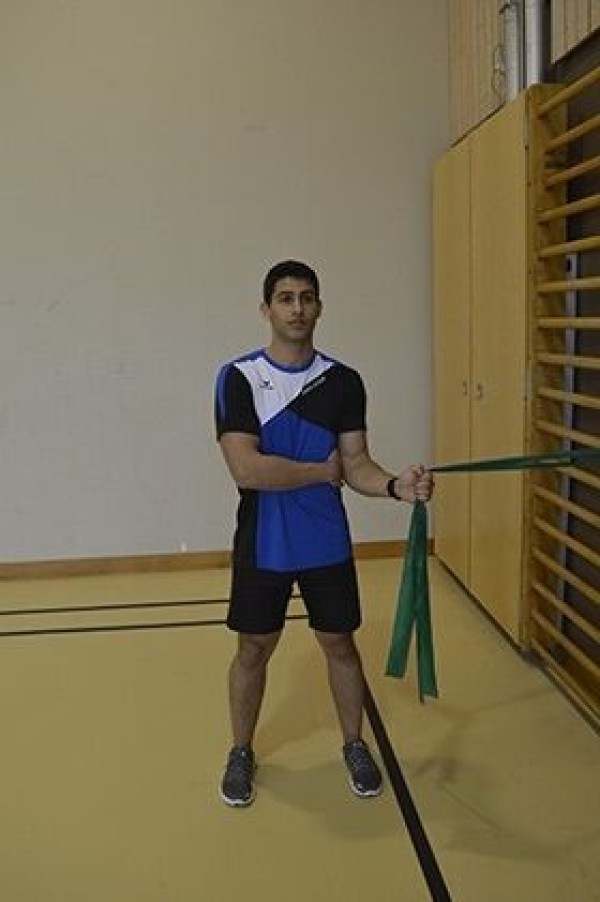

Attach the elastic band to the wall bars (or a tree, for example) at stomach height, stand shoulder-width apart (90 degree angle) to the wall bars (to the tree), arms stretched out towards the wall bars (tree) (to the left), grasp the elastic band with both hands, bring the stretched arms in front of the body at shoulder height and back to the starting position, keeping the upper body stable.
Attention:
No torso rotation, the movement only takes place in the shoulder joint.
Lighten:
Choose an elastic band with less resistance.
Harden:
Choose an elastic band with greater resistance.
1 elasticated rubber band
1 wall bar/tree
Bring your arms in front of your body while standing (right) ► internal rotation
Power
Individual work


Attach the elastic band to the wall bars (or a tree, for example) at stomach height, stand shoulder-width apart (90 degree angle) to the wall bars (tree), arms stretched out towards the wall bars (tree) (to the right), grasp the elastic band with both hands, bring the stretched arms in front of the body at shoulder height and back to the starting position, keeping the upper body stable.
Attention:
No torso rotation, the movement only takes place in the shoulder joint.
Lighten:
Choose an elastic band with less resistance.
Harden:
Choose an elastic band with greater resistance.
1 elasticated rubber band
1 wall bar/tree
Jump onto an object ► jump
Power
Individual work

Jump with both legs onto the object on the ground (e.g. tyre) and back down to the starting position.
Attention:
Keep your upper body upright and cushion your landing.
Lighten:
Select a lower element; lower cadence.
Harden:
Higher cadence; additional weight (on the feet); standing on the object, jump back up to the starting position.
1 tyre (10DM)
1 tyre (DURO)/helmet ► Make the exercise easier
2 weight cuffs/1 weight waistcoat ► Make the exercise more difficult (additional weight)
Step onto an object (left) ► step up
Power
Individual work


Stand upright in front of the plyo box (the vaulting box - 1 intermediate element plus top), step onto the object first with the left leg, then with the other leg and back down to the starting position (stair climbing). A weight is held in both hands or in the arms (dumbbells, kettlebells, medicine ball). The start/starting leg remains identical for each exercise.
Attention:
Keep your upper body upright.
Lighten:
Select a lower element; lower cadence.
Harden:
Select a higher element; higher cadence; more weight/greater load; additional weight (on the feet).
1 plyo box/swivel box
2 dumbbells/kettlebells/1 medicine ball
2 weight cuffs/1 weight waistcoat ► make the exercise more difficult (additional weight)
Step onto an object (left) ► step up
Power
Individual work


Stand upright in front of the plyo box (the vaulting box - 1 intermediate element plus top), first step onto the object with the left leg, then with the other leg and back down to the starting position (stair climbing). The start/starting leg remains the same for each exercise.
Attention:
Keep your upper body upright.
Lighten:
Select a lower element; lower cadence.
Harden:
Choose a higher element; higher cadence; hold the weight in both hands; additional weight (on the feet).
Variation:
Alternate with the left/right foot first (more demanding in terms of coordination).
1 plyo box/swing box
2 dumbbells/kettlebells/1 medicine ball ► make the exercise more difficult (additional weight)
2 weight cuffs/1 weight waistcoat ► make the exercise more difficult (additional weight)
Step onto an object (left) ► step up
Power
Individual work
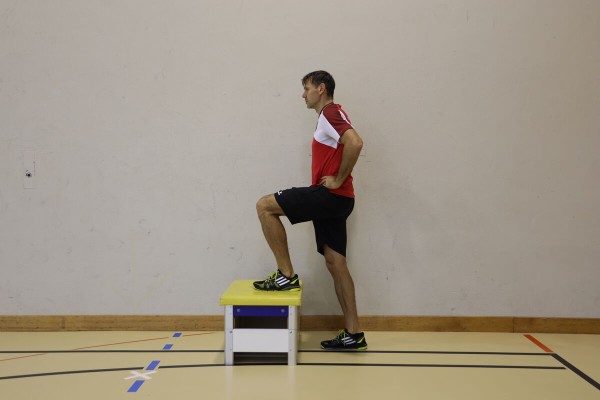
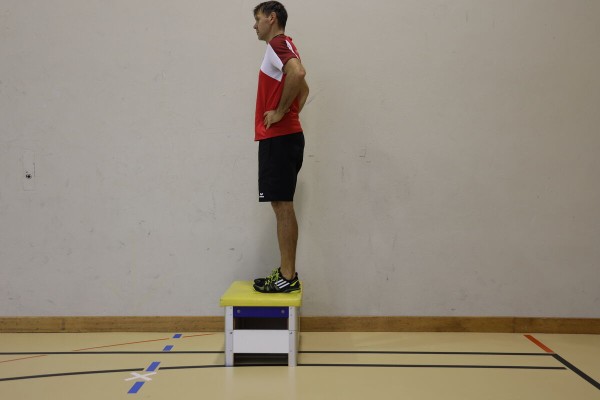
Stand upright in front of the plyo box (the vaulting box - 1 intermediate element plus top), with one leg stretched out on the floor and the other (left) leg bent on the raised surface. Extend the bent leg and at the same time move the leg placed on the floor onto the base in order to stand on the box/swinging box. Then move both legs back to the starting position (right leg back on the floor, left leg remains on the raised surface).
Attention:
Keep your upper body upright, distribute your weight over your entire foot, push your knees outwards (do not tilt inwards).
Lighten:
Select a lower element.
Harden:
Select a higher element; additional weight (on the back, in the hands or on the foot).
1 plyo box/swinging box
2 dumbbells/kettlebells/1 medicine ball/weight cuff/weight waistcoat ► make the exercise more difficult (additional weight)
Step onto an object (left) ► step up
Power
Individual work

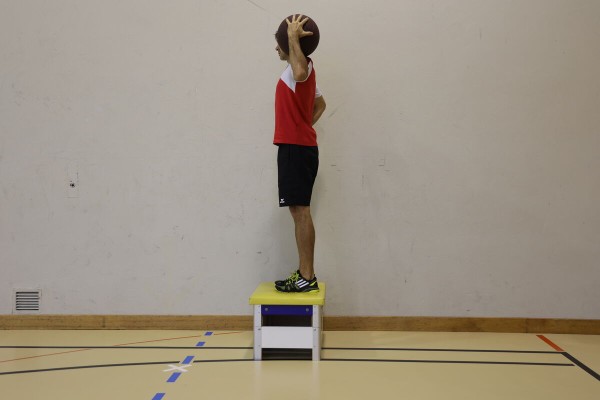
Stand upright in front of the plyo box (the vaulting box - 1 intermediate element plus top), with one leg stretched out on the floor and the other (left) leg bent on the raised surface. A medicine ball (or another weight such as a dumbbell or kettlebell) is held on the shoulder with a bent arm on the side where the leg is placed on the raised surface. Extend the bent leg and at the same time move the leg placed on the floor onto the base to get to a standing position on the box/swinging box. Then move both legs back to the starting position (right leg back on the floor, left leg remains on the raised surface).
Attention:
Keep your upper body upright, distribute your weight over your entire foot, push your knees outwards (do not tilt inwards).
Lighten:
Select a lower element; do not hold any weight on the shoulder.
Harden:
Select a higher element; more weight; additional weight on the foot.
Variation:
Hold a weight (dumbbell or kettlebell) in both hands with hanging arms.
1 plyo box/swinging box
1 medicine ball/dumbbell/kettlebell
1 weight sleeve/weight waistcoat ► make the exercise more difficult (additional weight)
1 additional dumbbell/kettlebell ► variation of the exercise
Step onto an object (right) ► step up
Power
Individual work


Stand upright in front of the plyo box (the vaulting box - 1 intermediate element plus top), step onto the object first with the right leg, then with the other leg and back down to the starting position (stair climbing). A weight is held in both hands or in the arms (dumbbells, kettlebells, medicine ball). The start/starting leg remains identical for each exercise.
Attention:
Keep your upper body upright.
Lighten:
Select a lower element; lower cadence.
Harden:
Select a higher element; higher cadence; more weight/greater load; additional weight (on the feet).
1 plyo box/swivel box
2 dumbbells/kettlebells/1 medicine ball
2 weight cuffs/1 weight waistcoat ► make the exercise more difficult (additional weight)
Step onto an object (right) ► step up
Power
Individual work


Stand upright in front of the plyo box (the vaulting box - 1 intermediate element plus top), first step onto the object with the right leg, then with the other leg and back down to the starting position (stair climbing). The start/starting leg remains the same for each exercise.
Attention:
Keep your upper body upright.
Lighten:
Select a lower element; lower cadence.
Harden:
Select a higher element; higher cadence; hold the weight in both hands; additional weight (on the feet).
1 plyo box/swing box
2 dumbbells/kettlebells/1 medicine ball ► make the exercise more difficult (additional weight)
2 weight cuffs/1 weight waistcoat ► make the exercise more difficult (additional weight)
Step onto an object (right) ► step up
Power
Individual work
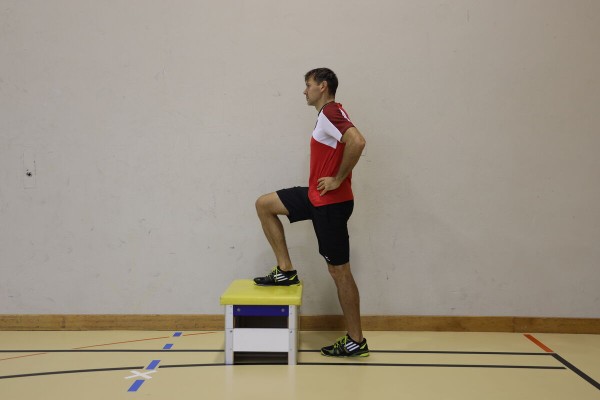

Stand upright in front of the plyo box (the vaulting box - 1 intermediate element plus top), with one leg stretched out on the floor and the other (right) leg bent on the raised surface. Extend the bent leg and at the same time move the leg placed on the floor onto the base in order to stand on the box/swinging box. Then move both legs back to the starting position (left leg back on the floor, right leg remains on the raised surface).
Attention:
Keep your upper body upright, distribute your weight over your entire foot, push your knees outwards (do not tilt inwards).
Lighten:
Select a lower element.
Harden:
Select a higher element; additional weight (on the back, in the hands or on the foot).
1 plyo box/swinging box
2 dumbbells/kettlebells/1 medicine ball/weight cuff/weight waistcoat ► make the exercise more difficult (additional weight)
Step onto an object (right) ► step up
Power
Individual work
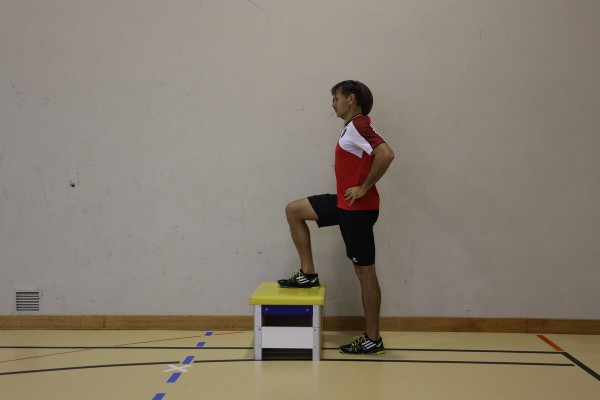
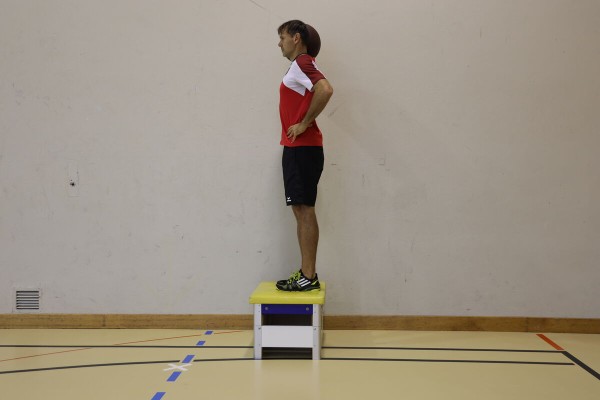
Stand upright in front of the plyo box (the vaulting box - 1 intermediate element plus top), with one leg stretched out on the floor and the other (right) leg bent on the raised surface. A medicine ball (or another weight such as a dumbbell or kettlebell) is held on the shoulder with a bent arm on the side where the leg is placed on the raised surface. Extend the bent leg and at the same time move the leg placed on the floor onto the base to get to a standing position on the box/swinging box. Then move both legs back to the starting position (left leg back on the floor, right leg remains on the raised surface).
Attention:
Keep your upper body upright, distribute your weight over your entire foot, push your knees outwards (do not tilt inwards).
Lighten:
Select a lower element; do not hold any weight on the shoulder.
Harden:
Select a higher element; more weight; additional weight on the foot.
Variation:
Hold a weight (dumbbell or kettlebell) in both hands with hanging arms.
1 plyo box/swinging box
1 medicine ball/dumbbell/kettlebell
1 weight sleeve/weight waistcoat ► make the exercise more difficult (additional weight)
1 additional dumbbell/kettlebell ► variation of the exercise
Step up onto an object ► step up
Power
Individual work


Stand upright with your feet shoulder-width apart in front of the object, step onto the object lying on the floor (e.g. tyre) first with one leg and then with the other and then back down to the starting position (climbing stairs). Switch the starting position/leg too.
Attention:
Keep your upper body upright.
Lighten:
Select a lower element; lower cadence.
Harden:
Higher cadence; additional weight (on the feet); standing on the object, two-legged jump upwards back to the starting position.
Variant:
Alternate with the left/right foot first (more demanding in terms of coordination).
1 tyre (10DM)
1 tyre (DURO)/helmet ► make the exercise easier (position)
2 weight cuffs/1 weight waistcoat ► make the exercise more difficult (additional weight)
Step up onto an object ► step up
Power
Individual work


Stand upright with your feet shoulder-width apart in front of the long bench, step onto the long bench first with one leg and then the other and then back down to the starting position (stair climbing). Alternate start/leg as well.
Attention:
Keep your upper body upright.
Lighten:
Select a lower element (e.g. vaulting box top); lower cadence.
Harden:
Choose a higher element; higher cadence; additional weight (on the feet); two-legged jump into the air after standing on the long bench.
Variant:
Alternate with the left/right foot first (more demanding in terms of coordination).
1 long bench
1 vaulting box top section ► easier exercise (position)
2 vaulting box elements (incl. top section) ► more difficult exercise (position)
2 weight cuffs/1 weight waistcoat ► more difficult exercise (additional weight)
Step onto an object alternately ► step up
Power
Individual work
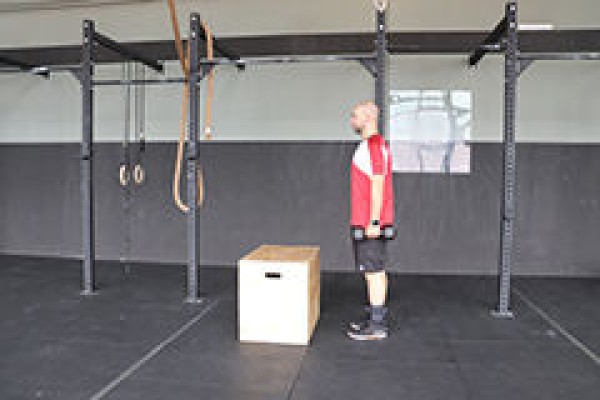


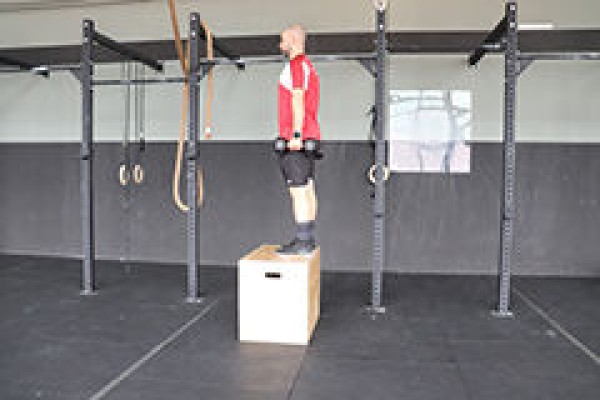


Stand upright with your feet about shoulder-width apart in front of a plyo box, a Swedish box, or a similarly stable raised surface. Keep your feet pointing forward as much as possible and distribute your weight evenly. Keep your upper body upright, look straight ahead, and engage your abdominal muscles slightly. Hold a weight in both hands or across your arms (dumbbells, kettlebells, medicine ball). Position yourself at a distance from the raised surface such that you can place your foot completely on it without leaning your upper body forward excessively. Place one foot completely and steadily on the raised surface, ensuring that both the ball of the foot and the heel are firmly planted. Gradually shift your body weight onto the raised leg. Press firmly into the surface with your entire foot and lift your body upward in a controlled manner. The knee of the rising leg remains stable throughout the movement and follows the direction of the toes. Then place the second leg on the raised surface as well and briefly stabilize the top position. Next, lower yourself back down in a controlled manner on one leg, then bring the second leg back down. Begin the next repetition with the other leg. Throughout the entire movement, keep the upper body, pelvis, and leg axis as stable as possible.
Attention:
The foot is not placed fully on the step, and the heel hangs over the edge; the knee of the stepping leg falls noticeably inward or swings sharply outward; the upper body leans sharply forward or to the side while stepping up; the arms are used to generate momentum. The lower leg pushes off the ground too forcefully, thereby relieving pressure on the actual working leg; when rising, the pelvis rotates or shifts noticeably to the side; the descent is too fast or uncontrolled; the heel of the raised leg lifts significantly off the surface during the push-up; the chosen elevation is so high that the movement can only be performed with compensatory movements; choose only a height at which the entire foot can be placed securely and the movement can still be performed in a controlled and pain-free manner; especially when lowering, actively slow down the movement and do not simply let yourself fall to the ground.
Lighten:
Use a lower plyo box or a lower Swedish box. Reduce the range of motion by using a lower platform. If you have balance issues, lightly support yourself against a wall, bar, or partner. Start by performing the exercise slowly and holding a short pause at the top of the movement. Perform the exercise without additional weight. First, perform several repetitions with the same leg and only then switch sides.
Harden:
Choose a higher platform, provided that your form remains stable. Increase the weight of the dumbbells, kettlebells, or medicine ball. Use a weight vest or sandbag as additional weight. Place an unstable support surface under the standing leg. Consciously slow down the downward movement over 2–4 seconds. Hold the top position for 2–3 seconds and stabilize your balance. Raise the free leg at the top with a controlled knee lift without setting it down on the platform. Perform the exercise on one leg in a more controlled manner by using the free leg for support as little as possible.
1 plyo box/swivel box
2 dumbbells/kettlebells/1 medicine ball
2 weight cuffs/1 weight waistcoat ► make the exercise more difficult (additional weight)
Step onto an object alternately ► step up
Power
Individual work


Stand upright in front of the (flat) bench, first with one leg, then with the other, climb onto the bench and back down to the starting position (stair climbing). Change starting position/leg after each exercise or after a few repetitions.
Starting position:
- From an upright, shoulder-width stance, position one foot on the bench
- Hold the weight in your hands on one or both sides or place it on your shoulders
- Tense your abdominal and gluteal muscles
Finishing position:
- Stand upright on the bench
- Keep your back straight
Attention:
Keep your upper body upright, distribute your weight over your entire foot, push your knees outwards (do not tilt inwards).
Variant:
Alternate with the left/right foot first (more demanding in terms of coordination).
1-2 dumbbell(s)/kettlebell(s) or 1 barbell
Climb onto an object in push-up position ► stair walking push up position
Power
Individual work


Push-up position, hands placed on an object (e.g. combat rucksack or tyre), step down from the object (move hands to the floor one after the other) and return to the starting position.
Attention:
No hollow back, tense torso, elbows bent approx. 45 degrees from the upper body ("A" shape with the arms), shoulders are fixed and pressed down towards the hips.
Lighten:
Support in place (possibly raise arms slightly alternately).
Harden:
Higher object; additional weight (on the back); unstable support for the legs.
1 combat rucksack/tyre (PUCH)
1 tyre (10DM) ► make the exercise more difficult (position)
1 weight vest/weight disc/sandbag/(additional) combat rucksack ► make the exercise more difficult (additional weight)
1 ball/1-2 balance cushions/1 balance board ► make the exercise more difficult (unstable base)