
Exercises (1882)
Extension and flexion of the legs in a hanging position ► bent knee leg raise
Power
Individual work

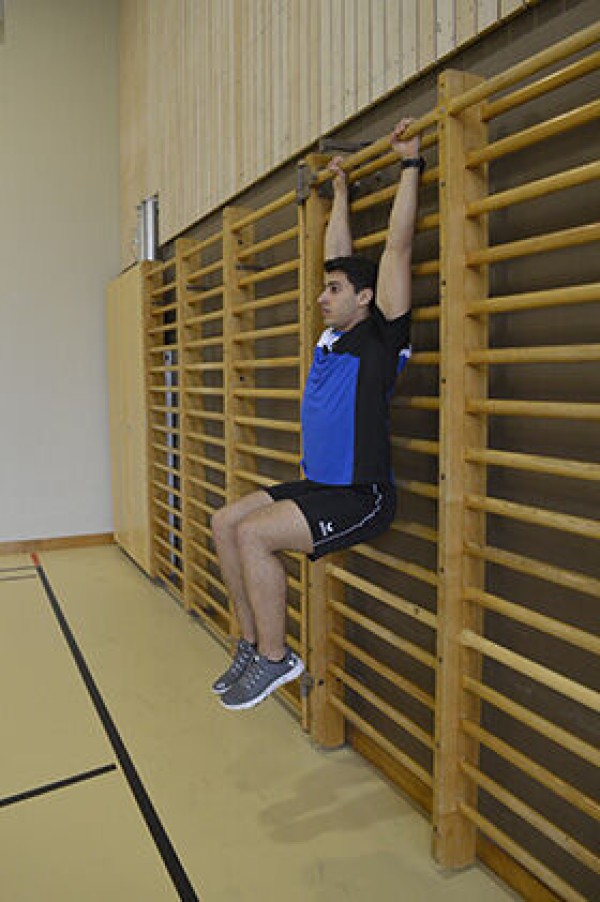
Hanging on the wall bars (back facing the wall bars), body stretched, legs bent and stretched (knees raised to hip height).
Attention:
Back always remains on the wall bars (movement as controlled as possible, without momentum).
Lighten:
Just hold the position with bent legs; lift your knees less high.
Harden:
Additional weight for the legs; stretch the legs.
1 wall bars
2 weight cuffs/1 (medicine) ball (e.g. football, volleyball, basketball) ► Make the exercise more difficult (additional weight)
Extension and flexion of the legs in push-up position ► suspended crunch
Power
Individual work
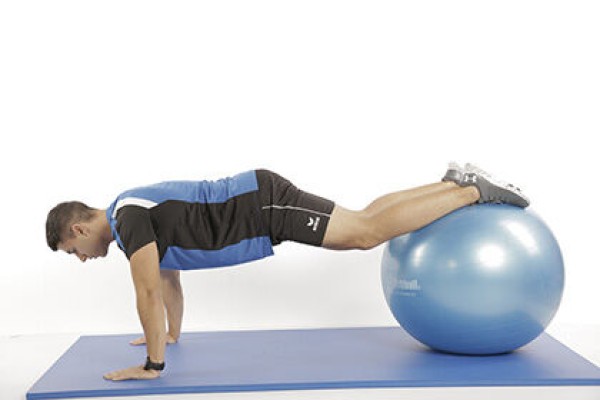
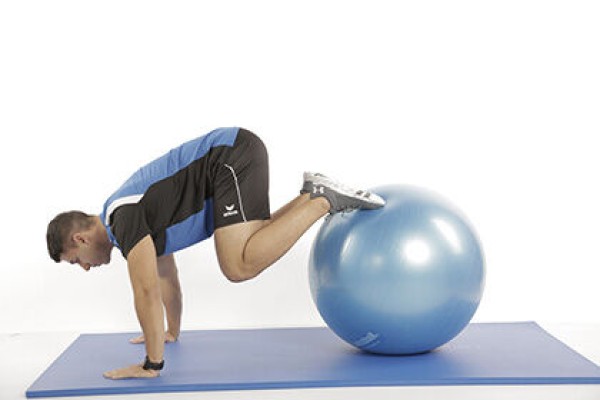
Assume a push-up position (plank), with your hands on the floor shoulder-width apart directly beneath your shoulders; your lower legs or feet rest on the exercise ball; your body forms a straight line (head-hips-feet); actively engage your core; keep your back neutral. Bend your legs in a controlled manner and pull the ball towards your upper body; keep your hips as stable as possible (do not lift them sharply); bring your knees towards your chest (crunch movement). Then slowly extend your legs back to the starting position. Breathing: breathe out as you pull the ball in, breathe in as you return to the starting position.
Attention:
Avoid arching your back (lower back sagging), do not let your hips shoot upwards (the movement becomes a pike rather than a crunch), roll the ball in a controlled manner (maintain sufficient stability), keep your shoulders stable (actively push from your shoulders, maintain a stable push-up position, no jerky movements).
Lighten:
Position the ball closer to the knees; reduce the range of motion (only bend the knees slightly); secure the exercise against a wall (ball against the wall – less instability); simply hold the position without moving (static work to start with).
Harden:
Additional weight (on your back); unstable support for your arms; actively lift your hips upwards (legs straight – the pike is significantly more challenging than the crunch); one-legged variation (lift one leg off the ball).
1 exercise ball
1 weight vest/weight disc/sandbag ► to make the exercise more difficult (additional weight)
1 balance cushion/balance board ► to make the exercise more difficult (unstable base)
Extension and flexion of the legs in the supine to shoulder position ► lying tuck shoot out
Power
Individual work
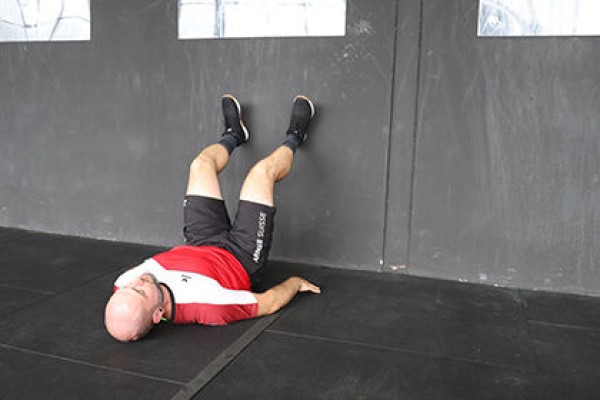
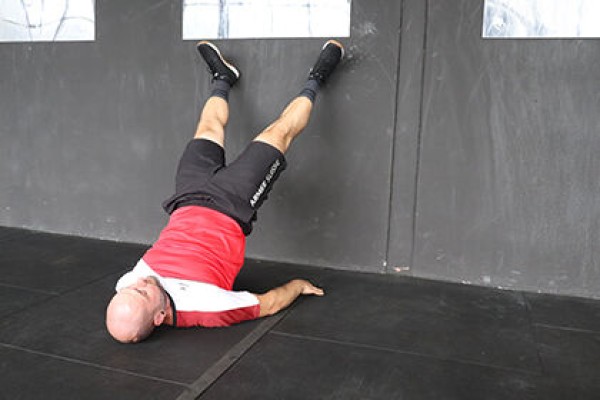
Lying on your back on a soft mat (hands may hold the sides of the mat), legs bent so that the soles of the feet can be pressed against the wall (90 degree angle in the hip and knee joints). From this position, swing your legs upwards to assume the shoulder position (lower back and buttocks lifted off the floor, head remains on the floor), placing your heels against the wall (hold the position briefly). Then lower your legs along the wall and bend them back to the starting position.
Attention:
In the shoulder position, the upper body and legs practically form a line (actively tense the torso).
Lighten:
Only hold the end position in the shoulder position very briefly and lower the body again immediately.
Harden:
Additional weight (on the legs).
1 wall
1 soft mat (small)
2 weight cuffs ► to make the exercise more difficult (additional weight)
Extension and flexion of the legs in supine position
Power
Partner work
1 trainee & 1 helper ► Note change of position
(= double the time required; for lesson planner see Organisation Kraft: Info button Execution)
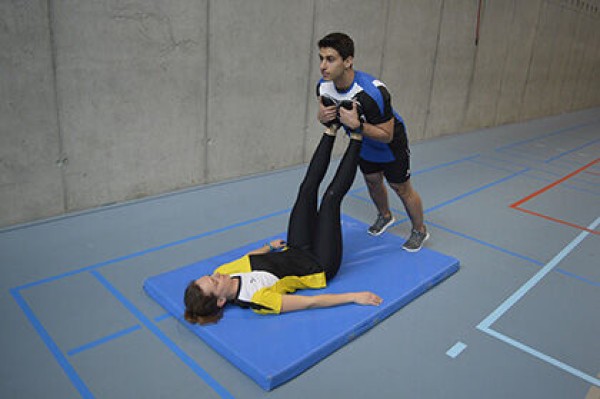
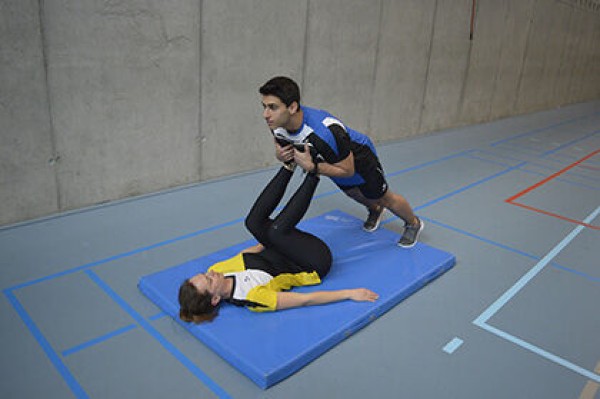
Trainee: Lies on their back with their legs raised and stretched out, hands on the back of their neck or flat on the floor at their sides, bending and stretching their legs to move their partner up and down (leg press).
Partner: Leans from a standing position with their chest on the raised feet (soles of the feet) of the active participant (slight forward lean, good body tension).
Attention:
Knees always remain centred over the feet (no tipping inwards).
Lighten:
The passive participant stands more upright.
Harden:
Stronger partner's submission; additional weight for the passive participant (on the chest or shoulders).
1 weight vest/weight disc/sandbag ► Make the exercise more difficult (additional weight)
Extension and flexion of the legs in supine position
Power
Individual work
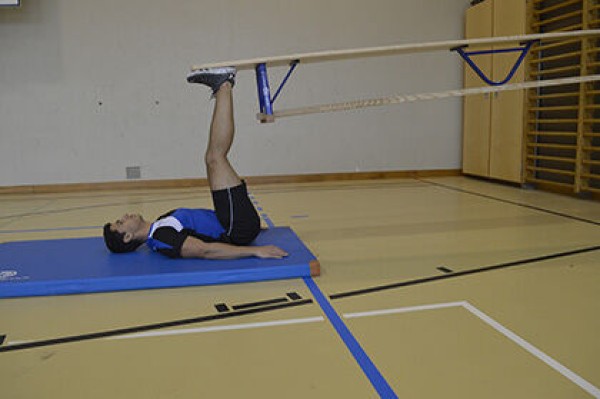
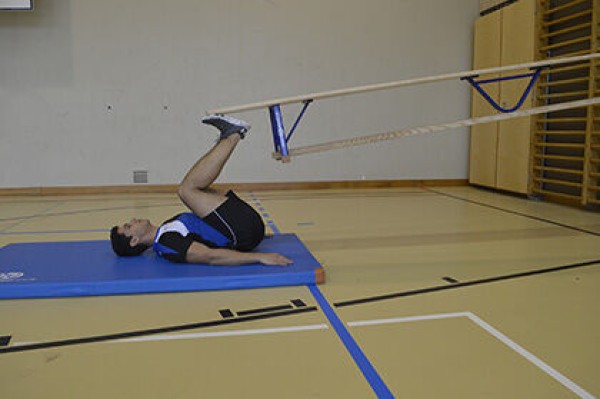
Long bench attached to the wall bars/swinging box, lying on your back on a soft mat, hands stretched out to the side on the floor (grasping the soft mat), feet supporting the free end of the long bench (legs bent, knees pointing towards the chest), legs (almost) fully extended and bent back to the starting position (raise and lower long bench).
Attention:
Do not fully extend legs, put weight on the whole foot.
Lighten:
Bend your legs less.
Harden:
Additional weight (weight disc on the long bench).
Additional weight (one partner sits at the other end of the long bench; the further forward towards the exerciser they move, the greater the weight to be lifted) - organisation = partner work.
1 vaulting box or wall bars
1 long bench
1 soft mat (small)
1 weight disc/sandbag ► to make the exercise more difficult (additional weight)
Extension and flexion of the legs in supine position ► bent leg raise
Power
Individual work
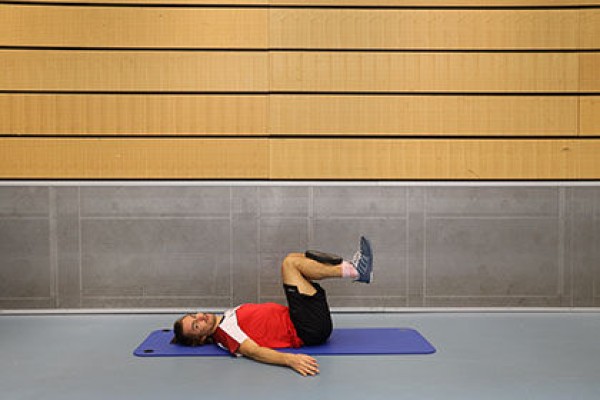
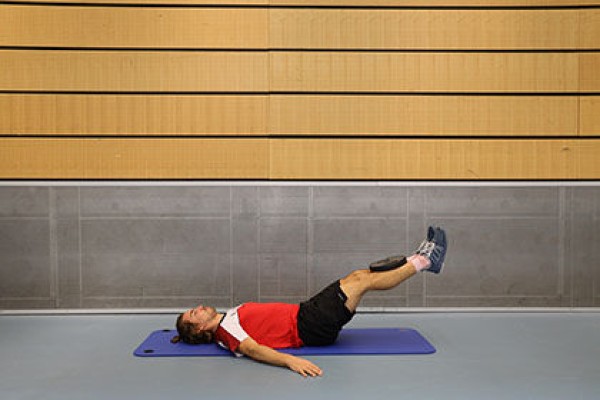
Lie on your back with your legs stretched out from the floor, a weight disc on your shins, arms stretched out to the side on the floor, bend your legs (approximately right angle at the knee joint, knees at buttock height) and stretch back to the starting position. Always hold the position with your legs stretched for a few seconds (4-8) before bringing your legs back again.
Attention:
Keep your back in contact with the floor (consciously tense your abdomen).
Lighten:
Extend your legs less; lift your legs further off the floor; only hold the position with your legs extended for a short time; no additional weight on your shins.
Harden:
More weight; hold the position with your legs extended for longer.
1 weight disc
Extension and flexion of the legs in supine position ► crunch kick
Power
Individual work
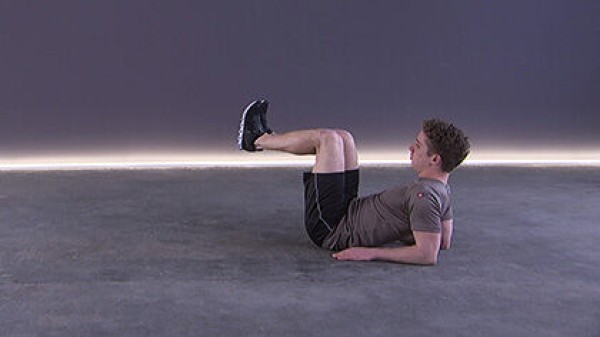
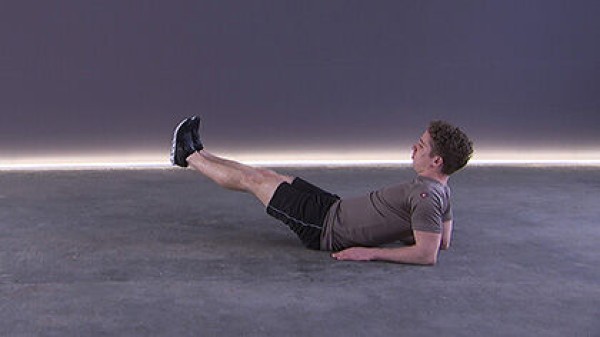
Back position, bent arms support the slightly raised upper body (forearms flat on the floor), bend the legs (knees at buttock height) and stretch forwards back to the starting position.
Attention:
Do not put your legs down completely, in the variations with the upper body lowered: Keep your (lower) back in constant contact with the floor (consciously tense your abdomen).
Lighten:
Just hold the position with slightly bent legs (without stretching your legs), stretch your legs less.
Harden:
Additional weight on, between or on top of the legs.
Variant I:
Upper body flat on the floor, arms stretched out to the sides on the floor.
Variant II:
Upper body flat on the floor, arms stretched out to the side on the floor, legs bent and stretched and then pushed out straight up by lifting the pelvis.
2 weight cuffs/1 weight disc/(medicine) ball/sandbag ► Make the exercise more difficult (additional weight)
Extension and flexion of the legs in supine position ► crunch kick / knee crunch
Power
Individual work

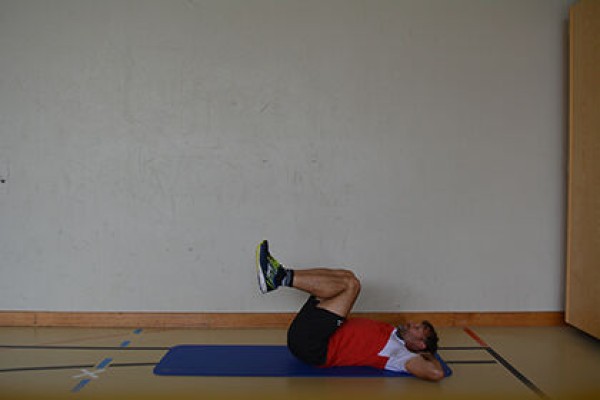
Back position, upper body flat on the floor, arms stretched out to the sides on the floor (or place hands under the buttocks / or clasp hands behind the head), bend legs (knees at buttock height) and stretch back to the starting position in front (bend and stretch legs).
Attention:
Do not put your legs down completely, keep your (lower) back in constant contact with the floor (consciously tense your abdomen).
Lighten:
Just hold the position with slightly bent legs (without stretching your legs), stretch your legs less.
Harden:
Additional weight on, between or on top of your legs.
2 weight cuffs/1 weight disc/(medicine) ball/sandbag ► Make the exercise more difficult (additional weight)
Extension and flexion of the legs in supine position ► leg curl
Power
Individual work
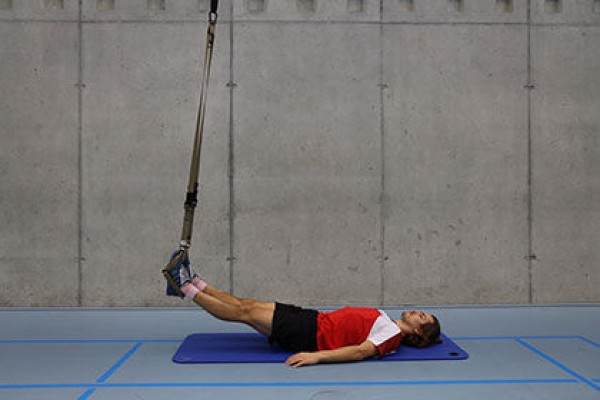
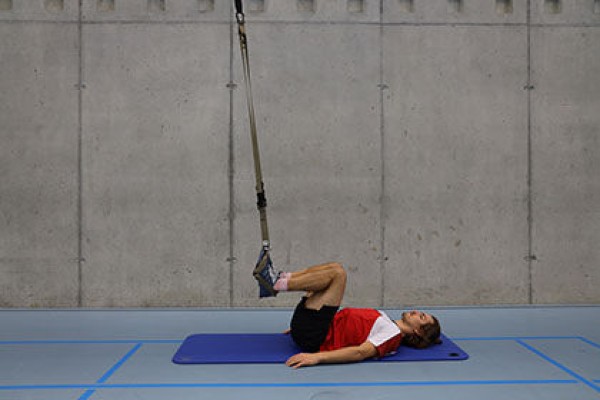
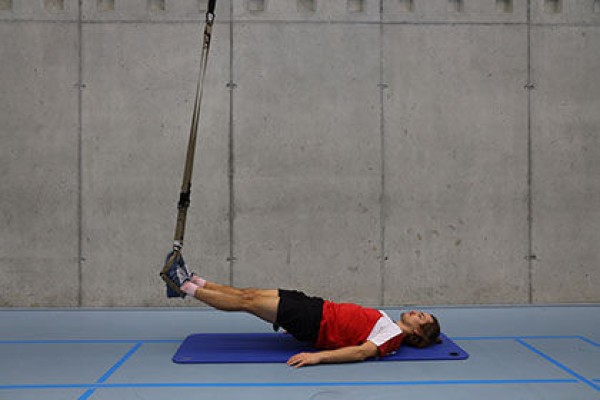
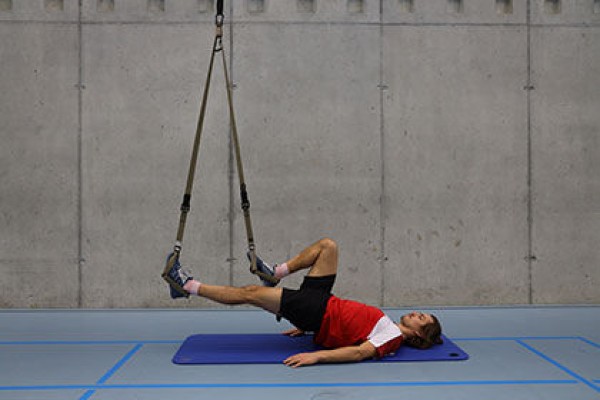
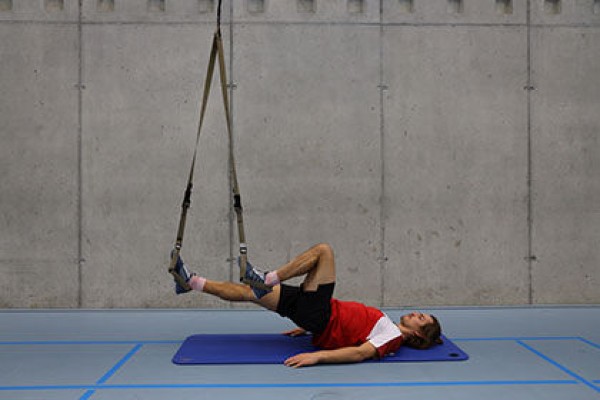
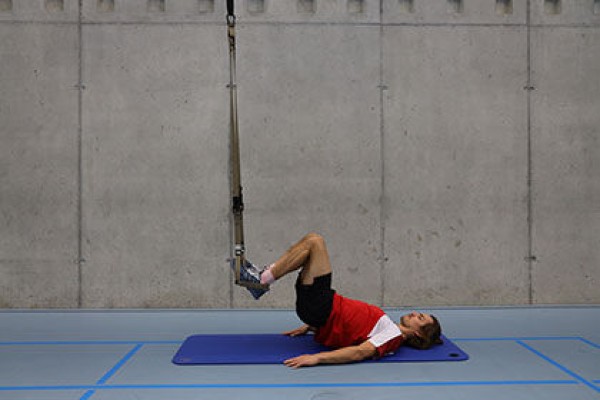
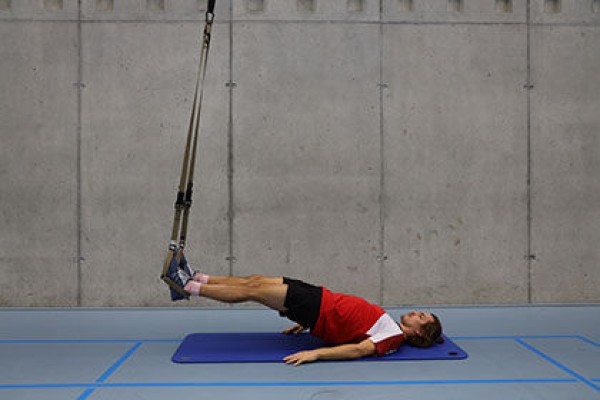
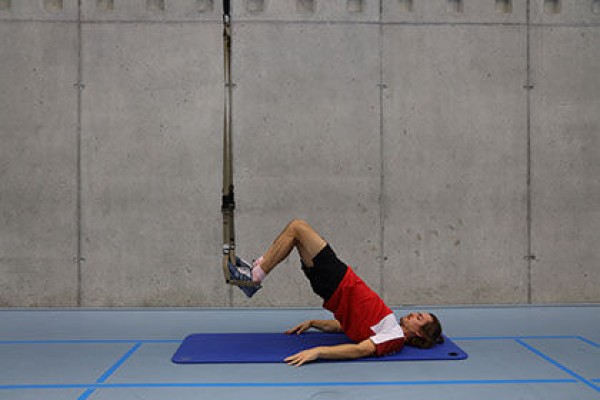
Progression I:
Adjust the sling trainer to mid-lower leg length (standing), lie on your back with your face up, fix your heels in the slings vertically below the attachment point, pull your heels towards your buttocks and return to the starting position. Press the heels down during the entire movement.
Progression II:
Analogue to progression I, but the pelvis is lifted off the floor (body tension, only the shoulders rest on the floor), alternately pull one leg up.
Progression III:
Analogue to progression II, but both legs are pulled up at the same time. When pulling the heels up, lift the pelvis and form a right angle with the knees.
Progression IV:
Analogue to progression III, still supine, but in the starting position the heels are not vertically under the attachment point but are closer to the body (sling trainer hangs at an angle and points towards the body), in addition the arms are stretched out in front (pointing upwards). The further away the head is from the attachment point, the more challenging the exercise becomes.
1 sling trainer
Extension and flexion of the legs in supine position ► leg press
Power
Individual work
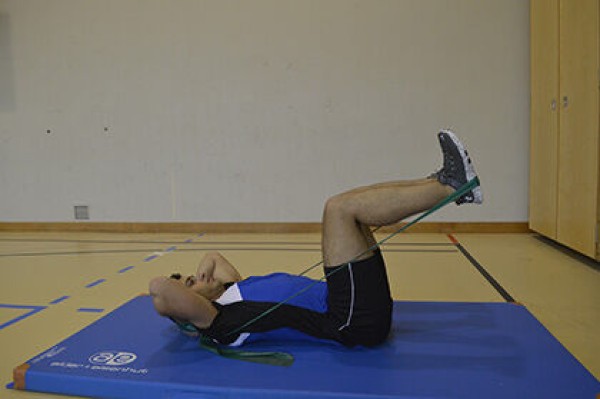

Lying on your back, legs bent in a high position with a right angle at the knee joint (lower legs parallel to the floor), centre of the band wrapped around the soles of your feet, grasp the ends of the band with your hands and place them on the back of your neck (elbows pointing outwards/to the side), stretch and bend your legs.
Attention:
Keep your back in constant contact with the floor.
Lighten:
Choose a rubber band with less resistance.
Harden:
Choose a rubber band with more resistance.
1 elasticated rubber band
Extension and flexion of the legs in shoulder position ► hamstring curl
Power
Individual work
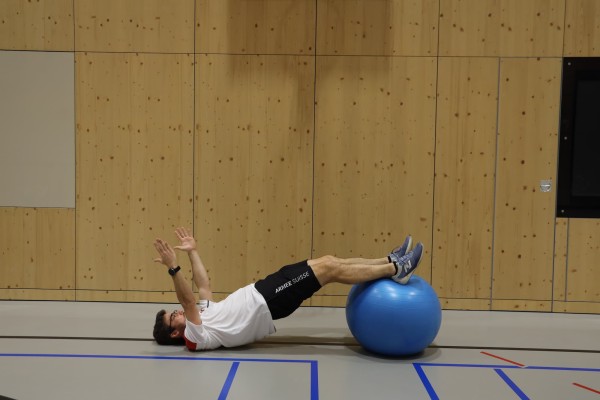
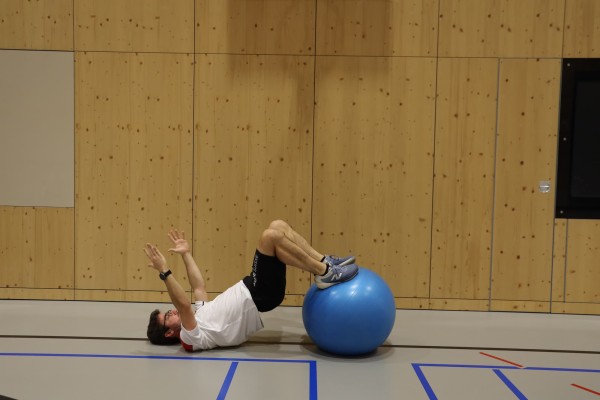
Lie on your back on the floor or a mat, place both heels hip-width apart on a gym ball, and actively point the tips of your toes upwards towards the ceiling (dorsal extension). Engage your core and gluteal muscles and lift your pelvis off the floor until your thighs, pelvis and upper body form a straight line (shoulder bridge). Extend your arms diagonally upwards (V-position). Keep your neck long, with the back of your head resting relaxed on the floor. Now, using the pressure of your heels on the ball, actively and controlled pull the ball towards your buttocks by bending your knees. Hold briefly for 1 second at the point of maximum flexion. Then slowly and in a controlled manner roll the ball back towards you until your legs are almost straight. The pelvis remains completely off the floor throughout the entire movement and does not touch the floor at any point.
Attention:
When bending the knees, the pelvis drops downwards instead of remaining raised; the lumbar spine becomes severely hyperextended (abdominal tension lost, extreme hollow back); the feet or knees tilt outwards or inwards; the ball is pulled in hastily and with a swing.
Lighten:
Hold a pure static shoulder bridge with your heels on the ball (without rolling in); lightly block the ball against a mat or wall so that it does not roll away to the side; after extending, briefly rest the pelvis on the floor, briefly relieve the strain and rebuild the position; smaller range of movement (bend the legs less/barely move the ball towards the body); place the arms at your sides on the floor.
Harden:
Perform on one leg - keep the heel of one foot on the ball, whilst the other leg is stretched vertically upwards into the air and remains stationary; deliberately slow down the forward rolling phase (extension) to 4 seconds; place an additional weight plate on your pelvis and hold it in place with your hands.
1 exercise ball / swiss ball
1 weight disc/dumbbell/sandbag ► make the exercise more difficult (additional weight)
Extension and flexion of the legs in shoulder position ► hamstring curl
Power
Individual work
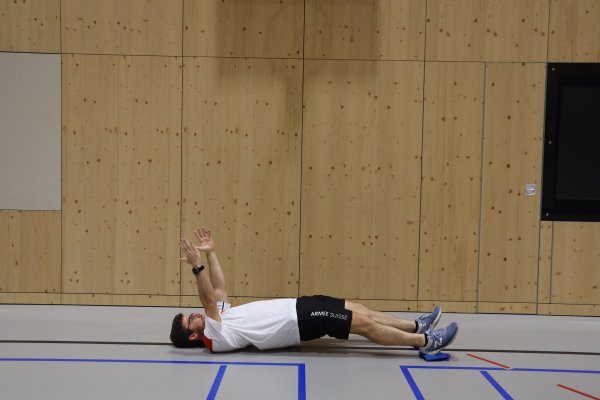
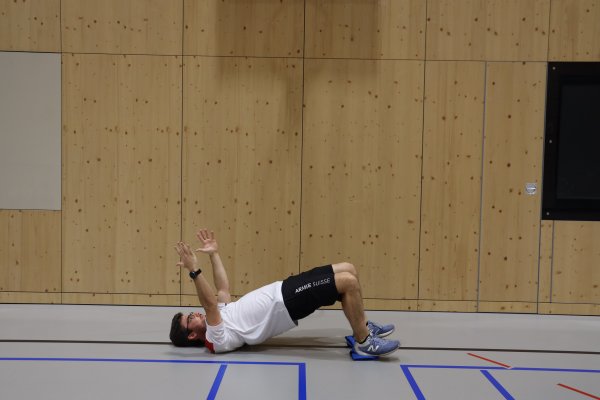
Lie on your shoulders with both heels resting on a towel. Extend your arms diagonally upwards (V-shape), tighten your abdominal and gluteal muscles, lift your pelvis and hold it in a stable position. Press your heels against the towel and bring your legs towards your bottom by bending your knees. Then, straighten your legs again and return to the starting position. Keep your hips raised throughout the movement.
Attention:
Do not let your pelvis sag or tilt to one side; do not arch your back; perform the movement slowly and in a controlled manner; do not let your knees turn outwards or inwards; do not use momentum from your hips.
Lighten:
Take small, slow steps backwards and forwards without a scarf; take shorter steps backwards.
Harden:
Perform the exercise on one leg (switch sides); add extra weight (to be placed on the hip).
1 sliding towel
1 weight disc/dumbbell► make the exercise more difficult (additional weight)
Extension and flexion of the legs in shoulder position ► leg curl
Power
Individual work
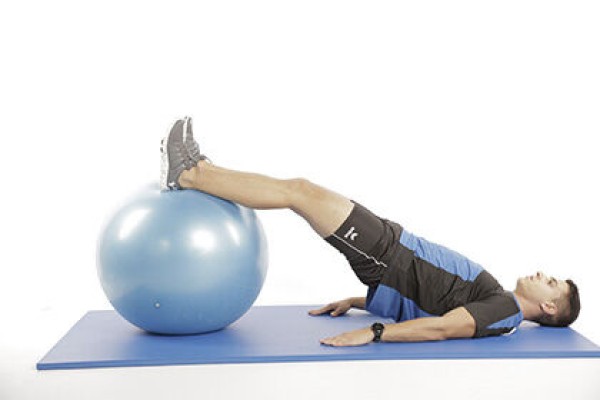
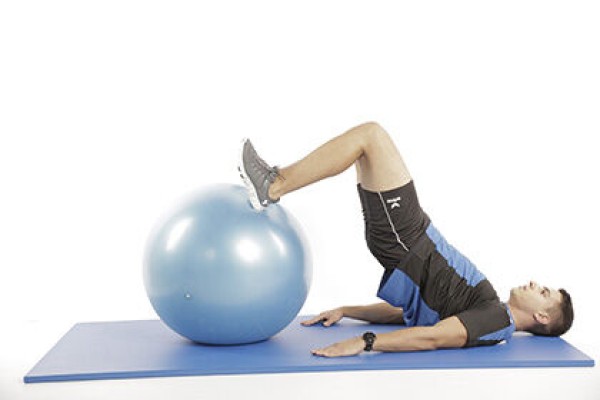
Shoulder position with legs stretched out on the exercise ball, arms resting at the sides on the floor, push hips up, bend legs (bring exercise ball to buttocks) and stretch back to starting position.
Attention:
Torso, hips and knees practically form a line in the starting position (do not let buttocks sag, push hips up, tense abdomen).
Lighten:
Just hold the position (without bending and stretching your legs), bend your legs less (hardly move the ball towards your body).
Harden:
Do not lay your arms flat on the floor, but cross them in front of your chest; hold additional weight with your hands on your hips.
1 exercise ball
1 weight disc/dumbbell/sandbag ► Make the exercise more difficult (additional weight)
Extension and flexion of the legs with raising and lowering of the upper body while standing (Romanian deadlift) ► romanian deadlift
Power
Individual work
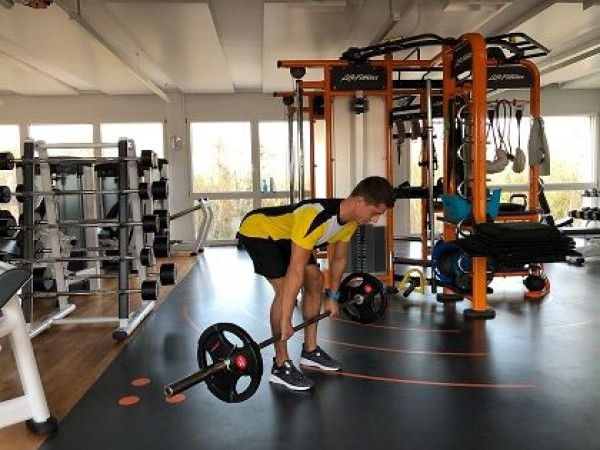
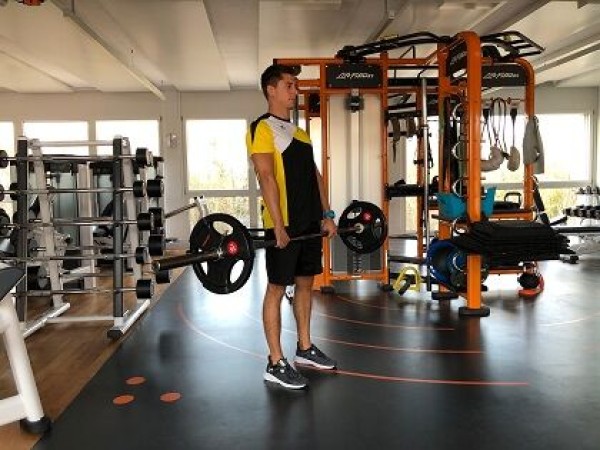
Standing upright with your feet hip-width apart, grip the barbell shoulder-width apart with your arms straight (hanging). Move the weight along your legs towards the floor, bending your knees only slightly. Then straighten your legs again and raise your upper body back to the starting position.
Starting position:
- Stand upright with hips hip-width apart
- Grasp the barbell with hands shoulder-width apart, arms hanging
Finishing position:
- Upper body tilted forwards
- Buttocks pushed back (hip hinge)
- Straight back
Attention:
The back remains straight throughout the entire exercise, i.e. the barbell should only be moved as far towards the floor as the correct posture allows (if possible, the weight can also be briefly lowered to the floor).
Extension and flexion of the legs with raising and lowering of the upper body while standing (Romanian deadlift) ► romanian deadlift
Power
Individual work
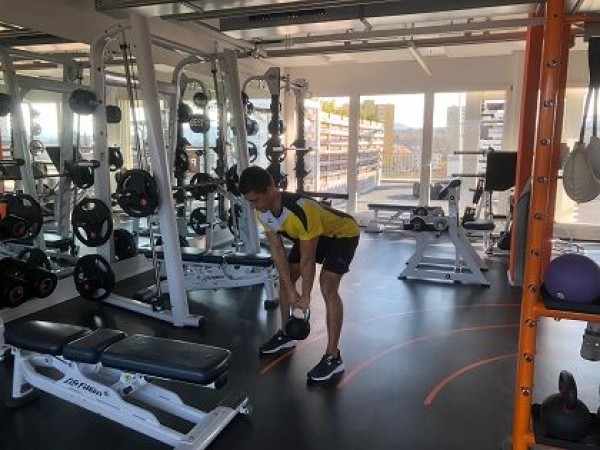

Stand upright with your feet hip-width apart and grasp the weight with both outstretched (hanging) arms. Move the weight between your legs towards the floor (if possible, move the weight along your legs towards the floor), bending your knees only slightly. Then straighten your legs again and raise your upper body back to the starting position.
Starting position:
- Stand upright with hips hip-width apart
- Hands grasp the weight shoulder-width apart, arms hanging
Finishing position:
- Upper body tilted forwards
- Buttocks pushed backwards (hip hinge)
- Straight back stretched out
Attention:
The back remains straight throughout the entire exercise, i.e. only lift the weight as far towards the floor as the correct posture allows (if possible, the weight can also be briefly lowered to the floor).
1 kettlebell
Extension and flexion of the legs with raising and lowering of the upper body while standing ► romanian deadlift
Power
Individual work


Stand upright with your feet shoulder-width apart, hold an object (e.g. a rucksack or sandbag) in front of your body with your arms hanging straight out in front of you, bend your upper body forwards with your back straight and bend your legs at slightly different times so that the object can be brought to the floor in front of your feet. Stretch your legs and straighten your upper body to return to the starting position (Romanian deadlift).
Attention:
Keep your back straight (tense your core).
Lighten:
Less/no weight.
Harden:
Hold the weight in front of your chest, on your neck or hold it up; more weight.
Variation:
Keep your legs straight and only tilt your upper body forwards.
1 sandbag/fighting rucksack
1 helmet ► Make the exercise easier
1 weight disc/tyre (PUCH) ► Make the exercise more difficult (additional weight)
Extension and flexion of the legs with upward movement of the arms while standing (left)
Power
Individual work


Squat, hold the pistol with outstretched arms in both hands next to the left standing leg, stretch your legs and at the same time bring your outstretched arms (pistol) diagonally upwards to the right above your head, bend your legs to return to the starting position.
Attention:
Keep your knees behind your toes in the squat position.
Lighten:
Bend your knees less (larger angle).
Harden:
Bend your knees more (smaller angle).
1 pistol (neutralised)
Extension and flexion of the legs with upward movement of the arms while standing (left)
Power
Individual work
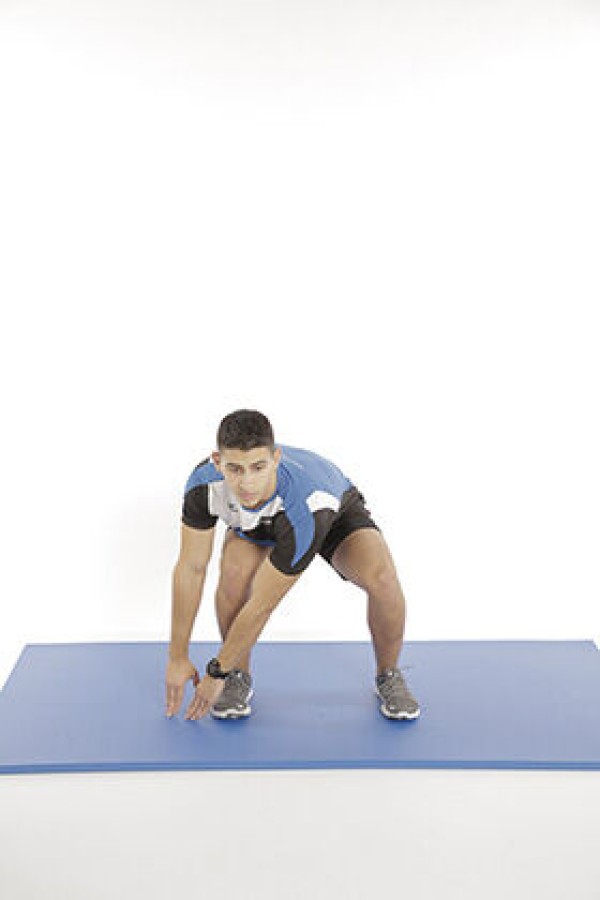
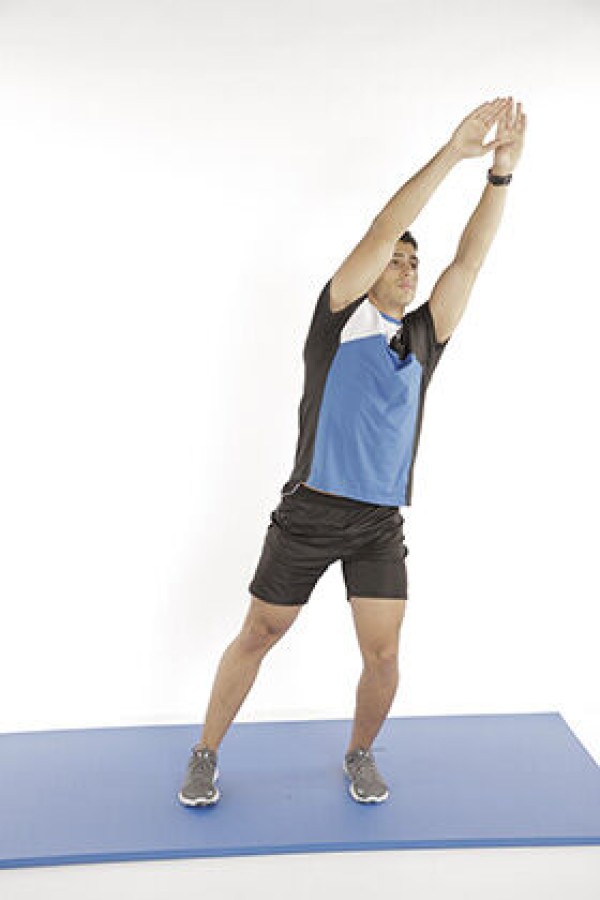
Squat, arms outstretched together next to the left standing leg, stretch your legs and at the same time bring your outstretched arms diagonally upwards to the right above your head, bend your legs to return to the starting position.
Attention:
Keep your knees behind your toes in the squat.
Lighten:
Bend your knees less (greater angle).
Harden:
Bend your knees more (smaller angle); hold additional weight on your arms or in your hands.
2 weight cuffs/weight balls/dumbbells/1 (medicine) ball/weight disc ► Make the exercise more difficult (additional weight)
Extension and flexion of the legs with upward movement of the arms while standing (right)
Power
Individual work
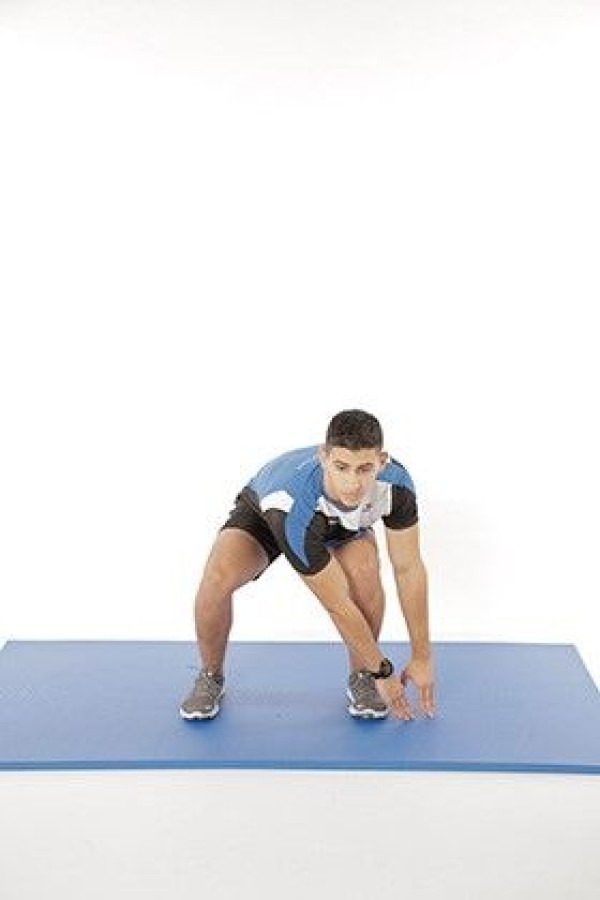
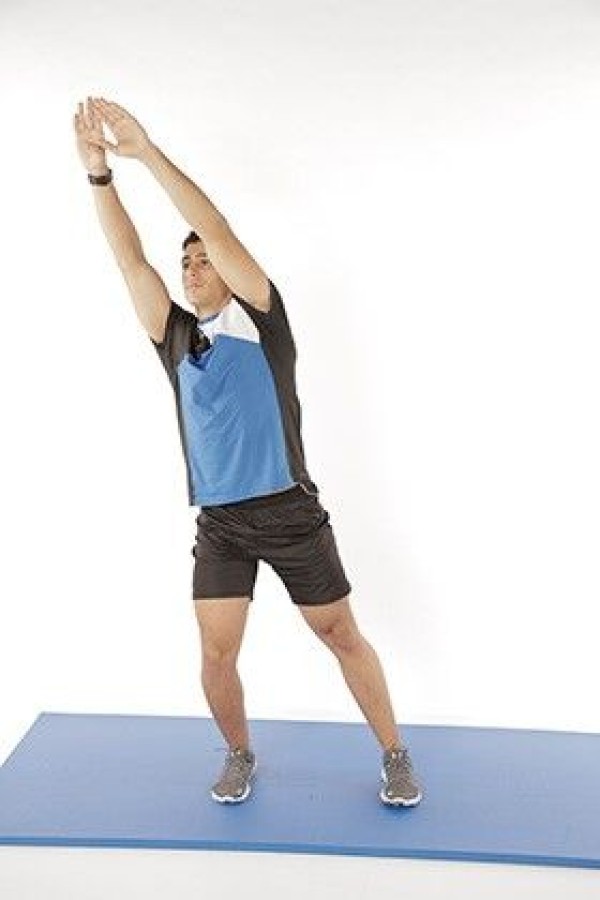
Squat, arms outstretched together next to the right standing leg, stretch your legs and at the same time bring your outstretched arms diagonally upwards to the left over your head, bend your legs to return to the starting position.
Attention:
Keep your knees behind your toes in the squat position.
Lighten:
Bend your knees less (greater angle).
Harden:
Bend your knees more (smaller angle); hold additional weight on your arms or in your hands.
2 weight cuffs/weight balls/dumbbells/1 (medicine) ball/weight disc ► Make the exercise more difficult (additional weight)
Extension and flexion of the legs and arms while standing (repositioning + pushing) ► clean + jerk
Power
Individual work

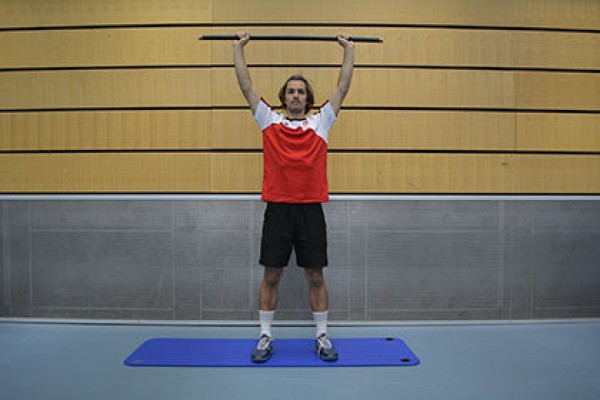

Squat down and grasp the barbell about shoulder-width apart (position the barbell over your midfoot), arms straight. Pull the bar upwards and catch the weight on your shoulders with your knees slightly bent (mainly pushing out of your legs - elbows pointing forwards). Then stretch your legs and work your upper body to bring the weight up to the high hold position.
Starting position:
- Squat, shoulder-width apart
- Upper body slightly bent forwards
- Arms shoulder-width apart and stretched
Finishing position:
- Stand upright
- Hold the bar overhead with arms almost outstretched
Attention:
This exercise is only for advanced users and requires a high level of knowledge, mobility and stability. Always make sure your back is straight (torso tension).
1 Langhantel
Extension and flexion of the legs and arms while standing (repositioning) ► clean
Power
Individual work


Squat down and grasp the barbell about shoulder-width apart (position the barbell over your midfoot), arms straight. Pull the bar upwards and catch the weight on your shoulders with your knees slightly bent (push it out of your legs).
Starting position:
- Squat, shoulder-width apart
- Upper body slightly bent forwards
- Arms shoulder-width apart and stretched
Finishing position:
- Stand upright
- Bar rests on your shoulders (elbows pointing forwards)
Attention:
This exercise is only for advanced users and requires a high level of knowledge, mobility and stability. Always keep your back straight (torso tension). In the final position, the weight of the bar should be on your shoulders and not in your hands.
1 Langhantel
Extension and flexion of the legs and arms while standing (repositioning) ► clean
Power
Individual work
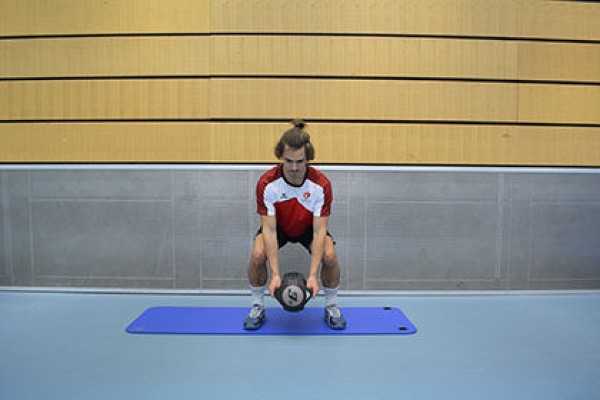
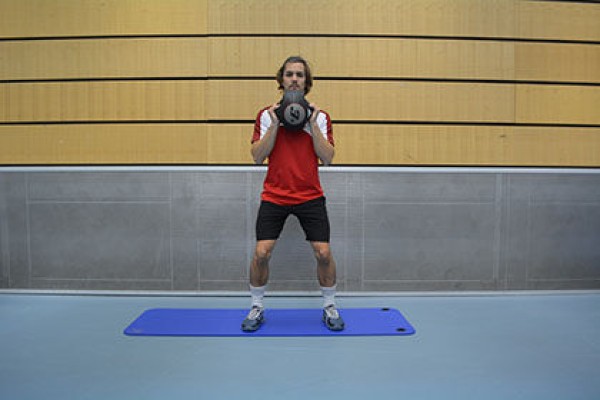
Squat down and grasp the weight (kettlebell) between your legs with your arms straight. Pull the weight upwards and catch it at chest height with slightly bent knees and bent arms (push from the legs - elbows pointing downwards, forearms parallel and facing forwards).
Starting position:
- Squat, standing shoulder-width apart
- Upper body slightly bent forwards
- Arms shoulder-width apart and stretched, grasp weight between legs
Finishing position:
- Stand upright
- Hold the weight in front of your chest (arms bent, elbows pointing downwards, forearms parallel and facing forwards)
Attention:
This exercise is for advanced users only and requires a high level of knowledge, mobility and stability. Always keep your back straight (torso tension).
1 kettlebell
Alternating extension and flexion of the legs and arms while standing ► clean + jerk
Power
Individual work
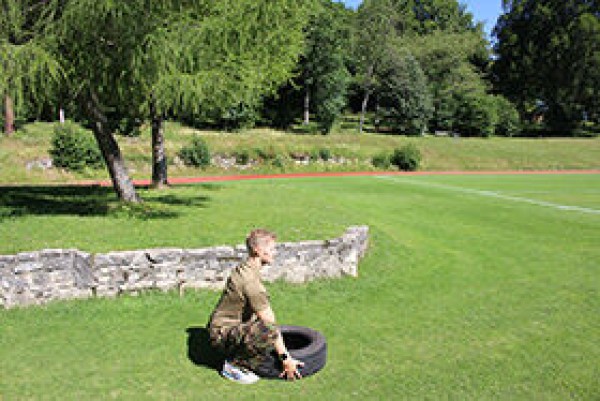

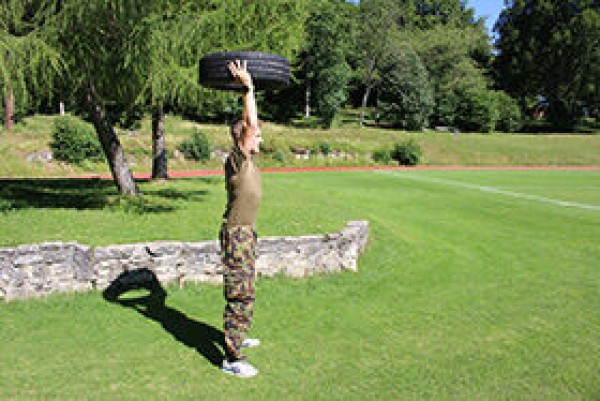
Grab the object lying on the floor (e.g. rucksack) with both hands and lift it above your head, place the object back down in front of your feet and start the exercise again.
Attention:
Keep your back straight, lift the weight from your legs and distribute it over your entire foot.
Lighten:
Less weight/load.
Harden:
More weight/greater load.
1 combat rucksack/weight plate
1-2 PET bottles (1.5 litres)/1 helmet ► Make the exercise easier
1 sandbag/tyre (PUCH) ► Make the exercise more difficult (additional weight)
Extension and flexion of the legs as well as moving an arm upwards while standing (upward hook) ► uppercut
Power
Individual work
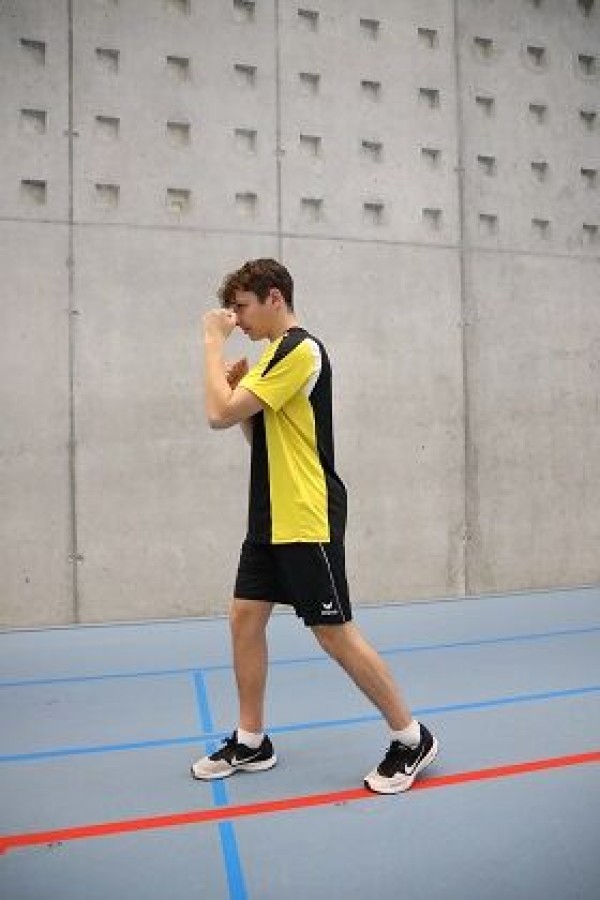
A distinction is made between the left-handed and right-handed stance. Right-handers take the left stance (left foot in front), while left-handers take the right stance (right foot in front). The left-hand stance: The left foot is placed one step forwards from a parallel stance approximately shoulder-width apart so that the right hand is behind. The right hand corresponds to the striking hand, the left hand to the leading hand. The distance between the two feet is approximately one shoulder width, with the feet on a diagonal to each other. The front foot stands on the entire sole, the heel of the back foot is raised. Both feet point forwards and the weight is evenly distributed over both legs. The front shoulder is turned slightly inwards. The whole body is slightly crouched, the knees are slightly bent and soft. The striking hand is placed in front of the chin and rests against the body. The lead hand is in front at eye level. The fists point outwards with the back. The arms are in front of the body and the elbows point downwards so that the arms cover the body. Alternately or in a free rhythm, the punching or leading hand is lowered to belly button height and brought back up to eye level in front of the face (upward hook, palm facing the face). The power of the punch is derived from the body action and not from the arm. The body action consists of stretching the leg and moving the hip forwards. The heel of the front foot turns outwards. When the fist comes up, turn away from the body into the punch.
Attention:
Always keep your arms up (chin or eye level).
Lighten:
Smaller movements/lower intensity of the punching movement (less leg extension/rotation).
Harden:
Hold additional weight on your arms or in your hands.
2 weight cuffs/weight balls/dumbbells ► Make the exercise more difficult (additional weight)
Extension and flexion of the legs and upward movement of the arm while standing (snatch) (left) ► snatch
Power
Individual work


Squat down and grab the weight (dumbbell or kettlebell) with one hand (left) between your legs, arm extended. By extending your legs and moving your arm upwards, pull the weight overhead (especially pushing it out of your legs) and stabilise the position by holding the weight up.
Starting position:
- Squat, hip-width apart
- Upper body slightly bent forwards
- Grasp the weight between the legs, arm extended
Finishing position:
- Stand upright
- Hold the weight overhead, arm almost extended in a high hold
Attention:
This exercise is only for advanced users and requires a high level of knowledge, mobility and stability. Always make sure your back is straight (torso tension).
1 dumbbell/kettlebell