
Exercises (1882)
Squat and jump to the side alternating ► squat & side jump
Power
Individual work


Get into a squat position with one leg on the balance half sphere, straighten your legs and simultaneously jump to the other side of the half sphere so that you change your standing leg on the sphere. With the landing movement, perform another squat and then jump back to the starting position in a fluid transition. In this way, the trainee jumps continuously from one side of the balance half-ball to the other and changes their standing leg on the training device with each exercise. In the lower squat position, the arms are bent and brought together in front of the body (landing), while the arms hang next to the body (flight phase) when the body is extended.
1 balance hemisphere
Squat and lunge alternating in jump (alternating jump) ► squat & jumping lunge
Power
Individual work
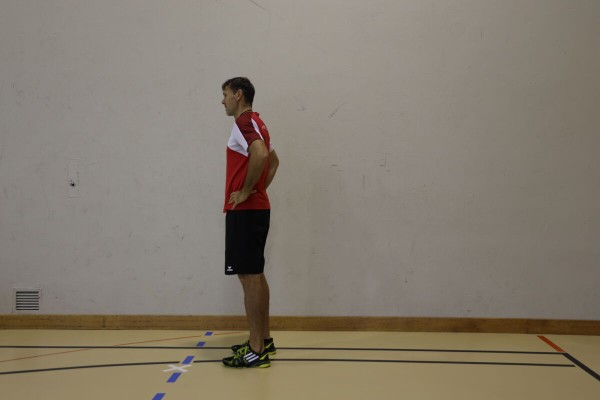
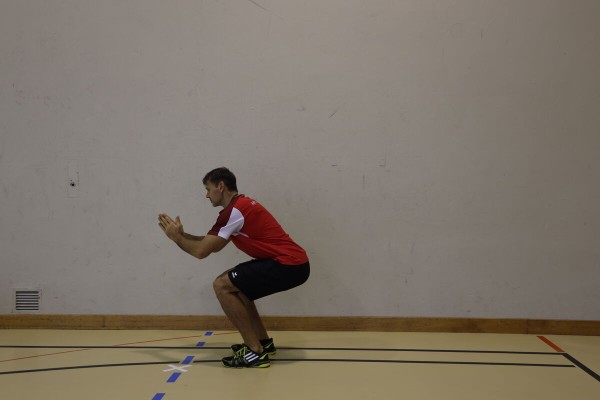
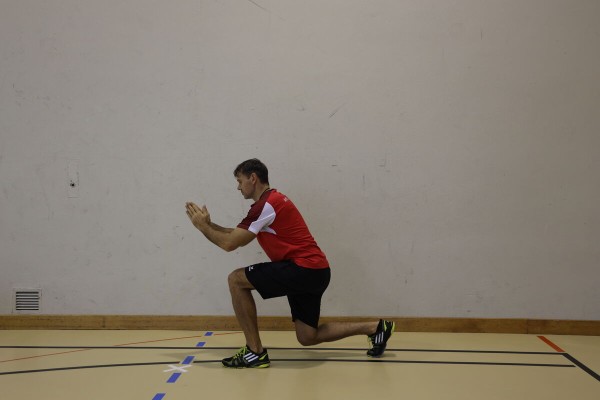

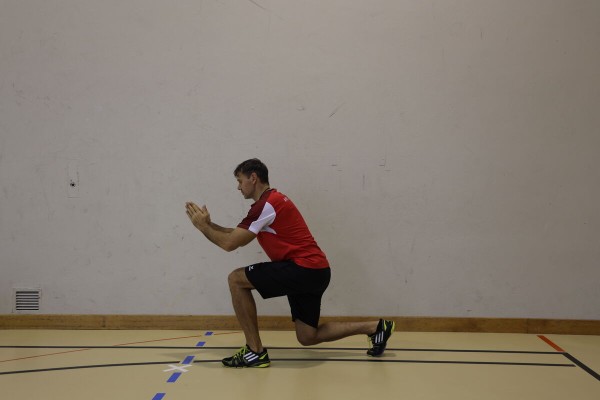
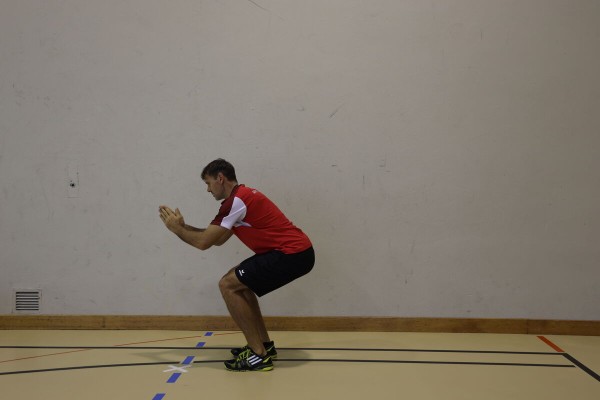


Stand with your feet shoulder-width apart, arms supported on your hips, bent or in front of you at chest height, bend your knees to approximately a right angle at the knee joints (buttocks at about knee height). From the deep squat position, perform a lunge backwards (upper body upright, abdomen tensed), arms again supported on the hips, folded on the chest, bent in front or at an angle, front (and back) leg bent to a right angle, two-legged jump to change leg position during the jump (move back leg forwards and front leg backwards - body position remains low), new alternating jump to return to the starting position in the lunge. Move the back leg forwards to the deep squat position before stretching the legs back to the starting position in a shoulder-width stance. After the new squat, change the side of the lunge compared to the previous version.
Attention:
When squatting, move your buttocks backwards, not your knees forwards. Keep your knees behind your toes. Keep your back straight at all times (tense your core), distribute your weight over your entire foot, push your knees outwards (do not tilt them inwards). When lunging, always keep the front knee behind the toe and centred over the foot. Keep your upper body as stable as possible.
Lighten:
Do not lower your buttocks too low (greater angle in the knees) when squatting. Higher basic position/lower upper body less (greater angle at the knees) when doing lunges.
Harden:
Additional weight (on the shoulders, with hanging arms or in a forward or upright position).
Variation:
Jump height can be varied: high jumps with plenty of time to change leg position or only small jumps with quick leg shifts.
1 weight vest/weight disc/(medicine) ball/sandbag/fighting backpack/2 dumbbells ► Make the exercise more difficult (additional weight)
Squat and straddle jump alternating ► sumo squat jump
Power
Individual work

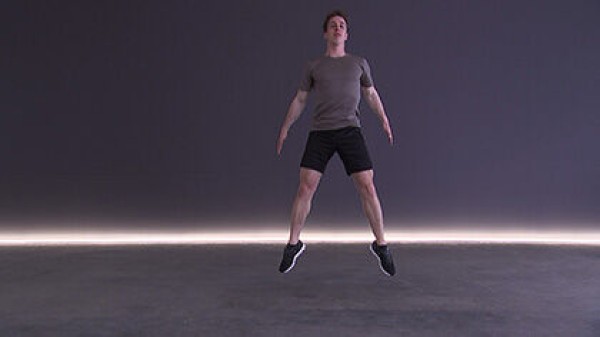
Stand with your feet shoulder-width apart, bend your knees to approximately a right angle at the knee joints (buttocks at about knee height), arms supported on your hips, folded across your chest, bent or in front of you at chest height, jump up and simultaneously spread and stretch your legs (straddle jump), cushion the jump (bend your knees slightly) and return to the starting position.
Attention:
Bring your buttocks back, not your knees forwards. Keep your knees behind your toes. Keep your back straight at all times.
Lighten:
Do not lower your buttocks too low (larger angle in the knees), smaller/less intense/higher jumps.
Harden:
Hold additional weight (on your shoulders, in front of you or with your arms hanging in your hands); larger, more intense/higher jumps.
2-4 weight vest/1 (medicine) ball/weight disc/sandbag/1-2 dumbbells ► Make the exercise more difficult (additional weight)
Knee bend and body extension alternating
Power
Individual work


Stand with your feet shoulder-width apart, arms bent in front of your body (hands at chest height), bend your knees to a right angle at the knee joints (buttocks at knee height, deep squat), stretch one arm overhead at the same time as you stretch your legs (slightly crosswise, hand approximately at the height of the opposite shoulder), squat down again and stretch the other arm upwards with the next body stretch.
Attention:
Move your buttocks backwards, not your knees forwards. Keep your knees behind your toes. Keep your back straight at all times.
Lighten:
Do not lower your body too low (greater angle in the knees).
Harden:
Additional weight (hold on the arms or in the hands).
2 weight cuffs/weight balls/dumbbells/1 weight waistcoat ► Make the exercise more difficult (additional weight)
Squat and jump onto an object alternately ► squat jump
Power
Individual work


Sit on an object lying on the floor (e.g. tyre - both legs inside or one leg inside and one leg outside the tyre), jump off with both legs to stand on the object, jump back to the starting position in the seat.
Attention:
Upright upper body, do not put all your weight down, keep your knees behind the tips of your feet.
Lighten:
Jump straight up from the seat without landing on the object in between (sit with both legs outside the tyre); lower your buttocks less (do not touch the object); lower cadence.
Harden:
Jump up after standing on the object with a direct landing on the seat; additional weight (on the shoulders); higher cadence.
1 tyre (10DM)
1 weight vest/sandbag/fighting rucksack ► to make the exercise more difficult (additional weight)
Squat and jump onto an object alternately ► squat jump
Power
Individual work
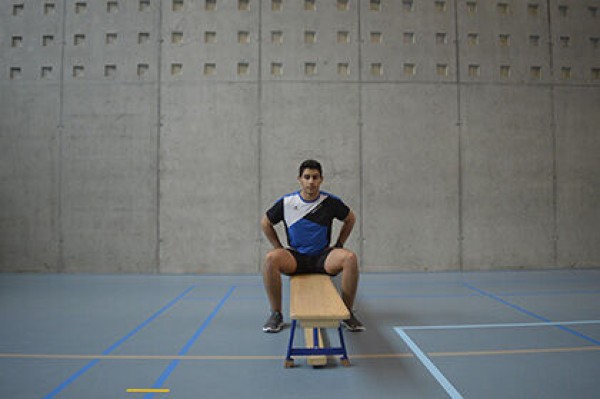

Sit on the long bench (one leg on each side of the bench), arms supported on the hips or in front, jump off with both legs to stand on the long bench, jump back to the starting position in the seat.
Attention:
Upright upper body, do not put all your weight down, keep your knees behind the tips of your feet.
Lighten:
Sit with both legs on the same side of the bench, only jump straight up from the seat without landing on the long bench in between; lower your buttocks less (do not touch the long bench); lower cadence.
Harden:
After standing on the long bench, jump up with a direct landing to the seat; choose a higher element (squat less intense, but jump up more difficult); additional weight (on the shoulders); higher cadence.
1 long bench
2 vaulting box elements (incl. top section) ► Make the exercise more difficult (position)
2 weight cuffs/1 weight vest/sandbag ► Make the exercise more difficult (additional weight)
Squat and stretch jump alternating ► squat jump
Power
Individual work


Stand with your feet shoulder-width apart, bend your knees to approximately a right angle at the knee joints (buttocks approximately at knee height), arms supported on your hips, folded across your chest or in front of you at chest height, jump up slightly, cushion the jump (bend your knees slightly) and return to the starting position.
Attention:
Bring your buttocks back, not your knees forwards. Keep your knees behind your toes. Keep your back straight at all times.
Lighten:
Do not lower your buttocks too low (larger angle in the knees), smaller/less intense/higher jumps.
Harden:
Hold additional weight (on your shoulders, in front of you or with your arms hanging in your hands); larger, more intense/higher jumps.
1 weight vest/(medicine) ball/weight disc/sandbag/1-2 dumbbells ► Make the exercise more difficult (additional weight)
Squat and stretch jump alternating ► squat jump
Power
Individual work
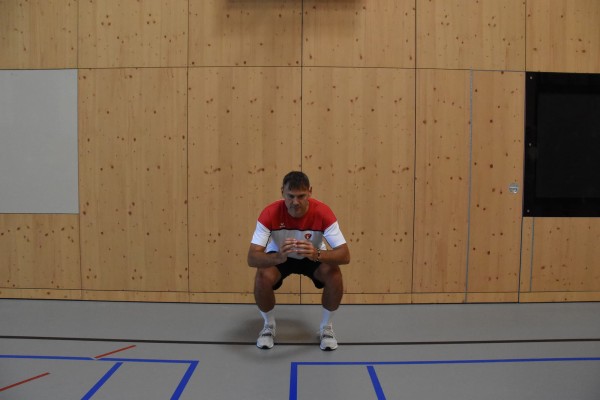
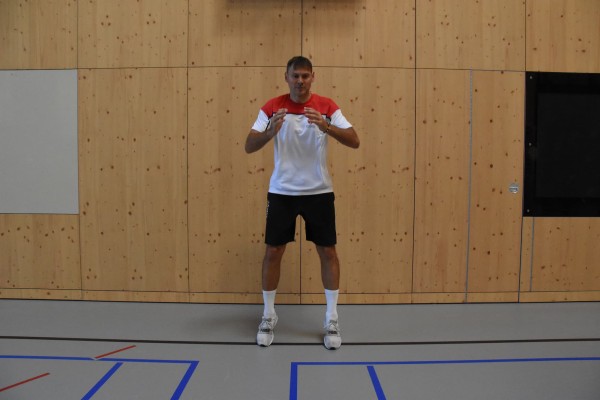
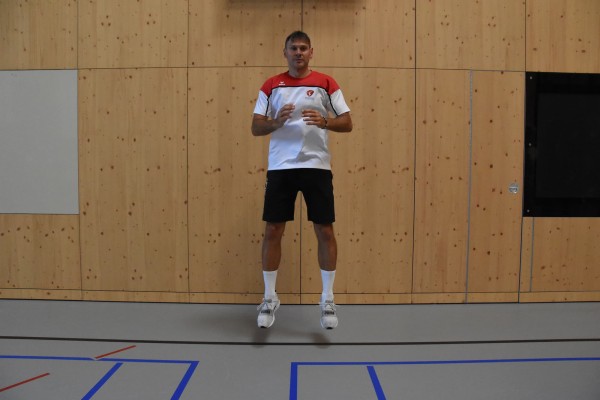
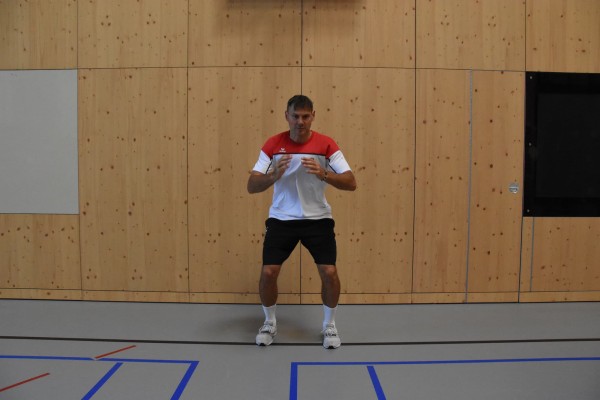
Stand shoulder-width apart, bend your knees almost to a right angle at the knee joints (buttocks slightly above knee height), arms supported on your hips, folded across your chest or in front of you at chest height (possibly with bent arms including hands), jump upwards, cushion the jump and return to the starting position. Repeat the sequence of movements continuously.
Attention:
Bring your buttocks back, not your knees forwards. Keep your knees behind your toes.
Lighten:
Do not lower your buttocks too low (larger angle in the knees), smaller/less intense/higher jumps.
Harden:
Hold additional weight (on your shoulders, in front of you or with your arms hanging in your hands); larger, more intense/higher jumps.
1 weight vest/(medicine) ball/weight disc/sandbag/1-2 dumbbells ► Make the exercise more difficult (additional weight)
Knee raises on the spot with arms held overhead ► knee raise with overhead plate hold (high knees)
Power
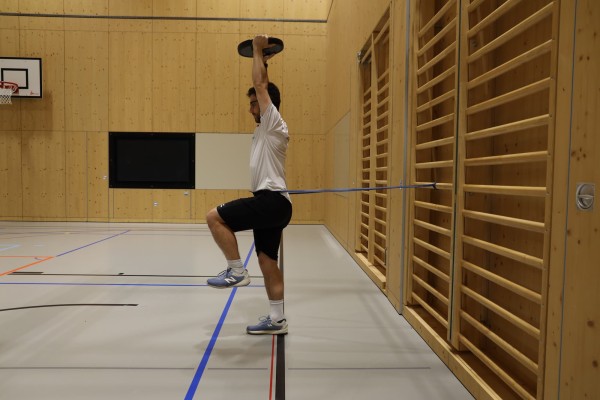
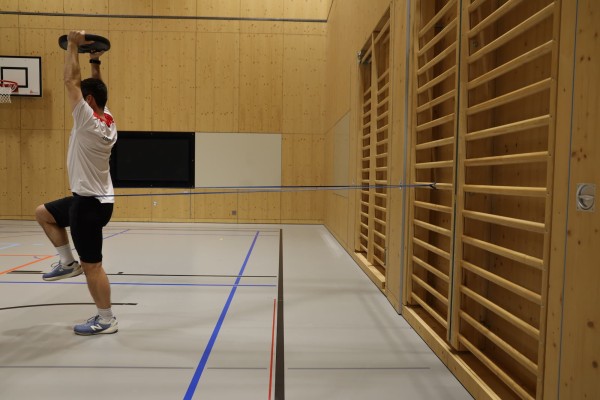
A fixed elasticated band (e.g. on the wall bars, on a post or candelabra) is worn around the hips. Move away from the attachment of the elastic band so that the band is well tensioned. Knee lift (lift your knees alternately with high intensity up to the level of your navel), holding a weight disc overhead with your arms almost outstretched.
Lighten:
Lift your knees less; less weight or no weight at all in the hold-up position.
Harden:
Stronger elastic band; more weight in the hold-up position; additional weights on the legs; knee lift on a soft surface (e.g. small soft mat).
1 wall of bars
1 elastic band
1 weight disc/medicine ball/dumbbell/kettlebell
1 small soft mat ► to make the exercise more difficult (support)
Knee raises on the spot with arms held overhead ► knee raise with overhead plate hold (high knees)
Power
Individual work
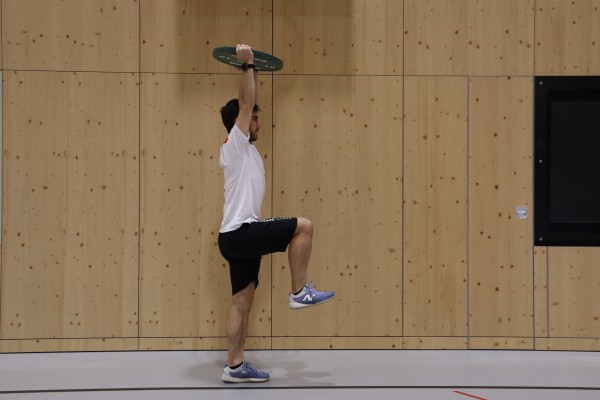
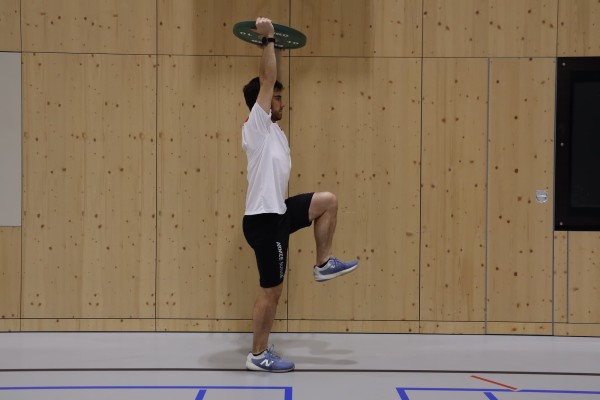
Stand upright with your feet hip-width apart, holding the weight plate above your head with both hands, arms almost fully extended. Keep your shoulders low and actively engage your core and glutes. Look straight ahead. Alternately lift one knee dynamically to approximately hip height. The other leg remains firmly on the floor. Keep the weight plate in the raised position throughout the exercise. Lift the knees rhythmically and in a controlled manner, alternating between them. Keep your upper body as upright and stable as possible.
Attention:
Do not lower the weight plate forwards or backwards; do not arch your back; do not raise your shoulders; keep your pelvis as still as possible; keep your supporting leg slightly bent and stable; actively lift your knee and do not simply swing it from the hip.
Lighten:
Lift your knees less high; use a lighter weight or no weight at all; hold the weight plate at forehead or shoulder height.
Harden:
Use more weight whilst holding the barbell aloft; perform knee-lift runs on a soft surface; lift your knees above hip height; increase your pace (high knees) / bounce slightly on your supporting leg.
Variation:
Use 2 dumbbells instead of a weight plate.
1 weight disc/medicine ball/dumbbell/kettlebell
1 small soft mat ► to make the exercise more difficult (support)
Kneeling position and jumping onto an object ► kneeling position & box jump
Power
Individual work


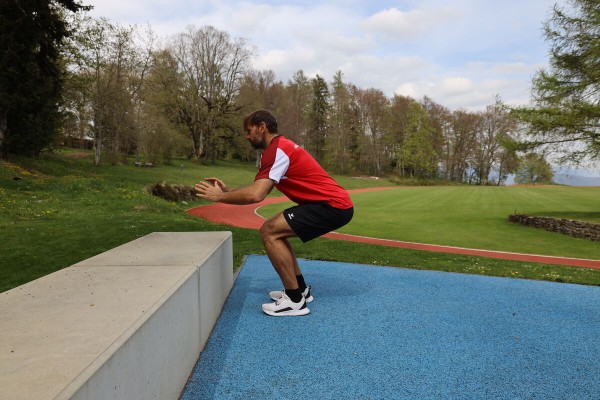

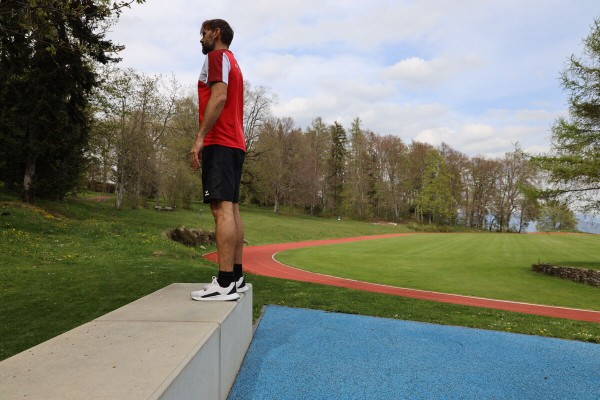
Stand on one knee, alternate between standing on one leg and assuming a deep squat position. From the squat position, tilt your upper body slightly forwards, stretch your arms backwards at an angle to your body (like a ski jumper on a ski jump), push off the floor powerfully to perform a jump onto a raised object (plyo box or swinging box element incl. top) (use the momentum of the arms), straighten your upper body (stand on the object) and jump back to the starting position (possibly the other side of the object), then return to the kneeling position. Change the starting leg with each execution.
Attention:
Land as softly as possible (cushion the jump with your knees).
Lighten:
Lower intensity between each execution; lower the height of the object.
Harden:
Additional weight; higher object.
1 flat bench/plyo box/swivel box
2-4 weight cuffs/1 weight waistcoat ► Make the exercise more difficult (additional weight)
Coconut thieves
Fighting and roughhousing games
Group work
2 teams
The participants in the "pinch team" face each other in pairs and each pinch a medicine ball between their backs/upper body. One after the other, the participants from the "capture team" try to capture the trapped medicine balls. Which team needs less time to conquer the medicine balls?
x medicine balls
1 stopwatch
King's abduction
Fighting and roughhousing games
Group work
2 teams
Two teams each have a castle (a large mat or simply a defined zone). Each team appoints one of their team-mates as king. The king is not known to the opposing team. Each team tries to identify the king of the opposing team and pull him into their own castle. Of course, the other players are allowed to help the king if he is about to be kidnapped. Only pulling, pushing and carrying the opponent is permitted.
2 soft mats (large) ► indoor version
8 marking cones/caps ► indoor and outdoor versions
Headstand to support ► tripod to plank kip
Power
Individual work


In a kneeling position, the head and bent arms are supported on the floor; a triangle is formed on the floor with the head and both hands. The larger the area of the triangle (i.e. the further apart the corners are), the greater the stability. This basic position is also the starting position for getting into the headstand. Now lift your knees off the floor and stretch your legs so that they are only resting on the tips of your toes (the position roughly corresponds to the letter "V"). Then lift one leg at a time off the floor and bend it (lower legs/soles of the feet pointing upwards, thighs pointing diagonally downwards); now the body is supported only by the head and hands (maintain balance). From this position, the legs are pushed out together at an angle backwards and upwards, while at the same time the arms are stretched, finally landing in the push-up position (high support, face/gaze downwards).
Attention:
When landing in the high support position (push-up position), consciously tense your torso so that you assume the position immediately (without sagging beforehand).
Lighten:
Lift and bend only one leg off the floor, the other leg remains stretched out on the floor (tiptoe position), making it easier to keep your balance. From this position, push yourself into a high support position.
Harden:
Additional weight (on the feet if necessary)
1 soft mat (small)
2 weight cuffs ► to make the exercise more difficult (additional weight)
Body hit (one touch)
Light-Contact
Partner work
Regular partner exchange.

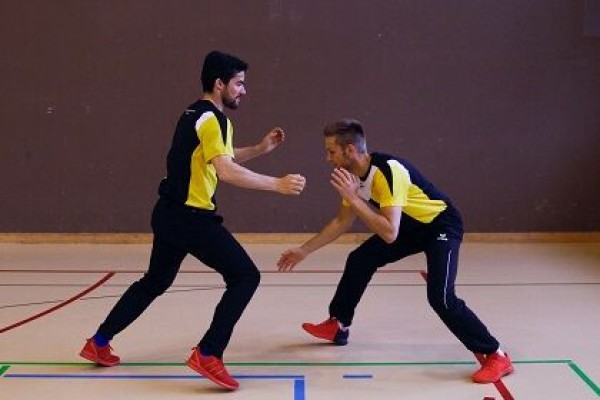
Two participants stand opposite each other and try to touch each other with their flat hands. The target area is the shoulder (safety note: only hit from the outside, not crosswise) and the knees (possibly also the stomach). Play for time or a certain number of points (possibly integrate partner changes).
Variant:
As a league game/royal tournament (winner advances, loser relegated).
No material required
Body hit (one touch)
Fighting and roughhousing games
Partner work
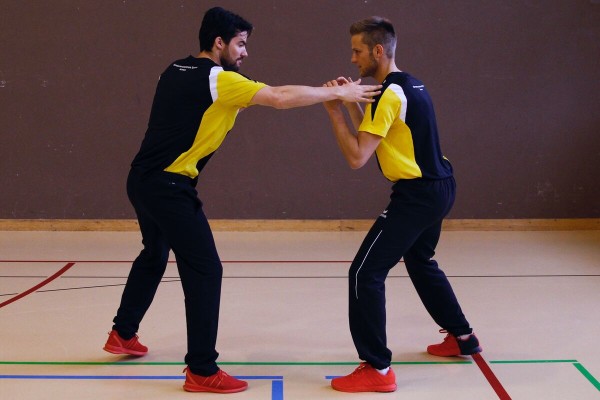
Two participants stand opposite each other and try to touch each other with their flat hands. The target area is the shoulder (safety note: only hit from the outside, not crosswise) and the knees (possibly also the stomach). Play for time or a certain number of points (possibly integrate partner change).
No material required
Crab fight
Fighting and roughhousing games
Partner work

Two participants lie face to face on their stomachs and lift their arms and upper body off the floor. Now both try to grab their opponent's hands and push them to the floor. The winner is the one who can keep their opponent's hands on the floor for two seconds.
2 soft mats (small) ►indoor version
2 tent sheets ►outdoor version
Indoor post set-up:
Connect the soft mats to each other on the narrow side using Velcro (exercise can also be carried out without mats)
Strength: Raising the upper body in prone position
Light-Contact
Partner work
The participants lie in a prone position facing each other (head facing their partner). At the same time, they raise their upper body and hand each other a medicine ball. The upper body is lowered and the participant with the ball brings it to their forehead and then stretches their arms forwards again. The partners perform the exercise again (raising the upper body), with the other participant now bringing the ball to their forehead.
2 soft mats (small)
1 medicine ball
Strength: Ball kicking in boxing position
Light-Contact
Individual work
From the boxing position, the medicine ball is pushed against the wall and caught again at head height.
1 wall
1 medicine ball
Strength: trunk flexion
Light-Contact
Partner work
Two participants lie on their backs with their legs bent opposite each other (legs pointing towards their partner; possibly hook each other's feet). At the same time, the participants perform a torso bend (raise/lower upper body) and hand each other a medicine ball (easy to difficult: hold ball in front, hold ball in front of chest, hold ball up with arms outstretched).
Variant:
One participant holds the claw with raised upper body towards the partner, who in turn also hits two straight lines on the claw with raised upper body. Both participants then perform a torso bend so that the claw can be handed over when the upper body is raised again. During the next exercise (trunk bend), the other participant now hits the claw, etc.
2 soft mats (small)
1 medicine ball
Variant:
1 claw
Strength: trunk flexion and ball kicking
Light-Contact
Partner work

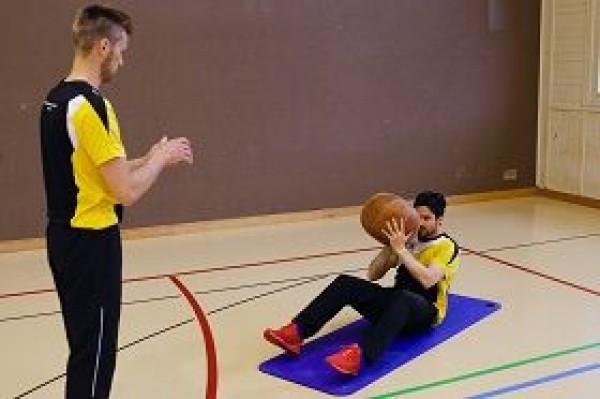

Participant A lies on their back with their legs bent and feet up. The shoulder blades are raised off the floor and the medicine ball is held in a boxing position in front of the head (one hand under the ball, one hand resting on the side of the ball). Participant B is standing approx. 1-2 metres away from their partner. Participant A pushes the ball towards their partner by simultaneously lifting their torso and stretching out their throwing arm. The partner holds the ball briefly and then throws it back again. Participant A changes throwing arm with each pass and does not touch the floor with their shoulders during the entire exercise (do not raise their upper body too high to ensure constant tension in their torso).
Variations:
- Heavier medicine ball
- Participant B throws the ball back immediately.
- Participant B stands further away.
Pro Gruppe:
1 Medizinball
1 Weichmatte (klein)
Strength: trunk flexion and straight stroke
Light-Contact
Partner work


Participant A lies on their back with their legs bent and feet up. The shoulder blades are raised off the floor and the fists are doubled in front of the head (hands at chin height). Participant B stands upright at his partner's head height with bent forearms (90 degrees at the elbow joint). Participant A raises his upper body explosively, rotates his upper body slightly and strikes crosswise against the hand of participant B (strikes with the left and right fist alternately). The upper body is lowered between repetitions, but the shoulder blades do not touch the floor.
Variant:
Lift the upper body, perform 3 alternating punches (e.g. li-re-li) and lower the upper body again.
Per participant
1 pair of boxing gloves
Per group
1 soft mat (small)
Power: Types of impact
Light-Contact
Partner work


Two participants stand one behind the other in front of the raised (large) soft mat. For 10-15 seconds, the person in front boxes a predetermined punch or punch combination against the mat (really exhausting themselves). Once the time has elapsed, he makes room for his partner and lines up behind him. The second participant now begins to hit the mat. The sports director specifies the number of passes.
Participant:
1 pair of boxing gloves
Pro group:
1 soft mat (large)
Strength: Skipping rope
Light-Contact
Individual work
Skipping rope:
- bipedal
- jumping on one leg (left/right)
- right/left leg first (variation: lift leg/knee correctly or jump only lightly on the ball of the foot)
- alternating right/left leg first (variation: lift leg/knee correctly or jump only lightly on the ball of the foot)
- alternating left/right heel on the floor
1 skipping rope
Strength/duel: abduction and adduction of the legs in push-up position and push-up
Light-Contact
Partner work
In the push-up position, support your arms with your hands on an inverted long bench and place your legs on the floor. Spread your legs apart in small jumps and bring them back together in the starting position. However, a push-up (bending and stretching the arms) is also integrated into the exercise in the position with the legs apart before the legs are brought together.
Variant:
Vary the position of the hands/arms (e.g. wide, narrow, together).
Duelling:
After the strengthening exercise, a light contact fight takes place on the wide or narrow side of the inverted long bench.
Per group of 2:
1 long bench
Participant:
1 pair of boxing gloves