
Exercises (1882)
Strength/duel: alternating raising and lowering of one leg in forearm support
Light-Contact
Partner work
In the forearm support, the outstretched legs and upper body practically form a line. The legs are supported by the tips of the toes on an inverted long bench and the upper body is supported by the forearms on the floor. The forearms lie flat and parallel to each other with the upper arms resting vertically on the floor (90 degree angle at the elbow joint). Alternately, one leg is raised slightly (foot approximately at heel height).
Duelling:
After the strengthening exercise, a light contact fight takes place on the wide or narrow side of the inverted long bench.
Per group of 2:
1 long bench
Participant:
1 pair of boxing gloves
Strength/duel: Push-up
Light-Contact
Partner work
Push-up position, legs placed on the inverted long bench; bend and stretch arms (lower and raise upper body).
Variant:
Vary the position of the hands/arms (e.g.: wide, narrow, together).
Duelling:
After the strengthening exercise, a light contact fight takes place on the wide or narrow side of the inverted long bench.
Per group of 2:
1 long bench
Participant:
1 pair of boxing gloves
Strength/duel: push-up and jump over an object
Light-Contact
Partner work
From a standing position, bend your legs and place your hands next to your feet to get into a squat position. Support yourself with your hands and jump backwards with both legs to get into a push-up position. Bend your arms to fully lower your upper body (prone position). From the prone position, push back into the push-up position with both arms and jump back into the squat position. In the squat position, the upper body is slightly tilted forwards, stretch your arms backwards at an angle along your body (like a ski jumper on a ski jump), push off the floor powerfully to perform a jump (lateral-sided) over the long bench (use the momentum of the arms). Straighten the upper body and restart the exercise (assume a push-up position) to finally jump back to the starting position.
Variant:
Jump frontally over the long bench.
Duelling:
After the strengthening exercise, a light contact fight takes place on the wide or narrow side of the inverted long bench.
Per group of 2:
1 long bench
Participant:
1 pair of boxing gloves
Strength/duel: Jumping over an object from the side with the upper body supported
Light-Contact
Partner work
Support your upper body with your arms on the inverted long bench. Jump with both legs from one side of the long bench to the other.
Variant:
Land and jump with the outer leg only.
Duelling:
After the strengthening exercise, a light contact fight takes place on the wide or narrow side of the inverted long bench.
Per group of 2:
1 long bench
Participant:
1 pair of boxing gloves
Strength/duel: alternating jump on an object
Light-Contact
Partner work
Stand with one leg on the inverted long bench and the other leg on the floor. Alternate the foot position while jumping.
Duelling:
After the strengthening exercise, a light contact fight takes place on the wide or narrow side of the inverted long bench.
Per group of 2:
1 long bench
Participant:
1 pair of boxing gloves
Circular movement of the arms while standing upright
Power
Individual work
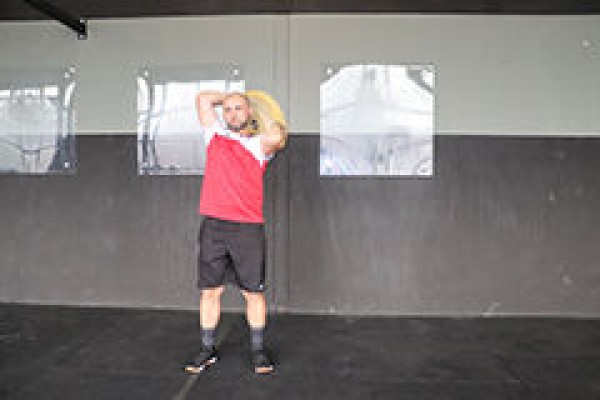


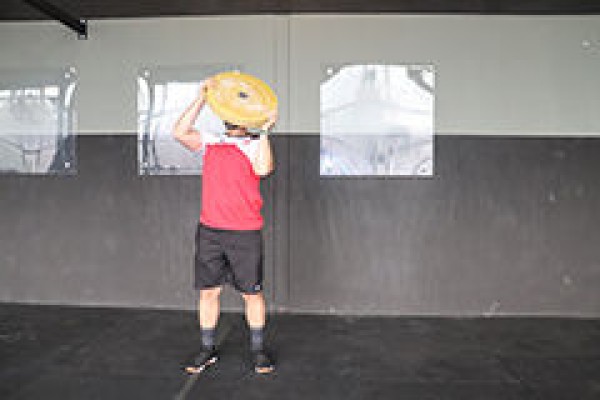

When standing upright, hold a weighted disc in front of your head with your arms bent and move the disc around your head with your arms bent, keeping the rest of your body stable except for your arms. The weight must be kept at head height throughout the exercise. Change the direction of rotation after one or more rounds.
Attention:
Upright posture.
Lighten:
Less weight.
Harden:
More weight.
1 weight disc
Circular movement of the arms in push-up position
Power
Individual work


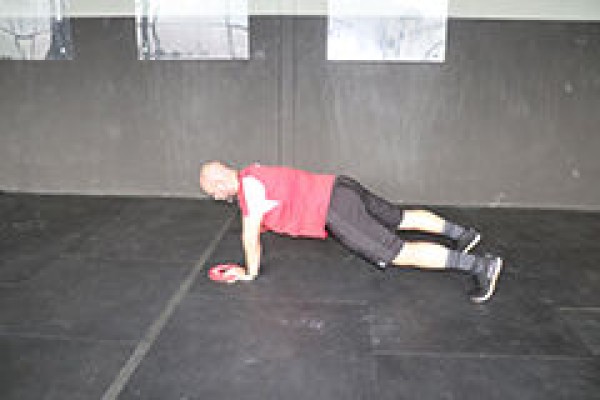


Push-up position (high support, face/gaze downwards) with legs slightly straddling and arms supported on two small weight discs. Slide one arm including the disc forwards along the floor as an extension of the body, then move the outstretched arm to the side (90 degree angle to the body) and return to the starting position (the movement corresponds to drawing a quarter circle, so to speak). Back in the push-up position, perform the same exercise with the other arm/disc.
Attention:
Head, torso, hips and knees form a line (do not let your buttocks sag, tighten your stomach).
Lighten:
Just hold the basic position (push-up position); reduce the range of motion of the playing arm or only move it forwards and back to the starting position.
Harden:
Additional weight (on the back and/or arms).
2 weight discs (small)
1 weight vest/weight disc/sandbag ► Make the exercise more difficult (additional weight)
2 weight cuffs ► Make the exercise more difficult (additional weight)
Circular movement of the legs in supine position ► double leg circle
Power
Individual work


Lie on your back with your arms flat on the floor at your sides or place your hands under your buttocks and your outstretched legs slightly off the floor. Perform circular movements with your legs closed (vary the range of movement and direction).
Attention:
Keep your (lower) back in constant contact with the floor (no hollow back, consciously tense your stomach), do not put your legs down.
Lighten:
Just hold the position (legs stretched out slightly off the floor).
Harden:
Clamp additional weight for the legs/between the legs.
2 weight cuffs/1 (medicine) ball ► Make the exercise more difficult (additional weight)
Circular movements of the arms while standing (frontal) ► arm circles (frontal)
Power
Individual work
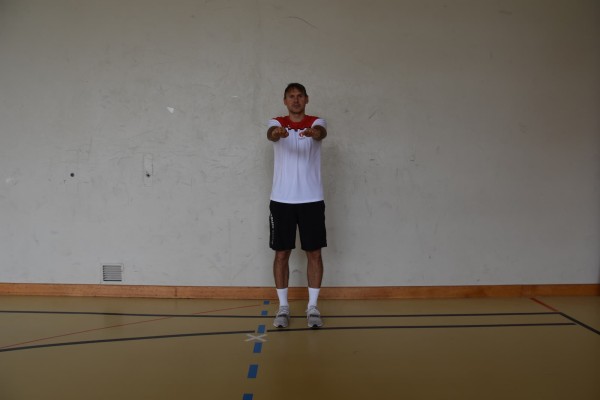
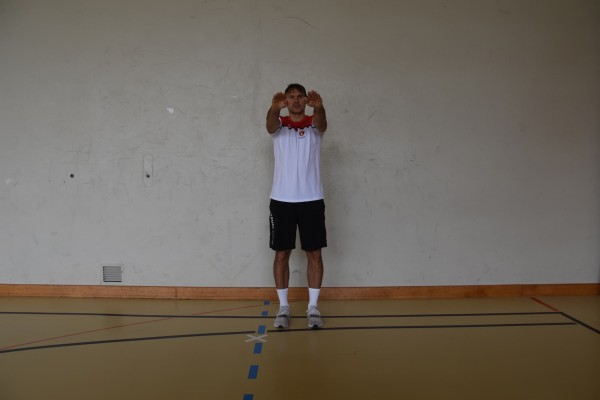
Stand upright with your feet shoulder-width apart, arms extended forwards (frontally) at shoulder height, perform small circles with your arms in both directions (shoulder height).
Attention:
Always keep your arms almost fully extended.
Lighten:
Stretch your arms less/bend them slightly.
Harden:
Hold additional weight on your arms or in your hands.
Variant:
Increase the range of motion (crown and navel height) and increase speed if necessary.
2 weight cuffs/weight balls/dumbbells ► Make the exercise more difficult (additional weight)
Circular movements of the arms while standing ► arm circles (lateral)
Power
Individual work
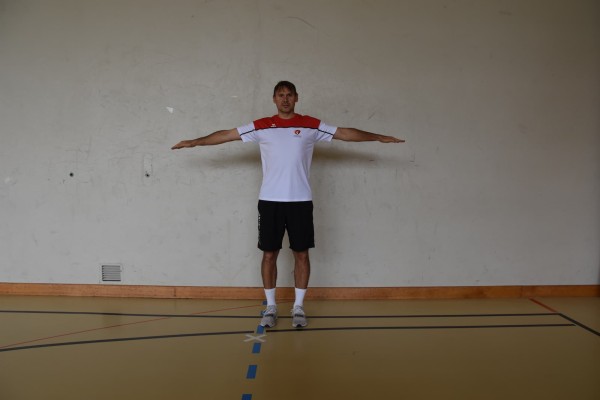
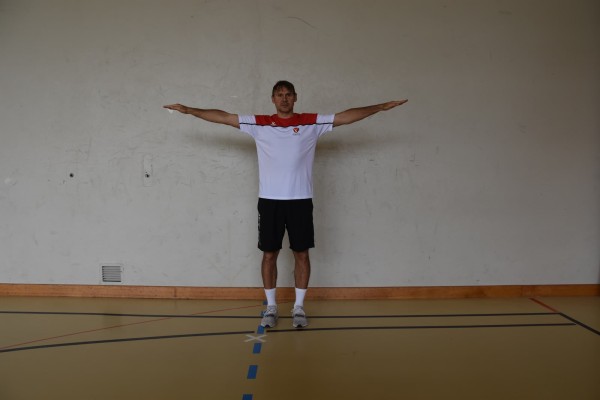
Stand upright with your feet shoulder-width apart, arms outstretched to the side at shoulder height, make small circles with your arms in both directions (shoulder height).
Attention:
Always keep your arms almost fully extended.
Lighten:
Stretch your arms less/bend them slightly.
Harden:
Hold additional weight on your arms or in your hands.
Variant:
Increase the range of motion (crown and navel height) and increase speed if necessary.
2 weight cuffs/weight balls/dumbbells ► Make the exercise more difficult (additional weight)
Pull down the load in supine position ► lying behind the neck pull down
Power
Partner work
1 trainee & 1 helper ► Note change of position
(= double the time required; for lesson planner see Organisation Kraft: Info button Execution)


Exerciser: Lie on your back and hold the gymnastics pole above your head with your arms stretched out horizontally (arms parallel to the floor), legs slightly bent and heels up, pull the gymnastics pole into your neck against the resistance of the elasticated straps, raising your head slightly (looking towards the ceiling).
Partner: Hold the loops above the gymnastics pole on the floor.
Attention:
The lower part of the back (lumbar spine) remains on the floor throughout the exercise.
Lighten:
Select less strong elastic bands; roll up the elastic bands less or reduce the distance to your partner.
Harden:
Select stronger elastic bands, roll up the elastic bands more or increase the distance to your partner.
1 gymnastic stick with elasticated strap
Running triangle
Basic training
Group work
2-8 participants per post
Start at the point where the two triangles meet in small groups. One group runs easily in the small triangle, the other group runs faster in the large triangle. The aim is to reach the corner where the triangles meet at the same time. After three laps, there is a smooth change to another control/triangle. The sports director determines 3 rounds of approx. 6-7 minutes each.
Track: In the form of two triangles of different sizes that touch in a corner
Intensity level: 3 (medium)
Max. speed: 80-90%
Rule of speech: speak in complete sentences
Note: the exercise form is suitable for changes in tempo and intensity
Variation:
Change posts/triangles after just one or two rounds or change the size of the triangles regularly.
5 marking cones/caps
Running (1000m/1km) ► run
Power
Individual work
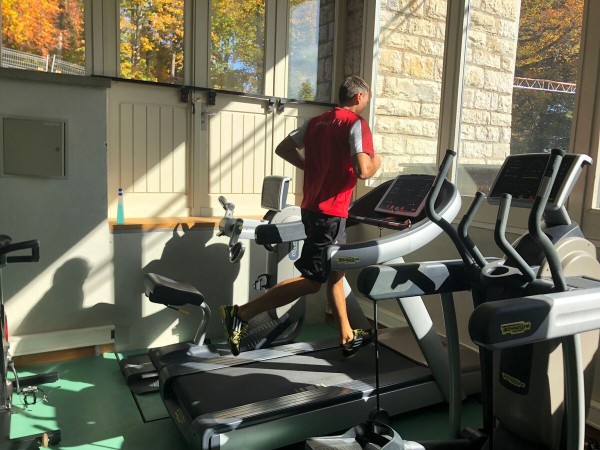
Cover a given distance (1000 m/1 km) by walking/running.
Lighten:
Lower speed.
Harden:
Higher speed.
1 circular track or predetermined route with markings
Running (100m) ► run
Power
Individual work

Cover a given distance (100 m) by walking/running.
Lighten:
Lower speed.
Harden:
Higher speed.
2 marking cones/caps/colouring sticks
Running (1600m/1.6km/1 mile) ► run
Power
Individual work

Cover a given distance (1600 m/1.6 km/1 mile) running/racing.
Lighten:
Lower speed.
Harden:
Higher speed.
1 circular track or predefined route with markings
Running (200m) ► run
Power
Individual work

Cover a given distance (200 m) by walking/running.
Lighten:
Lower speed.
Harden:
Higher speed.
2 marking cones/caps/colouring sticks
Running (25-100m) ► run
Power
Individual work


Cover a given distance (between 25-100 metres) by walking/running.
Lighten:
Lower speed.
Harden:
Higher speed.
Variation:
Change gait (e.g. backwards, on all fours, crawling, etc.).
2 marking cones/caps/colouring sticks
Running (300m) ► run
Power
Individual work

Cover a given distance (300 m) by walking/running.
Lighten:
Lower speed.
Harden:
Higher speed.
1 circular track or predefined route with markings
Running (400m) ► run
Power
Individual work

Cover a given distance (400 m) by walking/running.
Lighten:
Lower speed.
Harden:
Higher speed.
1 circular track or predefined route with markings
Running (600m) ► run
Power
Individual work

Cover a given distance (600 m) by walking/running.
Lighten:
Lower speed.
Harden:
Higher speed.
1 circular track or predefined route with markings
Running (800m) ► run
Power
Individual work

Cover a given distance (800 m) walking/running.
Lighten:
Lower speed.
Harden:
Higher speed.
1 circular track or predefined route with markings
Running (800m) ► run
Power
Individual work
Cover a given distance (800 m) by walking/running.
Lighten:
Lower speed.
Harden:
Higher speed.
1 circular track or predefined route with markings
Running ► run
Power
Individual work

Cover a distance by walking (longer distance) or running (shorter distance).
Lighten:
Lower speed.
Harden:
Higher speed.
No material required
Push up / forearm support ► push up / pillar bridge
Power
Partner work
Exercise both muscle groups ► Note the change of position
(= double the time required; for lesson planner see Organisation Strength: Info button Execution)


One participant is in the forearm support position, the other participant is in the push-up position to the side of their partner at torso height (body view of the participants corresponds to the letter "T"). The trainee in the push-up position places their feet on their partner's back and lowers their upper body by bending and stretching their arms (push-up), while the trainee in the forearm support maintains a stable position.
Attention:
Tense your core, do not let your pelvis sag (applies to both participants); during the push-ups, bend your elbows approx. 45° from the upper body ("A" shape with the arms), shoulders are fixed and pressed down towards the hips.
Lighten:
Lower the knees (feet vertically in the air); barely bend the arms (lower the upper body less); support the arms on a raised surface.
Harden:
Additional weight (on the back).
1 Raised base (e.g. 1-2 vaulting box elements incl. top section) ► Make the exercise easier (position)
1 Weight vest/weight disc/sandbag ► Make the exercise more difficult (additional weight)
Push up / forearm support ► push up / pillar bridge
Power
Partner work
Exercise both muscle groups ► Note the change of position
(= double the time required; for lesson planner see Organisation Strength: Info button Execution)

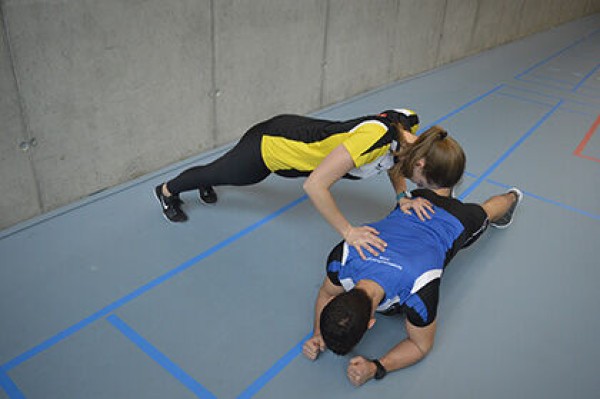
Exercise description:
One participant is in the forearm support position, the other participant is in the push-up position to the side of their partner at torso height (body view of the participants corresponds to the letter "T"). The trainee in the push-up position places their hands on their partner's back and lowers their upper body by bending and stretching their arms (push-up), while the trainee in the forearm support maintains a stable position.
Attention: Tense the torso, do not let the pelvis sag (applies to both participants); elbows bent at an angle of approx. 45° from the upper body during the push-ups ("A" shape with the arms), shoulders are fixed and pressed down towards the hips.
Lighten: Lower the knees (feet vertically in the air); barely bend the arms (lower the upper body less).
Harden: Additional weight (on your back); support your feet on a raised surface.
1 weight vest/weight disc/sandbag ► Make the exercise more difficult (additional weight)
1 raised base (e.g. 1-2 vaulting box elements incl. top section) ► Make the exercise more difficult (position)