
Exercises (3302)
Step onto an object alternately ► step up
Power
Individual work
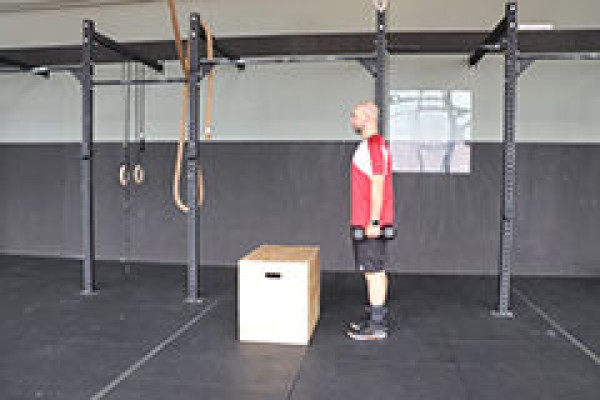


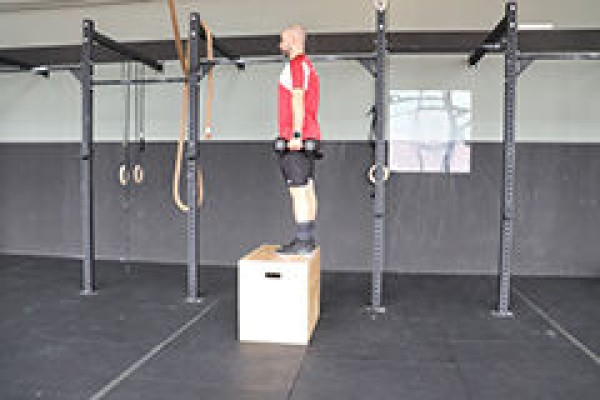


Stand upright with your feet about shoulder-width apart in front of a plyo box, a Swedish box, or a similarly stable raised surface. Keep your feet pointing forward as much as possible and distribute your weight evenly. Keep your upper body upright, look straight ahead, and engage your abdominal muscles slightly. Hold a weight in both hands or across your arms (dumbbells, kettlebells, medicine ball). Position yourself at a distance from the raised surface such that you can place your foot completely on it without leaning your upper body forward excessively. Place one foot completely and steadily on the raised surface, ensuring that both the ball of the foot and the heel are firmly planted. Gradually shift your body weight onto the raised leg. Press firmly into the surface with your entire foot and lift your body upward in a controlled manner. The knee of the rising leg remains stable throughout the movement and follows the direction of the toes. Then place the second leg on the raised surface as well and briefly stabilize the top position. Next, lower yourself back down in a controlled manner on one leg, then bring the second leg back down. Begin the next repetition with the other leg. Throughout the entire movement, keep the upper body, pelvis, and leg axis as stable as possible.
Attention:
The foot is not placed fully on the step, and the heel hangs over the edge; the knee of the stepping leg falls noticeably inward or swings sharply outward; the upper body leans sharply forward or to the side while stepping up; the arms are used to generate momentum. The lower leg pushes off the ground too forcefully, thereby relieving pressure on the actual working leg; when rising, the pelvis rotates or shifts noticeably to the side; the descent is too fast or uncontrolled; the heel of the raised leg lifts significantly off the surface during the push-up; the chosen elevation is so high that the movement can only be performed with compensatory movements; choose only a height at which the entire foot can be placed securely and the movement can still be performed in a controlled and pain-free manner; especially when lowering, actively slow down the movement and do not simply let yourself fall to the ground.
Lighten:
Use a lower plyo box or a lower Swedish box. Reduce the range of motion by using a lower platform. If you have balance issues, lightly support yourself against a wall, bar, or partner. Start by performing the exercise slowly and holding a short pause at the top of the movement. Perform the exercise without additional weight. First, perform several repetitions with the same leg and only then switch sides.
Harden:
Choose a higher platform, provided that your form remains stable. Increase the weight of the dumbbells, kettlebells, or medicine ball. Use a weight vest or sandbag as additional weight. Place an unstable support surface under the standing leg. Consciously slow down the downward movement over 2–4 seconds. Hold the top position for 2–3 seconds and stabilize your balance. Raise the free leg at the top with a controlled knee lift without setting it down on the platform. Perform the exercise on one leg in a more controlled manner by using the free leg for support as little as possible.
1 plyo box/swivel box
2 dumbbells/kettlebells/1 medicine ball
2 weight cuffs/1 weight waistcoat ► make the exercise more difficult (additional weight)
Step onto an object alternately ► step up
Power
Individual work


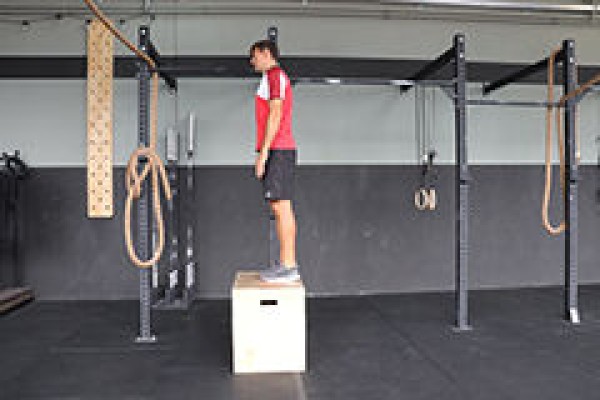


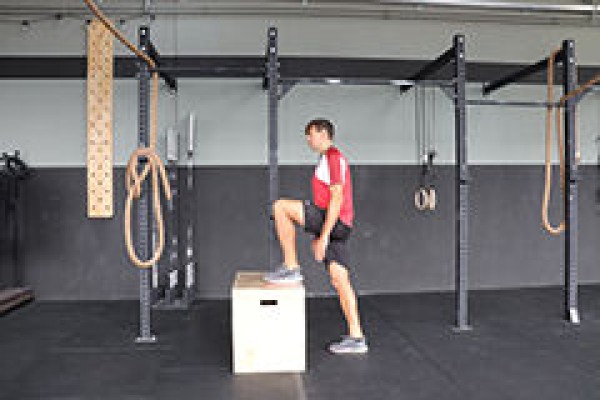


Stand upright with your feet about shoulder-width apart in front of a plyo box, a Swedish box, or a similar stable raised surface. Your feet should point forward as much as possible, and your weight should be evenly distributed. Keep your upper body upright, look straight ahead, and lightly engage your abdominal muscles. Your arms should hang loosely at your sides or be used to help maintain balance. Choose a distance from the raised surface that allows you to place your foot completely on it without leaning your upper body forward excessively. Place one foot completely and steadily on the raised surface, ensuring that both the ball of the foot and the heel are firmly supported. Gradually shift your body weight onto the standing leg. Press firmly into the surface with your entire foot and lift your body upward in a controlled manner. The knee of the rising leg remains stable during the movement and follows the direction of the toes. Next, place the second leg on the raised surface as well and briefly stabilize the upper position. Then lower yourself back down in a controlled manner on one leg and subsequently bring the second leg back down. Begin with the other leg for the next repetition. Throughout the entire movement, keep the upper body, pelvis, and leg axis as stable as possible.
Attention:
The foot is not placed fully on the step, and the heel hangs off the edge; the knee of the ascending leg turns significantly inward or veers sharply outward; the upper body leans sharply forward or to the side while stepping up; the lower leg pushes off the floor too forcefully, thereby relieving pressure on the actual working leg; when stepping up, the pelvis rotates or shifts noticeably to the side; the descent is too fast or uncontrolled; the heel of the supporting leg lifts significantly off the surface during the push-up; the chosen step is so high that the movement can only be performed with compensatory movements; choose only a height at which the entire foot can be placed securely and the movement can still be performed in a controlled and pain-free manner; especially when stepping down, actively slow down the movement and do not simply let yourself fall to the ground.
Lighten:
Use a lower plyo box or a lower Swedish box; reduce the range of motion by using a lower platform; if you have balance issues, lightly brace yourself against a wall, bar, or partner; start by performing the exercise slowly and holding a short pause at the top of the movement; perform the exercise without additional weight; start by doing several repetitions with the same leg and only then switch sides.
Harden:
Choose a higher elevation, provided that the setup remains stable; hold dumbbells or kettlebells in your hands; Use a weight vest or sandbag for additional weight; use an unstable surface; consciously slow the downward movement over 2–4 seconds; hold the top position for 2–3 seconds and stabilize your balance; lift the free leg at the top with a controlled knee lift without setting it down on the platform; perform the exercise on one leg in a more controlled manner by using the free leg for support as little as possible.
1 plyo box/swing box
2 dumbbells/kettlebells/1 medicine ball ► make the exercise more difficult (additional weight)
2 weight cuffs/1 weight waistcoat ► make the exercise more difficult (additional weight)
2 unstable surface ► make the exercise more challenging (unstable surface)
Step onto an object alternately ► step up
Power
Individual work


Stand upright in front of the (flat) bench, first with one leg, then with the other, climb onto the bench and back down to the starting position (stair climbing). Change starting position/leg after each exercise or after a few repetitions.
Starting position:
- From an upright, shoulder-width stance, position one foot on the bench
- Hold the weight in your hands on one or both sides or place it on your shoulders
- Tense your abdominal and gluteal muscles
Finishing position:
- Stand upright on the bench
- Keep your back straight
Attention:
Keep your upper body upright, distribute your weight over your entire foot, push your knees outwards (do not tilt inwards).
Variant:
Alternate with the left/right foot first (more demanding in terms of coordination).
1-2 dumbbell(s)/kettlebell(s) or 1 barbell
Climb onto an object in push-up position ► stair walking push up position
Power
Individual work


Push-up position, hands placed on an object (e.g. combat rucksack or tyre), step down from the object (move hands to the floor one after the other) and return to the starting position.
Attention:
No hollow back, tense torso, elbows bent approx. 45 degrees from the upper body ("A" shape with the arms), shoulders are fixed and pressed down towards the hips.
Lighten:
Support in place (possibly raise arms slightly alternately).
Harden:
Higher object; additional weight (on the back); unstable support for the legs.
1 combat rucksack/tyre (PUCH)
1 tyre (10DM) ► make the exercise more difficult (position)
1 weight vest/weight disc/sandbag/(additional) combat rucksack ► make the exercise more difficult (additional weight)
1 ball/1-2 balance cushions/1 balance board ► make the exercise more difficult (unstable base)
Climb onto an object in push-up position ► stair walking push up position
Power
Individual work


Push-up position, hands placed on the top of the vaulting box; step down from the box (move your hands to the floor one after the other) and return to the starting position.
Attention:
No hollow back, tense torso, elbows bent at an angle of approx. 45 degrees from the body ("A" shape with the arms), shoulders are fixed and pressed down towards the hips.
Lighten:
Support yourself in place (if necessary, lift your arms slightly alternately).
Harden:
Higher object (e.g. additional vaulting box element or long bench); additional weight (on your back); unstable support for your legs.
1 vaulting box top
1 additional vaulting box element or 1 long bench ► make the exercise more difficult (position)
1 weight vest/weight disc/sandbag ► make the exercise more difficult (additional weight)
1 ball/balance cushion/balance board ► make the exercise more difficult (unstable base)
Stepping onto an object whilst maintaining balance alternating ► step-up to balance
Power
Individual work
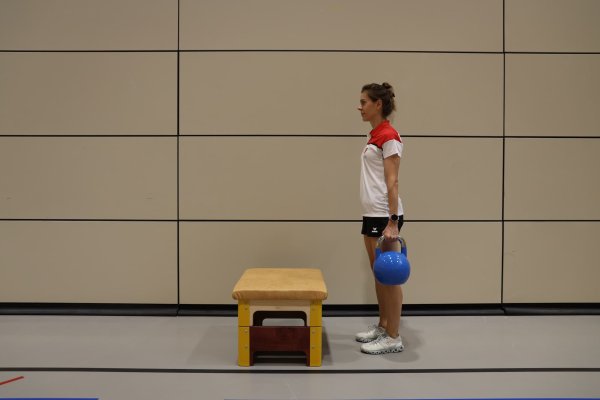
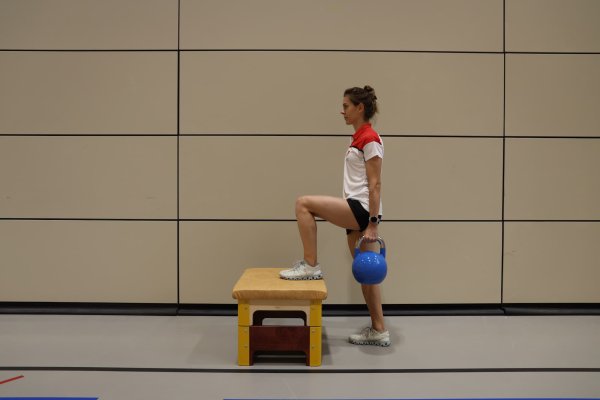
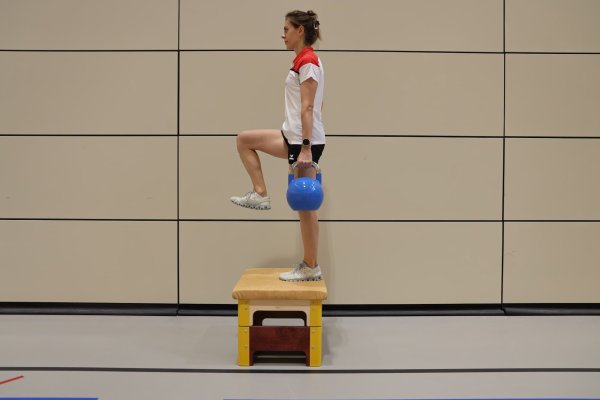
Stand upright, facing the Swedish bench with your feet hip-width apart, engage your core and hold a dumbbell in the hand on the side of your supporting leg. Place your foot completely and firmly in the centre of the bench, ensuring that the ball of your foot and your heel are in full contact with it. Shift your body weight onto your front leg and push yourself up powerfully. Once at the top, bring your free leg straight up in a controlled knee lift (at least 90° at the hip and knee), whilst the opposite arm moves forwards and upwards in a runner’s arm swing. ‘Freeze’ in this end position on one leg for 1–2 seconds, keeping your pelvis level and your shoulders relaxed. Then, in a controlled and decelerated manner, bring the free leg back and down towards the floor, reset the supporting leg and switch sides.
Attention:
The lower leg pushes off the ground with momentum (a jump rather than the supporting leg exerting force).
The knee of the lifting leg buckles inwards as it is pushed upwards.
The final position at the top is not stabilised, but is immediately exited.
The pelvis sags downwards on the side of the free leg whilst standing on one leg (Trendelenburg sign).
Only the forefoot rests on the edge of the bench, whilst the heel hangs in the air.
The descent is uncontrolled and unchecked (‘plummeting’).
Lighten:
Choose a lower box/bench height; in the top position, let the free leg lightly tap the bench with the tips of the toes, rather than holding it freely in the air; Slow down the pace of the movement.
Use your fingertips to brace yourself against a wall or bar at the sides.
Choose lighter dumbbells.
Harden:
Additionally, wear a weight vest or increase the weight of the dumbbells.
Consciously slow down the downward movement (eccentric phase) significantly over 3–4 seconds before the foot touches the floor.
Place the foot of your supporting leg on a balance pad on the bench.
Seamlessly incorporate a slight calf raise on your supporting leg from the top of the knee lift.
1 plyo box/vaulting box
1 dumbbell
1 dumbbell ► makes the exercise more challenging (additional weight)
1 weighted vest ► makes the exercise more challenging (additional weight)
1 unstable surface ► makes the exercise more difficult (balance component)
Step onto an object and one-legged jump (left) ► step up & hop
Power
Individual work
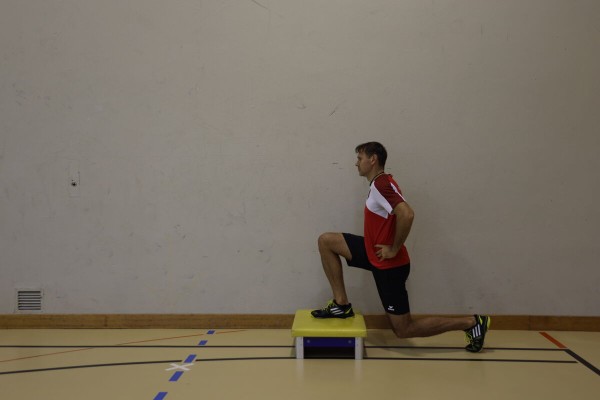

Stand in a lunge in front of the plyo box (the vaulting box - 1 intermediate element plus top), with the back (left) leg resting on the tip of the toe. Move the back leg onto the raised surface (leg bent at approximately a right angle), extend the free leg in a fluid movement and at the same time perform a small jump into the air. Land back on the plyo box/swinging box using only the leg with which the one-legged jump was performed. Then move the free leg back to the starting position in a lunge. The other (right) leg accompanies the movement (bend the leg during the jump), but is only lifted off the floor and put down again in the same position (do not place the foot on the raised surface).
Attention:
Keep the upper body upright, distribute the weight over the entire foot, push the knee outwards (do not tilt inwards).
Lighten:
Select a lower element; do not perform a jump.
Harden:
Select a higher element; add weight (on the shoulder, in the hands or on the foot).
1 plyo box/swivel box
1-2 dumbbells/kettlebells/weight man chains/1 weight vest/medicine ball ► make the exercise more difficult (additional weight)
Step onto an object and one-legged jump (left) ► step up & hop
Power
Individual work
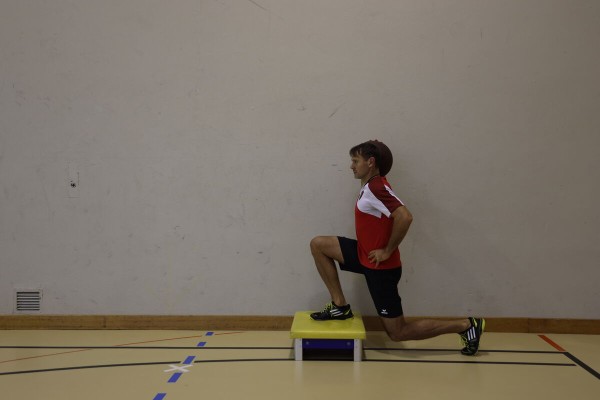
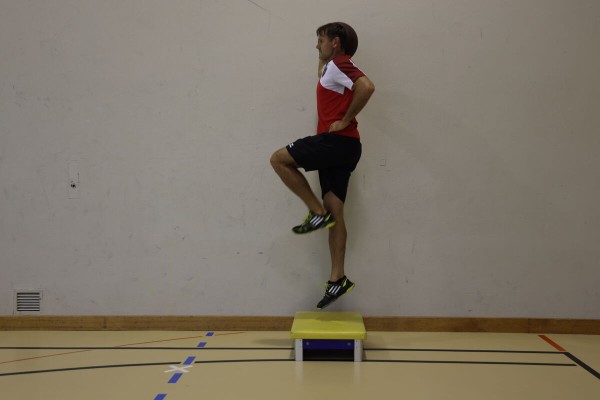
Stand in a lunge in front of the plyo box (the vaulting box - 1 intermediate element plus top), with the back (left) leg placed on the tip of the toe. A medicine ball (or another weight such as a dumbbell or kettlebell) is held on the side where the leg is placed on the raised base with the arm bent at the shoulder. Move the back leg onto the raised surface (leg bent at approximately a right angle), extend the free leg in a fluid movement and at the same time perform a small jump into the air. Land back on the plyo box/swinging box using only the leg with which the one-legged jump was performed. Then move the free leg back to the starting position in a lunge. The other (right) leg accompanies the movement (bend the leg during the jump), but is only lifted off the floor and put down again in the same position (do not place the foot on the raised surface).
Attention:
Keep your upper body upright, distribute your weight over your entire foot, push your knees outwards (do not tilt them inwards).
Lighten:
Select a lower element; do not jump; do not hold any weight on the shoulder.
Harden:
Select a higher element; more weight; additional weight on the foot.
Variation:
Hold a weight (dumbbell or kettlebell) in both hands with hanging arms.
1 plyo box/swinging box
1 medicine ball/dumbbell/kettlebell
1 weight sleeve/weight waistcoat ► make the exercise more difficult (additional weight)
1 additional dumbbell/kettlebell ► variation of the exercise
Step onto an object and one-legged jump (right) ► step up & hop
Power
Individual work

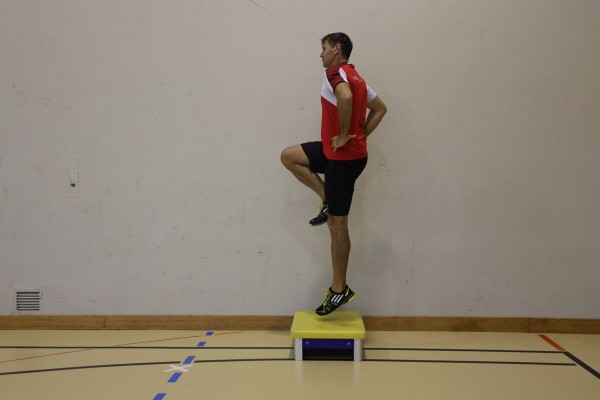
Stand in a lunge in front of the plyo box (the vaulting box - 1 intermediate element plus top), with the back (right) leg resting on the tip of the toe. Move the back leg onto the raised surface (leg bent at approximately a right angle), extend the free leg in a fluid movement and at the same time perform a small jump into the air. Land back on the plyo box/swinging box using only the leg with which the one-legged jump was performed. Then move the free leg back to the starting position in a lunge. The other (left) leg accompanies the movement (bend the leg during the jump), but is only lifted off the floor and put down again in the same position (do not place the foot on the raised surface).
Attention:
Keep the upper body upright, distribute the weight over the entire foot, push the knee outwards (do not tilt inwards).
Lighten:
Select a lower element; do not perform a jump.
Harden:
Select a higher element; add weight (on the shoulder, in the hands or on the foot).
1 plyo box/swivel box
1-2 dumbbells/kettlebells/weight man chains/1 weight vest/medicine ball ► make the exercise more difficult (additional weight)
Step onto an object and one-legged jump (right) ► step up & hop
Power
Individual work
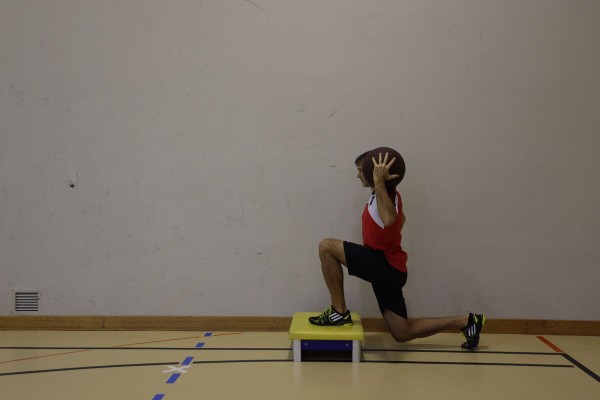
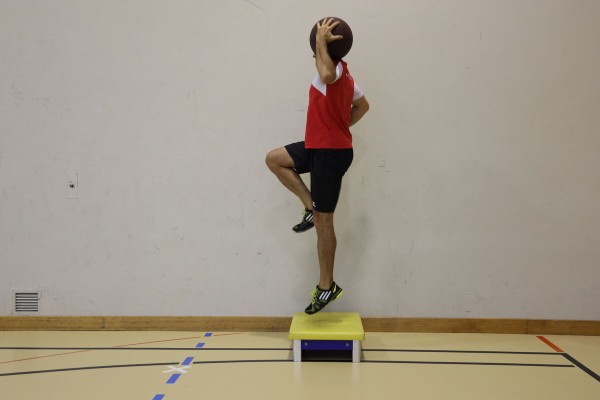
Stand in a lunge in front of the plyo box (the vaulting box - 1 intermediate element plus top), with the back (right) leg placed on the tip of the toe. A medicine ball (or another weight such as a dumbbell or kettlebell) is held on the side where the leg is placed on the raised base with the arm bent at the shoulder. Move the back leg onto the raised surface (leg bent at approximately a right angle), extend the free leg in a fluid movement and at the same time perform a small jump into the air. Land back on the plyo box/swinging box using only the leg with which the one-legged jump was performed. Then move the free leg back to the starting position in a lunge. The other (left) leg accompanies the movement (bend the leg during the jump), but is only lifted off the floor and put down again in the same position (do not place the foot on the raised surface).
Attention:
Keep the upper body upright, distribute the weight over the entire foot, push the knee outwards (do not tilt inwards).
Lighten:
Select a lower element; do not jump; do not hold any weight on the shoulder.
Harden:
Select a higher element; more weight; additional weight on the foot.
Variation:
Hold a weight (dumbbell or kettlebell) in both hands with hanging arms.
1 plyo box/swinging box
1 medicine ball/dumbbell/kettlebell
1 weight sleeve/weight waistcoat ► make the exercise more difficult (additional weight)
1 additional dumbbell/kettlebell ► variation of the exercise
Up and down movements in squat position (pulsating movement) ► squat pulse
Power
Individual work
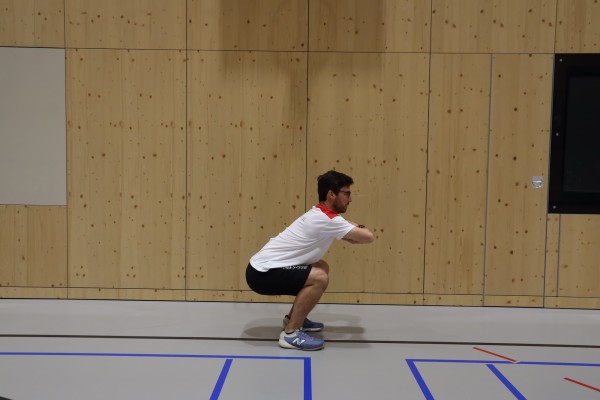
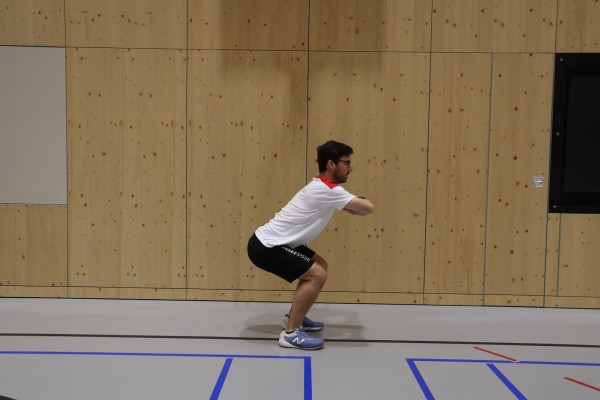
Deep squat position (ideally thighs parallel to the floor), feet hip to shoulder-width apart, knees pointing slightly outwards (10-30 degrees), corresponding to the tips of the feet, upper body upright, chest out, shoulders back down, abdominal muscles tensed. In this position, perform small pulsating up and down movements (approx. 5-10cm). The movements are controlled and rhythmic, without losing tension.
Attention:
Keep your back straight. Keep your knees stable (do not tilt them inwards). Keep your core tensed throughout the exercise.
Lighten:
Less deep squat position (the deeper, the more challenging).
Harden:
Additional weight (on your shoulders, in front of you or with hanging arms in your hands).
1 weight vest/(medicine) ball/weight disc/barbell/sandbag/2 dumbbells ► make the exercise more difficult (additional weight)
Bounce
Coordination exercises
Individual work
Take a running start parallel to the band, jump off over the front foot, touch down on the line with the back foot first, cushion the swing well with your knees and land in a cross-legged stance.
Variant
Jump without a running start with both feet at the same time.
Easier:
Jump onto a lower slackline.
Harder:
Jump onto a higher slackline; jump with a half turn.
1 Slackline
Lunge (left) ► split squat / split lunge
Power
Individual work


Lunge, upper body upright, front (left) leg on the balance board (board on the wedges) and bent to approximately a right angle, arms supported on the hips, crossed on the chest or behind the head or in front, hold the position.
Attention:
Upright upper body (tense torso), front knee always remains behind the tip of the foot and centred over the foot, distribute weight over the entire front foot.
Lighten:
Without a balance board; lower your upper body less (greater angle at the knees).
Harden:
Balance board on the roller (instead of on the wedges); additional weight (on the shoulders, with hanging arms or in a forward or upright position).
Variant:
Bend and straighten the front leg (raise and lower the upper body).
1 balance board
2 wedges (semicircular)
1 roller ► make the exercise easier
1 weight vest/weight disc/(medicine) ball/barbell/sandbag/2 dumbbells ► make the exercise more difficult (additional weight)
Lunge (left) ► split squat / split lunge
Power
Individual work


Start in a standing position on the balance board (lengthways on the board), with the leg resting flat on one end of the balance board (left) and the leg supported on the tips of the toes at the other end (right). Bend both legs so that the knee of the back leg (right) touches the balance board. Then stretch both legs back to the starting position.
Lighten:
Without the balance board; lower your upper body less (greater angle at the knees).
Harden:
Additional weight (on the shoulders, with hanging arms or in a forward or upright position).
1 balance board
1 weight vest/weight disc/(medicine) ball/sandbag/2 dumbbells ► make the exercise more difficult (additional weight)
Lunge (left) ► split squat / split lunge hold
Power
Individual work

Stand upright, arms supported on the hips, lunge forward (with the left leg), bend the front (and back) leg to a right angle, hold the position.
Caution:
Always keep the front knee behind the tip of the foot and centred over the foot. Lower your body in the centre (follow the back knee like a plumb line, keep your upper body upright, tense your stomach).
Lighten:
Lower your upper body less (greater angle in the knees).
Harden:
Additional weight (on the shoulders, with hanging arms or in a forward or upright position); unstable base for supporting the front leg.
1 weight vest/weight disc/(medicine) ball/barbell/sandbag/fighting backpack/2 dumbbells ► Make the exercise more difficult (additional weight)
1 ball/balance cushion/balance board ► Make the exercise more difficult (unstable surface)
Lunge (right) ► split squat / split lunge
Power
Individual work

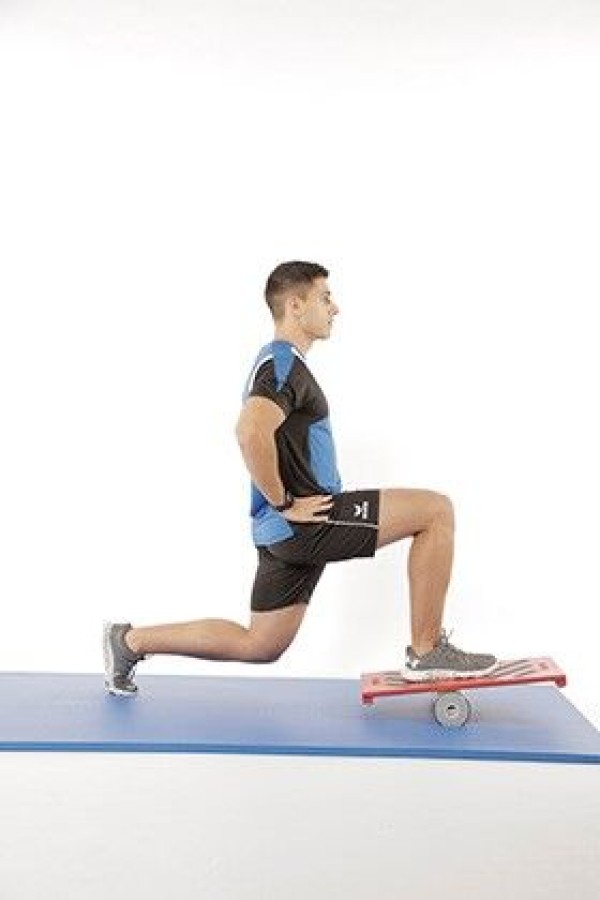
Lunge, upper body upright, front (right) leg on the balance board (board on the wedges) and bent to approximately a right angle, arms supported on the hips, crossed on the chest or behind the head or in front, hold the position.
Attention:
Upright upper body (tense torso), front knee always remains behind the tip of the foot and centred over the foot, distribute weight over the entire front foot.
Lighten:
Without a balance board; lower your upper body less (greater angle at the knees).
Harden:
Balance board on the roller (instead of on the wedges); additional weight (on the shoulders, with hanging arms or in a forward or upright position).
Variant:
Bend and straighten the front leg (raise and lower the upper body).
1 balance board
2 wedges (semicircular)
1 roller ► make the exercise easier
1 weight vest/weight disc/(medicine) ball/barbell/sandbag/2 dumbbells ► make the exercise more difficult (additional weight)
Lunge (right) ► split squat / split lunge
Power
Individual work


Start in a standing position on the balance board (lengthways on the board), with the leg resting flat on one end of the balance board (right) and the leg supported on the tips of the toes at the other end (left). Bend both legs so that the knee of the back leg (left) touches the balance board. Then straighten both legs back to the starting position.
Lighten:
Without the balance board; lower your upper body less (greater angle at the knees).
Lighten:
Additional weight (on the shoulders, with arms hanging down or in a forward or upright position).
1 balance board
1 weight vest/weight disc/(medicine) ball/sandbag/2 dumbbells ►Make the exercise more difficult (additional weight)
Lunge (right) ► split squat / split lunge hold
Power
Individual work

Stand upright, arms supported on the hips, lunge forward (with the right leg), bend the front (and back) leg to a right angle, hold the position.
Attention:
Always keep the front knee behind the tip of the foot and centred over the foot. Lower your body in the centre (follow the back knee like a plumb line, keep your upper body upright, tense your stomach).
Lighten:
Lower your upper body less (greater angle in the knees).
Harden:
Additional weight (on the shoulders, with hanging arms or in a forward or upright position); unstable base for supporting the front leg.
1 weight vest/weight disc/(medicine) ball/barbell/sandbag/fighting backpack/2 dumbbells ► make the exercise more difficult (additional weight)
1 ball/balance cushion/balance board ► make the exercise more difficult (unstable surface)
Lunge alternating with jump (alternating jump) ► jumping lunge
Power
Individual work


Lunge (upper body upright, stomach tensed), arms supported on the hips, folded across the chest, bend the front (and back) leg to a right angle, straighten the legs for a two-legged jump, change leg position during the jump (move the back leg forwards and the front leg backwards), land in the starting position (mirror-inverted).
Attention:
Always keep your front knee behind the tip of your foot and centred over your foot. Keep your upper body as stable as possible.
Lighten:
Higher basic position/lower your upper body less (greater angle in the knees).
Harden:
Additional weight (on the shoulders, with hanging arms or in a forward or upright position).
Variation:
Jump height can be varied: high jumps with plenty of time to change leg position or only small jumps with quick leg shifts.
1 weight vest/weight disc/(medicine) ball/sandbag/fighting backpack/2 dumbbells ► make the exercise more difficult (additional weight)
Lunge alternating with jump (alternating jump) ► jumping lunge / lunge jump
Power
Individual work
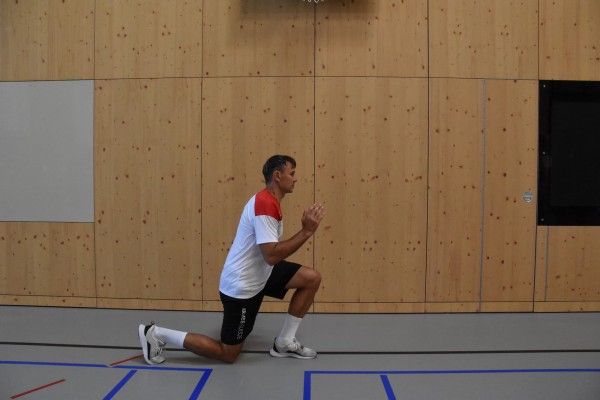
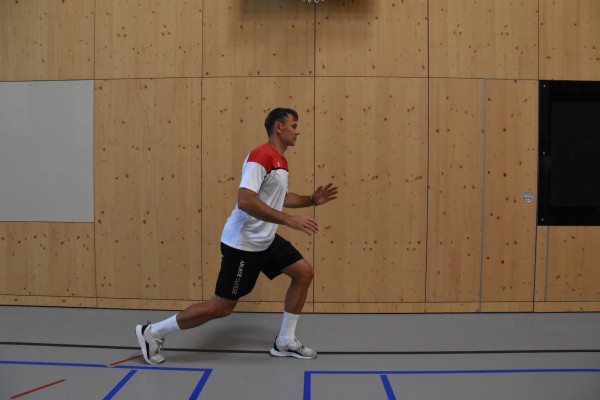
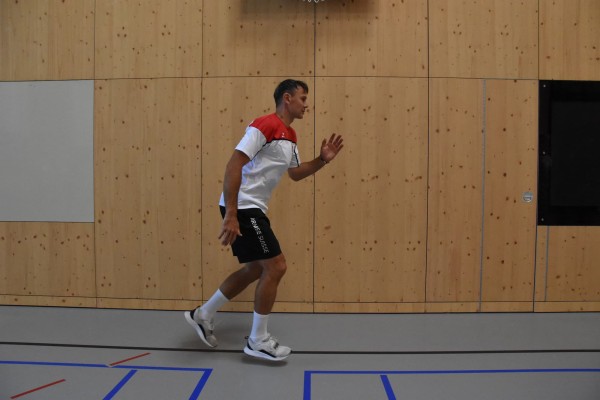
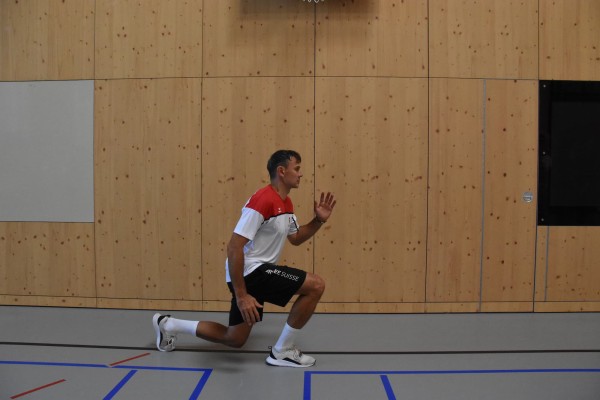
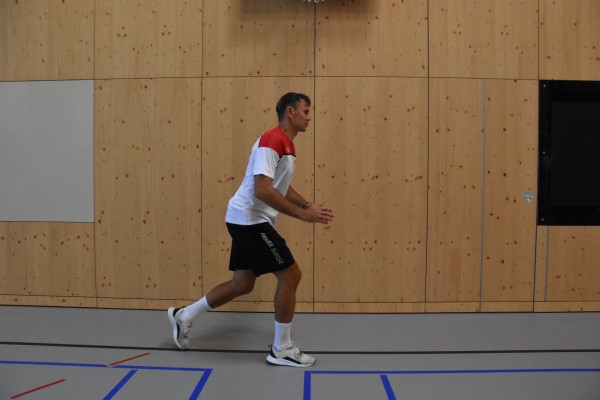
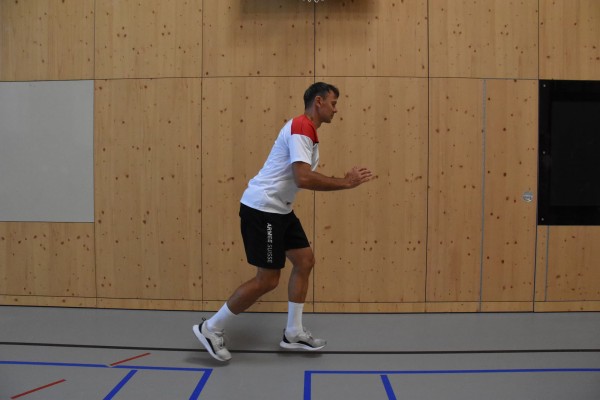
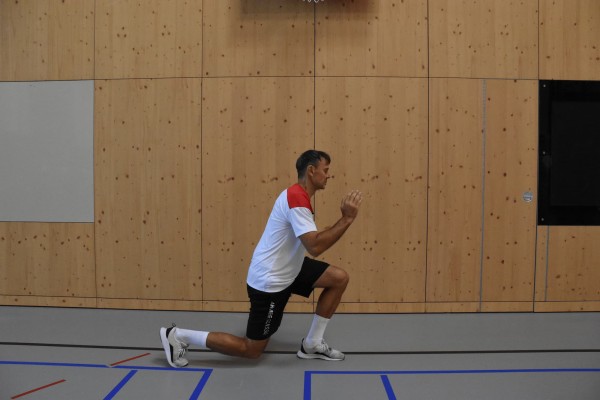
Lunge (upper body tilted slightly forwards, stomach tensed), arms bent (front arm = side of the back leg; back arm = side of the raised leg), bend the front (and back) leg to a right angle, straighten the legs for a two-legged jump, change leg position during the jump (back leg forwards and front leg backwards), landing in the starting position (mirror-inverted). Continuously switch between the two positions without remaining in the lunge position for too long.
Attention:
Keep your upper body as stable as possible.
Lighten:
Higher basic position/lower your upper body less (greater angle in the knees).
Harden:
Additional weight (hold in arms).
Variation:
Jump height can be varied: high jumps with plenty of time to change leg position or only small jumps with quick leg shifts.
1 weight vest/weight disc/(medicine) ball/sandbag/fighting backpack/2 dumbbells ► make the exercise more difficult (additional weight)
Lunge alternating in jump with rotation of the upper body (alternating jump) ► jumping lunge
Power
Individual work


Lunge, upper body rotated towards the bent leg with arms as straight as possible (looking to the side), front (and back) leg bent to a right angle, legs stretched out for a two-legged jump, change leg position during the jump (move back leg forwards and front leg backwards) and move the upper body and arms to the other side, landing in the starting position (mirror-inverted).
Attention:
Always keep the front knee behind the tip of the foot and in the centre of the foot.
Lighten:
Higher starting position/lower upper body less (larger angle in the knees).
Harden:
Additional weight (hold in your hands).
Variation:
Jump height can be varied: high jumps with plenty of time to change leg position or only small jumps with quick leg shifts.
1 weight vest/weight disc/(medicine) ball/1-2 dumbbells ► make the exercise more difficult (additional weight)
Lunge from a standing position (left) ► lunge
Power
Individual work


Stand upright, upper body upright and stomach tensed, arms supported on the hips, folded across the chest or in front, lunge forwards (with the left leg), bend the front (and back) leg to a right angle, push off the front (left) leg to return to the starting position.
Attention:
Always keep the front knee behind the tip of the foot and centred over the foot.
Lighten:
Lower the upper body less (greater angle at the knees).
Harden:
Additional weight (on the shoulders, with hanging arms or in a forward or upright position).
1 weight vest/weight disc/(medicine) ball/barbell/sandbag/fighting backpack/2 dumbbells ► make the exercise more difficult (additional weight)
Lunge from a standing position (left) ► lunge
Power
Individual work
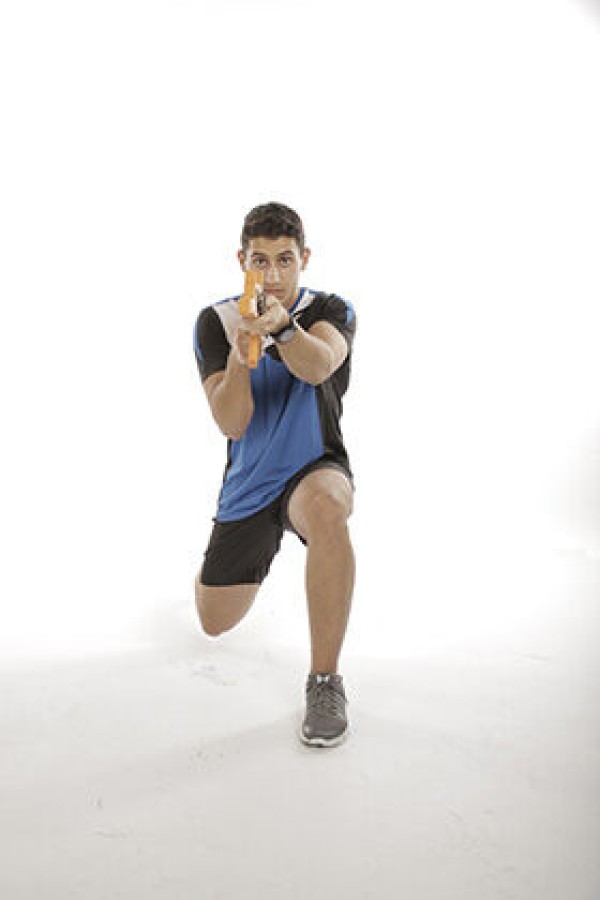
Stand, upper body upright and stomach tensed, weapon held high or in front, lunge forward (with the left leg), bend the front (and back) leg to approximately a right angle, push off the front (left) leg to return to the starting position.
Attention:
Always keep the front knee behind the tip of the foot and centred over the foot.
Lighten:
Lower the upper body less (greater angle at the knees).
Variant:
With each lunge, the assault rifle is passed between the legs.
1 assault rifle (neutralised)
Lunge from a standing position (left) ► lunge
Power
Individual work


The barbell rests on the upper back. From a hip-width upright stance, take a large step forwards (with your left leg), lowering your hips so low that your back knee almost touches the floor (both legs at right angles, so to speak). The front (left) leg is then pushed backwards to return to the starting position.
Starting position:
- Stand with hips wide apart
- Feet pointing forwards
- Barbell placed on upper back, grasp barbell with wide overhand grip
- Look (always) straight ahead in neutral position
Finishing position:
- The front knee is bent at a right angle directly over the heel
- The back knee almost touches the floor
- The upper body remains upright
Attention:
The front knee always remains behind the toe and centred over the foot.
Variant:
Replace the barbell with dumbbells, which are held next to the body with outstretched arms (or also hold the kettlebell in front of the chest or in a holding position).
1 barbell
2 dumbbells/kettlebell ► variation of the exercise
Lunge from a standing position (left) ► lunge
Power
Individual work

Stand, upper body upright and stomach tensed, pistol held out in front of you with arms outstretched, lunge forwards (with the left leg), bend the front (and back) leg to a right angle, push off the front (left) leg to return to the starting position.
Attention:
Always keep the front knee behind the tip of the foot and centred over the foot.
Lighten:
Lower the upper body less (greater angle at the knees).
Variant:
With each lunge, the pistol is passed between the legs (change hands between the legs).
1 pistol (neutralised)