
Exercises (3302)
Extension and flexion of the arms while seated (chest press) ► chest press
Power
Individual work
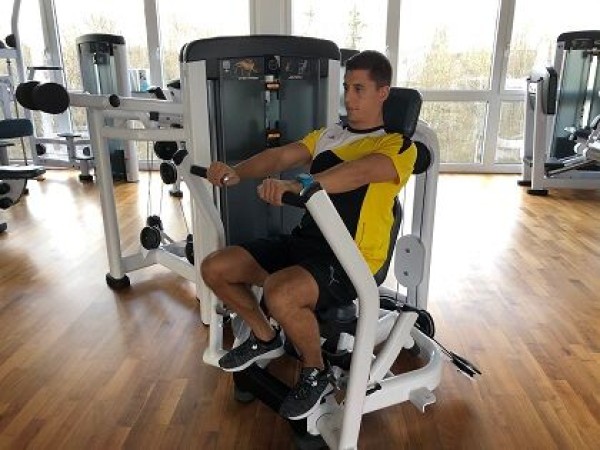
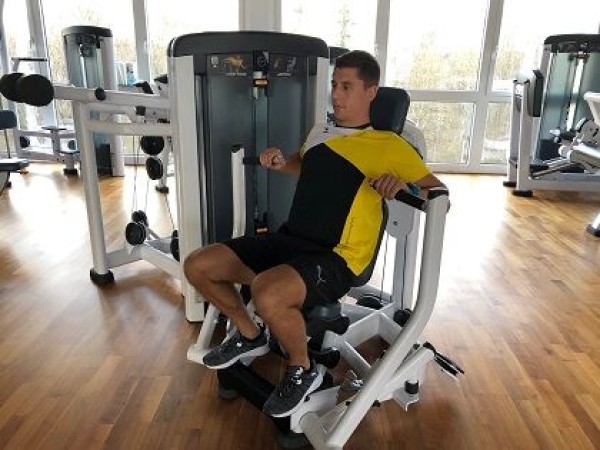
In the seated position, grasp the handles at chest height with your arms bent (upper grip), move your arms forwards against the resistance (try to squeeze your hands together a little) and return to the starting position.
Starting position:
- Sitting, arms bent
- Build up tension
Finishing position:
- Arms almost stretched out, keep a slight bend in the elbow
- Try to squeeze hands together (tense chest)
Attention:
Movement is in the shoulders and arms, not in the upper body. Elbows bent approx. 45° from the upper body ("A" shape with the arms). Shoulders are fixed and pressed down towards the hips.
Extension and flexion of the arms in a seated position (row pull) ► low row
Power
Individual work
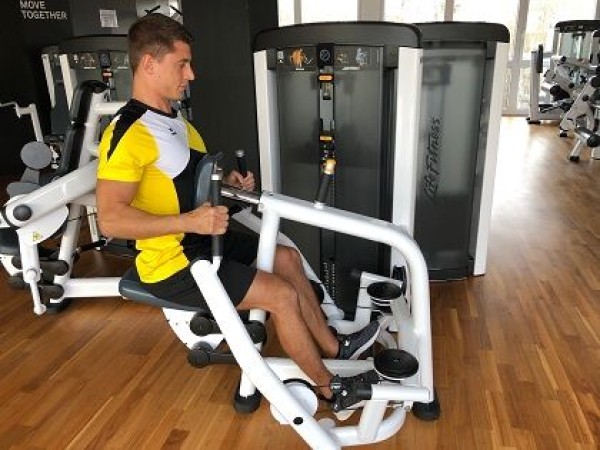

In the seated position, pull the handles towards your body (bring your hands to your chest) and stretch your arms back to the starting position.
Starting position:
- Sitting with arms almost straight in front of you
- Straight back stretched
Finishing position:
- Arms bent (elbows on body, hands brought to chest)
Extension and flexion of the arms in a seated position (rowing pull) ► row
Power
Individual work
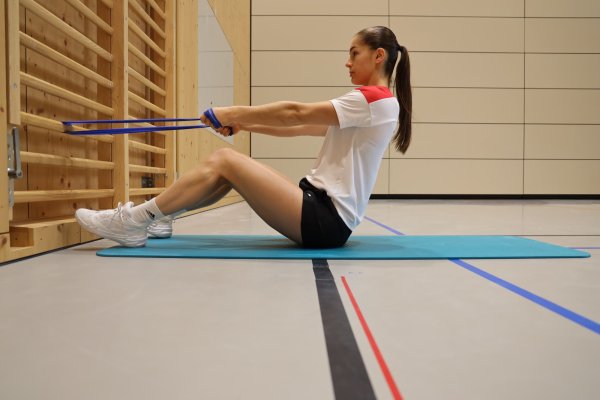
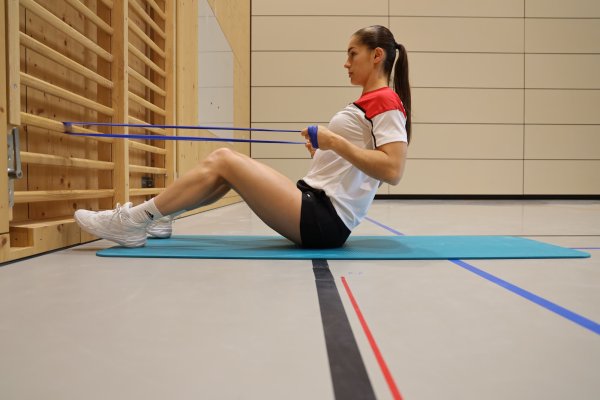
Sit facing the wall bars or another stable anchor point. Secure the resistance band firmly at approximately shoulder height. Keep your legs apart and your feet firmly planted on the floor. Lean your upper body slightly backwards without rounding your back. Actively engage your abdominal muscles and keep your chest upright. Grasp one end of the resistance band in each hand. To begin with, your arms are stretched out in front of you and the resistance band is already under slight tension. Keep your shoulders relaxed and as far away from your ears as possible. From the stable starting position, pull both elbows back in a controlled manner. Move your elbows to the sides of your body, keeping them at approximately shoulder height or slightly below. At the same time, actively move your shoulder blades backwards and slightly downwards. Bring your hands towards your chest in a controlled manner. The movement ends when the elbows are positioned at the sides or slightly behind the upper body and the shoulder blades have been actively drawn together. Hold the end position briefly. Then slowly and in a controlled manner, extend your arms forwards again. The shoulder blades may move forwards in a controlled manner without the upper body slumping. Throughout the entire movement, the upper body remains as still as possible and the core is engaged.
Attention:
The back becomes rounded or is severely overextended; the upper body moves noticeably forwards and backwards during the pull; momentum from the upper body is used to overcome the resistance; the shoulders are pulled up significantly towards the ears during the pull; the shoulder blades are not actively drawn back; the elbows are moved uncontrollably far upwards or downwards; the arms are pulled forwards by the resistance band as they return to the starting position; the tension in the resistance band is completely lost between repetitions; tighten your stomach and keep your upper body stable throughout the entire movement; the resistance band must be securely attached to the anchor point and must not be able to come loose during the exercise.
Lighten:
Use a resistance band with less tension; sit closer to the anchor point to reduce the pre-tension; Slightly reduce the range of motion; perform the movement more slowly and take a short pause between repetitions; initially practise only the shoulder blade movement before performing the full rowing stroke.
Harden:
Use a resistance band with greater tension; sit further away from the anchor point to increase the tension; hold the end position of the pull for 2–3 seconds; deliberately slow down the return movement over 3–4 seconds; perform the exercise with one arm whilst keeping the torso stable to prevent rotation; carry out several repetitions in succession without fully releasing the tension in the band.
1 elasticated rubber band
1 wall bar/tree
Extension and flexion of the arms in a seated position (rowing pull) ► row
Power
Partner work


Both participants sit with their legs slightly bent, facing their partner, the soles of their feet touching those of the other person, one participant holds the elasticated loops, the other participant holds the gymnastics pole at knee height, both exercisers perform a rowing movement at the same time by pulling their arms/elbows backwards past their body (bring their hands to their chest, pull their shoulder blades together).
Attention:
The upper body remains upright, no leaning back, torso is tensed (no hollow back) and the movement comes from the back muscles (pull elbows backwards).
Lighten:
Select less strong elastic bands, roll up elastic bands less.
Harden:
Select stronger elastic bands, roll up elastic bands more.
1 gymnastic stick with elasticated strap
Extension and flexion of the arms in a seated position (rowing pull) ► row
Power
Individual work
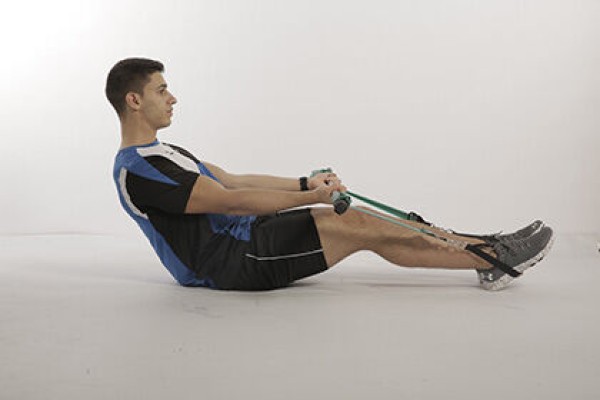

Sit with your legs straight and your upper body leaning slightly backwards, your feet in the loops, the gymnastics pole slightly above knee height with loosely stretched elastic bands, pull the gymnastics pole towards your navel (move your elbows backwards and pull your shoulder blades together) and return to the starting position.
Attention:
The movement only takes place in the arms (upper body remains stable).
Lighten:
Select less strong elastic bands; roll up the elastic bands less.
Harden:
Select stronger elastic bands; roll up the elastic bands more.
1 gymnastic bar with elasticated straps
Extension and flexion of the arms while seated ► Shoulder press
Power
Individual work
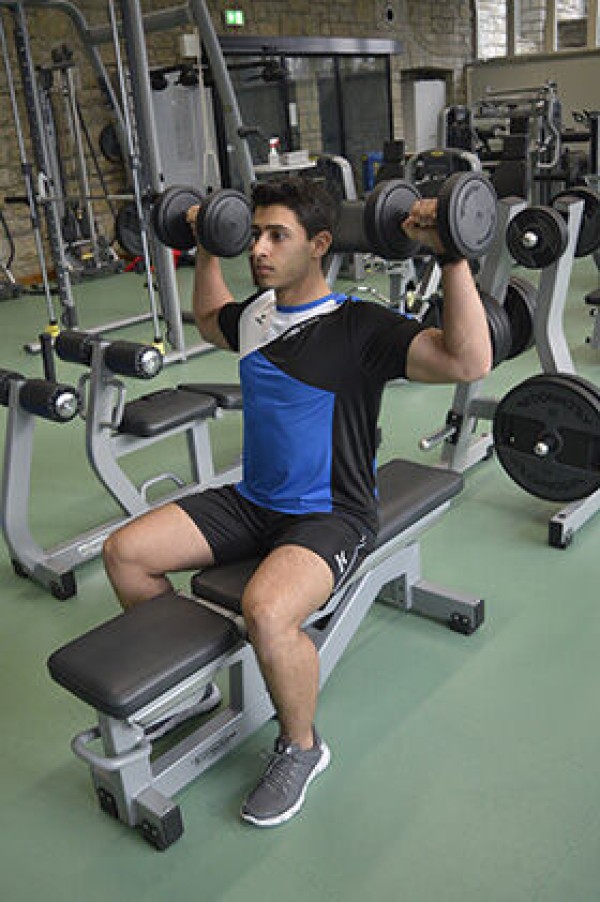
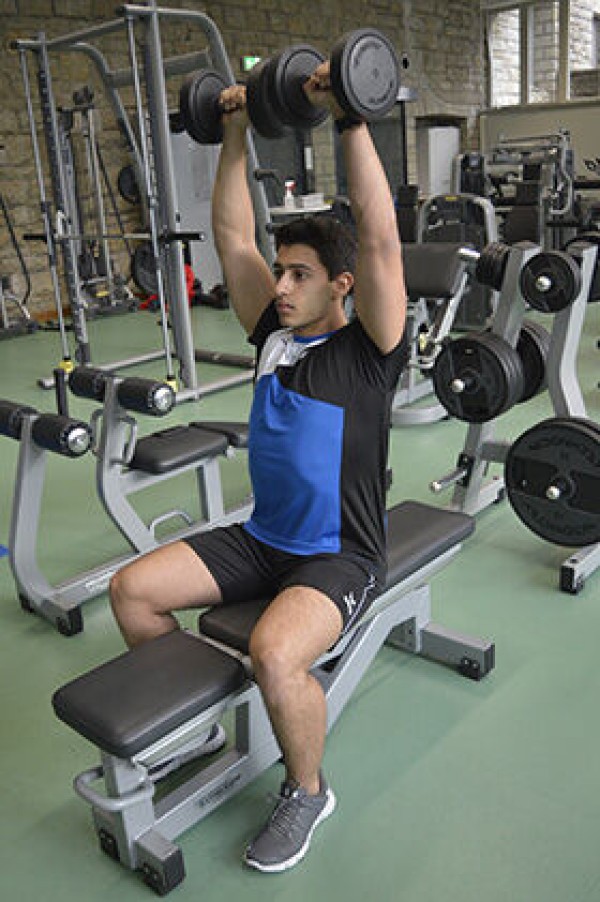
Sitting on the flat bench, hold the dumbbells at head height (elbows bent at shoulder height). Now slowly push the weight up in parallel (arms shoulder-width apart, dumbbells almost together) and return to the starting position.
Starting position:
- Sit on the flat bench, back straight, torso tensed, feet flat on the floor
- Arms bent at the side, elbows approximately at shoulder height, wrists fixed
Finishing position:
- Arms (almost) fully extended shoulder-width apart in a high position (dumbbells may also touch slightly)
Variant I:
The exercise can be performed standing up.
Variant II:
The weights can also be lifted alternately.
2 dumbbells
1 flat bench
Extension and flexion of the arms in the seated position ► biceps curl
Power
Individual work
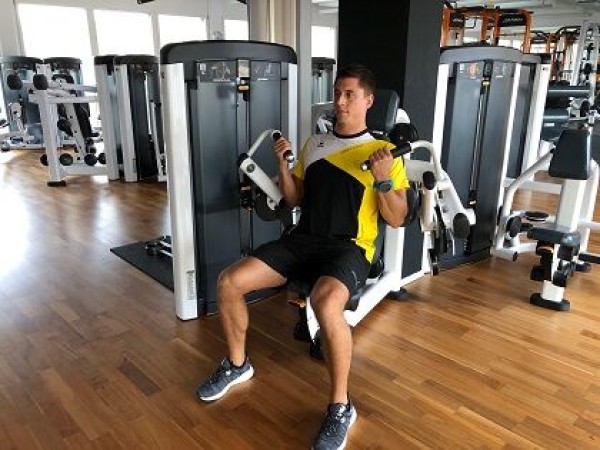

In the seated position, grasp the handles with your arms almost straight, place your elbows on the padding, pull the handles upwards (bend your arms, bring your hands to your chest) and do not lose contact between your elbows and the padding.
Starting position:
- Sitting, arms pointing almost straight downwards
- Elbows on the pad (underhand grip)
- Straight, stretched back
Finishing position:
- Arms bent
- Position of the upper body/back unchanged
- Elbows remain in contact with the padding
Extension and flexion of the arms while seated ► lat pull down
Power
Individual work
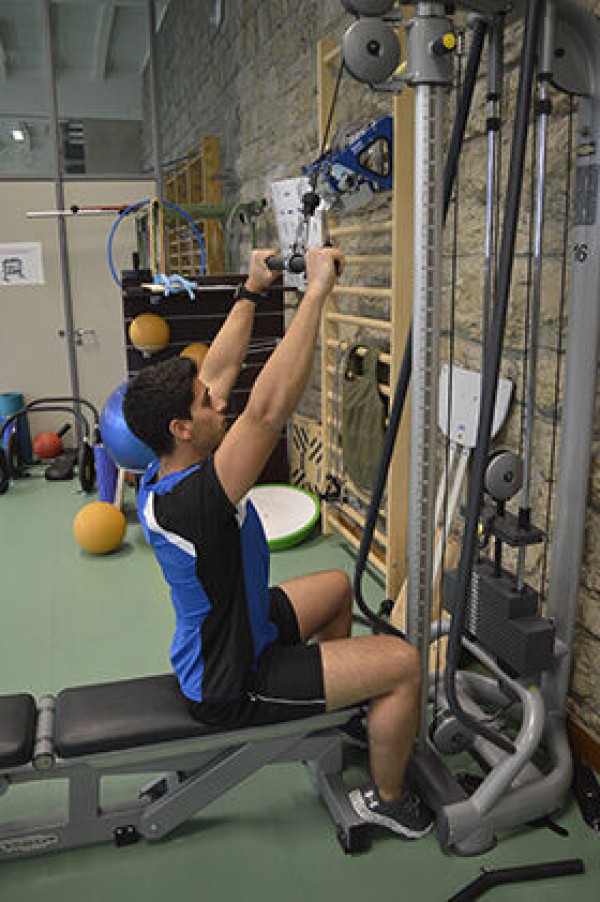
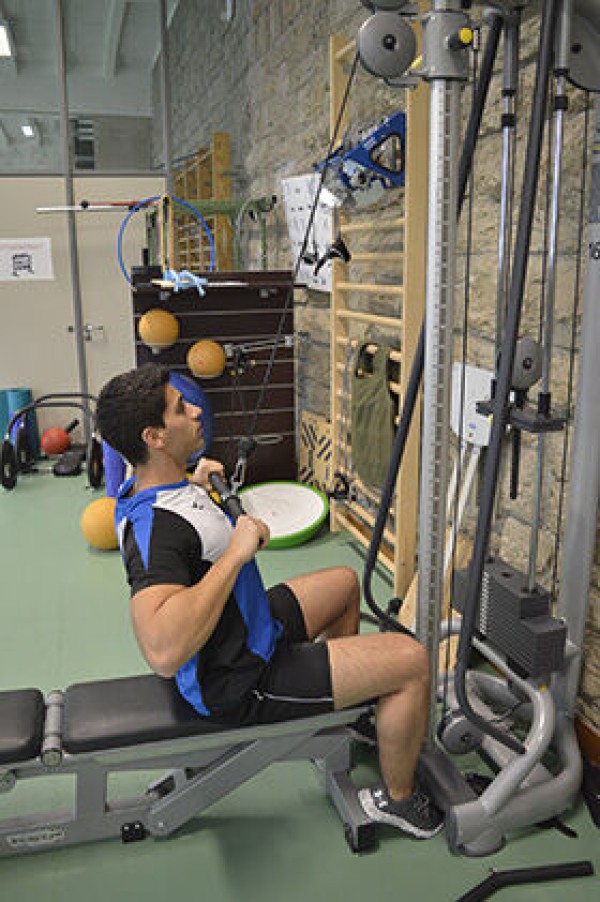
In a seated position, slowly raise the bar towards your chest and back again until your upper arms are almost straight.
Starting position:
- Sitting on the chair/flat bench, upper body tilted slightly backwards
- Arms not fully extended in a high position, hands grasping the bar with an overhand grip
- Back straight, tense core muscles
Finishing position:
- Bar almost touches the chest
- Elbows are behind the body
- Torso remains stable in the starting position
Attention:
Upper body is in a slightly reclined position, keep the back straight throughout the exercise (no movement in the upper body & no hollow back), do not pull into the neck.
1 weight tower/machine ► cable pulley (high)
1 chair/flat bench
Extension and flexion of the arms while seated ► pull down / lat machine
Power
Individual work
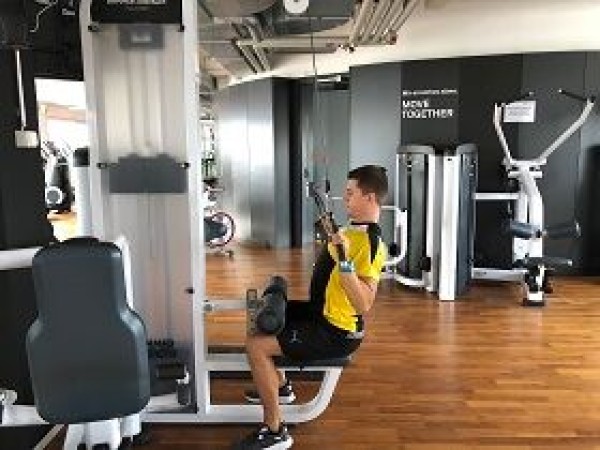
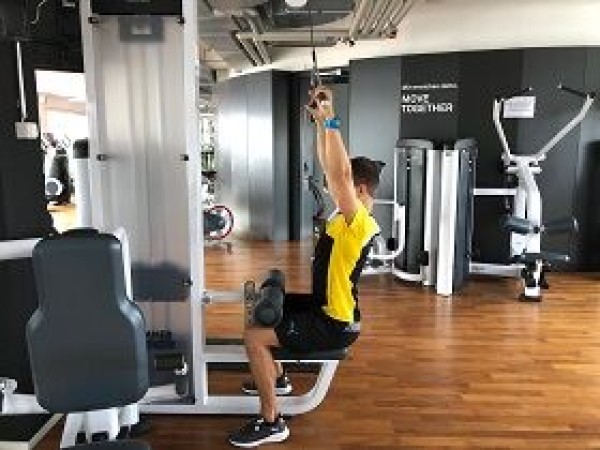
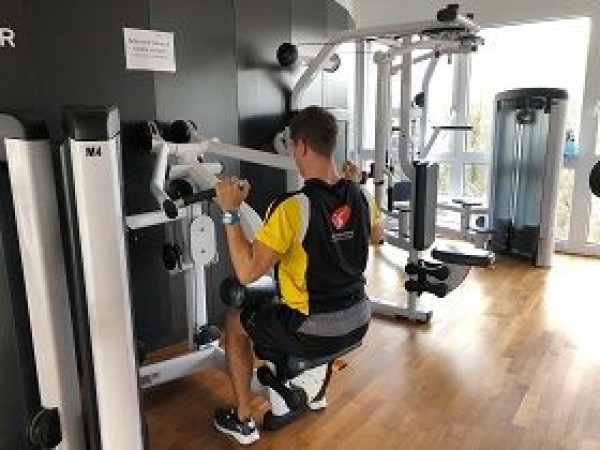
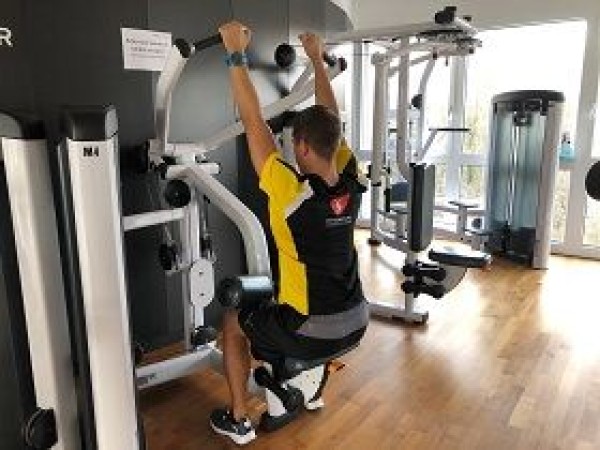
Grab the bar (for the cable pulley) or handles (for the machine), sit down and secure your thighs under the pad. Then pull the bar/handles down towards your sternum and return to the starting position.
Starting position:
- Sit with your upper body stretched out (slightly reclined)
- Tense your core muscles
Finishing position:
- Elbows pulled back and down
- Bar under your chin / hands almost at shoulder height
Extension and flexion of the arms while seated ► seated dumbell z-press
Power
Individual work


Sit upright with your legs stretched out on the floor, hold a dumbbell in each hand and place your arms at an angle next to your body (elbows pointing downwards close to your body, forearms pointing horizontally upwards, dumbbells at shoulder height). Extend your arms overhead (hold them up) and lower them back to the starting position.
Attention:
Always keep your back straight (body tension).
Lighten:
Bend your legs (slightly); less weight.
Harden:
More weight.
2 dumbbells
Extension and flexion of the arms while seated ► Shoulder press
Power
Individual work
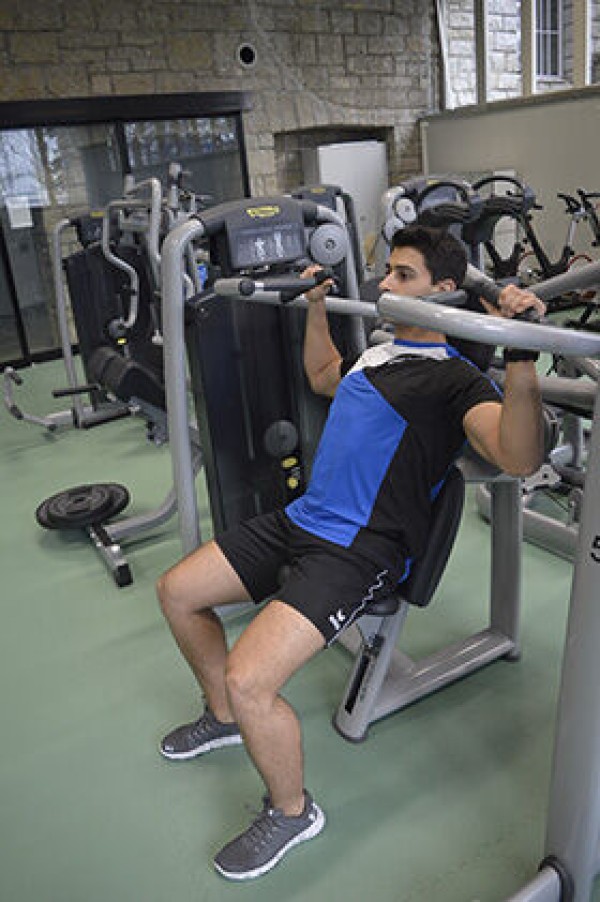
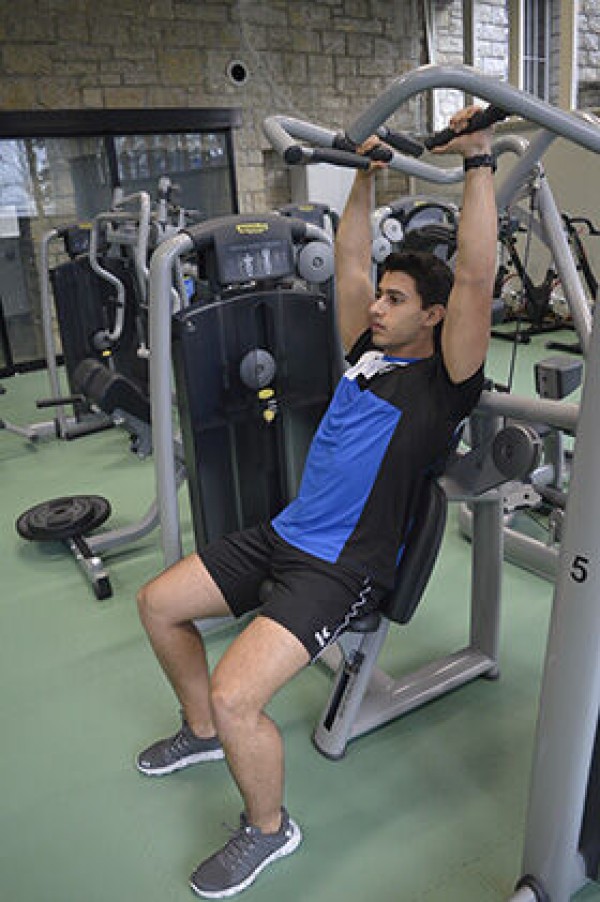
In a seated position, slowly push the bar upwards and return to the starting position.
Starting position:
- Sitting on the chair/flat bench, upper body erect (torso tensed)
- Hold the bar with an overhand grip, wrists fixed (no bending), elbows approximately at chest height.
Final position:
- Arms almost fully extended in a high position
Attention:
Avoid a hollow back position (tense your stomach), shoulders (especially shoulder blades) remain low. Arms always move at the same angle as the bar.
1 strength tower/machine ► shoulder push-up
1 chair/flat bench
Extension and flexion of the arms while seated ► Shoulder press
Power
Individual work
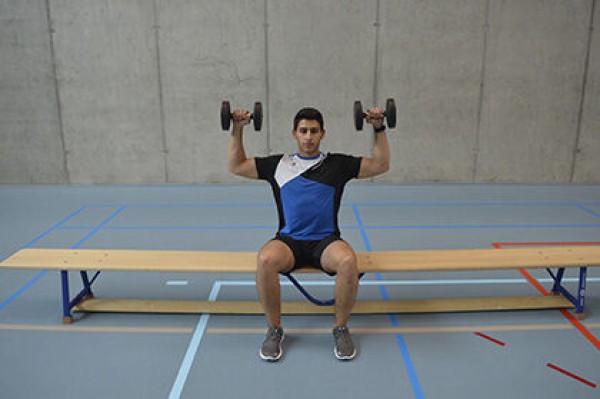
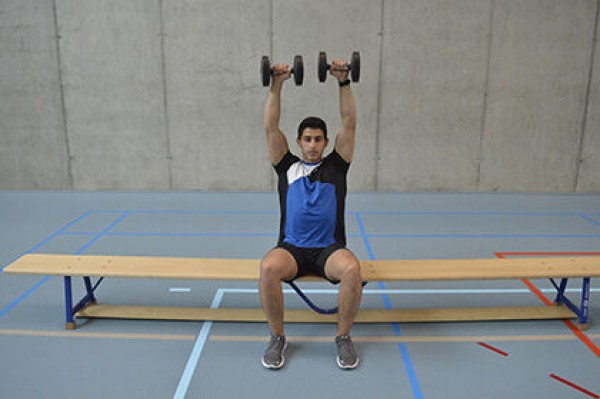
Sit upright on the long bench (or the Swedish box top), arms bent at shoulder height with the dumbbells in your hands (right angle at the elbow joint), palms facing forwards (overhand grip), bring your arms/dumbbells together above your head and lower them back to the starting position.
Attention:
Do not fully extend your arms, straight back (possibly back against a wall), actively tense your torso.
Lighten:
Less weight.
Harden:
More weight.
Variant I:
Exercise performed in a standing position.
Variant II:
After each exercise, bring your arms/dumbbells together in front of your head (elbows at shoulder height) with your palms facing your face.
1 long bench or 2 vaulting box elements (incl. upper section)
2 dumbbells
Extension and flexion of the arms while seated ► triceps extension
Power
Individual work

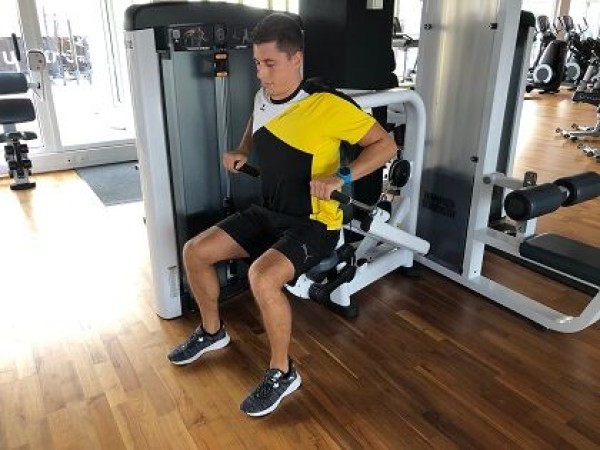
While seated (body slightly forward), bend the arms (elbows close to the body at about chest height), press down on the handles (holding them in the upper grip) and return to the starting position (stretch and bend the arms).
Starting position:
- Sitting with arms bent
- Straight back stretched, with the upper body leaning slightly forwards
Finishing position:
- Arms almost stretched (pointing towards the floor)
Extension und Flexion der Arme im Sitz/Kniestand ► behind the neck lat pull down
Power
Individual work
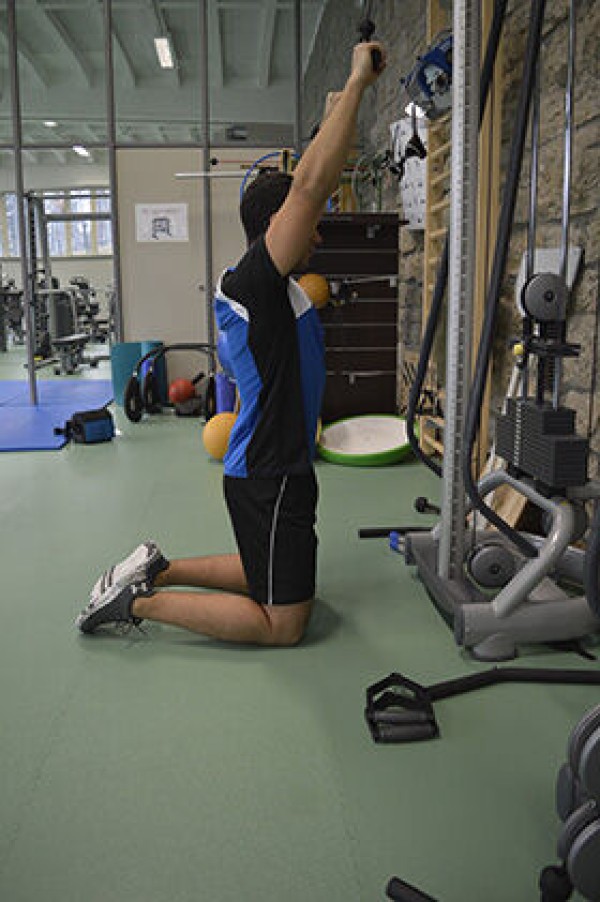
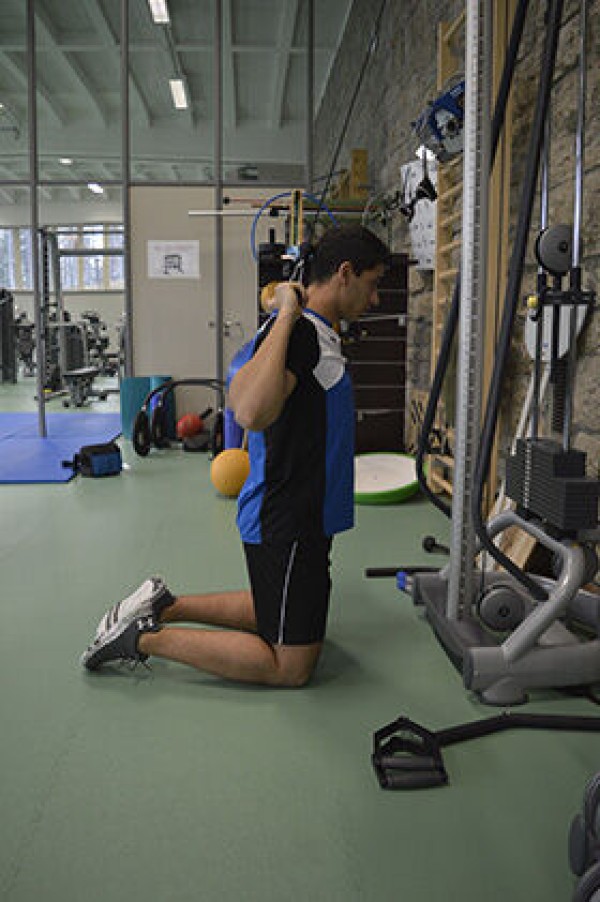
In a seated (or kneeling) position, hold your almost straight arms up, slowly bring the bar behind your head and back to the starting position.
Starting position:
- In a seated or kneeling position, upper body upright (torso tensed)
- Arms almost fully extended in upright position, hold bar in upper grip.
Finishing position:
- Pull bar behind head
- Torso remains upright
Attention:
Exercise for advanced users. Only perform this exercise if you have shoulder mobility (bring both arms overhead behind your head without compensating in the lumbar spine with a hollow back)! Keep your shoulders low.
Variant:
The wider the grip, the more the upper back and shoulder muscles are used.
1 weight tower/machine ► cable pulley (high)
1 chair/flat bench (optional)
Extension and flexion of the arms while standing
Power
Partner work
1 trainee & 1 helper ► note change of position
(= double the time required; for lesson planner see Organisation Kraft: Info button Execution)
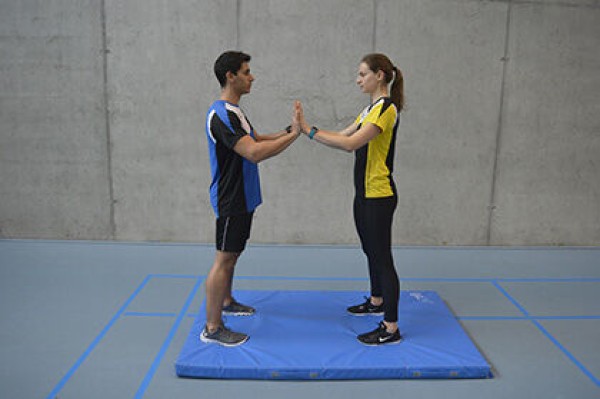
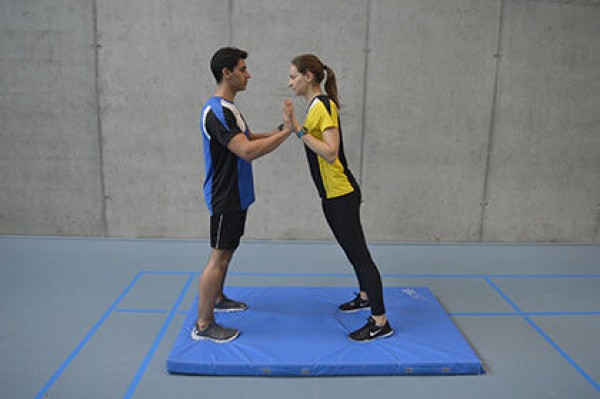
Practitioner: Stand upright with a shoulder-width stance frontally facing your partner at a distance of approximately one arm's length and hold their hands at chest height, bend and stretch the arms to tilt the upper body forwards and return to the starting position (chest press, push the arms out forwards and pull them towards the body).
Partner: Standing upright, counter the movement of the active participant.
Attention:
Elbows bent approx. 45° from the upper body ("A" shape with the arms), shoulders are fixed and pushed down towards the hips.
Lighten:
Less resistance/pressure from your partner.
Harden:
Stronger resistance/pressure from your partner.
No material required
Extension and flexion of the arms while standing
Power
Individual work
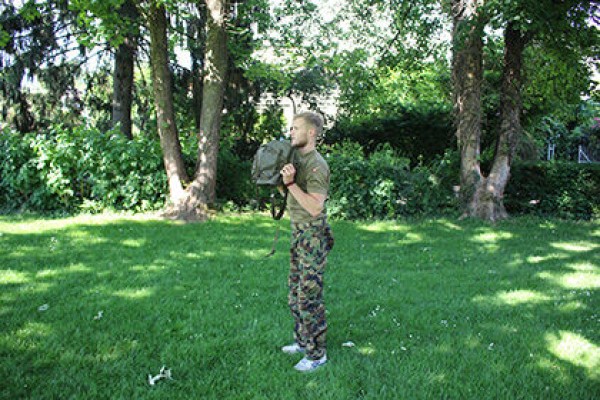
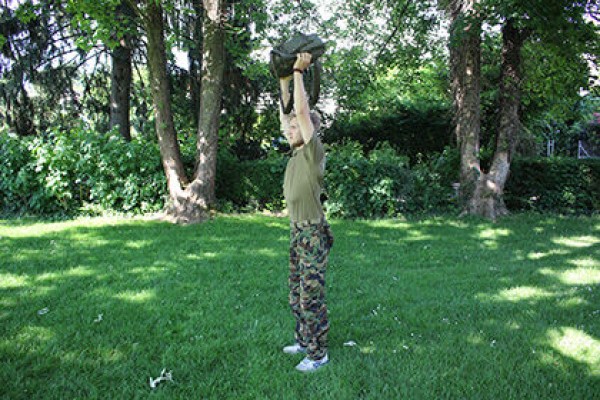
Hold an object (e.g. rucksack, weight disc, sandbag, tyre) with both hands at chest height and lift it by stretching your arms above your head, then bend your arms to return the object to the starting position.
Attention:
Keep your back straight.
Lighten:
Less weight/load.
Harden:
More weight/greater load.
1 weight disc/(medicine) ball/sandbag/fighting backpack
1 helmet/1-2 PET bottles (1.5 litres) ► make the exercise easier
1 tyre (PUCH) ► make the exercise more difficult (additional weight)
Extension and flexion of the arms while standing
Power
Individual work

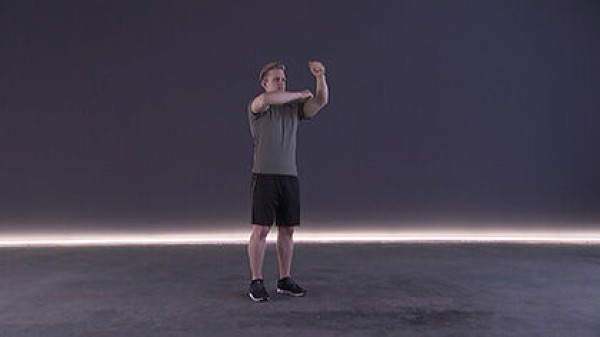
A distinction is made between the left-handed and right-handed stance. Right-handers take the left stance (left foot in front), while left-handers take the right stance (right foot in front). The left-hand stance: The left foot is placed one step forwards from a parallel stance approximately shoulder-width apart so that the right hand is behind. The right hand corresponds to the striking hand, the left hand to the leading hand. The distance between the two feet is approximately one shoulder width, with the feet on a diagonal to each other. The front foot stands on the entire sole, the heel of the back foot is raised. Both feet point forwards and the weight is evenly distributed over both legs. The front shoulder is turned slightly inwards. The whole body is slightly crouched, the knees are slightly bent and soft. The striking hand is placed in front of the chin and rests against the body. The lead hand is in front at eye level. The fists point outwards with the back. The arms are in front of the body and the elbows point downwards so that the arms cover the body. Alternate one arm in front of the other (circular movement), keeping the elbows practically stable at the same height.
Attention:
Always hold your arms up (chin or eye level).
Lighten:
Lower your elbows (circular movements at chest height).
Harden:
Hold additional weight on your arms or in your hands.
2 weight cuffs/weight balls/dumbbells ► make the exercise more difficult (additional weight)
Extension and flexion of the arms while standing
Power
Individual work
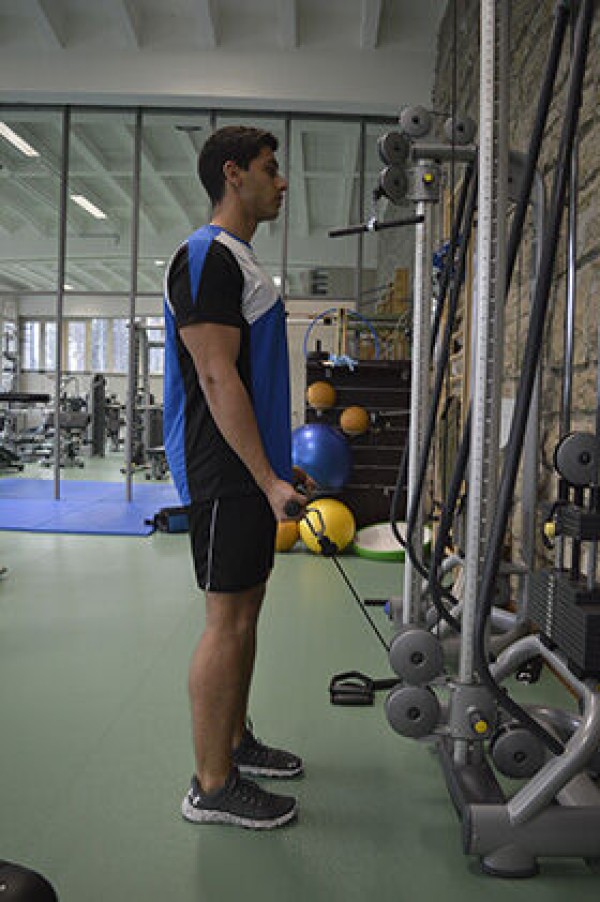
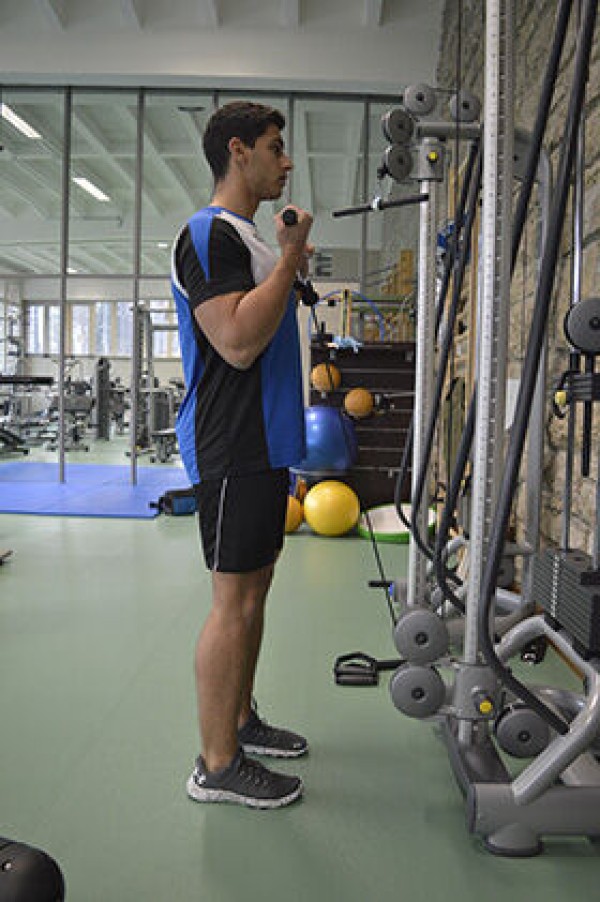
Stand upright, elbows fixed at the waist, almost straight arms holding the bar in front of the body at hip height. Slowly pull the bar up towards your chest in a controlled manner and return to the starting position. The movement comes from the elbow joint.
Starting position:
- Stand upright (shoulder-width apart or in a lunge)
- Arms are almost straight, elbows are fixed at the waist
- Grip the bar in front of the body at hip height
Finishing position:
- Bar at chest height with arms bent
- Elbows still fixed at the waist
- Upper body position remains stable
Attention:
If you use too much weight, there is a risk that you will work with momentum and therefore put more strain on the back muscles and less on the arm flexors. Position your arms in front of your body and always extend your arms as far as they will go. Keep your shoulders fixed (press towards your hips).
1 weight tower/machine ► cable pulley (deep)
Extension and flexion of the arms while standing
Power
Individual work

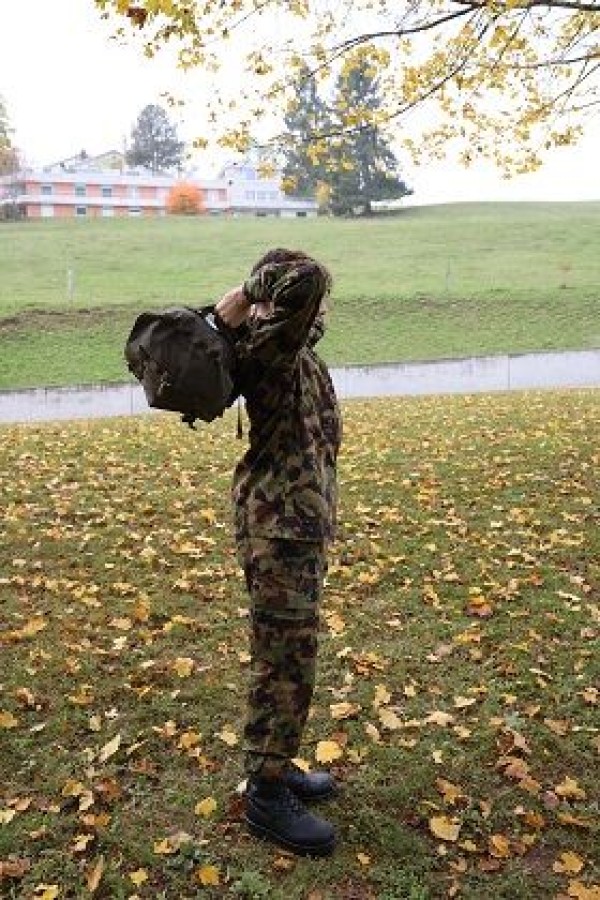
Stand upright (feet parallel or slightly offset), hold object (e.g. tyre or rucksack) above head with arms almost outstretched, bend and stretch arms (bring object behind head, movement in elbow joint, upper arms stable).
Attention:
Tighten your stomach, straight back, elbows remain shoulder-width apart in the same place at head height.
Lighten:
Less weight.
Harden:
More weight.
1 tyre (PUCH)/fighting rucksack/weight plate
1-2 PET bottles (1.5 litres)/1 helmet ► make the exercise easier
1 sandbag/tyre (DURO) ► make the exercise more difficult (additional weight)
Extension and flexion of the arms while standing
Power
Individual work
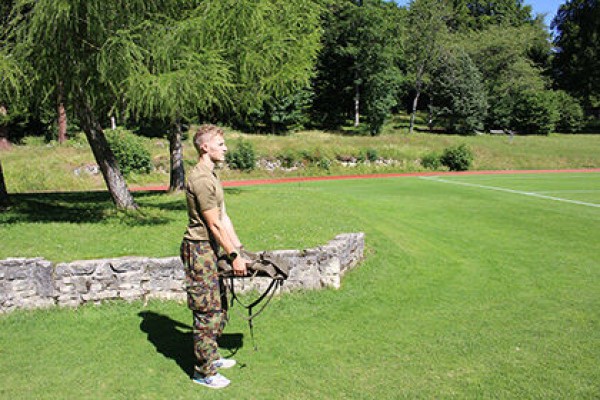
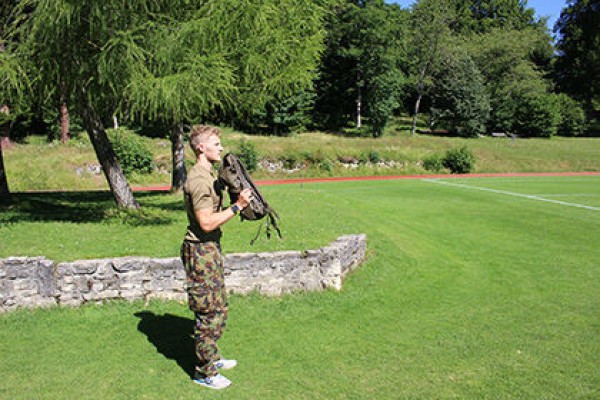
Stand upright with your feet shoulder-width apart, hold the object (e.g. rucksack) at hip height with your arms hanging straight, raise the rucksack to your chest by bending your arms and lift it over your head to stretch your whole body. Lower the object again by reversing the sequence of movements.
Attention:
Work without momentum if possible, avoid a hollow back position in the end position (actively tense the torso), fix the shoulders (press towards the hips).
Lighten:
Less weight/load.
Harden:
More weight/greater load.
1 combat rucksack/(medicine) ball
1 helmet ► make the exercise easier
1 weight disc/sandbag/tyre (PUCH) ► make the exercise more difficult (additional weight)
Extension and flexion of the arms while standing
Power
Individual work
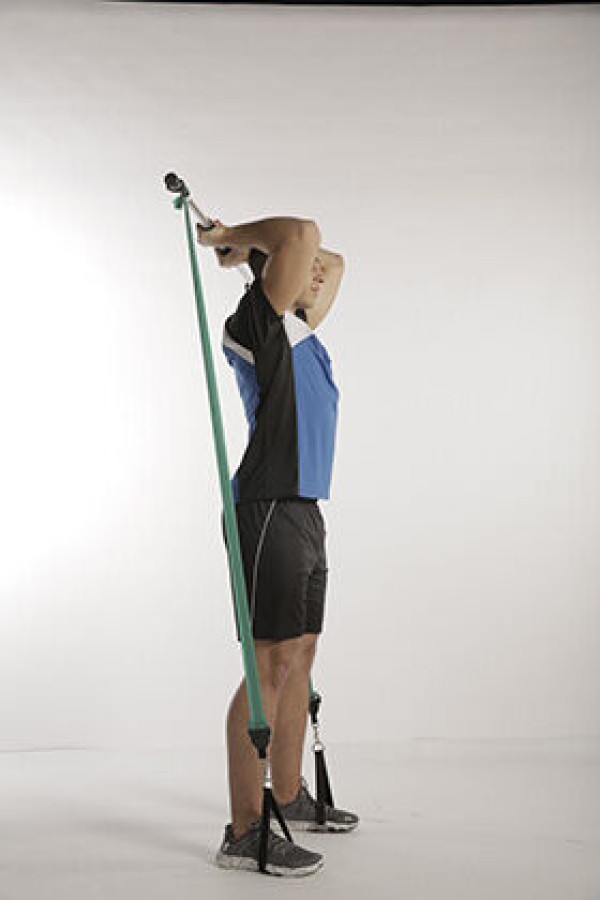
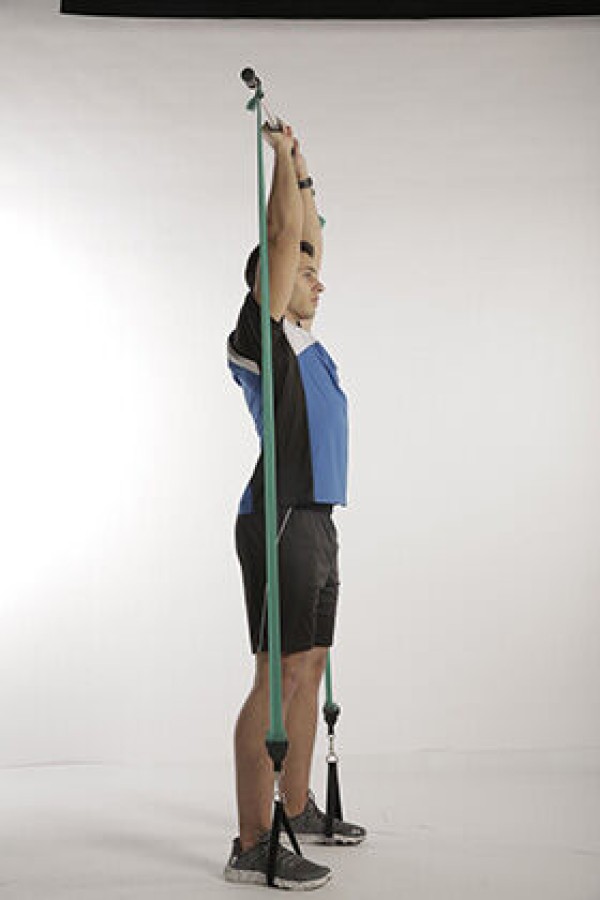
Stand upright with your feet shoulder-width apart, feet in the loops, hold the gymnastics pole behind your head with both hands, elbows bent and close to your head, back of your hands pointing downwards, stretch your (lower) arms and bend back to the starting position.
Attention:
Movement only takes place in the elbows, which remain close to the head, no hollow back (tense torso).
Lighten:
Choose less strong elastic bands; roll up the elastic bands less.
Harden:
Choose stronger elastic bands; roll up the elastic bands more.
1 gymnastic bar with elasticated straps
Extension and flexion of the arms while standing
Power
Individual work
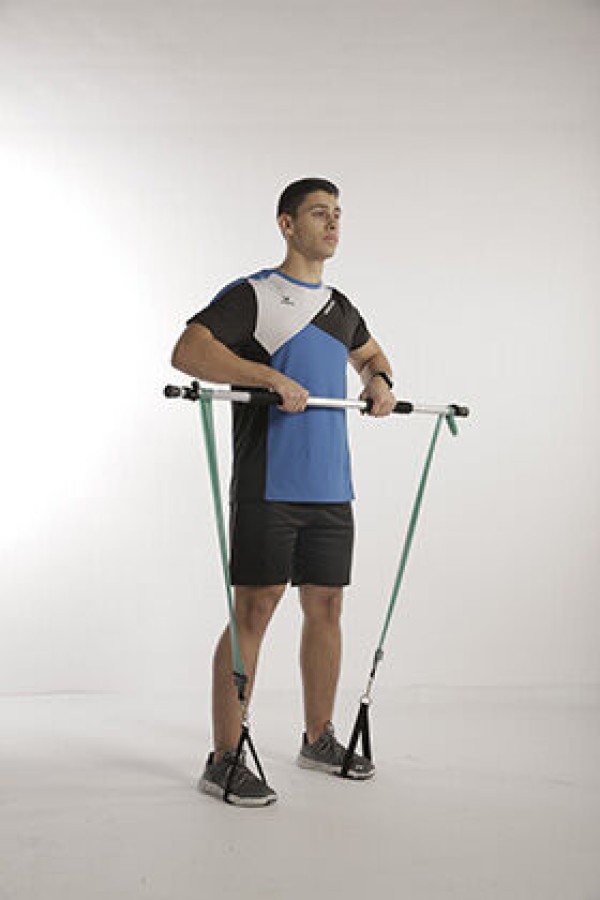
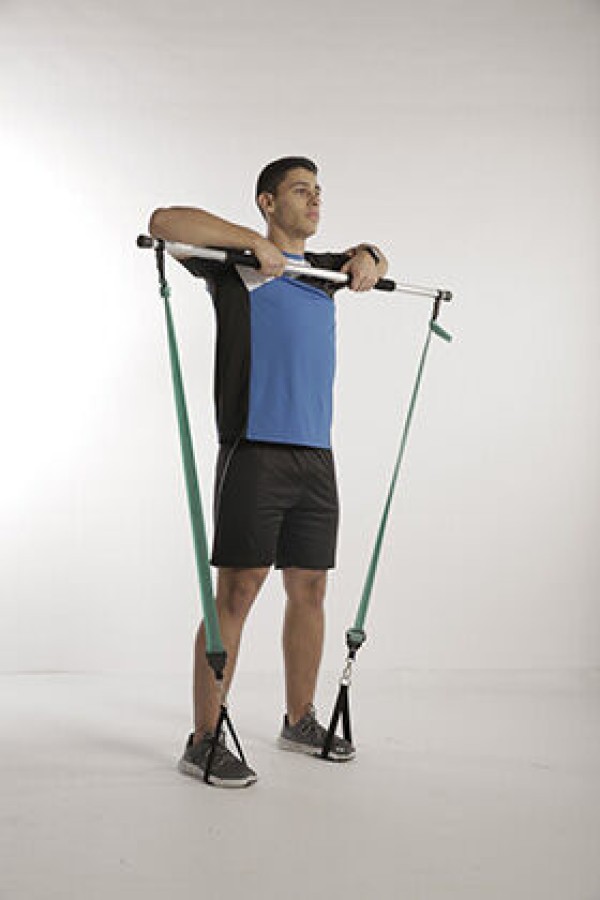
Stand upright with your feet in the loops, hold the gymnastics pole at about hip height in front of your body, close the upper grip of your hands in the centre of the pole (palms facing down), pull your hands close to your body up to chest height and lower them back to the starting position.
Attention:
The movement only takes place in the arms (upper body remains stable), no hollow back (tense torso).
Lighten:
Choose less strong elastic bands; roll up the elastic bands less.
Harden:
Choose stronger elastic bands; roll up the elastic bands more.
1 gymnastic bar with elasticated straps
Extension and flexion of the arms while standing
Power
Individual work
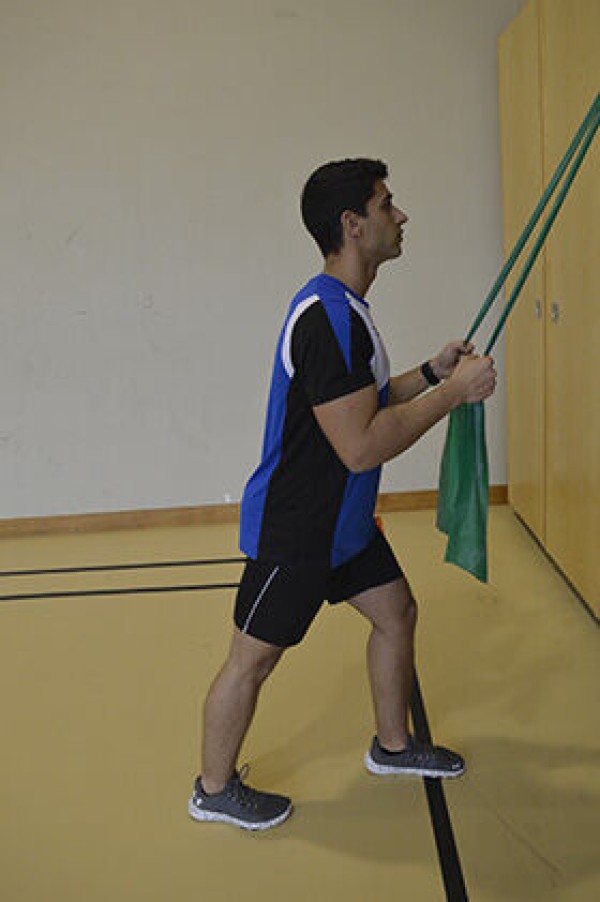
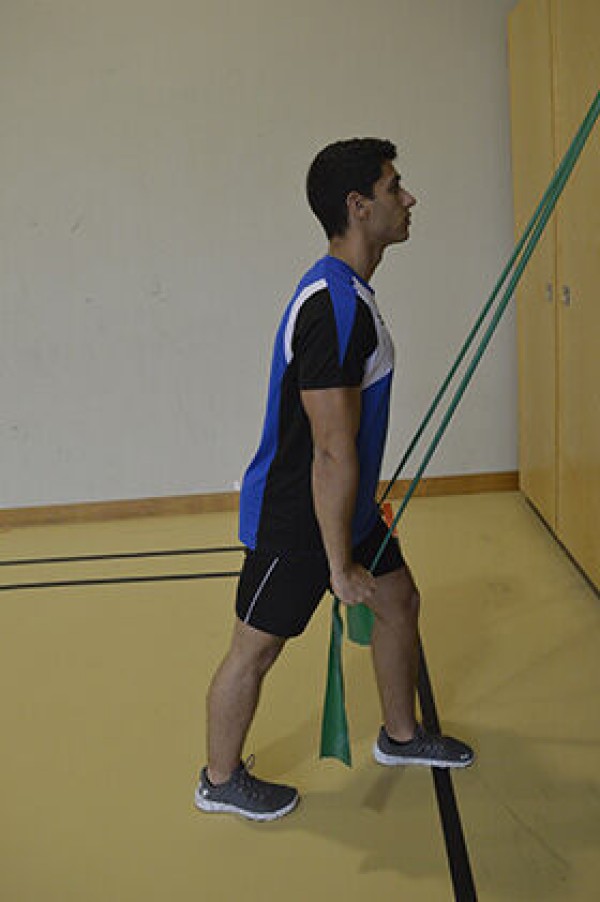
Attach the elastic band to the wall bars (or e.g. a tree) slightly above head height, take a stepping position facing the elastic band, upper body slightly bent forward, arms bent (hands approximately at chest height) and hands holding the elastic band (the band is taut), upper arms resting against the body, stretch arms and bend back to starting position without changing the position of the elbows (only the elbow joint moves).
Attention:
The upper body and upper arms do not move (the movement only takes place in the forearms).
Lighten:
Select a rubber band with less resistance.
Harden:
Select a rubber band with greater resistance.
1 elasticated rubber band
1 wall bar/tree
Extension and flexion of the arms while standing
Power
Individual work
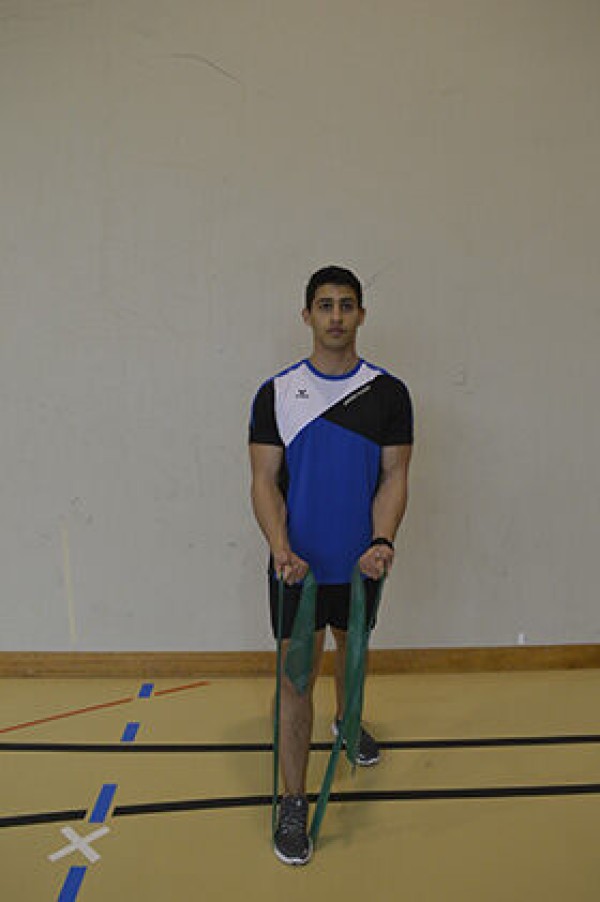
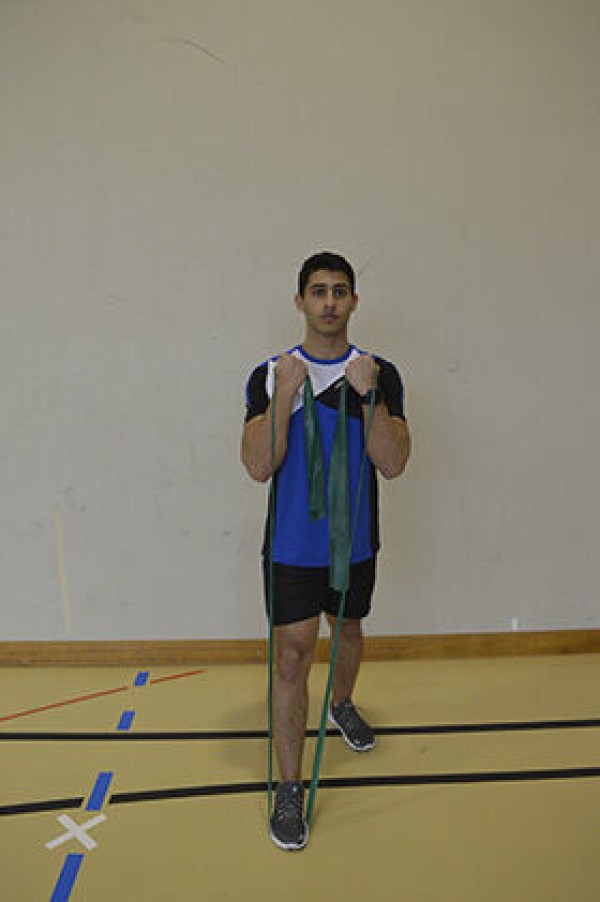
Stepping position, step onto the centre of the elastic band with your front foot, hold the band slightly in front of your body at about hip height with your arms hanging down, bend your arms (bring your hands to your chest) and stretch back to the starting position, keeping your elbows close to your body.
Attention:
Movement only takes place in the elbows (do not lean backwards with your upper body for support).
Lighten:
Choose a rubber band with less resistance.
Harden:
Choose a rubber band with more resistance.
1 elasticated rubber band
Extension and flexion of the arms while standing
Power
Individual work
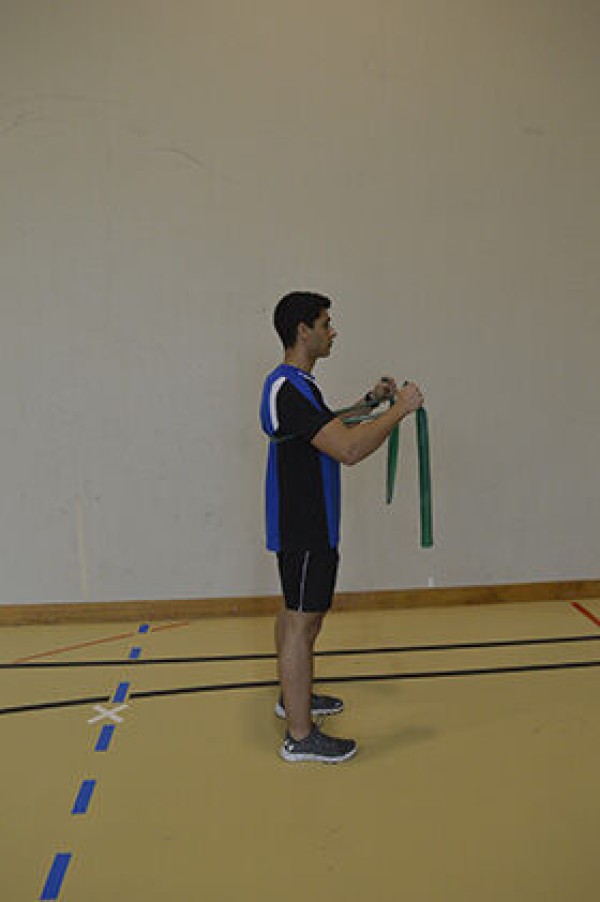
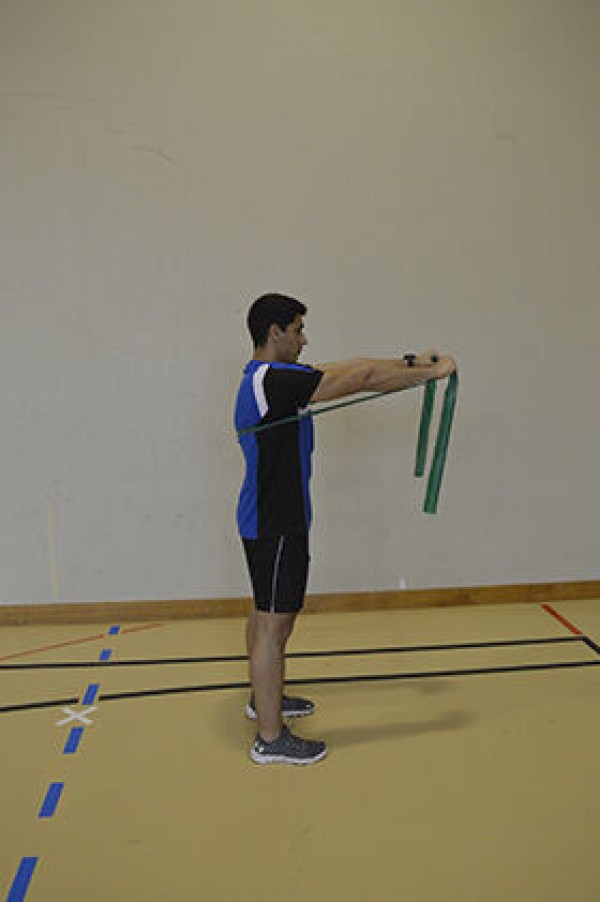
Stand upright, shoulder-width apart, hold one end of the elastic band in front of your chest with your arms bent, with the band running behind your body (approximately armpit height), stretch your arms and bend back to the starting position.
Attention:
Do not pull your shoulders up/to your neck.
Lighten:
Choose a rubber band with less resistance.
Harden:
Choose a rubber band with greater resistance.
Variation:
Fix the band behind the body at shoulder height on the wall bars/on the tree.
1 elasticated rubber band
1 wall bar/tree ► variation of the exercise