
Exercises (3274)
Interval training (medium): 10-12 x 400 (intensive)
Interval training
Single run or in strength groups, with the pacemaker controlling the time
Exercise duration: 400 metres
Break: 2-3 minutes (easy running)
Repeats: 10-12 times
Intensity level: 4 (hard)
Max HR: 90-95% (intensive interval method)
Rule of speech: speak in full sentences / short exchanges
On the basis of good basic training, the training form ideally follows with extensive interval units before moving on to the intensive variant. Intensive interval training is ultimately used by ambitious runners to work on their basic speed. The heart rate range is 90-95% of the maximum heart rate. The training takes place at or above the anaerobic threshold, i.e. in the "red zone". This requires the activation of fast-twitch muscle fibres and improves maximum oxygen uptake, lactate tolerance and pace hardness. The pace is fast (at competition speed or slightly below) and the breaks between efforts are longer than in the extensive form (suitable as training for shorter competitions such as 5km or 10km runs).
Interval training can be completed both on a track and off-road. The advantage of running on the track is that the runner always has control over the distance and the current running pace, which can promote the development of a sense of speed.
In interval training, it is important that the participants/groups try to cover approximately the same distance in the specified time for each interval or to complete a specified distance in approximately the same time. The various options for this type of training are as follows:
- Loop track: To ensure that the participants have enough space available for the run, they can be spread out on the loop track at the start. Using a stopwatch, each runner measures their own time for the specified distance. After the interval, the participants continue at a relaxed trot and start the next run after the break time has elapsed (variant: break on the spot). The participants moving at a relaxed trot must ensure that they do not hinder the runners who are in an exertion phase.
- Course: The defined course to be completed is marked. Participants start and stop their time independently (staggered start possible). The participants continue to move at a relaxed trot during the breaks, but make sure that they are back at one of the two possible starting positions at the end of the break time (variant: break in place). The sports leader defines the running routes for the outward and return routes to avoid collisions.
Variant: it is also possible to complete a shorter route several times until the desired distance is reached. Here too, it is important to pay attention to the running directions so that there are no collisions. The breaks are carried out as described above, except that in this form the start/finish is always in the same place. - Longer-distance circuit: A marker is placed on the course after every 400 metres (load) (e.g. balloon, route tape, wooden wedge). The participants keep moving after the interval (relaxed trotting), but make sure that they are back at the last marker at the end of the break time in order to start the next run. The participants who are in the recovery phase take care not to hinder the active runners. Ideally, the participants should be approximately back at the starting point after the last interval (10 intervals = 4 km running distance, 12 intervals = 4.8 km running distance), otherwise additional teaching time must be calculated for the return shift.
Distance markers (signs with metres)
1 signalling instrument (e.g. whistle)
FTA evaluation (group formation)
Per participant:
1 heart rate monitor
For sports leader or per participant/group:
1 stopwatch
Interval training (medium): 4-8 x 1 (extensive or intensive)
Interval training
Single run or in strength groups, with the pacemaker controlling the time
Exercise duration: 1 minute
Pause: 1-2 minutes
Repetitions: 4-8 times
Intensity level: 3 (medium) / 4 (hard)
Max HR: 80-90% (extensive interval method) / 90-95% (intensive interval method)
Rule of speech: speak in full sentences / short exchanges
Both beginners to running training and experienced runners benefit from the extensive interval method. Ideally, you should choose the extensive variant before the intensive interval units, but the runner should already have a good basic training programme. The breaks between the workouts are relatively short and the running pace is somewhat slower than during intensive interval training (80-90% HRmax). It is important that the heart rate does not fall below 120 beats per minute so that the body does not slow down too much. Extensive interval training takes place slightly below the anaerobic threshold and aims to increase aerobic performance (ideal training for longer competitions such as half marathons or marathons). Intensive interval training is used by ambitious runners to work on their basic speed. The heart rate range is 90-95% of the maximum heart rate. The training takes place at or above the anaerobic threshold, i.e. in the "red zone". This requires the activation of fast-twitch muscle fibres and improves maximum oxygen uptake, lactate tolerance and pace hardness. The pace is fast (at competition speed or slightly below) and the breaks between efforts are longer than with the intensive form (suitable as training for shorter competitions such as 5km or 10km runs).
Interval training can be completed both on a track and off-road. Running on the track has the advantage that the runner always has control over the distance and the current running pace, which can promote the development of a sense of speed.
In interval training, it is important that the participants/groups try to cover approximately the same distance in the specified time for each interval or to complete a specified distance in approximately the same time. The various options for this type of training are as follows:
- Loop track: To ensure that the participants have enough space available for the run, they can be spread out on the loop track at the start. The load starts from the same starting point for each individual runner for each repetition. During the breaks, the participants return to their starting point. The participants can check/calculate the distance travelled after each interval (comparison with the previous run). The sports director has all participants in view and can therefore start or stop the intervals with a signal.
Variant: run in the opposite direction during the straight repetitions instead of returning to the starting point during the breaks (goal: reaching the starting point). - Distance of at least 500 metres: Distances are marked with signs (every 25-50m). Each participant receives a stop/pulse watch, runs the course independently and memorises the distance covered (it is possible to stagger the start of the participants, whereby the running routes must be determined in order to avoid collisions). After the break time has elapsed, the participants run the same distance back to the starting point. During the breaks, the participants wait in place or continue running at a relaxed trot, but return to the starting point in good time (end of the previous interval). If the course allows, the sports director can give the start/stop signal for all participants (no staggering possible).
Variant: If you only have a short course available, you must turn around at the end of the course and continue running in the opposite direction (define running routes) until the end of the exercise time. At the next interval, the participants run the distance they ran before in the opposite direction back to the starting point (comparison with the previous run). - Longer distance circuit: The distances are marked with signs (every 25-50m). Each participant receives a stop/pulse watch, runs the course independently and calculates the distance covered (no staggered start of the participants necessary). During the breaks, the participants wait in place or continue running at a relaxed trot until the end of the break time. At each interval, the participants must calculate the distance travelled based on the start/end point of the interval (comparison with the previous run). After the last interval, all runners return to the starting point, which takes additional time. Ideally, the running distance corresponds approximately to the distance that can be covered in the time available in order to generate as little additional displacement time as possible.
Distance markers (signs with metres)
1 signalling instrument (e.g. whistle)
FTA evaluation (group formation)
Per participant:
1 heart rate monitor
For sports leader or per participant/group:
1 stopwatch
Interval training (medium): 6-8 x 300 (extensive or intensive)
Interval training
Single run or run in strength groups, with the pacemaker controlling the time
Intensity level: 300 metres
Pause variant I: 1-3 minutes (relaxed running or on the spot)
Pause variant II: 200 metres at a relaxed trot
Repeats: 6-8 times
Intensity level: 3 (medium) / 4 (hard)
Hmax: 80-90% (extensive interval method) / 90-95% (intensive interval method)
Rule of speech: speak in full sentences / short exchanges
Both beginners to running training and experienced runners will benefit from the extensive interval method. Ideally, you should choose the extensive variant before the intensive interval units, but the runner should already have a good basic training programme. The breaks between the workouts are relatively short and the running pace is somewhat slower than during intensive interval training (80-90% HRmax). It is important that the heart rate does not fall below 120 beats per minute so that the body does not slow down too much. Extensive interval training takes place slightly below the anaerobic threshold and aims to increase aerobic performance (ideal training for longer competitions such as half marathons or marathons). Intensive interval training is used by ambitious runners to work on their basic speed. The heart rate range is 90-95% of the maximum heart rate. The training takes place at or above the anaerobic threshold, i.e. in the "red zone". This requires the activation of fast-twitch muscle fibres and improves maximum oxygen uptake, lactate tolerance and pace hardness. The pace is fast (at competition speed or slightly below) and the breaks between efforts are longer than with the intensive form (suitable as training for shorter competitions such as 5km or 10km runs).
Interval training can be completed both on a track and off-road. Running on the track has the advantage that the runner always has control over the distance and the current running pace, which can promote the development of a sense of speed.
In interval training, it is important that the participants/groups try to cover approximately the same distance in the specified time for each interval or to complete a specified distance in approximately the same time. The various options for this type of training are as follows:
- Loop track: To ensure that the participants have enough space available for the run, they can be spread out on the loop track at the start. Using a stopwatch, each runner measures their own time for the specified distance. After the interval, the participants decide for themselves whether they want to stay where they are or continue at a relaxed trot. The next interval starts after 1-3 minutes (extensive 1-2 minutes, intensive 2-3 minutes) or 200 metres (keep the selected recovery form for training). Participants moving at a relaxed trot must ensure that they do not hinder the runners who are in an exertion phase.
- Course: The defined course to be completed is marked. Participants start and stop their time independently (staggered start possible). If the participants pause at the end of the course, it must be clearly defined on which side they will run back at the next interval (avoid collisions). If the participants move at a relaxed trot during the breaks, it is important to ensure that they are back at one of the two possible starting positions after the break time (2 minutes) has elapsed (break variant II not suitable).
Variant: it is also possible to complete a shorter distance several times until the desired distance is reached. It is important to pay attention to the running directions to avoid collisions. The breaks are carried out as described above, except that in this form the start/finish is always at the same place. - Longer-distance circuit: A marker is placed on the course after every 300 metres (exertion) and then after 200 metres (break) (e.g. balloon, route tape, wooden wedge). Variant I for the breaks is not suitable (however, if the participants only take breaks on the spot, only sections of 300 metres could be marked). Ideally, the participants should be approximately back at the starting point after the last interval so as not to lose additional time for the return leg (6 intervals = 1.8 km, 8 intervals = 2.4 km).
Distance markers (e.g. marker cones or route tape)
FTA evaluation (group formation)
Per participant:
1 heart rate monitor
Per participant/group:
1 stopwatch
Interval training (medium): 8 x 400 (extensive)
Interval training
Single run or in strength groups, with the pacemaker controlling the time
Exercise duration: 400 metres
Pause: 1-2 minutes (easy running)
Repeats: 8 times
Intensity level: 3 (medium)
Max HR: 80-90% (extensive interval method)
Rule of thumb: speak in full sentences
Both beginners and experienced runners benefit from the extensive interval method. Ideally, you should choose the extensive variant before the intensive interval units, but the runner should already have a good basic training programme. The breaks between the workouts are relatively short and the running pace is somewhat slower than during intensive interval training (80-90% HRmax). It is important that the heart rate does not fall below 120 beats per minute so that the body does not slow down too much. Extensive interval training takes place slightly below the anaerobic threshold and the aim is to increase aerobic performance (ideal training for longer competitions such as half marathons or marathons).
Interval training can be completed both on a track and off-road. The advantage of running on the track is that the runner always has control over the distance and the current running pace, which can promote the development of a sense of speed.
In interval training, it is important that the participants/groups try to cover roughly the same distance in the specified time for each interval or to complete a specified distance in roughly the same time. The various options for this type of training are as follows:
- Loop track: To ensure that the participants have enough space available for the run, they can be spread out on the loop track at the start. Using a stopwatch, each runner measures their own time for the specified distance. After the interval, the participants continue at a relaxed trot and start the next run after the break time has elapsed (variant: break on the spot). The participants moving at a relaxed trot must ensure that they do not hinder the runners who are in an exertion phase.
- Course: The defined course to be completed is marked. Participants start and stop their time independently (staggered start possible). The participants continue to move at a relaxed trot during the breaks, but make sure that they are back at one of the two possible starting positions at the end of the break time (variant: break in place). The sports leader defines the running routes for the outward and return routes to avoid collisions.
Variant: it is also possible to complete a shorter route several times until the desired distance is reached. Here too, it is important to pay attention to the running directions so that there are no collisions. The breaks are carried out as described above, except that in this form the start/finish is always in the same place. - Longer-distance circuit: A marker is placed on the course after every 400 metres (load) (e.g. balloon, route tape, wooden wedge). The participants keep moving after the interval (relaxed trotting), but make sure that they are back at the last marker at the end of the break time in order to start the next run. The participants who are in the recovery phase take care not to hinder the active runners. Ideally, the participants should be approximately back at the starting point after the last interval (8 intervals = 3.2 km running distance), otherwise additional teaching time must be taken into account for the return journey.
Distance markers (e.g. marker cones or route tape)
FTA evaluation (group formation)
Per participant:
1 heart rate monitor
Per participant/group:
1 stopwatch
Interval training (medium): Mountain running
Interval training
Single run or run in strength groups, with the pacemaker controlling the time
Fast and short runs up hills are of course particularly suitable for preparing for a mountain run, but are also valuable for running on flat terrain. This is because hill sprints strengthen the running-specific muscles and also make you faster, as a sprint activates the rapidly contracting muscle fibres and improves the capacity of the neuromuscular system. It also increases stride length and trains good body tension and arm work. Stronger leg muscles take the strain off the knee, hip and ankle joints, which helps to prevent injuries.
Logically, the difficulty of hill/mountain runs lies primarily in the incline, as an incline of just a few per cent is enough to make even an experienced runner's legs burn within a few seconds and push the cardiopulmonary system to its maximum level. Sprints of 10-20 seconds are generally ideal and ensure rapid exhaustion, but longer units can also be completed as training.
Exercise duration: 45-60 seconds running up a hill
Break: 1-3 minutes
Repeats: 4-10 times
Intensity level: 3 (medium) / 4 (hard)
Hmax: 80-90% (extensive interval method) / 90-95% (intensive interval method)
Rule of speech: speak in full sentences / short exchanges of words
For the exertion, the participants/groups run up the hill/mountain (possibly staggered start from place groups). staggered start for reasons of space), during the break they have time to return to the starting position (adjust the intensity of the load and the recovery phase to the training goal). After the first interval, the participants/groups memorise how far they have climbed the hill/mountain in the specified time, as they will try to cover the same distance in each subsequent session (it is always important to cover the same distance per running session during interval training). There are the following options for timekeeping:
- each participant receives a stopwatch/pulse clock and completes their training sessions independently;
- the sports leader starts and stops the time for the participants/groups (staggering makes sense, keep track of the break times);
- it is started in strength groups, with the pacemaker checking the time using the stopwatch/pulse clock.
Variant:
If the course is not long enough to fully utilise the time, you can turn around at the end of the hill and return to the start to tackle the hill again. This means you memorise the number of runs plus the distance completed up to the end of the interval.
1 signalling instrument (e.g. whistle)
Evaluation FTA (group formation)
Per participant:
1 heart rate monitor
For sports leader or per participant/group:
1 stopwatch
Interval training (medium): Skipping rope
Interval training
Together in the group, in small groups or each participant independently
Exercise duration: 60-90 seconds of jumping rope
Pause: 30-60 seconds resting in place or walking around at a leisurely pace
Repeats: 4-8 times
Intensity level: 3-4 (medium-hard)
Hmax: 80-95%
Rule of speech: speak in full sentences - short exchanges
The participants jump rope during the specified time without interruption if possible (technique free). The intensity of the jumping is adjusted according to the target. The skipping takes place in a group, with the sports instructor responsible for ensuring that the load and break times are adhered to (small groups with a group leader are also possible), or each participant carries out the interval units independently.
Variant:
Integrate variations of rope jumping (specified by the sports instructor, e.g. a special technique every 10 jumps): running in place, running in place with knee lifts, two-footed jumps, double rope turns, crossed arms, backwards rope jumping, etc.
Per participant:
1 skipping rope
1 heart rate monitor
For sports leaders or per participant/group:
1 stopwatch
Interval training (medium): Stair run
Interval training
Individual run
(possibly also run in strength groups depending on the size of the stairs, with the pace maker controlling the time)
Stair running is a gentle, effective and therefore ideal strength and endurance workout for runners, which also improves coordination, concentration and running technique. Above all, training on the stairs can improve the short forefoot strike, which is particularly beneficial for so-called heel runners. Training on the stairs can be very varied and playful, but can also be used for interval training with short and intensive sessions. Stairs that are as long (and wide) as possible simplify the type of exercise.
Exercise duration: 45-60 seconds running up a flight of stairs
Break: 1-3 minutes
Repeats: 4-8 times
Intensity level: 3 (medium) / 4 (hard)
Hmax: 80-90% (extensive interval method) / 90-95% (intensive interval method)
Rule of speech: speak in full sentences / short exchanges of words
For the workload, the participants/groups run up the stairs (possibly staggered start from place level). staggered start for reasons of space), during the break they have time to return to the starting position (agree on running directions so that the participants do not get in each other's way). After the first interval, the participants/groups memorise how far they have climbed the stairs in the specified time, as they will try to cover the same distance in each subsequent session (it is always important to cover the same distance per running session during interval training). For this type of exercise, however, the length of the staircase is usually not sufficient to fully utilise the time, so you can turn around at the end of the staircase and return to the start to tackle the staircase again. This means that you memorise the number of runs plus the distance covered until the end of the interval. Depending on the training goal, the sports instructor adjusts the intensity of the exercise and the recovery phase.
There are the following options for climbing the stairs:
- in a sprint - free technique (any number of steps per stride); Climb the stairs as quickly as possible while still concentrating on the steps (short ground contact time, not touching down with the entire foot)
- two-step run
- put one leg alternately on each step
- step on each step with both legs
- one-leg jumps (determine/vary the number of steps)
- double jumps (determine/vary number of steps)
- squat jumps
- side jumps
To stop the time, you have the following options:
- each participant receives a stopwatch/pulse clock and completes their training sessions independently;
- the sports director starts and stops the time for the participants/groups (staggering makes sense, keep an overview with the break times);
- it is started in strength groups, with the pace maker checking the time using the stopwatch/pulse clock.
1 signalling instrument (e.g. whistle)
Evaluation FTA (group formation)
Per participant:
1 heart rate monitor
For sports leader or per participant/group:
1 stopwatch
Hunter's ball
Stimulate circulation
Group work
2 groups
One group is located in a marked square field (side length approx. 4-5 metres). The second group (hunters) spreads out outside this field and has to hit as many players as possible within the field with two softballs within a certain time. Each contact with the ball (even from the ground) scores a point, so the inner group may not play the ball out even if it remains in the field (the ball must be retrieved by the hunters). Those who are hit remain in the field, those who leave the field score a point.
Variant:
The hunters try to hit the other group with a gym ball (via the ground or directly). Whoever is hit performs an additional task outside the playing field (e.g. 50x rope skipping). After completing the additional task, you return to the playing field (optional: after a hit, you are eliminated and perform an additional task until the end of the round, such as the forearm support or wall sitting). If a group manages to ensure that only a certain number of opponents are left on the field (or no one is left), the game is over.
2 foam/soft balls
1 exercise ball ►Variant
Sports leader:
1 stopwatch
Jass card race
Increase pulse
Group work
4-5 participants per group
Each group has a set of Jass cards (cards face down) at the turnaround point. The runner may only take certain cards there that have been defined by the game master (e.g. red or black cards). Otherwise, the card is placed face down again and the runner returns to the group without a card to send the next runner onto the course with a handshake. Which group is the first to have collected all the cards provided (18 cards) or the most cards after a certain time?
Variant I:
The criteria are made stricter by only collecting a certain colour (e.g. all heart cards, only pictures of a certain colour).
Variant II:
The runners collect a card of their choice in each round, which is used to build card houses at the starting point. Which group is the first to have built 5 card houses or the most card houses after a certain time (1 house consists of a total of 7 cards)?
Variant III:
Four groups are formed and each team is assigned a colour (diamonds, hearts, spades, clubs). Only 1 set of cards is used. The respective runners of the groups run to this set and turn over a card. They may only take the revealed card with them if it matches the colour of their group. Otherwise, they run back to the group without a card to send the next runner onto the course with a handshake. Which team is the first to collect all the cards of their colour?
1 stopwatch
Per group:
1 set of jacket cards
Juggler
Stimulate circulation
Individual work
The participant tries to balance a stick/stick on one part of the body (e.g. foot, head, elbow, palm).
Variant:
Balancing two sticks/sticks simultaneously.
Per participant:
1-2 sticks/sticks ►Smolball, floorball, intercross/lacrosse, badminton/speedminton, Nordic walking
Juggler
Coordination exercises
Individual work
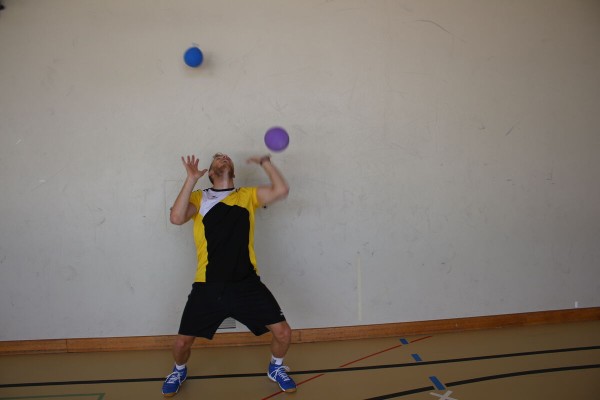
Hold two, three or more balloons in the air at the same time by flapping them with your hands without one balloon falling to the ground.
Variant I:
Hold balloons or balls/shuttles in the air with a tennis or badminton racket.
Variant II:
Hold juggling scarves in the air by plucking them.
8 balloons
2 badminton/tennis rackets
4 badminton shuttles/balls
6 juggling cloths
Juggler
Coordination exercises
Individual work
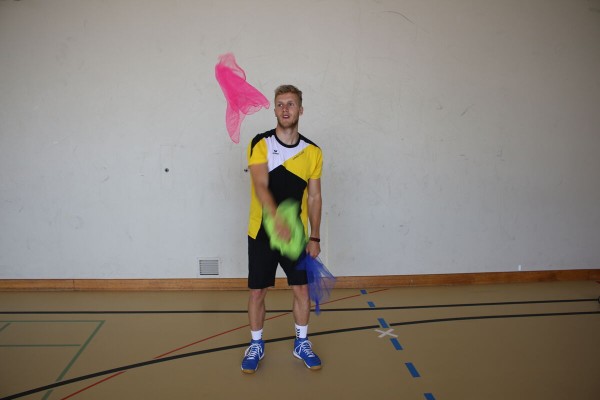
The participants try to juggle with different utensils:
- Juggling one-handed with 2 balls or two-handed with 3 balls (tennis balls, foam balls, floorball balls, possibly even frisbees). Also possible standing on a balancing board.
- Holding juggling scarves in the air.
- Holding a badminton shuttle with the racket in the air while sitting down and standing up. Perform half and full body rotations while juggling. The same exercise can be performed with the Indiaca.
- Throw the foam ball into the air or against a wall and catch it with the frisbee. Throw the foam ball to each other in pairs and catch it with the frisbee.
Make it easier:
Juggling can be practised on an inclined surface (e.g. door of the equipment room/garage door; small mats set up at an angle). The balls are not thrown straight up into the air, but onto the sloping surface. This gives the participant more time to learn the basic movement.
► Differentiation ability, rhythmisation ability, reaction ability
3 tennis/unihockey/smolball balls, throwing discs, juggling cloths
1 Indiaca
1 badminton racket incl. badminton shuttle
1 balance board
Door of the equipment room/garage door ►Facilitate the exercise
Juggler
Light-Contact
Partner work
The participant tries to keep 3 juggling scarves in the air for as long as possible. The participant is in double cover and pulls the scarves upwards by crossing their arms over the scarves.
6 juggling cloths (3 per participant)
Beetle turning
Fighting and roughhousing games
Partner work
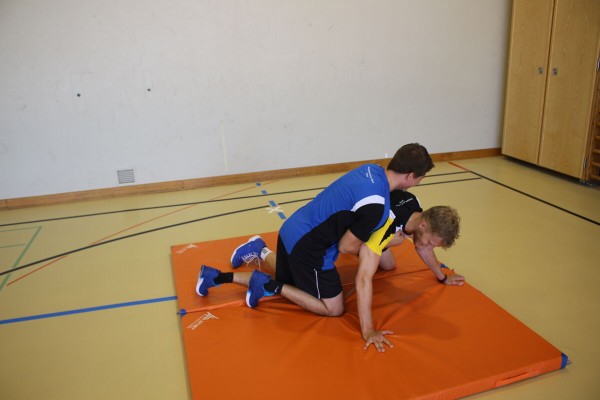
One participant is in a four-foot stance in the centre of a mat/turf area. His opponent tries to turn him onto his back. Switch roles after each (successful) attempt.
Variant:
Time the participant until the attempt is successful or the opponent has a specific time limit for their attempt.
2-4 soft mats (small) ►Indoor version
2 tent sheets ►Outdoor version
1 stopwatch ►Variation of the exercise
Indoor post set-up:
Using soft mats to form a rectangular field of mats.
Box clearance
Stimulate circulation
Group work
2-3 (or more) participants try to throw/shoot/hit all the balls from one or more box elements (by hand, foot or with the game device, depending on the type of game). The remaining participants collect the balls and bring them back. Does the throwing team manage to empty all the box elements or is the transport team too fast?
Variant:
The sports leader specifies different ways of transporting the balls back (e.g. bouncing the ball, rolling it, guiding/juggling it with the feet/playing equipment or pinching it between the knees).
Per participant:
1 racket/stick ►smolball, floorball, intercrosse/lacrosse
1-2 Swedish box
x balls ►basketball, blitzball/rugby/football, FooBaSKILL, futsal/football, handball, intercrosse/lacrosse, smolball, floorball, volleyball
Kastensurfer
Coordination exercises
Individual work
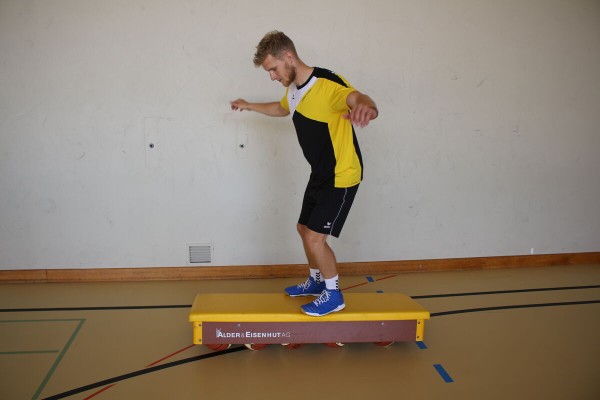
The participant tries to keep their balance while standing on the unstable box lid.
► Balance ability
1 vaulting box top
3-4 basket/medicine balls
Post structure:
One vaulting box top is placed on three to four medicine or basketballs
Cat's jump I
Parkour
Individual work

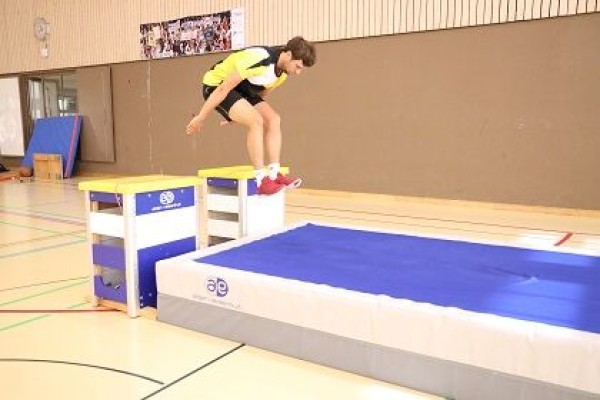
Start with a straight run-up, frontal jump, support yourself with your hands on one of the two vaulting boxes, bring your legs between your arms to stand on the large soft mat.
outdoor:
Straight run-up, frontal jump followed by a squat jump and short support phase with both hands over the obstacle.
Variations:
One-legged or two-legged jump;
Shorter or longer obstacle.
2 vaulting boxes ►indoor version
1 soft mat (large) ►indoor version
1 elasticated rubber band ►indoor version
Indoor post set-up:
Place two vaulting boxes next to each other at a distance of approx. 50 cm. 50cm apart, place a large soft mat behind them and stretch an elastic rubber band between the vaulting boxes if necessary.
outdoor:
A table (approx. size of a table tennis table).
Cat's jump II
Parkour
Individual work
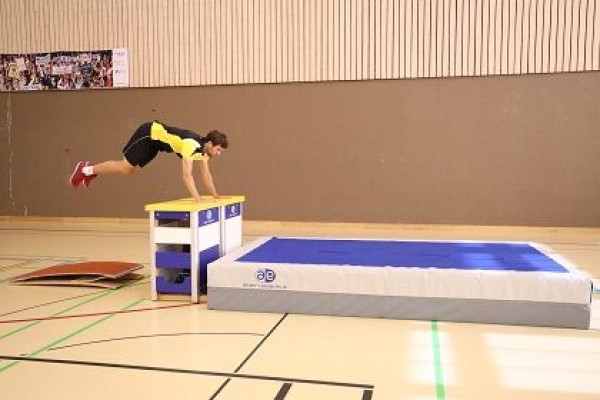
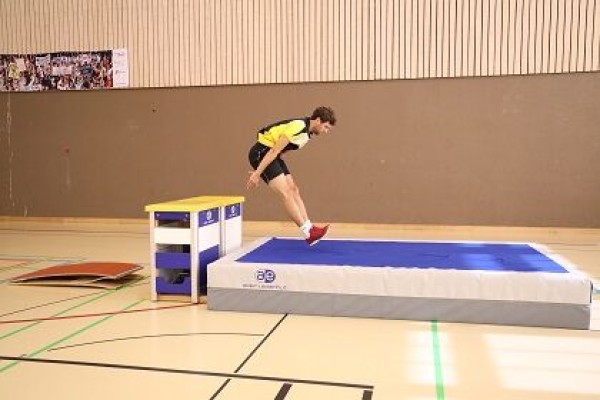
Strong run-up, two-legged take-off from the Reuter board, support yourself with both hands on the vaulting box, pass your legs between your arms to land on the soft mat.
Variant:
Landing with both feet between your hands on the vaulting box, direct take-off to stand on the soft mat.
1 vibratory box
1 soft mat (large)
1 Reuter board
Post setup:
Place the vibratory box between a Reuter board and a large soft mat.
Cat's jump III
Parkour
Individual work
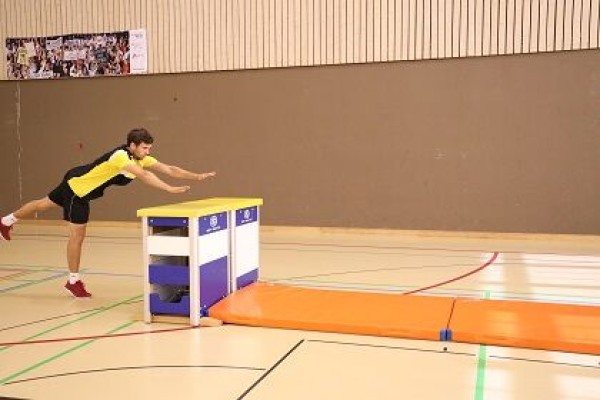

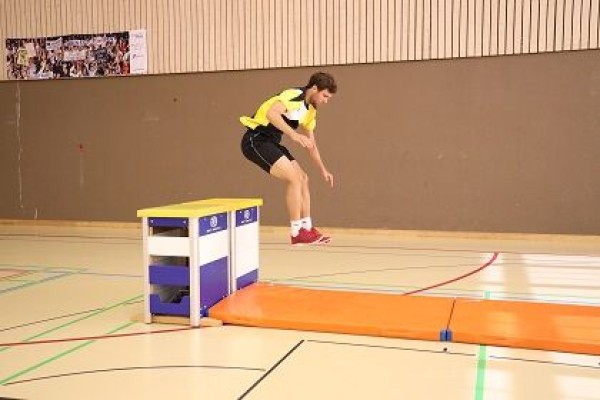
Strong run-up, frontal take-off, moving the centre of gravity forwards, support yourself with both hands on the vaulting box, bring your legs between your arms to land on the small soft mat.
1 vaulting box
1 soft mat (small)
Post setup:
Place a small soft mat behind a vaulting box.
Squat jump in push-up position ► plank jump
Power
Individual work


Push-up position (high support, face/look down), bend your legs during the jump (bring your knees between your arms) and stretch back out to the starting position for the next jump.
Attention:
Keep your upper body stable in the starting position (tense your stomach).
Lighten:
Just hold the basic position (push-up position); smaller jumps (bring your knees less forwards).
Harden:
Additional weight (on the legs); unstable base (for the arms).
2 weight cuffs ► to make the exercise more difficult (additional weight)
1 balance cushion/balance board ► to make the exercise more difficult (unstable surface)
Stimulate circulation
Group work
Basic version:
All participants stand in a circle. One person has the ball. They throw the ball to anyone they like. The person who catches the ball says their own name out loud. The next person chooses someone else, throws the ball to them and does not say their name yet, as they do not know it. The person who catches the ball says their own name again.
Example:
Person A throws the ball to someone → “I’m Marc.”
Marc throws the ball on → “I’m Sarah.”
Sarah throws it on → “I’m Thomas.”
Variations: When catching the ball, the person says their name whilst performing a simple movement (e.g. a squat, lifting a knee, turning round). The group repeats the name and movement.
When the ball is touched, everyone says their name and a piece of additional information about themselves (e.g. a hobby – ‘I’m Marc and I like playing football’ or, more briefly, ‘Marc, hobby: football’). The group tries to remember the names and details.
Once everyone’s names have been called out once, the person with the ball tries to say the name of the person who is going to catch it (before throwing the ball).
Sarah! → Pass to Sarah.
If the name is correct, Sarah catches the ball and carries on (or a correction is made and the correct name is given first).
Once the children have learnt the names, a second ball can be introduced to the game to boost concentration and communication.
Variation: The person who receives the ball must immediately call out the name of the next player and pass the ball on. If anyone hesitates or calls out the wrong name, they must carry out an extra task (e.g. 3 squats, 3 jumping jacks, run once round the group). The sports director can integrate other additional tasks (e.g. clap your hands once on whistle). The sports director is the referee for all variants and interrupts the game if necessary.
Variation:
After a few rounds, you can adapt the exercise by setting a passing order: everyone gets the ball once. The group tries to memorise the order. The ball is then passed around in the same order again – without anyone saying the names. You could then time the exercise and try to complete the round faster and faster.
1–2 balls
1 stopwatch
Kettenball
Stimulate circulation
Group work
6-8 participants per group
The group lines up in a column (straddle position). Each participant faces the person in front, with a distance of around one to two metres between them. The participant at the back rolls a ball through the legs of the person in front. The last participant in the chain catches the ball and transports it back to the other end of the line. The ball is then rolled through the tunnel again.
Possible competition form: The winner is the group in which all participants have rolled the ball through the tunnel once (or several times) and the whole group is seated.
Variant:
The ball can also be passed from participant to participant between their legs or over their heads instead of being rolled (shortening the distance). These shapes can be combined again immediately and the ball must be passed once between the legs and then over the head.
Per group:
1 ball (e.g. basketball, softball, football, volleyball, medicine ball)
Kickball - Brennball
Games / Tournament
Game idea:
The game idea is similar to that of baseball. Two teams, a kicker and a catcher, try to score as many points as possible during a certain period of time.
Scoring points:
A point is scored when a run is successfully completed. If necessary, points are also awarded for successfully caught balls.
Playing field:
Can be adapted to the available possibilities.
Number of participants:
10 against 10
Game rules:
One player of the kick team plays the ball from the kick zone into the catch zone (throwing or kicking). He then runs around the pitch back into the kicking zone. Meanwhile, the catcher tries to catch the ball and bring it to their "nest" as quickly as possible. The ball must be passed from catcher to catcher, as it is not allowed to run with the ball. As soon as the ball is placed in the "nest", a loud whistle sounds from the game leader. A run is successful if the runner is back in the kick zone before the whistle sounds (the ball is in the "nest"). The run markers are neutral points where the runner can interrupt his run and wait for the next kick. If a runner is not at a run mark when the referee blows his whistle, he must return to the kick zone without having scored a point for his team.
If the ball is caught directly out of the air by the catching team, they are awarded a point and the runner must return to the kick zone.
Variant:
If a runner is found between the running marks when the referee whistles, he is completely eliminated from the game so that the kicking team becomes smaller (provide additional tasks).
Kickball/burnball: 7 against 4
Forms of play / exercises
7 attackers 4 defenders

On 2 or more pitches, 7 attackers play against 4 defenders. The attackers try to play 20 passes, for example. The defenders simultaneously aim to touch an attacker who is in possession of the ball. If they succeed, the game starts again. After 5 attempts, switch functions.
Objective: free running, accurate passing, cover work, anticipation.
Pitch:
4 armbands / covers
1 rugby ball
Kickball/fireball: Snap ball
Forms of play / exercises
2 teams of 3-4 players each
Two teams are formed (3-4 players). One team rolls a ball to itself as often as possible. The opposing team tries to capture the ball and make lots of passes. Whoever has the ball is not allowed to move. Who will be the first to make ten passes in a row?
Objective: free running, precise passing, cover work, anticipation.
Pitch:
4 armbands / covers
1 rugby ball