
Exercises (1882)
Lifting and lowering the arms and legs, with flexion and extension of the arms, whilst lying on your stomach ► superman pull
Power
Individual work
Lie on your stomach with your arms stretched out in front of you (like ‘Superman’), legs also stretched out, and your gaze directed downwards (neck in a neutral position). At the same time, lift your arms, chest and legs slightly off the floor, then pull your arms back towards your shoulder blades (as if ‘rowing’ in the air). As you do this, move your elbows back and downwards, consciously drawing your shoulder blades together. Stretch your arms forward again. Maintain tension and lower yourself back down in a controlled manner or remain in the air.
Attention:
Do not overextend your lower back (lifting too high – can cause pressure), do not tilt your head back (puts strain on the cervical spine), do not swing (instead of controlled movement), do not raise your shoulders (instead of pulling them back and down), do not use too wide a range of motion (without control).
Lighten:
Lift only your upper body (keep your legs on the floor); or move only your arms (keep your legs down); perform the movement without a 'pull' (just a static Superman hold).
Harden:
Hold the top position for longer; slow, controlled repetitions (time under tension); hold extra weight in your hands; apply resistance during the ‘pull’; combine with pauses at the end point (isometric).
2–4 weight cuffs/2 medicine balls/dumbbells ► Increase the intensity of the exercise (additional weight)
Raising and lowering the legs on a slope ► kipping toes to bar
Power
Individual work


Hold on to the horizontal bar (overhand grip) in a hanging position (full body extension, arms overhead in a high position). Send a movement impulse from the torso to initiate a tilting movement in the hips (legs together, dynamic change from the hollow and arch positions). The tilting movement causes the legs to swing towards the horizontal bar so that the tips of the toes touch the bar (jackknife - arms behind the bar). Then lower your legs back to the starting position (find the rhythm so that the individual repetitions can be performed smoothly one after the other).
Attention:
Movement impulse comes from the hips; do not tense your shoulders.
Lighten:
Shorten the range of motion (lift legs only 90 degrees); only lift toes as high as possible; full range of motion but alternating with one leg.
Harden:
Additional weight; directly from the hanging position (strict and without tilting movement).
1 horizontal bar
2 weight cuffs/1 weight waistcoat ► Make the exercise more difficult (additional weight)
Raising and lowering the legs alternately in the seat ► flutter kick
Power
Individual work


When seated, use your arms to support your upper body, which is tilted slightly backwards, and move your outstretched, slightly raised legs up and down in constant alternation.
Attention:
Do not put your legs down.
Lighten:
Just hold the position (legs outstretched and slightly raised from the floor).
Harden:
Add weight to the legs.
Variant I:
Cross or open the legs and bring them back together.
Variant II:
Make circular movements (in both directions) with the legs.
2 weight cuffs ► Make the exercise more difficult (additional weight)
Raising and lowering the legs in the seat alternately ► pike alt leg raise / pike leg lift / seated leg lifts
Power
Individual work

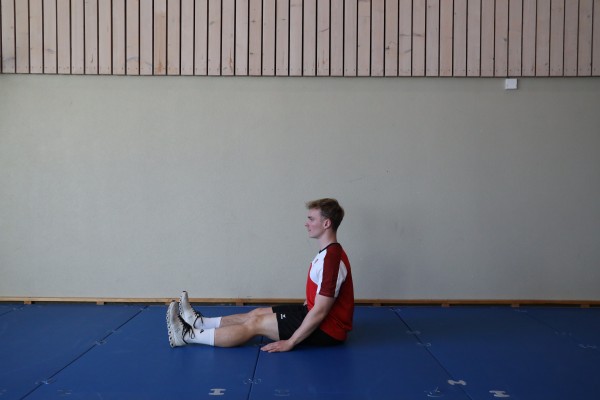

While sitting with your upper body upright and legs straight, alternately raise and lower one leg.
Lighten:
Bend your legs.
Harden:
Additional weight for the legs.
2 weight cuffs ► Make the exercise more difficult (additional weight)
Raising and lowering the legs in prone position ► reverse hyperextension
Power
Individual work


Prone position (upper body flat on the floor), arms bent (elbows approx. 90° degrees at head height or slightly below), clamp the exercise ball between your legs, raise your straight legs (ball) and lower them back to the starting position.
Attention:
Do not lower your legs completely.
Lighten:
Just hold the position with your legs raised (no lifting and lowering of the legs/ball), lift the legs/ball less.
Harden:
Additional weight on the legs.
1 exercise ball
2 weight cuffs ► to make the exercise more difficult (additional weight)
Raising and lowering the legs in prone position ► reverse hyperextension
Power
Individual work


Prone position, arms bent beside the body (or stretched out in front of you) with contact with the floor, raise and lower slightly bent (or stretched) legs.
Attention:
Do not lower legs completely.
Lighten:
Bend your legs more (heels closer to your buttocks); only hold the position with your legs raised.
Harden:
Legs stretched out; additional weight on/between the legs.
2 weight cuffs/1 (medicine) ball ► Make the exercise more difficult (additional weight)
Raising and lowering the legs in prone position ► reverse hyperextension
Power
Individual work


Prone position, arms bent beside the body with contact with the floor and head resting on the hands (or arms stretched out in front), both legs bent (right angle in the knee joint, soles of the feet pointing vertically upwards), actively push the legs/soles of the feet upwards, hold the position briefly and lower the legs back to the starting position.
Harden:
Additional weight on/between the legs.
2 weight cuffs/1 (medicine) ball ► Make the exercise more difficult (additional weight)
Raising and lowering the legs in prone position ► reverse hyperextension
Power
Individual work


Stomach position on the vaulting box, hips at the end of the box, hands grasping the top of the vaulting box, legs hanging towards the floor. Raise/extend your legs in extension of your body (movement in the hip joint) and lower them back to the starting position.
Attention:
Keep your legs as straight as possible.
Lighten:
Lift your legs less.
Harden:
Additional weight for the legs.
1 vaulting box
2 weight cuffs/1 (medicine) ball (e.g. football, volleyball, basketball) ► Make the exercise more difficult (additional weight)
Raising and lowering the legs in prone position ► reverse hyperextension
Power
Individual work

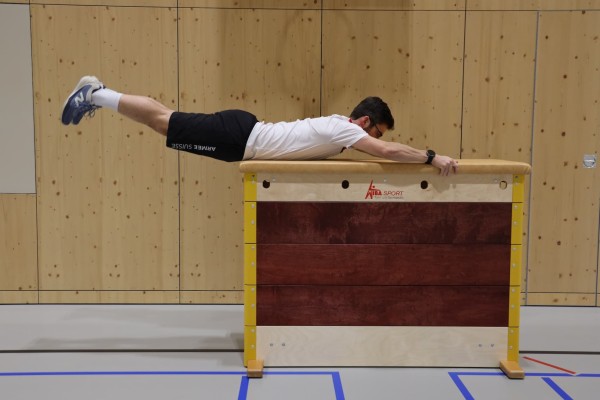
Lie face down on a Swedish box so that your pelvis or lower abdomen rests on the edge and your legs hang freely downwards. Hold onto the top of the box with your hands to stabilise your upper body. Your legs should hang straight towards the floor. Lift your legs, keeping them straight, from the hips until they are in line with your torso (your body forms a straight line from head to toe). The movement comes exclusively from the hip joint – the upper body remains still and fixed on the box throughout the exercise. Then lower your legs back to the starting position in a controlled manner, without using momentum.
Attention:
Perform the movement in a controlled manner and without momentum; lift the legs from the hips (not primarily by hyperextending the lumbar spine); keep the upper body and pelvis stable on the Swedish box; do not arch the lower back excessively; lift the legs only as far as a neutral spinal position can be maintained; keep the knees slightly bent or straight, depending on the chosen variation; return slowly to the starting position.
Lighten:
Lift your legs less high / reduce the range of motion; keep your knees slightly bent / lower or rest your legs briefly between repetitions; lie face down on the floor and lift your arms and legs.
Harden:
Hold an extra weight for your legs or between your feet.
1 vaulting box
2 weight cuffs/1 (medicine) ball (e.g. football, volleyball, basketball) ► make the exercise more difficult (additional weight)
Raising and lowering the legs whilst hanging ► straight knee leg raise / hanging leg raise
Power
Individual work
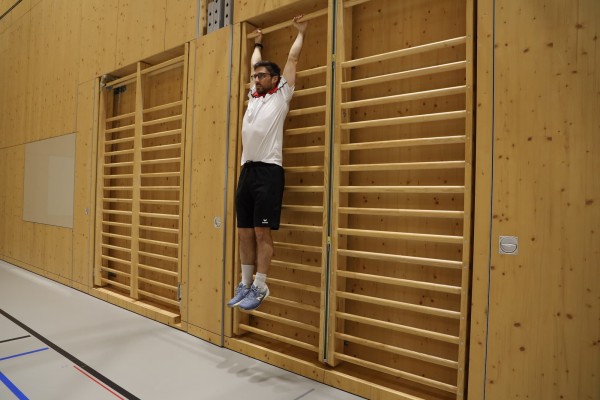
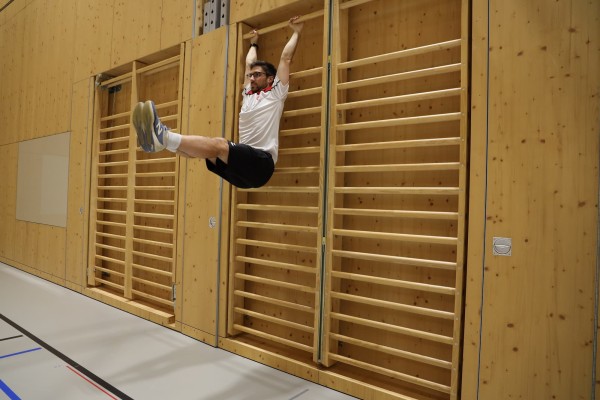
Hang from the wall bars and grip the rungs firmly with both hands. Your arms should be almost fully extended. Let your legs hang loosely downwards; keep your torso stable and your shoulders actively pulled down. Raise your straight legs forwards or upwards in a controlled manner. Perform the movement primarily by bending at the hips and whilst actively engaging your core. Then lower your legs slowly and in a controlled manner, without letting them swing back uncontrollably.
Attention:
Do not use momentum from your upper body; do not arch your back excessively as you lower yourself; do not pull your shoulders up towards your ears; do not simply let your legs drop; keep your core engaged throughout the entire movement.
Lighten:
Perform with bent knees (knee raise); lift your legs only partially, using a smaller range of motion.
Harden:
Use extra weight on your legs; lower the bar more slowly, hold briefly at the top of the movement.
1 wall bars
2 weight cuffs/1 (medicine) ball (e.g. football, volleyball, basketball) ► make the exercise more difficult (additional weight)
Raising and lowering the legs whilst hanging ► straight knee leg raise / hanging leg raise
Power
Individual work
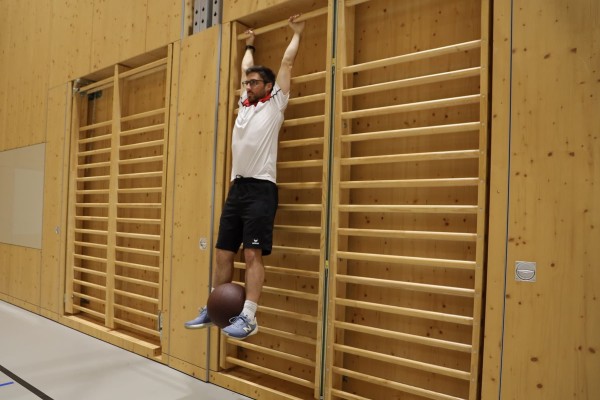
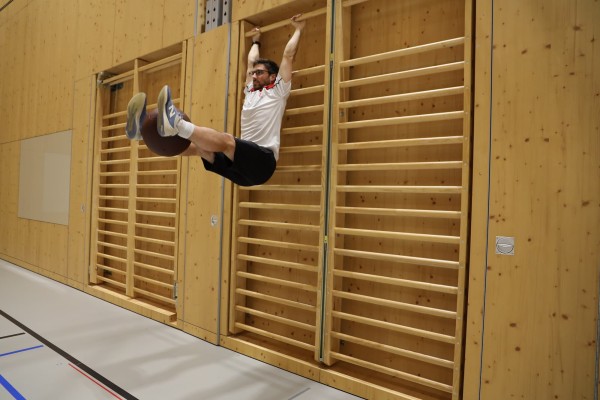
Stabilise yourself in a hanging position on the wall bars (back against the bars and body fully extended). The legs are fully extended, with a weight held securely between the feet. From the starting position, lift both extended legs together forwards and upwards to approximately hip height, then lower them slowly again. The weight remains securely between the feet throughout the entire movement.
Attention:
Keep your legs as straight as possible (do not deliberately bend your knees); do not use momentum from your upper body and do not let your legs swing; move your pelvis in a controlled manner and do not arch your back excessively; Stabilise your core, particularly whilst lowering yourself; lower your legs slowly and in a controlled manner – do not simply let them drop; avoid arching your back too much; do not raise your shoulders or position them unnecessarily close to your ears; breathe evenly; do not hold your breath.
Lighten:
Perform the exercise without weights / bend your legs slightly; use a lighter weight.
Harden:
Use heavier weights; lift your legs above hip height or towards the wall bars; perform the movement particularly slowly (especially the lowering phase); hold briefly at the highest point.
1 wall bars
2 weight cuffs/1 (medicine) ball (e.g. football, volleyball, basketball) ► make the exercise more difficult (additional weight)
Raising and lowering the legs in a hanging position ► hanging leg raise
Power
Individual work


Hanging on the wall bars (back facing the wall bars), body stretched out, outstretched legs raised and lowered.
Attention:
Keep legs as stretched out as possible; back always remains on the wall bars, movement as controlled as possible (without momentum).
Lighten:
Lift your legs less; bend your legs.
Harden:
Additional weight for the legs.
Variation:
Cross over a painting stick with your legs alternately from one side and the other.
1 wall bars
2 weight cuffs/1 (medicine) ball (e.g. football, volleyball, basketball) ► Make the exercise more difficult (additional weight)
1 colouring stick ► Variation of the exercise
Raising and lowering the legs in supine position ► leg raise
Power
Individual work


Lie on your back, arms stretched out and held high, legs also stretched out and slightly raised, tense your stomach and raise your shoulder blades (lift your upper body slightly), raise and lower your legs.
Attention:
Do not lower your shoulders, no hollow back (pull your belly button towards your spine).
Lighten:
Just hold the position (without raising and lowering your legs).
Harden:
Additional weight on the legs (and arms).
2-4 weight cuffs/1-2 weight balls/1 weight disc/dumbbell ► Make the exercise more difficult (additional weight)
Raising and lowering the legs in supine position ► leg raise
Power
Individual work


Back position, arms stretched out in a high position, hold the pistol with both hands, legs also stretched out and slightly raised, tense your stomach and raise your shoulder blades (raise your upper body slightly), raise and lower your legs.
Attention:
Do not lower your shoulders, no hollow back (pull your belly button towards your spine).
Lighten:
Just hold the position (without raising and lowering your legs).
1 pistol (neutralised)
Raising and lowering the legs in supine position ► leg raise
Power
Individual work


Back position, legs and arms stretched out in high hold, hold assault rifle by handguard and butt parallel to the ground (barrel/piston pointing to the side), raise and lower legs.
Attention:
Do not lower shoulders and legs.
Lighten:
Hold position only (without raising and lowering legs); lower legs less; bend legs; bring arms towards forehand.
1 assault rifle (neutralised)
Raising and lowering the legs in supine position ► leg raise
Power
Individual work


Lie on your back, legs stretched and slightly raised, arms at your sides on the floor, hands on the soft mat (stability), raise and lower your legs.
Attention:
Keep your back in constant contact with the floor (no hollow back, consciously tense your stomach), do not lower your legs.
Lighten:
Lift your legs a little more and lower them less; just hold the position.
Harden:
Additional weight for the legs.
Variant I:
Lift and lower your legs alternately.
Variant II:
Bend your legs together (straight or turn to the side) and stretch.
1 soft mat (small)
2 weight cuffs/(medicine) ball ► Make the exercise more difficult (additional weight)
Raising and lowering the legs in supine position ► leg raise
Power
Individual work


Lie on your back on the vaulting box with your buttocks at the end of the box, hands grasping the other end of the box, legs stretched out in a high position, raise and lower your legs.
Attention:
Keep your legs as stretched as possible, keep your back in constant contact with the top of the vaulting box (no hollow back, consciously tense your stomach).
Lighten:
Lower your legs less.
Harden:
Additional weight for the legs.
1 vaulting box
2 weight cuffs/1 (medicine) ball (e.g. football, volleyball, basketball) ► Make the exercise more difficult (additional weight)
Raising and lowering the legs in supine position ► leg raise
Power
Individual work

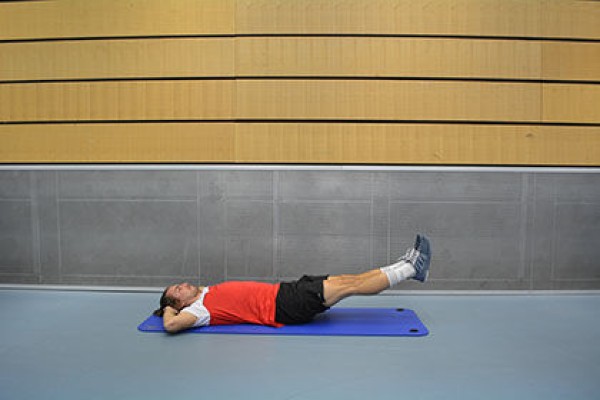
Lie on your back with your arms crossed behind your head. Raise and lower your outstretched, slightly raised legs together or move them up and down in opposite directions.
Attention:
Keep your (lower) back in constant contact with the floor (no hollow back, consciously tense your abdomen), do not put your legs down.
Lighten:
Just hold the position (legs stretched out and slightly raised off the floor).
Harden:
Additional weight for the legs (or arms held high if necessary).
Variant I:
Move your legs from the left to the right side.
Variant II:
Execute circular movements (integrate changes of direction).
Variant III:
Open your legs and bring them together again.
Variant IV:
Cross your legs alternately (open and close).
2-4 weight cuffs/1 weight ball/weight disc/dumbbell ► Make the exercise more difficult (additional weight)
Raising and lowering the legs in supine position ► lying leg raise
Power
Individual work


Lie on your back with your legs straight; place your arms at your sides or under your bottom for stability; engage your core and press your lower back gently into the floor. From this position, lift your legs upwards in a controlled manner (until your hips form an angle of approximately 90° or until your legs are vertical). Slowly lower the legs back to the starting position, stopping just before they touch the floor, without letting the back arch. The movement comes from the hips, not from momentum.
Attention:
Do not arch your lower back; do not swing your legs up or down; do not lower them too quickly; do not let your hip flexors do all the work (abdominal muscles not sufficiently engaged); do not tense your neck or lift your head (unnecessary additional tension).
Lighten:
Keep your knees bent rather than straightening your legs; lift one leg at a time (for better control); use a smaller range of motion; place your hands under your bottom for support; vary the movement: bend your legs, stretch them upwards, lower your straight legs in a controlled manner.
Harden:
Straight legs + slower eccentric phase (more core tension); stop legs just above the floor (hover hold); weight on the feet; hanging leg raises as a progression whilst hanging, toes to bar as an explosive variation, or V-ups.
Variation I:
Alternately lift and lower your legs.
Variation II:
Bend your legs together (keeping them straight or turning them out to the side) and then straighten them.
1 soft mat (small)
2 weight cuffs/1 (medical) ball (e.g. football, volleyball, basketball) ► Make the exercise more challenging (additional weight)
Raising and lowering the legs in supine position ► lying leg raise
Power
Individual work


Lie on your back, legs stretched out in extension of your body and slightly raised from the floor, a dumbbell is clamped between your feet, hold on to a fixed object behind your head with your hands, arms bent (about 90 degrees at the elbow joint - upper arms pointing horizontally to the side at shoulder height, forearms pointing upwards), raise and lower your legs.
Attention:
Keep your (lower) back in constant contact with the floor (no hollow back, consciously tense your abdomen), do not lower your legs.
Lighten:
Lift your legs slightly more in the starting position and lower them less during the exercise; bend your legs; less or no additional weight.
Harden:
More weight.
1 dumbbell
Raising and lowering the legs in supine position alternately ► flutter kick
Power
Individual work
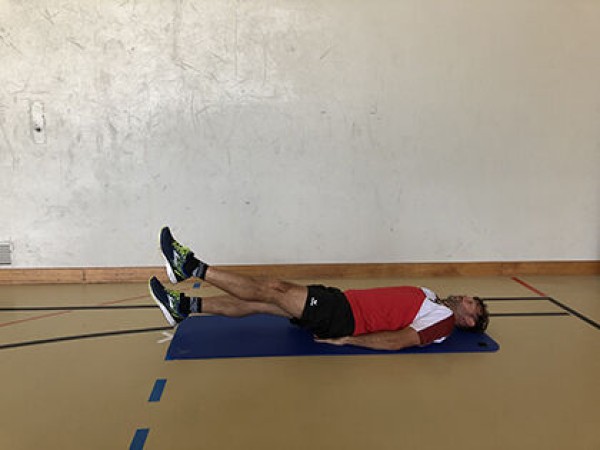

Lie on your back with your arms flat on the floor at your sides (or place your hands under your buttocks / or clasp your hands behind your head), move your outstretched, slightly raised legs up and down in constant alternation.
Attention:
Keep your (lower) back in constant contact with the floor (no hollow back, consciously tense your stomach), do not put your legs down.
Lighten:
Just hold the position (legs stretched out and slightly raised off the floor).
Harden:
Additional weight for the legs.
Variant I:
Cross or open your legs and bring them back together.
Variant II:
Make circular movements (in both directions) with your legs.
2 weight cuffs ► Make the exercise more difficult (additional weight)
Raising and lowering the legs in supine position alternately ► flutter kick
Power
Individual work
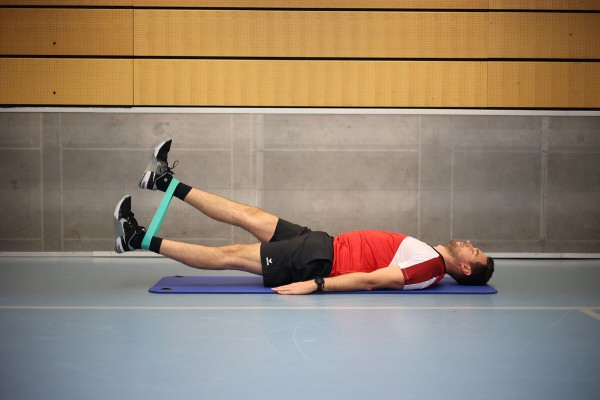
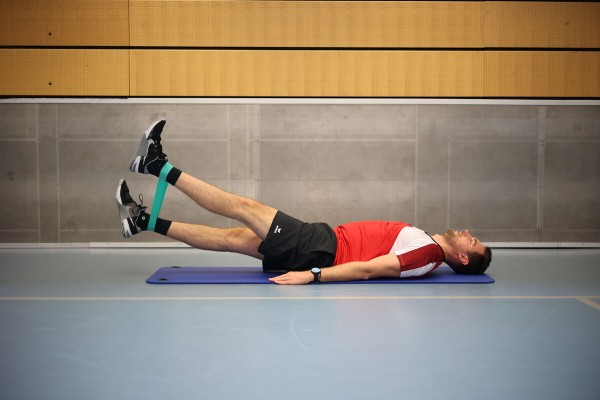
Lie on your back with your arms flat on the floor at your sides (or place your hands under your buttocks/or clasp your hands behind your head), stretch an elasticated band between your legs (place the band around your ankles) and move your slightly raised legs up and down (hip flexion/extension).
Attention:
Keep your (lower) back in constant contact with the floor (no hollow back, consciously tense your stomach), do not put your legs down.
Lighten:
Choose an elastic band with less resistance.
Harden:
Choose an elastic band with more resistance.
1 mini-band
Raising and lowering the legs in lateral position (left)
Power
Individual work


Sideways position (right), exercise ball clamped between the outstretched legs, raise and lower legs (ball)
Attention:
Head, torso, hips and knees practically form a line, do not fully lower the lower leg.
Lighten:
Support legs slightly raised in place (without lifting and lowering the legs/ball); lift and lower legs/ball less.
Harden:
Additional weight on the legs.
1 exercise ball
2 weight cuffs ► to make the exercise more difficult (additional weight)
Raising and lowering the legs in lateral position (right)
Power
Individual work


Sideways position (left), exercise ball clamped between the outstretched legs, raise and lower legs (ball)
Attention:
Head, torso, hips and knees practically form a line, do not fully lower the lower leg.
Lighten:
Support legs slightly raised in place (without lifting and lowering the legs/ball); lift and lower legs/ball less.
Harden:
Additional weight on the legs.
1 exercise ball
2 weight cuffs ► to make the exercise more difficult (additional weight)
Raising and lowering the legs and pelvis in supine position ► leg raise
Power
Individual work


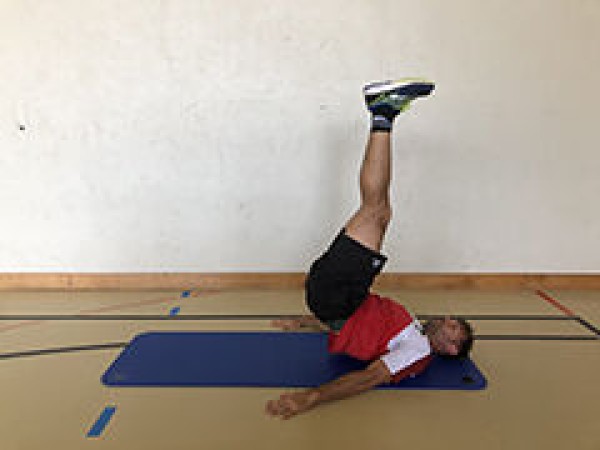
Lie on your back with your arms at your sides on the floor (or with your arms bent behind your head and your hands gripping a fixed object to ensure more stability/hold). Raise outstretched, slightly bent legs together and push out vertically upwards (release buttocks from the floor). Then lower your buttocks and lower your legs back to the starting position.
Attention:
Do not lower your legs completely.
Lighten:
Lift and lower your legs only (without pushing them vertically upwards).
Harden:
Additional weight for the legs.
2-4 weight cuffs/1 weight ball/weight disc/dumbbell ► Make the exercise more difficult (additional weight)