
Exercises (660)
FlowFit (Part 3)
Mobilisation of the joints / dynamic stretching
Individual work
FlowFit - complete exercise sequence (film)
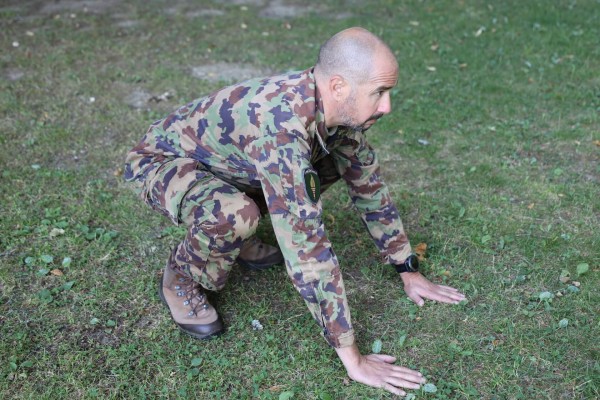
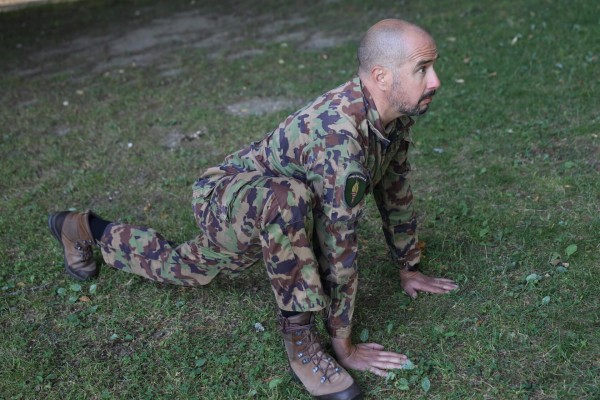
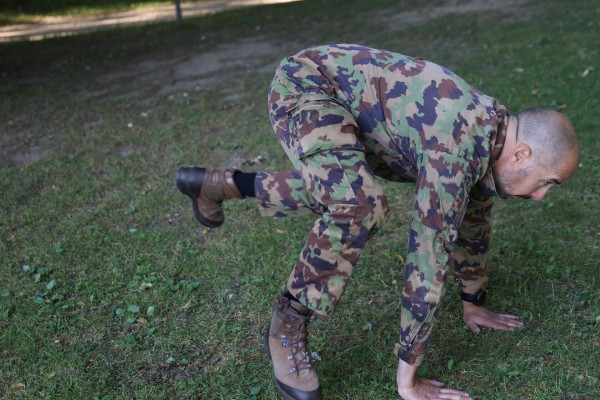
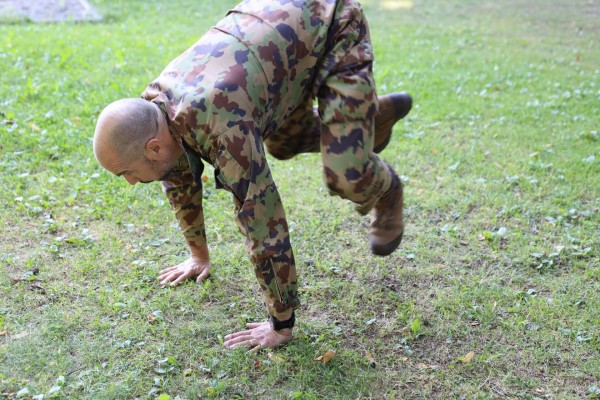
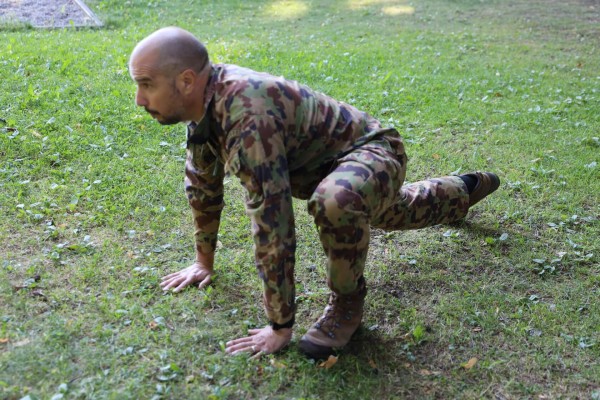
From the deep squat position, shift the weight of your upper body forwards so that you can bring your outstretched arms to the floor. From this position, move one foot further forwards to place it next to the supporting hand (place the foot on the same side of the body as close as possible to the edge of the hand). The other leg is moved backwards and supported on the tip of the toe. At the same time as the leg position is shifted, the upper body/weight is shifted so that the arms are perpendicular to the floor. Now swap the leg position by jumping off with both legs. Then bring the back leg back next to the other leg, straighten the upper body and release the hands from the floor to return to the deep squat position. Finally, straighten your legs to stand upright.
Lighten up:
Support your arms on a raised surface (e.g. bench or large stone).
No material required
FlowFit (Part 4)
Mobilisation of the joints / dynamic stretching
Individual work
FlowFit - complete exercise sequence (film)
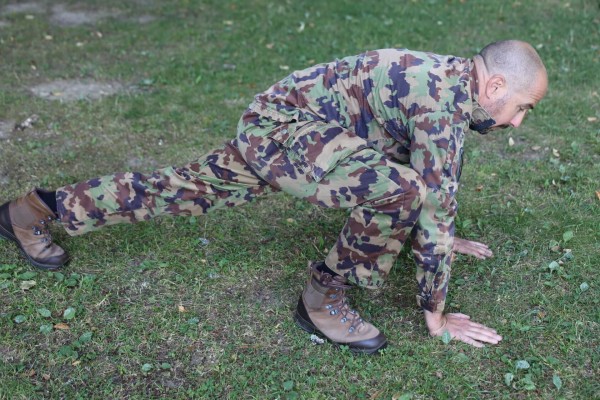
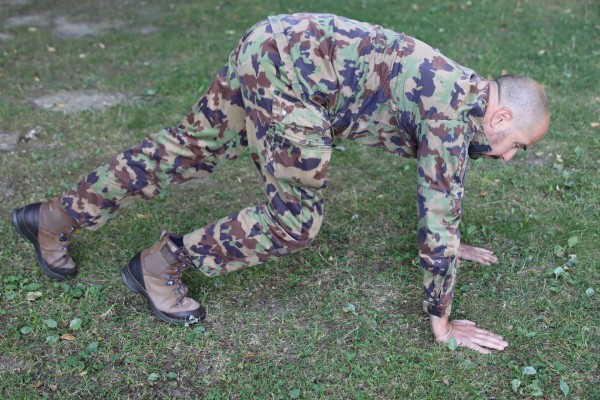
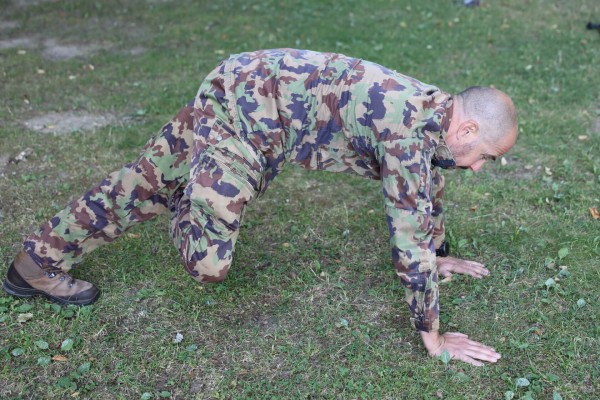
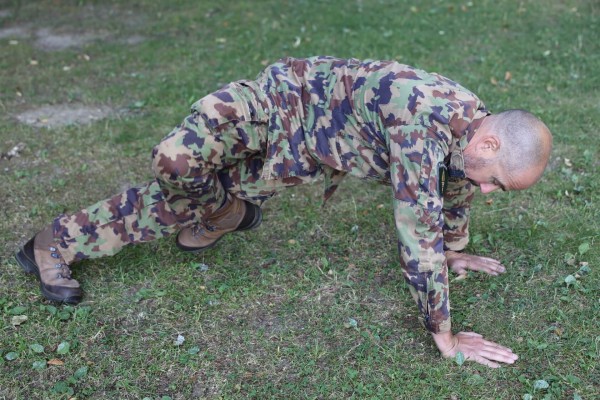
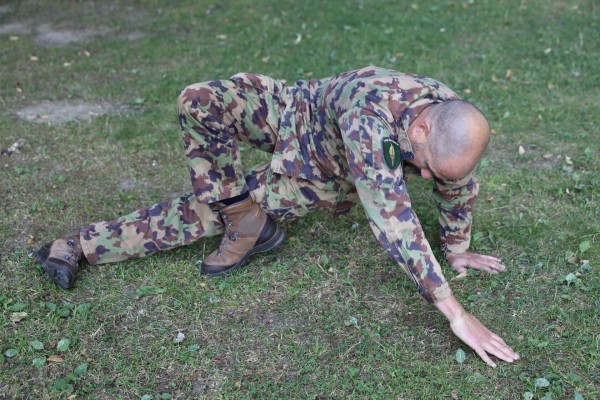
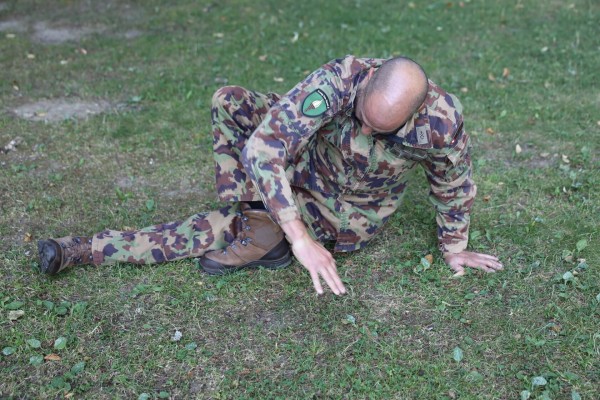
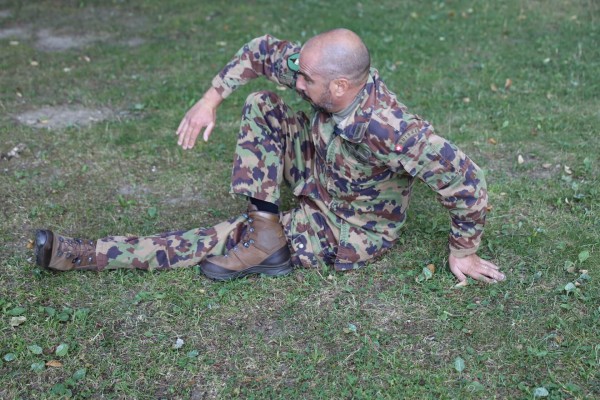
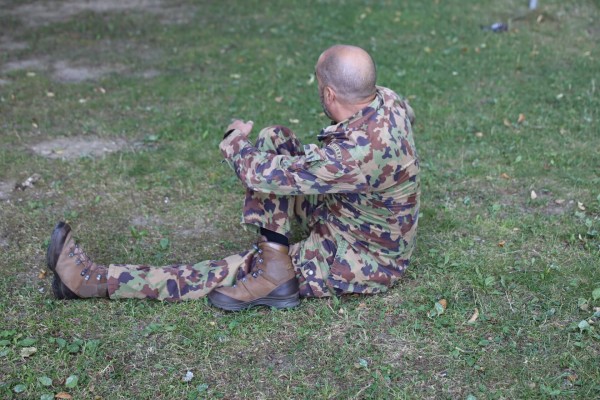
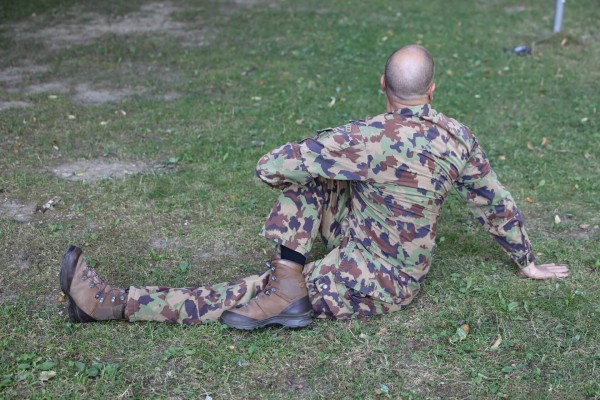
From the deep squat position, shift the weight of your upper body forwards so that you can bring your outstretched arms to the floor. From this position, move one foot further forwards to place it behind the supporting hand (same side of the body - knee at the elbow). The other leg is extended backwards and supported on the tip of the toes. At the same time as shifting the leg position, the upper body/weight is shifted so that the arms are perpendicular to the floor. From this position, release the front foot from the floor and move the outer instep of the foot towards the knee of the other leg extended backwards. At the same time, turn the upper body out so that you reach the seat, placing the foot of the bent leg flat on the floor and the outstretched leg also flat on the floor (the instep of the bent leg is finally on the outside of the knee of the outstretched leg - the legs are crossed). During this movement, the hand on the body side of the bent leg is also lifted off the floor and the elbow is brought to the bent knee. In a seated position, with one leg pointing forwards and the other knee pointing vertically upwards, turn the upper body further out to look backwards. The hand grasps the bent knee and pulls it back to the side of the foot placed on the floor. Reverse the sequence of movements to return to the squat position. Now perform the exercise on the other side. Return to the deep squat position and finally straighten your legs to stand upright.
No material required
FlowFit (Part 5)
Mobilisation of the joints / dynamic stretching
Individual work
FlowFit - complete exercise sequence (film)
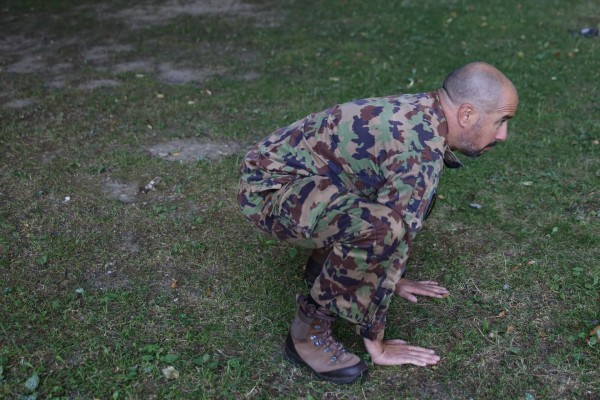
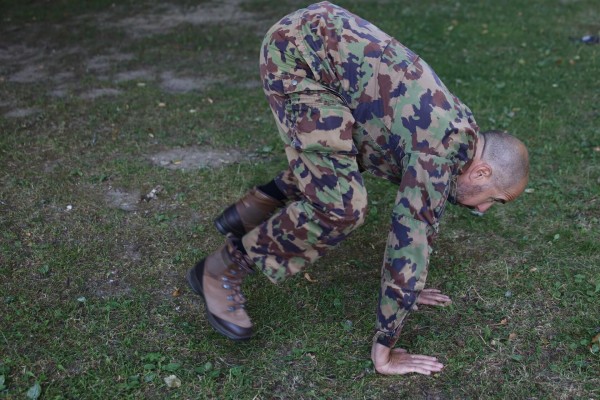
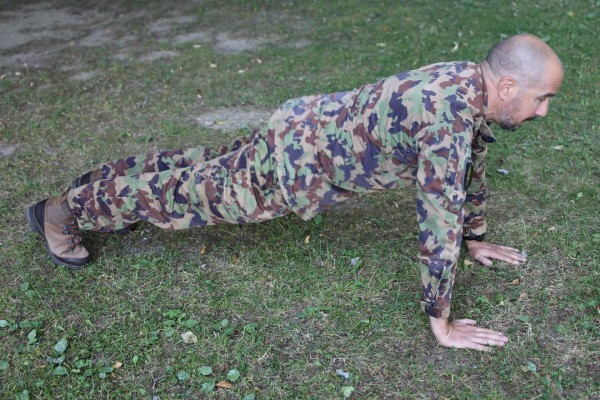
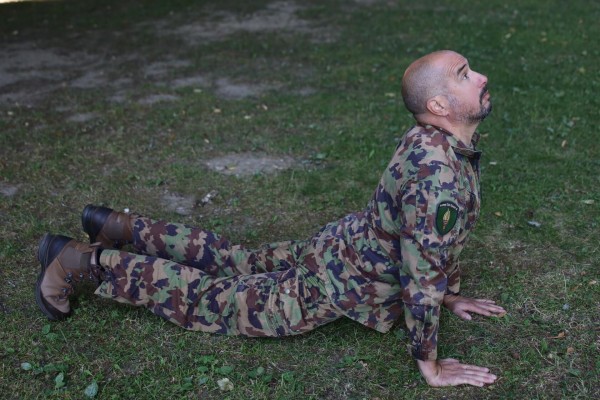
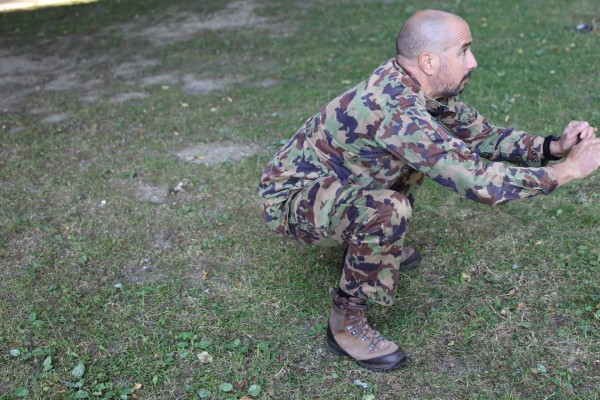
From the deep squat position, the weight of the upper body is shifted forwards so that the outstretched arms can be brought to the floor. Place your arms as close to your feet as possible. Jump off with both legs and stretch your legs backwards to get into the push-up position. Now press your thighs to the floor and at the same time look forwards at an angle (hollow back position). Again in a jump, bring your legs back to your arms to return to the deep squat position. Finally, straighten your legs back to the standing position.
Caution:
Do not allow your pelvis to sag in the push-up position (actively tense your torso) so that your legs and upper body practically form a line.
Lighten up:
Do not move your legs while jumping, but rather move one leg after the other backwards or forwards. Support your arms on a raised surface (e.g. bench or large stone).
No material required
FlowFit (Part 6)
Mobilisation of the joints / dynamic stretching
Individual work
FlowFit - complete exercise sequence (film)
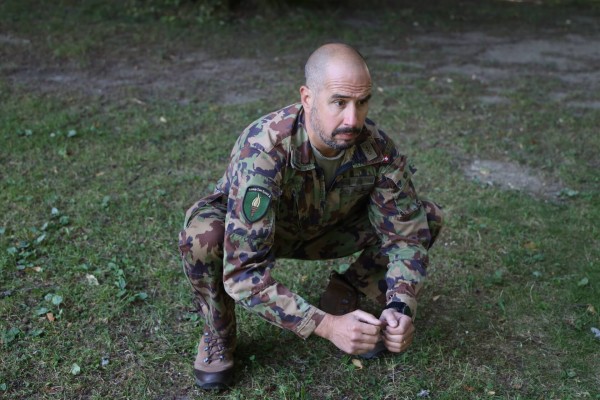
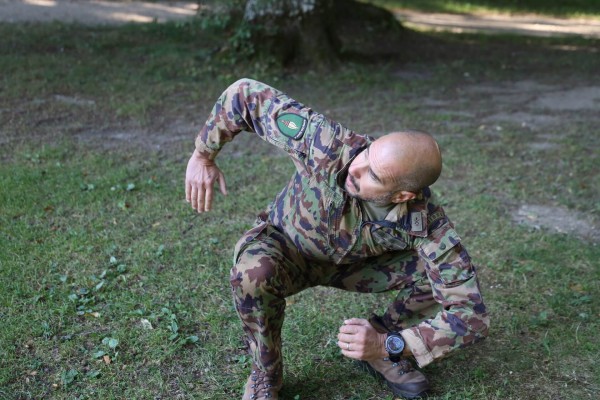
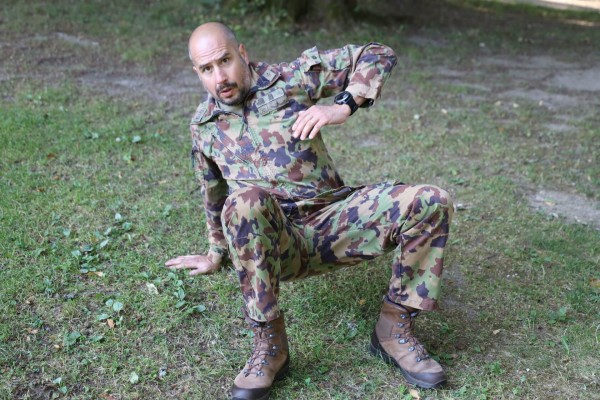
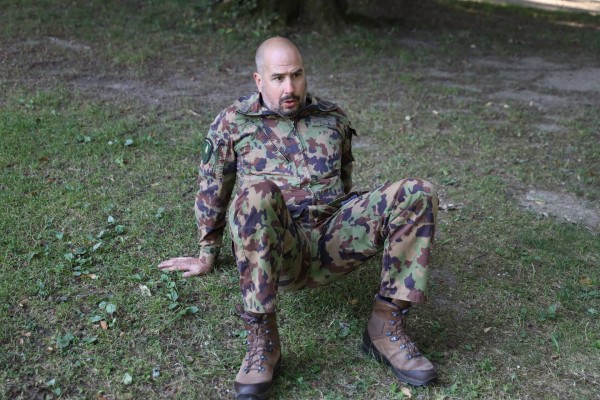
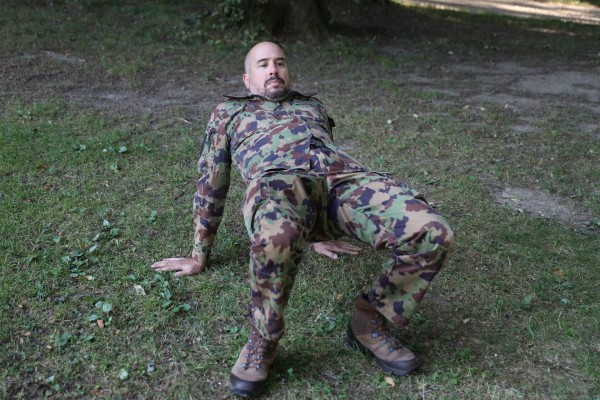
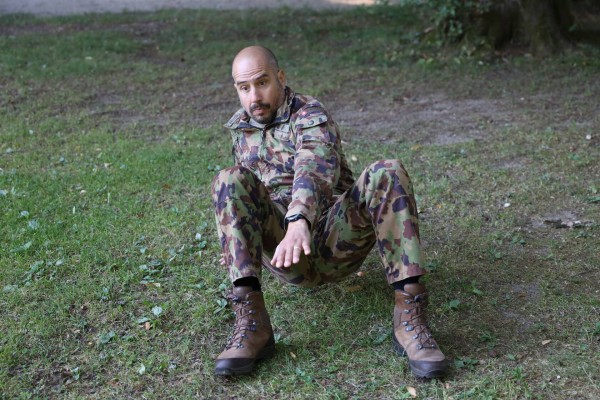
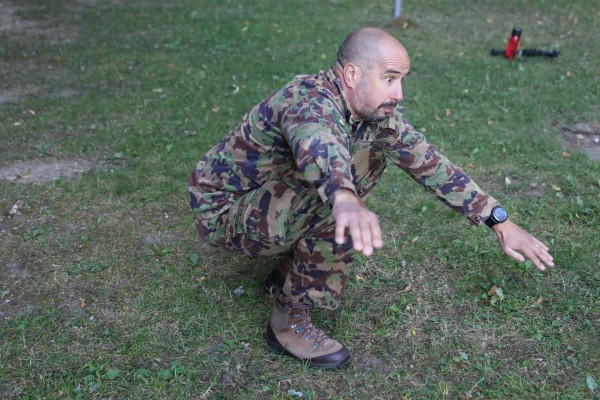
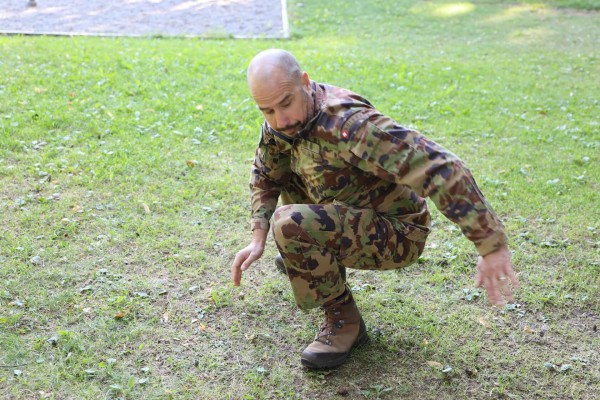
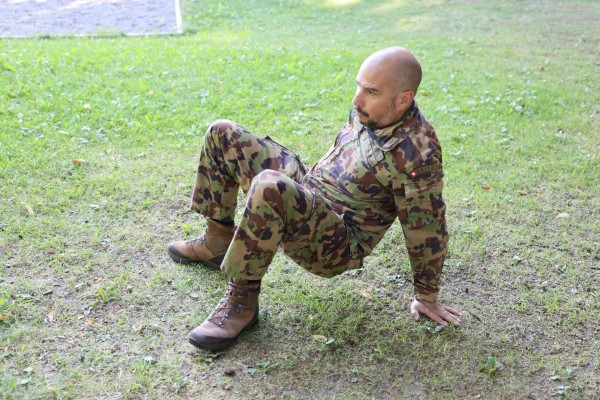
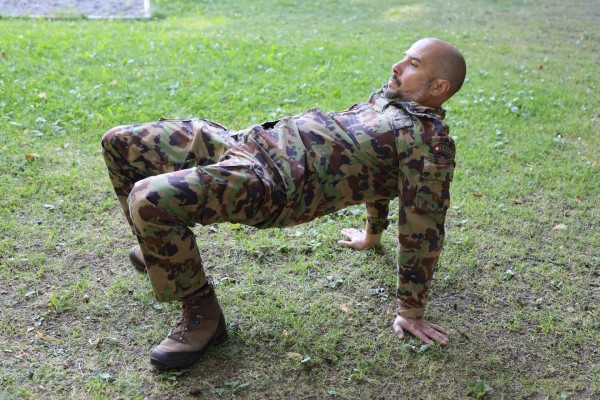
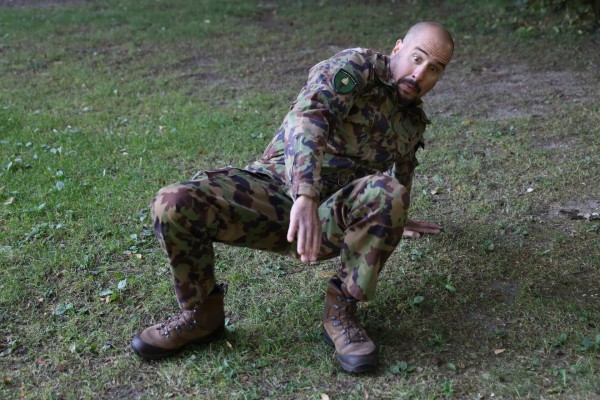
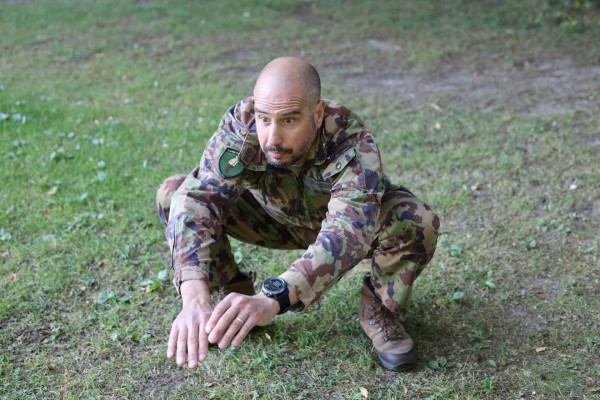
From the deep squat position, alternate between moving one arm backwards to get into the inverted quadruped position (chest pointing upwards). Actively push your pelvis upwards so that your upper body and thighs practically form a line. Lower the pelvis again and bring one arm after the other back between the knees back into the squatting position. Perform the exercise again, but this time change the starting side (arm that is first moved backwards or forwards). Return to the deep squat position, then straighten your legs back to standing.
Caution:
Centre one arm between your knees and move the other to the side in a semi-circle to support the rotation/twist of the upper body (momentum) to return to the squat position.
Lighten the load:
Support your arms on a raised surface (e.g. bench or large stone).
No material required
FlowFit (Part 7)
Mobilisation of the joints / dynamic stretching
Individual work
FlowFit - complete exercise sequence (film)
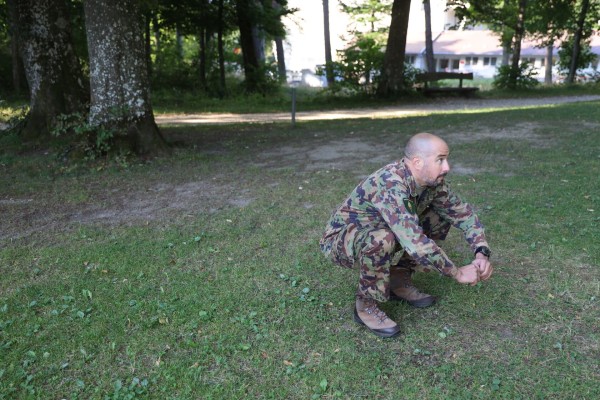
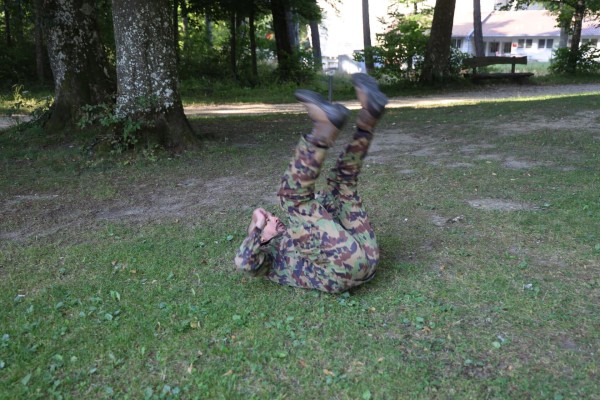
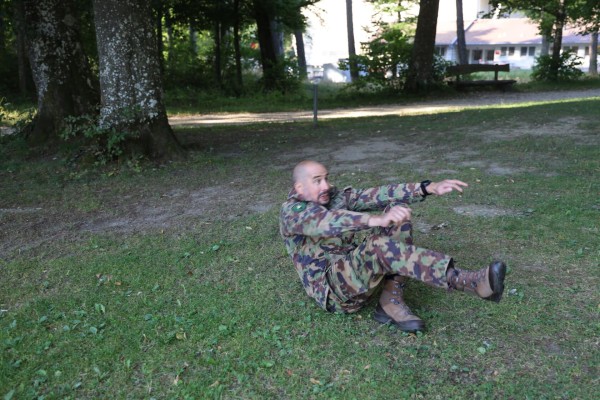
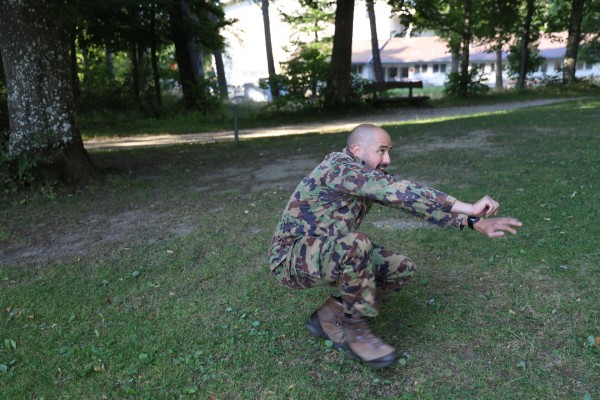
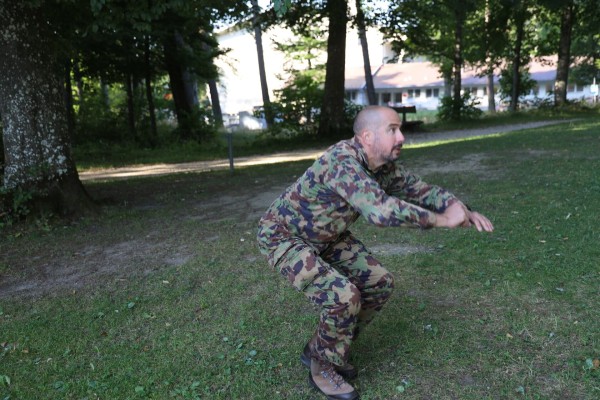
From the deep squat position, drop back onto your back. The arms are bent and the hands are brought to the floor next to the head, the legs are also bent and pointing diagonally forwards. In a flowing sequence of movements, push yourself off the floor with your hands and bring your legs forwards to the floor again (lift your upper body off the floor and straighten up). When standing up, however, only one leg is placed on the floor at first, with the other leg still pointing forwards. Only when you assume the deep squat position is the leg that was initially raised off the floor also lowered. Now perform the exercise on the other side (place the other leg on the floor first when standing up). Return to the deep squat position and finally straighten your legs to a standing position.
Caution:
Knee of the training leg should remain as centred as possible over the foot when standing up.
Easier:
Arms support the movement more clearly (more momentum); the almost extended free leg is brought to the ground with the heel to support the standing up movement.
Harder:
Use less momentum (hardly any support from the arms).
No material required
FlowFit: Explanation of the exercises
Introduction/Info
FlowFit - complete exercise sequence (film)
The instructor explains the 7 exercises to the participants, which comprise a complete exercise sequence (flow). The correct execution and possible misalignments/error patterns are pointed out.
The individual exercises are demonstrated by the sports instructor, after which the participants can try out the exercises themselves (possibly working with the add-on method: Exercise 0, exercise 1, exercise 0+1, exercise 2, exercise 0+1+2 etc.)
1 flipchart with a sketch of the exercise
Escape catch
Stimulate circulation
Group work
Groups of 2-3
Groups of 3 are formed (number the participants per group). As soon as the sports leader calls out one of the numbers 1-3, the group member concerned becomes the catcher and tries to catch the other two participants. Whoever is caught within a certain time performs an additional task (e.g. push-ups, stretch jumps, etc.). The groups can be reshuffled from time to time.
Variant:
Perform the same game as a partner exercise.
No material required
Football-Drill
Stimulate circulation
Group work
The participants line up in several rows; front to the sports leader (distance between the participants to the front/back and to the side 2-3 metres).
The participants line up in several rows at a sufficient distance from each other, facing the exercise leader. The participants trot loosely in place. If the sports leader stretches an arm out to the side, the participants move sideways in the respective direction. If the sports leader stretches his arms forwards or places them on his chest, this causes the participants to move backwards or forwards. Various exercises (stretch jump, prone position, rapid skipping in place for a few seconds, sit down/stand up or others) are integrated by signals from the sports leader (e.g. 1-4 whistles). After an exercise, the participants trot in place again until the next arm signal from the instructor.
Variant I:
The participants perform the movements in the opposite direction to that indicated by the instructor. The sports leader can make the drill even more difficult by making incorrect movements (including exercises).
Variant II:
The participants line up in a circle around the sports leader and move in a circle around him (note: not suitable for more than 20 participants).
Sports director:
1 signal/hand whistle
Fruit salad
Stimulate circulation
Group work
4 groups
Four groups each spread out in a corner of a square (e.g. corners of a hall). The participants handle a ball there (dribbling or juggling is also possible). Each group chooses a "fruit name". If the sports leader calls out two "fruits", these two groups have to change/swap corners. On the command "fruit salad", all groups change corners diagonally.
Variant:
The sports leader can specify the type of ball guidance for moving from corner to corner (e.g. pinch the ball between the legs and bounce, roll the ball, guide the ball with the weaker leg only, etc.)
Per participant:
1 stick ► Smolball, floorball
1 ball ► Basketball, FooBaSKILL, Futsal/Football, Handball, Smolball, Tchoukball, floorball
Memory relay
Increase pulse
Group work
4-5 participants per group
A solution sheet (e.g. key words, a section of a poem, rules of the game, grade badges, etc.) is placed at the turning point of the relay. The runners run to the solution sheet and memorise as much information as possible so that it can be transferred to an answer sheet at the start. The next runner is therefore well advised not to start immediately, but to communicate with the previous runner in order to organise the solution process as ideally as possible. The group that is the first to complete the answer sheet correctly or is furthest along with the solution after a certain time wins the relay.
Per group:
1 solution sheet
1 answer sheet
Writing materials
Goaltime
Increase pulse
Group work
2 teams
The teams collect points by throwing the frisbee through a goal and a teammate catches the disc in the zone behind the goal. At the start of the game, one player from each team stands behind the clear line, where the frisbee is thrown into the air by the sports director. All other players spread out in the playing area. Whoever catches the disc has the right to attack on their side and now passes the frisbee into the field to a teammate. If a pass is made through the goal arc and the disc is caught within the catch zone, the team is awarded one point. Two points are awarded if the pass is made from behind the clear line.
After a successful attack, the frisbee remains in possession, but must first be played behind the clear line before the next attack can be attempted. Likewise, after a turnover (frisbee falls to the ground, frisbee or player leaves the field of play or a pass attempt is intercepted), you must first cross the clear line before you can go on the hunt for points.
A bar with offset uprights (a handball goal without a net or two high jump poles/mobile net stands with a rope as a crossbar) can be used as a goal arch. The catch zone can be defined with cones, colouring sticks or marker cones. The clear line should be approx. 15-20 metres away from the goal.
1 frisbee
x bibs
6 cones
1 bar (or similar as a goal)
Group formation
Stimulate circulation
Groups of 3-6
As a small group, you move freely in the hall/area. The sports leader can specify various forms of movement (crossing legs, circling arms, crouching, touching the floor, hopping, one-legged hopping, etc.).
- As soon as the sports leader calls out a number, the group stops and forms up so that as many limbs (legs, arms, head or buttocks) touch the floor as specified by the sports leader (e.g. number 5 = 3 legs and 2 arms). Number 5 = 3 legs and 2 arms).
Variant:
The sports leader can request "mandatory limbs" (e.g. 1 head or max. 1 leg).
- As soon as the sports leader calls out a number, corresponding groups must be formed (e.g. number 7 = groups of 7). Each participant only looks after themselves. Whoever remains performs an additional exercise defined by the sports leader (e.g. 3 stretch jumps, 5 jumping jacks, 4 push-ups, etc.). If the group size is not correct, all participants in the group must perform the additional exercise; if the group is complete, it is advisable to send newcomers away. After a check of the group formation and execution of the additional exercises, new small groups are formed, which move freely again.
Variant:
The sports leader can define how the group joins together (back to back, prone position and outstretched arms meet at a centre point, one-legged stand and the hands are placed on the shoulders of a group member).
- It is also possible to combine both forms of exercise by having the sports leader define the group size and the number of limbs that are allowed to touch the floor (e.g. group of 6 - 5 limbs).
No material required
Group formation
Stimulate circulation
Group work
Each participant moves freely in the hall/area to the music. The sports leader can specify various forms of movement (crossing legs, circling arms, crouching, touching the floor, hopping, hopping with one leg, etc.). During a break in the music, the sports leader calls out a number so that the corresponding groups must be formed (e.g. number 7 = groups of 7). Whoever remains performs an additional exercise defined by the sports leader (e.g. 3 stretch jumps, 5 jumping jacks, 4 push-ups, etc.). If the group size is not correct, all participants in the group must perform the additional exercise. When the music starts again, the participants move freely around the room again, matching the music.
Variant I:
The instructor can define how the group joins together (back to back, prone position and outstretched arms meet to form a centre, one-legged stand and hands are placed on the shoulders of a group member).
Variant II:
In addition to the group formation, define the number of limbs that may touch the floor (e.g. group of 6 - 5 limbs).
1 music system incl. music (various)
Shark catching
Stimulate circulation
Group work
The participants ("fish") try to get past the catchers ("sharks") to the other side of the hall or the end zone defined in the area (2-3 catchers to start). In doing so, they guide a ball (with their hand, foot or playing equipment). Anyone who loses the ball or has it stolen by a "shark" also becomes a catcher. The "sharks" chase the "fish" without carrying a ball. The "fish" are safe in the zones behind two defined (base) lines. The game continues back and forth until all the "fish" have been eaten.
Per participant:
1 stick ► Smolball, floorball
1 ball ► Basketball, FooBaSKILL, Futsal/Football, Handball, Smolball, floorball
Shark catching
Stimulate circulation
Group work
The participants ("fish") try to get past the catchers ("sharks") to the other side of the hall or to the end zone defined in the area (2-3 catchers at the start). If a "fish" is eaten (touched) by a "shark", this in turn becomes a catcher. The "fish" are safe in the zones behind two defined (base) lines. The game continues back and forth until all the "fish" have been eaten.
No material required
Hand organ
Stimulate circulation
Partner work
Two participants stand opposite each other and pass the aid to each other (approx. 8 metres apart). After four (or more) faultless passes, both participants may move one step backwards. For each error (ball/shuttle/throwing disc falls to the ground, ball cannot be received correctly, ball is not controlled with the playing equipment, etc.), the participants must reduce the throwing distance by one step.
Variant I:
Depending on the game equipment or type of ball, a specific throwing, striking or shooting technique may be required for passing.
Variant II:
Multiple groups of 2 compete against each other (2 rows). The winning binomial is the one that reaches a certain distance first after the sports director's start signal.
Per participant:
1 bat/stick ► Intercrosse/Lacrosse, Smolball, Floorball, Badminton/Speedminton
Per group of 2:
1 disc (Frisbee)/ball/shuttle ► Frisbee Ultimate, Basketball, Blitzball/Rugby/Football, FooBaSKILL, Futsal/Football, Handball, Intercrosse/Lacrosse, Smolball, Floorball, Volleyball, Badminton/Speedminton
Catching rabbits
Stimulate circulation
Group work
The participants spread out in pairs next to each other lying on their stomachs on the floor (the game can also be played standing up, with the pairs standing behind or next to each other). A "hunter" tries to catch a "hare" (or several "hunters" chase several "hares"). If the "hare" lies down/stands next to a group of two, the participant on the other side of the group becomes the "hare". If the "hunter" catches the "hare", the roles change.
Variant:
If the "hare" joins a group of 2, the participant on the opposite side becomes the "hunter". The previous "hunter" becomes the "hare".
No material required
Hasenjagd
Stimulate circulation
Group work
Group of 4
Two participants swing the rope (2-3 skipping ropes knotted together). One participant moves from one side to the centre, jumps over the rope or runs directly to the other side. As soon as the first runner is in the centre, the second runner may also start. The runner behind tries to catch up with the runner in front (hare & hunter). The runners move in the shape of a figure of eight. The positions are swapped from time to time.
Attention:
Depending on the direction of the swing, there is an easier and more difficult side to get to the centre.
Per group:
2-3 skipping ropes or 1 rope/rope
Back and forth
Stimulate circulation
Group work
2-4 participants (catchers) are in the centre of the playing field in a rectangle marked with lines or cones. The remaining participants try to pass the ball from one side of the playing field to the other (with their hand, foot or playing equipment) or without carrying any aids, whereby they must pass through the catchers' rectangle. The catchers try to play the ball away from the other participants as they cross the rectangle or, in the variant without carrying the ball, to touch the other participants. No balls may be caught/touched outside the rectangle. Anyone who loses/touches the ball must perform an additional exercise outside the playing area until the end of the game (e.g. forearm support or sitting on the wall). Which participant can keep their ball until the end or is not caught until the end?
Variant:
If a participant loses their ball or it is caught, they also become the catcher afterwards.
Per participant:
1 bat/stick ►smolball, floorball
1 ball ►basketball, FooBaSKILL, futsal/football, handball, smolball, floorball
4 marking cones/caps ►field boundary (rectangle)
Hot Box
Stimulate circulation
Group work
2 teams with 3-6 participants each
Two teams of 3-6 players play against each other in a field. The field consists of an outer and inner square. The attacking team scores a point with a pass to a team-mate who is in the smaller centre square. If the disc/ball falls to the ground, flies out of the playing field or is intercepted by the opponent, the defenders become the attacking team. If this happens, the new attackers must first catch the disc/ball outside the outfield. Only then may they attempt to score. If a point is scored, the team remains in possession of the disc/ball and therefore in attack, but must also pass the disc/ball out of the outfield and catch it there before the next attempt. If the game is played with a ball, bouncing the ball is not permitted and the number of steps with the ball is limited (e.g. maximum 3 steps).
1 ball/throwing disc (Frisbee) ►Basketball, FooBaSKILL, Handball, Frisbee Ultimate
8 marking cones/caps ►Court markings (outer and inner squares)
3-6 playing ribbons/bibs ►Team identification
Jumping relay
Stimulate circulation
Group work
5-7 participants per group
All participants in a group hop together in a chain to a defined point (e.g. around a turnaround, to the hall wall or over a certain line) and back. The person in front holds the left knee of the person behind (or the right knee in the second round). In another form, the person behind holds the left or right foot of the person in front. The two forms can also be combined (different outward and return routes).
Variant:
The group transports a long bench between their legs.
Per group:
2 colouring sticks/marking cones/cones ►start and reversal mark (optional)
Per group:
1 long bench ►Variant
Indoor cycling
Stimulate circulation
Individual work
Indoor cycling involves cycling indoors, whereby the workout on the indoor bike is even slightly more efficient than cycling outside. Whether for burning fat, strengthening the cardiovascular system, ergo for health or for the muscles, training with the indoor bike offers a holistic workout and entails hardly any risks. At a moderate speed with correspondingly low resistance, indoor cycling is an ideal way to stimulate the circulatory system during the run-in.
1 Fahrradergometer/Indoor-Bike/Spinning-Bike
Indoor cycling
Increase pulse
Individual work
Indoor cycling involves cycling indoors, whereby the workout on the indoor bike is even slightly more efficient than cycling outside. Whether for burning fat, strengthening the cardiovascular system, ergo for health or for the muscles, training with the indoor bike offers a holistic workout and entails hardly any risks. This holistic workout makes indoor cycling ideal for getting the heart rate up at the end of the warm-up. A high basic speed can be selected or constant changes of pace provide the necessary intensity.
1 Fahrradergometer/Indoor-Bike/Spinning-Bike
Info: General training principles
Introduction/Info
Methodical training principles, also known as training principles, are guiding principles that apply to all sporting activities. Those who plan their training independently and do not follow fixed training plans should adhere to the following training principles:
Training stimulus:
The training stimulus must exceed a certain threshold. The required level of stimulus depends on the training status of the respective athlete. This means that a certain stimulus does not have the same effect for every person. For example, a competitive athlete needs a greater stimulus to make progress than a healthy athlete.
Individualised load:
The training must be tailored to the individual needs and the mental and physical requirements of the person training. Factors include age, gender and training condition. The limits of endurance must be respected without compromise.
Increasing load:
Over time, training stimuli that remain the same only have a maintaining effect. If you want to increase your performance, the load must also be increased so that the body continues to be stimulated to adapt.
Right load sequence:
If several coordinative-technical and conditioning skills are trained in one training session, you should pay attention to the correct sequence.
Coordination, technique and speed training takes place in a recovered state, immediately after the warm-up. Strength training is then carried out before any endurance training, followed by a cool-down and any stretching.
Varying loads:
Similar training stimuli lose their effect over time. This is why training loads must be varied systematically and according to plan. Monotony for the psyche and monotony for the organs should be avoided. Variation can be achieved by changing the intensity (weight), the volume (sets) and the choice of exercises.
Varying loads:
Different forms such as strength, endurance or coordination training place different loads on the body, which is why the focus should not be on just one area.
Avoiding imbalances:
Muscular imbalances are defined as increased muscle shortening and/or muscle weakening between the agonist (player) and antagonist (opponent) due to one-sided strength development with simultaneous neglect of their ability to stretch. They are caused by a lack or absence of physical exertion and one-sided strain during sport or in everyday life. Insufficient regeneration and incorrect execution of movements can also lead to injuries to the musculoskeletal system.
Optimal ratio of strain and recovery:
Regeneration is just as important as strain. Regenerative measures must be planned and implemented just as carefully as training. It is important to bear in mind that regeneration processes are also influenced by psychological and emotional factors.
Continuous exercise:
Regular training develops performance potential. As a general rule, it is better to train for a shorter period several times a week than just once and for a very long time. Interruptions to training that do not serve the purpose of targeted regeneration usually lead to a reduction in performance.
Different adaptation times:
The different regeneration and adaptation processes require different amounts of time. Functional adaptations occur faster than structural ones. For example, the musculature adapts more quickly than the passive parts of the musculoskeletal system (e.g. tendons or bones of the skeleton).
1 flipchart with the general training principles (optional)
Info: FlowFit
Introduction/Info
FlowFit - complete exercise sequence (film)
FlowFit is a sequence of 7 exercises, whereby a squat is always performed first to get into the starting position in a deep squat before one of the exercises is performed afterwards. The flowing sequence of exercises fits perfectly into the run-in to mobilise the joints and stretches the various muscle groups dynamically. The aim is to improve mobility/stability, which is why the quality of the execution of the movement plays a central role. It is therefore not at all about completing the exercises as quickly as possible. The exercise sequence can be repeated as often as required (e.g. how many repetitions can be completed within a certain time limit - but make sure that the quality of the movements does not suffer). The individual exercises can also be performed several times in succession for training purposes.
1 flipchart with a sketch of the exercise