
Exercises (660)
Dynamic stretching: calf muscles
Mobilisation of the joints / dynamic stretching
Individual work

Light lunge, lean your body forwards and support yourself with your hands on the wall. Bend the front leg, stretch the back leg and place both feet flat on the floor (press the heel of the back foot against the floor). The stretch can be intensified by increasing the amount of support. Push your hips and front knee forwards in a rocking motion while continuing to press your back heel firmly against the floor to support the dynamic stretch. Then switch legs.
Variant:
The exercise can also be performed without a wall by placing both feet flat on the floor in a stepping position and tilting the upper body slightly forwards.
1 wall/wall or similar
Dynamic stretching: calf muscles
Mobilisation of the joints / dynamic stretching
Individual work

Light lunge in front of a wall with straight legs, lift the toe of the front foot and press it against the wall while pressing the heel into the floor (the leg remains straight). The closer the heel is to the wall, the more intense the stretch. Tilt the upper body forwards to support the dynamic stretching. Then switch legs.
1 wall/wall or similar
Dynamic stretching: calf muscles
Mobilisation of the joints / dynamic stretching
Individual work

Stand with your feet hip-width apart, slightly forward and support your body against the wall with your hands. Keep your legs straight and your feet flat on the floor (heels pressed against the floor). The stretching can be intensified by increasing the amount of support. Bend and stretch your arms slightly to bounce your upper body towards your hands and support the dynamic stretching.
1 wall/wall or similar
Dynamic stretching: calf muscles
Mobilisation of the joints / dynamic stretching
Partner work

Lunge towards your partner. With your arms stretched out, press your palms against your partner's and press the heel of your back leg onto the floor. Bend and stretch your arms slightly to bounce your upper body towards your hands/partner and support the dynamic stretching. Then switch legs.
No material required
Dynamic stretching: calf muscles
Mobilisation of the joints / dynamic stretching
Individual work


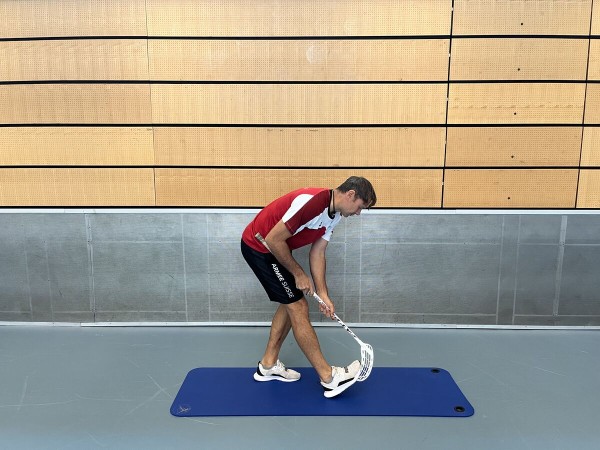
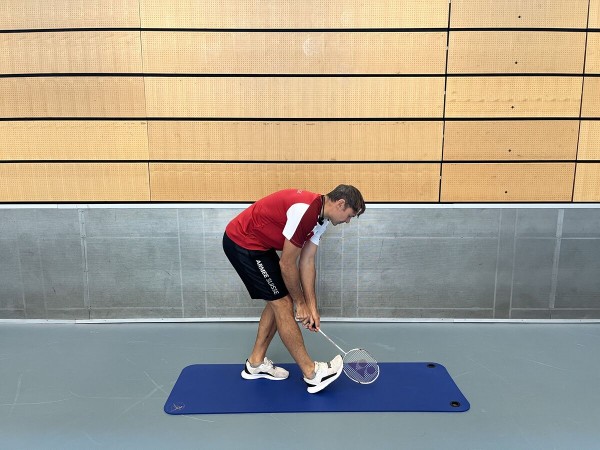
Light lunge, with the front leg stretched and the back leg slightly bent. Bend the foot of the front leg (remote position) and pull the tip of the foot towards your body while rocking with the aid. Then switch legs.
Per participant:
1 stick ►unihockey, intercrosse/lacrosse, Nordic walking
1 racket ►badminton/speedminton, smolball
1 throwing disc (frisbee) ►frisbee ultimate
1 elastic rubber band//string/skipping rope/playing rope
1 gymnastics stick with elastic band
Dynamic stretching: calf muscles
Mobilisation of the joints / dynamic stretching
Partner work

Stand hip-width apart opposite your partner, tilt your upper body forwards and press your palms against your partner's with your arms stretched out overhead (holding them up). Press your heels onto the floor.
No material required
Dynamic stretching: calf muscles
Mobilisation of the joints / dynamic stretching
Partner work


Stand hip-width apart opposite your partner, tilt your upper body forwards and press your palms against the aid with your arms stretched out overhead (holding them up) (clamp the object together). Press your heels onto the floor.
Per group of 2:
1 ball ►baseball, blitzball/rugby/football, fistball, futsal/football, handball, FooBaSKILL, volleyball
1 stick ► floorball, intercrosse/lacrosse, Nordic walking
1 racket ►badminton/speedminton, smolball
1 throwing disc (frisbee) ►frisbee ultimate
1 elasticated rubber band/power tube/skipping rope/playing rope
1 gymnastics stick with elastic band
Dynamic stretching: calf muscles
Mobilisation of the joints / dynamic stretching
Partner work


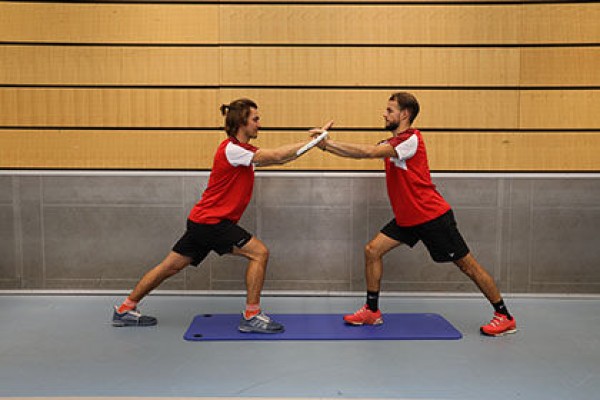


Lunge towards your partner. With outstretched arms, press your palms against the aid (pinch the object together) and press the heel of the back leg onto the floor. Bend and stretch your arms slightly to bend your upper body towards your hands/partner and support the dynamic stretching. Then switch legs.
Per group of 2:
1 ball ►baseball, blitzball/rugby/football, fistball, futsal/football, handball, FooBaSKILL, volleyball
1 stick ► floorball, intercrosse/lacrosse, Nordic walking
1 racket ►badminton/speedminton, smolball
1 throwing disc (frisbee) ►frisbee ultimate
1 elasticated rubber band/power tube/skipping rope/playing rope
1 gymnastics stick with elastic band
Dynamic stretching: calf muscles
Mobilisation of the joints / dynamic stretching
Individual work
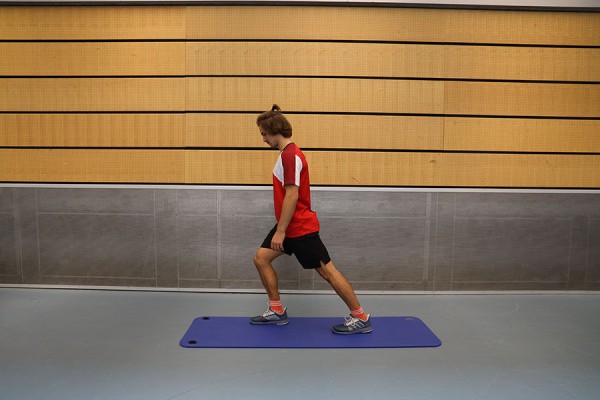
In a stepping position, both feet lie flat on the floor (front leg bent, back leg stretched - press the heel of the back leg against the floor), lean the upper body forwards in a rocking motion. The stretch can be intensified with a larger support. Then switch legs.
No material required
Dynamic stretching: calf muscles
Mobilisation of the joints / dynamic stretching
Individual work

From a shortened stride position, bend the back leg forwards in the knee joint so far that the knee rises above the tip of the foot (the tilt creates a stretch in the lower calf of the back bent leg - heels always remain on the floor). Then switch sides.
No material required
Dynamic stretching: calf muscles
Mobilisation of the joints / dynamic stretching
Individual work

With the leg slightly bent, place the toe of the foot on a small elevation (e.g. step) and press the heel down, rocking. The supporting leg is either also placed on the elevation (better variation) or underneath the elevation on the surface. Then switch sides.
No material required
Dynamic stretching: calf muscles
Mobilisation of the joints / dynamic stretching
Individual work
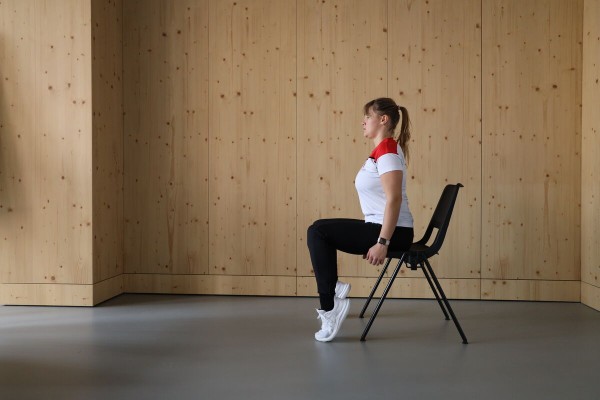
Sitting on a chair with your back straight, raise the heels of your legs as high as possible (legs only rest on the tips of your feet). Perform small rocking movements (raise and lower your heels).
1 (office) chair
Ice hockey: big circles
Stimulate circulation
Group work
3 players per group
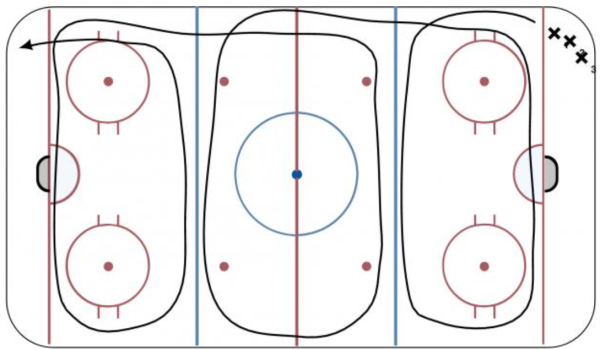
The players form three large circles around the face-off points in the three zones (offensive, neutral and defensive zones).
the whole pitch
Ice hockey: small circles
Stimulate circulation
Group work
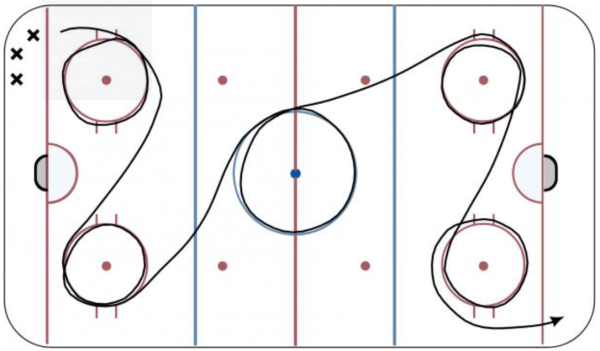
The players run round the five circles on the playing field.
forwards
backwards
keeping your gaze fixed on the centre at all times (switching from running forwards to running backwards)
The whole pitch
Ice hockey: skating the lines
Increase pulse
Group work
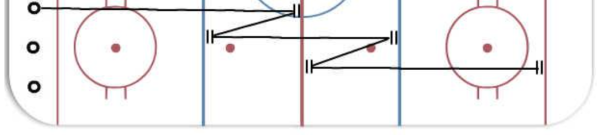
The players run from line to line, stopping briefly each time they change direction (do not run in circles). When stopping, they must always keep their eyes on the centre of the pitch. The exercise is carried out twice (once on each side of the pitch).
The whole pitch
Ice hockey: fits
Stimulate circulation
Group work
4–5 players per group
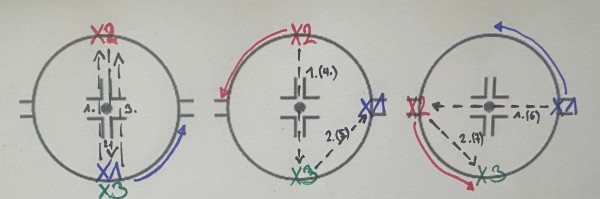
X1 plays to X2
X2 plays back to X1
X1 plays back to X2 and moves counterclockwise after passing (1/4 circle)
X2 plays to X3 (position taken by X1) and also moves counterclockwise after passing (1/4 circle)
X3 plays to X1
X1 plays to X2 and moves counterclockwise again after the feed (1/4 circle); assumes the starting position of X2 accordingly
X2 plays to X3 and joins the waiting group (1/4 circle shift)
X3 and X1 restart the exercise
After a few passes change direction (rotate clockwise).
Later, the starting player can independently decide in which direction to start.
1 centre circle per group
Ice hockey: fits
Stimulate circulation
Partner work
Two players stand facing each other (vis-à-vis) a few metres apart. Player A passes the first puck to Player B. Player B receives the puck and sets it slightly to one side. Player A passes the second puck to Player B, who plays it straight back. Player A now receives this puck, moves it slightly to one side, and then plays the next pass straight back. The exercise continues in this way without interruption. After a while, switch from the forehand to the backhand side, or incorporate flip passes.
2 pucks per group
Ice hockey: fits (3 v 1 / 4 v 1)
Stimulate circulation
Group work
Groups of 4 (3:1) or groups of 5 (4:1)
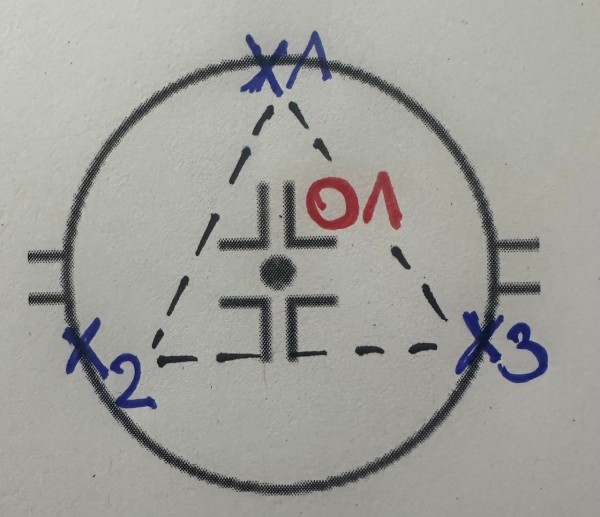
Three (or four) players position themselves around the face-off circle and attempt to keep possession of the puck through quick and precise passing amongst themselves. A defender attempts to intercept or win the puck. After losing possession of the puck (e.g. a misplaced pass, fumbling the puck whilst receiving it, or a pass intercepted by a defender), the player who lost the puck swaps roles with the defender.
1 centre circle per group
Explanation of the exercises/items/test forms
Transition main part
The sports leader explains the various exercises/posts or test forms to the participants and points out the correct execution (including organisational instructions) as well as possible misalignments/error patterns.
Explanation of the exercises/items/test forms
Introduction/Info
The sports leader explains the various exercises/posts or test forms to the participants and points out the correct execution (including organisational instructions) as well as possible misalignments/error patterns.
Alternating extension and flexion of one leg while standing (knee raise in place / skipping) ► run in place with knee raise (high knees)
Increase pulse
Individual work
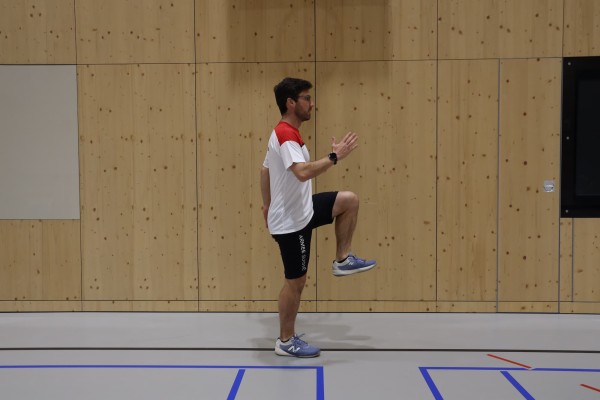

Stand upright with hips wide apart (starting position, then one leg always moving freely), alternately lift one knee straight up to navel height and lower it back to the standing position, the arms swing along and support the movement (knee lift in place). The rhythm/intensity can be varied.
Attention:
Keep your upper body stable/upright, actively support the movement with your arms.
Lighten:
Lift your knees less high; slower execution (reduce rhythm/intensity).
Harden:
Lift your knees higher; fast execution (increase rhythm/intensity); perform the exercise on a soft mat.
Variant I:
Execute the movement very slowly and linger briefly in the one-legged stance to further improve your balance.
Variant II:
Arms folded behind the head, elbows crossed towards the raised knee.
Variant III:
Knees turned out to the side when lifting, arms swinging more to the side.
1 soft mat ► Make the exercise more difficult
Catch
Stimulate circulation
Group work
Multiple catchers try to touch the remaining participants in a limited playing field. If a participant is caught or leaves the playing field while running away, they wait in place until they are freed. The following variations are suitable for this:
- Legs in straddle position: release by crawling between the legs
- Crouching position with lowered head (Böckli): Liberation by jumping over using a straddle jump
- Underarm support: Liberation by jumping over with both legs
- Kneeling position with one leg raised, one arm bent in a high hold: Release by sitting down on the raised leg and pulling down the bent arm ("flush after going to the loo").
Variant:
Whoever is caught performs an additional task outside the playing field (e.g. global forearm support or wall sit until the end of the pass).
2-3 game ribbons/ribbons ►catcher
FlowFit (Part 0)
Mobilisation of the joints / dynamic stretching
Individual work
FlowFit - complete exercise sequence (film)
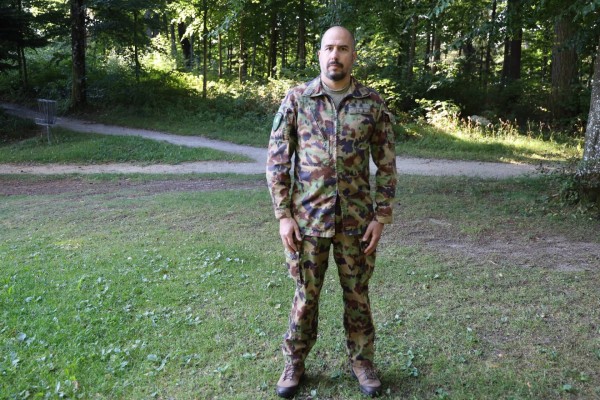
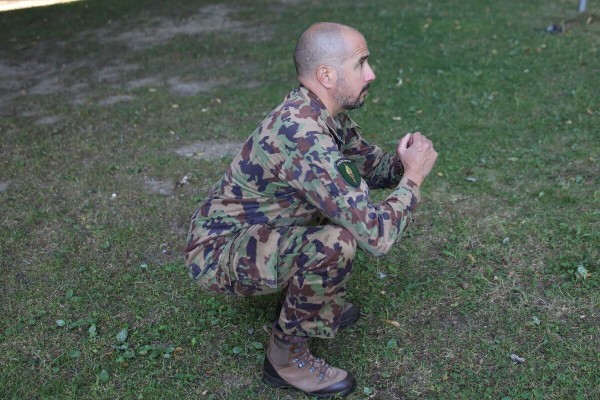
Stand shoulder-width apart, arms hanging at the sides of the body, bend the knees until the buttocks are lower than knee height and at the same time bring the hands together in front of the body at chest height (arms bent with the elbows at the knees). Maintain a deep squat position.
Caution:
Lower your buttocks backwards, not your knees forwards. Keep your knees behind your toes. Keep your back straight at all times (tense your core), distribute your weight over your entire foot, push your knees outwards (do not tilt inwards).
Lighten up:
Do not lower your buttocks too low (greater angle in the knees - buttocks at or above knee height).
No material required
FlowFit (Part 1)
Mobilisation of the joints / dynamic stretching
Individual work
FlowFit - complete exercise sequence (film)
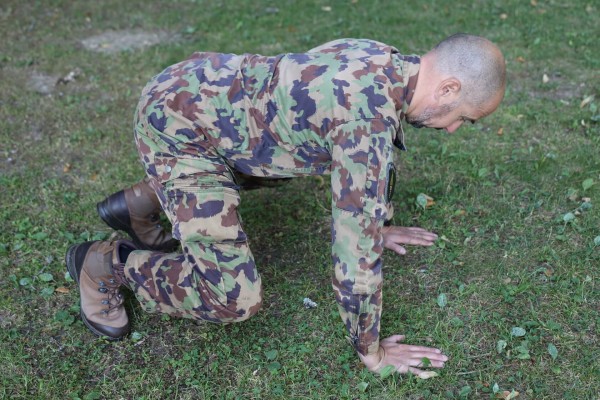
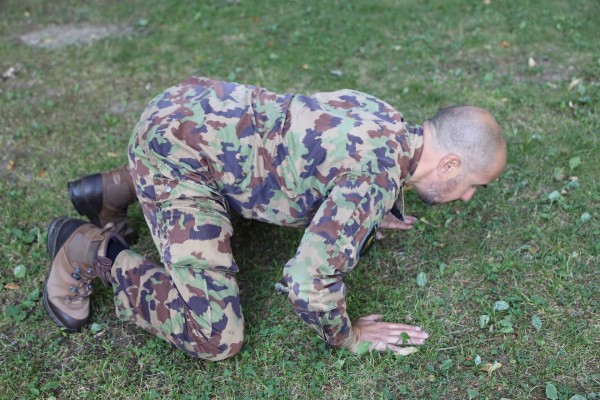
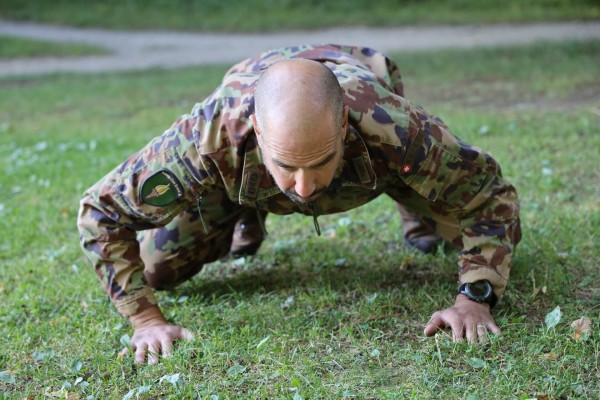
From the deep squat position, the weight of the upper body is shifted forwards so that you can finally support yourself on the floor with outstretched arms (knees do not touch the floor). In this quadruped position, the heels are lifted off the floor (tiptoe position) and the legs are bent, pushing the knees outwards. Perform a push-up from this "frog position". After the push-up, return to the deep squat position by pushing off the floor with your arms to shift your weight onto your feet. Straighten your legs to stand upright.
Caution:
When performing the push-ups, make sure that you not only bend and straighten your arms, but also work with your legs (actively push your knees outwards).
Lighten the load:
Support your arms on a raised surface (e.g. bench or large stone).
No material required
FlowFit (Part 2)
Mobilisation of the joints / dynamic stretching
Individual work
FlowFit - complete exercise sequence (film)
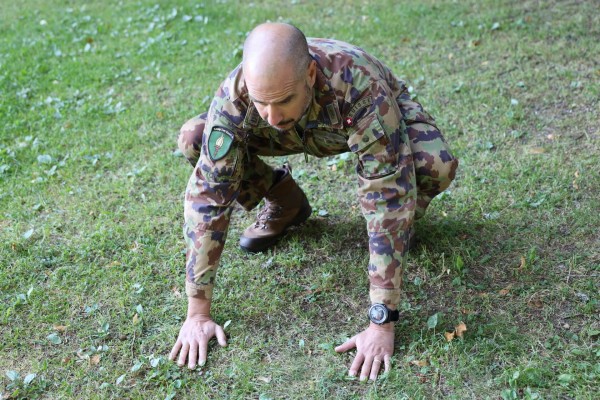
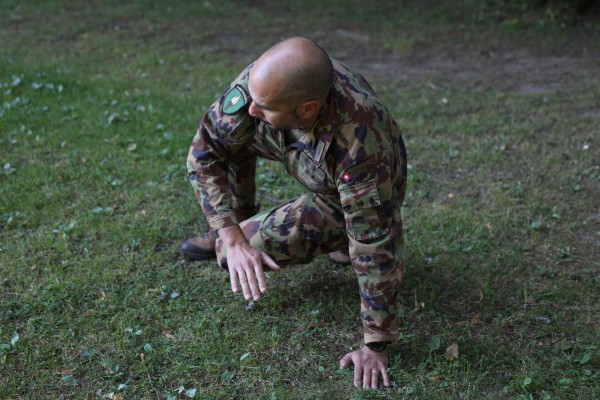
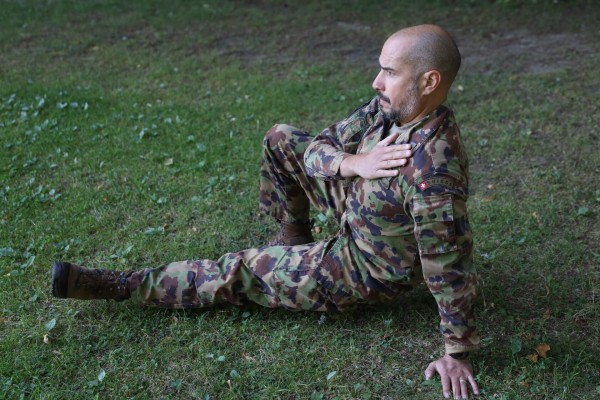
From the deep squat position, shift the weight of your upper body forwards so that you can bring your outstretched arms to the floor. From this position, lift one foot and one arm crosswise off the floor. Bring the foot under the body to the other side and stretch the leg out to the side (including rotation of the upper body - chest and leg point in the same direction). At the same time, wrap your arm and place your hand on your chest. The weight is then distributed on one foot and on the arm supported on the floor. Reverse the sequence of movements to return to the starting position and perform the exercise on the other side. Return to the deep squat position and finally straighten your legs to stand upright.
Caution:
Do not lower your buttocks or the leg stretched out to the side to the floor, but still keep them as low as possible. Actively push the shoulder of the supporting arm backwards and hold it in place so that the shoulder joint is protected/relieved.
Lighten the load:
Support your arms on a raised surface (e.g. bench or large stone).
No material required