
Exercises (3302)
Liegestützposition und Unterarmstütz alternierend ► push up position & elbow plank / push up position & front plank / push up position to elbow plank / push up position to front plank
Power
Individual work


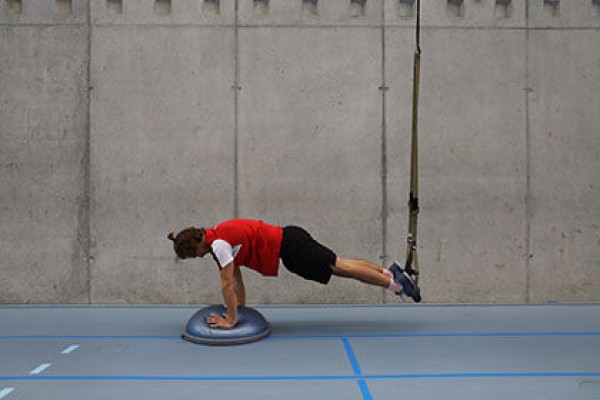
Switch from the push-up position to the forearm support and back (bend and stretch one arm at a time), with the hands or forearms placed on a balance hemisphere and the feet in the sling trainer (adjust the sling trainer to the length of the centre of the lower leg - while standing; feet vertically under the attachment point).
Attention:
Head, torso, hips and knees practically form a line (do not stretch your buttocks upwards or allow them to sag, tense your stomach).
Lighten:
Perform the exercise without the sling trainer and/or balance half-ball.
1 balance hemisphere
1 sling trainer
Alternating push-up position and forearm plank ► push up position & elbow plank / push up position & front plank / push up position to elbow plank / push up position to front plank
Power
Individual work
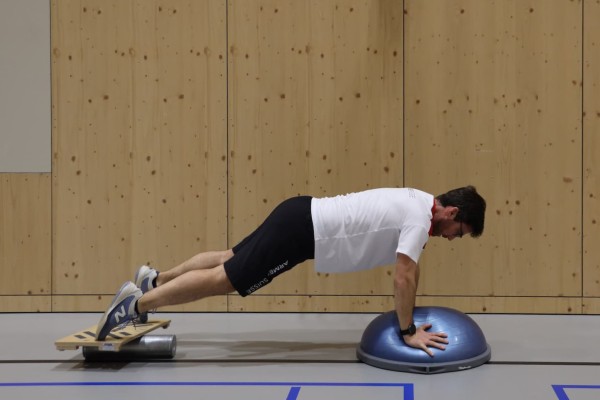
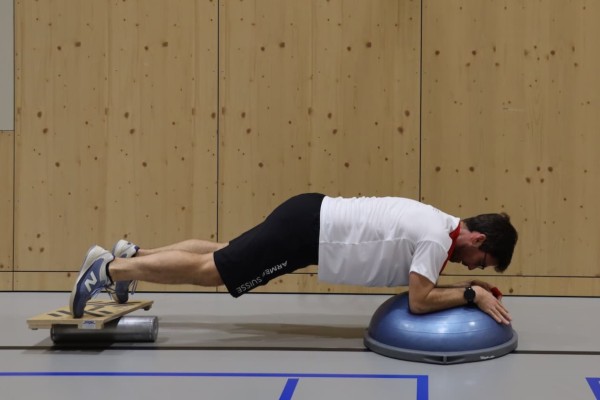
Push-up position: feet hip-width apart on the balance board, hands shoulder-width apart on the balance hemisphere; legs and torso form a straight line; actively engage your abdominal muscles and buttocks. From the push-up position, lower one arm at a time in a controlled manner into the forearm support position. Continue to stabilise your body, then lower one arm at a time back onto your palm and push yourself back up into the push-up position. Alternate the leading hand regularly.
Attention:
Keep your body as stable and straight as possible throughout the movement; do not rotate your hips sideways or raise and lower them excessively; actively engage your core; position your hands beneath or slightly outside your shoulders; do not let your shoulders slump forwards.
Lighten:
Perform the exercise without the balance board; use the balance hemisphere with the flat side facing downwards = an easier version.
Harden:
Extra weight (on the back); balance ball with the flat side facing upwards.
1 balance hemisphere
1 ball/balance cushion/balance board
1 weight vest/weight disc/sandbag ► to make the exercise more difficult (additional weight)
Alternating push-up position and forearm plank ► push up position & elbow plank / push up position & front plank / push up position to elbow plank / push up position to front plank
Power
Individual work
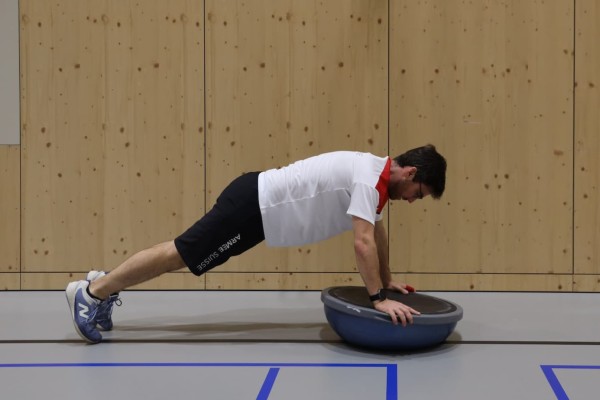
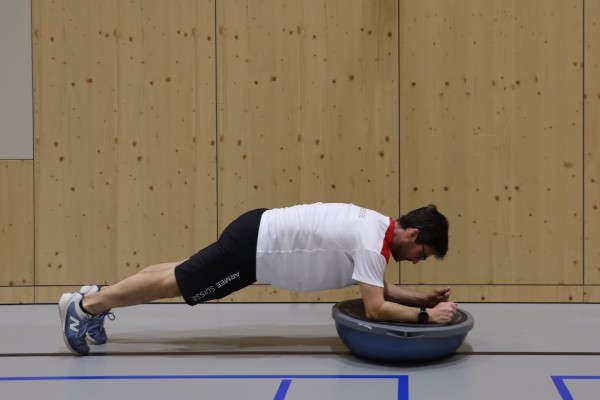
Push-up position: feet hip-width apart, hands shoulder-width apart on the balance ball; legs and torso form a straight line; actively tense your stomach and buttocks. From the push-up position, lower one arm at a time in a controlled manner into the forearm support position. Continue to stabilise your body, then lower one arm at a time back onto your palm and push yourself back up into the push-up position. Alternate the leading hand regularly.
Attention:
Keep your body as stable and straight as possible throughout the movement; do not rotate your hips sideways or raise and lower them too much; actively engage your core; position your hands beneath or slightly outside your shoulders; do not let your shoulders slump forwards.
Lighten:
Use the balance ball with the flat side facing downwards; rest your knees on the floor; perform the exercise without the balance ball.
Harden:
In the front plank position on the balance ball, perform additional shoulder taps; lift one foot slightly off the floor during the movement; use a balance board for the legs / add extra weight (on your back).
1 balance hemisphere
1 weight vest/weight disc/sandbag ► to make the exercise more difficult (additional weight)
1 ball/balance cushion/balance board ► to make the exercise more difficult (unstable base)
Push-up competition
Fighting and roughhousing games
Partner work

Two participants assume the push-up position (facing each other). The participants try to unbalance each other by pulling their arms away (or dodging). Whoever leaves the push-up position first (e.g. knees touch the floor) loses.
No material required
Push-up competition
Fighting and roughhousing games
Group work
The participants assume the push-up position and try to make another participant fall (knees on the floor) (pull hands away, push, dodge, unbalance, etc.). Whoever leaves the push-up position is eliminated and performs an additional exercise (e.g. wall sit, push-ups, forearm support). Which participant remains in the push-up position until the end?
No material required
Push-up worm
Stimulate circulation
Group work
4-6 participants per group
The group members stand in front of each other in the push-up position with their feet resting on the shoulders of the person behind them. The last member of the group stands in an upright position and leads the group around a defined point (e.g. around a turnaround, to the hall wall or over a certain line) and back.
Per group:
2 colouring sticks/marking cones/caps ►start and reversal mark (optional)
Light-Contact
Stimulate circulation
Legwork:
- Two participants are opposite each other. Participant A moves sideways with Chassé steps, participant B constantly tries to stay opposite their partner. After the roles have been swapped, it is also possible to move in all directions. Contact can be trained by having the fists of the leading hand of both participants touch slightly with each step.
- Two participants are opposite each other. Participant A takes 1-3 steps forwards, participant B tries to retreat without delay. As soon as A stops, the partner may attack 1-3 steps. The exercise is performed without punches, the hands are in a boxing position or clasped behind the body.
- Torero: The participants face each other at a slight distance. Participant A stretches his arm forwards and runs towards participant B (the fist is aimed at the opponent's forehead). Before the attacker catches the defender, participant B dodges to the side (outer side of participant A's arm).
Evasive manoeuvre:
- Duck avoidance: Participant A performs a straight punch (target opponent's forehead), Participant B ducks under the punch.
- Rolling avoidance: Participant A throws a slap/side-hook, Participant B rolls out the punch with an upper body movement.
- Lateral avoidance: Participant A performs a straight punch, participant B avoids to the outside of the partner's punching hand.
Defensive behaviour:
- From a standing position, participant A performs a single punch, participant B avoids by avoiding the upper body.
- From a standing position, competitor A performs a single strike, competitor B defends by blocking (defence with the arms).
- From a standing position, competitor A performs a single strike, competitor B evades by taking steps.
Competition:
- Both participants try to touch their opponent on the shoulder (note: only from the outside, not crosswise) and on the knees. After a hit, both participants move back and touch a defined line (e.g. volleyball sideline) before attacking again.
- one-touch: Both participants try to touch each other (excl. forearms, incl. forehead). With each hit, a defined line (e.g. volleyball line) is touched before the fight continues.
No material required
Light-Contact: Sensitisation level 1-3
Stimulate circulation
Partner work
Stage 1:
Touch in a controlled manner (an immobile target) from a standing position: Participant A puts his hands behind his back, participant B touches him with light blows to the stomach, shoulder and forehead. Participant A tries to keep his eyes open and gives feedback if the blow was too strong or missed.
Stage 2:
Controlled touching from a standing position (a moving target). Participant A puts his hands behind his back, participant B touches him with light blows to the stomach, shoulder and forehead. A tries to keep his eyes open and gives feedback if the blow was too strong or missed. The distance is constantly readjusted between the individual hits: Participant A takes two steps in any direction after each punch, participant B must follow.
Stage 3:
Both participants face each other in a boxing stance. Participant B touches his partner on the forehead with light blows. After participant A has felt the hit, he immediately counters by extending his arm towards participant B's forehead. This verifies whether participant B immediately goes back into cover/the defence position after the blow. After some time, swap roles.
Participant:
1 pair of boxing gloves
Light-Contact: Sensitisation level 4-6
Stimulate circulation
Partner work
Stage 4:
Two punches are connected fluently: From a standing position, competitor B attempts to connect two punches fluently and touch his opponent with both. After the series of punches, competitor A counters by taking one or two steps.
Stage 5:
Multiple punches to a moving target: Competitor A keeps his hands in the basic position and moves slowly and constantly in all directions, but does not actively defend. Participant B tries to touch his opponent as often as possible in succession and connect several punches. From time to time (e.g. after approx. 8 hits), participant A counters to check whether participant B is covered. After some time, the roles are switched.
Stage 6:
Adjust the distance to a fast-moving target and control the (punch) hardness: Participant A is constantly on the move and tries to dodge the punches from participant B using footwork. The defender gives feedback if the punch was too strong. After some time, the roles are switched.
Participant:
1 pair of boxing gloves
Line run
Orienteering
Single run or groups of 2/3
Send participants/groups onto the course in staggered formation (note the distance to the first starter/starting group on the run card)
In the terrain, the sports director distributes controls in advance, which the participants then run to individually or in small groups during the line run. For this purpose, the participants receive a control overview and a running map. The controls are run in numerical order. The line run can be carried out both as an exercise and as a competition. It is worth staggering both variants so that each participant/group has to work independently and cannot simply follow a forerunner/group (note the time intervals/difference to the first start time on the run card for evaluation purposes). The control overview with the running map can either be handed out together with the start signal or distributed to the runners/groups a certain time before the start. For the line run, each participant/group has a defined amount of time to find as many or as many controls as possible.
Variant I:
Prepare the control transfer point: The participants do not receive a map on which the controls are already marked, but must mark the controls themselves at a control transfer point (e.g. using coordinates, azimuth or measuring point method). The control sheets remain at the start even after the transfer. Before the participants set off on the course, the sports director checks the marked controls.
Variant II:
The control that must be approached first is marked on the map. In this variant, the participants can also be sent on the course without staggering, as they do not start in the same direction. However, this varies the running distances (rather unsuitable as a form of competition).
Orienteering controls (to be unplugged)
1 stopwatch
Participant/group:
1 orienteering map with control overview incl. designation (prepared in advance by the sports director)
1 running map form 30.063
1 bussole
Variation of the exercise:
Participant/group:
1 control transfer sheet
1 map scale
1 pencil and eraser
Line run with cube
Increase pulse
Group work
4-6 participants per group
6 lines are defined. The runner whose turn it is rolls the dice. According to the result, he must run to the corresponding line and back again.
Variant:
With two dice. The lower number indicates the repetitions, the higher number the line.
Per group:
1-2 cubes
Line support ball
Stimulate circulation
Group work
2 teams
Both teams try to place the ball behind a defined goal line in the opponent's half of the pitch. A player may run with the ball until an opponent touches him on the back. He must then pass the ball to a team-mate (no throwing). This ball exchange must take place within three seconds, otherwise possession of the ball changes.
Variant:
The participants have one or more game ribbons tucked into their trousers (approx. 2/3 visible). If the ball carrier's ribbon is snatched, he must give the ball to the opposing team.
1 ball (e.g. foam/softball, blitz ball, rugby)
x game ribbons/leashes ►team identification
Participant:
1-3 game ribbons ►Variant
Line drawing
Fighting and roughhousing games
Partner work

Two participants stand opposite each other on a line and grab each other by one hand or forearm. The participants try to pull their opponent over the line. Whoever crosses the line first loses.
Variant:
Whoever has to lift one leg off the ground first loses.
2 marking cones/caps (optional) ►Pitch marking
Post setup:
Caps mark the centre line.
A gentle cool-down (jog)
Regeneration
Group work
Ziel
Regulate circulation gradually
Maintain blood circulation
Relax your legs after exercise
Make a smooth transition from activity to recovery
Implementation
The group jogs at a very gentle pace around the hall or on a flat circuit outdoors. The pace should be slow enough that they can easily hold a conversation at any time.
Procedure
Minutes 0–3: Light jogging
Take small, relaxed steps
Consciously keep your shoulders relaxed
Don’t clench your hands
Don’t run into each other or feel the need to overtake
chatting casually with one another as you go
Minutes 3–8: Variation on the movement
Approximately 20–30 seconds each:
a gentle, relaxed jog
a light shake of the arms
slow sideways running to the left and right
Minutes 8–10: Mindful walking and breathing
Breathe in for four steps
Breathe out for four to six steps
Let your arms swing loosely
Consciously let your shoulders drop as you breathe out
Coaching tips
“The tempo should feel almost too slow.”
“We want to wind down the cycle and not introduce another training stimulus.”
“Take smaller steps and try to shake your legs out.”
Loose running (active regeneration)
Regeneration
Together in the group
Make a point of not turning this into a proper running session.
Intensity:
approx. RPE 2–3/10 (1 = very light, 3 = light, 5 = moderate, 7 = hard, 10 = maximum effort)
→ You can hold a conversation without any difficulty.
Possible sequence of events:
5 minutes
a very gentle warm-up
10 minutes
light jogging
short movement exercises in between:
wide arm circles
loosening the shoulders
walking sideways
walking backwards
short mobilisation exercises
5 minutes
Slow down again
Pay conscious attention to your breathing and how your body feels
Important: It’s not a case of ‘the faster, the better’. Participants should feel more refreshed at the end of the exercise session than they did before.
Stretching and mobilisation exercises
Relaxation
Together in the group
Moving from large movements to specific mobilisation:
Example Compass
Approx. 45 seconds of work / 15 seconds of rest for each set:
Shoulder circles
Arm circles
Trunk rotation
Cat-Cow
Pelvic circles
Lunge with rotation
Knee circles
Ankle mobilisation
Leg swings forwards/backwards
Sideways leg swings
After that, do another 2–3 exercises that the group finds particularly enjoyable.
A good guiding principle:
Not: ‘How far will I get?’
But rather: “How does the movement feel?”
Loosening exercises
Relaxation
Partner work
Groups of 2
The partner performs various loosening exercises by hand on the lying participant (swinging and shaking the limbs and making circular movements with them). Vary the speed and range of movement. Then change roles.
Participants lying on their back:
- Loosen leg left/right (swing/shake)
- Circular movements with leg left/right
- Bend and stretch leg left/right
- Loosen arm left/right in upright, horizontal and vertical position (swing/shake)
Participants lying on their stomach:
- Loosen leg left/right (swing/shake out)
No material required
Loosening exercises
Relaxation
Partner work
Groups of 2
The partner performs various loosening exercises (swinging and shaking the limbs and making circular movements with them) on the lying participant using the aid (e.g. power hose/skipping rope). Vary the speed and range of movement. Then change roles.
Participants lying on their back:
- Loosen leg left/right (swing/shake)
- Circular movements with leg left/right
- Loosen arm left/right in upright, horizontal and vertical position (swing/shake)
Participants lying on their stomach:
- Loosen leg left/right (swing/shake out)
Per group:
1 skipping rope / ribbon
Loosening exercises
Relaxation
Individual work
The participants perform various loosening exercises (swinging and shaking the limbs and performing circular movements with them). Vary the speed and range of movement.
- Leg loosening left/right (swinging/shaking)
- Circular movements with leg left/right
- Bending and stretching leg left/right
- Arm loosening left/right in upright, horizontal and vertical position (swinging/shaking)
No material required
Loosening exercises
Relaxation
Partner work
Stand facing each other in pairs, grasp hands and perform loose pushing and pulling movements. Circular movements can also be integrated in both directions or the arms can be moved up and down alternately.
No material required
long exhale
Relaxation
Inhale 4 sec.
Exhale 6–8 sec.
no breathing pauses
Repeat for 5-7 minutes – focus deliberately on prolonged exhalation.
lower body
Stretching
2 rounds, each 40 sec. / 20 sec. change
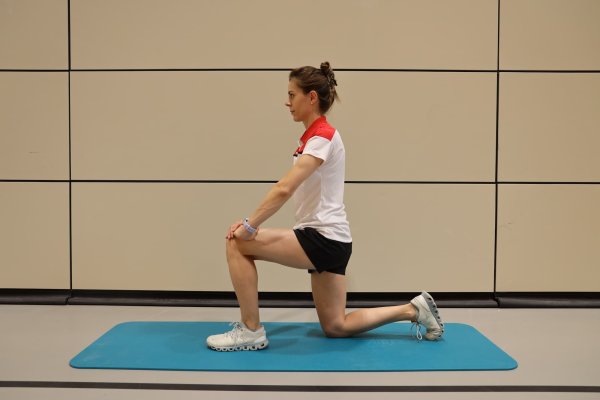
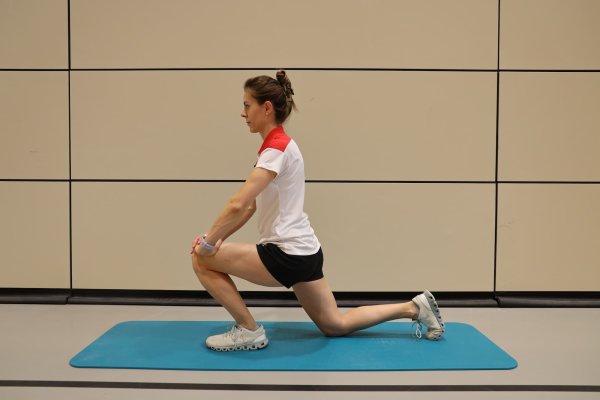
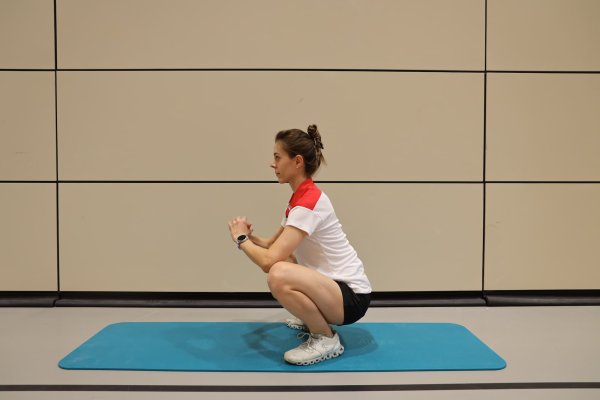
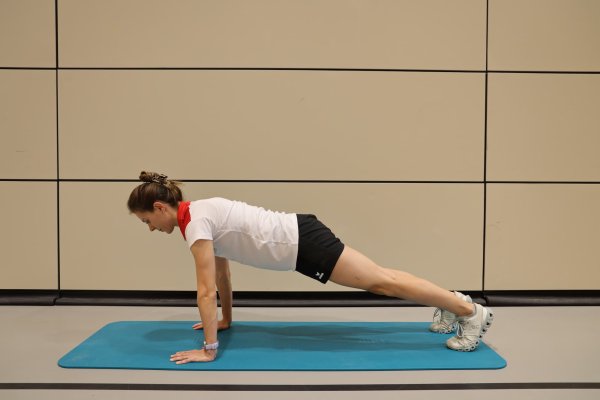
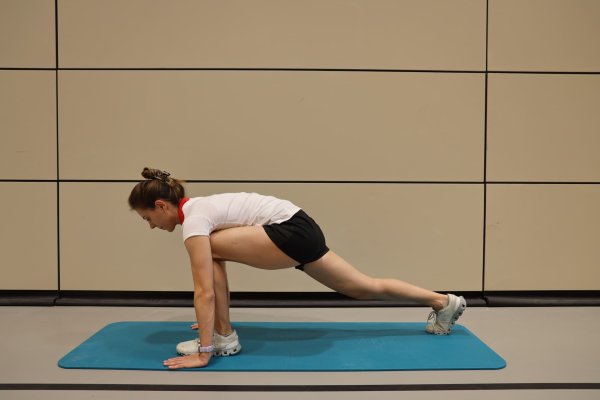
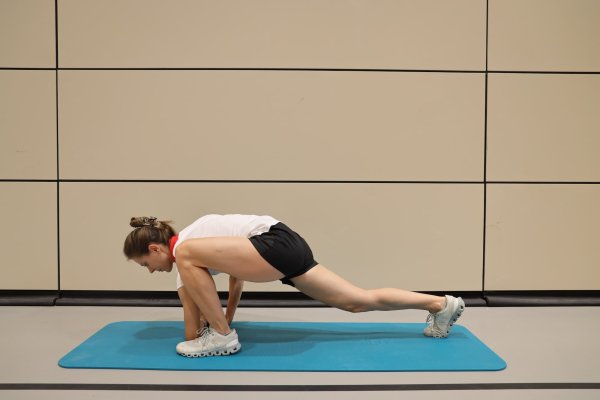
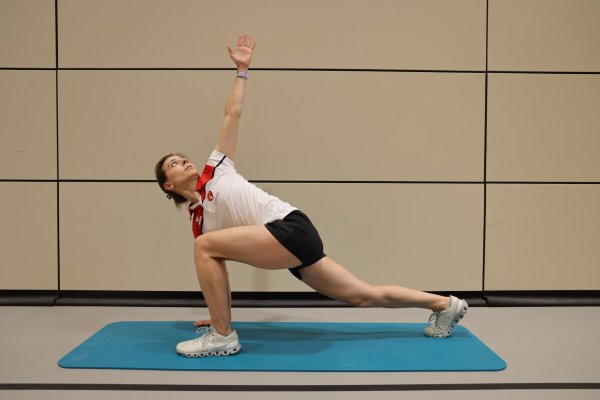
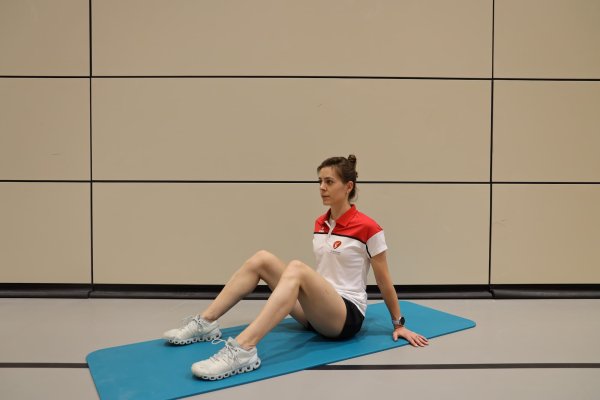
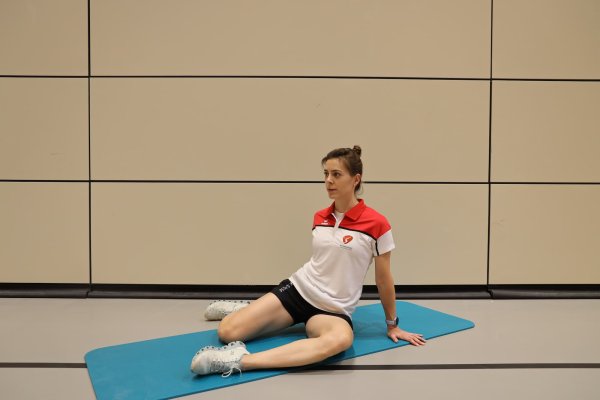
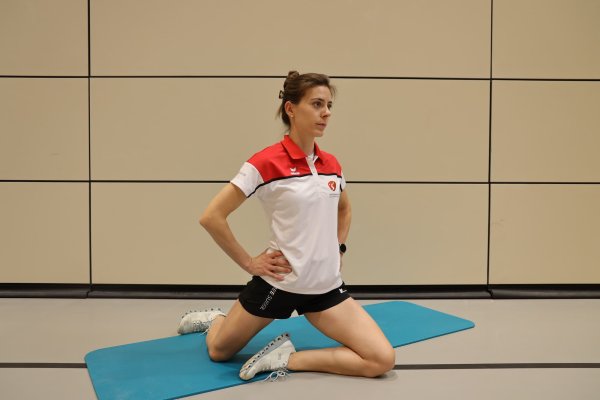
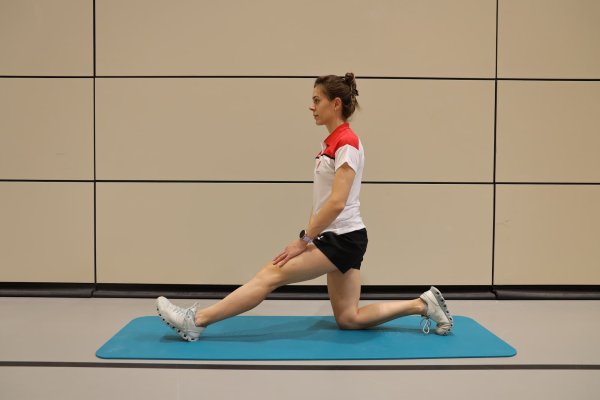
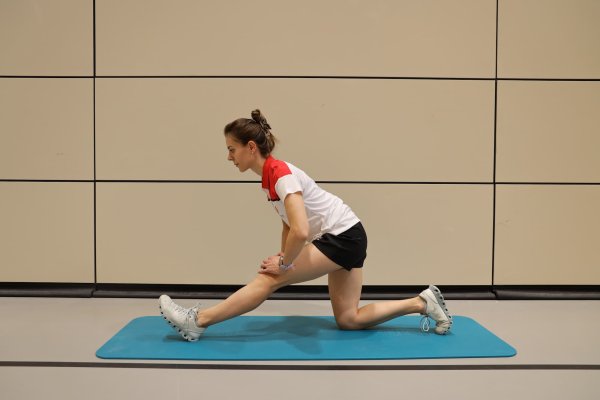
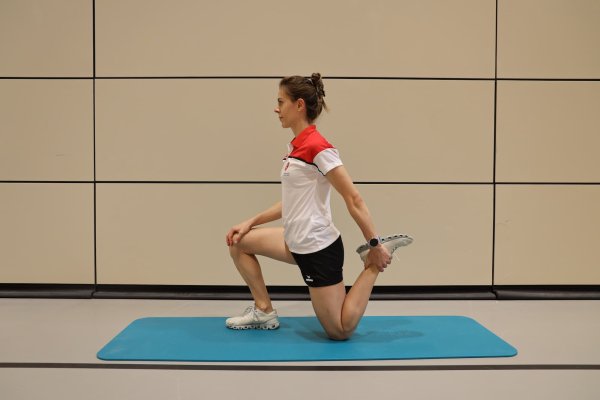
1. Ankle rocks – mobilising the ankle joint
(Images 1-2)
2. Deep squat hold - deep squat
(Image 3)
3. World's greatest stretch - Ausfallschritt + Rotation
(Images 4-7)
4. 90/90 hip switch – hip mobilisation
(Images 8-10)
5. Hamstring stretch – back of the thighs
(Images 11-12)
6. Quadriceps stretch – front of the thigh
(Image 13)
Focus: hips, legs, ankles
Lyrics
Stimulate circulation
Group work
Each participant moves freely in the hall/area to a specific song selection. The sports leader can specify various forms of movement (crossing legs, circling arms, crouching, touching the floor, hopping, hopping with one leg, etc.). As soon as the participants hear defined words in the song lyrics, they must perform a task announced by the sports leader:
- Air jump
- Sit on the floor briefly
- Touch the floor briefly with your stomach
- Greet/hug a partner
Example:
- Song choice: "dr Parkingmeter" by Mani Matter.
- Task:
- "20gi" = push-up;
- "Outo" = stretch jump;
- "Poscht" = touch the floor with your back.
1 music system incl. music (specific song selection)
Massage
Relaxation
Partner work
Groups of 2
The participants perform massages on their partner using an aid (e.g. tennis ball or throwing object). During the circular movements with the ball, the circumference (small-large) and the pressure (no pressure on joints) are varied.
Participant in supine position, massage by partner of:
- Front thigh muscles
- Abdominal muscles
- Chest muscles
- Arms
Participant in prone position, massage by partner of:
- Calf muscles
- Back thigh muscles
- Buttock muscles
- Back muscles
- Arms
Per group:
1 tennis ball
1 soft mat
Mat disposal
Fighting and roughhousing games
Group work
2-4 groups with 6-14 participants each
The group lines up behind a starting marker. There is a large soft mat in front of the group. On the start command, a binomial (possibly holding hands) or a single participant jumps onto the mat. After the jump, the next pair/participant is handed over, who in turn jumps onto the mat. The aim of mat jumping is to jump onto the soft mat in such a way that the mat is propelled as far forwards as possible. The winner is the group that gets their soft mat over a line or against a wall first. To ensure that the mat is not pushed further forwards when climbing down, the mat must always be left in the direction of the goal.
Per group:
1 soft mat (large)
1 marking cone/cap/painting stick