
Exercises (3302)
Dynamic stretching: calf muscles
Mobilisation of the joints / dynamic stretching
Individual work
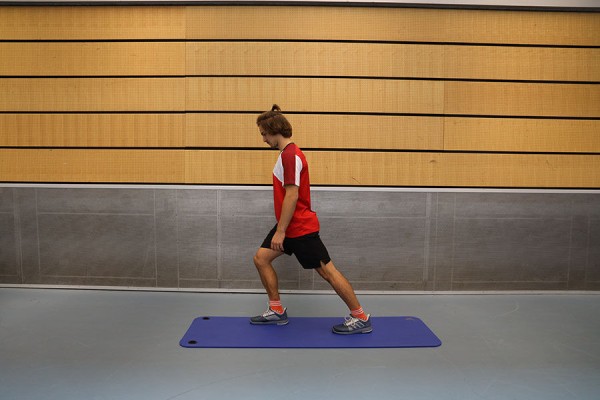
In a stepping position, both feet lie flat on the floor (front leg bent, back leg stretched - press the heel of the back leg against the floor), lean the upper body forwards in a rocking motion. The stretch can be intensified with a larger support. Then switch legs.
No material required
Dynamic stretching: calf muscles
Mobilisation of the joints / dynamic stretching
Partner work


Stand hip-width apart opposite your partner, tilt your upper body forwards and press your palms against the aid with your arms stretched out overhead (holding them up) (clamp the object together). Press your heels onto the floor.
Per group of 2:
1 ball ►baseball, blitzball/rugby/football, fistball, futsal/football, handball, FooBaSKILL, volleyball
1 stick ► floorball, intercrosse/lacrosse, Nordic walking
1 racket ►badminton/speedminton, smolball
1 throwing disc (frisbee) ►frisbee ultimate
1 elasticated rubber band/power tube/skipping rope/playing rope
1 gymnastics stick with elastic band
Dynamic stretching: calf muscles
Mobilisation of the joints / dynamic stretching
Partner work


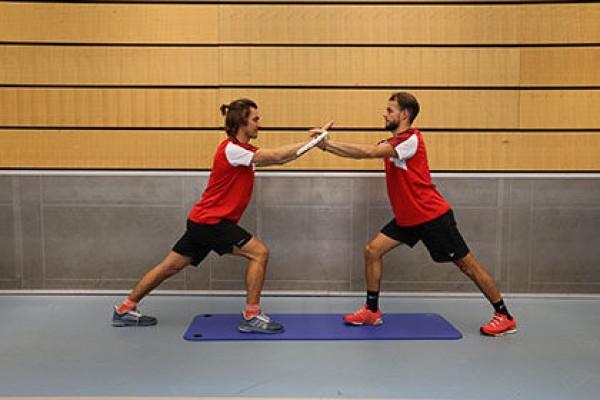


Lunge towards your partner. With outstretched arms, press your palms against the aid (pinch the object together) and press the heel of the back leg onto the floor. Bend and stretch your arms slightly to bend your upper body towards your hands/partner and support the dynamic stretching. Then switch legs.
Per group of 2:
1 ball ►baseball, blitzball/rugby/football, fistball, futsal/football, handball, FooBaSKILL, volleyball
1 stick ► floorball, intercrosse/lacrosse, Nordic walking
1 racket ►badminton/speedminton, smolball
1 throwing disc (frisbee) ►frisbee ultimate
1 elasticated rubber band/power tube/skipping rope/playing rope
1 gymnastics stick with elastic band
Dynamic stretching: calf muscles
Mobilisation of the joints / dynamic stretching
Individual work

From a shortened stride position, bend the back leg forwards in the knee joint so far that the knee rises above the tip of the foot (the tilt creates a stretch in the lower calf of the back bent leg - heels always remain on the floor). Then switch sides.
No material required
Dynamic stretching: calf muscles
Mobilisation of the joints / dynamic stretching
Individual work

With the leg slightly bent, place the toe of the foot on a small elevation (e.g. step) and press the heel down, rocking. The supporting leg is either also placed on the elevation (better variation) or underneath the elevation on the surface. Then switch sides.
No material required
Dynamic stretching: calf muscles
Mobilisation of the joints / dynamic stretching
Individual work
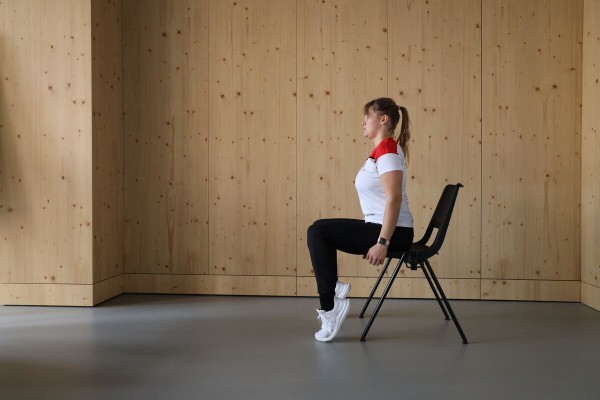
Sitting on a chair with your back straight, raise the heels of your legs as high as possible (legs only rest on the tips of your feet). Perform small rocking movements (raise and lower your heels).
1 (office) chair
Move one leg backwards in an alternating squat position
Power
Individual work
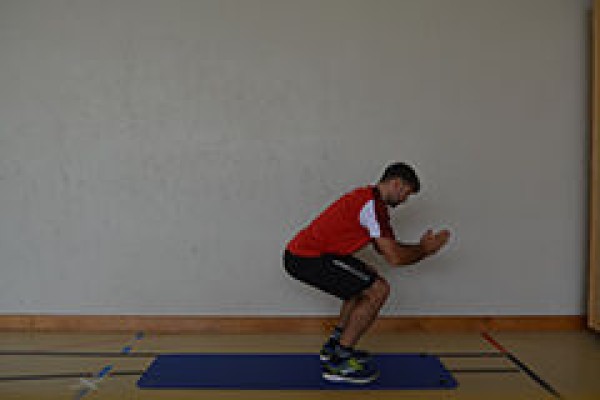
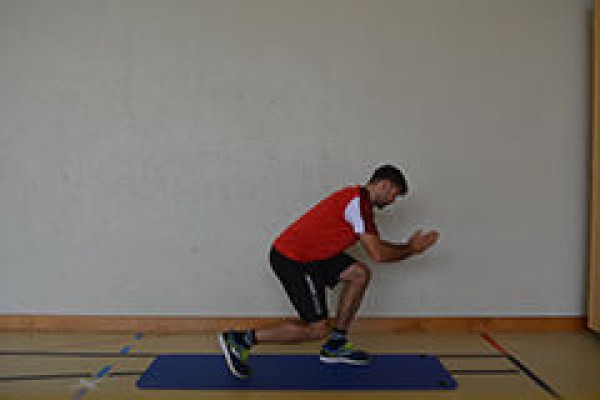
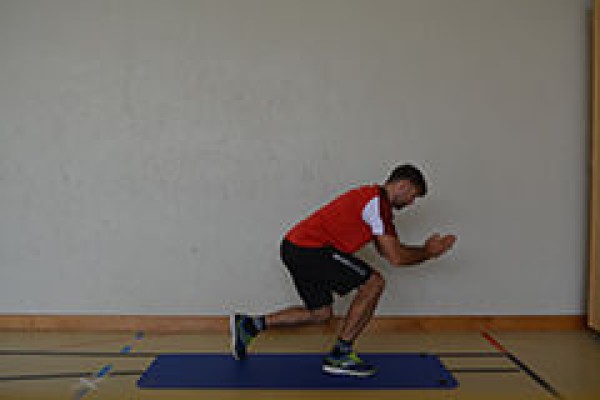
Get into a squat position (deep squat), alternating between moving one leg backwards (toes touching the floor behind the body) and back to the starting position.
Attention:
The starting position in the squat position always remains stable/unchanged.
Lighten:
Move your leg less far back.
Harden:
Tighten an elasticated band between your legs (mid-thigh height).
No material required
1 elasticated rubber band ► to make the exercise more difficult
Move one leg backwards in an alternating squat position
Power
Individual work
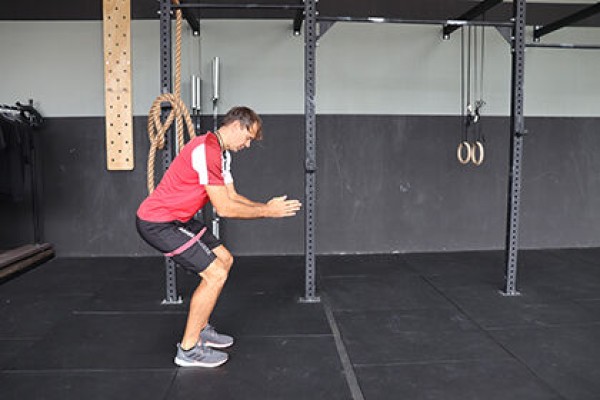
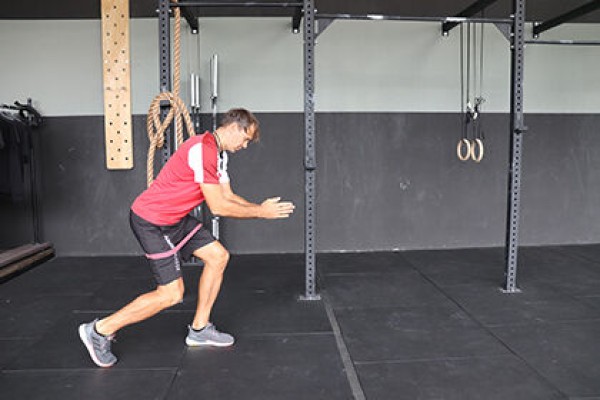
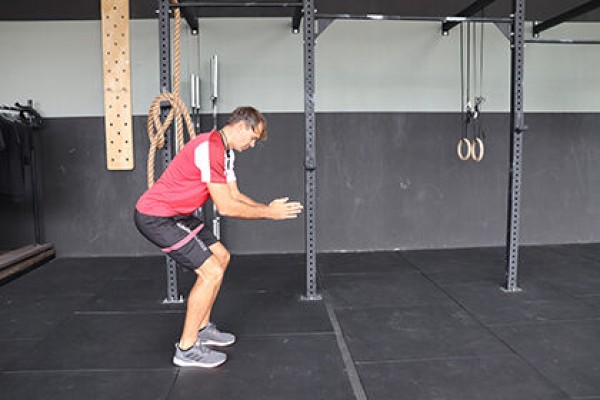
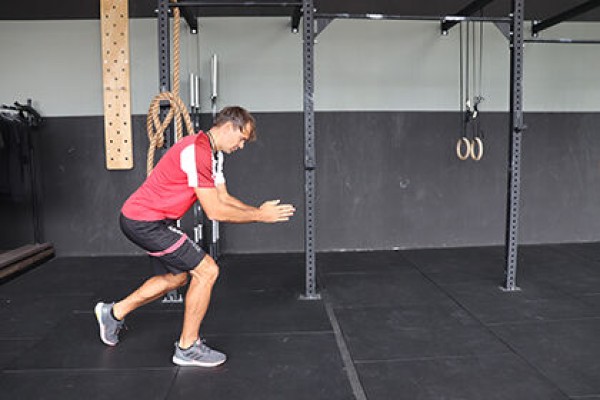
Knee bend position (deep squat) with an elasticated band stretched between the legs (mid-thigh height), alternate between moving one leg backwards (toes touching the floor behind the body) and back to the starting position.
Attention:
The starting position in the squat position always remains stable/unchanged.
Lighten:
Select an elastic band with less resistance.
Harden:
Select an elastic band with greater resistance.
1 elasticated rubber band
Move one leg backwards in a squat position alternating ► monster walk (backwards)
Power
Individual work
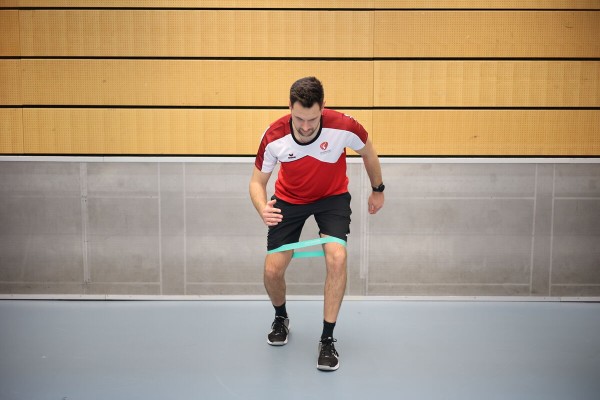
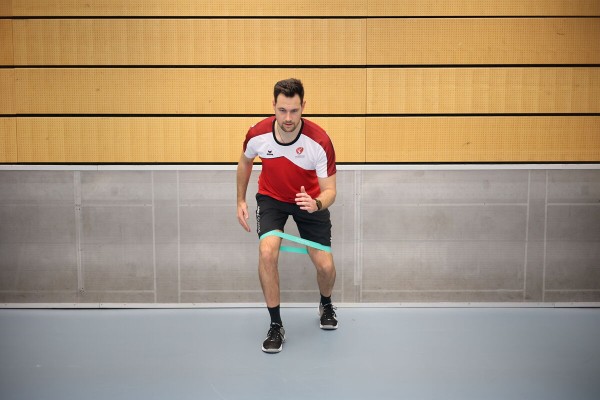
Get into a squat position (deep squat) with an elasticated band stretched between the legs (slightly above the knees), alternate between positioning one leg backwards (foot completely off the ground) and returning to the starting position.
Attention:
The starting position in the squat position always remains stable/unchanged.
Lighten:
Select an elastic band with less resistance.
Harden:
Select an elastic band with greater resistance.
1 mini-band
Move one leg backwards in squat position and stretch jump alternately
Power
Individual work
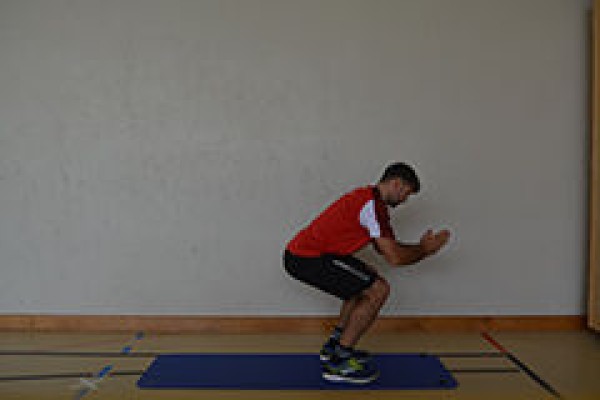


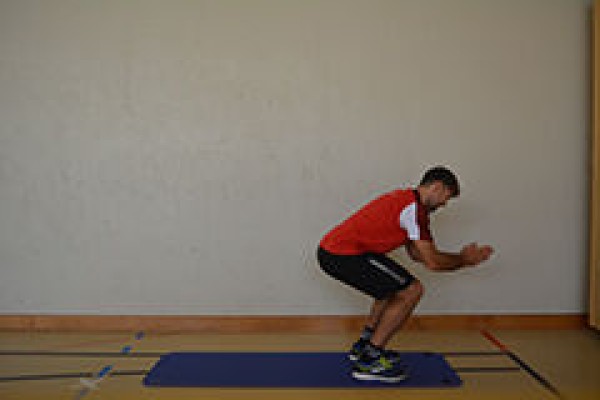
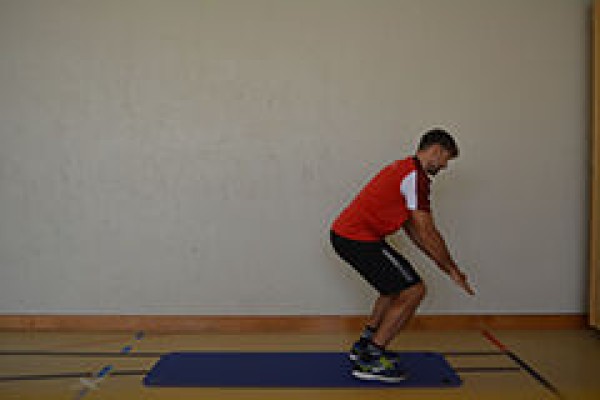
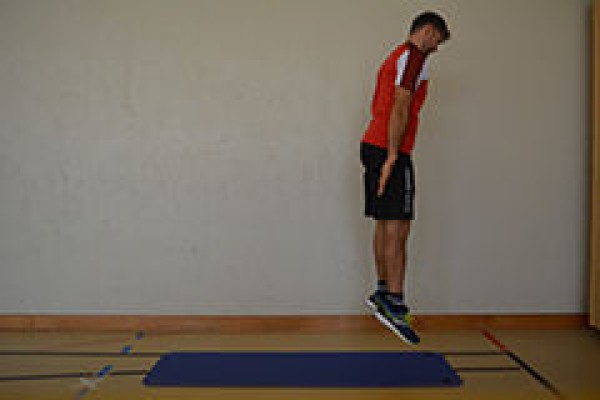
Squat position (deep squat) with arms bent in front of you (palms pressed against each other), alternately move one leg backwards (toes touching the floor behind the body) and back to the starting position, then perform a stretch jump (simultaneously stretch the arms and move them behind the body, palms facing backwards) and return to the starting position (squat position) to start the exercise from the beginning.
Attention:
Starting position in the squat position remains stable/unchanged when moving the leg backwards.
Lighten:
Move the leg less far backwards; stretch jump less high.
Harden:
Tighten an elastic band between the legs.
No material required
1 elasticated rubber band ► to make the exercise more difficult
Move one leg backwards in squat position and stretch jump alternately
Power
Individual work

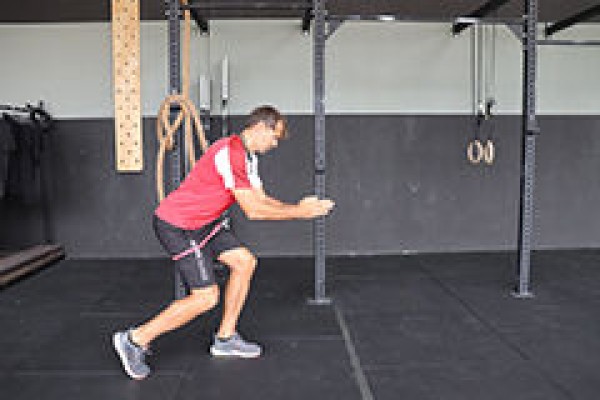


Squat position (deep squat) with arms bent in front of you (palms pressed against each other), with an elasticated rubber band stretched between your legs (mid-thigh height), alternately move one leg backwards (toes touching the floor behind the body) and back to the starting position, then perform a stretch jump (simultaneously stretch your arms and bring them behind your body, palms facing backwards) and return to the starting position (squat position) to start the exercise again.
Attention:
The starting position in the squat position remains stable/unchanged when moving the leg backwards.
Lighten:
Move the leg less far backwards; stretch jump less high; choose an elastic band with less resistance.
Harden:
Choose an elastic band with greater resistance.
1 elasticated rubber band
Move one leg backwards and back in single-leg stance (left) ► kick-back
Power
Individual work
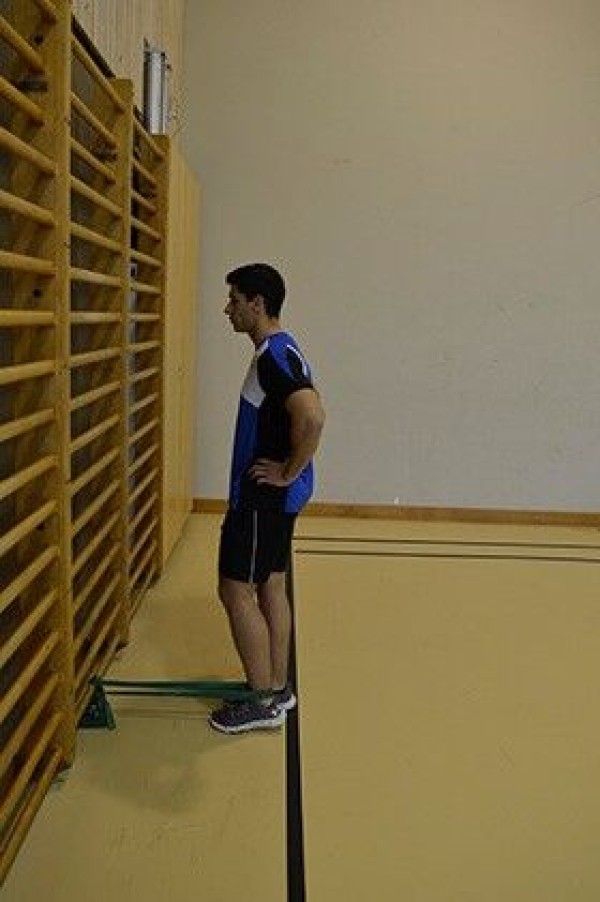
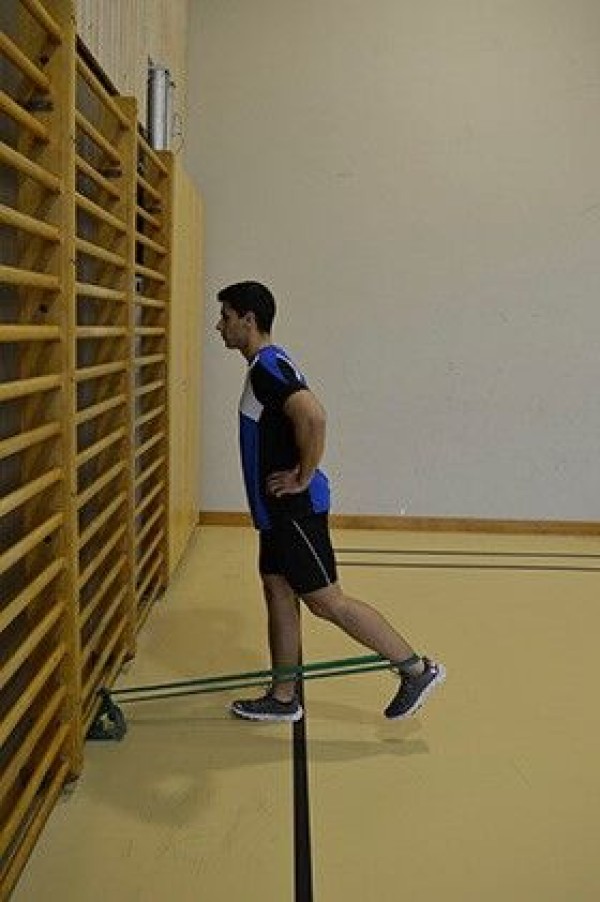
One-legged stand (right), upright position facing the wall bars (or e.g. a tree), tie the elastic band into a loop at ankle height on the wall bars (on the tree), step into the loop with the training leg (left), bend the leg slightly (lifted off the floor) backwards and return to the starting position.
Attention:
The upper body remains stable (arms can support themselves on the wall bars/tree).
Lighten:
Choose a rubber band with less resistance.
Harden:
Choose a rubber band with greater resistance.
1 elasticated rubber band
1 wall bar/tree
Move one leg backwards and back in single-leg stance (left) ► kick-back
Power
Individual work


Stand on one leg (right), with the free leg (left) only slightly raised off the floor, the body position is upright, stretch an elasticated band between the legs (place the band around the ankles). From this position, move the training leg (left) backwards (one-sided hip flexion), leaning the upper body slightly forwards. Then bring the leg and upper body back to the starting position.
Faciliter:
Choose an elastic band with less resistance.
Compliquer:
Choose an elastic band with greater resistance.
1 mini-band
Move one leg backwards and back in single-leg stance (right) ► kick-back
Power
Individual work
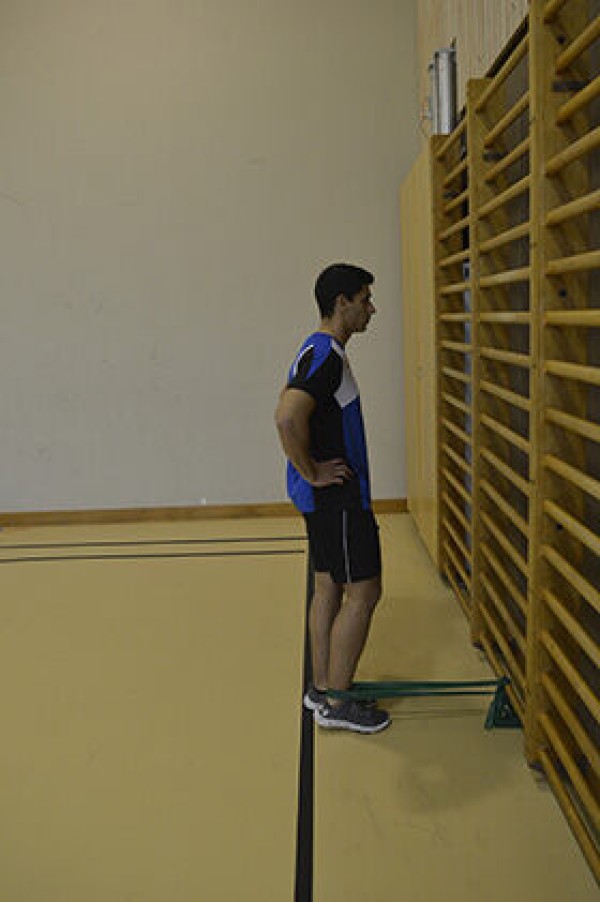
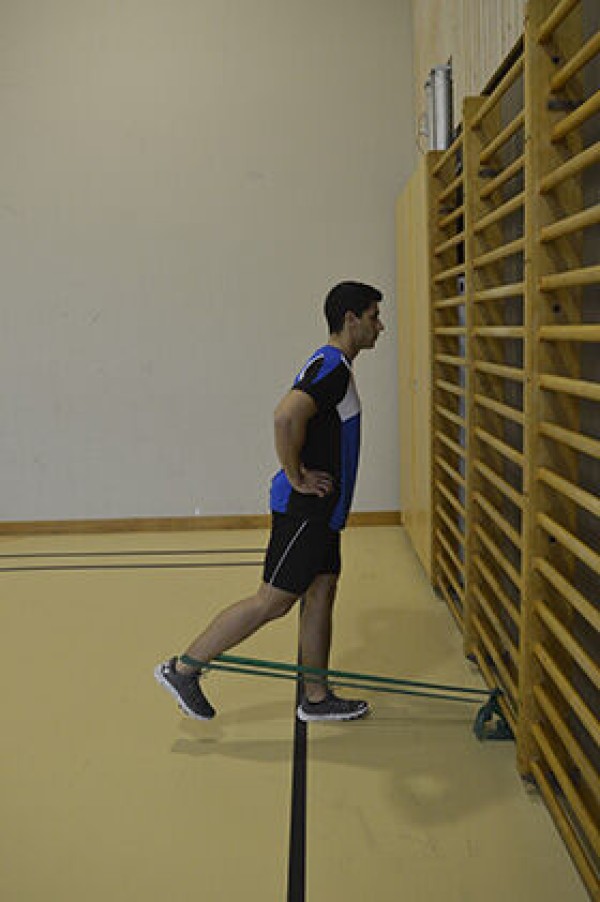
One-legged stand (left), upright position facing the wall bars (or e.g. a tree), tie the elastic band into a loop at ankle height on the wall bars (on the tree), step into the loop with the training leg (right), bend the leg slightly (lifted off the floor) backwards and return to the starting position.
Attention:
The upper body remains stable (arms can support themselves on the wall bars/tree).
Lighten:
Choose a rubber band with less resistance.
Harden:
Choose a rubber band with greater resistance.
1 elasticated rubber band
1 wall bar/tree
Move one leg backwards and back in single-leg stance (right) ► kick-back
Power
Individual work


Stand on one leg (left), with the free leg (right) only slightly raised off the floor, the body position is upright, stretch an elasticated band between the legs (place the band around the ankles). From this position, move the training leg (right) backwards (one-sided hip flexion), leaning the upper body slightly forwards. Then return the leg and upper body to the starting position.
Lighten:
Choose an elastic band with less resistance.
Harden:
Choose an elastic band with more resistance.
1 mini-band
Move one leg forwards in a squat position alternating ► monster walk (forwards)
Power
Individual work

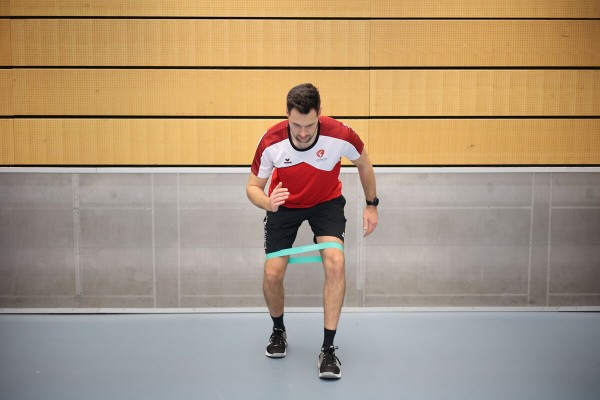
Get into a squat position (deep squat) with an elasticated band stretched between the legs (slightly above the knees), alternate between positioning one leg forwards (foot completely off the ground) and returning to the starting position.
Attention:
The starting position in the squat position always remains stable/unchanged.
Lighten:
Select an elastic band with less resistance.
Harden:
Select an elastic band with greater resistance.
1 mini-band
Alternating one leg to the side while standing ► tall monsterwalk (sideways)
Power
Individual work


Stand upright shoulder-width apart, with an elasticated rubber band stretched between the legs (place the band around the ankles), alternately move one leg to the corresponding side (place the foot completely down) and return to the starting position.
Lighten:
choose a rubber band with less resistance.
Harden:
choose a rubber band with greater resistance.
1 mini-band
Move one leg to the side in an alternating squat position ► monster walk (sideways)
Power
Individual work


Squat position (deep squat), with an elasticated band stretched between the legs (slightly above the knees), alternately move one leg to the corresponding side (put the foot down completely) and return to the starting position.
Attention:
The starting position in the squat position always remains stable/unchanged.
Lighten:
Select an elastic band with less resistance.
Harden:
Select an elastic band with greater resistance.
1 mini-band
Single-leg extension and flexion of the leg whilst raising and lowering the upper body whilst standing (Romanian deadlift) (left) ► single-leg Romanian deadlift
Power
Individual work
Stand upright on one leg (left), with the knee slightly bent. Hold your weight in the opposite hand. Keeping your back straight, bend forwards from the hips whilst the free leg (right) moves backwards and upwards as a straight extension of your upper body. When your upper body is almost parallel to the floor (standing balance), actively push back through the heel of your standing leg (left) and your glutes to return to the upright one-legged stance.
Attention:
The pelvis must not rotate towards the side of the free leg (right) (both hip bones should always point parallel to the floor, like headlights).
No rounding of the lower back.
Keep the shoulder blades pulled back and down.
The upper body and leg must maintain a straight line.
Lighten:
"Kickstand" variation: Place the tip of the foot of the back leg (right) on the floor, slightly offset, to act as a support (90 per cent of the load at the front, 10 per cent at the back).
Perform without additional weight (using only your own body weight).
Rest one hand lightly against a wall or pole.
Harden:
Place your standing leg on an Airex cushion/balance cushion.
Significantly increase the additional weight.
Gently open/rotate your pelvis out of the standing balance position and return to the standing balance position.
1 dumbbell/kettlebell
1 wall/balance beam ► makes the exercise easier
1 Airex mat/balance cushion ► makes the exercise more difficult (balance component)
1 dumbbell/kettlebell ► makes the exercise more difficult (additional weight)
Single-leg extension and flexion of the leg whilst raising and lowering the upper body whilst standing (Romanian deadlift) (right) ► single-leg Romanian deadlift
Power
Individual work
Stand upright on one leg (right), with the knee slightly bent. Hold your weight in the opposite hand. Keeping your back straight, bend forwards from the hips whilst the free leg (left) moves backwards and upwards as a straight extension of your upper body. When your upper body is almost parallel to the floor (standing balance), actively pull yourself back into the upright one-legged stance using the heel of your standing leg (right) and your glutes.
Attention:
The pelvis must not rotate towards the side of the free leg (left)(both hip bones should always point parallel to the floor, like headlights).
No rounding of the lower back.
Keep the shoulder blades pulled back and down.
The upper body and leg must maintain a straight line.
Lighten:
"Kickstand" variation: Place the tip of the rear foot (left) on the floor, slightly offset, to act as a support (90% of the load at the front, 10% at the back).
Perform without additional weight (using only your own body weight).
Rest one hand lightly against a wall or pole.
Harden:
Place your standing leg on an Airex cushion/balance cushion.
Significantly increase the additional weight.
Gently open/rotate your pelvis out of the standing balance position and return to the standing balance position.
1 dumbbell/kettlebell
1 wall/balance beam ► makes the exercise easier
1 Airex mat/balance cushion ► makes the exercise more difficult (balance component)
1 dumbbell/kettlebell ► makes the exercise more difficult (additional weight)
One-legged star tapping ► star excursion balance
Power
Individual work
Stand on your slightly bent supporting leg, with your hands on your hips. Using the tip of the foot of your other leg (the ‘working’ leg), gently tap three points on the floor in turn, without shifting your weight onto them: 1. Far forward, 2. Far to the side, 3. Diagonally backwards and outwards. The supporting leg works continuously through the knee and ankle joints to maintain balance. Afterwards, chenge sides.
Attention:
Do not shift your weight onto the tapping leg (just tap gently, as if on an eggshell).
The supporting knee remains stable along the leg’s axis at all times and does not collapse inwards or outwards.
The upper body remains upright and does not fall into hyperlordosis or hyperkyphosis.
During the star movements, the knee should not extend beyond the tips of the toes.
Lighten:
Reduce the tapping radius (Choose points closer to your body).
Between changes of direction, briefly place your free foot on the floor next to your supporting foot.
Rest one hand lightly against a wall or marker stick.
Harden:
Stand on an Airex cushion/balance cushion or a rolled-up mat.
Hold a kettlebell/dumbbell in front of your chest in the goblet grip.
Do not focus on a fixed point, but actively look around the room.
Increase your range of movement (larger radius of movement).
1 wall/balance beam ► makes the exercise easier (reduces balance)
1 Airex cushion/balance cushion ► makes the exercise more difficult (increases balance)
1 kettlebell/dumbbell ► makes the exercise more difficult (additional weight)
Single leg jump (left) ► hop
Power
Partner work
1 trainee & 1 helper ► note change of position
(= double the time required; for lesson planning see organization strength: implementation info button)
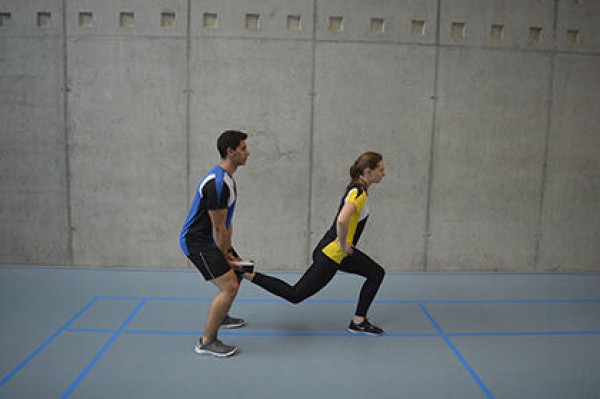
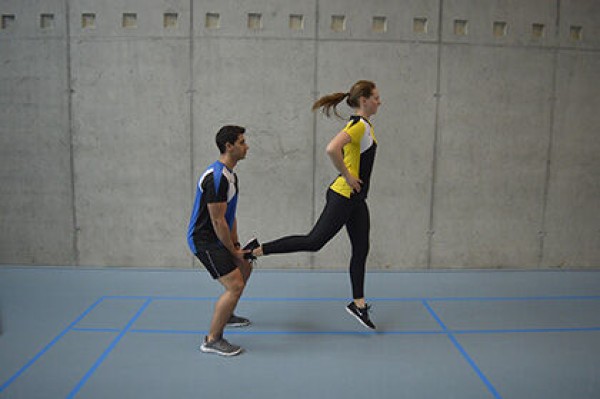
Trainee: Left standing leg bent, right leg also bent but held high, arms supported on the hips, upper body upright, perform single-leg jumps into the air.
Partner: Holds the right foot (the leg held high) of the active participant and accompanies the movement.
Attention:
Knee of the supporting leg always remains behind the tip of the foot and centred over the foot (no tipping inwards), cushion the landing over the entire foot, concentrated work (prevent injuries).
Lighten:
Larger angle in the knee (more upright position) before the jump.
Harden:
Smaller angle in the knee (lower position) before the jump; additional weight (on the shoulders).
1 weight vest/sandbag ► make the exercise more difficult (additional weight)
Single leg jump (right) ► hop
Power
Partner work
1 trainee & 1 helper ► note change of position
(= double the time required; for lesson planner see organization force: Info button execution)
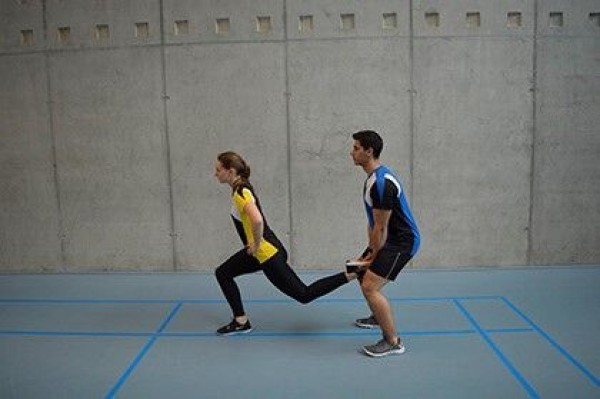
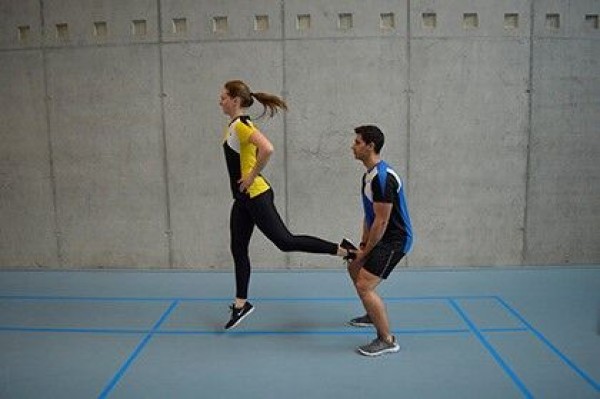
Trainee: Right standing leg bent, left leg also bent but held high, arms supported on the hips, upper body upright, perform single-leg jumps into the air.
Partner: Holds the left foot (the leg held high) of the active participant and accompanies the movement.
Attention:
Knee of the supporting leg always remains behind the tip of the foot and centred over the foot (no tipping inwards), cushion the landing over the entire foot, concentrated work (prevent injuries).
Lighten:
Larger angle in the knee (more upright position) before the jump.
Harden:
Smaller angle in the knee (lower position) before the jump; additional weight (on the shoulders).
1 weight vest/sandbag ► make the exercise more difficult (additional weight)
Einbeinstand (left) ► single leg stability
Power
Individual work
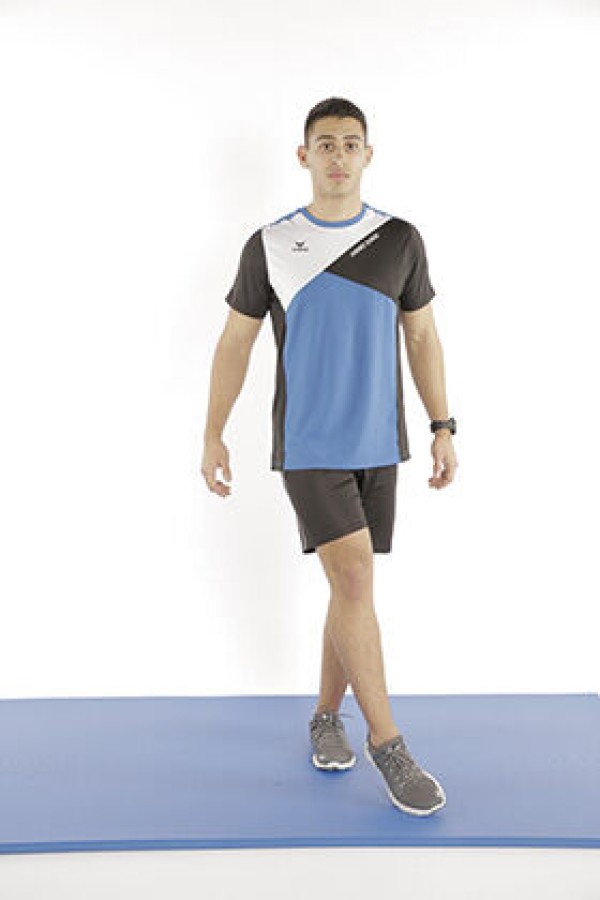
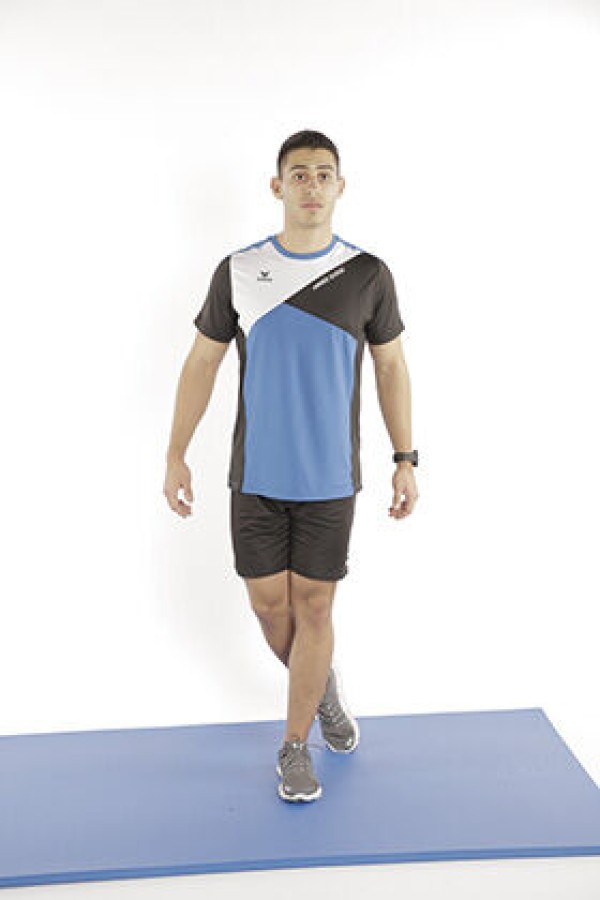
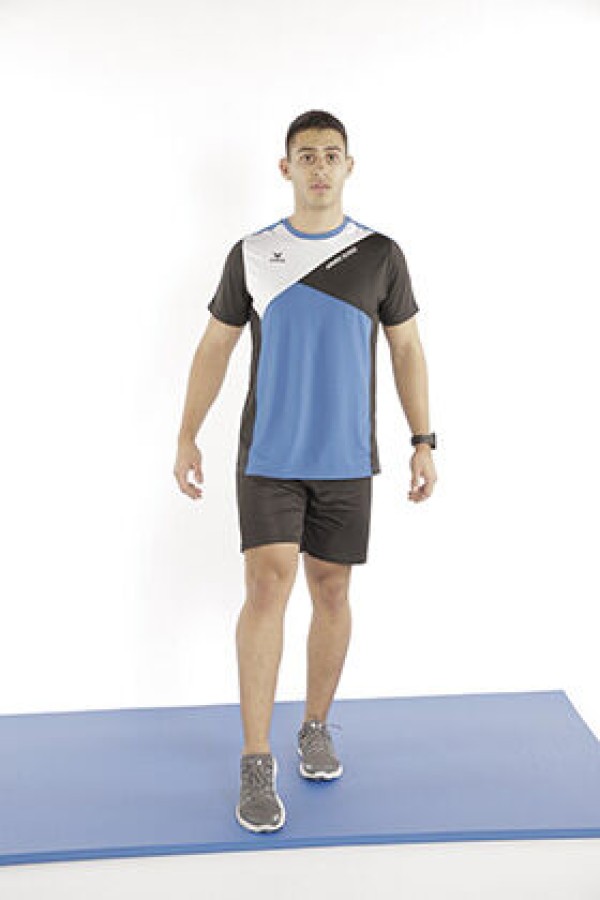

One-legged stand, standing leg (left) slightly bent, bring the other leg around the body in the shape of a pentagonal star (alternatively, only tap the corners of the star with the foot or always bring the foot to the centre in between).
Attention:
Keep the upper body upright (maintain balance).
Lighten:
Bend the supporting leg less (greater angle in the knee).
Harden:
Bend the supporting leg more (smaller angle in the knee); hold additional weight (on the leg or on the chest/shoulders, in the hands).
Variant:
Complete the exercise while jumping.
1 weight cuff/weight vest/weight disc/(medicine) ball/sandbag/fighting backpack/2 dumbbells ► make the exercise more difficult (additional weight)
Einbeinstand (left) ► single leg stability balance board
Power
Individual work

One-legged stand (left) on the balance board (board on the semicircular wedges, wide side of the board in front of the body), tilt forwards/backwards without the balance board touching the floor.
Attention:
Exercise is relatively difficult, at the beginning possibly against a wall for support or with the support of a partner.
Lighten:
Stand on the half-round wedges (without balance board); stand on the balance board with both legs.
Harden:
Balance board on the roller (instead of on the wedges).
Variant:
Tilt the narrow side of the board in front of your body, sideways, without the balance board touching the floor.
1 balance board
2 wedges (semicircular)
1 roller ► to make the exercise more difficult