
Exercises (660)
Running memory
Increase pulse
Group work
4 groups
A large rectangle laid out with marker cones serves as a circuit. A set of memory cards is laid out in each corner. A group positions itself in each corner. At the start of the game, each group may reveal two cards from their set. If they match, two more may be revealed. Otherwise, the whole group has to run a lap around all the marker cones. Which team is the first to find all the pairs?
Variant:
Specify the type of movement (e.g. forwards, backwards, hopping on one leg, crab-walking, etc.).
4 sets of memory cards
4 marker cones
Running ladder
Stimulate circulation
Group work
4-8 participants per group
The running ladder is used for coordination and speed-strength training and improves running style. The easy-to-perform exercises promote mobility and muscular balance.
The running ladder should be familiarised with by means of various exercises in smaller groups. It is advisable to keep the upper body, especially the head, upright during all exercises. The exercises should be performed with concentration and in a rested state. You should start with slow and technically clean movements before increasing the speed.
- Left foot field 1 - Right foot field 2 - Left foot field 3 - Right foot field 4
- Left foot field 1 - Right foot field 1 - Left foot field 2 - Right foot field 2 (next run right foot first)
- Left foot/right foot field 1 - Spreading step (jump) Left foot/right foot outside the ladder between fields 1 and 2 - Left foot/right foot field 2
- Spreading step Left foot/right foot outside the ladder field 1 - in the jump Step left foot/right foot outside the ladder between bays 1 and 2
- Spreading step left foot/right foot outside the ladder between bays 2 and 3
- Spreading step left foot/right foot outside the ladder between bays 1 and 2
- Spreading step left foot/right foot outside the ladder between bays 2 and 3
- Front to the side: Right foot square 1 - Left foot square 1 - Right foot square 2 - Left foot square 2 (next run: front other side/left foot ahead)
- Front to side: Right foot square 1 - Left foot square 1 - Right foot outside square 1 (forwards/backwards)- Left foot outside square 1 - Right foot square 2 - Left foot square 2 (next run: other side, i.e.h. forwards / backwards)
- Knee lever up: Knee right lift foot right field 1 - foot left outside of ladder field 1 - knee right lift foot right field 2 - foot left outside of ladder field 2
- Foot left field 1 - foot right field 1 - foot left outside of field 2 - foot right field 2 - foot left field 2 - foot right outside of field 3 - foot left field 3 - foot right field 3
- 2 fields forwards, 1 field backwards: Foot right field 1 - Foot left field 1 - Foot right field 2 - Foot left field 2 - Foot right field 1 - Foot left field 1 - Foot right field 2 - Foot left field 2 - Foot right field 3 - Foot left field 3 - Foot right field 2 - Foot left field 2 (next run Foot left ahead)
- Further exercises/variants under: soccerdrills
Variant:
After the coordination ladder, the participants perform a few double jumps before completing a short sprint. They then rejoin the group.
Per group:
2 running ladders
3 hurdles or 6 colouring sticks and 3 ropes ►Variant
Living stopwatch
Increase pulse
Group work
2 teams
A team transports game ribbons (or balls) from one side of the pitch to the other. The sports director can specify the method of transport (e.g. pinch the ribbon between the knees, pinch the ribbon between the feet and move by hopping). Only one ribbon may be carried per run. This team defines the time available for the other team to score points. As soon as all the game ribbons have been transported to the other side, the run ends and the teams swap roles. There are various ways to collect points:
Throwing task:
- Hitting a basketball hoop from outside the trapeze
- Throwing a Frisbee from a long bench
- Throwing tennis balls into a box
Strength exercise:
- 10 push-ups, 10 trunk bends and 10 stretch jumps = 1 point
- 50 x rope jumps = 1 point
Course:
- Complete obstacle course. 1 lap = 1 point
- Complete the running lap. 1 lap = 1 point
x game ribbons (or balls)
Living stopwatch
Increase pulse
Group work
2 teams
Half of the participants line up in the centre of a square equipped with a rope (jumpers). The remaining participants spread out evenly in the corners of the running lap (runners). At a signal from the sports director, the first runner starts to the next corner, where he sends the second runner onto the course with a handshake. He in turn joins the waiting group at the back. The runners run until each participant is back at the starting point, thereby setting the time available for the rope jumpers in the centre of the square. From the start command, the jumpers in the centre count their jumps. They collect points for their team for each revolution of the rope (e.g. 20 jumps = 1 point).
Which team scores more points in their round?
For half of the participants:
1 skipping rope
4 cones
Living stopwatch
Increase pulse
Group work
2 teams
Half of the participants line up in the centre of a square in two columns of one, facing each other and equipped with a ball (passers). The remaining participants spread out evenly in the corners of the running circle (runners). At a signal from the sports director, the first runner starts to the next corner, where he sends the second runner onto the track with a handshake. He in turn joins the waiting group at the back. The runners run until each participant is back at the starting point, thereby setting the time available for the passers in the centre of the square. From the start command, the foremost passer in the column passes the ball to the player on the opposite side. After the pass, he runs to the other side and stands behind the waiting group. Each complete pass by foot or hand (the sports director may define rules such as Ground pass or receiving the ball between two specific lines) scores one point. Which team scores more points during their pass?
Variant I:
Define different ways of transporting the ball for the group in the centre (instead of passes):
- Ball (e.g. medicine ball or gym ball) medicine ball or gymnastics ball) in a high hold
- Transport the ball on your thighs in a four-footed gait
- Tuck the ball between your feet and bounce
Variant II:
The runners carry/lead a ball and pass it to the next runner in the corner:
- Bounce the ball
- Dribble the ball with their feet
- Roll the ball with their hands
1 ball (football, volleyball, basketball or handball)
4 cones
1 medicine or exercise ball
1 additional ball
Ladder relay
Increase pulse
Group work
4-6 participants per group
One ribbon per team is attached to the bottom rung of the wall bars. The first participant in the group runs to the rung, removes the ribbon and attaches it one rung higher. He then takes over from the next runner, who in turn attaches the ribbon higher up. Which group attaches the ribbon to the top rung first?
Variant:
Hanging the ribbon from the bottom to the top and back to the starting position)?
For each group:
1 play bar
1 wall bars
Push-up worm
Stimulate circulation
Group work
4-6 participants per group
The group members stand in front of each other in the push-up position with their feet resting on the shoulders of the person behind them. The last member of the group stands in an upright position and leads the group around a defined point (e.g. around a turnaround, to the hall wall or over a certain line) and back.
Per group:
2 colouring sticks/marking cones/caps ►start and reversal mark (optional)
Light-Contact
Stimulate circulation
Legwork:
- Two participants are opposite each other. Participant A moves sideways with Chassé steps, participant B constantly tries to stay opposite their partner. After the roles have been swapped, it is also possible to move in all directions. Contact can be trained by having the fists of the leading hand of both participants touch slightly with each step.
- Two participants are opposite each other. Participant A takes 1-3 steps forwards, participant B tries to retreat without delay. As soon as A stops, the partner may attack 1-3 steps. The exercise is performed without punches, the hands are in a boxing position or clasped behind the body.
- Torero: The participants face each other at a slight distance. Participant A stretches his arm forwards and runs towards participant B (the fist is aimed at the opponent's forehead). Before the attacker catches the defender, participant B dodges to the side (outer side of participant A's arm).
Evasive manoeuvre:
- Duck avoidance: Participant A performs a straight punch (target opponent's forehead), Participant B ducks under the punch.
- Rolling avoidance: Participant A throws a slap/side-hook, Participant B rolls out the punch with an upper body movement.
- Lateral avoidance: Participant A performs a straight punch, participant B avoids to the outside of the partner's punching hand.
Defensive behaviour:
- From a standing position, participant A performs a single punch, participant B avoids by avoiding the upper body.
- From a standing position, competitor A performs a single strike, competitor B defends by blocking (defence with the arms).
- From a standing position, competitor A performs a single strike, competitor B evades by taking steps.
Competition:
- Both participants try to touch their opponent on the shoulder (note: only from the outside, not crosswise) and on the knees. After a hit, both participants move back and touch a defined line (e.g. volleyball sideline) before attacking again.
- one-touch: Both participants try to touch each other (excl. forearms, incl. forehead). With each hit, a defined line (e.g. volleyball line) is touched before the fight continues.
No material required
Light-Contact: Sensitisation level 1-3
Stimulate circulation
Partner work
Stage 1:
Touch in a controlled manner (an immobile target) from a standing position: Participant A puts his hands behind his back, participant B touches him with light blows to the stomach, shoulder and forehead. Participant A tries to keep his eyes open and gives feedback if the blow was too strong or missed.
Stage 2:
Controlled touching from a standing position (a moving target). Participant A puts his hands behind his back, participant B touches him with light blows to the stomach, shoulder and forehead. A tries to keep his eyes open and gives feedback if the blow was too strong or missed. The distance is constantly readjusted between the individual hits: Participant A takes two steps in any direction after each punch, participant B must follow.
Stage 3:
Both participants face each other in a boxing stance. Participant B touches his partner on the forehead with light blows. After participant A has felt the hit, he immediately counters by extending his arm towards participant B's forehead. This verifies whether participant B immediately goes back into cover/the defence position after the blow. After some time, swap roles.
Participant:
1 pair of boxing gloves
Light-Contact: Sensitisation level 4-6
Stimulate circulation
Partner work
Stage 4:
Two punches are connected fluently: From a standing position, competitor B attempts to connect two punches fluently and touch his opponent with both. After the series of punches, competitor A counters by taking one or two steps.
Stage 5:
Multiple punches to a moving target: Competitor A keeps his hands in the basic position and moves slowly and constantly in all directions, but does not actively defend. Participant B tries to touch his opponent as often as possible in succession and connect several punches. From time to time (e.g. after approx. 8 hits), participant A counters to check whether participant B is covered. After some time, the roles are switched.
Stage 6:
Adjust the distance to a fast-moving target and control the (punch) hardness: Participant A is constantly on the move and tries to dodge the punches from participant B using footwork. The defender gives feedback if the punch was too strong. After some time, the roles are switched.
Participant:
1 pair of boxing gloves
Line run with cube
Increase pulse
Group work
4-6 participants per group
6 lines are defined. The runner whose turn it is rolls the dice. According to the result, he must run to the corresponding line and back again.
Variant:
With two dice. The lower number indicates the repetitions, the higher number the line.
Per group:
1-2 cubes
Line support ball
Stimulate circulation
Group work
2 teams
Both teams try to place the ball behind a defined goal line in the opponent's half of the pitch. A player may run with the ball until an opponent touches him on the back. He must then pass the ball to a team-mate (no throwing). This ball exchange must take place within three seconds, otherwise possession of the ball changes.
Variant:
The participants have one or more game ribbons tucked into their trousers (approx. 2/3 visible). If the ball carrier's ribbon is snatched, he must give the ball to the opposing team.
1 ball (e.g. foam/softball, blitz ball, rugby)
x game ribbons/leashes ►team identification
Participant:
1-3 game ribbons ►Variant
Lyrics
Stimulate circulation
Group work
Each participant moves freely in the hall/area to a specific song selection. The sports leader can specify various forms of movement (crossing legs, circling arms, crouching, touching the floor, hopping, hopping with one leg, etc.). As soon as the participants hear defined words in the song lyrics, they must perform a task announced by the sports leader:
- Air jump
- Sit on the floor briefly
- Touch the floor briefly with your stomach
- Greet/hug a partner
Example:
- Song choice: "dr Parkingmeter" by Mani Matter.
- Task:
- "20gi" = push-up;
- "Outo" = stretch jump;
- "Poscht" = touch the floor with your back.
1 music system incl. music (specific song selection)
Mat sweeping
Stimulate circulation
Group work
2 teams
The mats are spread out in the hall, with one half lying on top with the wrong side up. One team now tries to turn the "right" side of the mats up, while the other team takes care of the mats on the other side. After each reversed mat, the team must change places and move on to another mat. The winner is the team that is able to turn more mats to their side after a certain playing time.
Variant:
Additionally large soft mats can be used, which may result in more points.
x soft mats (small)
x soft mats (large) ► Variant
Mat run
Stimulate circulation
Group work
The participants run in a criss-cross pattern around the mats (committee tents) distributed around the hall (in the grounds). Various forms of movement (e.g. circling arms, crossing legs, etc.) are integrated independently or according to the instructions of the sports leader. As soon as the sports leader calls out a number, all participants spread out on the mats (committee tents) according to the number called out. Whoever remains performs an additional task (e.g. a strength exercise such as 5 push-ups). If the number of people on the mat does not correspond to the number specified by the sports leader, these participants must also perform the additional task (excess participants should therefore be sent away).
x Soft mats (small)/firing tents (for in the field)
Mat jumping
Increase pulse
Group work
8-14 participants per group
The group lines up behind a starting marker. There is a large soft mat in front of the group. On the start command, a binomial (grasping hands) jumps onto the mat. After the jump, it is the next pair's turn to jump onto the mat (flying change after leaving the mat or clapping off the next binomial). The aim of mat jumping is to jump onto the soft mat in such a way that the mat is pushed as far forwards as possible. The winner is the group that gets their soft mat over a defined line or against a wall first. To prevent the mat from being pushed further forwards when climbing down, the mat must always be left in the direction of the goal.
Variant:
The participants jump onto the mat individually.
Per group:
1 soft mat (large)
1 colouring stick
Mat relay
Increase pulse
Group work
4-6 participants per group
One participant at a time sits on the mat (slippery side of the mat at the bottom) and is pulled round a turn by another participant. Back at the starting position, the positions are switched and the participant who was sitting on the mat pulls the next participant in the group.
Which group was the first to transport all participants sitting on the mat around the turning point and back?
Per group:
1 soft mat (small)
2 colouring sticks
Mat hiking
Increase pulse
Group work
6-8 participants per group
The participants sit under the mat (facing the target). The mat is now guided forwards with the help of the hands, whereby the sitting positions must always be changed (i.e. after the mat has passed over them, the participants must stand up and sit down again in front of the group in order to transport the mat further). Which group will be the first to cross the finish line?
Per group:
1 soft mat (small)
Memory relay
Increase pulse
Group work
4-5 participants per group
A memory sheet with signs/symbols (e.g. degree signs, circle, square, etc.), pictures (e.g. tree, star, house, etc.) or formulae (e.g. a2+b2=c2, 4+5x3=19, etc.) is located at the turning point. The runners memorise as many fields as possible so that they can enter them on a blank answer sheet at the start. The next runner is therefore well advised not to start immediately, but to communicate with the previous runner to clarify the status of the solution process. The first group to complete all the fields on the answer sheet correctly wins the relay.
Per group:
1 solution sheet
1 answer sheet
Writing materials
Human gates
Increase pulse
Group work
Groups of 2
Two players form a team and play against another team of two. One player from each team stands hip-width apart to form a goal (define playing areas). The inverted stick can be used as a defence aid. The other two players play against each other on the field and try to score a goal. At a signal from the game leader (e.g. whistle or shout), the players and "human goals" swap roles. In this form of the game, it is important to diligently switch opponents.
Variant:
The new "goal" remains in place when the roles are switched.
Pro Tn:
1 floorball stick
1 floorball
Mobilisation
Mobilisation of the joints / dynamic stretching
Individual work
Mobilisation of the following joints:
- Ankle
- Knee
- Hip
- Spine
- Shoulder
- Elbow
- Wrist
- Cervical vertebra
Variant:
In place of the sports leader, one participant gives the exercise. After each exercise, another participant takes on the role of leader.
No material required
Mobilisation
Mobilisation of the joints / dynamic stretching
Partner work
Mobilise the following joints together with your partner:
- Ankle
- Knee
- Hip
- Spine
- Shoulder
- Elbow
- Wrist
- Cervical vertebra
Variant:
In place of the sports leader, one participant gives the exercise. After each exercise, another participant takes on the role of leader
.No material required
Mobilisation
Mobilisation of the joints / dynamic stretching
Individual work
Mobilisation of the following joints with the use of an aid:
- Ankle
- Knee
- Hip
- Spine
- Shoulder
- Elbow
- Wrist
- Cervical vertebra
Variant:
In place of the sports leader, one participant gives the exercise. After each exercise, another participant takes on the role of leader
Per Tn:
1 ball ►baseball, blitzball/rugby/football, fistball, futsal/football, handball, FooBaSKILL, volleyball
1 stick ► floorball, intercrosse/lacrosse, Nordic walking
1 racket ►badminton/speedminton, smolball
1 throwing disc (frisbee) ►frisbee ultimate
1 elasticated rubber band/power tube/skipping rope/playing rope
1 gymnastics stick with elastic band
Mobilisation
Mobilisation of the joints / dynamic stretching
Partner work
Mobilisation of the following joints together with a partner and using an aid:
- Ankle
- Knee
- Hip
- Spine
- Shoulder
- Elbow
- Wrist
- Cervical vertebra
Variant:
Instead of the instructor, one participant leads the exercise. After each exercise, another participant takes on the role of leader.
Per group of 2:
1 ball ►baseball, blitzball/rugby/football, fistball, futsal/football, handball, FooBaSKILL, volleyball
1 stick ► floorball, intercrosse/lacrosse, Nordic walking
1 racket ►badminton/speedminton, smolball
1 throwing disc (frisbee) ►frisbee ultimate
1 elasticated rubber band/power tube/skipping rope/playing rope
1 gymnastics stick with elastic band
Mobilisation: Elbow
Mobilisation of the joints / dynamic stretching
Individual work
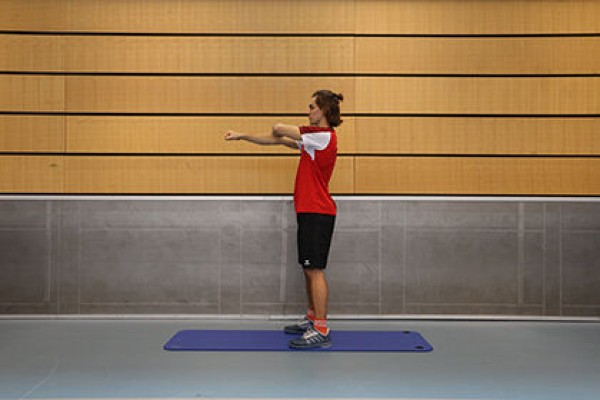

Hold one arm outstretched at chest height. The hand of the other arm grasps the elbow of the outstretched arm from below (bend the arm in front of the body). Alternately bend the playing arm over and under the bent arm/the pivot point formed and then extend it again. Switch sides from time to time (rotate the other arm).
Variant:
Exercise can also be performed in a seated or kneeling position.
No material required