
Exercises (1641)
Move leg forwards and back in shoulder position (right)
Power
Individual work

Shoulder position, one leg (right) bent, the other stretched out or also bent but held high, arms flat on the floor at the side of the body, pelvis raised, bounce forwards and back to the starting position with the supporting leg (right) (touch down with the heel).
Attention:
Pelvis always remains raised, upper body only rests on the shoulders.
Lighten:
Just hold the position with your pelvis raised; move your standing leg less.
Harden:
Additional weight (on the hips).
Variation:
Remnant carpet/felt slipper/glider under the standing leg to glide forwards and backwards.
Move your legs to the side while sitting alternately
Power
Individual work

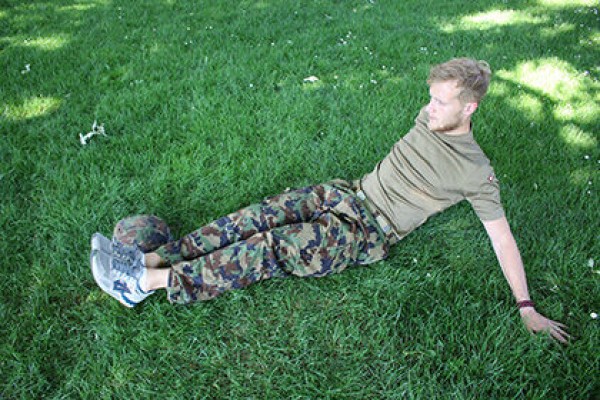
Sit on the floor, upper body slightly tilted backwards and supported by the hands, legs slightly raised from the floor in front of you and almost stretched out, alternately move the legs sideways over an object placed at foot level (e.g. helmet or rucksack), briefly tapping the floor with the heels on each side. Alternate legs sideways over an object (e.g. helmet or rucksack) placed at foot level, briefly touch the ground with your heels on each side.
Attention:
Do not put your feet down.
Lighten:
Legs bent more strongly.
Harden:
Legs extended; additional weight on/between the legs.
1 helmet/fighting rucksack
2 weight cuffs/1 PET bottle (1.5 litres)/ball/(additional) helmet/fighting rucksack ► make the exercise more difficult (additional weight)
Move your legs to the side while sitting alternately
Power
Individual work
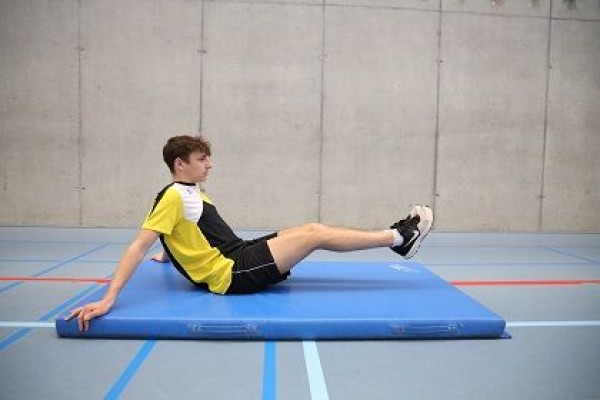

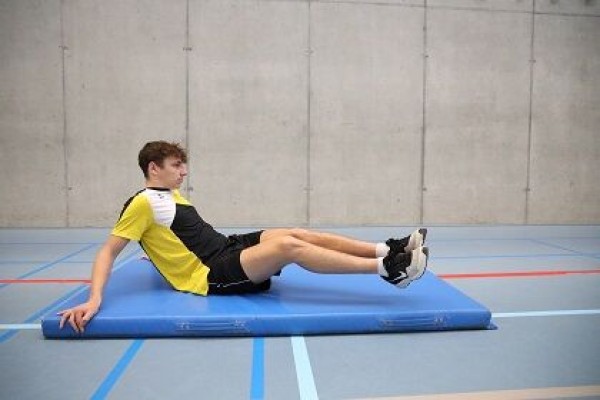
Sit on the floor, upper body tilted slightly backwards and supported by the hands, legs slightly raised from the floor in front of you and almost stretched out, alternate legs from one side to the other (optionally tap the floor briefly with your heels on each side).
Caution:
Do not put your feet down.
Lighten:
Bend your legs more.
Harden:
Legs stretched out; additional weight on/between the legs.
2 weight cuffs/1 (medicine) ball/weight disc/dumbbell ► make the exercise more difficult (additional weight)
Move one leg backwards in an alternating squat position
Power
Individual work
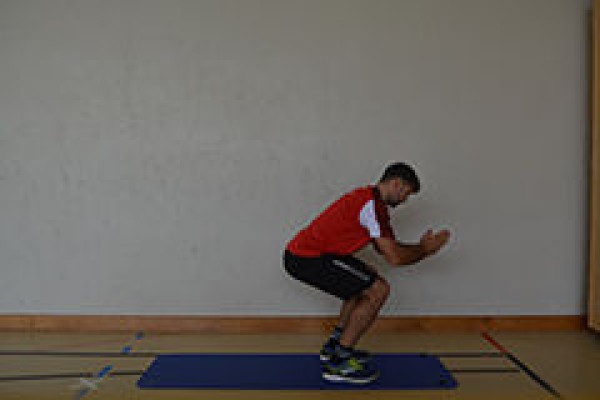
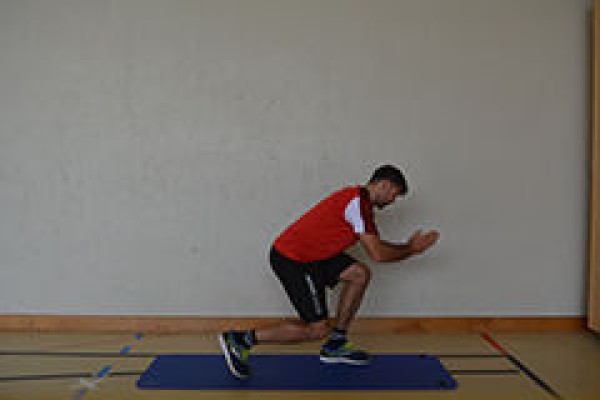
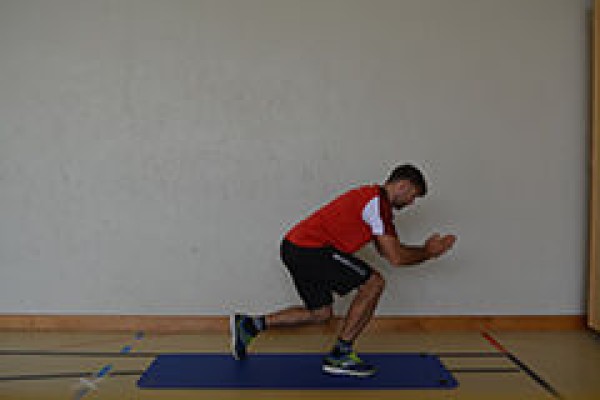
Get into a squat position (deep squat), alternating between moving one leg backwards (toes touching the floor behind the body) and back to the starting position.
Attention:
The starting position in the squat position always remains stable/unchanged.
Lighten:
Move your leg less far back.
Harden:
Tighten an elasticated band between your legs (mid-thigh height).
No material required
1 elasticated rubber band ► to make the exercise more difficult
Move one leg backwards in an alternating squat position
Power
Individual work
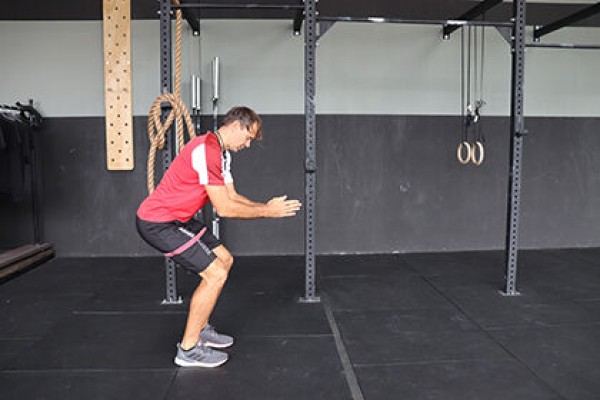
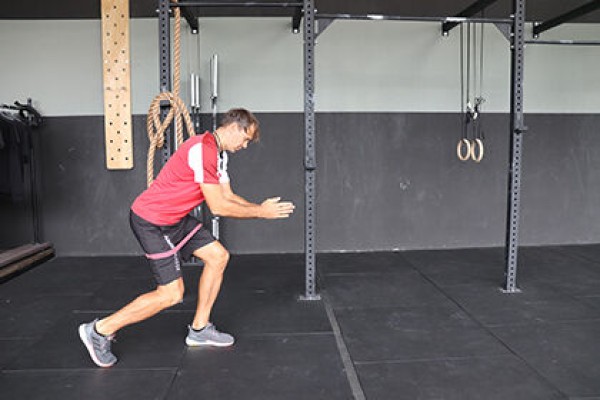
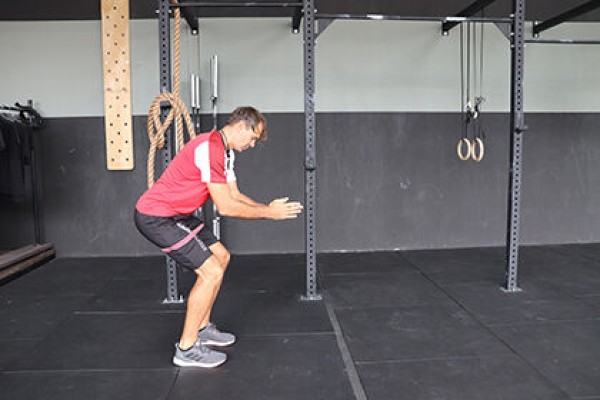
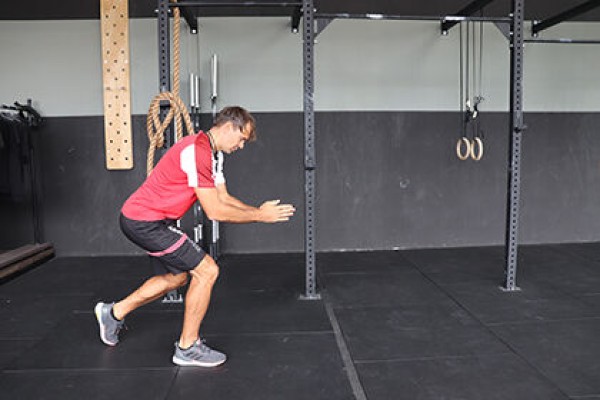
Knee bend position (deep squat) with an elasticated band stretched between the legs (mid-thigh height), alternate between moving one leg backwards (toes touching the floor behind the body) and back to the starting position.
Attention:
The starting position in the squat position always remains stable/unchanged.
Lighten:
Select an elastic band with less resistance.
Harden:
Select an elastic band with greater resistance.
1 elasticated rubber band
Move one leg backwards in a squat position alternating ► monster walk (backwards)
Power
Individual work
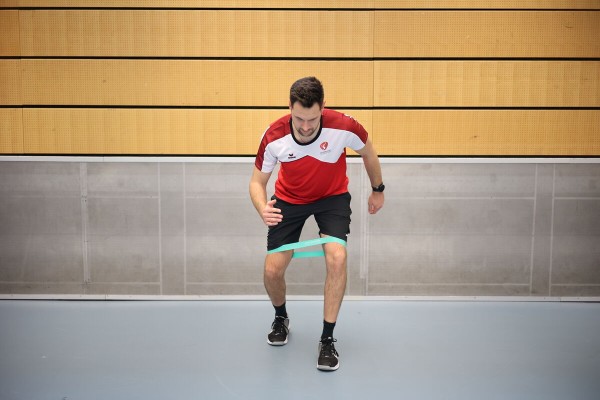
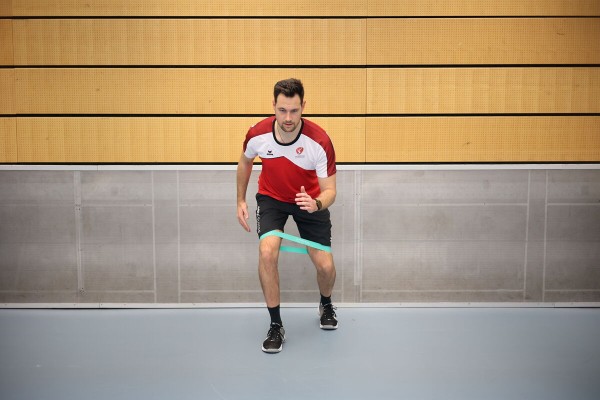
Get into a squat position (deep squat) with an elasticated band stretched between the legs (slightly above the knees), alternate between positioning one leg backwards (foot completely off the ground) and returning to the starting position.
Attention:
The starting position in the squat position always remains stable/unchanged.
Lighten:
Select an elastic band with less resistance.
Harden:
Select an elastic band with greater resistance.
1 mini-band
Move one leg backwards in squat position and stretch jump alternately
Power
Individual work
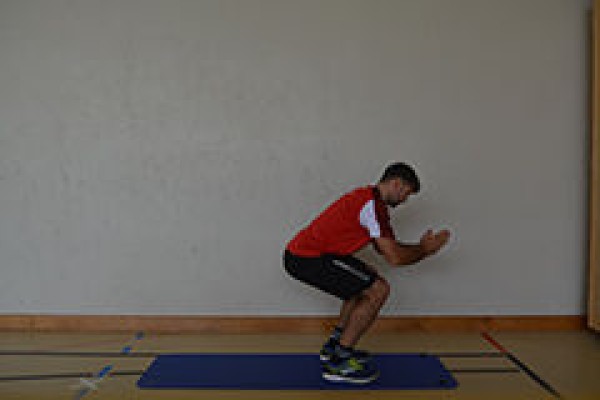


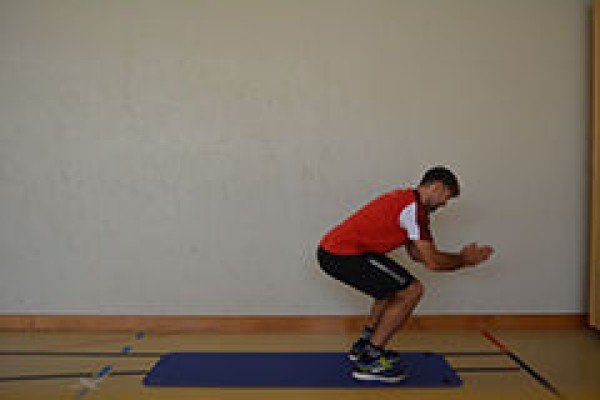
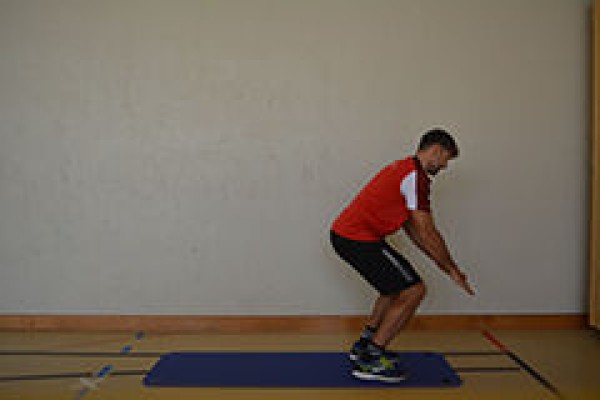
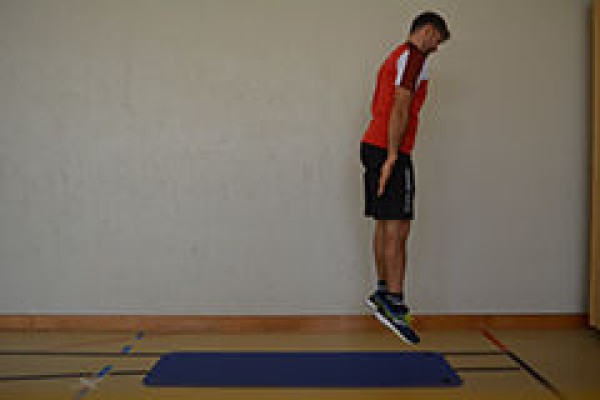
Squat position (deep squat) with arms bent in front of you (palms pressed against each other), alternately move one leg backwards (toes touching the floor behind the body) and back to the starting position, then perform a stretch jump (simultaneously stretch the arms and move them behind the body, palms facing backwards) and return to the starting position (squat position) to start the exercise from the beginning.
Attention:
Starting position in the squat position remains stable/unchanged when moving the leg backwards.
Lighten:
Move the leg less far backwards; stretch jump less high.
Harden:
Tighten an elastic band between the legs.
No material required
1 elasticated rubber band ► to make the exercise more difficult
Move one leg backwards in squat position and stretch jump alternately
Power
Individual work

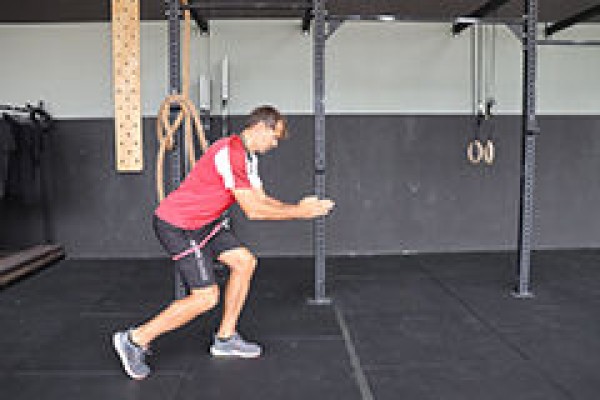


Squat position (deep squat) with arms bent in front of you (palms pressed against each other), with an elasticated rubber band stretched between your legs (mid-thigh height), alternately move one leg backwards (toes touching the floor behind the body) and back to the starting position, then perform a stretch jump (simultaneously stretch your arms and bring them behind your body, palms facing backwards) and return to the starting position (squat position) to start the exercise again.
Attention:
The starting position in the squat position remains stable/unchanged when moving the leg backwards.
Lighten:
Move the leg less far backwards; stretch jump less high; choose an elastic band with less resistance.
Harden:
Choose an elastic band with greater resistance.
1 elasticated rubber band
Move one leg backwards and back in single-leg stance (left) ► kick-back
Power
Individual work
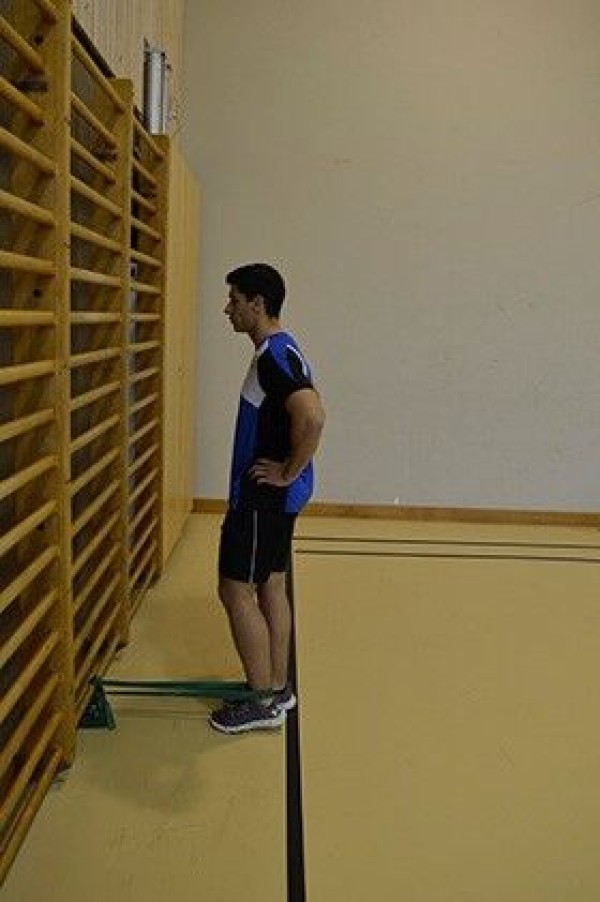
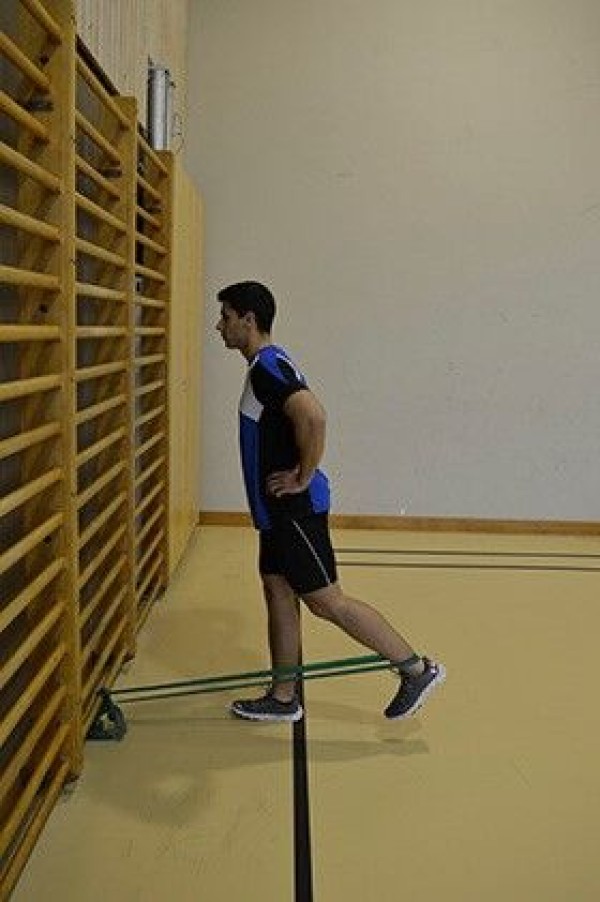
One-legged stand (right), upright position facing the wall bars (or e.g. a tree), tie the elastic band into a loop at ankle height on the wall bars (on the tree), step into the loop with the training leg (left), bend the leg slightly (lifted off the floor) backwards and return to the starting position.
Attention:
The upper body remains stable (arms can support themselves on the wall bars/tree).
Lighten:
Choose a rubber band with less resistance.
Harden:
Choose a rubber band with greater resistance.
1 elasticated rubber band
1 wall bar/tree
Move one leg backwards and back in single-leg stance (left) ► kick-back
Power
Individual work


Stand on one leg (right), with the free leg (left) only slightly raised off the floor, the body position is upright, stretch an elasticated band between the legs (place the band around the ankles). From this position, move the training leg (left) backwards (one-sided hip flexion), leaning the upper body slightly forwards. Then bring the leg and upper body back to the starting position.
Faciliter:
Choose an elastic band with less resistance.
Compliquer:
Choose an elastic band with greater resistance.
1 mini-band
Move one leg backwards and back in single-leg stance (right) ► kick-back
Power
Individual work
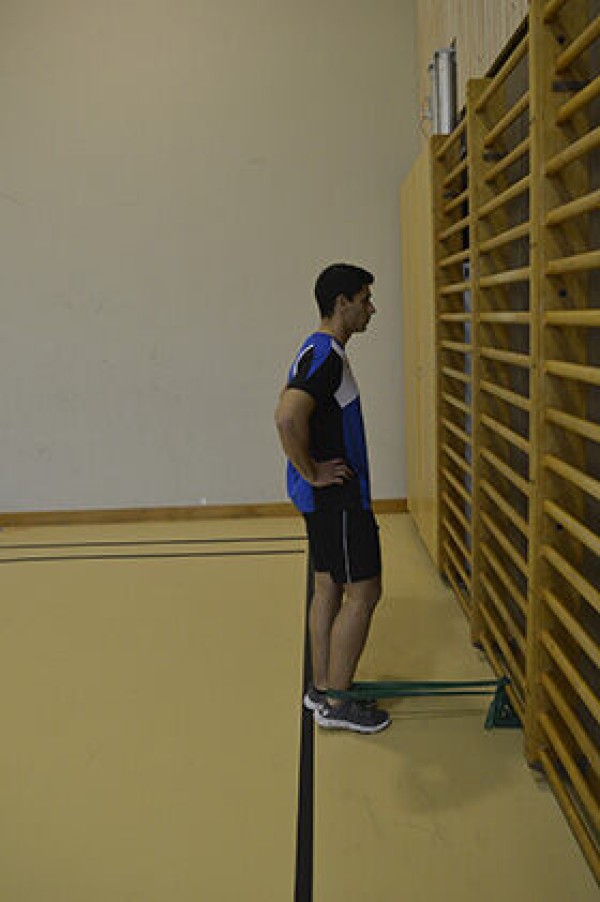
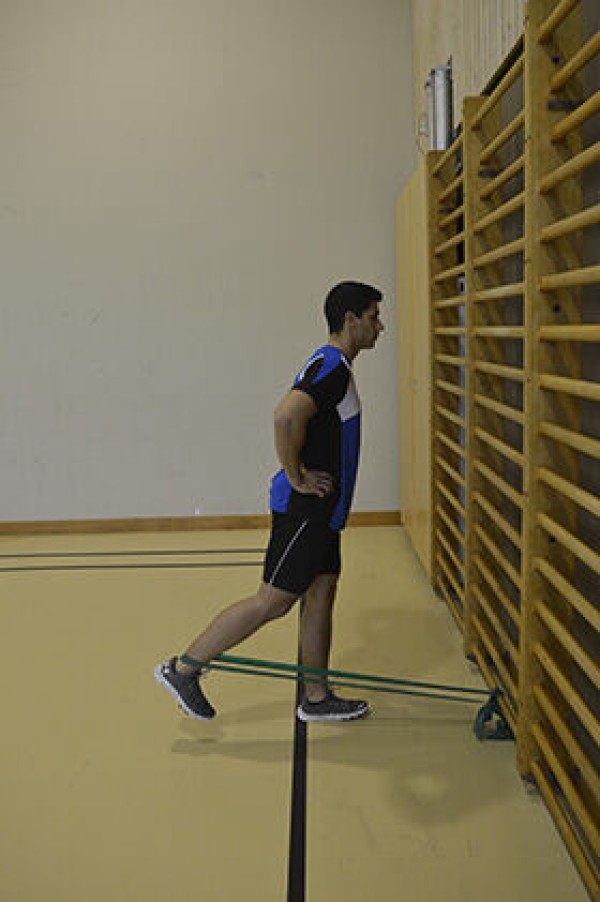
One-legged stand (left), upright position facing the wall bars (or e.g. a tree), tie the elastic band into a loop at ankle height on the wall bars (on the tree), step into the loop with the training leg (right), bend the leg slightly (lifted off the floor) backwards and return to the starting position.
Attention:
The upper body remains stable (arms can support themselves on the wall bars/tree).
Lighten:
Choose a rubber band with less resistance.
Harden:
Choose a rubber band with greater resistance.
1 elasticated rubber band
1 wall bar/tree
Move one leg backwards and back in single-leg stance (right) ► kick-back
Power
Individual work


Stand on one leg (left), with the free leg (right) only slightly raised off the floor, the body position is upright, stretch an elasticated band between the legs (place the band around the ankles). From this position, move the training leg (right) backwards (one-sided hip flexion), leaning the upper body slightly forwards. Then return the leg and upper body to the starting position.
Lighten:
Choose an elastic band with less resistance.
Harden:
Choose an elastic band with more resistance.
1 mini-band
Move one leg forwards in a squat position alternating ► monster walk (forwards)
Power
Individual work

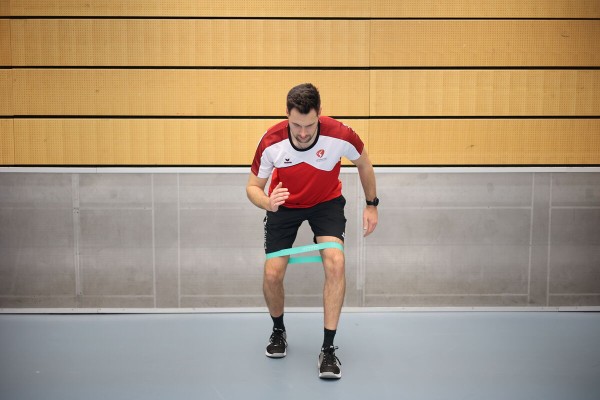
Get into a squat position (deep squat) with an elasticated band stretched between the legs (slightly above the knees), alternate between positioning one leg forwards (foot completely off the ground) and returning to the starting position.
Attention:
The starting position in the squat position always remains stable/unchanged.
Lighten:
Select an elastic band with less resistance.
Harden:
Select an elastic band with greater resistance.
1 mini-band
Alternating one leg to the side while standing ► tall monsterwalk (sideways)
Power
Individual work


Stand upright shoulder-width apart, with an elasticated rubber band stretched between the legs (place the band around the ankles), alternately move one leg to the corresponding side (place the foot completely down) and return to the starting position.
Lighten:
choose a rubber band with less resistance.
Harden:
choose a rubber band with greater resistance.
1 mini-band
Move one leg to the side in an alternating squat position ► monster walk (sideways)
Power
Individual work


Squat position (deep squat), with an elasticated band stretched between the legs (slightly above the knees), alternately move one leg to the corresponding side (put the foot down completely) and return to the starting position.
Attention:
The starting position in the squat position always remains stable/unchanged.
Lighten:
Select an elastic band with less resistance.
Harden:
Select an elastic band with greater resistance.
1 mini-band
Single-leg deadlift ► single-leg deadlift
Power
Individual work
Stand upright, shift your weight onto your supporting leg and hold a dumbbell in the hand on the opposite side. Keep the knee of your supporting leg slightly bent, your upper body upright, your core firmly engaged and your pelvis aligned exactly parallel to the floor. Initiate the movement by pushing your hips back (hip hinge) and leaning your upright upper body forwards in a controlled manner, whilst the free leg moves backwards and upwards in a straight line, like a pendulum. Lower the dumbbell vertically. Only bend forwards as far as your back remains straight and your pelvis does not rotate to the side. The toes of the rear leg should point towards the floor. Using pressure from the heel, as well as the back of the thigh and the buttocks of the supporting leg, powerfully extend the hips forwards and return to an upright position in a controlled manner. Ideally, move the free leg directly into the next repetition without touching the floor, and switch sides once the specified time or number of repetitions has elapsed.
Attention:
The back rounds, particularly in the lumbar and thoracic spine; the pelvis tilts upwards or downwards on the side of the raised leg, instead of remaining parallel to the floor; the supporting leg is either fully extended or bends far too deeply, as in a squat; the barbell moves far away from the body towards the front; the knee of the supporting leg buckles inwards; the movement is performed hastily or with momentum from the upper body; the head is hyperextended towards the nape of the neck.
Lighten:
Keep the toes of the rear foot set back by about half a step, lightly touching the floor like a "training wheel"; Perform the exercise without additional weight, extending your arms out to the sides for balance; use your free hand to support yourself lightly against a wall or pole; reduce the angle of forward lean.
Harden:
Increase the dumbbell weight or hold a dumbbell in each hand; place your supporting leg on a balance pad (Airex) to maximise the challenge to your ankle and foot stability; slow the downward movement to 3–4 seconds; hold the position horizontally for 2 seconds before returning to the starting position.
1 dumbbell
2 dumbbells ► make the exercise more difficult (additional weight)
1 unstable surface ► makes the exercise more difficult (balance component)
Single leg jump (left) ► hop
Power
Partner work
1 trainee & 1 helper ► note change of position
(= double the time required; for lesson planning see organization strength: implementation info button)
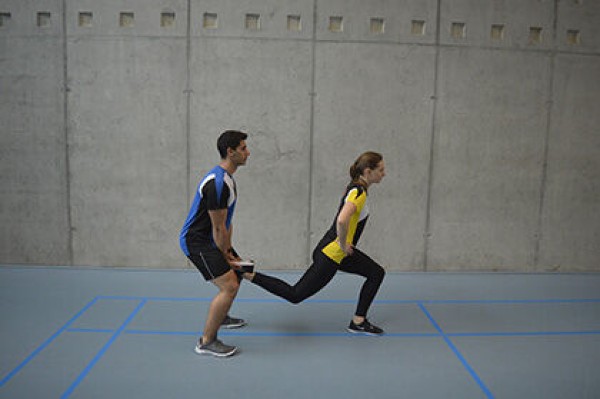
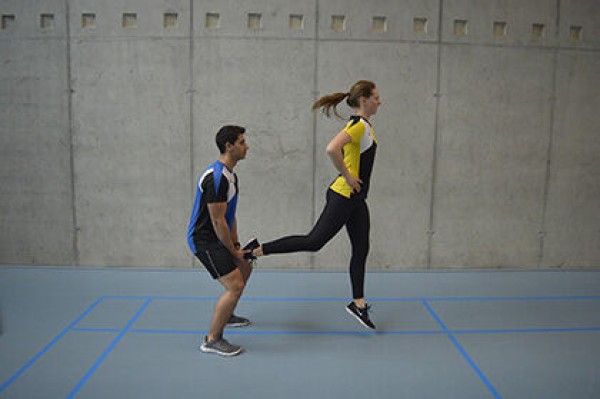
Trainee: Left standing leg bent, right leg also bent but held high, arms supported on the hips, upper body upright, perform single-leg jumps into the air.
Partner: Holds the right foot (the leg held high) of the active participant and accompanies the movement.
Attention:
Knee of the supporting leg always remains behind the tip of the foot and centred over the foot (no tipping inwards), cushion the landing over the entire foot, concentrated work (prevent injuries).
Lighten:
Larger angle in the knee (more upright position) before the jump.
Harden:
Smaller angle in the knee (lower position) before the jump; additional weight (on the shoulders).
1 weight vest/sandbag ► make the exercise more difficult (additional weight)
Single leg jump (right) ► hop
Power
Partner work
1 trainee & 1 helper ► note change of position
(= double the time required; for lesson planner see organization force: Info button execution)
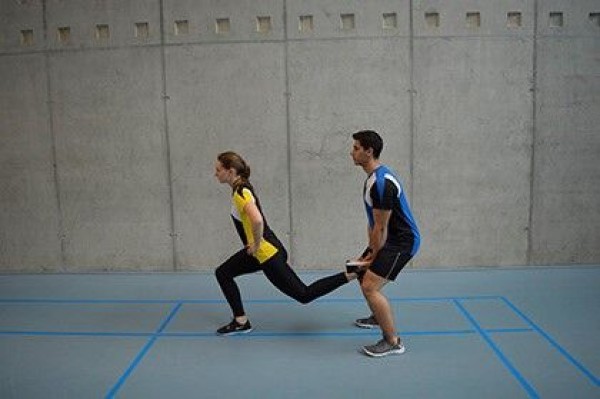
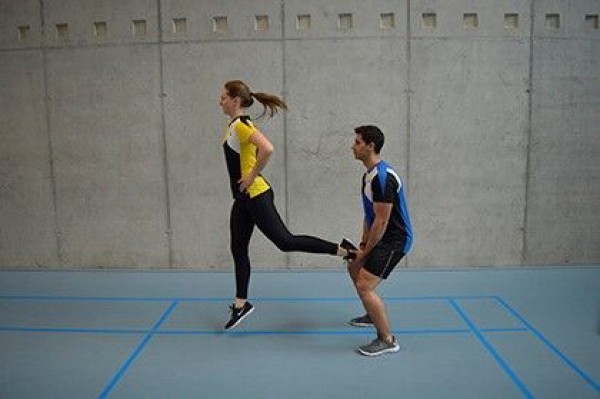
Trainee: Right standing leg bent, left leg also bent but held high, arms supported on the hips, upper body upright, perform single-leg jumps into the air.
Partner: Holds the left foot (the leg held high) of the active participant and accompanies the movement.
Attention:
Knee of the supporting leg always remains behind the tip of the foot and centred over the foot (no tipping inwards), cushion the landing over the entire foot, concentrated work (prevent injuries).
Lighten:
Larger angle in the knee (more upright position) before the jump.
Harden:
Smaller angle in the knee (lower position) before the jump; additional weight (on the shoulders).
1 weight vest/sandbag ► make the exercise more difficult (additional weight)
Einbeinstand (left) ► single leg stability
Power
Individual work
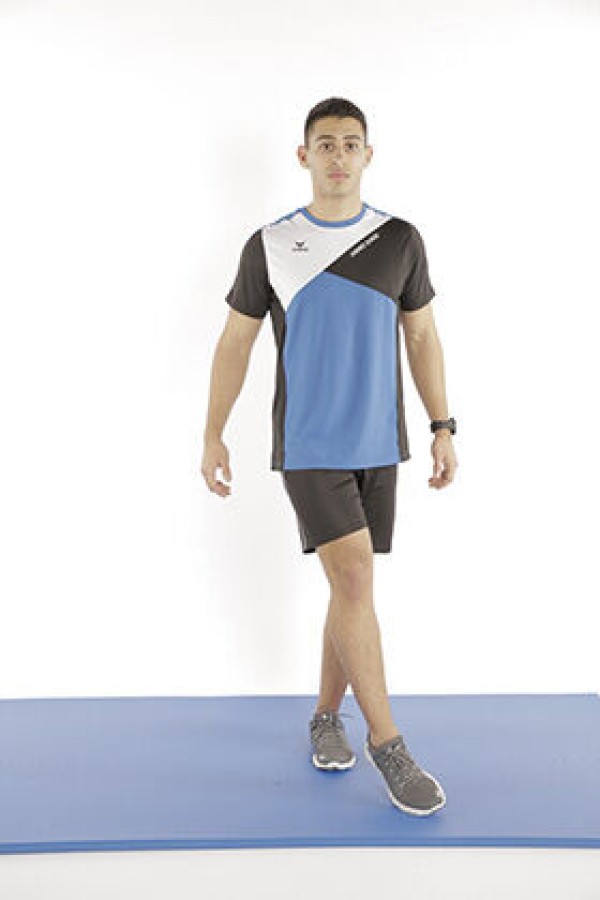
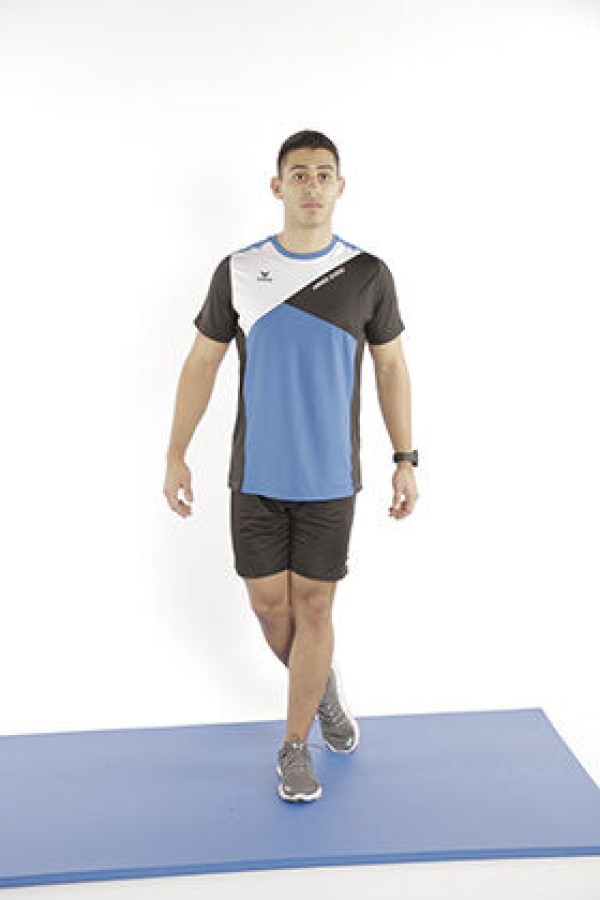
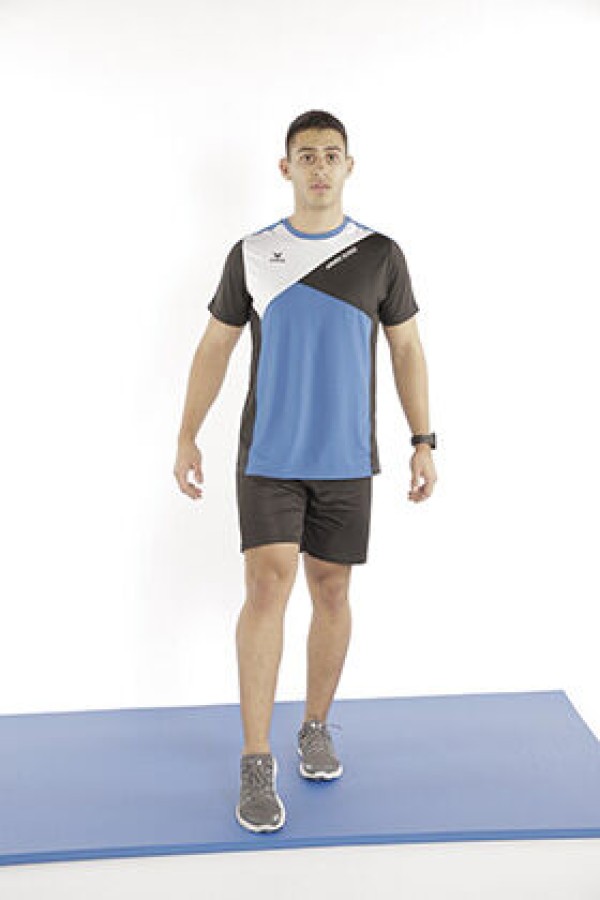

One-legged stand, standing leg (left) slightly bent, bring the other leg around the body in the shape of a pentagonal star (alternatively, only tap the corners of the star with the foot or always bring the foot to the centre in between).
Attention:
Keep the upper body upright (maintain balance).
Lighten:
Bend the supporting leg less (greater angle in the knee).
Harden:
Bend the supporting leg more (smaller angle in the knee); hold additional weight (on the leg or on the chest/shoulders, in the hands).
Variant:
Complete the exercise while jumping.
1 weight cuff/weight vest/weight disc/(medicine) ball/sandbag/fighting backpack/2 dumbbells ► make the exercise more difficult (additional weight)
Einbeinstand (left) ► single leg stability balance board
Power
Individual work

One-legged stand (left) on the balance board (board on the semicircular wedges, wide side of the board in front of the body), tilt forwards/backwards without the balance board touching the floor.
Attention:
Exercise is relatively difficult, at the beginning possibly against a wall for support or with the support of a partner.
Lighten:
Stand on the half-round wedges (without balance board); stand on the balance board with both legs.
Harden:
Balance board on the roller (instead of on the wedges).
Variant:
Tilt the narrow side of the board in front of your body, sideways, without the balance board touching the floor.
1 balance board
2 wedges (semicircular)
1 roller ► to make the exercise more difficult
Einbeinstand (right) ► single leg stability
Power
Individual work


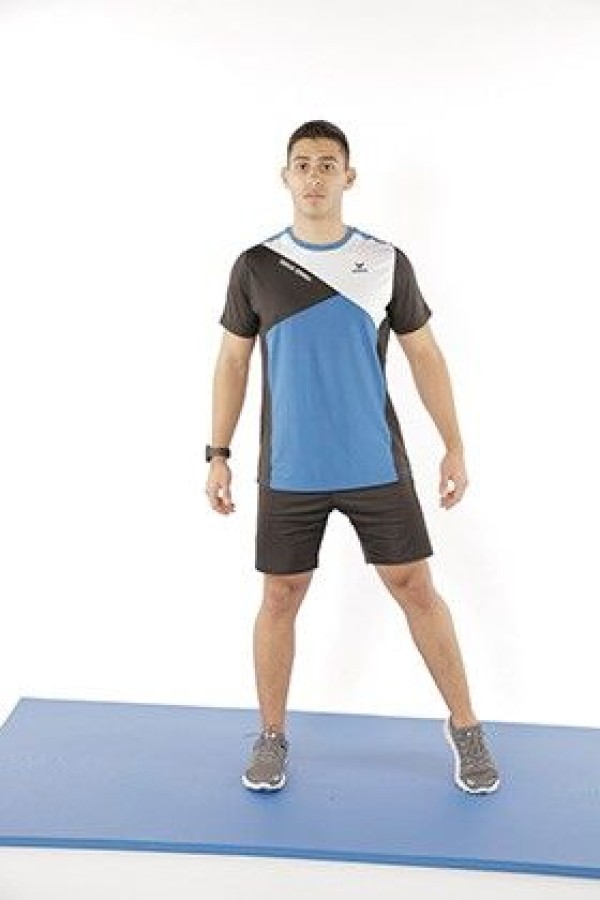
One-legged stand, standing leg (right) slightly bent, bring the other leg around the body in the shape of a pentagonal star (alternatively, only tap the corners of the star with the foot or always bring the foot to the centre in between).
Attention:
Keep the upper body upright (maintain balance).
Lighten:
Bend the supporting leg less (greater angle in the knee).
Harden:
Bend the supporting leg more (smaller angle in the knee); hold additional weight (on the leg or on the chest/shoulders, in the hands).
Variant:
Complete the exercise while jumping.
1 weight cuff/weight vest/weight disc/(medicine) ball/sandbag/fighting backpack/2 dumbbells ► make the exercise more difficult (additional weight)
Einbeinstand (right) ► single leg stability balance board
Power
Individual work
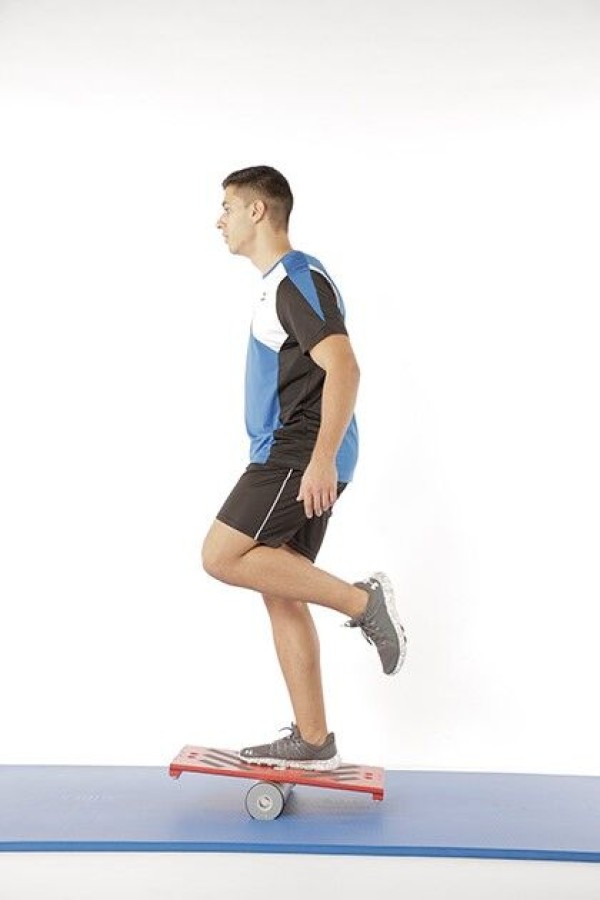
One-legged stand (right) on the balance board (board on the semicircular wedges, wide side of the board in front of the body), tilt forwards/backwards without the balance board touching the floor.
Attention:
Exercise is relatively difficult, at the beginning possibly against a wall for support or with the support of a partner.
Lighten:
Stand on the half-round wedges (without balance board); stand on the balance board with both legs.
Harden:
Balance board on the roller (instead of on the wedges).
Variant:
Tilt the narrow side of the board in front of your body, sideways, without the balance board touching the floor.
1 balance board
2 wedges (semicircular)
1 roller ► to make the exercise more difficult
Move one arm forwards or backwards alternately while kneeling ► front raise
Power
Individual work


Kneeling position, buttocks raised (do not sit on your heels) and upper body leaning slightly forwards. Hold a dumbbell in each hand and alternately stretch one arm straight forwards (parallel to the floor) and one arm backwards. Change arm position directly (arms straight forwards or backwards).
Starting position:
- Kneeling, buttocks slightly raised, upper body tilted forwards
- One arm extended forwards and one backwards
- Straight back, tension in the torso (no hollow back)
Finishing position:
- Other arm extended forwards or backwards than in the starting position. back than in the starting position
- Body position remains stable (straight back)
Variant:
Exercise performed in a standing position with the upper body leaning slightly forwards.
2 dumbbells
Move your elbows backwards while standing
Power
Individual work
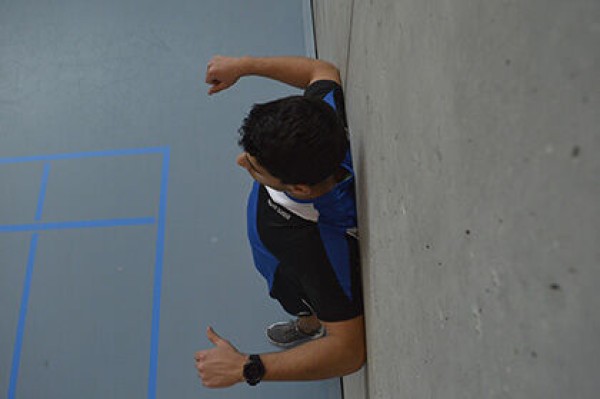

Stand leaning diagonally against the wall (back against the wall), arms bent at the side at shoulder height (hands facing forwards), push your elbows back (upper body away from the wall) and return to the starting position.
Attention:
Do not rest your shoulder blades completely on the wall.
Lighten:
Stand upright.
Harden:
Foot further away from the wall (increase the incline).
1 wall
Move your elbows forwards while standing
Power
Individual work
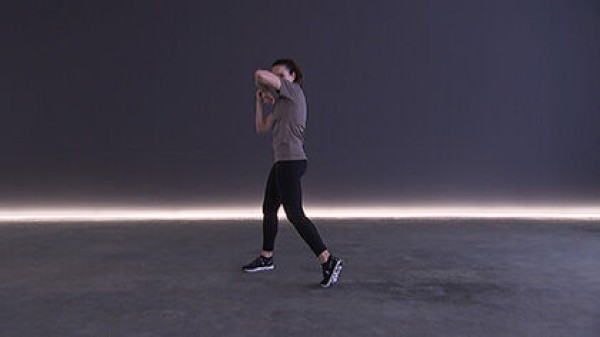
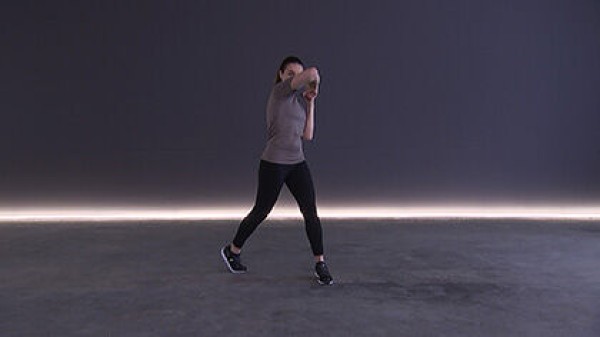
A distinction is made between the left-handed and right-handed stance. Right-handers take the left stance (left foot in front), while left-handers take the right stance (right foot in front). The left-hand stance: The left foot is placed one step forwards from a parallel stance approximately shoulder-width apart so that the right hand is behind. The right hand corresponds to the striking hand, the left hand to the leading hand. The distance between the two feet is approximately one shoulder width, with the feet on a diagonal to each other. The front foot stands on the entire sole, the heel of the back foot is raised. Both feet point forwards and the weight is evenly distributed over both legs. The front shoulder is turned slightly inwards. The whole body is slightly crouched, the knees are slightly bent and soft. The striking hand is placed in front of the chin and rests against the body. The lead hand is in front at eye level. The fists point outwards with the back. The arms are in front of the body and the elbows point downwards so that the arms cover the body.
Alternate between bringing one elbow forwards at eye level (pointing forwards/upper arm in the direction of your gaze) and turning your upper body with it.
Attention:
Always hold your arms up (chin or eye level).
Lighten:
Lower your elbows forward (chest height).
Harden:
Hold additional weight on your arms or in your hands.
2 weight cuffs/weight balls/dumbbells ► make the exercise more difficult (additional weight)