
Exercises (270)
End of lesson: topic regeneration
Conclusion/Info
Together in the group
To finish off, wind down deliberately once more.
5 Min.
lie on your back
breathe calmly
close your eyes
be mindful of your body
Now, a brief reflection:
Questions:
How does your body feel now compared to when you started?
Which exercise helped you the most?
Which of these would you actually use after a tough workout?
What is the difference for you between ‘recovery’ and ‘doing nothing’?
Stretching and mobilisation exercises
Relaxation
Together in the group
Moving from large movements to specific mobilisation:
Example Compass
Approx. 45 seconds of work / 15 seconds of rest for each set:
Shoulder circles
Arm circles
Trunk rotation
Cat-Cow
Pelvic circles
Lunge with rotation
Knee circles
Ankle mobilisation
Leg swings forwards/backwards
Sideways leg swings
After that, do another 2–3 exercises that the group finds particularly enjoyable.
A good guiding principle:
Not: ‘How far will I get?’
But rather: “How does the movement feel?”
Loosening exercises
Relaxation
Partner work
Groups of 2
The partner performs various loosening exercises by hand on the lying participant (swinging and shaking the limbs and making circular movements with them). Vary the speed and range of movement. Then change roles.
Participants lying on their back:
- Loosen leg left/right (swing/shake)
- Circular movements with leg left/right
- Bend and stretch leg left/right
- Loosen arm left/right in upright, horizontal and vertical position (swing/shake)
Participants lying on their stomach:
- Loosen leg left/right (swing/shake out)
No material required
Loosening exercises
Relaxation
Partner work
Groups of 2
The partner performs various loosening exercises (swinging and shaking the limbs and making circular movements with them) on the lying participant using the aid (e.g. power hose/skipping rope). Vary the speed and range of movement. Then change roles.
Participants lying on their back:
- Loosen leg left/right (swing/shake)
- Circular movements with leg left/right
- Loosen arm left/right in upright, horizontal and vertical position (swing/shake)
Participants lying on their stomach:
- Loosen leg left/right (swing/shake out)
Per group:
1 skipping rope / ribbon
Loosening exercises
Relaxation
Individual work
The participants perform various loosening exercises (swinging and shaking the limbs and performing circular movements with them). Vary the speed and range of movement.
- Leg loosening left/right (swinging/shaking)
- Circular movements with leg left/right
- Bending and stretching leg left/right
- Arm loosening left/right in upright, horizontal and vertical position (swinging/shaking)
No material required
Loosening exercises
Relaxation
Partner work
Stand facing each other in pairs, grasp hands and perform loose pushing and pulling movements. Circular movements can also be integrated in both directions or the arms can be moved up and down alternately.
No material required
long exhale
Relaxation
Inhale 4 sec.
Exhale 6–8 sec.
no breathing pauses
Repeat for 5-7 minutes – focus deliberately on prolonged exhalation.
lower body
Stretching
2 rounds, each 40 sec. / 20 sec. change
1. Ankle rocks – mobilise the ankle joint
2. Deep squat hold – deep squat squat
3. World’s greatest stretch – lungstroke + rotation
4. 90/90 hip switch – hip mobilisation
5. Hamstring stretch – back thigh
6. Quad stretch – front of thigh
Focus: hips, legs, ankle joints
Massage
Relaxation
Partner work
Groups of 2
The participants perform massages on their partner using an aid (e.g. tennis ball or throwing object). During the circular movements with the ball, the circumference (small-large) and the pressure (no pressure on joints) are varied.
Participant in supine position, massage by partner of:
- Front thigh muscles
- Abdominal muscles
- Chest muscles
- Arms
Participant in prone position, massage by partner of:
- Calf muscles
- Back thigh muscles
- Buttock muscles
- Back muscles
- Arms
Per group:
1 tennis ball
1 soft mat
Couples’ massage
Relaxation
Partner work
Set clear rules:
Always coordinate the pressure with your partner.
Do not cause pain.
Do not apply pressure directly to the spine, joints or bones.
Use slow, gentle movements.
Communication: ‘more / less / more comfortable / stop’.
Procedure
10 mins. Person A is having a massage
For example:
Calves
Front of thighs
Back of thighs
Buttocks
Back/shoulder area
Then change:
10 mins. Person B is having a massage
Massage techniques
Stroking
Kneading
Circular movements with the palms
Gentle pressure with the thumbs
Light ‘shaking’ of the muscles
If you have the equipment to hand, you could also use tennis balls or massage balls – but this isn’t essential.
Optional per group:
1–2 tennis balls or massage balls
Passives Stretching
Stretching
Individual work
Stretch the following muscle groups (without rocking movements):
- Calf muscles
- Thigh muscles
- Gut muscles
- Abductors
- Adductors
- Belly muscles
- Back muscles
- Chest muscles
- Shoulder muscles
- Arm extensors
- Arm flexors
- Neck muscles
.
Variant:
In place of the exercise leader, one participant gives the exercise. After each exercise, another participant takes on the role of leader
No material required
Passives Stretching
Stretching
Individual work
Stretch the following muscle groups using an aid (without rocking movements):
- Calf muscles
- Thigh muscles
- Gut muscles
- Abductors
- Adductors
- Abdominal muscles
- Back muscles
- Chest muscles
- Shoulder muscles
- Arm extensors
- Arm flexors
- Neck muscles
Variation:
In place of the exercise leader, one participant gives the exercise. After each exercise, another participant takes on the role of leader
Per Tn:
1 ball ► Basketball, Blitzball/Rugby/Football, Fistball, Futsal/Football, Handball, FooBaSKILL, Volleyball
1 stick ► Floorball, Intercrosse/Lacrosse, Nordic walking
1 racket ►badminton/speedminton, smolball
1 throwing disc (frisbee) ►frisbee ultimate
1 elasticated rubber band/gym stick with elastic band/stretch tube/skipping rope/spinbond
Passives Stretching
Stretching
Partner work
Stretch the following muscle groups together with your partner (without rocking movements):
- Calf muscles
- Thigh muscles
- Buttock muscles
- Abductors
- Adductors
- Abdominal muscles
- Back muscles
- Chest muscles
- Shoulder muscles
- Arm extensors
- Arm flexors
- Neck muscles
.
Variation:
In place of the exercise leader, one participant gives the exercise. After each exercise, another participant takes on the role of leader
No material required
Passives Stretching
Stretching
Partner work
Stretch the following muscle groups together with your partner using an aid (without rocking movements):
- Calf muscles
- Thigh muscles
- Gut muscles
- Abductors
- Adductors
- Abdominal muscles
- Back muscles
- Chest muscles
- Shoulder muscles
- Arm extensors
- Arm flexors
- Neck muscles
Variant:
In place of the exercise leader, one participant gives the exercise. After each exercise, another participant takes on the role of leader
Per group of 2:
1 ball ► Basketball, Blitzball/Rugby/Football, Fistball, Futsal/Football, Handball, FooBaSKILL, Volleyball
1 stick ► Floorball, Intercrosse/Lacrosse, Nordic walking
1 racket ►badminton/speedminton, smolball
1 throwing disc (frisbee) ►frisbee ultimate
1 elasticated rubber band/gym stick with elastic band/stretch tube/skipping rope/spinbond
Passive stretching: adductors
Stretching
Individual work
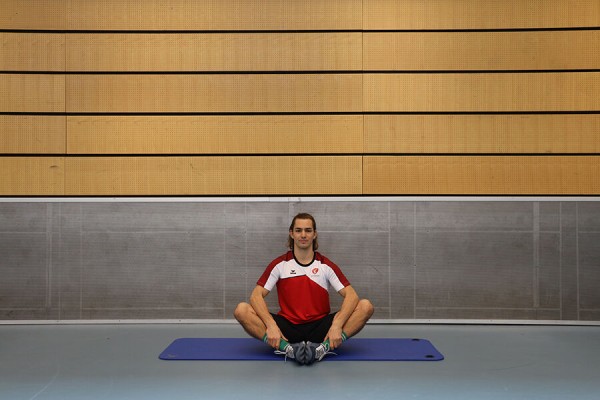
Sit upright, bend your legs and place the soles of your feet flat against each other in front of your body. Use your hands to pull your feet towards your body and press your elbows on the inside of your knees (press your knees towards the floor). Keep your upper body upright.
No material required
Passive stretching: adductors
Stretching
Partner work
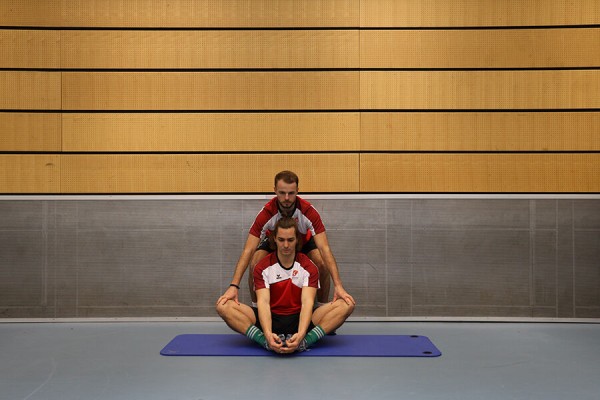
Sit upright, bend your legs and place the soles of your feet flat against each other in front of your body. Use your hands to pull your feet towards your body, keeping your upper body upright. The partner stands behind the seated participant and presses the knees lightly to the floor (adjust the intensity to the partner). The position is then changed.
No material required
Passive stretching: adductors
Stretching
Individual work
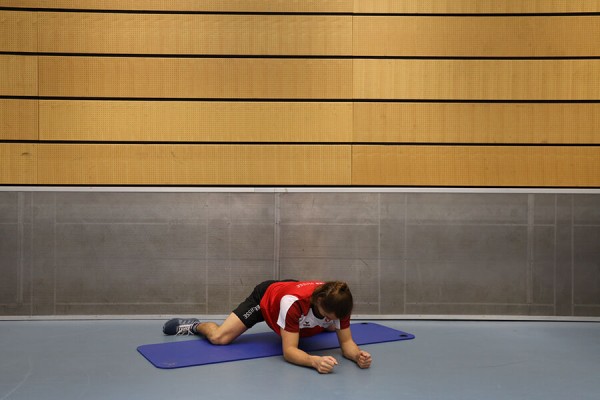
Stand on four feet, supporting yourself on your knees and hands. Then stand on your forearms and let your legs move outwards, pushing your buttocks backwards. Move your hips towards the floor. From time to time, you can try to spread your legs a little further outwards.
No material required
Passive stretching: adductors / back muscles (below)
Stretching
Individual work
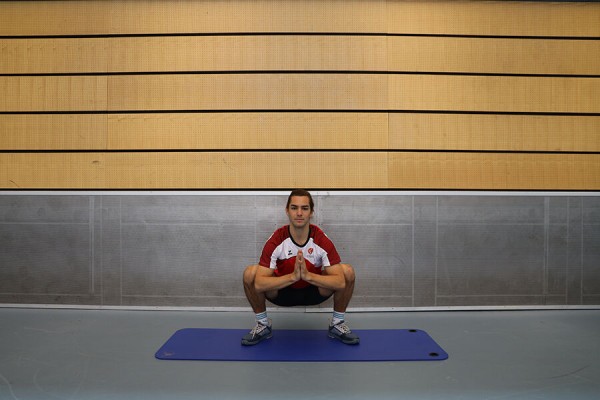
Squat low (buttocks below the knees), feet pointing slightly outwards, back straight (upper body leaning slightly forwards), use your elbows to push your knees slightly outwards.
No material required
Passive stretching: adductors / back muscles (below)
Stretching
Individual work

Sit with your legs bent and your feet flat on the floor, bring your arms forwards under your legs (from the inside to the outside between your legs) so that each hand grips the instep of your foot (same side of your body) and keep your back straight. Use your hands to pull your upper body (chest) forwards (always keep your back straight).
No material required
Passives Stretching: Armmuskulatur
Stretching
Individual work
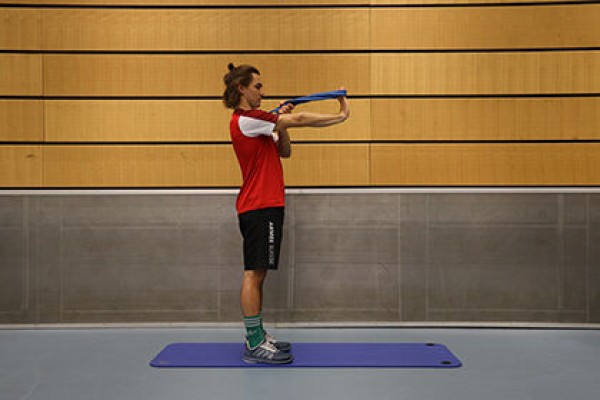
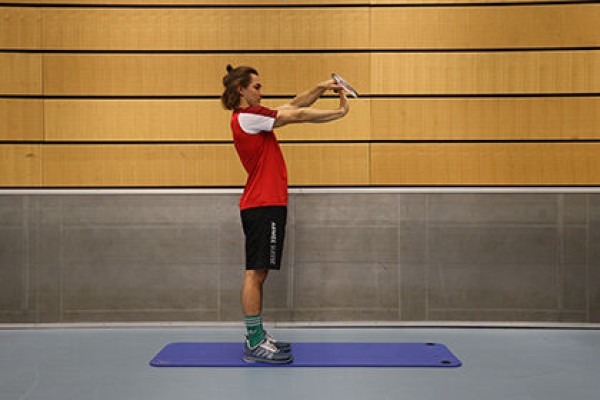
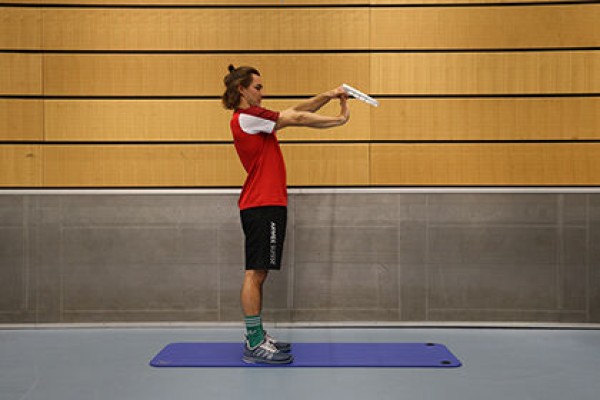
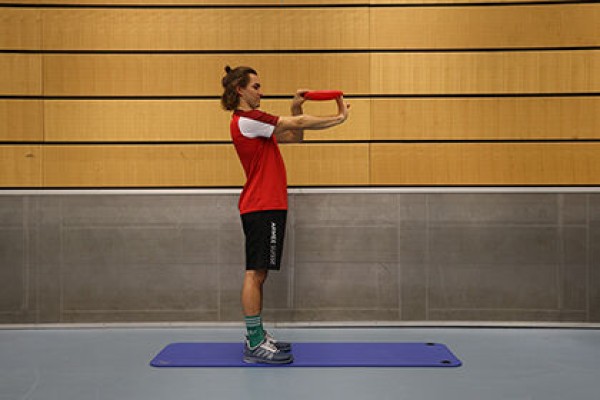
Stand hip-width apart, with one arm stretched out horizontally in front of the body at chest height. Bend your wrist so that your palm is facing forwards (fingers pointing upwards) and pull your fingers towards your body with your other hand and the aid. Then switch sides.
Variant:
Exercise can also be performed in a seated or kneeling position.
Per participant:
1 stick ►unihockey, intercrosse/lacrosse
1 racket ►badminton/speedminton, smolball
1 throwing disc (frisbee) ►frisbee ultimate
1 elastic rubber band/string/skipping rope/spinbond
Passives Stretching: Armmuskulatur
Stretching
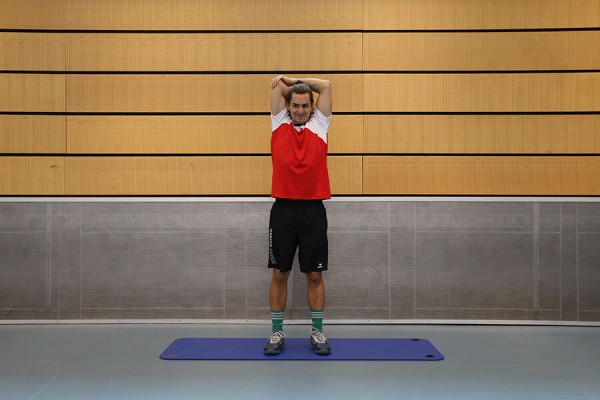
Stand hip-width apart, bend one arm upwards so that the hand touches the back between the shoulder blades and the elbow points upwards. Pull your elbow towards your body with the other hand. Then switch sides.
Variant:
Exercise can also be performed in a seated or kneeling position.
No material required
Passives Stretching: Armmuskulatur
Stretching
Individual work
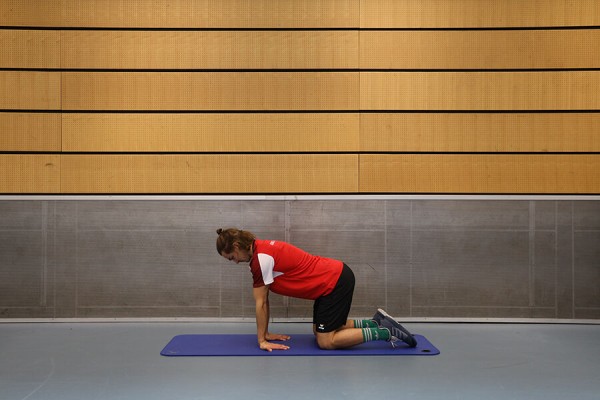
In a kneeling position, place your arms vertically on the floor in front of your body, supporting your upper body as it leans forwards. Turn your arms out so that your fingers are pointing towards your body and lean slightly backwards to intensify the stretch.
No material required
Passives Stretching: Armmuskulatur
Stretching
Individual work
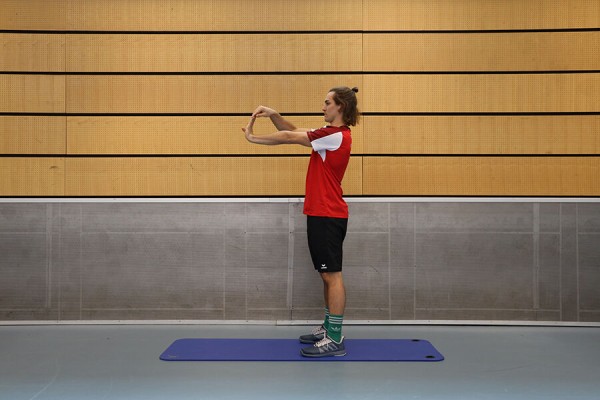
Stand hip-width apart, with one arm stretched out horizontally in front of the body at chest height. Bend your wrist so that your palm is facing forwards (fingers pointing upwards). Pull your fingers towards your body with the other hand. Then switch sides.
Variant:
Exercise can also be performed in a seated or kneeling position.
No material required
Passives Stretching: Armmuskulatur
Stretching
Partner work
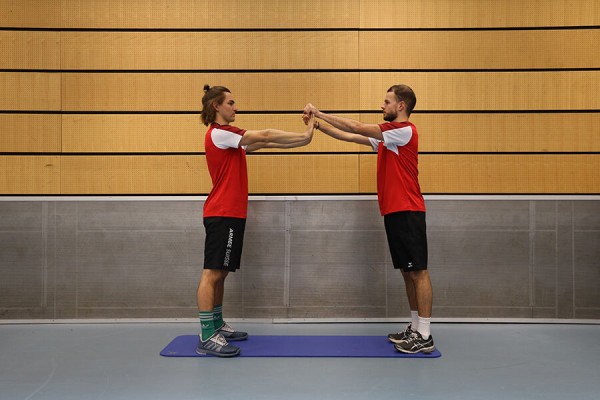
Stand upright facing your partner, stretch your arms horizontally forwards in front of your body (bend your hand, palm facing your partner). The partner presses the fingertips lightly in the direction of the active participant. The position is then changed.
Variant:
Exercise can also be performed in a seated or kneeling position.
No material required
Passive stretching: abdominal muscles
Stretching
Individual work
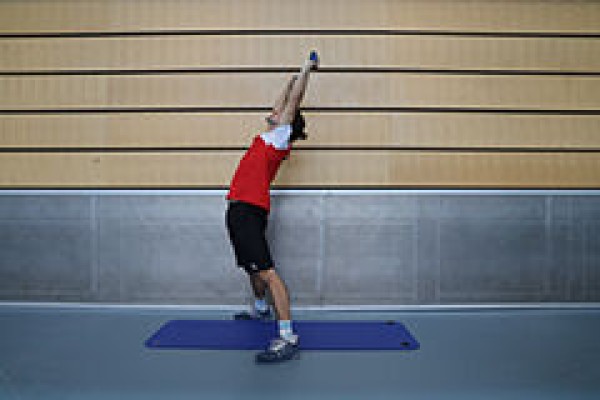
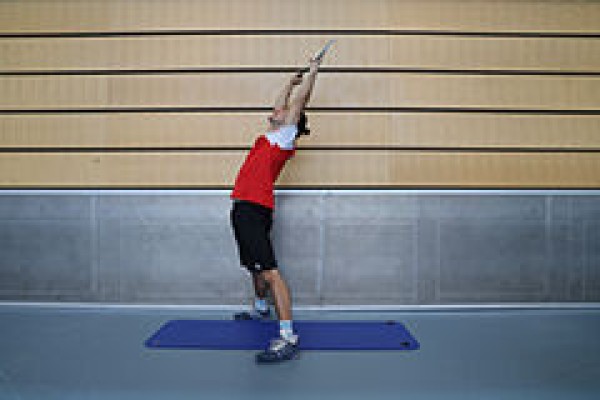
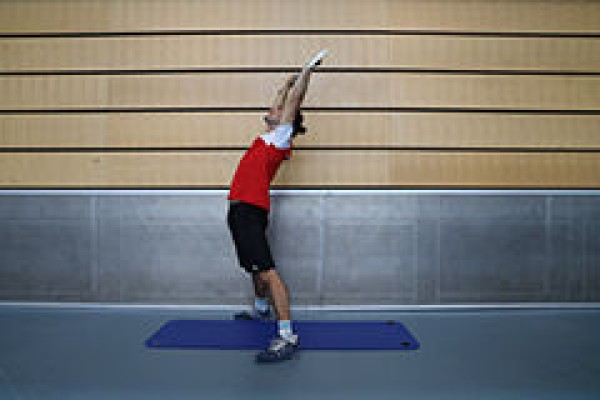
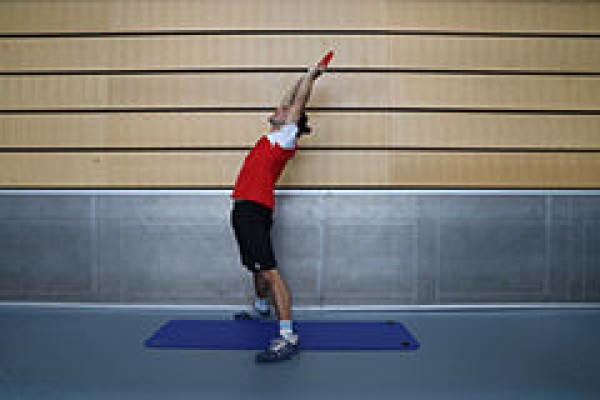
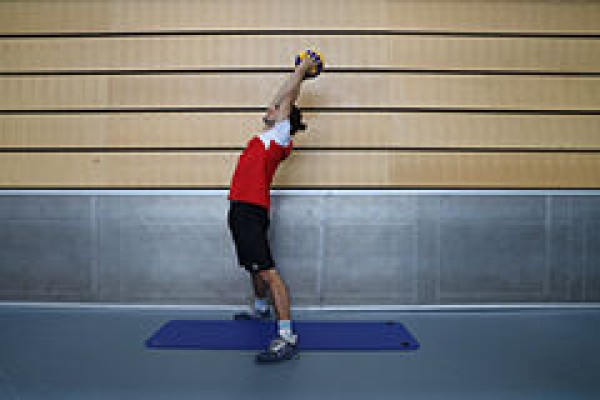
Stand upright with your legs slightly straddled and your arms (including aids) stretched out in an upright position. Tilt your upper body (as well as arms and aids) backwards.
Variant:
Exercise can also be performed in a seated or kneeling position.
Per Tn:
1 ball ►baseball, blitzball/rugby/football, fistball, futsal/football, handball, FooBaSKILL, volleyball
1 stick ► floorball, intercrosse/lacrosse, Nordic walking
1 racket ►badminton/speedminton, smolball
1 throwing disc (frisbee) ►frisbee ultimate
1 elasticated rubber band/power tube/skipping rope/playing rope
1 gymnastics stick with elastic band