
Exercises (2338)
Speedminton: Change hands
Forms of play / exercises
Groups of 2
Passing game in teams of two; change of hands after each shot. Who makes fewer mistakes?
Per participant:
1 speedminton racket
Per group:
1 speeder
Speedminton: Game
Forms of play / exercises
Group work
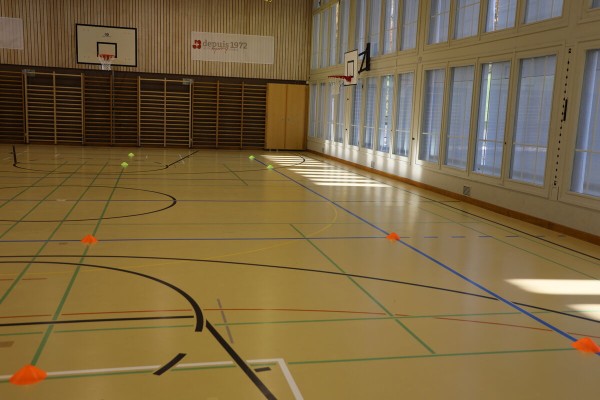
Single game for a certain number of points (e.g. 10). If the group size is uneven (e.g. 3 participants), one player enjoys a break, whereby the duration of the game is reduced (e.g. 7 points) so that waiting times are shortened.
Additional task Strengthening:
After each game, the loser completes a strength exercise: 5x push-ups
2 speedminton rackets
1 speedminton shuttle
8 marker cones
Speedminton: Staffellauf
Forms of play / exercises
Teamwork
Pendulum relay with several teams (participants of the teams are evenly distributed on markers approx. 20 metres apart). Each team has a bat and a speeder. The first runner from each team must balance the speeder with the bat to the other side and hand the bat and speeder to the next runner. If the speeder falls down, it must be picked up and placed back on the bat. Each player completes two runs (i.e. the players are in the same position at the end as at the beginning).
Variant:
The players must hit the speeder into the air at least 10 times during the race.
Per participant:
1 speedminton racket
Per team:
1 speeder
Speedminton: Exercises for beginners
Forms of play / exercises
Individual work

Juggle speeder in various positions (smooth transitions):
- standing
- walking
- sitting
- on your stomach
- on your back
- running
- walking backwards, etc.
Per participant:
1 speedminton racket
1 speeder
Speedminton: Changeover
Forms of play / exercises
Groups of 2

Passing game in teams of two; the players sit opposite each other and pass the speeder to each other. From this position, the players take it in turns to lie on their backs without interrupting the rally.
Per participant:
1 speedminton racket
Per group:
1 speeder
Mirror run
Light-Contact
Partner work


Two participants stand opposite each other. One participant moves to the side with a step. The feet remain shoulder-width apart, the foot closer to the direction of movement initiates the movement. The weight is on the balls of the feet, the steps are springy and gliding. The partner constantly tries to remain facing him and imitate all (arm) movements. After a while, the roles are swapped.
No material required
Mirror jump
Light-Contact
Partner work

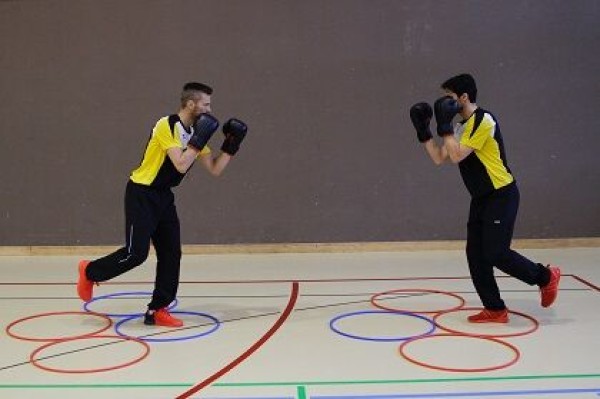
Two participants stand opposite each other on one leg and both hold their fists at head height. One participant sets the positions by jumping with one leg between the tyres laid out on the floor (identical tyre arrangement for both participants). The second participant tries to re-establish the same distance as quickly as possible. After a certain time, change the jumping leg and/or the rollers.
Per group:
8 tyres
Play with howler
Games / Tournament
Play idea:
The team in possession of the howler attempts to move the ball in the direction of the targeted end zone. The opposing team tries to prevent this movement and force possession of the howler by means of a "turnover" (see rules of the game). The howler may only be moved by throws from one player to the other.
Scoring points:
The aim is to catch the howler in the opposite end zone following a pass from a team-mate and thus score a point.
Playing field:
Rectangular field with an end zone at each end. 64mx37m with 18m outdoor end zone, 40mx25m with 15m indoor end zone.
The pitch is bounded by cones. The connections between them form the side or out lines.
Number of ends:
7 against 7 outdoor, 5 against 5 indoor
Game rules:
At the start of the game and after each point, the teams line up on their end zone line. The team that starts or has just scored throws a high, long pass towards the opponent's end zone (throw-off). As soon as the howler is released, all participants may move freely on the field.
The howler may be thrown in any direction. The player with the howler in his hands may neither walk nor run, only star steps are allowed. However, if the toy is caught during the race, the movement may be slowed down by the required number of steps. The howler may not be handed over, but must move from A to B through the air. If the attackers are unable to catch the howler (the howler touches the ground, flies out of bounds or the opponent intercepts it or knocks it to the ground), the defending team gains possession of the howler and attacks. This is referred to as a "turnover". There is no interruption to the game.
The defender covering the thrower must keep at least an arm's length away. Only one player may cover the thrower at a time; the next defender must be at least three metres away. The attacker must play the howler after a maximum of 10 seconds. To signal this, the defender counts the seconds out loud.
Body contact or tackling is not permitted. Each player is responsible for signalling an infringement of the rules. There is no referee. Fair play is therefore very important. If an attacker and a defender catch the howler at the same time, it belongs to the attacker.
Optional: After a successful point is scored, the teams switch sides. The team that scored the point then starts again with a throw-off towards the opposing team.
Sprinting/throwing an object
Power
Individual work

Purpose
Training and testing of the throwing technique
Additional equipment
5 HG 85 throwing gun
Starting position
lying down, Stgw with empty magazine
Procedure
Sprint 50 m into a throwing position (target time 15 s)
5 throws from different throwing distances
Conditions
4 hits and 3 different freely selectable throwing distances
Notes
If no realistic HG targets are available, marked target areas can also be used (e.g.
for reasons of efficiency, several throwers should be able to practise at the same time.
with an increased routine, the requirements in terms of throwing distance should be increased.
Material per participant: Tenue CNM
Additional material: 6 G-discs with posts, 3 fanjons, 2 red/white marking tapes, 2 boxes with 16 HG 85 clay pellets
Sprinting
Power
Individual work

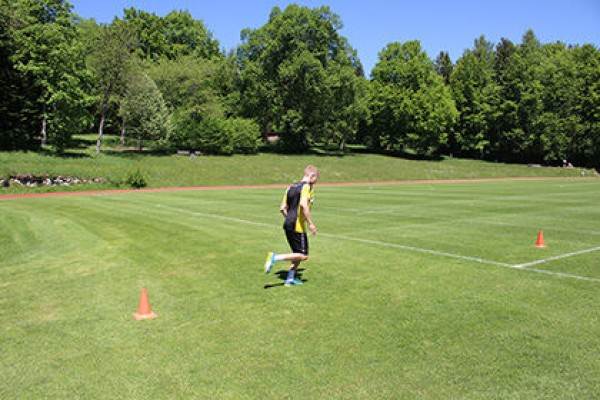
Cover a given distance (between 10-20 metres) as quickly as possible/at a sprint (if necessary, shuttle back and forth between the markers several times).
Lighten:
Lower speed.
Harden:
Higher speed.
Variant:
Do not sprint but change your gait between the markers (e.g. backwards, on all fours, crawling, etc.).
2 marinating cones/caps/colouring sticks
Jump
Coordination exercises
Individual work
Stand on the slackline with your front foot straight and your back foot across the line. Perform a jump without changing your basic position.
Easiern:
Perform the exercise closer to the attachment.
Harder:
Perform the exercise in the centre of the slackline.
1 Slackline
Jump in place
Power
Individual work


Stand upright with your feet shoulder-width apart, arms supported on your hips or bent in front of your body. Powerful jump vertically into the air.
Attention:
Keep your upper body upright (keep your core tensed).
Lighten:
Smaller/less intense jumps.
Harden:
Larger/intensive jumps; additional weight (on the chest/shoulders, hold in the hands, hold in front).
Variation:
With each jump, pull the tips of your feet towards your knees (bend your feet).
2 weight cuffs/short dumbbells/1 weight vest/weight disc/(medicine) ball/sandbag/fighting backpack ► Make the exercise more difficult (additional weight)
Jump in place one-legged (left)
Power
Individual work


One-legged stand (left), arms supported on the hips or bent in front of the body. Powerful jump vertically into the air.
Attention:
Keep your upper body upright (tense your core).
Lighten:
Smaller/less intense jumps.
Harden:
Bigger/more intense jumps; additional weight (on your chest/shoulders, hold in your hands, in front of you).
Variation:
With each jump, pull the tips of your feet towards your knees (bend your feet).
1 weight cuff/weight vest/weight disc/(medicine) ball/sandbag/fighting backpack/2 dumbbells ► Make the exercise more difficult (additional weight)
Jump on the spot one-legged (left) (one-legged jump) ► pogo tuck jump
Power
Individual work
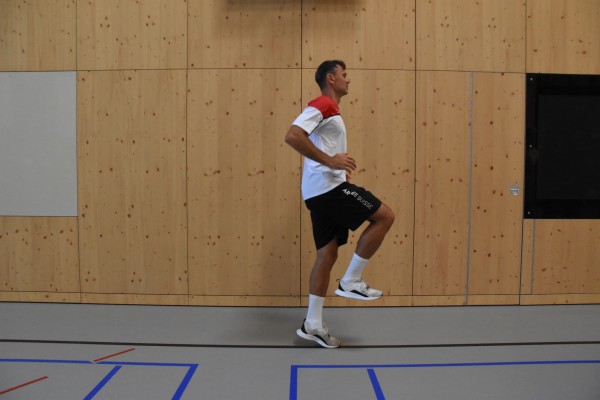
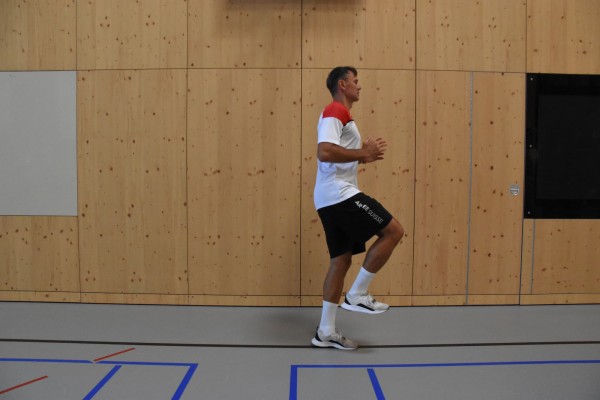
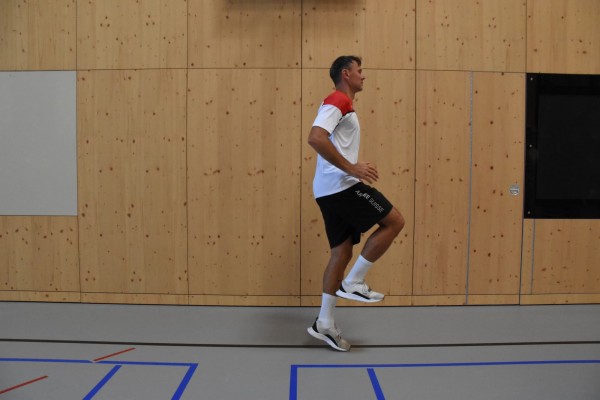
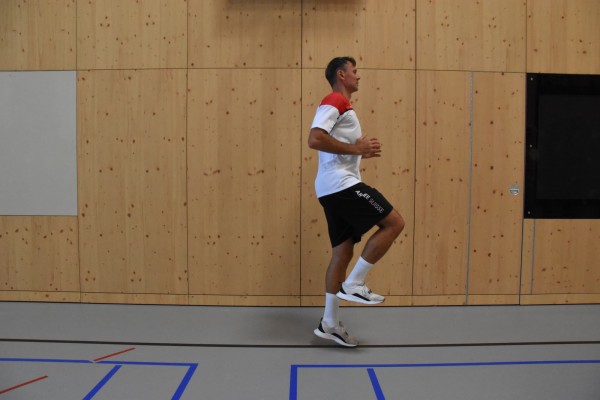
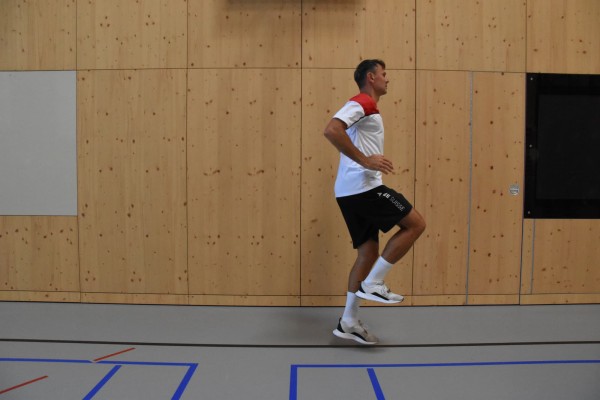
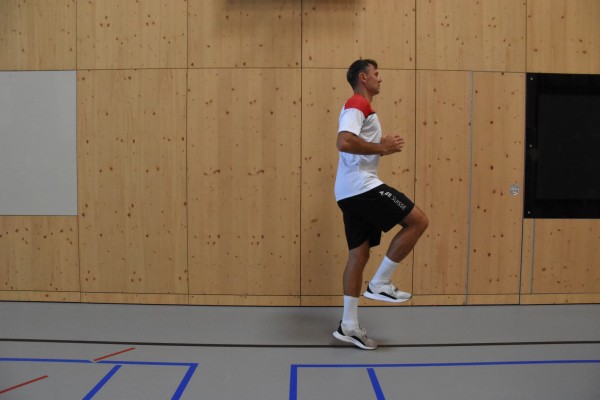
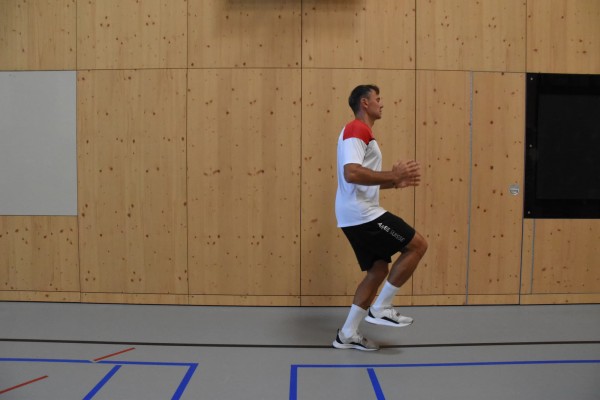
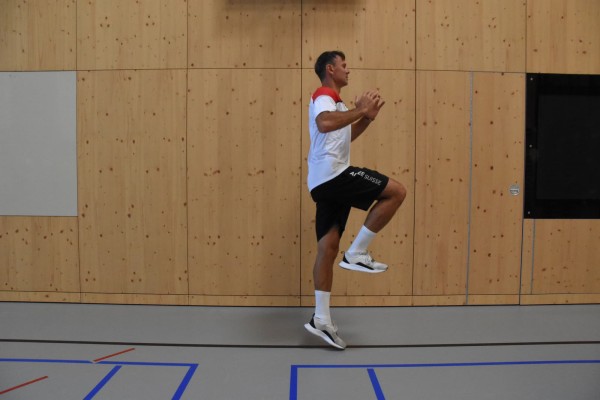
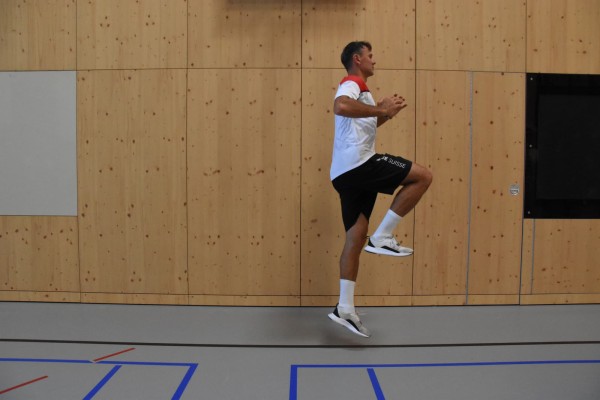
Steady hopping in place on one leg (left) without putting your heel down completely. Every few repetitions (e.g. always after 5 small hops) perform a jump upwards (one-legged jump). The arms can support the jump by pulling them up and overhead when jumping from hip height.
Attention:
Keep your upper body upright (tense your core).
Lighten:
Smaller/less intense jumps into the air.
Harden:
Higher/intensive jumps; additional weight (on your chest/shoulders, hold in your hands, hold in front of you).
Variation:
Pull the tip of your foot towards your knee (bend your foot) with each jump.
1 weight cuff/weight vest/weight disc/(medicine) ball/sandbag/fighting backpack/2 dumbbells ► Make the exercise more difficult (additional weight)
Jump on the spot one-legged (left) (one-legged jump) ► rudiment hop
Power
Individual work
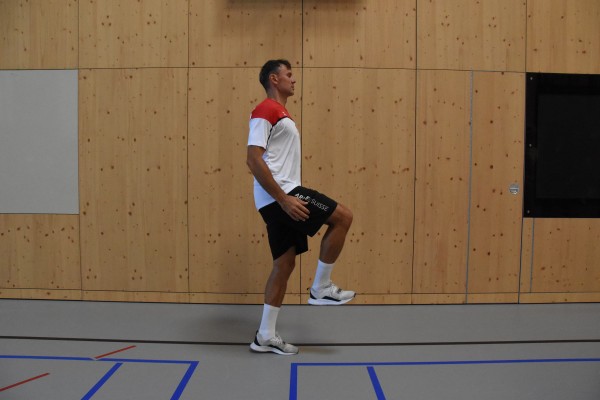
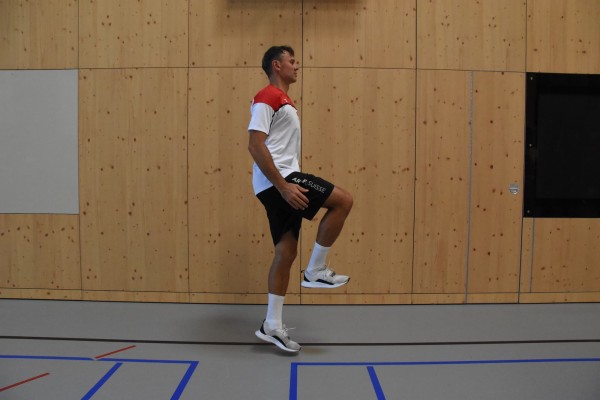
Stand on one leg (left), with the free (right) leg raised (approximately right angle in the knee joint so that the knee is at about hip height in front of the body). Jump steadily in place, putting your heel down completely with each repetition.
Attention:
Keep your upper body upright (keep your core tensed).
Lighten:
Smaller/less intense jumps.
1 weight cuff/weight vest/weight disc/(medicine) ball/sandbag/fighting backpack/2 dumbbells ► Make the exercise more difficult (additional weight)
Jump in place one-legged (right)
Power
Individual work


One-legged stand (right), arms supported on the hips or bent in front of the body. Powerful jump vertically into the air.
Attention:
Keep your upper body upright (keep your core tensed).
Lighten:
Smaller/less intense jumps.
Harden:
Bigger/more intense jumps; additional weight (on your chest/shoulders, hold in your hands, in front of you).
Variation:
With each jump, pull the tips of your feet towards your knees (bend your feet).
1 weight cuff/weight vest/weight disc/(medicine) ball/sandbag/fighting backpack/2 dumbbells ► Make the exercise more difficult (additional weight)
Jump on the spot one-legged (right) (one-legged jump) ► pogo tuck jump
Power
Individual work
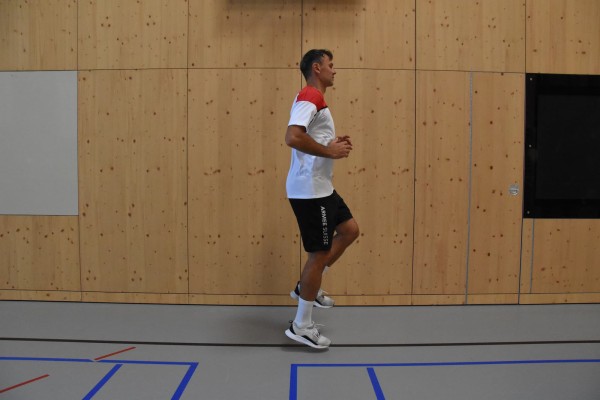
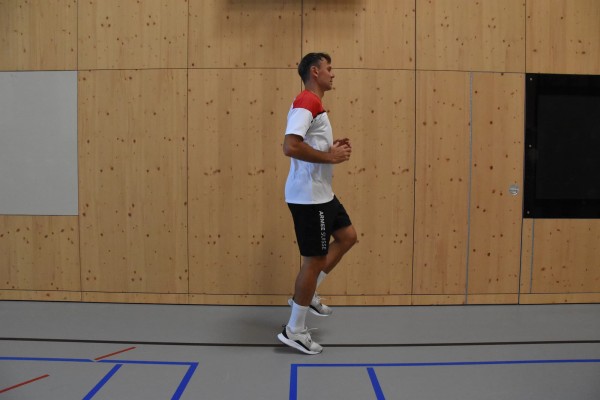
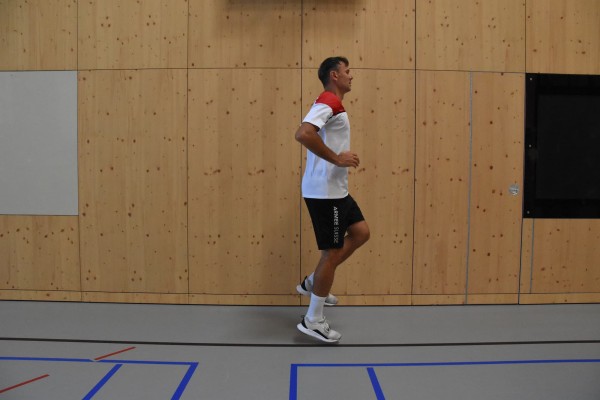
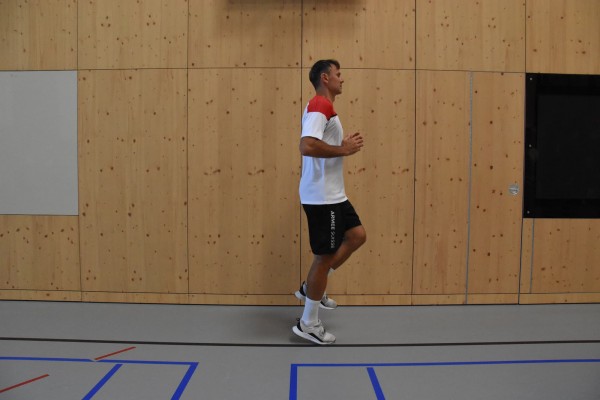
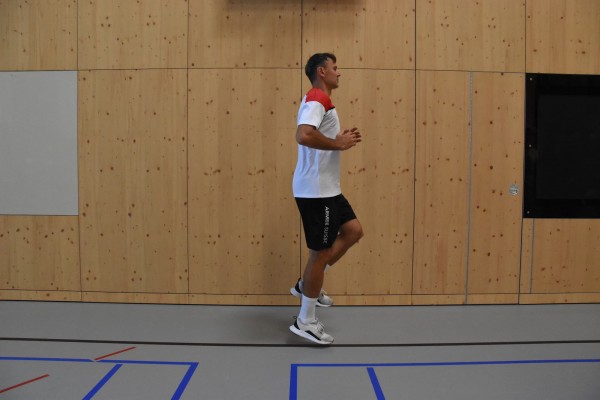
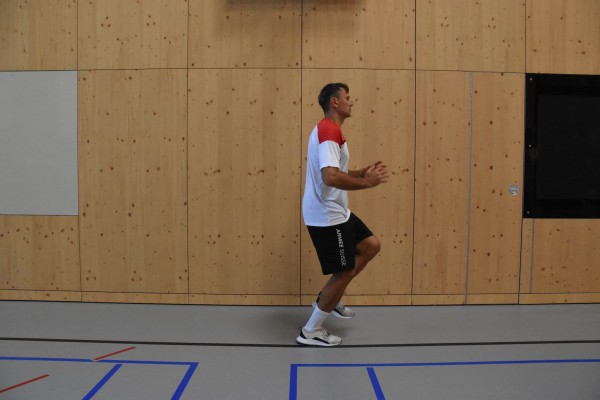
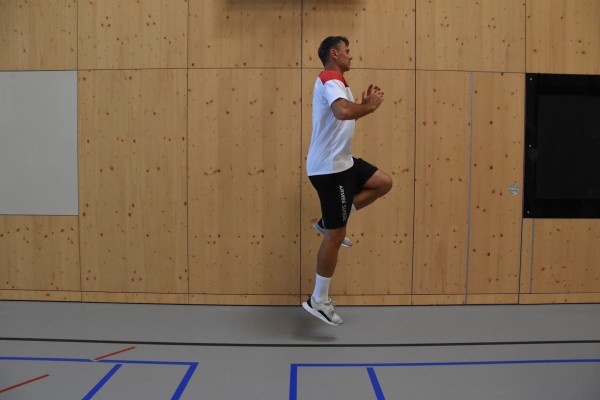
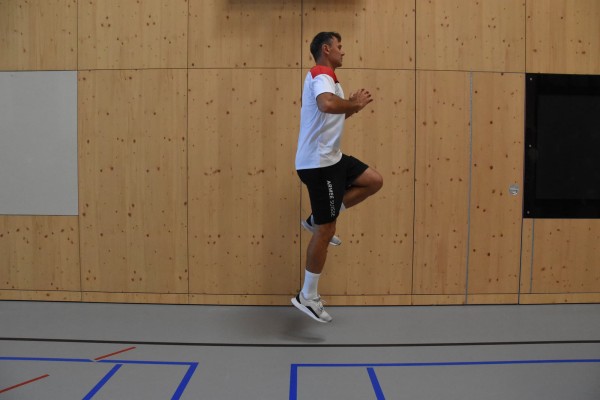
Steady hopping in place on one leg (right) without putting your heel down completely. Every few repetitions (e.g. always after 5 small hops) perform a jump upwards (one-legged jump). The arms can support the jump by pulling them up and overhead when jumping from hip height.
Attention:
Keep your upper body upright (tense your core).
Lighten:
Smaller/less intense jumps into the air.
Harden:
Higher/intensive jumps; additional weight (on your chest/shoulders, hold in your hands, hold in front of you).
Variation:
Pull the tip of your foot towards your knee (bend your foot) with each jump.
1 weight cuff/weight vest/weight disc/(medicine) ball/sandbag/fighting backpack/2 dumbbells ► Make the exercise more difficult (additional weight)
Jump on the spot one-legged (right) (one-legged jump) ► rudiment hop
Power
Individual work
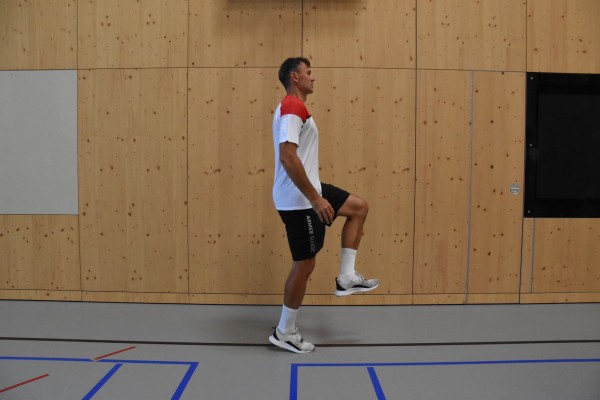
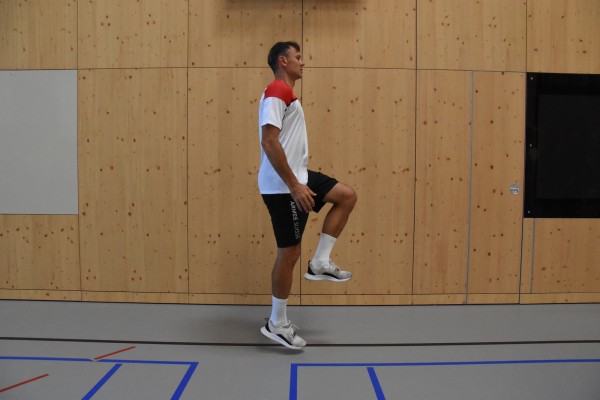
Stand on one leg (right), with the free (left) leg raised (approximately right angle in the knee joint so that the knee is at hip height in front of the body). Jump steadily in place, putting your heel down completely with each repetition.
Attention:
Keep your upper body upright (keep your core tensed).
Lighten:
Smaller/less intense jumps.
1 weight cuff/weight vest/weight disc/(medicine) ball/sandbag/fighting backpack/2 dumbbells ► Make the exercise more difficult (additional weight)
Jump in place with extension and flexion of one leg alternating ► runner hop
Power
Individual work
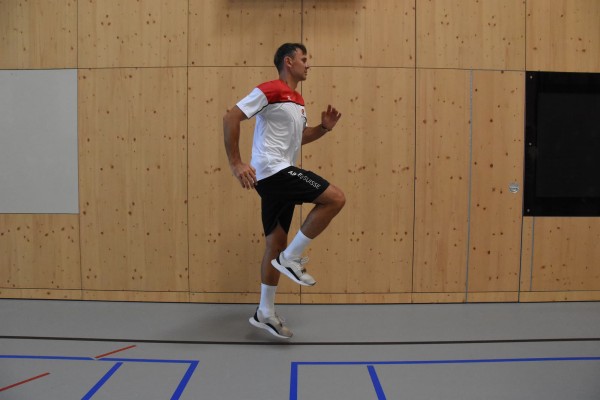
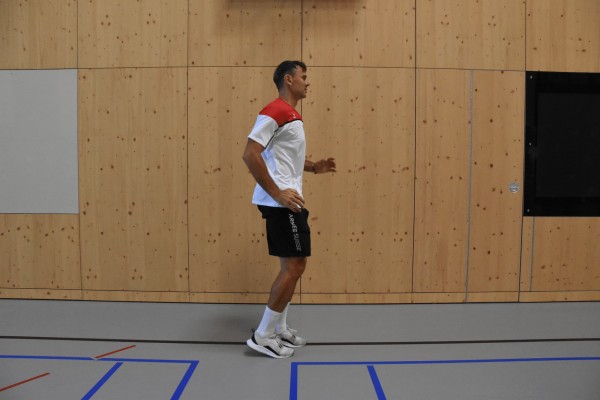
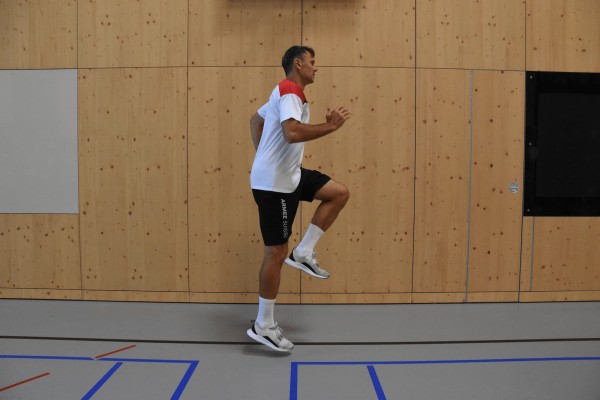
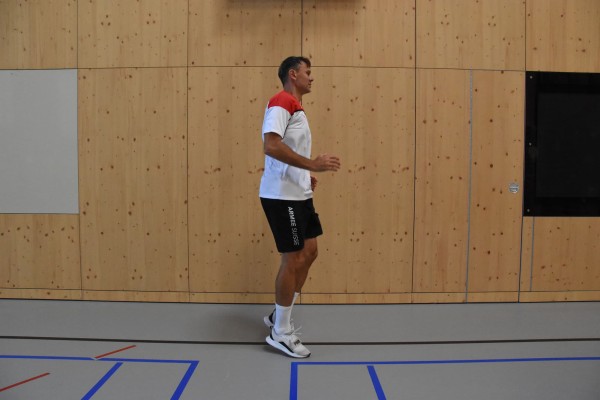
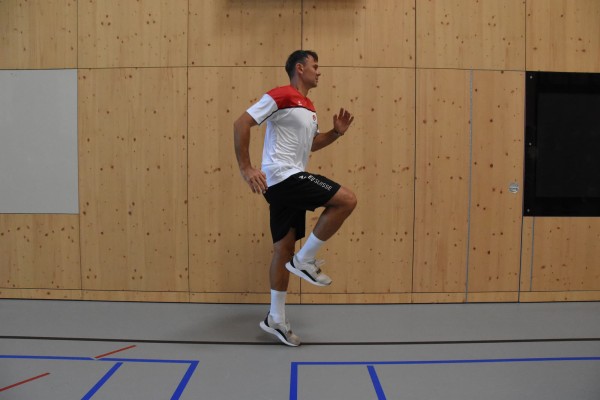
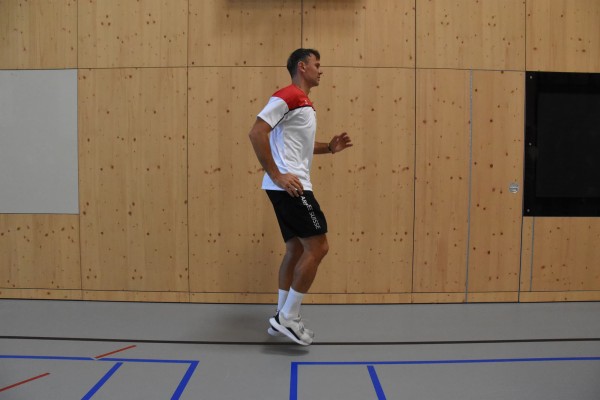
Stand upright with your feet shoulder-width apart, hopping steadily in place. Alternately bend one leg during the two-legged small jump (raise the knee in front of the body to approximately hip height). Land on both legs (heels completely off the ground), keeping the ground contact time as short as possible before the next repetition. Support your arms on your hips or support the movement with your arms (arms bent and stretched - arm bent on the opposite side where the knee is raised - sprinter position).
Caution:
Keep your upper body upright (tense your core).
Lighten:
Smaller/less intense jumps (lift your knees less).
Harden:
Higher/more intense jumps; additional weight (on your chest/shoulders, hold in your hands, in front of you).
2 weight cuffs/short dumbbells/1 weight vest/weight disc/(medicine) ball/sandbag/fighting rucksack ► Make the exercise more difficult (additional weight)
Jump in place and flexion and extension of the legs
Power
Individual work

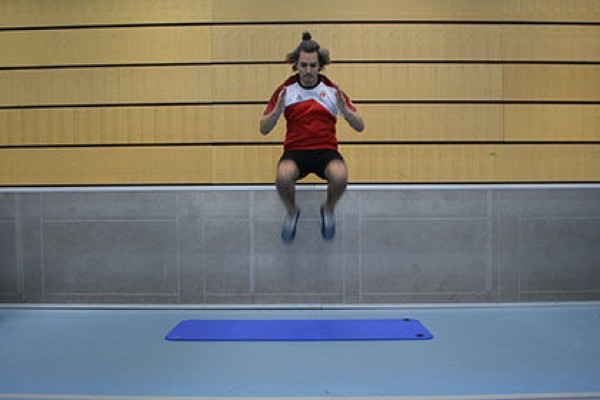


Stand upright on the balls of your feet with your knees slightly bent and your arms bent in front of your body (or supported on your hips). Jump up into the air and bend your legs (raise your knees approximately to navel height). Bounce steadily in place (fast frequency) without putting your heels down (jump on your toes).
Attention:
Keep your upper body upright (keep your core tensed).
Lighten:
Lift your knees less, smaller/less intense jumps.
Harden:
Lift your knees further; bigger/more intense jumps; additional weight (on your chest/shoulders, hold in your hands, hold in front of you).
2 weight cuffs/short dumbbells/1 weight vest/weight disc/(medicine) ball/sandbag/fighting backpack ► Make the exercise more difficult (additional weight)
Jump in place and hip rotation ► jump + hip rotation
Power
Individual work
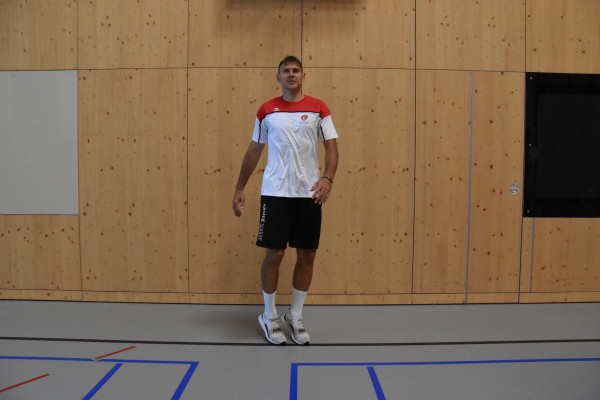
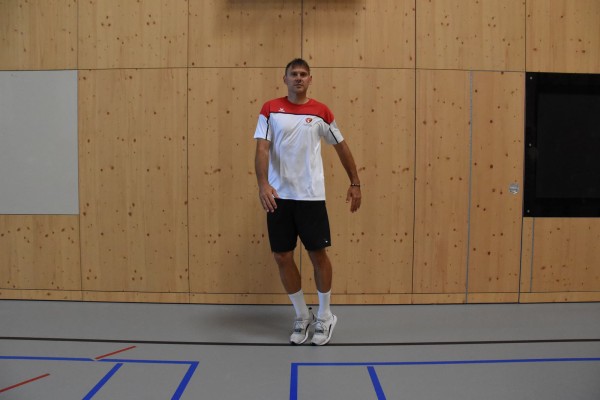
Continuous jumping with both legs in place (feet closer than shoulder width), with the hips alternately turned out to one side (feet pointing to the respective side). The upper body and gaze always remain directed forwards, the heels are never fully lowered.
Attention:
The upper body remains upright (tense the torso).
Harden:
Additional weight (on the chest/shoulders, hold in the hands, hold in front).
2 weight cuffs/short dumbbells/1 weight vest/weight disc/(medicine) ball/sandbag/fighting backpack ► Make the exercise more difficult (additional weight)
Jump onto an object
Power
Individual work


Jump onto the long bench on both legs and back down again.
Attention:
Keep your upper body upright, cushion your landing.
Lighten:
Jump over a line (omit the long bench); choose a lower element (e.g. vaulting box top); lower cadence.
Harden:
After standing on the long bench, jump upwards; choose a higher element; keep additional weight on your feet/shoulder; higher cadence.
1 long bench
1 vaulting box top section ► Make the exercise easier (position)
2 vaulting box elements (incl. top section) ► Make the exercise more difficult (position)
2 weight cuffs/1 weight vest/sandbag ► Make the exercise more difficult (additional weight)
Jump onto an object ► box jump
Power
Individual work


From a standing position, tilt your upper body slightly forwards, stretch your arms backwards at an angle to your body (like a ski jumper on a ski jump), push off the ground powerfully to jump onto a raised object (plyo box or swinging box element incl. top) (use the momentum of your arms), straighten your upper body (stand on the object) and jump back to the starting position (possibly the other side of the object).
Attention:
Land as softly as possible (cushion the jump with your knees).
Lighten:
Lower the intensity between each execution; lower the height of the object.
Harden:
Additional weight; higher object.
Variation:
Bouncing from one side of the object to the other by jumping sideways.
1 flat bench/plyo box/swivel box
2-4 weight cuffs/1 weight waistcoat ► Make the exercise more difficult (additional weight)
Jump from a kneeling position onto an object ► kneeling position to box jump
Power
Individual work
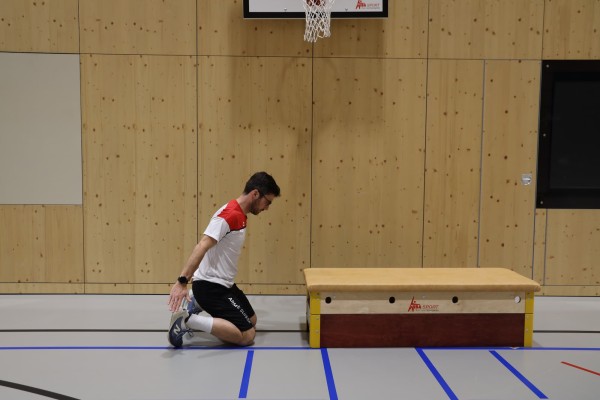
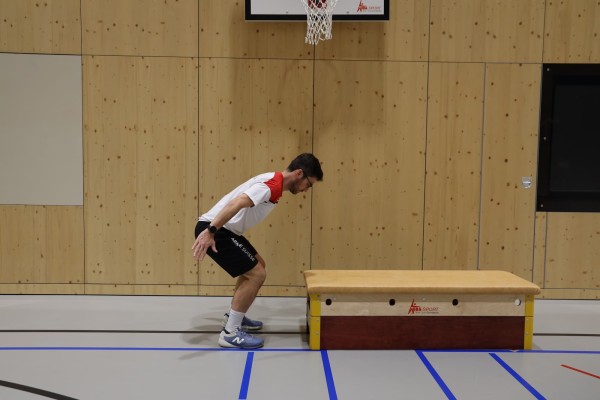
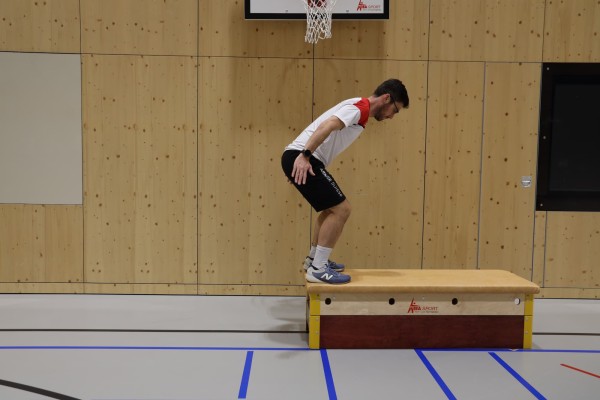
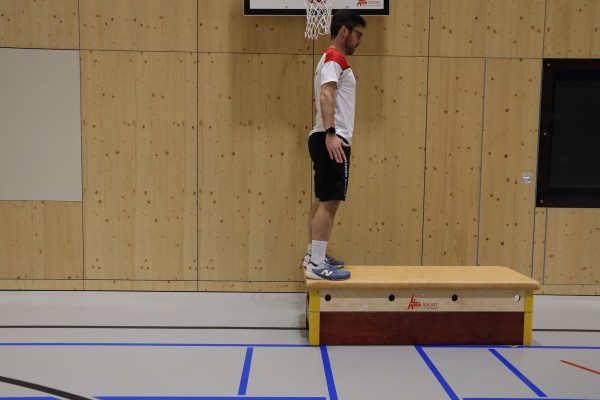
Position yourself on your knees in front of a stable raised surface (e.g. a plyo box or a Swedish box, including the top section). Move your hips backwards and lean your upper body slightly forwards, stretching your arms diagonally backwards alongside your body (like a ski jumper on the ski jump). From this position, jump forwards or upwards powerfully and explosively (using the momentum of your arms) through your hips and legs, landing on the platform with both feet simultaneously. Cushion the landing in a controlled manner with your knees slightly bent. Then stand upright on the box and return to a squatting position in a controlled manner.
Attention:
Only use a box that is sufficiently stable and non-slip; adjust the height of the box to suit your performance level; jump explosively from a hip extension (not just from the knees); place both feet firmly on the box upon landing; do not let your knees cave inwards upon landing; cushion the landing softly and in a controlled manner; keep your core stable throughout the jump.
Lighten:
Use a smaller step; start by standing up from a raised kneeling position without jumping.
Harden:
Use a taller object; perform the jump with as little ground contact time as possible; add extra weight.
1 flat bench/plyo box/swivel box
2-4 weight cuffs/1 weight waistcoat ► make the exercise more difficult (additional weight)